The rise of Islamic banking creates an interest in its own right as a rising branch in financial intermediation, particularly in the post-crisis era.Footnote 1 At the same time, it also merits attention from students of Islamism due to its possible connections with Islamic movements. In addition, economic behavior’s suitability for empirical analysis allows us to bring new empirical evidence to the popular but rather speculative debate on the motives of Islamic actors.Footnote 2 A better understanding of the preferences of Islamic economic actors, particularly the relative weight of religious and pragmatic interests, can help to gauge the direction that Islamic movements might take in certain contexts.
Our study of Islamic banks and their customers reveals important conclusions about Islamic actors and challenges some dominant assumptions. First, in contrast to popular views that consider Islamic economic actors as financiers of radical Islam, we find that these actors have pragmatic motivations and may adapt to liberal systems in order to seize economic incentives. Our findings also contradict exceptionalist assumptions that portray Islamic actors as essentially different, and particularly more ideological, than their counterparts. We find that many Islamic actors pursue self-interest just as do their non-Islamic counterparts, and they are open to reconsidering their behavior if the otherwise preferable option becomes too costly. Finally, we argue that this finding has political and economic implications, as it may reflect Islamic actors’ chances to become part of liberal systems. If “rational” behavior is a prerequiste of liberalism, as suggested by seminal studies such as that by Adam Przeworski,Footnote 3 then one can argue that Islamic actors can satisfy this requirement.
The Islamic finance movement and its discontents
Modern Islamic banks were originally formed to solve the fiscal problems of Islamic actors and thereby to help finance Islamic societies. Because earning interest on cash balances—called riba in Arabic—is considered a major sin in the Muslim faith, doing business with conventional banks constitutes a problem for devout Muslims. The inherent structure of Islamic banks, also called “participation banks” (katılım bankası) in Turkey, is different from that of conventional banks. Instead of taking deposits and issuing loans based on the principle of a pre-determined interest rate, Islamic banks engage in partnerships where profits as well as losses are shared with customers. Net profits generated as a result of lending activities determine the profit shares offered on “participation accounts,” which are an analogue to savings accounts in conventional banks.Footnote 4 Islamic banks do not extend direct loans to their borrowers, either.Footnote 5 Financing takes place not by issuing direct loans or charging interest, but rather in the form of a trade agreement. Enabling devout individuals to earn money without interest, these banks argue that they help to finance Islamic societies. Furthermore, they suggest that they also contribute to the broader economic environment by bringing new and otherwise idle capital into the market.
Islamic financial institutions arose chiefly in the 1970s, with the emergence of the oil revenues of the Middle East. The increase in oil prices over the past ten years and the economic rise of Asian Muslim nations contributed to the growth of the Islamic financial sector. Islamic banks made another leap forward following the global financial crisis that began in 2007. While conventional banks holding “toxic” assets faced losses and subsequent shortages of liquidity, Islamic banks remained immune to such problems because they stayed away from such assets. Thus, Islamic banks became a preferable alternative not only for Muslim investors wishing to avoid interest due to religious restrictions, but also for other customers seeking alternative forms of investment.
Political factors, most particularly the rise of modern Islamic movements in the Muslim world since the late 1970s, also played a critical role in the rise of Islamic banks. The rise of Islamism undoubtedly created more demand for Islamic economic investment alternatives. Under the circumstances, even secular states such as Turkey or Malaysia promoted the Islamic banking sector, not simply to respond to such demands, but also to send a political message to Islamic constituencies and receive their support.Footnote 6
The rise of Islamic banks has stimulated debates regarding their relationship with Islamist movements, with skeptics suspecting that these banks finance Islamic radicalism. In Turkey, such skeptics played an important role in the military intervention against the coalition government led by the pro-Islamic Welfare Party (Refah Partisi, RP) in 1997. The military claimed that this Islamist group in Turkey was pursuing an Islamic revolution, and that Islamic banks were the main financiers.Footnote 7 After the attack on the World Trade Center on September 11, 2001, more observers started to consider the political role played by Islamic financial institutions and their customers. As Clement Henry and Rodney Wilson explain,Footnote 8 in the aftermath of the attacks, the United States government began portraying Islamic banks as targets of the “war on terror” and attacking them legally and financially. More recently, some influential studies have argued that the Islamic finance movement does not challenge liberalism, but rather creates a niche for itself within the liberal order.Footnote 9 Similarly, studies comparing Islamic and conventional financial institutions, such as that of Laurent Weill, have suggested that Islamic financial institutions do not enjoy a captive client base simply due to their Islamic character, but rather they compete with conventional banks.Footnote 10 In the same vein, recent research on Islamic business groups has highlighted the key role of economic interests, which may even supersede ideology, in shaping the political and economic agenda of these actors.Footnote 11 However, Islamic banks and other financial insitutions still retain their “mystery” and are viewed with suspicion not only in the West, but also in predominantly Muslim nations such as Turkey, Egypt, and Tunisia.
This paper provides a comparative analysis of Islamic and conventional banking in Turkey, with a focus on individuals who are typically left out of the literature. Our research applies a wide range of methods to new empirical evidence in order to analyze the motivations and behavior of Islamic economic actors who determine the cash flow to Islamic banks, as well as to assess the role Islamic actors can play in economic and political life.
Analyzing the workings of the bank lending channel in Turkey, we examine whether or not there are significant differences among Islamic and conventional banks in response to a change in interest rate vis-à-vis the monetary transmission mechanism. In this way, we investigate the behavioral patterns of Islamic financial actors, whom we operationalize as the customers of Islamic banks. We test whether these actors behave purely out of religious motivations, or if they instead also respond to pragmatic interests that may contradict Islamic principles. Our findings suggest that Islamic banks’ customers are at least as sensitive to interest rate changes as the customers of conventional banks. Coupled with the fact that Islamic banks are slower to adjust their rates of return, we conclude that these banks are more vulnerable to interest rate changes triggered by the monetary transmission mechanism relative to conventional banks. An increase in interest rates due to tight monetary policy leads to a slower increase in the profit shares distributed by Islamic banks and widens the wedge between the rates of return offered by Islamic and conventional banks. This leads to a decline in the sources of funds that are channeled to Islamic banks, which is consistent with rational consumer behavior. As our interviews with Islamic bank customers also demonstrate, devout individuals prefer Islamic financing so long as it provides competitive economic advantages. However, when other financial options become economically advantageous, many individuals prefer those, despite their religious concerns. This finding refutes certain general assumptions about Islamic actors, which is critical in assessing the role they play in economic and political life. We suggest that, despite the widely accepted beliefs in the literature, Islamic economic actors do not behave primarily by fixed ideological motivations, although they may weigh their ideological preferences against their economic interests and seek to balance them. As subsequent sections will explain, this flexibility has important implications, as it suggests that these actors could adapt to liberal economic and political systems that require compromise and pragmatism.
The curious case of Islamic banks: The Islamic bank as a “black box”?
The role of Islamic banking in world financial markets continues to increase. This development creates a good deal of curiosity about these institutions, not only among the public but also in academic circles in various fields, including economics, Islamic law, and political science. Those studies whose broad outlines are given below successfully described the functioning of these institutions, the economic and religious needs that they met, or the political and economic context that enabled, or sometimes challenged, their development. Nevertheless, most of these studies focus on the banks as the main units of analysis, rather than investigating the preferences and behavior of the individuals who do business with these institutions. As such, many studies have portrayed Islamic banks as a “black box,” showing only their inputs and outputs without examining the decision-making processes of the participating actors. Examination of the motivations and choices of the individuals who shape these institutions, not to mention the political implications of these qualities, is often lacking. Moreover, in many cases description has prevailed over analysis, and the lack of empirical evidence has prevented scholars from making convincing claims about these economic actors.
Studies of Islamic banks are most prevalent in the economics literature and typically analyze the economic advantages offered by these banks. They describe the functioning of these newly founded institutions and consider if they contribute to the economy.Footnote 12 Such studies have compared Islamic financial institutions with their conventional counterpartsFootnote 13 and questioned if Islamic banks offered more effective alternatives in certain circumstances, such as during financial crises,Footnote 14 in agricultural economies,Footnote 15 for small enterprises,Footnote 16 or in reflecting the effects of monetary economic regulations upon the economy.Footnote 17 Others have considered whether Islamic banks make a contribution to economic development by bringing into the financial market the revenues of individuals who refuse to invest their money in conventional banks or stocks.Footnote 18 One important contribution of these studies has been to highlight, albeit implicitly, that Islamic banks do not merely respond to religious demands, but offer certain economic advantages that have attracted customers. However, these studies have focused on the institutions or financial sectors, rather than on the customers, and so they have provided little in the way of insight into or evidence of actors’ preferences.
A parallel set of literature has developed in the area of Islamic studies that investigates which type of contracts offered by these institutions have performed better in serving Islamic goals (for instance, murabaha versus mudaraba contracts), or to what extent these institutions contribute to Islamic economies by collecting zakat,Footnote 19 protecting small enterprises, or supporting production.Footnote 20 Some such studies have highlighted concerns arising from the fact that Islamically more suitable contracts, such as mudaraba, have not necessarily been more popular among the customers of Islamic banks, who often prefer more questionable but economically advantageous contracts, such as murabaha. These studies challenge the assumption that Islamic banks always serve Islamic goals, but their impact has been limited since they often remain normative and have very rarely employed empirical analysis.
A substantive effort to better understand the motives and behavior of Islamic economic actors has remained absent in political studies of Islamism as well. Until recently, the limited amount of research into the politics of Islamic finance has typically consisted of descriptive analyses explaining the process of formation of Islamic financial institutions.Footnote 21 This lack of interest on the part of political scientists is unfortunate inasmuch as Islamic financial actors can impact economic and political life in Muslim nations due to the large sums of financial resources that they can control and channel to Islamic political parties. Therefore, understanding the preferences of these actors, the extent of their commitment to religious principles, and their willingness to consider non-Islamic politico-economic systems is critical to predicting the roles they may play in the politics of the societies in which they operate.
Finally, in the past decade, particularly after the Al-Qaeda attack on the World Trade Center in 2001, studies of the politics of Islamic finance have proliferated as many observers came to view Islamic financial actors as political agents.Footnote 22 The United States government played a particularly important role in portraying Islamic institutions as the financiers of radical Islam and, therefore, targets of the “war on terror.”Footnote 23 This reaction increased political and academic interest in Islamic economic actors. New and successful studies have developed to investigate the links between Islamic political and financial groups, how Islamic finance impacts political Islam and vice versa, and most importantly whether or not Islamic banks finance Islamic fundamentalism.Footnote 24 Some of these studies have examined links between the managers of Islamic banks and Islamic political parties,Footnote 25 while others have measured the activities of Islamic banks in regions where Islamic parties are popular and studies the links between the development of these banks and Islamic movements.Footnote 26 Other studies analyzed the winners (e.g., the Muslim Brotherhood and similar organizations as well as small merchants and industrialists) and losers (e.g., the agricultural sector, large-scale entrepreneurs, and black market currency traders) of this rising sector,Footnote 27 the supportive or preventive roles that governments play in the foundation of these institutions,Footnote 28 and the economic factors—such as the discovery of oil in the region, government debt, or the transition to export-led growth—that contributed to the rise of Islamic banks.Footnote 29 While these studies have made important contributions by highlighting the politics of the Islamic financial sector, many of them remained focused on the financial institutions rather than on the individuals who form them. However, the omission of Islamic actors as units of analysis limits our understanding of the agency that shapes these institutions. By focusing on the Islamic identity of the actors, observers may miss the complexity of the decision-making, preference-ordering, and adaptive strategies involved in these actors’ financial activities. As a result, we still know too little concerning the motivations and behavior of “homo Islamicus” and whether, and if so to what extent and in what ways, he or she differs from homo economicus. Nevertheless, this difference constitutes a critical issue in studies of Islamism, as the following section will illustrate.
“Rational actors” and religious commitments: Exceptionalism in studies of Islamic actors
Islamic actors’ differences from their non-Islamic counterparts in terms of economic, political, or social behavior constitutes an interest in many social science disciplines. One particular focus of these inquiries is whether Islamic individuals are driven primarily by religious doctrine or if they rather behave according to universal motives, such as interest maximization. This question has important political and economic implications, as theorists suggest that pragmatic behavior constitutes a prerequisite for liberalism.
In his seminal work Democracy and the Market, Przeworski argued that democratic liberal systems do not necessarily require individuals who truly believe in liberal values, but they do require rational actors who pursue their interests and who can be flexible and adapt to circumstances.Footnote 30 These are actors who are willing to bargain and who may settle with non-ideal situations.Footnote 31 Liberal systems are initiated by actors who seek to maximize interests, and they consolidate over time as the actors start to actually internalize and habituate democratic and liberal behavior.Footnote 32 Thus, liberal systems can be founded even without liberal participants, as long as there are self-interested actors willing to reconsider their demands, order and postpone some of them, and join partnerships with people who share different beliefs. Ideologues, on the other hand, do not constitute preferable participants for liberal systems in that they are difficult to negotiate with and cling to their ideals, sometimes even at the cost of their lives.Footnote 33
The neo-liberal turn of Islamic groups since the 1990s in Turkey, Egypt, and elsewhere stimulated debates on the liberalization of Islamic groups. Some scholars have argued that Islamists can adapt to non-Islamic systems, such as liberal democracies, if some of their economic interests are harnessed.Footnote 34 Some of these studies compare Islamic moderation with the democratization of former Communist parties in Europe and suggest that Islamists can follow the same path.Footnote 35 Nevertheless, other scholars have claimed that Islamic moderation is an oxymoron. Accordingly, Islamists’ move towards liberalism in such places as Turkey and Egypt can only be a tactic to survive and obtain power so as to eventually overthrow non-Islamic institutions. Underlying this thought is the assumption that Islamists are inherently fundamentalist actors.
The presumption that Islamic actors are different from other actors in being driven primarily by religious doctrine retains a substantial place in the literature on Islamism. Although challenged by critical studies, “Islamic exceptionalism” continues to constitute an intellectual barrier in the study of Islamist actors and movements.Footnote 36 Exceptionalist accounts suggest that we cannot understand Islamic actors with the general theoretical tools we have, because Islamic actors, parties, and institutions are governed by unique (Islamic) principles. One of the widely argued political implications of this view is that Islamic actors cannot adapt to non-Islamic economic or political systems, such as liberalism.Footnote 37 According to such views, qualities like negotiation, adaptation, interest calculation, pragmatism, and rational consumer behavior are widely shared among non-Islamic or secularist groups, but they are not to be expected from Islamists. These accounts tend to portray Islamic actors as ideologues unable to be as flexible and pragmatic as their non-Islamic counterparts, and who are thus incompatible with liberal economic or political systems. Finally, it should be noted that the view of Islamic actors as substantially different from their counterparts is not unique to secularist accounts, but can also be observed among Islamic approaches. According to these accounts, an observing Muslim is primarily motivated to live an Islamic life and contribute to the founding of an Islamic society. In this vein, Islamic accounts suggest that homo Islamicus differs from homo economicus by preferring a moral economy over pragmatic benefits.Footnote 38 In sum, regardless of their ideological points of reference, the dominant view of Islamic actors depicts them as individuals motivated primarily to promote an Islamic society. Despite some critical studies, the explanatory power of Islamic identity remains amplified in the literature in the absence of sufficient counter-evidence.
Islamic banks and the lending channel
Our goal in this section is to investigate whether there are any quantifiable differences in the customer behavior of conventional versus Islamic banks. Specifically, we want to see how the balance sheet components of these two types of banks change in response to a monetary policy action represented by an interest rate change. The particular framework that we analyze is the bank lending channel.
The monetary transmission mechanism depicts the alternative ways in which changes in the monetary policy are transmitted to the rest of the economy. Since the 1980s, two broad transmission mechanisms have been discussed in the macroeconomics literature: an interest-rate or money channel, in which interest rates adjust to clear markets and influence borrowing and lending behavior; and a credit channel, in which the quantity as much as the price of loanable funds transmits monetary policy to the economy. Within the credit channel literature, a narrow bank lending channel view suggests that changes in the policy stance and the quantity of reserves directly affect the amount of lending that banks can do.
The chain of events that constitutes the bank lending channel begins with a change in the monetary policy stance. For the post-2005 period analyzed in this paper, monetary policy actions can be captured by changes in interest rates, which has been the operational instrument of the Central Bank of the Republic of Turkey (Türkiye Cumhuriyet Merkez Bankası, TCMB) for that period. Following, say, an increase in interest rates, the central bank drains reserves from the system through open market sales. Assuming that it is costly for banks to raise external funding in order to make up for the decline in their reserves, banks reduce their loans. The inherent assumption in the bank lending channel is that bank reserves are imperfect substitutes for external funding. This assumption is particularly valid for countries such as Turkey, where the financial system is less developed and alternative funding opportunities are limited.Footnote 39
In order to investigate the existence of the bank lending channel, we focus on the balance sheet components of Islamic and conventional banks. Specifically, we decompose bank liabilities into those that are subject to reserve requirements (which are essentially demand deposits for conventional banks and current accounts for Islamic banks) and those that are exempt from reserve requirements (which are time deposits for conventional banks and participation accounts for Islamic banks). According to the bank lending channel, a tight monetary policy action that is represented by an interest rate hike leads to a decline in reservable deposits, which in turn reduces bank loans.
A finding suggesting that the customers of Islamic banks remain indifferent to changes in interest rates, and hence that there is no change in reservable deposits, would support the argument that Islamic actors are not motivated by economic interests, and this would imply that Islamic banks are not affected by the bank lending channel. The opposite result, on the other hand, would refute popular assumptions, illustrating that Islamic economic actors are not essentially different from their counterparts. Therefore, our investigation as to whether or not Islamic banks are affected by the lending channel has one-to-one implications for the understanding of the economic choices of Islamic actors.
The period following a monetary policy action constitutes a unique opportunity for the purposes of our analysis investigating the extent of religious motives in determining the behavior of Islamic bank customers. An unanticipated change in monetary policy, such as an increase in interest rates, constitutes a theoretical conflict for these individuals—albeit only briefly—where they must choose between either remaining with Islamic banks or switching elsewhere. This type of conflict is rare in practice, because normally Islamic banks provide almost the same advantages that conventional banks do, as the profit rates offered by Islamic banks generally match the interest rates offered by conventional banks. However, during the brief periods immediately after monetary policy actions, Islamic banks may become temporarily less advantageous than conventional banks until they once again match their profit rates with the interest rates. Thus, these periods of adjustment allow us to observe how Islamic actors behave when faced with a dilemma between religious and pragmatic preferences.
To that end, we estimate a monthly structural vector autoregression (VAR) for Turkey. We conduct an impulse response analysis to measure the response to a change in interest rates of both conventional and participation banks. We use the following variables in the listed Cholesky order: interest rate; US dollar/Turkish lira exchange rate; consumer price index (CPI); conventional banks’ liquid assets; participation banks’ liquid assets; demand deposits of conventional banks; current accounts of Islamic banks (i.e., the analogue of conventional banks’ demand deposits); time deposits of conventional banks; participation accounts of Islamic banks (i.e., the analogue of conventional banks’ time deposits); loans of conventional banks; loans of Islamic banks; and industrial production index. Most variables apart from policy rate are seasonally adjusted using the Census X-13 method.Footnote 40 This VAR follows the general set-up established in the literature.Footnote 41 Accordingly, monetary policy is assumed to affect macroeconomic variables immediately, but is not itself affected by them within the same month. There is a contemporaneous spillover from the exchange rate to the inflation rate. This assumption is consistent with the inherent structure of the Turkish economy, which relies heavily on imported intermediate goods. Going back to the Cholesky ordering, monetary policy affects bank liabilities contemporaneously, which feeds into bank loans and hence industrial production.Footnote 42
All variables except interest rates are in logarithmic form as a precaution against non-stationarity.Footnote 43 The data is monthly, expanding from December 2005 through March 2013. We use one lag in the VAR to conserve degrees of freedom within a relatively short sample of 86 observations. This lag specification is also supported by the Schwarz information criterion.Footnote 44
As we look at bank liabilities, there are two sources of bank funding in the model. The first source is demand deposits for conventional banks and current accounts for participation banks, both of which have negligible returns for the account holders and are subject to reserve requirements; that is, banks need to hold a certain fraction of these deposits as reserves at the central bank. Instead of monetary gains, depositors choose to hold these accounts for their liquidity and convenience, such as the ability to make payments without carrying money. The second source of funding is time deposits for conventional banks and participation accounts for participation banks. The primary motivation for holding these accounts is their monetary returns. According to the monetary transmission mechanism, an increase in interest rates increases the opportunity cost of non-interest bearing accounts (such as demand deposits and current accounts) and leads to a decline in such accounts. Meanwhile, accounts with positive returns (such as time deposits and participation accounts) increase depending on the speed of adjustment of the rate of return on such accounts.
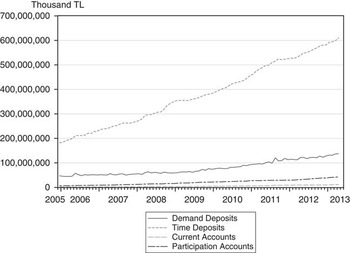
Figure 1 provides a comparative perspective of the relative magnitudes of alternative sources of funding for conventional and participation banks. The total sources of funding for conventional banks are an order of magnitude larger than those of participation banks, reflecting the relative market shares of the two types of banks. Indeed, as of December 2005, which is the beginning of our sample, total demand deposits were about 25 times larger than those of current accounts, while time deposits were about 28 times larger than participation accounts. The figure illustrates that, while all four channels of funding increased over time, the gap between conventional and participation banks’ sources somewhat narrowed. By the time we reach the end of our sample in April 2013, the ratio of demand deposits over current accounts declined to 12, while the ratio of time deposits over participation accounts declined to 14. One reason for the relative increase in the market share of participation banks could be the outbreak of the recent financial crisis. The crisis triggered worries about the stability of the banking system, which may have led to increased demand for an alternative banking system such as Islamic banking. Indeed, it is noted that Islamic banks generally have higher leverage ratios, and they have increased their liquidity ratios during the recent financial crisis.Footnote 45
Sources of funding for conventional and participation banks.

To return to the VAR exercise, our goal in this exercise is to compare the responses of conventional and participation banks to a monetary policy shock. Three different scenarios are plausible: 1) If the customers of conventional banks are more sensitive to relative rates of return, an increase in interest rate leads to a larger decline in demand deposits relative to current accounts. 2) If the customers of participation banks are more sensitive to relative rates of return, an increase in interest rate leads to a larger decline in current accounts relative to demand deposits. 3) If the customers of both types of bank have similar sensitivities to rates of return, the decline in demand deposits and current accounts should be comparable. Meanwhile, the change in time deposits and participation accounts depends on the speed of adjustment of the relative rates of return offered on these accounts in response to a change in interest rates.
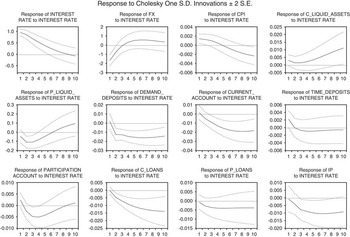
Figure 2 shows the results from the impulse response analysis of the twelve-variable VAR model. The figure illustrates the responses of the variables to a one standard deviation shock to the interest rate. In response to a tight monetary policy action represented by the interest rate shock (the first panel), demand for the Turkish lira goes up, which leads to a decline in the real exchange rate (the second panel). As the interest rate shock diminishes, so does its impact on the real exchange rate. Meanwhile, the tight monetary policy action is associated with a decline in the price level in the second quarter (the third panel), consistent with the monetary transmission mechanism where a contractionary monetary policy puts downward pressure on the price level by reducing aggregate demand.
The fourth and the fifth panels respectively show the response of liquid assets to an interest rate shock for conventional banks (c_liquid_assets) and participation banks (p_liquid_assets). We observe that liquid assets follow a U-shaped path following an interest rate shock, which is interpreted as evidence for the existence of the bank lending channel.Footnote 46 Bank loans are contractual agreements and cannot be changed immediately in response to a monetary policy action. Indeed, when there is a tight monetary policy action that reduces the liquidity in the banking system, the immediate response of the banking system is to increase its liquidity by selling off its liquid assets. In the long run, however, banks reduce their loan portfolios and bring back their liquid assets to their optimal level. In countries like Turkey, where the financial system is heavily dependent on the banking system, it is natural to expect a U-shape in liquid assets, which suggests that the bank lending channel is effective.Footnote 47
Two panels that are critical for the purposes of this study are the sixth and the seventh panels, which trace the responses to an interest rate shock of demand deposits at conventional banks and current accounts at participation banks. Generally, both funding sources exhibit a decline in response to an increase in interest rates, which is consistent with rational depositor behavior. The increase in interest rates leads to an increase in the opportunity cost of holding these accounts, leading the investors to search for alternative instruments for their savings. The declines in the two funding sources are of comparable magnitude, although depositors who hold demand deposits seem to adjust somewhat faster than current account holders. Overall, we observe that there is no significant difference in terms of the basic motivations of customers in allocating their savings to low-yield instruments at the two types of banks. Both types of customers consider the changes in relative rates of return in making their optimal allocations.
The eighth and the ninth panels compare the responsiveness of time deposits and participation accounts, both of which provide higher yields. If the rates of return in these accounts competitively follow the interest rate change induced by monetary policy, then these accounts may increase following a rate hike.Footnote 48 While both types of accounts exhibit an increase in the first month, participation accounts display a significant decline around the third month, suggesting that the profit shares in such accounts cannot be adjusted as fast as interest rate adjustments in time deposits.
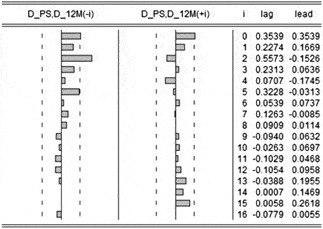
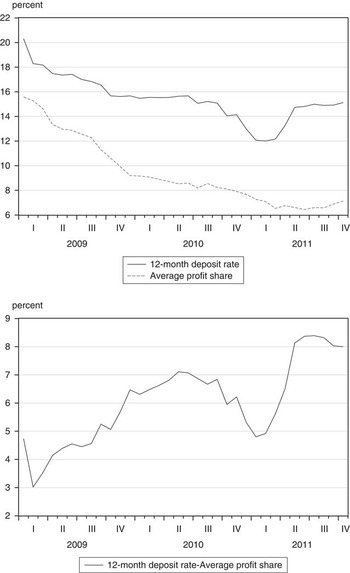
Figure 3 compares the interest rates offered on 12-month time deposits with the profit shares distributed by participation banks. The top panel reflects the fact that, even though average profit share is lower than rates offered on time deposits, the two rates of return follow the same general trend. Indeed, when we test for cointegration between these two series, we find a significant relationship (not shown). These findings are consistent with a free market economy where profit shares are highly correlated with market interest rates; indeed, for the interval from 2009 to 2011, the simple correlation coefficient between the two series is 0.87. What is particularly important for our purposes is how the changes in one series are followed by the other. For example, when there is a change in 12-month interest rates, how long does it take for the profit rates to follow? To answer that question, we construct the cross-correlations between the two series. Table 1 shows the lag and lead correlations between changes in profit shares and changes in 12-month interest rates. Accordingly, the maximum correlation between the two series takes place two months after a change in 12-month interest rates; the correlation coefficient is 0.55. This finding suggests that profit shares tend to change in the same direction as interest rates, but likely with a two-month lag or longer.Footnote 49 The slower adjustment of profit shares is consistent with the contractual nature of these agreements and explains the decline in participation accounts following an increase in interest rates. The decline in the relative rate of return leads to a decrease in such accounts, which is once again consistent with rational investor behavior.
Cross-correlations between profit shares and 12-month deposit rates 2009:01–2011:10.

Note: Correlations are asymptotically consistent approximations. There are 33 observations. D_PS is the monthly change in profit share, while D_12M is the monthly change in 12-month deposit rate.
Panels ten and eleven of Figure 2 respectively show the response of bank loans at conventional banks (c_loans) and participation banks (p_loans). Following a tight monetary policy action, both types of bank loans decrease, which is consistent with the bank lending channel. The decline in bank loans is only significant for conventional banks. This suggests that participation banks may also be slow in adjusting the rates on their loans relative to conventional banks. As a result, even though demand for loans at conventional banks decreases in response to higher loan rates, demand for loans at participation banks may not decline significantly if the costs of obtaining such loans does not increase immediately. The last panel of Figure 2 shows the response of the industrial production index, which declines following tight monetary policy, which is consistent with the predictions of the monetary transmission mechanism.
Impulse-response analysis.

The analysis in this section suggests that there is no statistical difference in the behavior of customers of the two types of bank in terms of searching for the best rate of return for their savings.Footnote 50 The observed differences between the balance sheet components of the two types of bank mostly reflect the speed of adjustment between the two banks, which is due to the structural differences between the operations of the two types.
Before concluding this section, it is worth highlighting one interesting aspect of Figure 3. While the rates of return offered by conventional banks and Islamic banks follow the same general trend, as shown in the upper panel, the difference between the two series widens over time, except for a brief period in the last quarter of 2010. The lower panel plots the spread between the average interest rate offered on 12-month deposits at conventional banks and the average profit share at Islamic banks. The decline in deposit rates in the last quarter of 2010 coincides with the announcement by the Federal Reserve System regarding the second round of quantitative easing. It would therefore be plausible to expect a decrease in deposit rates during that time, following the increase in the risk appetite. Nevertheless, while deposit rates sharply bounced back in early 2011, we do not observe a similar increase in profit shares, which widens the spread between the rates of return offered by the two types of banks. For this, there could be several potential explanations that are consistent with the increase in the spread. One explanation that is consistent with rational economic behavior is related to the perceived riskiness of conventional banks, which increased over the course of the financial crisis as these banks increased their exposure to foreign currency borrowing. This may have led individuals to switch to Islamic banks despite lower returns. Alternatively, it could be the case that the customers of Islamic banks were becoming more religious and, hence, less rational, and thus were willing to accept lower returns. Yet another plausibility is the increase in the share of deposits held by government institutions in Islamic banks, which may have lowered the elasticities associated with these accounts.Footnote 51
Comparison of alternative rates of return.

The “interest” paradox among Islamic economic actors
It is widely assumed that Islamic economic actors’ main goal is to avoid un-Islamic, interest-based gains and to finance an Islamic society.Footnote 52 Nevertheless, the closer look taken at these actors’ investment and consumer behavior in the previous section suggests that they are not indifferent to pragmatic incentives and that they show sensitivity to interest rates.
When we shared our findings with Islamic bank managers, they typically suggested that those account holders who are sensitive to interest rates and leave Islamic banks during rate hikes constitute that minority of their customer base who choose them in the first place not for religious reasons, but merely to diversify their interests. However, devout individuals, their “true” customers, would not shift their accounts elsewhere, regardless of changes in interest rates.Footnote 53 These comments reflect popular assumptions suggesting that Islamic actors are categorically different from their non-Islamic counterparts and behave according to purely ideological motives. We disagree with this argument, because it is unlikely for the minority of Islamic bank customers to drive the overall rational behavior that was documented in the previous section. The analysis in the following section provides further evidence against these popular assumptions.
While the previous section showed Islamic bank customers’ sensitivity to interest rates through macro-level data, this section demonstrates at micro-level that this sensitivity can also be observed among devout customers who prefer Islamic banks for religous reasons. In this section, we present the results of our interviews investigating the motivations of Islamic economic actors and analyze how they respond to dilemmas that arise between religious convictions and pragmatism. More specifically, we examine individuals’ sensitivity towards interest payments in their financial transactions. The interviews analyze to what extent the customers remain “loyal” to interest-free economic options and whether they are likely to turn to other options if their economic interests dictate such moves.
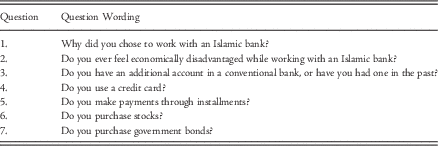
The interviews were conducted with 104 individuals.Footnote 54 The interviewees were selected via snowball sampling, which is a preferable methodology in order to establish a rapport between interviewee and interviewer when discussing topics as sensitive as ours.Footnote 55 The questions, as shown in Table 2, primarily investigated why the respondents chose to work with an Islamic bank (i.e., for religious or other reasons), if they ever felt economically disadvantaged during their experiences with Islamic banks, and if they had or have had an additional account in a conventional bank. Other questions included whether or not the interviewees possessed a credit card, if they made payments through installments, whether they held stocks, and whether they purchased government bonds.
Interview questions used to evaluate actors’ sensitivity toward “interest aversion”.
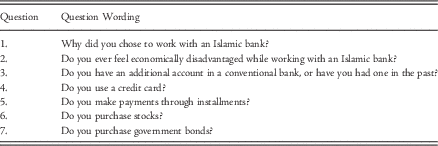
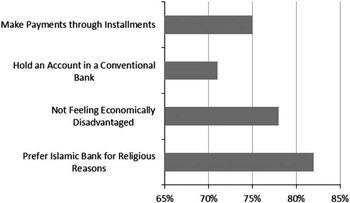
Figure 4 summarizes the interview results, which suggest that a majority (81.7 percent) of the customers prefer Islamic banks owing to religious sensitivities; that is, in order to avoid “interest.” On the other hand, most interviewees (78 percent) do not feel economically disadvantaged in doing business with Islamic banks. This is consistent with the findings presented in the previous section, where it was documented that profit rates are typically in sync with interest rates such that, most of the time, customers do not face a dilemma between religious and economic preferences. However, the majority (71 percent) of the customers who specifically mentioned that they had chosen Islamic banks for religious reasons also admitted that they already held an account in a conventional bank, or at least that they had one at some point, for such practical reasons as ATM accessibility or advantageous payment opportunities.
Interest aversion among Islamic bank customers.

The individuals’ attitudes towards installment payments and credit cards also offer interesting findings on actors’ sensitivity towards the notion of interest payments. In Turkey, many stores offer their customers the option to pay on installment in exchange for a higher total price. This creates a dilemma for devout consumers, because most Islamic authorities describe this type of payment as another form of interest. Moreover, installment payments typically involve credit card use. However, credit cards, even when offered by Islamic banks, raise questions regarding their compatibility with Islamic principles. Islamic banks avoid interest, but they do charge for “delayed payment” of debt. For some scholars, though, this type of a charge is no different from an interest rate. Even so, 75 percent of our interviewees noted that they chose to make payments on installment, typically using a credit card and even when there was a higher price for the purchase. Despite their religious concerns, the actors turned towards this option owing to the economic disadvantages of making the entire payment up front, as well as to the absence of alternative Islamic payment options.Footnote 56
In sum, the interviews provide supporting evidence to our findings in the VAR exercise, suggesting that the customers of Islamic banks can simultaneously be both religious and pragmatic. While they seek to unite both Islamic and economic interests, they may choose one over the other when they fail to fulfill both. Islamic banks are often able to harmonize religious and pragmatic preferences and thereby decrease the pressure on individuals to choose between the two options. However, when such dilemmas do occur, individuals act as rational agents and make their choices by taking the opportunity costs into account. They remain loyal to Islamic banks when other alternatives are not economically superior, yet they consider shifting their investments when the other options become significantly more advantageous.
Conclusion
This study has observed the behavior of Islamic bank customers and analyzed the impact of religious commitment on their economic decisions. In particular, we have investigated the extent of “interest aversion” among Islamic economic actors when faced with a dilemma between religious and pragmatic preferences. To this end, we provided a comparison of Islamic and conventional banks around the workings of the bank lending channel.
Our findings suggest that there are no statistically significant differences between the sensitivities or the economic rationalities of the customers of the two types of bank. As our interviews also confirm, devout individuals prefer Islamic banks so long as they provide competitive gains, but that they may consider alternative investments or economic transactions when those offer superior advantages.
Our analysis allowed for an empirical testing of the assumptions regarding Islamist actors based on “Islamic exceptionalism.” Our research, specifically based on the case of Turkey, demonstrates firstly that Islamic economic actors do not constitute a monolithic entity. Secondly, just like their counterparts, many Islamic individuals weigh their ideological and pragmatic preferences before making a choice. They try to follow Islamic principles when these overlap with their pragmatic interests, but they are open to reconsidering their choices when their religious and economic interests diverge. Finally, this adaptive rationality has politico-economic implications suggesting that Islamic actors can become part of liberal systems. We believe that this is an important finding that should be investigated further by future studies that might bring additional evidence on an individual level.
Finally, there are two more important questions that deserve further discussion. First, is there a monetary threshold that determines the effectiveness of the aforementioned economic incentives? More specifically, are actors are more likely to respond to incentives above a certain level of opportunity cost? Second, does income level impact actors’ likelihood to respond to economic incentives? In other words, are wealthier people more likely to deviate from their commitment to interest-free banking because their stakes are higher? Or does wealth, at least at a certain minimum, make actors more economically satisfied and, thus, more indifferent to economic incentives? These issues are outside of the scope of our current analysis and require further research.