Introduction
It is recognized that the intrauterine environment plays an important role in lifelong development. There is evidence that maternal stress in pregnancy due to daily hassles, negative life events, psychological distress, or a natural disaster can shape child outcomes in a range of developmental domains. For example, child temperament,Reference Blair, Glynn, Sandman and Davis 1 , Reference Buitelaar, Huizink, Mulder, de Medina and Visser 2 cognitionReference Buitelaar, Huizink, Mulder, de Medina and Visser 2 , Reference Davis and Sandman 3 and language skills,Reference Laplante, Brunet, Schmitz, Ciampi and King 4 and motor functioningReference Cao, Laplante, Brunet, Ciampi and King 5 – Reference Simcock, Kildea and Elgbeili 7 can all be adversely affected by prenatal maternal stress (PNMS).
The primary model accounting for the effects of PNMS on child development is the fetal programming hypothesis,Reference Barker 8 whereby prenatal insults can cause long-lasting changes to the developing fetus via the hypothalamic–pituitary–adrenal axis. Elevated levels of maternal stress hormones, such as glucocorticoids, cross the placental barrier altering fetal neurodevelopment at critical time-points in gestation.Reference Grant, Sandman, Wing, Dmitrieva and Davis 9 Research shows that different developmental domains are vulnerable to stress at different times in pregnancy, such as the first trimester for temperament characteristicsReference Blair, Glynn, Sandman and Davis 1 , Reference Buitelaar, Huizink, Mulder, de Medina and Visser 2 and third trimester for motor functioning.Reference Cao, Laplante, Brunet, Ciampi and King 5 – Reference Simcock, Kildea and Elgbeili 7 Moreover, male and female placentas differ in their responsiveness to varying levels of maternal glucocorticoids, thereby moderating how stress-related hormone levels affect in utero development for each sex.Reference Clifton 10 Studies suggest that PNMS can differentially affect outcomes for each sex; for example, girls showing increased rates of anxiety and fearfulnessReference Sandman, Glynn and Davis 11 and poorer motor skills (with third trimester exposure)Reference Cao, Laplante, Brunet, Ciampi and King 5 compared with boys.
Non-human animal studies testing the fetal programming hypothesis of PNMS can randomly assign pregnant animals to stressful conditions, manipulate the type and level of the stressor, and control the timing of the stressor in pregnancy. For obvious ethical reasons, human studies of PNMS cannot do this with pregnant women. Natural disasters provide an opportunity that overcomes this problem due to their quasi-random distribution that can affect many pregnant women at various stages in pregnancy. Utilizing a disaster also enables differentiation of the maternal stress response and thus, examination of the differential contribution of mothers’ objective experience of the disaster, cognitive appraisal of the event and subjective stress reaction to child development.Reference King and Laplante 12 Furthermore, this approach overcomes design confounds of maternal personality or genetic factors influencing child development that are inherent in studies using psychosocial or mental health stressors.
In utero exposure to a natural disaster is associated with a range of adverse developmental outcomes,Reference Simcock, Kildea and Elgbeili 7 , Reference Tees, Harville and Xiong 13 , Reference Laplante, Fraser and Brunet 14 including increases in autism spectrum disorder (ASD) prevalence and symptoms.Reference Blanc, Antoine and Mouchenik 15 – Reference Walder, Laplante and Sousa-Pires 17 One characteristic of children with ASD is poor social and interpersonal skills and accompanying delays in theory of mind (ToM).Reference Peterson and Siegal 18 This refers to understanding that other people have mental states such as thoughts, desires and beliefs that may differ from one’s own.Reference Wellman and Woolley 19
Research shows that first-order ToM, a component of which we investigate in the current study, develops in an extended sequential progression across the preschool period.Reference Wellman and Liu 20 Table 1 shows the typical progression of preschooler’s mental state understanding from about 2.5 years when toddlers understand that other’s desires may differ from one’s own through to about 5 years when children understand that other’s may not behave in accordance with their emotions.Reference Wellman and Liu 20 However, ToM continues to develop across the school years as older children begin to understand complex mental concepts such as irony and metaphor. Furthermore, older children and adults’ with ASDs, who often have deficits of first-order ToM, fail more advanced tests of ToM (e.g. understanding vignettes involving jokes and lies);Reference Happe 21 showing evidence of long-term impairment in this domain of social functioning.
Scaled tasks from Wellman and Liu’s20 preschool theory-of-mind scale and mean age of passing each progressive taskReference Wellman, Fang and Peterson 56

a Task used in the current study
ToM allows people to understand and predict another person’s emotions and behaviors in terms of their individual mental states, which transforms their ability to engage socially with others.Reference Ashington and Jenkins 22 Indeed, research has shown that individual differences in ToM play an important role in children’s social functioning and relationships. For example, delayed ToM is related to poorer school adjustment,Reference Dunn 23 less social competenceReference Londale and Chandler 24 and decreased peer acceptance;Reference Slaughter, Imuta, Peterson and Henry 25 factors that have implications for long-term mental health outcomes, such as increases in externalizing behaviors. This highlights the importance of early development of ToM in children’s everyday functioning: children with better ToM have a social advantage over children with poorer ToM.
Given the importance of ToM in child development, a number of studies have investigated factors accounting for individual differences in this domain. For example, in typically developing children, earlier ToM is associated with having more siblings,Reference Perner, Ruffman and Leekam 26 better language skills,Reference Ashington and Jenkins 27 advanced pretend play abilities,Reference Lillard 28 , Reference Schwebel, Rosen and Singer 29 higher socio-economic statusReference Cole and Mitchell 30 and mothers’ use of mental state discourse.Reference Ruffman, Slade and Crowe 31 , Reference Symons, Peterson, Slaughter, Roche and Doyle 32 A genetic component has also been identified with identical twins being more similar in their ToM skill than fraternal twins.Reference Hughes and Cutting 33 Furthermore, there is a close relationship between parents and their children’s ToM performance,Reference Sabbagh and Seamans 34 and parents of children on the autism spectrum,Reference Baron-Cohen and Hammer 35 also show deficits in ToM, suggesting intergenerational transmission of ToM. However, whether prenatal events contribute to individual differences in typically developing children’s ToM has not yet been examined.
The aim of the current study was to examine whether maternal exposure to a severe flood during pregnancy shaped children’s ToM. The current study had a unique opportunity to utilize the sudden onset Queensland flood that occurred in Australia in January 2011. Over 70% of the State was declared a disaster zone and the floods inundated over 33,000 homes. Economic damage was in excess of $2 billion and there were 35 flood-related fatalities. Using data from the prospective longitudinal Queensland Flood Study (QF2011) we addressed two research questions: (1) to what extent do objective and subjective components of PNMS predict young children’s ToM? and (2) does sex of the child or gestational timing of the flood moderate these effects?
Method
Participants
Participants were eligible for recruitment if they were pregnant with a singleton during the January 2011 Queensland floods, over 18 years of age, and spoke English. All women recruited into this study resided in flood-affected regions of Brisbane or surrounding municipalities. Women who were already enrolled in an unrelated study (Midwives @ New Group practice Options, M@NGO)Reference Tracy, Hartz and Hall 36 at a major tertiary hospital situated in a flood-affected area of Brisbane were invited to participate in the QF2011 study. Women were also invited into the study by midwives during antenatal check-ups at the same hospital in order to increase sample size. Additional women also responded to recruitment information flyers that were placed in hospitals or doctors’ offices that were located nearby the study hospital. Recruitment commenced once ethical approval was obtained (April 2011) and continued until 12-months post-flood (January 2012) when an n=230 was achieved. All women were pregnant during the flood and n=61 were pregnant when they completed the recruitment questionnaire and n=69 had given birth to the study child. A detailed description of recruitment methods and procedures can be found in the QF2011 protocol paper.Reference Simcock, Kildea and Elgbeili 7
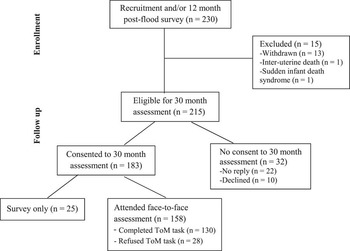
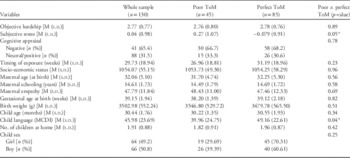
The current sample included n=130 mothers and their children, comprised of mothers who completed a survey on their flood-related experiences at recruitment into the QF2011 study and whose child attended a face-to-face developmental assessment at 30 months of age. Data from 28 additional participants were excluded as the child refused to participate in the ToM task. This refusal rate may be due to fatigue as the ToM task was administered three-quarters through the 2 h assessment. Figure 1 depicts the flow of the QF2011 cohort at enrollment through the 30-month follow-up assessment. Sample characteristics are presented in Table 2.
Cohort diagram showing enrollment into the QF2011 study and attrition and participation in the 30-month theory of mind (ToM) follow-up assessment.

Descriptive statistics for the predictor variables and covariates for the whole sample and by poor and perfect theory of mind (ToM) scores with comparisons between poor and perfect subsamples

MCDI, MacArthur Communicative Development Inventory.*P⩽0.05.
Procedure
The QF2011 study received ethical approval from the study site Human Research Ethics Committee (#1844M) and The University of Queensland (#2013001236) and all participants provided written informed consent. Women completed a survey regarding their flood-related objective experiences and subjective reactions, demographics and mental health at recruitment into the QF2011 study and at 12 months post-flood. At 30 months post-partum mothers also completed a survey regarding their demographics and mental health and the mother–child dyads were invited to attend a 2 h face-to-face developmental assessment at the study site hospital that evaluated children’s cognitive, motor, behavioral and physical development, as well as a single measure of children’s ToM.
Outcome variable
ToM task
ToM was evaluated with two diverse desires (DD) scenarios similar to those used with this age group in prior ToM research.Reference Wellman and Woolley 19 Children were asked to judge whether their own desire differed from another character’s desire. The same female researcher administered the DD scenarios to all the children using a standardized script based on that reported in prior research using the same task.Reference Wellman and Woolley 19 , Reference Wellman and Liu 20 She sat beside the toddler and produced a parrot puppet from a bag and said: ‘This is my friend Beaky Bird and he’s ready for a snack.’ The researcher placed a laminated card depicting two side-by-side color photographs on the table. She pointed to each photo, saying: ‘Here’s an apple and a cookie. Which snack would you like to eat?’ Once the toddler had replied verbally or pointed to a photo (own desire) the researcher said: ‘That’s a good choice! But Beaky Bird wants to eat the (other choice) now; he doesn’t want to eat the (child’s response). Which snack would Beaky Bird choose to eat?’ (other desire). The other DD scenario involved a koala puppet and the choice was between playing on a slide or a bike. The order of the two DD scenarios was counterbalanced across participants and they were videoed for later reliability coding. The mothers who attended the developmental assessment were thanked with a $30 gift voucher and their child received a small toy.
ToM scoring and reliability
For each DD scenario, children were credited with a pass if they selected the alternate choice from their own desire, and a fail if they selected their own choice; giving a score range of 0–2. Given the low frequency of children scoring 0 (n=8) and 1 (n=37), the scores were dichotomized into children who did poorly in the DD tasks (scores of 0 and 1) v. children who performed perfectly (score of 2; n=85). A second independent observer randomly coded 20% of the DD video clips. Intercoder reliability of intraclass correlations was excellent (0.97).
Predictor variables
Objective stress response
Mothers’ flood-related hardship experience was assessed using the Queensland Flood Objective Stress Scale (QFOSS), a questionnaire tailored especially for the Queensland flood. Items were based on the events that occurred during the flood and they assessed four key dimensions of stress: threat (e.g. ‘Were you injured?’), loss (e.g. ‘Did you experience loss of personal income?’), scope (e.g. How may days were you without electricity?’) and change (e.g. ‘Did you spend any time in a temporary shelter?’). Using a pre-established scoring protocol, points for each item were attributed according to the relative severity of flood exposure.Reference King, Kildea and Austin 37 Each dimension had possible scores ranging from 0 (no impact) to 50 (extreme impact), and were summed to provide a total individual objective hardship score (QFOSS range=0–200); higher scores indicated higher levels of objective hardship.
Composite subjective stress
Mothers’ emotional reaction to the flood was assessed using three self-report questionnaires whose scores were computed to create a COmposite Score for MOthers’ Subjective Stress (COSMOSS). The 22-item Impact of Event Scale – Revised IES-R,Reference Weiss and Marmar 38 assessed symptoms of post-traumatic stress from the flood during the previous 7 days (e.g. ‘any reminder brought back feelings about the flood’) using a five-point Likert scale: 0 (not at all true) to 4 (extremely true). This scale has high internal consistency (α coefficients range: 0.79–0.94) and good test–retest reliability (correlation coefficients range: 0.51–0.94.Reference Weiss and Marmar 38 , Reference Creamer, Bell and Failla 39 The 13-item Peritraumatic Distress Inventory PDI-Q;Reference Brunet, Weiss and Metzler 40 retrospectively assessed the severity of emotional distress and panic-like physical reactions experienced at the time of the flood (e.g. ‘I had the feeling I was about to lose control of my emotions’) using a rating scale from 0 (not at all true) to 4 (extremely true). This scale has high internal consistency (coefficient α=0.76) and stability.Reference Brunet, Weiss, Metzler and Best 41 The 10-item Peritraumatic Dissociative Experiences Questionnaire PDEQ;Reference Marmar, Weiss and Metzler 42 assessed the severity of dissociative-like experiences at the time of the flood (e.g. ‘I had moments of losing track of what was going on…’) using a rating scale from 1 (not true at all) to 5 (extremely true). This scale has high internal consistency (Cronbach’s α=0.85).Reference Brunet, Weiss, Metzler and Best 41
The COSMOSS score was created using principal component analysis (PCA) on the IES-R, PDI and PDEQ total scores including data from all 230 QF2011 participants. The PCA-derived algorithm was: COSMOSS=0.358×IES-R+0.397×PDI+0.387×PDEQ. The PCA resulted in one factor explaining 76.27% of the overall subjective stress variance, which was standardized, such that a positive COSMOSS score is above the mean reflecting higher subjective stress levels.
Cognitive appraisal
Mothers’ overall impression of the flood was assessed using a single item: ‘If you think about all of the consequences of the 2011 Queensland flood on you and your household, would you say the flood has been…?’ They rated their appraisal on a five-point Likert scale, from very negative (1) to very positive (5). Due to a narrow range of responses this item was dichotomized into ‘Negative’ and ‘Neutral/Positive’; and this enabled us to compare women who were stressed by the flood (Negative appraisal) to those who were not (Positive or Neutral appraisal). Prior research has demonstrated that single-item measures are reliable and valid tools when compared with multi-item assessment tools.Reference Yohannes, Dodd, Morris and Webb 43
Timing of flood exposure
The gestational age at which the fetus was exposed to the flood in utero was calculated as the difference between the peak date of the flood and estimated conception dates. Estimated date of conception was calculated by subtracting 280 days (40 weeks of pregnancy) from women’s due date. Thus, larger numbers reflect exposure later in pregnancy.
Covariates
Maternal and toddler factors
To control for potentially confounding variables previously documented to affect children’s ToM scores, we gathered data on maternal age when birthing the study child and education level, and the total number of children in the household at 30 months. We also assessed socio-economic status using the socio-economic index for areas scores, based on Australian post-code and census data (M=1000; SD=100); whereby scores above the mean reflect relative advantaged socio-economic status. Maternal empathy was assessed using the Empathy Quotient scaleReference Baron-Cohen and Wheelwright 44 in which mothers rated 40 statements (‘strongly agree’ to ‘strongly disagree’ scored as 0, 1 or 2); yielding a maximum score of 80. The children’s productive vocabulary for a checklist of 100 words was assessed using parent-report on the MacArthur Communicative Development Inventory-III (MCDI-III).Reference Fenson, Marchman and Thal 45
Statistical analyses
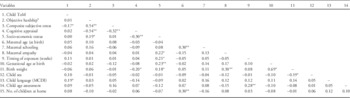
Descriptive analyses were performed on the predictor variables and covariates for the whole sample and as a function of performance on the ToM task: poor v. perfect (see Table 2). Maternal objective stress was significantly positively skewed on the Kolmogorov–Smirnov test of normality; thus it was normalized using a natural log-transformation. Associations between toddlers ToM scores, predictor variables, and covariates were assessed with Pearson’s product-moment correlations, which are shown in Table 3.
Correlations between children’s theory of mind (ToM) scores, predictor variables and covariates

MCDI, MacArthur Communicative Development Inventory.
a Log-transformed scores.
*P⩽0.05; **P<0.01
To assess the effects of PNMS on the dichotomized ToM score, hierarchical multiple logistic regressions were run. Objective hardship was first entered in the model, followed by composite subjective stress and cognitive appraisal. Then, child sex was entered in the model followed by gestational timing of flood exposure. All covariates that were significantly associated with the outcome were entered in the next steps. Finally, interaction terms between PNMS measures and sex or timing were entered in separate models. The Bonferroni method for multiple testing correction was used to account for the number of interaction effect tested. To preserve power, non-significant variables were removed, except for objective hardship and any variable included in a significant interaction, and the models were then rerun. Significant interactions were then probed using the PROCESS SPSS macroReference Hayes 46 to compute the conditional effects and their significance.
Results
Descriptive statistics
Analyses revealed no differences in the demographic and psychological characteristics between the mothers who participated in the current study and those for whom no child data were available. Moreover, the participating and excluded dyads did not differ in terms sex of the toddlers, exposure to the flood, or gestation timing of flood exposure (data not shown).
The descriptive analyses are presented in Table 2. Results showed that two-thirds of the 30-month-olds achieved perfect ToM scores (2/2 on the DD scenarios) whereas one-third got none or one of the scenarios correct. Comparisons between the maternal stress scores showed a trend for the mothers of children who performed poorly to have higher composite subjective stress scores compared with mothers of toddlers who performed perfectly (P=0.05). However, there were no differences between girls (M=1.70, SD=0.46) and boys (M=1.61, SD=0.49). ToM scores and a χ2 test showed no difference in the likelihood that girls and boys would get perfect or poor scores. Children who performed perfectly on the ToM task had significantly higher productive vocabularies on the CDI-III than children who performed poorly (t(128)=−2.14, P<0.05). There were no other group differences for other covariates.
Correlations
Table 3 presents the correlations between the children’s ToM scores, the predictor variables and the covariates. Higher composite subjective PNMS levels predicted worse performance on the ToM DD scenarios. However, there was no relation between maternal objective hardship or cognitive appraisal and children’s ToM performance. There was a significant correlation between children’s MCDI and ToM scores, with higher vocabularies related to better ToM. There were no other significant correlations between ToM scores and the covariates.
Logistic regression
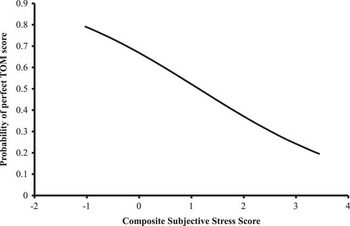
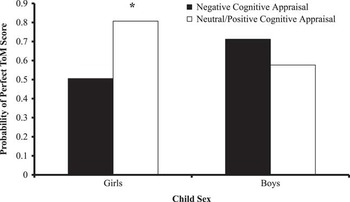
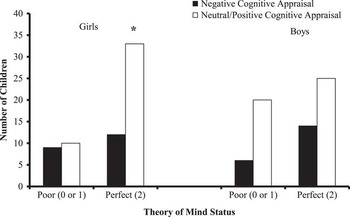
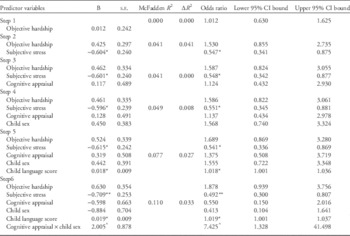
The initial model indicated that timing of exposure was unrelated to the outcome variable and was thus removed from the model. Results for the final trimmed hierarchical multiple logistic model are presented in Table 4. Objective hardship was entered in step 1, but its effect on ToM was not significant (P=0.96). In step 2, a significant effect of composite subjective stress was detected (P=0.01), such that children whose mothers were more emotionally distressed were less likely to have a perfect ToM score (see Fig. 2). Cognitive appraisal of the flood was added to the model in step 3, but was not significantly associated with the outcome (P=0.81). In step 4, child sex was added to the model but no significant difference between boys and girls ToM scores was detected (P=0.24). In step five, the only covariate significantly correlated to the outcome, children’s language score, was added to the model, and a significant association to ToM was detected (P=0.04), such that better language score was associated with higher odds of having a perfect ToM score. Finally, the interaction between cognitive appraisal and sex approached significance (adjusted p=0.07) and is presented in Fig. 3. In addition, Fig. 4 depicts the number of girls and boys who achieved poor v. perfect ToM scores when their mother’s had a negative v. neutral or positive cognitive appraisal of the floods.
Main effect of maternal composite subjective stress on children’s theory of mind (ToM) scores. Children were more likely to have a perfect ToM score with lower levels of maternal subjective stress (numbers below the mean of zero) compared with higher levels of maternal subjective stress (numbers above the mean of zero).

Moderating effect of maternal cognitive appraisal on theory of mind (ToM) by child sex. Girls were more likely to have a perfect ToM score with a neutral or positive maternal appraisal style than a negative appraisal style; but maternal cognitive appraisal did not affect boys theory of mind. *P<0.05.

The number of girls and boys who attained poor v. perfect theory of mind scores as a function of their mother’s cognitive appraisal of the impact (negative v. positive or neutral) of the floods. *P<0.05.

Logistic regressions between theory of mind scores, predictor variables and covariates
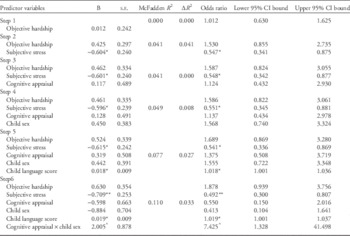
Interaction effect is significant after correcting for multiple testing; child sex: boy=0, girl=1.
^ P<0.1; *P<0.05; **P<0.01.
Probing the interaction revealed that girls whose mothers had a neutral or positive cognitive appraisal of the flood had significantly higher probability of having a perfect ToM score compared with girls whose mothers had a negative appraisal (P=0.04). Also, in children whose mothers had a neutral or positive cognitive appraisal of the flood, girls had a significantly higher probability of getting a perfect ToM score than boys (P=0.03). For the final model, which explained 11% of the variance of ToM scores, maternal subjective stress, child language skill, and the cognitive appraisal-by-sex interaction remained significant predictors.
Discussion
The research reported here provides a novel contribution to the literature by examining (1) the extent to which mothers’ stress responses to disaster-related hardship in pregnancy predicts individual differences in children’s ToM performance; and (2) whether sex of the child or gestational timing of the flood can moderate these effects of PNMS on children’s ToM.
Addressing our first research question, this is the first study to the best of our knowledge to document a relation between prenatal factors and toddler social understanding on a ToM task. The results showed that higher levels of subjective PNMS were associated with children being less likely to attain a perfect ToM score, even when controlling for maternal objective hardship and children’s language skill. This shows that in addition to the number of previously documented early childhood and family factors that affect ToM,Reference Ashington and Jenkins 27 , Reference Lillard 28 , Reference Symons, Peterson, Slaughter, Roche and Doyle 32 this important skill that predicts later social functioningReference Dunn 23 , Reference Londale and Chandler 24 is also shaped by prenatal events.
However, the level of maternal objective hardship experienced did not influence children’s ToM performance. This result differs to that of a cohort of Quebec children affected by an ice storm that occurred in 1998 (Project Ice Storm), showing that both objective hardship and subjective distress in the pregnant women during a natural disaster predicted autistic-like traits in the children when they were aged 6 years.Reference Walder, Laplante and Sousa-Pires 17 However, a ToM deficit is only one of the ways that children with ASD differ from typically developing children; so the other aspects of ASD may account for this inconsistent finding with objective stress between the two cohorts. The differential relation between objective and subjective PNMS and child outcomes has been documented in research using different types of disasters experienced in pregnancy.Reference Harville, Xiong and Buekens 47 , Reference Laplante, Brunet and King 48 This finding fits with Lazarus’ appraisal theory, whereby two people who experience the same event may react completely differently to it.Reference Folkman and Lazarus 49 , Reference Smith and Lazarus 50 Indeed, the differential effect subjective and objective flood-related stress had on child ToM in the current QF2011 cohort with this particular outcome at 30 months, showed they can operate independently.
Addressing our second research question regarding moderators of PNMS on ToM, the results showed that girls were more likely to exhibit poor ToM when their mother’s rated the overall impact of the floods as negative compared with neutral or positive. Furthermore, girls had a higher likelihood of attaining a perfect ToM score than boys when their mothers had a neutral or positive cognitive appraisal style, even when controlling for the objective severity of the event. Thus, girls’ ToM was buffered against the effects of flood-related PNMS when their mother’s had a neutral or positive view of the disaster. In Project Ice Storm, maternal cognitive appraisal of the storm predicted their children’s genome-wide DNA methylation signatures, suggesting one mechanism by which this element of PNMS may influence fetal development.Reference Cao-Lei, Dancause and Elgbeili 51
In the QF2011 cohort we cannot rule out the possibility that maternal tendency toward positive appraisal predicts ToM in their daughters by way of genetic transmission of traits; or indeed the possibility that there is an intergenerational transmission of higher maternal subjective stress reactions negatively influencing their children’s ToM. On the other hand, contrary to prior research,Reference Sabbagh and Seamans 34 in the current study we found no association between maternal autistic-like traits (on the Empathy Quotient) and the girls (r=0.02, P=0.90) or boys (r=−0.07, P=0.62) ToM scores.
Sex differences in the PNMS literature also support the finding that girls’ development may be more resilient to the negative effects of PNMS than boys’;Reference Fineberg, Ellman and Schaefer 52 with some exceptions reported.Reference Sandman, Glynn and Davis 11 Sex differences are thought to be programmed during gestation with higher levels of stress hormones differentially affecting male and female fetuses.Reference Clifton 10 Although this is the first study to examine how PNMS affects children’s ToM, one study shows that PNMS exposure predicts more ASD symptoms (characterized by delayed ToM) in boys than girls,Reference Ronald, Pennell and Whitehouse 53 with marginal support for similar sex differences reported in two other ASD studies.Reference Kinney, Miller, Crowley and Gerber 16 , Reference Walder, Laplante and Sousa-Pires 17
The benefit of a positive/neutral maternal cognitive appraisal style to buffer the negative effects of PNMS on development was also found in the QF2011 cohort with respect to infant motor functioning and timing of the flood in pregnancy.Reference Simcock, Kildea and Elgbeili 7 This suggests that the way a mother thinks about a stressful event during pregnancy can influence the impact of the event on her child’s development. This finding fits with Lazarus’ transactional model of stress, in which one’s appraisal of the stressor mediates the impact of the stress on an individual.Reference Lazarus and Folkman 54
Although child sex moderated the negative effects of maternal cognitive appraisal on ToM, there were no significant interactions with timing of the flood in gestation. This contrasts with other disaster studies have found particular aspects of child development susceptible to PNMS effects at different points in gestation, such as first trimester for autistic-like traitsReference Walder, Laplante and Sousa-Pires 17 and third trimester for motor functioning.Reference Cao, Laplante, Brunet, Ciampi and King 5 , Reference Simcock, Kildea and Elgbeili 7 Interestingly, Project Ice Storm has found that significant timing effects at one ageReference Laplante, Barr and Brunet 55 are no longer viable at later ages.Reference Laplante, Brunet, Schmitz, Ciampi and King 4 Thus, effects of timing of exposure to stress in pregnancy may be age-dependent. Further research to learn more about how timing of stress in pregnancy affects ToM development is warranted.
There were some limitations to the current study. First, as the 2 h face-to-face assessment included multiple measures of child development we were only able to include a single measure of ToM to avoid overburdening the toddlers; future PNMS studies should endeavor to evaluate different aspects of ToM. Second, there is no ‘zero flood-exposure’ control group against which to compare the QF2011 flood-affected children’s ToM performance. Third, the sample size was relatively small which may have resulted in power too low to detect small effect sizes, such as a main effect or interaction with timing. Fourth, the sample was also relatively homogenous with respect to maternal and demographic factors which may limit generalization of the findings to the wider population. Furthermore, as the subjective stress measures were administered on average 6.90 months (range=2.99–10.98 months) after the flood occurred, there may be some recall biases influencing maternal report of their immediate reactions to the disaster. An additional of assessment of mother’s physiological stress response to the flood could have overcome this limitation and provided another index of PNMS. However, due to the logistics of quickly establishing the QF2011 study in the wake of the flood and attaining ethical approval, such delays in survey administration and difficulties obtaining biological samples were inevitable. However, strengths of the study include an independently administered ToM task rather than utilizing maternal report on this aspect of child development, and the use of a natural disaster to overcome confounds inherent in some PNMS studies and also enables examination of how the mothers’ objective stress experiences, her emotional reactions and appraisal of the floods influence child development.
In summary, the current results show that both subjective PNMS and maternal cognitive appraisal shaped children’s ToM, independent of potential covariates such as maternal demographics and empathy, gestational age and birth weight, and child language skill. Moreover, child sex moderated the impact of cognitive appraisal girls ToM, whose performance on the DD ToM scenarios benefited from a maternal neutral/positive appraisal style, but had no effect on boys’ performance. The QF2011 study continues to monitor the development of these children and will report on the effects of flood-related PNMS on aspects of social functioning that can be more comprehensively assessed at later ages.
Acknowledgments
Many thanks to the QF2011 families for participating in this study. Thanks to Helen Stapleton and Laura Shoo for study coordination, to Donna Amaraddio for participant retention and administration, and to Belinda Lequertier, Katrina Moss, and Rebecca McCarthy for data collection.
Financial Support
This research was funded by the Canadian Institutes of Health Research (CIHR; # MOP-1150667; awarded to S. King, S. Kildea, and co-PIs), and a Quick Response Grant Program from the Mater Research, funding from the Mater Child Youth Mental Health Service, and Mater and Australian Catholic University Midwifery Research Unit.
Conflicts of Interest
None.
Ethical Standards
The authors assert that all procedures contributing to this work comply with the ethical standards of the relevant national guidelines on human experimentation (the Australian National Statement on Ethical Conduct on Human Research (2007 – updated 2015) and the Helsinki Declaration of 1975 as revised in 2008, and has been approved by the institutional committees at Mater Research Institute (#1844M) and The University of Queensland (#2013001236).