Introduction
Attention deficit hyperactivity disorder (ADHD), characterized by inattention, hyperactivity and impulsivity, is one of the most common childhood-onset psychiatric disorders (Centers for Disease Control and Prevention, 2010; Merikangas et al. Reference Merikangas, He, Burstein, Swanson, Avenevoli, Cui, Benjet, Georgiades and Swendsen2010). It is associated with increased rates of family conflict, poor peer relationships (Barkley et al. Reference Barkley, Fischer, Smallish and Fletcher2006; Able et al. Reference Able, Johnston, Adler and Swindle2007), unintentional injuries or trauma (Barkley et al. Reference Barkley, Guevremont, Anastopoulos, DuPaul and Shelton1993; Swensen et al. Reference Swensen, Birnbaum, Ben, Greenberg, Cremieux and Secnik2004), impaired driving, substance-use disorders, low educational achievement, decreased work performance (Mannuzza et al. Reference Mannuzza, Klein, Bessler, Malloy and LaPadula1993; Kessler et al. Reference Kessler, Lane, Stang and Van Brunt2009) and high health-care costs (Leibson et al. Reference Leibson, Katusic, Barbaresi, Ransom and O'Brien2001; Meyers et al. Reference Meyers, Classi, Wietecha and Candrilli2010). Impairing symptoms of ADHD may persist into adulthood in as many as 65% of cases (Faraone et al. Reference Faraone, Biederman and Mick2006a). The persistence of ADHD suggests that the impact of the disorder goes often beyond childhood and adolescence, and that most health-care professionals, not only pediatricians and child psychiatrists, are likely to encounter individuals with ADHD in their clinical practice.
Despite the public health importance of ADHD, several key areas remain understudied. For example, prior studies have shown that individuals with ADHD are at an increased risk for substance-use disorders (Biederman et al. Reference Biederman, Monuteaux, Mick, Spencer, Wilens, Silva, Snyder and Faraone2006b; Elkins et al. Reference Elkins, McGue and Iacono2007) and other psychiatric disorders (Biederman et al. Reference Biederman, Newcorn and Sprich1991, Reference Biederman, Monuteaux, Mick, Spencer, Wilens, Silva, Snyder and Faraone2006b; Kessler et al. Reference Kessler, Adler, Barkley, Biederman, Conners, Demler, Faraone, Greenhill, Howes, Secnik, Spencer, Ustun, Walters and Zaslavsky2006; Elkins et al. Reference Elkins, McGue and Iacono2007). However, to date, no study has examined which psychiatric disorders are independently associated with ADHD and for which the association disappears after controlling for other disorders. Furthermore, although the co-morbidity of ADHD with Axis I disorders has been extensively documented, no community study has investigated the association between ADHD and personality disorders or the extent to which co-morbidity contributes to explain the levels of disability (Biederman et al. Reference Biederman, Faraone, Spencer, Mick, Monuteaux and Aleardi2006a; Fayyad et al. Reference Fayyad, De Graaf, Kessler, Alonso, Angermeyer, Demyttenaere, De Girolamo, Haro, Karam, Lara, Lepine, Ormel, Posada-Villa, Zaslavsky and Jin2007) and poor social functioning (Barkley et al. Reference Barkley, Fischer, Smallish and Fletcher2006; Able et al. Reference Able, Johnston, Adler and Swindle2007) consistently documented in individuals with ADHD.
The relationship between ADHD and impulsive behaviors is also poorly understood. Clinical studies have indicated that ADHD often co-occurs with behaviors characterized by lack of planning or deficient inhibitory control (Barkley, Reference Barkley1997; Swanson, Reference Swanson2003), such as reckless driving (Barkley et al. Reference Barkley, Guevremont, Anastopoulos, DuPaul and Shelton1993; Fried et al. Reference Fried, Petty, Surman, Reimer, Aleardi, Martin, Coughlin and Biederman2006) and gambling problems (Faregh & Derevensky, Reference Faregh and Derevensky2011). However, whether those associations extend to individuals in the general population is unknown (Froehlich et al. Reference Froehlich, Lanphear, Epstein, Barbaresi, Katusic and Kahn2007).
There is also scarce information regarding treatment-seeking patterns among individuals with ADHD. The National Comorbidity Survey – Adolescent Supplement (NCS-A) found that 59.8% of individuals with attention deficit hyperactivity disorder had sought treatment for ADHD at the time of the survey (Merikangas et al. Reference Merikangas, He, Burstein, Swendsen, Avenevoli, Case, Georgiades, Heaton, Swanson and Olfson2011). However, because its age range is 13 to 18 years, its results cannot be extrapolated to adults. By contrast, the National Comorbidity Survey Replication (Kessler et al. Reference Kessler, Adler, Barkley, Biederman, Conners, Demler, Faraone, Greenhill, Howes, Secnik, Spencer, Ustun, Walters and Zaslavsky2006), which focuses exclusively on adults, found that 25.2% of the respondents had received treatment for ADHD during the last year, but did not provide information on lifetime cumulative treatment rates, which are important to evaluate unmet treatment needs (Biederman et al. Reference Biederman, Monuteaux, Mick, Spencer, Wilens, Silva, Snyder and Faraone2006b; Kessler et al. Reference Kessler, Adler, Barkley, Biederman, Conners, Demler, Faraone, Greenhill, Howes, Secnik, Spencer, Ustun, Walters and Zaslavsky2006; Fayyad et al. Reference Fayyad, De Graaf, Kessler, Alonso, Angermeyer, Demyttenaere, De Girolamo, Haro, Karam, Lara, Lepine, Ormel, Posada-Villa, Zaslavsky and Jin2007).
The goal of this study was to fill these gaps in knowledge of adult ADHD by drawing on data from the National Epidemiologic Survey on Alcohol and Related Conditions (NESARC), a large representative sample of the US adult population. Our goals were to: (1) investigate independent associations between ADHD and co-morbid psychiatric disorders controlling for other Axis I and Axis II co-morbid disorders; (2) examine the associations between ADHD and impulsive behaviors; (3) compare quality of life, perceived health, level of social support and stress among individuals with and without ADHD; and (4) estimate rates of treatment seeking among individuals with ADHD.
Method
The NESARC (Grant et al. Reference Grant, Stinson, Dawson, Chou, Ruan and Pickering2004b, Reference Grant, Goldstein, Chou, Huang, Stinson, Dawson, Saha, Smith, Pulay, Pickering, Ruan and Compton2009) was the source of data. The NESARC target population at wave 1 was the civilian non-institutionalized population 18 years and older residing in households and group quarters. Blacks, Hispanics and adults aged 18–24 years were oversampled, with data adjusted for oversampling, household- and person-level non-response. Interviews were conducted by experienced lay interviewers with extensive training and supervision (Grant et al. Reference Grant, Stinson, Dawson, Chou, Ruan and Pickering2004b, Reference Grant, Goldstein, Chou, Huang, Stinson, Dawson, Saha, Smith, Pulay, Pickering, Ruan and Compton2009). All procedures, including informed consent, received full ethical review and approval from the US Census Bureau and US Office of Management and Budget. After excluding respondents who were ineligible for wave 2 (e.g. deceased), 34 653 respondents were re-interviewed, and sample weights were developed to additionally adjust for wave 2 non-response. Weighted data were then adjusted to be representative of the civilian population of the USA on socio-economic variables based on the 2000 Decennial Census (Grant et al. Reference Grant, Goldstein, Chou, Huang, Stinson, Dawson, Saha, Smith, Pulay, Pickering, Ruan and Compton2009).
Diagnostic assessment
Sociodemographic measures included age, sex, race/ethnicity, nativity and marital status. Socio-economic measures included education, insurance type, employment status and individual income.
The diagnostic interview was the Alcohol Use Disorder and Associated Disabilities Interview Schedule–DSM-IV version (AUDADIS-IV; Grant et al. Reference Grant, Dawson and Hasin2007a) wave 2 version (Grant et al. Reference Grant, Dawson and Hasin2007b), a valid and reliable fully structured diagnostic interview designed for use by professional interviewers who are not clinicians.
ADHD was assessed at wave 2 of the NESARC; responders were asked the symptoms of DSM-IV ADHD. Consistent with DSM-IV, lifetime and childhood AUDADIS-IV diagnoses of ADHD required the respondent to meet the DSM-IV symptom thresholds. Subtypes were included as well, accordingly to the DSM-IV definition. Twenty symptom items operationalized the 18 ADHD criteria. Symptoms had to be present for at least 6 months, have onset before the age of 18 years and interfere significantly with social, school or work functioning. The age of onset criterion was increase to 18 years old, as endorsed by the DSM-5 ADHD committee (Faraone et al. Reference Faraone, Biederman, Spencer, Mick, Murray, Petty, Adamson and Monuteaux2006b; Kieling et al. Reference Kieling, Kieling, Rohde, Frick, Moffitt, Nigg, Tannock and Castellanos2010). Test–retest reliability for ADHD was good (k=0.71) (Ruan et al. Reference Ruan, Goldstein, Chou, Smith, Saha, Pickering, Dawson, Huang, Stinson and Grant2008). Internal consistency reliability of the ADHD symptom items (Cronbach's α=0.89) was excellent (Ruan et al. Reference Ruan, Goldstein, Chou, Smith, Saha, Pickering, Dawson, Huang, Stinson and Grant2008).
Mood disorders assessed by the AUDADIS included DSM-IV major depressive disorder (MDD), dysthymia, and bipolar I and II disorder. Anxiety disorders included DSM-IV panic disorder, social anxiety disorder, specific phobias, generalized anxiety disorder (GAD) (Williams et al. Reference Williams, Marchuk, Gadde, Barefoot, Grichnik, Helms, Kuhn, Lewis, Schanberg, Stafford-Smith, Suarez, Clary, Svenson and Siegler2003) and post-traumatic stress disorder (PTSD). Personality disorders were assessed on a lifetime basis at wave 1 and included avoidant, dependent, obsessive-compulsive, paranoid, schizoid, histrionic and antisocial personality disorders. Borderline, schizotypal and narcissistic personality disorders were measured at wave 2. AUDADIS-IV methods to diagnose these disorders are described in detail elsewhere (Hasin et al. Reference Hasin, Goodwin, Stinson and Grant2005; Grant et al. Reference Grant, Hasin, Stinson, Dawson, Goldstein, Smith, Huang and Saha2006). Test–retest reliabilities for AUDADIS-IV mood, anxiety, impulsive and personality disorders in the general population and clinical settings were fair to good (k=0.40–0.77) (Canino et al. Reference Canino, Bravo, Ramirez, Febo, Rubio-Stipec, Fernandez and Hasin1999; Grant et al. Reference Grant, Dawson, Stinson, Chou, Kay and Pickering2003; Petry et al. Reference Petry, Stinson and Grant2005; Ruan et al. Reference Ruan, Goldstein, Chou, Smith, Saha, Pickering, Dawson, Huang, Stinson and Grant2008). Convergent validity was good to excellent for all affective, anxiety and personality diagnoses (Grant et al. Reference Grant, Dawson, Stinson, Chou, Kay and Pickering2003, Reference Grant, Hasin, Stinson, Dawson, Chou, Ruan and Pickering2004a, Reference Grant, Hasin, Blanco, Stinson, Chou, Goldstein, Dawson, Smith, Saha and Huang2005, Reference Grant, Hasin, Stinson, Dawson, Goldstein, Smith, Huang and Saha2006; Compton et al. Reference Compton, Conway, Stinson, Colliver and Grant2005; Hasin et al. Reference Hasin, Goodwin, Stinson and Grant2005; Ruan et al. Reference Ruan, Goldstein, Chou, Smith, Saha, Pickering, Dawson, Huang, Stinson and Grant2008), and selected diagnoses showed good agreement (k=0.64–0.68) with psychiatrist reappraisals (Canino et al. Reference Canino, Bravo, Ramirez, Febo, Rubio-Stipec, Fernandez and Hasin1999).
Extensive AUDADIS-IV questions covered DSM-IV lifetime prevalence and 12-month incidence diagnoses for alcohol and drug-specific abuse and dependence for 10 classes of substances. The good to excellent (k=0.70–0.91) test–retest reliability of AUDADIS-IV substance-use disorder diagnoses has been documented in clinical and general population samples (Grant et al. Reference Grant, Harford, Dawson, Chou and Pickering1995, Reference Grant, Dawson, Stinson, Chou, Kay and Pickering2003; Chatterji et al. Reference Chatterji, Saunders, Vrasti, Grant, Hasin and Mager1997; Hasin et al. Reference Hasin, Carpenter, McCloud, Smith and Grant1997; Canino et al. Reference Canino, Bravo, Ramirez, Febo, Rubio-Stipec, Fernandez and Hasin1999; Ruan et al. Reference Ruan, Goldstein, Chou, Smith, Saha, Pickering, Dawson, Huang, Stinson and Grant2008). Convergent, discriminant and construct validity of AUDADIS-IV substance-use disorder criteria and diagnoses was good to excellent (Hasin et al. Reference Hasin, Grant and Endicott1990, Reference Hasin, Schuckit, Martin, Grant, Bucholz and Helzer2003; Hasin & Paykin, Reference Hasin and Paykin1999), including in the World Health Organization/National Institutes of Health International Study on Reliability and Validity (Room et al. Reference Room, Janca, Bennett, Schmidt and Sartorius1996; Cottler et al. Reference Cottler, Grant, Blaine, Mavreas, Pull, Hasin, Compton, Rubio-Stipec and Mager1997; Hasin et al. Reference Hasin, Carpenter, McCloud, Smith and Grant1997; Pull et al. Reference Pull, Saunders, Mavreas, Cottler, Grant, Hasin, Blaine, Mager and Ustun1997) where clinical reappraisals documented good validity of DSM-IV alcohol and drug-use disorder diagnoses (k=0.54–0.76). Consistent with DSM-IV, ‘primary’ AUDADIS-IV diagnoses excluded disorders that were substance-induced or due to general medical conditions. Furthermore, diagnoses of MDD ruled out bereavement.
Impulsive behaviors and lifetime trauma
Behaviors reflecting deficits in executive functions, such as lack of planning and deficient inhibitory control, were also examined. Specifically, the study queried about problems with gambling and spending too much money, reckless driving, quitting jobs without knowing what to do next and having sudden changes in personal goals or career plans. Questions came from the borderline and antisocial personality disorder modules of the AUDADIS-IV, both of which have good reliability (k=0.71 and k=0.67, respectively) (Ruan et al. Reference Ruan, Goldstein, Chou, Smith, Saha, Pickering, Dawson, Huang, Stinson and Grant2008).
As part of the PTSD diagnostic module, all NESARC respondents were asked if they ever experienced any of the 23 traumatic events described during the interview. Lifetime trauma exposure was measured as the number of traumatic events the respondent experienced.
Last 12 months perceived health, social support and stress
Perceived general health during the last 12 months was assessed using the Short Form 12 version 2 (SF-12; Ware et al. Reference Ware, Kosinski, Turner Bowker and Gandek2002), a reliable and valid measure of disability used in population surveys, which includes the physical component summary, social functioning scale, role emotional scale and mental health scale (Ware et al. Reference Ware, Kosinski, Turner Bowker and Gandek2002). Low social support during the last 12 months was assessed using the Interpersonal Support Evaluation List (ISEL-12), a 12-item scale designed to measure social support (Cohen et al. Reference Cohen, Doyle, Skoner, Rabin and Gwaltney1997). The Perceived Stress Scale-4 (PSS-4) assesses the individual propensity to perceive an event as stressful, based on the individual's locus of control and self-efficacy (Cohen & Williamson, Reference Cohen, Williamson, Spaceapam and Oskamp1988). Higher values indicate greater likelihood to perceive events as stressful and lower sense of self-efficacy.
Treatment history
Respondents were classified as receiving lifetime treatment if they: (1) visited a doctor, counselor, therapist or psychologist to get help for ADHD; or (2) were prescribed medications to alleviate symptoms related to ADHD. Respondents receiving treatment were also asked the age at which they first sought treatment.
Statistical analyses
Weighted percentages and means were computed to derive sociodemographic and clinical characteristics of respondents with and without a lifetime diagnosis of ADHD. Logistic regression yielded odds ratios (ORs), indicating measures of association between a lifetime diagnosis of ADHD and sociodemographic characteristics, lifetime and 12 months co-morbidity, associated impulsive behaviors, and adverse outcomes. Two sets of logistic regressions, yielding adjusted ORs were conducted to examine each outcome (e.g. co-morbid psychiatric disorders, associated lifetime number of trauma). The first set adjusted only for sociodemographic characteristics that differed between individuals with and without a lifetime history of ADHD. The second set further adjusted for the presence of other co-morbid psychiatric disorders that differed between individuals with and without a lifetime history of ADHD to identify the independent contribution of ADHD to the outcome of interest (e.g. associated impulsive behaviors).
Because the combined standard error of two means (or percentages) is always equal to or less than the sum of the standard errors of those two means, in our analyses we conservatively consider that two confidence intervals (CIs) whose values do not overlap differ significantly from one another (Agresti, Reference Agresti2002). We consider significant ORs those whose CI does not include 1. Standard errors and 95% CIs for all analyses were estimated by using SUDAAN (version 9.0; Research Triangle Institute, USA), to adjust for the design effects of the NESARC.
Results
Sociodemographic and socio-economic characteristics (Table 1)
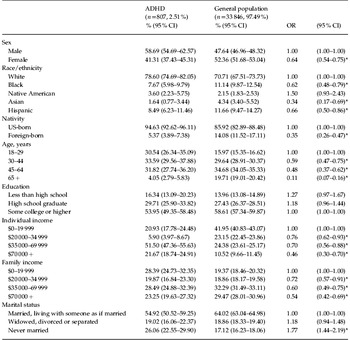
The overall lifetime prevalence of the combined subtype of ADHD was 2.51% (95% CI 2.28–2.76). The odds of ADHD were significantly lower in women than in men (OR 0.64, 95% CI 0.54–0.75) and in blacks (OR 0.62, 95% CI 0.48–0.79), Hispanics (OR 0.66, 95% CI 0.50–0.86), and Asian Americans (OR 0.34, 95% CI 0.17–0.69) than among whites. Being US-born, never married, or in the youngest cohort (ages 18–29 years) increased the risk for ADHD. The risk of ADHD was inversely related to age and to individual and family income.
Sociodemographic and socio-economic characteristics of individuals with and without ADHD in the National Epidemiologic Survey on Alcohol and Related Conditions

ADHD, Attention deficit hyperactivity disorder; CI, confidence interval; OR, odds ratio.
* Significant at p<0.05.
Lifetime and 12-month co-morbidity (Table 2)
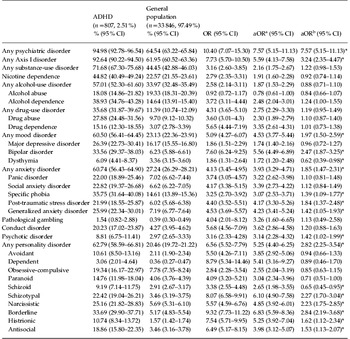
Most individuals with a lifetime history of ADHD (94.98%) had a lifetime history of at least one psychiatric diagnosis, compared with 64.54% in non-ADHD (OR 10.40, 95% CI 7.07–15.30). Individuals with ADHD were significantly more likely than those without ADHD to have a lifetime Axis I disorder (OR 7.73, 95% CI 5.70–10.50) and a personality disorder (OR 6.56, 95% CI 5.52–7.79). All psychiatric disorders, with the exception of alcohol abuse, were significantly associated with ADHD. The strongest associations were with borderline personality disorder (OR 9.32, 95% CI 7.73–11.22), schizotypal personality disorder (OR 8.07, 95% CI 6.58–9.91), dependent personality disorder (OR 8.79, 95% CI 5.34–14.46) and bipolar disorder (OR 7.60, 95% CI 6.24–9.25). A similar pattern was observed when 12-month, rather than lifetime, diagnoses of Axis I disorders were examined (see the Supplementary material, available online)Footnote †. Most individuals with a lifetime history of ADHD (71.84%) had at least one psychiatric diagnosis during the last 12 months, compared with 33.12% in non-ADHD individuals (OR 5.15, 95% CI 4.24–6.26).
Lifetime psychiatric co-morbidity of individuals with and without ADHD in the National Epidemiologic Survey on Alcohol and Related Conditions

ADHD, Attention deficit hyperactivity disorder; CI, confidence interval; OR, odds ratio; aOR, adjusted odds ratio.
a Adjusted for sociodemographic characteristics.
b Adjusted for sociodemographic characteristics and other psychiatric disorders.
* Significant at p<0.05.
After adjusting for sociodemographic characteristics, all associations were reduced but maintained significant. However, after further adjusting for other co-morbid psychiatric disorders, only the associations with lifetime and 12-month alcohol dependence, bipolar disorder, specific phobia, PTSD, GAD, psychotic disorder, schizotypal, narcissistic, borderline, histrionic and antisocial personality disorder remained positive and statistically significant. ADHD was negatively and significantly associated with schizoid personality disorder and dysthymia. All other associations were no longer significant.
Impulsive behaviors and number of traumas (Table 3)
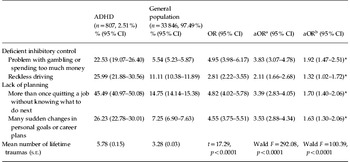
The prevalence of behaviors reflecting lack of planning and deficient inhibitory control was higher among individuals with ADHD than those without ADHD. Individuals with ADHD were more likely to develop lifetime problems with gambling or spending too much money (OR 4.95, 95% CI 3.98–6.17), to drive recklessly (OR 2.81, 95% CI 2.22–3.55), to frequently quit a job without knowing what to do next (OR 4.82, 95% CI 4.02–5.78) and to experience many sudden changes in personal or career goals (OR 4.55, 95% CI 3.75–5.51). After adjusting for sociodemographic and co-morbid disorders, all associations remained significant.
Impulsive behaviors and number of traumas among individuals with and without ADHD in the National Epidemiologic Survey on Alcohol and Related Conditions

ADHD, Attention deficit hyperactivity disorder; CI, confidence interval; OR, odds ratio; aOR, adjusted odds ratio; s.e., standard error.
a Adjusted for sociodemographic characteristics.
b Adjusted for sociodemographic characteristics and other psychiatric disorders.
* Significant at p<0.05.
Individuals with ADHD had a significantly greater number of lifetime traumatic events than individuals without ADHD. This difference maintained significance after adjusting for sociodemographic and co-morbidity.
Perceived health, social support and stress (Table 4)
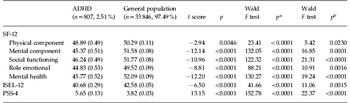
Individuals with ADHD had significantly lower scores on the SF-12 physical, social, emotional and mental subscales. They scored significantly higher on the PSS-4 (t=13.15, p<0.0001) and significantly lower on the ISEL-12 than individuals without ADHD (t=−6.50, p<0.0001). All differences remained significant after adjusting for sociodemographic characteristics and co-morbidity.
Last 12 months perceived health, social support and stress of individuals with and without ADHD in the National Epidemiologic Survey on Alcohol and Related Conditions

ADHD, Attention deficit hyperactivity disorder; SF-12, Short Form 12 version 2; ISEL-12, Interpersonal Support Evaluation List; PSS-4, Perceived Stress Scale-4.
Data are given as mean (standard error).
a Adjusted for sociodemographic characteristics.
b Adjusted for sociodemographic characteristics and other psychiatric disorders.
Lifetime treatment history (Table 5)
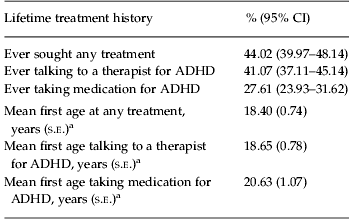
The lifetime rate of treatment seeking for ADHD was 44.02% (95% CI 39.97–48.14%) and the average age for first treatment seeking was 18.40 years. Counseling and psychotherapy were received by 41.07% of the sample (95% CI 37.11–45.14%), with an average age for first treatment of 18.65 years. Only 27.61% (95% CI 23.93–31.62%) were prescribed medication to treat ADHD. The average age of first treatment for medication was 20.63 years of age.
Lifetime treatment history of individuals with ADHD in the National Epidemiologic Survey on Alcohol and Related Conditions

ADHD, Attention deficit hyperactivity disorder; CI, confidence interval; s.e., standard error.
a Among individuals who sought treatment.
Discussion
In a large, nationally representative sample of US adults, individuals with a lifetime history of ADHD had an increased prevalence of all psychiatric disorders, even after adjusting for sociodemographic characteristics. However, after adjusting for other co-morbid disorders ADHD was independently associated only with increased risk of bipolar disorder, narcissistic, histrionic, borderline, antisocial and schizotypal personality disorder, GAD, PTSD and specific phobia. Furthermore, after adjusting for co-morbidity, individuals with a lifetime history of ADHD had a significantly higher tendency to engage in behaviors reflecting lack of planning and deficient inhibitory control, and to experience high rates of adverse consequences, including trauma. ADHD was also associated with significantly lower perceived health, social support and higher stress. Although lifetime treatment rates for ADHD were 44.02%, the average age of first treatment contact was 18.40 years of age, suggesting that ADHD was undertreated in this cohort.
Consistent with previous findings (Kessler et al. Reference Kessler, Adler, Barkley, Biederman, Conners, Demler, Faraone, Greenhill, Howes, Secnik, Spencer, Ustun, Walters and Zaslavsky2006), our unadjusted analyses showed that ADHD was associated with a broad range of lifetime Axis I disorders (Kessler et al. Reference Kessler, Adler, Barkley, Biederman, Conners, Demler, Faraone, Greenhill, Howes, Secnik, Spencer, Ustun, Walters and Zaslavsky2006; Fayyad et al. Reference Fayyad, De Graaf, Kessler, Alonso, Angermeyer, Demyttenaere, De Girolamo, Haro, Karam, Lara, Lepine, Ormel, Posada-Villa, Zaslavsky and Jin2007). Consistent with clinical studies (Miller et al. Reference Miller, Flory, Miller, Harty, Newcorn and Halperin2008), we also found extensive co-morbidity with Axis II disorders, which had not been previously examined in national, community samples. After adjusting for other co-morbid disorders, individuals with ADHD had higher rates of bipolar disorder, cluster B personality disorders, GAD and PTSD. The higher than expected rate of co-occurrence between ADHD and bipolar disorder has been previously noted across different ages in clinical samples (Nierenberg et al. Reference Nierenberg, Miyahara, Spencer, Wisniewski, Otto, Simon, Pollack, Ostacher, Yan, Siegel and Sachs2005; Singh et al. Reference Singh, DelBello, Kowatch and Strakowski2006), and is consistent with the documented genetic (Faraone et al. Reference Faraone, Biederman and Monuteaux2001), neuroanatomical (Biederman et al. Reference Biederman, Makris, Valera, Monuteaux, Goldstein, Buka, Boriel, Bandyopadhyay, Kennedy, Caviness, Bush, Aleardi, Hammerness, Faraone and Seidman2008a) and cognitive-style commonalities between both disorders (Doyle et al. Reference Doyle, Wilens, Kwon, Seidman, Faraone, Fried, Swezey, Snyder and Biederman2005). Previous studies also documented an association between childhood ADHD and cluster B personality disorders (Bernstein et al. Reference Bernstein, Cohen, Skodol, Bezirganian and Brook1996; Miller et al. Reference Miller, Flory, Miller, Harty, Newcorn and Halperin2008). Clinical studies of ADHD adults have documented higher levels of neuroticism (Jacob et al. Reference Jacob, Romanos, Dempfle, Heine, Windemuth-Kieselbach, Kruse, Reif, Walitza, Romanos, Strobel, Brocke, Schafer, Schmidtke, Boning and Lesch2007), novelty seeking and harm avoidance (Jacob et al. Reference Jacob, Romanos, Dempfle, Heine, Windemuth-Kieselbach, Kruse, Reif, Walitza, Romanos, Strobel, Brocke, Schafer, Schmidtke, Boning and Lesch2007; Faraone et al. Reference Faraone, Kunwar, Adamson and Biederman2009) and reward dependence (Faraone et al. Reference Faraone, Kunwar, Adamson and Biederman2009). Although the association with cluster B personality disorders may be partly due to overlapping diagnostic criteria, the disorders may also co-occur because of common temperamental traits (Anckarsater et al. Reference Anckarsater, Stahlberg, Larson, Hakansson, Jutblad, Niklasson, Nyden, Wentz, Westergren, Cloninger, Gillberg and Rastam2006), or exposure to common environmental risk factors such as adverse early experiences with fear or anger (Lara et al. Reference Lara, Pinto, Akiskal and Akiskal2006). The high rates of GAD may be a consequence of the increasing difficulties adapting to the psychosocial environment due to impairments in executive functions (Faraone et al. Reference Faraone, Biederman, Spencer, Wilens, Seidman, Mick and Doyle2000). Furthermore, individuals with ADHD are exposed to higher risks of accidents and major life events (Barkley, Reference Barkley2002; Barkley et al. Reference Barkley, Fischer, Smallish and Fletcher2006), which in turn may explain the high rates of PTSD.
After adjusting for co-morbidity, individuals with ADHD did not have higher rates of substance-use disorders (SUDAAN, version 9.0; Research Triangle Institute, USA). Prior studies that have assessed the effect of psychiatric co-morbidity of the association between ADHD and substance-use disorders, with highly variable methods and sample sizes, focused mostly on oppositional defiant and conduct disorders (Barkley et al. Reference Barkley, Fischer, Edelbrock and Smallish1990; Biederman et al. Reference Biederman, Mick, Faraone and Burback2001, Reference Biederman, Petty, Dolan, Hughes, Mick, Monuteaux and Faraone2008b; Burke et al. Reference Burke, Loeber and Lahey2001; August et al. Reference August, Winters, Realmuto, Fahnhorst, Botzet and Lee2006; Elkins et al. Reference Elkins, McGue and Iacono2007; Molina et al. Reference Molina, Pelham, Gnagy, Thompson and Marshal2007). Results have been contradictory, leaving unanswered the question of whether the association of ADHD with subsequent substance-use disorders is independent or mediated by co-morbidity with oppositional defiant or conduct disorders. Our results seem to support the hypothesis that the association between ADHD and substance-use disorders is mediated by co-morbidity with other externalizing disorders, such as oppositional defiant or conduct disorders. It also provides new evidence suggesting that, at least in some cases, the association between ADHD and substance-use disorders may be mediated by anxiety disorders, which were highly co-morbid with ADHD in our sample.
The mediating effect of co-morbidity on the association between ADHD and substance-use disorders may have important clinical implications. Pharmacological treatment of ADHD appears to reduce the risk of developing substance-use disorders (Faraone & Wilens, Reference Faraone and Wilens2003; Wilens et al. Reference Wilens, Faraone, Biederman and Gunawardene2003). This may be due to the improvement of ADHD symptoms or possibly through other mechanism, such as improvement of mood (Candy et al. Reference Candy, Jones, Williams, Tookman and King2008), suggesting the potential efficacy of medications other than stimulants, or even psychotherapy, in preventing the development of substance-use disorders in individuals with ADHD. The association between substance-use disorders and different ADHD subtypes and symptoms may be mediated by different co-morbid disorders (Lee et al. Reference Lee, Humphreys, Flory, Liu and Glass2011). Alternatively, different co-morbid conditions may predict substance-use disorders based on their shared risk factors (i.e. disruptive parental style, trauma history) (Lee et al. Reference Lee, Humphreys, Flory, Liu and Glass2011). Future studies should seek to examine the pathways linking different conditions to the development of substance-use disorders associated with ADHD in order to tailor subjective preventive interventions. Because it is possible that our results from the general population may differ from those in clinical samples, which typically ascertain patients with greater severity, future work in clinical samples needs to determine if the association between ADHD and substance-use disorders can be accounted for by co-morbid conditions.
Individuals with ADHD were more likely than those without ADHD to engage in a variety of impulsive behaviors such as spending too much money and experiencing gambling problems (Faregh & Derevensky, Reference Faregh and Derevensky2011), reckless driving (Barkley et al. Reference Barkley, Guevremont, Anastopoulos, DuPaul and Shelton1993; Fried et al. Reference Fried, Petty, Surman, Reimer, Aleardi, Martin, Coughlin and Biederman2006) or quitting a job without knowing what to do next. Because the results held after adjusting for co-morbidity, they indicate that these impulsive behaviors are independently associated with ADHD. ADHD shares with impulse control disorders difficulties delaying rewards (Sonuga-Barke et al. Reference Sonuga-Barke, Dalen and Remington2003), as well as decision-making styles predisposing to risk-taking choices. The high rates of impulsive behaviors (Barkley, Reference Barkley2002), lack of attention (Barkley et al. Reference Barkley, Murphy, Dupaul and Bush2002), or deficient inhibitory control among individuals with ADHD may also help explain their greater risk of trauma.
Our study found that less than half of individuals with ADHD ever sought treatment, and only about one-quarter ever received medication. These rates are slightly lower than those reported by the NCS-A, which focused on adolescents (Merikangas et al. Reference Merikangas, He, Burstein, Swanson, Avenevoli, Cui, Benjet, Georgiades and Swendsen2010), but consistent with the 12-month treatment rates from the National Comorbidity Survey Replication, which also focused on adults (Kessler et al. Reference Kessler, Adler, Barkley, Biederman, Conners, Demler, Faraone, Greenhill, Howes, Secnik, Spencer, Ustun, Walters and Zaslavsky2006). Overall, these results document important unmet needs for individuals with ADHD. An important, novel finding of our study was that the mean age among those who sought treatment was over 18 years. ADHD is traditionally thought of as a disorder of childhood and adolescence generally treated by child psychiatrists and psychologists (Faraone et al. Reference Faraone, Biederman and Mick2006a). Because our findings suggest that symptoms of ADHD often persist beyond adolescence, they suggest a need for primary-care doctors and mental health professionals working with adults to become familiar with the diagnoses and current treatments for ADHD. Many of these professionals may be currently unfamiliar with the evidence-based assessment and treatment of patients with ADHD (Epstein et al. Reference Epstein, Langberg, Lichtenstein, Mainwaring, Luzader and Stark2008).
Our study has the limitations common to most large-scale surveys. First, the diagnosis of ADHD was endorsed directly by the subject, without additional support from a caregiver, spouse or parent. Studies that rely on information provided by informants are associated with significantly higher ADHD prevalence rates than those based on information provided only by the patient (Polanczyk et al. Reference Polanczyk, de Lima, Horta, Biederman and Rohde2007). This may help explain, at least partially, the lower ADHD prevalence of the present study compared with the 4.4% estimated prevalence of the National Comorbidity Survey Replication (Kessler et al. Reference Kessler, Adler, Barkley, Biederman, Conners, Demler, Faraone, Greenhill, Howes, Secnik, Spencer, Ustun, Walters and Zaslavsky2006). Second, ADHD was assessed only at wave 2. Therefore, longitudinal studies are needed to examine prospectively the course of ADHD in the general population. Third, because the NESARC sample included only civilian households, information was unavailable on individuals in prison, who have higher rates of ADHD (Rosler et al. Reference Rosler, Retz, Retz-Junginger, Hengesch, Schneider, Supprian, Schwitzgebel, Pinhard, Dovi-Akue, Wender and Thome2004). Fourth, the NESARC did not include assessment of eating disorders, which have been associated with ADHD (Cortese et al. Reference Cortese, Bernardina and Mouren2007). Fifth, the NESARC sample includes individuals with ADHD onset as late as at 18 years of age, which is not in strict agreement with the DSM-IV definition, although the group revising ADHD diagnostic criteria will probably increase the age at onset into adolescence (Kieling et al. Reference Kieling, Kieling, Rohde, Frick, Moffitt, Nigg, Tannock and Castellanos2010). Furthermore, age of onset may moderate some of the associations examined (e.g. with measures of quality of life and co-morbid disorders).
In summary, our results indicate that ADHD is common and associated with a broad range of psychiatric disorders, impulsive behaviors, and greater number of traumas, even after adjusting for additional co-morbidity. Less than half of individuals with ADHD seek treatment during their lifetime and when treatment is sought, it is often in late adolescence or early adulthood. Improving the diagnoses and treatment of ADHD may help decrease its burden on individuals, their families and society at large.
Note
Supplementary material accompanies this paper on the Journal's website (http://journals.cambridge.org/psm).
Acknowledgements
The National Epidemiologic Survey on Alcohol and Related Conditions (NESARC) was sponsored by the National Institute on Alcohol Abuse and Alcoholism with supplemental support from the National Institute on Drug Abuse. Work on this paper was supported by National Institutes of Health (NIH) grants DA019606, DA020783, DA023200, DA023973, and MH082773 (C.B.), F31DA025377 (B.T.K.), and the New York State Psychiatric Institute (C.B.).
Declaration of Interest
S.V.F. received consulting fees and was on advisory boards for Shire Development and received research support from Shire and the NIH. In previous years, he received consulting fees or was on advisory boards or participated in continuing medical education programs sponsored by: Shire, McNeil, Janssen, Novartis, Pfizer and Eli Lilly. S.V.F. receives royalties from a book published by Guilford Press: Straight Talk about Your Child's Mental Health. S.C. received financial support to attend medical meetings from Eli Lilly & Company and Shire Pharmaceuticals, has been co-investigator in studies sponsored by GlaxoSmithKline, Eli Lilly & Company, and Genopharm, served as scientific consultant for Shire Pharmaceuticals and is supported by a grant from the European Commission (Marie Curie grant for career development, international outgoing fellowship, PIOF-253103). S.B., S.P. and S.W. report no financial relationships with commercial interests.