


Introduction
Depression carries considerable morbidity and mortality, and is one of the world's leading causes of disability (WHO, 2008). One in five people will suffer a lifetime major depressive episode (MDE) (Judd et al., Reference Judd, Akiskal, Zeller, Paulus, Leon, Maser, Endicott, Coryell, Kunovac, Mueller, Rice and Keller2000). Individuals who experience a single episode of major depressive disorder (MDD) often go on to follow a chronic course with up to 80% suffering multiple episodes during their lifetime (Kingston, Dooley, Bates, Lawlor and Malone, Reference Kingston, Dooley, Bates, Lawlor and Malone2007). Although symptom reduction is the aim of acute phase treatments, maintaining that state of wellness has become a primary challenge for mental health professionals (Mueller, Leon and Keller, Reference Mueller, Leon and Keller1999).
More than 50% of people will again meet the criteria for MDD within 3 years of the first episode (Hart, Craighead and Craighead, Reference Hart, Craighead and Craighead2001) and 85% will experience a second MDE within 15 years, with each additional episode increasing the risk by 18% (Mueller et al., Reference Mueller, Leon and Keller1999). Judd et al. (Reference Judd, Akiskal, Zeller, Paulus, Leon, Maser, Endicott, Coryell, Kunovac, Mueller, Rice and Keller2000) reported that depressive symptoms are evident approximately 60% of the time during long-term follow-up. Other authors have discussed these issues stating that each new episode may increase in severity, increase the risk of experiencing another episode, and decrease survival time between episodes (Hart et al., Reference Hart, Craighead and Craighead2001).
Although cognitive behaviour therapy (CBT) has been efficacious in treating depression and reducing relapse rates, waiting lists in health care settings make individual therapy difficult to access (Hollon et al., Reference Hollon, DeRubeis, Shelton, Amsterdam, Ronald, Solomon, O'Reardon, Lovett, Young, Haman, Freeman and Gallop2005). In Australia up to two-thirds of people with anxiety and depression do not access effective treatment (Andrews and the Tolkien II Team, Reference Andrews2006). High relapse rates and pressure on health care resources have increased demand for continuation-phase treatments and/or prophylactic treatments (Vittengl, Clark, Dunn and Jarrett, Reference Vittengl, Clark, Dunn and Jarrett2007). Mindfulness-based cognitive therapy (MBCT) is one such treatment as it provides greater accessibility being a group based intervention, and has a specific focus on relapse prevention.
Based upon the theoretical framework of information processing theories, MBCT was developed by Segal, Williams and Teasdale (Reference Segal, Williams and Teasdale2002). It is an 8-week group-based intervention where participants are trained in mindfulness meditation techniques, as well as techniques from cognitive therapy (Kingston et al., Reference Kingston, Dooley, Bates, Lawlor and Malone2007). MBCT is designed to reduce relapse and recurrence in depression by teaching participants to disengage from metacognitive processes that are thought to increase vulnerability to depression, such as rumination, and improve awareness and acceptance of negative thoughts and feelings (Teasdale et al., Reference Teasdale, Segal, Williams, Ridgeway, Soulsby and Lau2000). Consequently, participants develop more adaptive ways of dealing with such experiences.
Evidence for MBCT in the prevention of relapse of depression has been growing. Ma and Teasdale (Reference Ma and Teasdale2004) report their findings as positioning MBCT in the category of a “probably efficacious” treatment according to the American Psychological Association, because they have contributed to two randomized controlled trials (RCTs) showing effectiveness. Teasdale et al. (Reference Teasdale, Segal, Williams, Ridgeway, Soulsby and Lau2000) demonstrated reduced relapse rates of recurrent depression to 37% in patients with a history of three or more MDEs, as compared with 66% in the treatment as usual group (TAU). Ma and Teasdale (Reference Ma and Teasdale2004) replicated Teasdale et al.'s (Reference Teasdale, Segal, Williams, Ridgeway, Soulsby and Lau2000) initial study, finding relapse rates of 36% for the MBCT participants and 78% for TAU group, thus obtaining an even larger effect size. Consequently, MBCT continues to be investigated as a relapse prevention treatment (Ree and Craigie, Reference Ree and Craigie2007). Recently research has also investigated its use as a treatment for those who are currently actively depressed with promising results (Eisendrath et al., Reference Eisendrath, Delucchi, Bitner, Fenimore, Smit and McLane2008; Kenny and Williams, Reference Kenny and Williams2007; Kingston et al., Reference Kingston, Dooley, Bates, Lawlor and Malone2007; Ree and Craigie, Reference Ree and Craigie2007).
There appear to be three primary limitations in the MBCT literature. First, follow-up periods for assessing the effect of MBCT on relapse prevention currently range from one month follow-up (Kingston et al., Reference Kingston, Dooley, Bates, Lawlor and Malone2007) to 15 months (Kuyken et al., Reference Kuyken, Byford, Taylor, Watkins, Holden, White, Barrett, Byng, Evans, Mullen and Teasdale2008). Longer follow-up is needed, given that a 15 year observational follow-up study for individuals who have experienced an episode of depression found an 85% rate of recurrence. Even for those who had remained well for at least 5 years after the initial episode, there was a 58% rate of recurrence (Mueller et al., Reference Mueller, Leon and Keller1999). Baer's (Reference Baer2003) empirical review of mindfulness training concurs with this view, highlighting the fact that follow-up data are rarely reported. Coelho, Canter and Ernst (Reference Coelho, Canter and Ernst2007) have also advocated for future studies to include longer follow-up periods.
Second, there is little literature regarding what, if any, mindfulness practice factors contribute to reduced relapse rates. Our literature search found no published studies, either quantitatively or qualitatively, investigating this topic. Treatment variables, such as compliance with ongoing mindfulness practice, frequency of practice, type of practice (e.g. formal meditation or being mindful during daily activities), clinical “booster” sessions, or how individuals use, and incorporate, mindfulness into their daily lives may act as protective factors for relapse.
Third, MBCT outcome research has focused on outcomes such as depression relapse rates, rather than on the metacognitive process that the treatment theoretically targets. Accordingly, most studies use measures of depressive symptomatology and/or clinical ranges of depression, with less focus on measuring metacognitive constructs, such as rumination or degree of mindfulness. MBCT has demonstrated reductions in a number of metacognitive factors proposed to contribute to the “style” of thinking that can make individuals vulnerable to depression (Broderick, Reference Broderick2005; Kingston et al., Reference Kingston, Dooley, Bates, Lawlor and Malone2007). Nolen-Hoeksema's (Reference Nolen-Hoeksema1991) Response Style Theory suggests that “repetitive and passive thinking about one's symptoms of depression; and on the causes, meanings and consequences of depressive symptoms” (p. 569) actually exacerbates the symptoms it is trying to reduce. Individuals who ruminate as a response to depressed mood often view the process as a helpful technique, not realizing that it is in fact inhibiting their problem-solving skills (Watkins and Moulds, Reference Watkins and Moulds2005). When individuals negatively appraise their feelings, behaviours, life situations and abilities to cope, their negative self-schema become activated. This leads to a continuance of distorted beliefs and thoughts about past experiences (Singer and Dobson, Reference Singer and Dobson2007). In line with this, Nolen-Hoeksema's (Reference Nolen-Hoeksema1991) research found that rumination predicted severity of depressive symptoms, illustrating the contributing and perpetuating role that rumination plays in the course of a depressive disorder.
MBCT utilizes an alternative metacognitive approach to the aforementioned rumination, which is to become aware of thoughts and feelings, yet to remain “open” to these experiences (Singer and Dobson, Reference Singer and Dobson2007). Individuals can be aware of the present moment, even if negative, and view these thoughts and feelings as simply passing events. Teasdale, Segal and Williams (Reference Teasdale, Segal and Williams1995) describe this as being in the “here and now”, which is hypothesized to help with the disengagement of ruminative processing. Singer and Dobson's (Reference Singer and Dobson2007) study on cognitive vulnerability to depression found that rumination maintained the intensity of a negative mood state, whereas acceptance decreased the intensity. This relationship highlights the preventative potential of changes in metacognitive processing and, if demonstrated, would add to the growing evidence pool for MBCT as a continuation-phase or prophylactic treatment for relapse prevention.
In summary, there is sufficient evidence for the continued investigation of MBCT as a treatment for relapse prevention for depression. The literature has highlighted its efficacy, yet the follow-up periods have been limited. Because the natural history of depression often follows a long and chronic course, the primary aim of this observational clinical audit was to examine relapse rates over an extended period of time following a structured MBCT intervention. In addition, a clinical audit allows us to maximize the external validity or generalizability to various settings (Ree and Craigie, Reference Ree and Craigie2007).
Our second aim was to explore relationships between treatment variables and depression scores at follow-up. Specifically, which components of the MBCT programme and subsequent mindfulness practice affect long-term depression outcomes? For example, is “booster” session attendance or frequency of mindfulness practice related to relapse outcome?
Finally, our study continued the investigation of the mechanisms underlying MBCT. The two modes of mind (rumination versus mindfulness) appear incompatible and therefore difficult if not impossible to hold simultaneously. Hence, it was hypothesized that level of mindful attention would be negatively associated with level of rumination and subsequent levels of depression.
Method
Data screening
Data were screened before analyses to ensure statistical assumptions were not violated. Analyses of missing data (attrition) did not show a significant difference in baseline depression scores between those who completed follow-up and those who refused or could not be contacted, t(67) = −1.48, p = .14, φ = .18. However, the effect size showed a small effect suggesting that perhaps with increased power the differences would have been significant. Specifically, the group that provided follow-up data (M = 21.87, SD = 12.26) appeared less depressed than the group that did not provide further data for this study (M = 26.50, SD = 13.57).
Participants
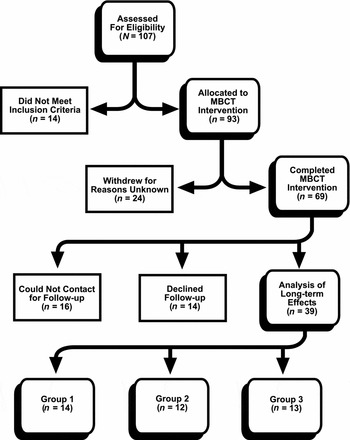
Sixty-nine eligible clients participated in 10 consecutive MBCT group programmes, between October 2005 and December 2007. Follow-up data were provided by 39 participants (56.52% participation rate – see Figure 1). Of these 39, ages were between 25 and 72 years including 30 (76.92%) females. Programmes were delivered through a public CBT clinic. Mood disorder clients were invited to participate in an MBCT course and given an individual pre-course interview to determine whether they met inclusion/exclusion criteria. Inclusion criteria for entry into the MBCT programme were that participants had to have met DSM-IV criteria for MDD, Bipolar Affective Disorder (BPAD) depressed phase, or Dysthymia. Participants also needed to have experienced three or more episodes of depression or to have had a chronic course for longer than 12 months that was related to a pattern of ruminative thought processes, determined through clinical interview. Participants were expected to attend all sessions and practise daily for 45 minutes, highlighting openness to using meditation as a way of managing depression. Exclusion criteria were that they could not be abusing substances in any way that would interfere with being able to meditate in clear consciousness. Potential participants who were currently actively suicidal were excluded unless they had access to a monitoring therapist outside of the MBCT programme.
Flowchart of recruitment throughout the trial

The study was approved by the Human Research Ethics Committee, School of Psychology, University of Adelaide, and by the Queen Elizabeth Hospital Ethics committee. Written informed consent to complete the questionnaires was obtained from participants prior to the MBCT programme commencing. Participants were informed that it was not compulsory to participate in the research in order to do the MBCT course.
Intervention
The intervention, led by trained MBCT teachers (a psychiatrist or clinical psychologist) followed the manualized MBCT programme described by Segal et al. (Reference Segal, Williams and Teasdale2002). Participants attended eight weekly sessions that were two and a half hours in length and were instructed to carry out approximately 45 minutes per day of homework, based on skills acquired in each session. At the conclusion of the course there was an individual post-course interview and the offer of four MBCT 2-hour booster class sessions per year.
Data collection
Pre- and post-course data were obtained from clinic patient files. Participants were given baseline measures at the pre-course interview and returned them at the first MBCT class. Post-course measures were given at the completion of the last class and participants returned them at the post-course interview. Cross-sectional follow-up data were collected contemporaneously from participants. This corresponded to follow-up periods between 6 months and 34 months after individuals completed the MBCT programme.
Beck Depression Inventory II (BDI-II: Beck, Steer, Ball and Ranieri, Reference Beck, Steer, Ball and Ranieri1996). The outcome measure was the BDI-II, a 21-item self-report questionnaire developed to assess the severity of depressive symptoms. Respondents are asked to indicate on Likert scales numbered 0 to 3, statements relating to biological, cognitive, and emotional symptoms. Higher scores indicate greater severity. Categorical cut-offs for the BDI-II are: 0–13: minimal depression; 14–19: mild depression; 20–28: moderate depression; and 29–63: severe depression. The BDI-II has good psychometric properties, being positively correlated with the Hamilton Depression Rating Scale (r = .71). The BDI-II also has good internal consistency (Cronbach's α = .91) (Beck et al., Reference Beck, Steer, Ball and Ranieri1996).
Rumination on Sadness Scale (RSS: Conway, Csank, Holm and Blake, Reference Conway, Csank, Holm and Blake2000). The RSS is a self-report questionnaire, consisting of 13-items. It was developed to measure various aspects of ruminative thinking, including intensity and repetitiveness of ruminative thoughts, difficulty stopping ruminative thoughts, excluding thoughts other than sad ones, attempts to analyze the cause of one's distress and the belief that it is beneficial, understanding the nature of the distress and lack of instrumental goal orientation (Conway et al., Reference Conway, Csank, Holm and Blake2000). The RSS has been shown to have good psychometric qualities. High internal reliability is reported (Cronbach's α = .91), and it has good convergent and discriminant validity (Conway et al., Reference Conway, Csank, Holm and Blake2000). In addition, when compared to the Ruminative Response Scale (Nolen-Hoeksema and Morrow, Reference Nolen-Hoeksema and Morrow1991) the RSS predicted more variance of the Beck Depression Inventory (Conway et al., Reference Conway, Csank, Holm and Blake2000).
The Mindful Attention Awareness Scale (MAAS: Brown and Ryan, Reference Brown and Ryan2003). The MAAS is a 15-item scale said to measure a core characteristic of dispositional mindfulness: open or receptive awareness of, and attention to, the present moment. Brown and Ryan (Reference Brown and Ryan2003) report good convergent and discriminant validity, and high internal consistency (Cronbach's α = .82).
For the purpose of this study we designed a 21-item follow-up, self-report questionnaire, using a combination of Likert scales and qualitative responses to record previous episodes of depression, past and present antidepressant medication use, booster session attendance, mindfulness practice, and perceptions of usefulness of MBCT. Demographic information was also collected.
Statistical analyses
Data were analyzed using SPSS version 16. Descriptive statistics and frequencies were used to describe the sample. Repeated measure analyses of variance (ANOVAs) were used to determine improvements in depression scores over three time points (pre, post, and follow-up) for each of the three follow-up groups separately (Group 1: 1–12 months, Group 2: 13–24 months, Group 3: 25–34 months). Groups were combined and univariate correlational analyses investigated associations between variables of interest. Based on these outcomes, one-way ANOVAs were used to explore whether Groups 1 and 2 (combined together) differed from Group 3 across mindfulness skills and components. Because power was limited in this small study, between-subject analyses in ANOVAs and multiple regression models were not attempted unless groups were combined, and rather than simply relying on null hypothesis significance testing, effect sizes were also calculated. Partial η2 is interpreted as .01, .06, and .14, representing small, moderate, and large effects, respectively, and for phi (φ) coefficients .10, .30, and .50 represent small, medium, and large effects, respectively (Cohen, Reference Cohen1988).
Results
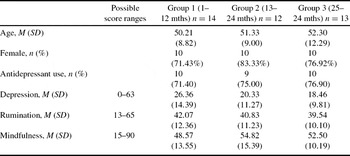
Participants were categorized into one of three groups according to how long ago they participated in an MBCT course prior to follow-up: Group 1 participants attended a MBCT course between one and 12 months previously, Group 2 participants attended a group between 13 and 24 months previously, and Group 3 participated in an MBCT course between 25 months and 34 months previously. These groupings were based on arbitrary follow-up periods often reported in the literature. Mean baseline scores for all three groups for depression, rumination, and mindfulness are presented in Table 1. Mean depression scores for the three groups prior to MBCT ranged from mild to moderate status (Beck, Rush, Shaw and Emery, Reference Beck, Rush, Shaw and Emery1979). Table 1 outlines the descriptive characteristics of each of the three groups separately.
Baseline participant characteristics for the three follow-up groups

MBCT's effects on depression over time
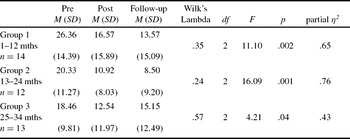
To assess the first aim of the study, repeated measure ANOVAs were used to determine whether depression decreased over time (from baseline to post course) and if any improvements were maintained at follow-up. The three separate follow-up groups were analyzed separately. Omnibus F tests are provided in Table 2. Results indicated that depression scores significantly decreased over time for all three groups showing large effects. Post hoc analyses for Group 1 showed significant improvements in depression from pre to post (p = .02), but not from post to follow-up (p = .63). These findings therefore suggest that improvements were maintained up to 12 months later, but did not significantly improve further. However, a trend was evident for improvement in mean depression score at follow-up. Overall, the group's depression status improved from moderate at baseline to almost minimal depression at follow-up.
Repeated measure ANOVA's for pre, post and follow-up BDI-II scores for all groups

Partial η2 = effect size, .01 small, .06 moderate, .14 large.
For Group 2, post hoc analyses revealed significant decreases in depression scores from pre to post (p = .01). Scores again were simply maintained from post to follow-up at 13–24 months (p = .98). However, the mean showed a trend towards further improvements in scores. Once again, this group's depression status moved from moderate to minimal over time.
Post hoc analyses for Group 3 showed once again that depression scores significantly improved from pre to post (p = .04), yet depression scores did not significantly change from post to follow-up (p = .93). These results suggest that improvements were maintained up to 34 months later; however, a declining trend in the mean depression score was evident, possibly indicating initial signs of relapse. In other words, this group's depression status started at mild and improved to minimal post-MBCT, but further inclined to a mild status again by follow-up.
Associations between depression at follow-up and variables of interest
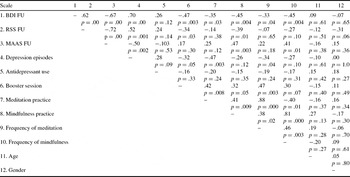
For the second aim of the study, correlations were calculated to determine which factors were associated with depression scores at follow-up (Table 3). As expected, depression at follow-up was highly related to how many self-reported depression episodes a person had had since the MBCT course and their level of rumination. Similarly, as shown in the first group of repeated measure analyses discussed above, depression at follow-up was also highly, negatively related to mindfulness at follow-up.
Correlation matrix of association between depression outcome and variables of interest

Ongoing practices, including the number of “booster” sessions attended and the practice and frequency of mindfulness and meditation, were all moderately related to depression at follow-up. In other words, those who continued the skills and practices taught in the MBCT course were more likely to better manage their depression. Reasonably, findings suggested that those with higher depression scores were still using antidepressant medication (ADM) at follow-up although associations were only small-to-moderate. Participants’ age and gender were unrelated to depression at follow-up.
Compatibility of rumination and mindfulness
To fulfill the third aim of the study, a correlation was used to investigate whether rumination and mindfulness were incompatible metacognitive processes (see Table 3). A strong, negative correlation was found, showing that the higher the level of mindfulness at follow-up, the lower the level of rumination. This result provides support for their proposed incompatibility.
Exploration of group differences
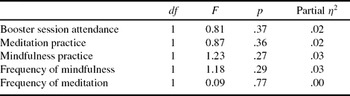
Initial repeated measures ANOVAs (Table 2) showed a pattern for Groups 1 and 2 of maintaining or further decreasing in depression scores from post to follow-up. Because a trend of increasing (worsening) depression scores was observed in Group 3, further exploratory analyses were performed. Groups 1 and 2 were combined and compared to Group 3, increasing power for between-subject analyses. One-way analyses of variance (ANOVAs) were conducted to determine if any differences between the two new groups occurred across mindfulness skills and components (Table 4). Although no statistically significant findings were produced, when effect sizes were considered, mindfulness practice and frequency of practice showed small differences between the groups. Specifically, Group 3 appeared to practise less mindfulness less often than Groups 1 and 2 combined. Group 3 also appeared to practise less meditation and attend fewer booster sessions, although differences between the groups were smaller.
Exploration of group differences between Groups 1 and 2 combined and Group 3 (n = 37)

Partial η2 = effect size, .01 small, .06 moderate, .14 large.
Discussion
MBCT's lasting effects
The current study shows that depression scores of participants with MDD improved from pre- to post-MBCT treatment and these gains were maintained, if not improved upon, for at least 2 years of follow-up. These findings are consistent with previous research indicating that MBCT is an effective treatment for relapse prevention in depression. Whereas previous studies’ follow-up periods have ranged from one month to 15 months, the current study suggests that MBCT's effects continue for at least 2 years.
Individuals who were followed up after the longest period of time (25–34 months), however, revealed a slightly different course. Following their statistically significant improvement from pre- to post-treatment, Group 3 then began to show a non-significant trend of increasing depression scores. There are several possible interpretations. Had our study been larger, a significant result may have been found due to increased power. Alternatively, had a non-significant finding still been obtained, it could still be interpreted as the start of a downward trend, indicating possible relapse. Given the natural trajectory of relapse of depression over time (Mueller et al., Reference Mueller, Leon and Keller1999), it is perhaps not surprising that as time passes, frequency of use of skills-sets may decrease, as may awareness of their importance. Conversely, as these participants had the lowest depression status at baseline, they may have been a group who, by virtue of their less severe status prior to the MBCT intervention, received less from the practice. This is consistent with Teasdale et al. (Reference Teasdale, Segal, Williams, Ridgeway, Soulsby and Lau2000) and Ma and Teasdale (Reference Ma and Teasdale2004) who demonstrated that less severe participants do not do as well with this approach.
The current study produced results with large effect sizes showing that the magnitude of change in depression scores following a structured MBCT intervention was powerful. These findings add to the few previous studies reporting effect sizes for follow-up (Baer, Reference Baer2003). Larger studies with longer follow-up are now advocated to determine whether these effects are reliable and generalizable to the population of depressive patients.
Associations between depression outcome and variables of interest
Investigation of particular treatment variables revealed a number of moderate-to-high relationships that may account for lower depression scores at follow-up. Primarily and consistent with theory (Teasdale et al., Reference Teasdale, Segal and Williams1995), level of mindful awareness was negatively related to symptom severity at follow-up. This may support the proposition that mindfulness could act as the facilitating metacognitive mechanism of change.
A number of course components encouraged within the MBCT programme such as ongoing meditation and mindfulness practice, and booster sessions, were also correlated with depression outcomes. As might be expected, frequency of practice was also predictive of better follow-up depression scores.
The relationship found between booster session attendance, ongoing mindfulness practice, and lower depression scores over time deserves further research to see if this is a robust finding. If so, MBCT programmes should routinely incorporate “booster” sessions or additional refresher courses as part of the programme, rather than as an adjunct. Although not significant, the trend indicated by Group 3 who received the MBCT intervention 2 or more years beforehand, of increasing in their depression scores at follow-up, suggest that more frequent, formal contact with MBCT trainers and skills may assist with maintaining treatment benefits. As with other types of learning, it might be that attentional control also requires repetition and reinforcement for long-term integration and adaptation.
Importantly, the current study provided some data on the degree of association between use of antidepressant medication (ADM) and depression outcome. This is an area with little previous investigation, with the two most notable MBCT studies of Teasdale et al. (Reference Teasdale, Segal, Williams, Ridgeway, Soulsby and Lau2000) and Ma and Teasdale (Reference Ma and Teasdale2004) excluding ADM use in their trials. Given that maintenance ADM is the mainstay approach for the treatment of recurrent depression (Ellis, Reference Ellis2004; National Institute for Clinical Excellence [NICE], 2004), findings suggested that those with higher depression scores were still using ADM at follow-up although associations were only small-to-moderate. The size of this relationship was interesting as about 74% of the sample classified as ADM users at follow-up. There might be several possible interpretations of this low association given the difficulties of ADM measurement. For example, the current sample may have had low rates of adherence of ADM, especially if they were the type of individuals who preferred to manage their depression with psychological interventions (van Schaik et al., Reference van Schaik, Klein, van Hout, van Marwijk, Beekman, de Haan and van Dyck2004), as shown by their inclusion in the MBCT programmes. Cooper et al. (Reference Cooper, Bebbington, King, Brugha, Meltzer, Bhugra and Jenkins2007) found that one-third of their sample did not take their medication as prescribed. NICE (2004) also make reference to the unpleasant side effects often experienced by users of ADM, another reason for low adherence. In addition, there is the possibility that our participants, after completing the MBCT course, were less likely to seek treatment from a primary health care provider for any depressive episode or symptoms.
Recently, Kuyken and colleagues (Reference Kuyken, Byford, Taylor, Watkins, Holden, White, Barrett, Byng, Evans, Mullen and Teasdale2008) published the results of an RCT comparing those with recurrent depression on ADM with those undertaking the structured MBCT programme with support to taper ADM usage. Among other findings, recurrence rates over 15 months were 47% in the MBCT group and 60% in the maintenance ADM group. Taper rates showed significant ADM reduction in the MBCT group, with 75% discontinuing ADM use completely. There were no cost differences between providing ADM maintenance and MBCT interventions, suggesting MBCT was a successful, alternative approach to the common psychopharmacological intervention. ADM usage in comparison with MBCT intervention deserves further attention, as does the effect MBCT has on medication use in the longer term.
Mechanisms of change
Our third aim was to explore mechanisms of change through MBCT. As in previous research (Nolen-Hoeksema and Morrow, Reference Nolen-Hoeksema and Morrow1993), those who ruminated were found to be more depressed. Our results showed that the more mindful a person was, the less ruminative processing they engaged in and this correlated highly with depression scores, supporting the suggestion of Teasdale et al. (Reference Teasdale, Segal, Williams, Ridgeway, Soulsby and Lau2000) that the primary ingredient for therapeutic change for those with highly ruminative depression is the metacognitive process of mindfulness. Furthermore, this suggests that MBCT is a potential treatment of choice for individuals in the actively depressed phase whose depressive symptoms are being maintained by a ruminative thinking style and who do not respond to ADM or CBT (Kenny and Williams, Reference Kenny and Williams2007).
The inverse relationship of rumination and mindfulness in our participants also supports Wells’ metacognitive self-regulatory executive function (S-REF) model, which hypothesizes that detached mindfulness requires an incompatible underlying metacognitive processing style as compared to the more perseverative thinking patterns of rumination (Wells and Matthews, Reference Wells and Matthews1996).
Exploration of group differences
The supplementary analysis yielded non-significant, small effects for some group differences in practices of meditation and mindfulness. The results may suggest mindfulness, rather than meditation, more clearly distinguished between those with decreasing trends in depression scores and those with increasing scores. Mindfulness provides a way of processing information, thoughts and feelings on an ongoing basis. For example, one can be mindful during daily activities such as doing the dishes or driving a car, whereas meditation is a more formal, longer concentration practice, done in a prescribed manner. Therefore, it might suggest that one can engage in informal mindfulness practices more frequently, which would be more powerful as a technique to reduce the dysfunctional process of rumination. Could it be that meditation may be sufficient but not the necessary condition for good outcome, whereas mindfulness is the necessary component?
Limitations
Some limitations need to be acknowledged. Most notable is the lack of a control group. Coelho et al. (Reference Coelho, Canter and Ernst2007) suggest that stringent RCTs and active comparison trials be conducted to test the effectiveness of MBCT itself, before clinical trials are conducted to assess the therapy in clinical practice. Positive findings could be a result of simply “doing something”. This is a common methodological weakness of MBCT research and future studies should compare MBCT with other specific psychological approaches (Baer, Reference Baer2003).
Findings of the present study should also be interpreted cautiously as it is unclear whether the follow-up sample were truly representative of the entire sample who received the MBCT intervention. Attrition analyses showing differences in baseline depression scores for those who did not participate and the current study's sample indicate small differences. Specifically, those who completed follow-up questionnaires appeared less depressed to begin with, compared with the non-participating group, suggesting that the more depressed participants may have refused study involvement as they were not well. However, it is noted that in the current study, which obtained a 57% response rate, there was a substantial figure of 16 (53% of those that did not participate in the follow-up) that could not be contacted to request participation, leaving only 14 participants who actually declined to participate.
Questions regarding reliability and validity of the data may be raised given that the primary outcome variable of depression (the BDI-II) was a self-report questionnaire and not a clinical interview using DSM-IV-TR. Similarly, the follow-up questionnaire asked for a subjective estimate of the number of previous episodes of depression. Thus data were potentially confounded by response or recall bias.
As the audit-type design of this study was reliant on self-report at one time point only, accurate time to event data (i.e. the time of first depressive relapse) could not be ascertained. In addition, dividing participants into three 12-month groups reduced sample sizes and subsequently statistical power, increasing the chance of Type II errors and limiting the generalizability of results.
Even though this study has extended previous follow-up periods, it is still a limitation that the follow-up time was not longer. Depression has a high rate of recurrence over a long period of time, and if MBCT is to benefit those with recurrent depression, then it is of interest to know exactly how long its effects might last. Although our results did see an increase or worsening in depression scores for those who attended the MBCT intervention two to two and half years previously, it is still clinically important to acknowledge the significant decrease in scores from baseline. It will be of interest to observe the trend over a longer period of time to clarify our findings of a possible increase in depression scores.
Finally, the sample was mostly females, thus limiting the applicability of the results to the male population. Although women are twice as likely to experience depression (Hyde, Mezulis and Abramson, Reference Hyde, Mezulis and Abramson2008), our sample demonstrated an even higher proportion than would be expected in the wider community.
Implications for future research
Despite the obvious limitations of clinical audits, they can provide preliminary explorations of associations between treatment variables and outcome variables to aid in future research design. The current study has highlighted the issue of mechanisms of change, such as level of mindfulness on proposed cognitive vulnerabilities to depression. In addition, the continued investigation of mindfulness and meditation practice, and attendance at “booster” sessions for maintenance of treatment gains, is indicated. Clearly, for these types of investigations, RCTs are the preferred choice of research design. It is also suggested that to increase small sample sizes, studies could include multi-centre sites for recruitment of participants. It is essential that studies include appropriate proportions of males and females to explore any gender differences in outcome following an MBCT intervention. Also important is to consider ethnically diverse groups. For studies investigating relapse rates, Vittengl et al. (Reference Vittengl, Clark, Dunn and Jarrett2007) suggest that researchers use “time to event” (survival) analyses to more accurately estimate relapse-recurrence rates and importantly, include sufficiently long follow-up periods that more accurately reflect the natural course of relapse in depression.
Conclusion
This clinical audit supports previous studies (Ma and Teasdale, Reference Ma and Teasdale2004; Teasdale et al., Reference Teasdale, Segal, Williams, Ridgeway, Soulsby and Lau2000) demonstrating the effectiveness of MBCT as a treatment for recurrent depression. Importantly, this study adds to the literature by suggesting that MBCT's lasting effects do continue up to at least 2 years after an MBCT intervention. However, there is an indication that over extended time, MBCT's effects may in fact start to weaken. This is an issue of particular interest for future research, given that MBCT is proposed to be a treatment for “recurrent” depression. Second, the current study found moderate relationships between MBCT treatment components and outcome variables, indicating that ongoing mindfulness skills are beneficial for relapse prevention. Finally, and as predicted by theory, a particularly strong, negative relationship was found between rumination, a cognitive vulnerability to depression, and the metacognitive approach of mindfulness.
Acknowledgements
The authors would like to thank the Centre for the Treatment of Anxiety and Depression in Thebarton, South Australia. In particular, thank you to the clients for your openness to try new psychological interventions for such chronic courses of illness.



Comments
No Comments have been published for this article.