

Introdution
Sargassum is a brown seaweed genus that is widespread in temperate, subtropical, and tropical waters of the Atlantic, Pacific, and Indian Oceans. In the Atlantic, there are more than 60 benthic species of Sargassum and two common free-floating pelagic species, Sargassum natans (Linnaeus) Gaillon 1828 and Sargassum fluitans (Børgesen) Børgesen 1914 (Guiry and Guiry, Reference Guiry and Guiry2024).
Sargassum species are highly differentiated into holdfast, cylindrical main axis, leaflike blades and gas-filled bladders (vesicles) or pneumatocysts (Graham et al., Reference Graham, James, Wilcox and Cook2022). The two free-floating (holopelagic) species, S. natans and S. fluitans, do not have a holdfast nor are attached to a substrate at any stage of their life cycle (Parr, Reference Parr1939). As no receptacles have been observed, these two species are self-sustaining by fragmentation and vegetative reproduction (Collins and Hervey, Reference Collins and Hervey1917). Both species have distinct morphotypes, with three of them dominating the holopelagic Sargassum biomass (S. natans I, S. natans VIII, and S. fluitans III) and displaying different degrees of branching and foliation (Parr, Reference Parr1939; Schell et al., Reference Schell, Goodwin and Siuda2015; Godínez-Ortega et al., Reference Godínez-Ortega, Cuatlán-Cortés, López-Bautista and van Tussenbroek2021). There is a significant difference in growth rates among the holopelagic Sargassum morphotypes, with S. fluitans III on average doubling its biomass in 13 days, S. natans I in 22 days, and S. natans VIII in 31 days, under favourable conditions (Corbin and Oxenford, Reference Corbin and Oxenford2023). Recently, Siuda et al. (Reference Siuda, Blanfuné, Dibner, Verlaque, Boudouresque, Connan, Goodwin, Stiger-Pouvreau, Viard and Rousseau2024) proposed a revision of the names of the three most common holopelagic Sargassum morphotypes, due to their distinct morphological characteristics and sympatry within drifting aggregations: Sargassum fluitans var. fluitans (for S. fluitans III), Sargassum natans var. natans (for S. natans I), and S. natans var. wingei (for S. natans VIII).
Holopelagic Sargassum gathers in extensive rafts that serve as nursery, spawning, foraging, roosting, and protective habitat for a diversity of marine organisms, including invertebrates, sea turtles, marine birds, marine mammals, and for approximately 120 species of fish, including commercially important fisheries species (Dooley, Reference Dooley1972; Wells and Rooker, Reference Wells and Rooker2004; Doyle and Franks, Reference Doyle and Franks2015; Pries et al., Reference Pries, Netburn, Batchelor and Hermanson2023). It is a unique and ecologically significant floating marine ecosystem, providing the necessary mechanism for motile epifauna and rafting animals dispersal to new locations (Haney, Reference Haney1986; Martin et al., Reference Martin, Taylor, Huston, Goodwin, Schell and Siuda2021; Graham et al., Reference Graham, James, Wilcox and Cook2022; Pérez-Pech et al., Reference Pérez-Pech, Jesús-Navarrete and Vargas-Espositos2024). Attached to Sargassum stipes, branches, and blades there is a diversity of sessile filter-feeding fauna, which are predated by fish and invertebrate motile fauna, such as crabs, shrimps, and nudibranchs (Martin et al., Reference Martin, Taylor, Huston, Goodwin, Schell and Siuda2021). Ten invertebrates and two vertebrates are endemic to holopelagic Sargassum, with specialized coloration and morphology to camouflage within the habitat (Coston-Clements et al., Reference Coston-Clements, Settle, Hoss and Cross1991).
For centuries, explorers and oceanographers have attempted to map the holopelagic Sargassum distribution in the Atlantic Ocean. They realized that there is a general pattern, called the North Atlantic subtropical gyre, a clockwise flow of the main ocean currents (the Gulf Stream to the west, the North Atlantic Current to the north, the Canary Current to the east, and the North Equatorial Current to the south), which has the Sargasso Sea at its core (Laffoley et al., Reference Laffoley, Roe, Angel, Ardron, Bates, Boyd, Brooke, Buck, Carlson, Causey, Conte, Christiansen, Cleary, Donnelly, Earle, Edwards, Gjerde, Giovannoni, Gulick, Gollock, Hallett, Halpin, Hanel, Hemphill, Johnson, Knap, Lomas, McKenna, Miller, Miller, Ming, Moffitt, Nelson, Parson, Peters, Pitt, Rouja, Roberts, Roberts, Seigel, Siuda, Steinberg, Stevenson, Sumaila, Swartz, Thorrold, Trott and Vats2011; Lomas et al., Reference Lomas, Bates, Buck and Knap2011). In 2011, a significant mass of Sargassum was discovered in the tropical Atlantic Ocean, south of the Sargasso Sea, and it has been increasing ever since, reaching mythic proportions and forming a new consolidated region known as the ‘Great Atlantic Sargassum Belt’, that extends from the Caribbean Sea and the Gulf of Mexico to tropical West Africa (Gower et al., Reference Gower, Young and King2013; Wang et al., Reference Wang, Hu, Barnes, Mitchum, Lapointe and Montoya2019; Léger-Pigout et al., Reference Léger-Pigout, Navarro, Ménard, Ruitton, Le Loc'h, Guasco, Munaron, Thibault, Changeux, Connan, Stiger-Pouvreau, Thibaut and Michotey2024). Since then, unusually large quantities of pelagic Sargassum began to wash ashore during the spring and summer months, affecting the Caribbean islands, the coasts of Florida, Mexico, Brazil and Central America and the Atlantic coastline of tropical West Africa (Smetacek and Zingone, Reference Smetacek and Zingone2013; Bloom, Reference Bloom2015; Sissini et al., Reference Sissini, Barreto, Széchy, Lucena, Oliveira, Gower, Liu, Bastos, Milstein, Gusmão, Martinelli-Filho, Alves-Lima, Colepicolo, Ameka, Graft-Johnson, Gouvea, Torrano-Silva, Nauer, Nunes, Barufi, Rorig, Riosmena-Rodríguez, Mello, Lotufo and Horta2017; Ody et al., Reference Ody, Thibaut, Berline, Changeux, André, Chevalier, Blanfuné, Blanchot, Ruitton, Stiger-Pouvreau, Grelet, Aurelle, Guéné, Bataille, Bachelier, Guillemain, Schmidt, Fauvelle, Guasco and Ménard2019; Chávez et al., Reference Chávez, Uribe-Martínez, Cuevas, Rodríguez-Martínez, van Tusenbroek, Francisco, Estévez, Celis, Monroy-Velásquez, Leal-Bautista, Álvarez-Filip, García-Sánchez, Masia and Silva2020; Yokoyama, Reference Yokoyama2022). Now holopelagic Sargassum is found well beyond the historic boundaries of the Sargasso Sea and places these regions at the heart of local and international concerns, because of the health, economic, and environmental risks it represents (Smetacek and Zingone, Reference Smetacek and Zingone2013; Chávez et al., Reference Chávez, Uribe-Martínez, Cuevas, Rodríguez-Martínez, van Tusenbroek, Francisco, Estévez, Celis, Monroy-Velásquez, Leal-Bautista, Álvarez-Filip, García-Sánchez, Masia and Silva2020; Schuhmann et al., Reference Schuhmann, Irvine, Oxenford, Degia and Valderrama2022; Hamel et al., Reference Hamel, Garcia-Guijano, Jin and Dalton2024).
There are 11 species of Sargassum recorded for the archipelago of Madeira, 10 of them benthic and one pelagic, Sargassum natans (Buch, Reference Buch1825; Grunow, Reference Grunow and Fenzl1870; Piccone, Reference Piccone1884; Bianchi et al., Reference Bianchi, Morri, Sartoni and Wirtz1998; Parente et al., Reference Parente, Gil-Rodríguez, Haroun, Neto, de Smedt, Hernández-González and Berecibar Zugasti2000; Cruz-Reyes et al., Reference Cruz-Reyes, Gil-Rodríguez, Haroun, Parente and Hernández-González2001; Neto et al., Reference Neto, Cravo and Haroun2001; Ferreira, Reference Ferreira2011; Ferreira et al., Reference Ferreira, Gonçalves Silva and Araújo2018). The main objective of this study is to document the co-occurrence of the two species of pelagic Sargassum in the Madeira archipelago. Following the survey, four species of invertebrates frequently found in this floating ecosystem were also identified.
Material and methods
Study area
The Madeira archipelago (32.00°–33.00°N; 17.50°–16.00°W) is located in the subtropical Northeast Atlantic. It is of volcanic origin and is formed by the islands of Madeira (737 km2), Porto Santo (42 km2), Desertas (13 km2) and Selvagens (~3 km2), which are 700 km off the North African coast and almost 1000 km south of mainland Portugal (Haroun et al., Reference Haroun, Cruz-Reyes, Herrera-López, Parente and Gil- Rodríguez2002; Mata et al., Reference Mata, Fonseca, Prada, Rodrigues, Martins, Ramalho, Madeira, Cachão, Silva, Matias, Dias, Araújo, Terrinha and Kullberg2013).
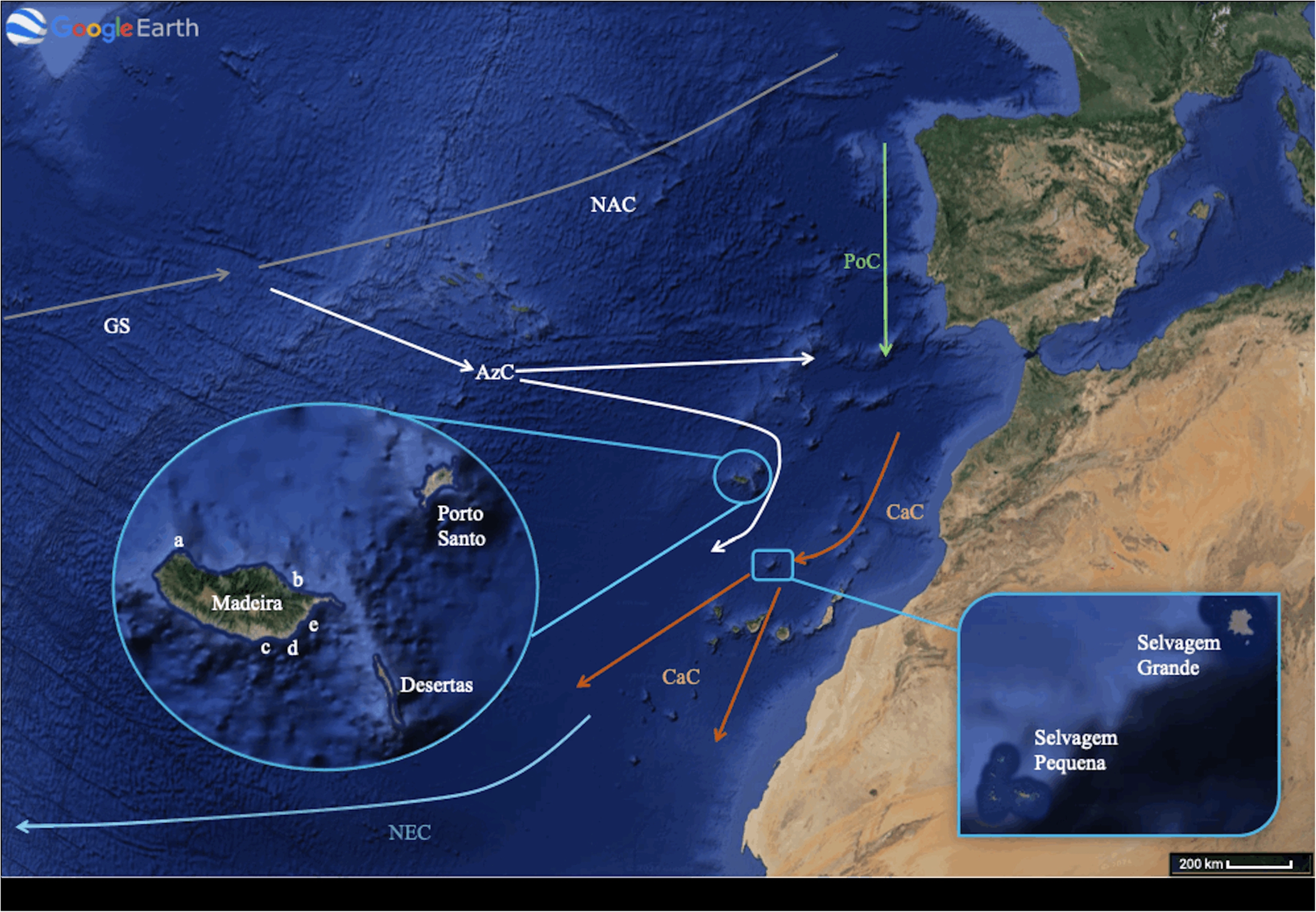
The Azores subtropical anticyclone mainly determines the weather conditions in this region, which is responsible for the predominance of northeast trade winds with an average speed of 20 km h−1 (Campuzano et al., Reference Campuzano, Nunes, Malhadas, Nunes, Jardim and Neves2009). The surface ocean currents in the Madeira Archipelago are part of the general circulation of the North Atlantic current system. The eastern part of this circulation system is formed by the Azores Current, the Portugal Current, the Canary Current and the North Equatorial Current (Figure 1).
Geographical location of the Madeira archipelago, with the Madeira Island's sampling site location (a – Porto Moniz, b – Porto da Cruz, c – Funchal, d – Reis Magos, e – Machico) and the eastern boundary currents of the North Atlantic Subtropical Gyre (AzC, Azores Current; CaC, Canary Current; PoC, Portugal Current; NEC, North Equatorial Current; GS, Gulf Stream, NAC, North Atlantic Current).
Field work
Pelagic Sargassum and some associated mobile epifauna were collected at a few different moments of opportunity. It should be noted that the observation of large masses of these pelagic algae in the Madeira archipelago is an unpredictable event, and it was not possible to plan a sampling trip in advance. The algae mats approach the coast drifting with the current and, if they do not get stranded in a bay, they continue their journey until they drift away from the islands into the open sea. For this reason, the time available for sampling is very limited and it is necessary to always have the equipment ready for when the opportunity arises.
Sargassum specimens were collected from free-floating mats off Funchal, south coast of Madeira Island (32°35′42″N 16°56′33″W, 07/07/2023), from masses washed ashore in Porto da Cruz, north coast of Madeira Island (32°46′04″N 16°49′17″W, 17/12/2023) and at Porto Santo Island (33°3′4.62″N 16°20′38.41″W, 12/11/2023) (Figure 1). At the first two sites, the Sargassum samples were collected fresh by hand, placed in airtight bags and taken to the laboratory on the same day as collection. In Porto Santo, the samples were packed in airtight bags with seawater, kept cold in the refrigerator and transported to the laboratory the following day in a cold box. Following a thorough sorting/identification of the entire sample, using Parr (Reference Parr1939) and Godínez-Ortega et al. (Reference Godínez-Ortega, Cuatlán-Cortés, López-Bautista and van Tussenbroek2021), both species of pelagic Sargassum (S. natans I, S. natans VIII, and S. fluitans III) were found at these three sampling sites. Two specimens of each morphotype were selected, per sampling site, dry in herbarium sheets and incorporated into the Natural History Museum of Funchal herbarium (MADM), with also some fragments preserved in silica gel and others in 4% Formalin.
Throughout the pelagic Sargassum sampling, it was observed that there was a large amount of associated epifauna visible to the naked eye. Although collecting epifauna was not the initial aim of the study, the authors decided to take the opportunity to collect samples of the most visible and common organisms found in the pelagic Sargassum samples. They were carefully separated from the substrate, by rinsing each sample of pelagic Sargassum with fresh water into a container and collecting the specimens that were loose from the algae. They were then identified, placed in specimen jars according to their taxonomic classification (20 individuals of each species), preserved in 70% alcohol and incorporated into the collection of the Natural History Museum of Funchal (MMF) and of the Naturalis Biodiversity Center, Leiden, Netherlands (RMNH).
Floating and stranded Sargassum mats were also observed and photographed, at Porto Moniz (north coast of Madeira), Porto Santo, Desertas, and Selvagens islands (Figure 2).
Accumulation of pelagic Sargassum in (A) Porto Moniz harbour (northwest coast of Madeira Island), (B) Porto Santo Island, (C) Deserta Grande (Desertas islands), (D) Selvagem Pequena, and (E) Selvagem Grande. Photo credits: Henrique Rodrigues, Ricardo Araújo, Isamberto Silva, and Manuel José de Jesus.

Results
Macroalgal records
Sargassum fluitans (Børgesen) Børgesen 1914
Material examined: MADM4150, MADM4152, MADM4153, MADM4155
Sargassum natans (Linnaeus) Gaillon
Material examined: MADM4149, MADM4151, MADM4154, MADM4156
Remarks: Sargassum fluitans and Sargassum natans specimens were collected entangled, free-floating, or in large mats that washed ashore in Funchal, Porto da Cruz and Porto Santo. Unlike S. natans, S. fluitans has thorny stems, which is the main determining feature that distinguishes these two pelagic Sargassum species (Parr, Reference Parr1939).
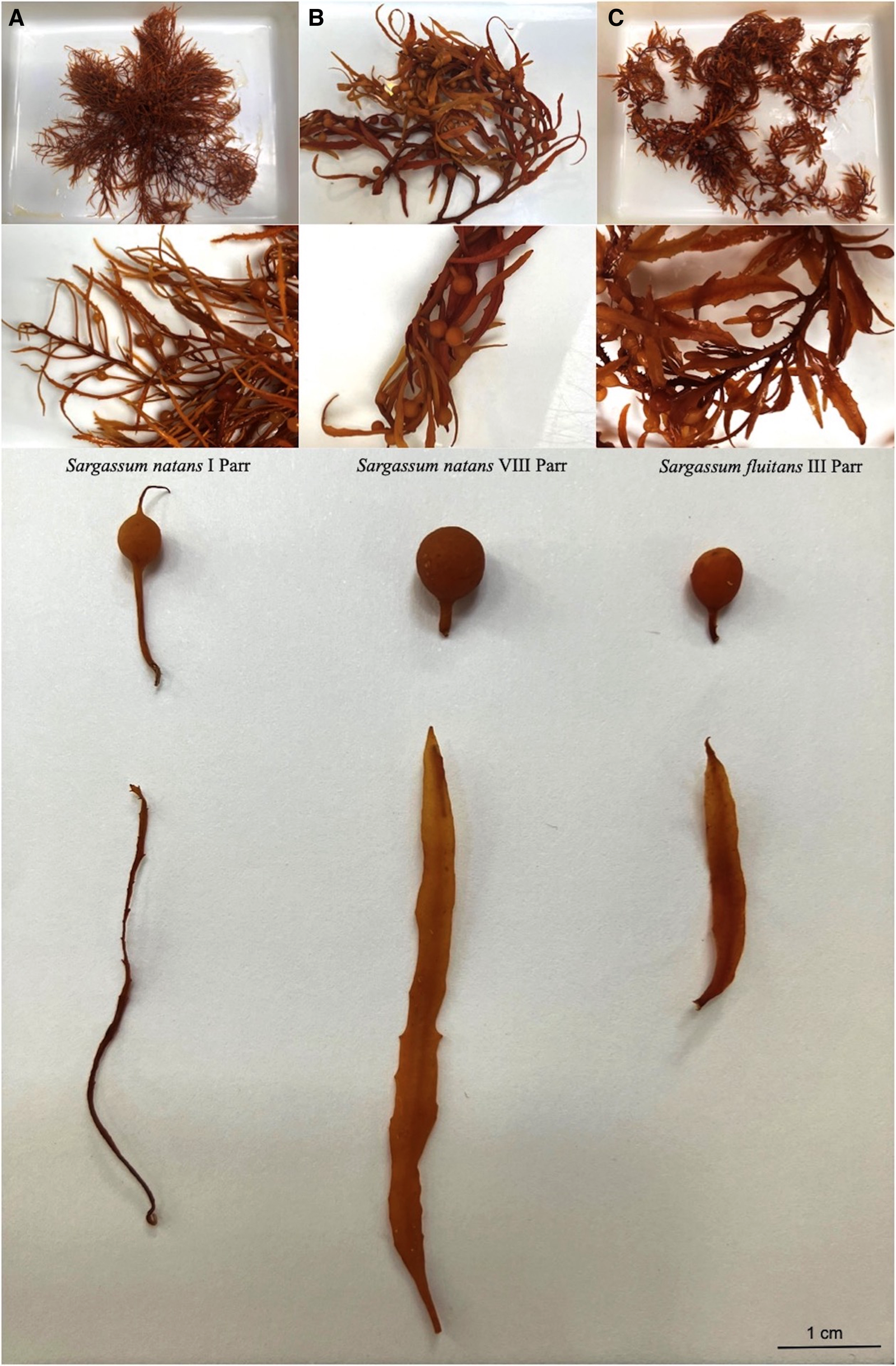
The specimens collected belong to the three morphotypes commonly found in Sargassum masses drifting in the Atlantic Ocean, Sargassum fluitans III, Sargassum natans I and VIII. S. fluitans III has small thorns along the stems, lacks apical spines on oblong bladders and has short, narrow blades; S. natans I has smooth stems (without thorns), narrow blades and apical spines on spherical bladders; S. natans VIII has thick and smooth stems (without thorns), spherical bladders rarely adorned with apical spine and has long, broad, and widely spaced blades (Parr, Reference Parr1939; Schell et al., Reference Schell, Goodwin and Siuda2015; Martin et al., Reference Martin, Taylor, Huston, Goodwin, Schell and Siuda2021) (Figure 3).
Three holopelagic Sargassum morphotypes recorded in the coastal waters of Madeira archipelago.
a. Sargassum natans I, with smooth stems, narrow blades and spherical bladders with apical spines; b. Sargassum natans VIII, with thick and smooth stems, long, broad, and widely spaced blades and spherical bladders rarely adorned with apical spine; c. Sargassum fluitans III, with small thorns along the stem, short and narrow blades and oblong bladders without apical spines.
Sargassum natans was previously recorded in Madeira (Buch, Reference Buch1825) and it is very likely that this observation might have been morphotype S. natans I. According to Parr (Reference Parr1939) in early observations of S. natans the dominant morphotype in the Sargasso Sea was S. natans I, while S. natans VIII was extremely rare (and isolated to the Caribbean) until the recent proliferation of the GASB (Schell et al., Reference Schell, Goodwin and Siuda2015; García-Sánchez et al., Reference García-Sánchez, Graham, Vera, Escalante-Mancera, Álvarez-Filip and van Tussenbroek2020). To the best of our knowledge, for S. natans VIII and for S. fluitans III this is the first record for the subtropical eastern Atlantic Ocean.
Mobile Epifaunal Records (Figure 4)
Hippolyte coerulescens (Fabricius, 1775) (Figure 4A)
Material examined: MMF50302, MMF50303, MMF50304, MMF50305, MMF50306, MMF50307, MMF 50311, RMNH.CRUS.D.59355.
(A) Hippolyte coerulescens (Fabricius, 1775), (B) Latreutes fucorum (Fabricius, 1798), (C) Scyllaea pelagica Linnaeus, 1758, and (D) Planes minutus (Linnaeus, 1758) Photo credits: Luís Berimbau.
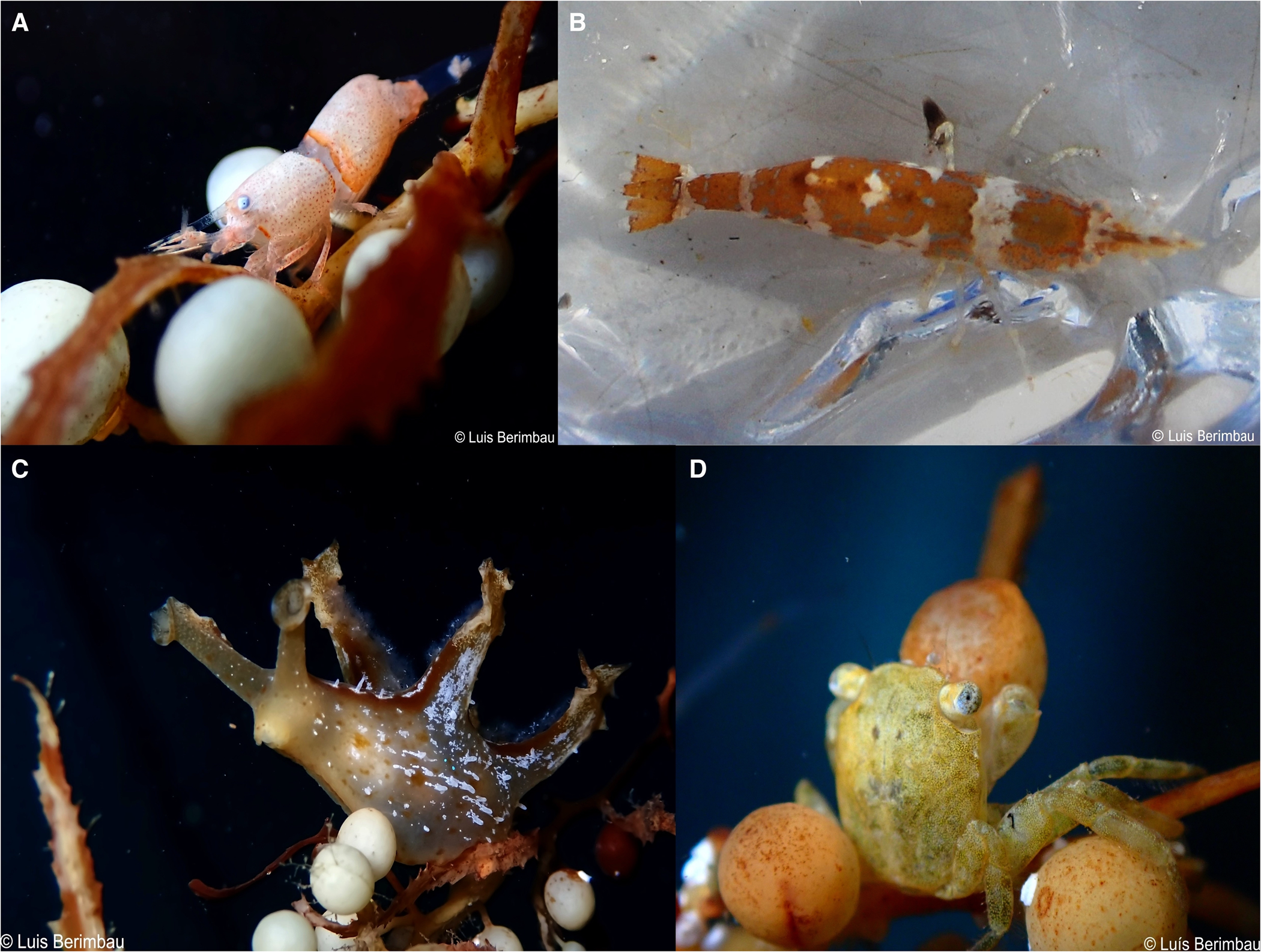
The specimens were found with Sargassum floating off Madeira Island. This amphi-Atlantic shrimp is usually associated with floating Sargassum (Coston-Clements et al., Reference Coston-Clements, Settle, Hoss and Cross1991). In the eastern Atlantic, H. coerulescens has previously been reported from the Azores (Lenz and Strunck, Reference Lenz and Strunck1914), the Canary Islands (Ortmann, Reference Ortmann and Hensen1893), and the Cape Verde Islands (Ortmann, Reference Ortmann and Hensen1893) but not yet from Madeira archipelago.
Latreutes fucorum (Fabricius, 1798) (Figure 4B)
Material examined: RMNH.CRUS.D.59354
This amphi-Atlantic shrimp species was also common on floating Sargassum off Madeira Island. It is known to live not only with pelagic Sargassum but also on benthic algae (Sivertsen and Holthuis, Reference Sivertsen and Holthuis1956; Chace, Reference Chace1972; Coston-Clements et al., Reference Coston-Clements, Settle, Hoss and Cross1991; Udekem D'Acoz, Reference Udenkem D'Acoz1999) and has been recorded from Madeira previously (Wirtz, Reference Wirtz2020).
Scyllaea pelagica Linnaeus, 1758 (Figure 4C)
Material examined: MMF50310, MMF50313, MMF50314
This amphi-Atlantic nudibranch species lives on floating algae (Pola et al., Reference Pola, Camacho-Garcia and Gosliner2012). It was common on Sargasssum floating off Madeira Island. In the eastern Atlantic, S. pelagica has been recorded south of Madeira, e.g. at the Canary Islands (Ortea et al., Reference Ortea, Moro, Bacallado and Caballer2014) but apparently not yet at Madeira Island or north of it.
Planes minutus (Linnaeus, 1758) (Figure 4D)
Material examined: MMF50312; RMNH.CRUS.D.59356
This amphi-Atlantic crab was by far the most common crustacean on Sargassum floating off Madeira and Porto Santo. It is known from Madeira archipelago, mainly associated with marine turtles and drifting debris (Manning and Holthuis, Reference Manning and Holthuis1981; Dellinger et al., Reference Dellinger, Davenport and Wirtz1997; Araújo and Wirtz, Reference Araújo and Wirtz2015). Planes minutus has already been reported for Madeira and the Azores by Lenz and Strunck (Reference Lenz and Strunck1914) and for the Canary Islands by Heller (Reference Heller1863).
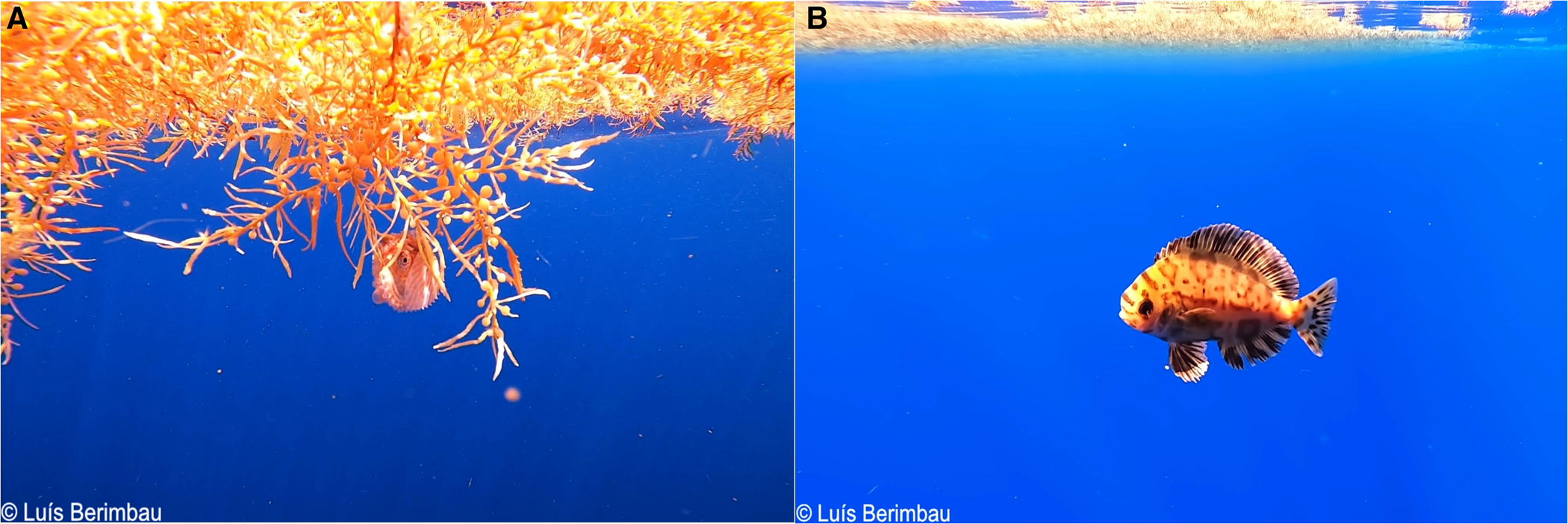
Some other species were observed associated with the pelagic Sargassum, like Argonauta argo Linnaeus, 1758 and Schedophilus ovalis (Cuvier, 1833), which were photographed but not collected (Figure 5).
(A) Argonauta argo Linnaeus, 1758 and (B) Schedophilus ovalis (Cuvier, 1833). Photo credits: Luís Berimbau.
Discussion
Since 2011, scientists worldwide are investigating the cause of the sudden increase in holopelagic Sargassum in the Atlantic Ocean, which was first noticed in the Madeira archipelago in 2023. Although the causes are not yet fully understood, there are several hypotheses that could explain this extreme event: an abnormal wind regime between 2009 and 2010 in the east-central Atlantic Ocean that led to the movement of Sargassum to the far eastern North Atlantic (Johns et al., Reference Johns, Lumpkin, Putman, Smith, Muller-Karger, Rueda-Roa, Hu, Wang, Brooks, Gramer and Werner2020), an enrichment of nutrients from the Amazon, Pará, and Orinoco rivers (Djakouré et al., Reference Djakouré, Araujo, Hounsou-Gbo, Noriega and Bourlès2017; Aquino et al., Reference Aquino, Noriega, Mascarenhas, Costa, Monteiro, Santana, Silva, Prestes, Araujo and Rollnic2022), an increase in dust from the Sahara desert (Johnson et al., Reference Johnson, Ko, Franks, Moreno and Sanchez-Rubio2012), a change in upwelling patterns off the north-east coast of Africa (Wang et al., Reference Wang, Hu, Barnes, Mitchum, Lapointe and Montoya2019) and an increase in sea temperature (Johns et al., Reference Johns, Lumpkin, Putman, Smith, Muller-Karger, Rueda-Roa, Hu, Wang, Brooks, Gramer and Werner2020). Nevertheless, investigating such a large-scale phenomenon must involve the study of physical and biological processes, like the physical transport of floating Sargassum and its growth in response to changing oceanic conditions (Berline et al., Reference Berline, Ody, Jouanno, Chevalier, André, Thibaut and Ménard2020; Corbin and Oxenford, Reference Corbin and Oxenford2023).
It is a fact that since 2011 there is a concomitant increase in holopelagic Sargassum beach landing events in the Caribbean Sea, the Caribbean coasts of Central America and Mexico, and on the Atlantic coastline of tropical West Africa (Gower et al., Reference Gower, Young and King2013; Franks et al., Reference Franks, Johnson and Ko2016; Wang et al., Reference Wang, Hu, Barnes, Mitchum, Lapointe and Montoya2019). The large growth in biomass increases the chance that some of this Sargassum might enter the Gulf Stream and then drifts along the subtropical gyre to the waters of the Madeira archipelago, crossing the Atlantic Ocean. It must be emphasized that this is not an unprecedented event, whenever meteo-oceanographic conditions are favourable, small amounts of holopelagic Sargassum can occasionally be found in the area of Madeira (Menezes, Reference Menezes1926; Levring, Reference Levring1974). What is unusual is the quantity that has been recorded since the end of 2023, in which large ‘rafts’ of Sargassum have washed up on the coast of the islands of Madeira, Desertas, Porto Santo, and Selvagens. There are also reports of large masses of holopelagic Sargassum washing up on the coasts of the Azores islands, having increased in volume since January 2024, following storms from the western Atlantic Ocean (Gabriel et al., Reference Gabriel, Maridakis and Fredericq2024; J. Faria, personal communication to SJF).
Although we have not yet observed any negative impact on the coastal ecosystems of the Madeira archipelago, we do have access to the record of what has happened in the affected areas since 2011, were many environmental, health, and economic impacts have already been reported, such as the decrease in biodiversity, with the death of marine organisms as a result of the destruction of their habitats (McLawrence et al., Reference McLawrence, Sealy and Roberts2017; van Tussenbroek et al., Reference Van Tussenbroek, Arana, Rodríguez-Martínez, Espinoza-Avalos, Canizales-Flores, González-Godoy, Barba-Santos, Vega-Zepeda and Collado-Vides2017; UNEP-CEP, 2021; López-González et al., Reference López-González, Lucho-Constantino and López-Pérez2023). Therefore, the recent influx of drifting holopelagic Sargassum approaching the coast of the Madeira archipelago needs a thorough monitoring effort, and, if necessary, some of the measures adopted in the coastal areas affected by this phenomenon should be implemented.
This could be a one-off situation, with a few occasional fragments of holopelagic Sargassum from the East Atlantic reaching the Madeira archipelago, or we could be facing a new reality. Whether it will become something common in the future, possibly seasonal, reflecting the changes taking place in the ocean, we will only know in the next few years. In the meantime, we should be vigilant and take the opportunity to study this phenomenon more thoroughly, tracking the frequency and intensity of these events and assessing any potential negative impacts on local biodiversity, possibly alongside researchers on the other eastern Atlantic islands that have been ‘visited’ by these floating algae.
Data
The data that support this study are in the Natural History Museum of Funchal (MMF) and in the Naturalis Biodiversity Center, Leiden (RMNH) collections and can be made available under request.
Acknowledgements
Special thanks to Ysabel Gonçalves and Pedro Sepúlveda for collecting some specimens of Sargassum and delivering them to the Natural History Museum of Funchal. To Henrique Rodrigues, Isamberto Silva, and Manuel José de Jesus for allowing us to use photographs of their authorship. To Daniela Gabriel and João Faria for giving us feedback about the Sargassum occurrence in the Azores.
Author Contributions
Study conception and design: SJF, LB, PW; data collection: PW, MK, RA; analysis and interpretation of results: SJF, PW, MK, RA, LB; wrote first draft: SJF; revision and edits to manuscript: PW, SJF, MK, RA; final approval of submitted manuscript: all authors.
Financial Support
This research received no specific grant from any funding agency, commercial, or not-for-profit sectors.
Conflict of Interest
The authors declare none.



