In an article published in this journal in 1996, I surveyed number stylization in monetary amounts recorded in Roman-era literature up to the Severan period.Footnote 1 I argued that certain leading digits such as 1, 3 and 4 were heavily over-represented in the evidence.Footnote 2 For the limited samples I used at the time these findings are not in need of revision. However, as I show here, a more inclusive approach to the material produces a substantially different picture. The most significant shortcoming of my study was my failure to take account of the probable distribution of leading digits in a random sample, which may serve as a benchmark for assessing the nature and extent of number preference. While I noted that lower leading digits were inherently more likely to occur than higher ones, I schematically related observed frequencies to an even distribution of leading digits (in which each of them is expected to make up one-ninth of the total). This benchmarking strategy is invalidated by a widely observed phenomenon known as Benford's Law, according to which leading digits frequently conform to a predictable pattern that greatly favours lower over higher numbers.Footnote 3 This is true in particular if observations are spread across several orders of magnitude. Ancient monetary valuations satisfy this condition since recorded amounts range from single digits to hundreds of millions. Yet, to the best of my knowledge, Benford's Law has never been applied to the study of these data.Footnote 4
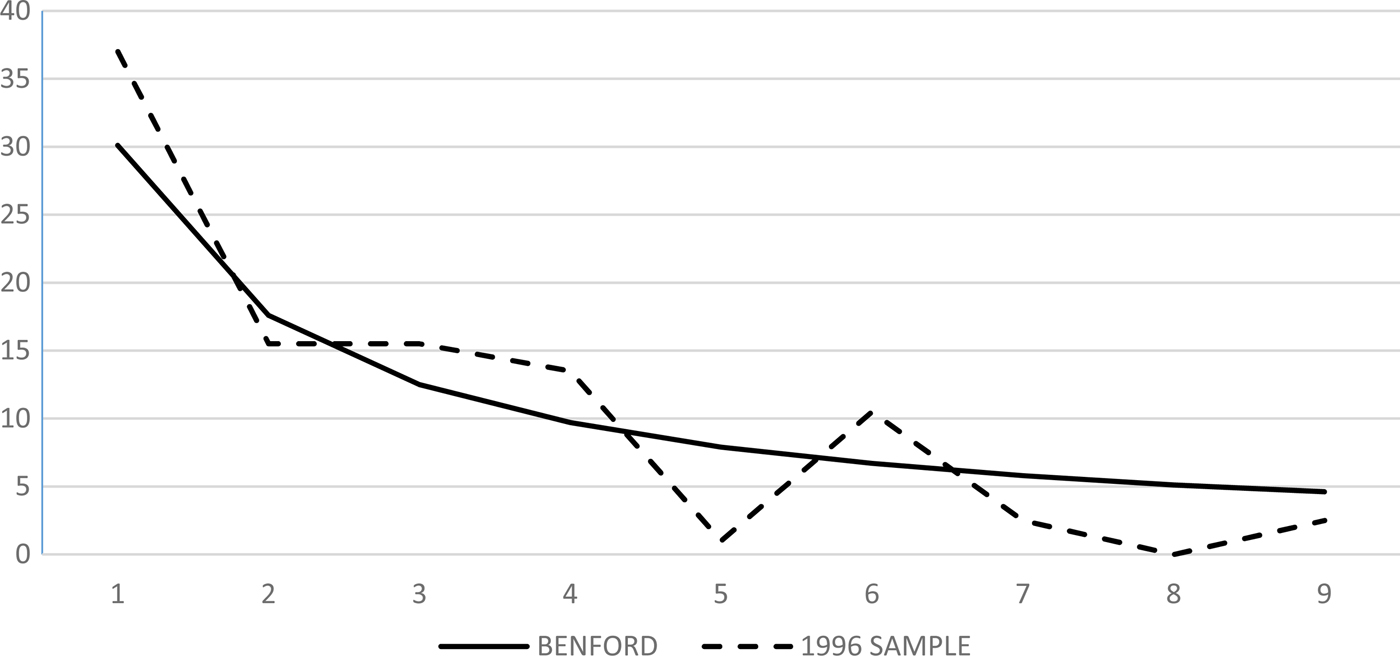
As a first example, I compare my 1996 sample of sixty-five references to Roman private fortunes and public finances to the expected probability distribution (Fig. 1).Footnote 5 While some discrimination in favour of 3, 4 and 6 appears to be visible here, it is not nearly as pronounced as I implied at the time. Moreover, this particular dataset may well be inadequate because it spans only three orders of magnitude (from 1 million to 900 million) and especially because of its relatively small size.
Distribution of leading digits for private wealth and public finances relative to Benford distribution

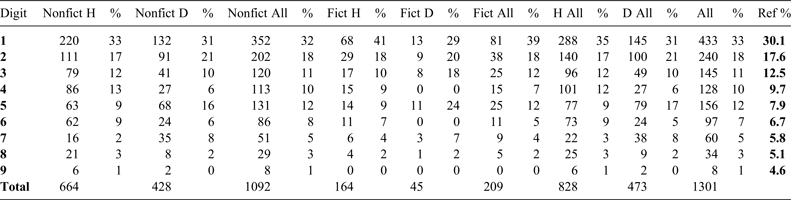
In order to address these two problems, I have gathered 1,865 references to amounts of money that are preserved in Greek and Latin literary texts and relate to Roman history from the beginning until c.a.d. 235.Footnote 6 These passages mention a wide variety of denominations: sesterces and denarii/drachmas are by far the most common, but occur alongside asses, talents or pounds of precious metal. For Benford's Law to serve as a plausible frame of reference, the numbers in a given series ought to represent equivalent units. In the following I therefore limit my investigation to a subset of 1,301 valuations, 828 of them expressed in sesterces and 473 in denarii or drachmas. In order to test for characteristics that might be specific to genre, I distinguish between poets and novelists (primarily Apuleius, Juvenal, Lucian, Martial, Ovid and Petronius, with a smattering of others), whose work is labelled ‘fiction’, and prose authors who primarily produced history, oratory, letters and technical literature, or (cum grano salis) ‘non-fiction’. Table 1 offers a breakdown of these data.
Data breakdown and reference values
(Nonfict[ion] and Fict[ion] in H[S] [i.e. sesterces] and D[enarii/rachmas]; Ref[erence] = Benford probability distribution)

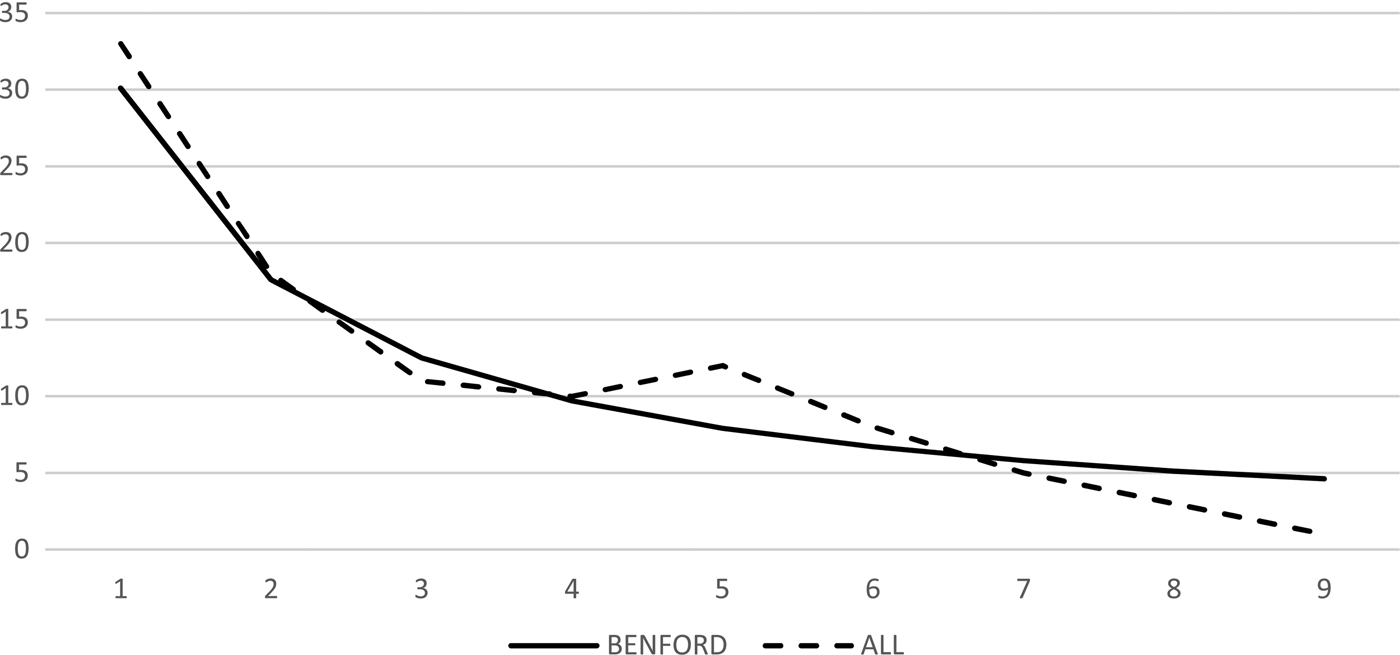
Comparison of all 1,301 observations with a Benford probability distribution reveals that the ancient data roughly follow the predicted pattern (Fig. 2), albeit with some deviations.
Distribution of leading digits for 1,301 monetary valuations relative to Benford distribution

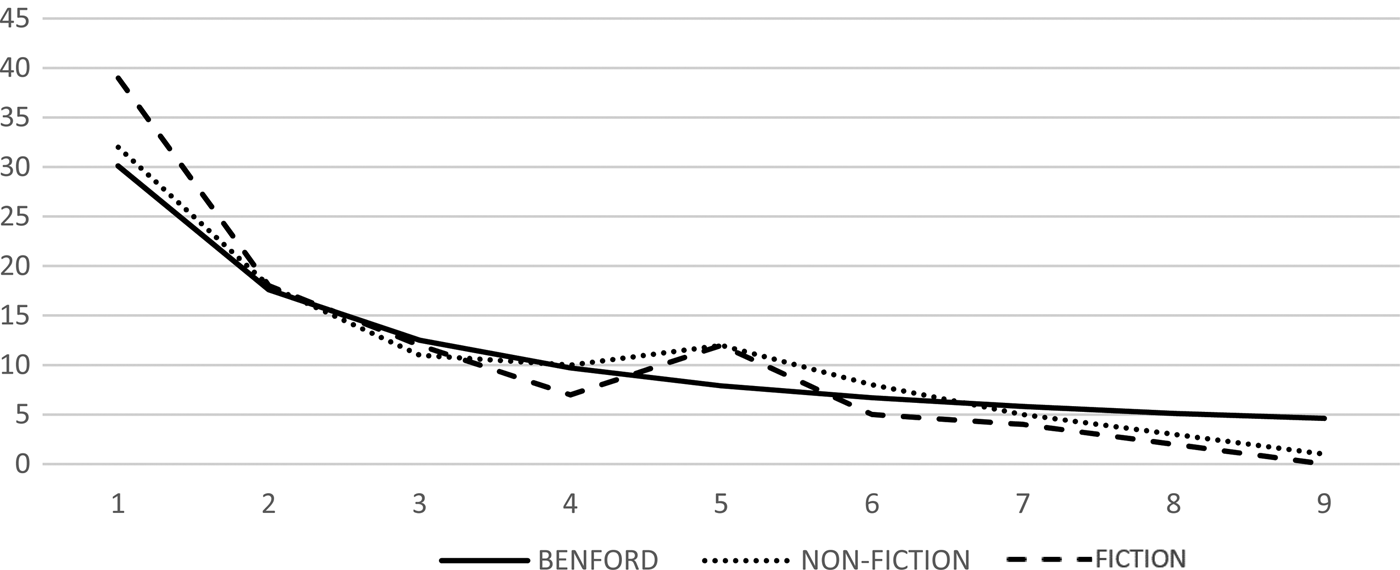
Fig. 3 shows the lack of any systematic difference between the patterns for fiction and the patterns for non-fiction, a non-trivial finding that contrasts with an earlier attempt to establish a hierarchy of numerical reliability among different types of texts.Footnote 7 While heaping on 1 is more pronounced in poetry and novels, both samples share the same characteristics, such as preference for 5 and discrimination against higher digits.
Distribution of leading digits according to genre relative to Benford distribution

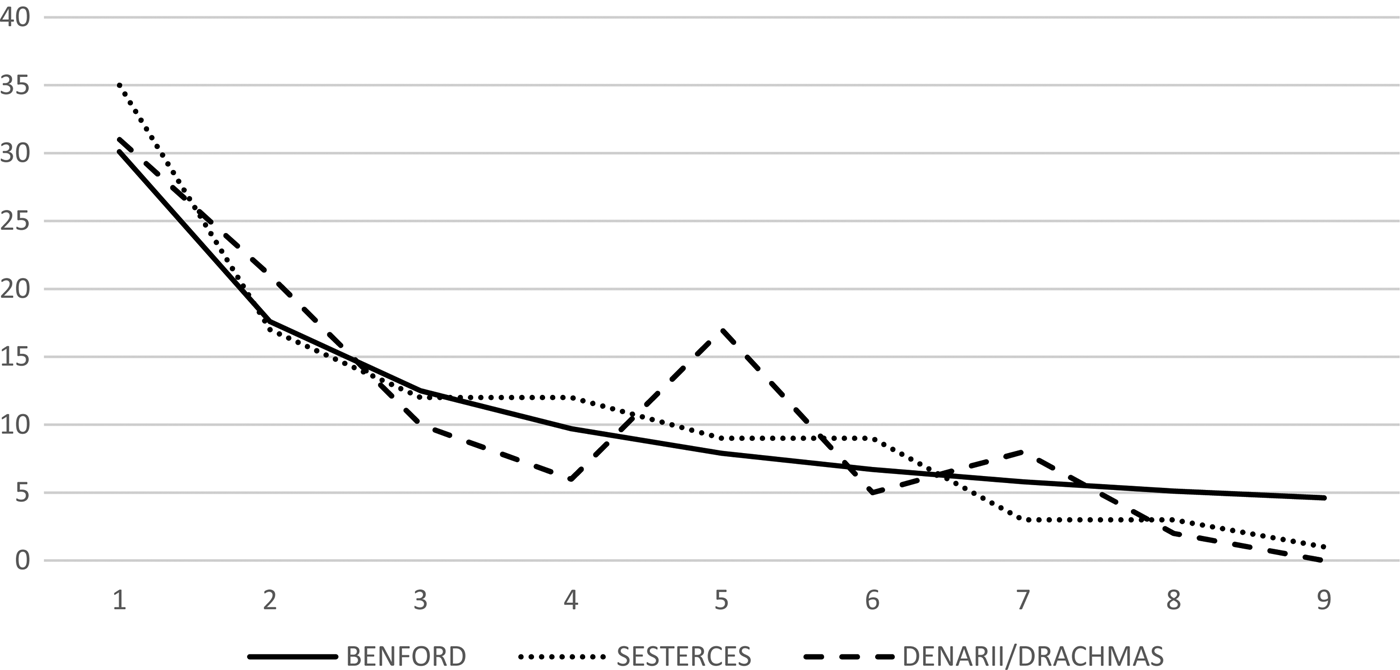
While it may be significant that the dataset for fiction is somewhat more idiosyncratic overall, in the aggregate, different genres exhibit the same biases, albeit to different degrees. At the same time, stylization practices vary according to monetary denomination (Fig. 4). The distribution of amounts expressed in sesterces conforms to the predicted pattern with remarkable precision. Moderate deviations arise from some measure of heaping on 1 as well as on 4 and 6—a pattern already established in my 1996 study—and more conspicuous neglect of higher digits. By contrast, valuations in denarii or drachmas diverge more significantly by favouring 5 at the expense of 3 and especially 4.
Distribution of leading digits according to denomination relative to Benford distribution

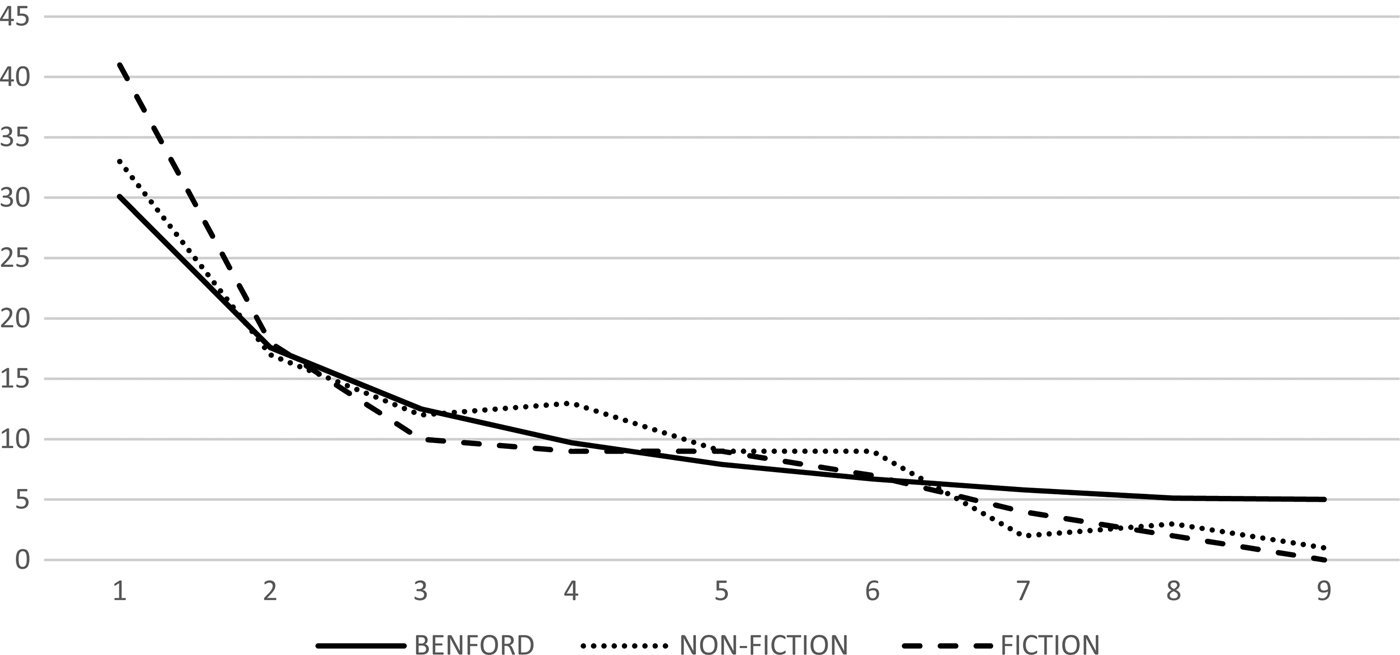
Sesterces-denominated valuations generally behave in the same way regardless of whether they are reported in works of fiction or in works of non-fiction: poetry and novels merely indulge more freely in heaping on 1 (Fig. 5).
Distribution of leading digits for sesterces relative to Benford distribution

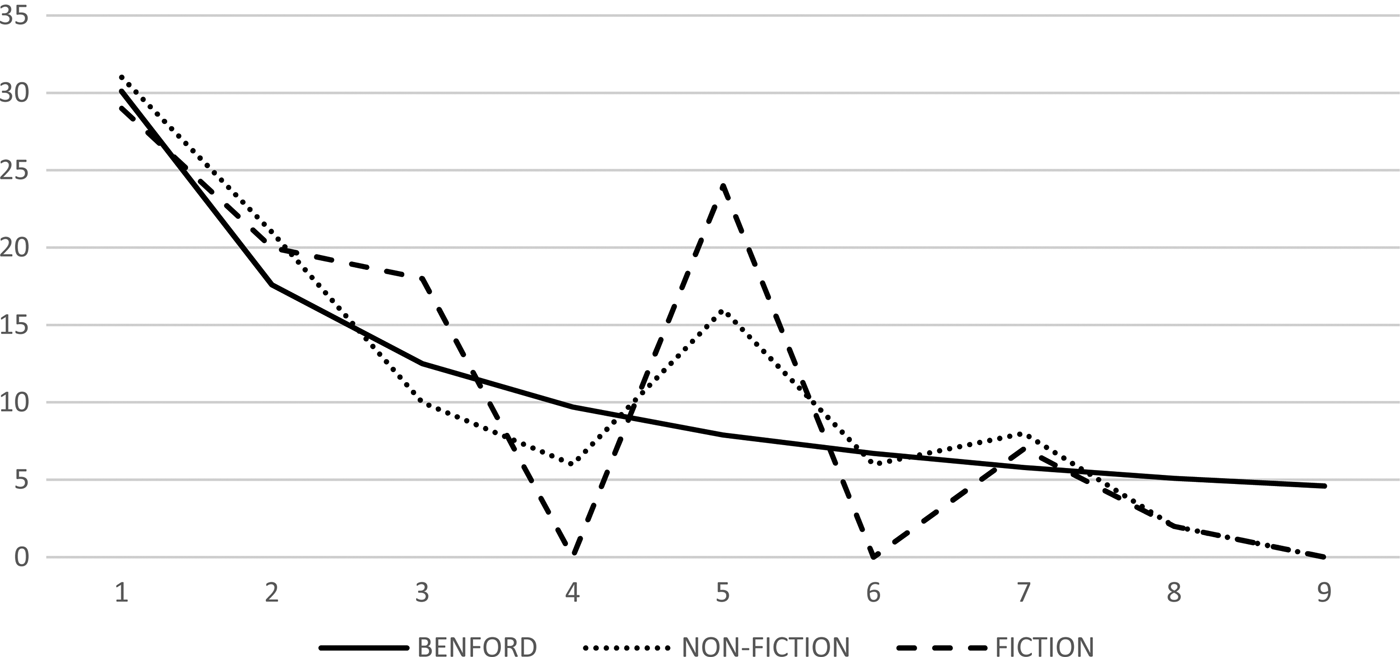
For denarii and drachmas, the leading digit 5 is strongly privileged across genres, but much more dramatically in fiction where 4 and 6 are completely eliminated in favour of that number (Fig. 6).
Distribution of leading digits for denarii/drachmas relative to Benford distribution

This points to the presence of a generalized preference that was merely given freer rein in works of fiction, but raises the question why different modes of stylization should be associated with different currency denominations. Whereas heaping on 1 and neglect of high digits are pervasive features of the literary record, a concentration on 5 can only be observed for denarii and drachmas. The provenance of the relevant passages strongly suggests that this particular feature is primarily a function of language. 77 percent of all 1,301 references are derived from Latin texts, compared to only 38 percent of those that feature the leading digit 5 for denarii or (mostly) drachmas. This specific preference is therefore best interpreted as an idiosyncratic characteristic of Greek literary language and culture.Footnote 8 It stands in striking contrast to the virtual absence of any preference for 5 in valuations expressed in sesterces, which originate almost exclusively from Latin texts.
Application of Benford's Law should caution us against exaggerating the severity of numerical distortion in ancient literature, at least as far as monetary values are concerned. The overall shape of the leading digit distribution in Fig. 2 is closely correlated with the expected probability distribution (r2 = 0.952). Moreover, the first digit mean of 3.06 for all 1,301 observations is not far below the expected (Benford) mean of 3.44. The former is depressed by heaping on 1 and concurrent neglect of higher digits. Taken together, these two propensities, which pervade the record, hint at a tendency to round numerals to the next highest power of 10, a practice that is not obviously associated with substantial distortion of scale. The only considerable divergence appears in Greek texts referencing amounts in drachmas. This has a modest impact on the dataset overall, but calls for particular circumspection in using these passages. In that case no simple adjustment seems feasible: we can only speculate how closely such figures approximated actual values. Systematic statistical analysis of number stylization is essential both for appraisals of the evidentiary value of numerical references and for our understanding of literary norms and cultural preferences.Footnote 9 I hope that this brief update will help inspire more comprehensive engagement with the very large bodies of relevant evidence that still await even the most cursory examination.