Nighttime fear, including fear of monsters and the dark, is a common experience for many children and adolescents, with prevalence rates of 64.2% and 73.3% being reported respectively (Gordon, King, Gullone, Muris, & Ollendick, Reference Gordon, King, Gullone, Muris and Ollendick2007a; Muris, Mercklebach, Ollendick, King, & Bogie, Reference Muris, Mercklebach, Ollendick, King and Bogie2001). For most children, nighttime fear is mild and transient (Bauer, Reference Bauer1976; Ferrari, Reference Ferrari1986). However, approximately 10% of children experience severe and persistent nighttime fear that disrupts sleep (Kushnir & Sadeh, Reference Kushnir and Sadeh2011) and impacts upon overall adjustment and quality of family life, thus requiring further clinical assessment and intervention (Muris et al., Reference Muris, Mercklebach, Ollendick, King and Bogie2001). In such cases, a diagnosis of specific phobia (American Psychiatric Association [APA], 2000) should be considered (Muris & Merckelbach, Reference Muris and Merckelbach2000). Given the severity of the problem and the non-trivial number of children and families who are affected, research that advances effective treatment for nighttime fear is warranted.
Children's phobias are characterised by multiple processes primarily affecting three domains of functioning — physiological, cognitive, and behavioural (King, Heyne, & Ollendick, Reference King, Heyne and Ollendick2005). Recent evidence supports a connection between children's fears and neurobehavioural functioning, including decreased working memory and increased somatic complaints (Kushnir & Sadeh, Reference Kushnir and Sadeh2010). The behavioural expressions of nighttime fear are numerous and include co-sleeping (Cortesi, Giannotti, Sebastiani, Vagnoni, & Marioni, Reference Cortesi, Giannotti, Sebastiani, Vagnoni and Marioni2008), frequent nightwakings, calling out to parents, and wandering unattended in the home at night (see Gordon, King, Gullone, Muris, & Ollendick, Reference Gordon, King, Gullone, Muris and Ollendick2007b). Tiredness and moodiness during the day can impair the child's academic outcomes and the quality of relationships. Social development may also be affected because the child commonly avoids sleeping away from home (e.g., school camps, friend's houses). Worry about having the fear may also decrease the child's self-esteem (Silverman & Treffers, Reference Silverman and Treffers2001). Moreover, parents are often unaware of their child's distress due to internalisation of the fears. In a sample of 500 Australian children aged 8 to 16 years, Gordon et al. (Reference Gordon, King, Gullone, Muris and Ollendick2007b) reported that one third had never disclosed their nighttime fears to another person.
Cognitive behavioural therapy (CBT) in the form of treatment packages is commonly used for children's fears and anxieties. CBT for nighttime fear has demonstrated effectiveness, with maintenance of gains at 2½- to 3-year follow-up being reported (Graziano & Mooney, Reference Graziano and Mooney1980; Reference Graziano and Mooney1982). CBT packages for nighttime fear have typically included various interventions, such as graded exposure or emotive imagery, cognitive self-instruction, relaxation, and reinforcement (see King, Ollendick, & Tonge, Reference King, Ollendick and Tonge1997, for a review). However, the selection of techniques for inclusion in treatment packages has not been based on any consistent rationale. Given that children's phobias impact three levels of functioning, techniques that intervene on each of these three levels is recommended (Gordon et al., Reference Gordon, King, Gullone, Muris and Ollendick2007b).
Graded exposure is a frequently used phobia reduction technique that intervenes in the behavioural domain by encouraging approach behaviours to a feared object or situation (King et al., Reference King, Heyne and Ollendick2005). For children, in vivo exposure is generally preferred (King, Cranstoun, & Josephs, Reference King, Cranstoun and Josephs1989). Giebenhain and O’Dell (Reference Giebenhain and O’Dell1984) successfully used graded exposure, via a rheostat illumination dimmer, to reduce children's phobia of the dark. Muscle relaxation is commonly used in conjunction with graded exposure to reduce the often overwhelming physiological symptoms of anxiety (e.g., beating heart, rapid breathing). Muscle relaxation can be delivered via a written script designed especially for children (Kendall, Reference Kendall1992). Such scripts encourage daily practice that can prepare children to implement muscle relaxation independently when they experience anxiety in bed and/or at night.
Cognitive restructuring — the process of replacing maladaptive, unhelpful thoughts with functional ones — is commonly used in treatments for children's fears and anxieties (Chorpita, Reference Chorpita2007). Previous studies of nighttime fear have used cognitive restructuring in the form of generalised ‘bravery statements’ such as ‘I am brave’ and ‘I can take care of myself in the dark’ (e.g., Graziano & Mooney, Reference Graziano and Mooney1980; Kanfer, Karoly, & Newman, Reference Kanfer, Karoly and Newman1975). Bravery statements were originally hypothesised to be effective for all children. However, research advances suggest that cognitive restructuring based on the unique language and thought processes of individual children (e.g., ‘Grandma will be proud of me if I am brave’) may have greater therapeutic potency (King et al., Reference King, Heyne and Ollendick2005).
The importance of parental operant factors, including excessive reassurance and overprotectiveness, are increasingly recognised in the etiology and maintenance of children's fears and anxieties (Rapee, Wignall, Hudson, & Schniering, Reference Rapee, Wignall, Hudson and Schniering2000). A few nighttime fear studies have included reinforcement of helpful parental behaviour (e.g., praise and encouragement; see Friedman & Ollendick, Reference Friedman and Ollendick1989; McMenamy & Katz, Reference McMenamy and Katz1989) but children have remained the main focus. Given recent advances, a stronger focus on parental behaviour would likely improve the effectiveness of treatment for nighttime fear.
Treatment manuals have been developed for a number of types of children's anxiety (Chorpita, Reference Chorpita2007). However, only one treatment manual for nighttime fear has been developed (Giebenhain & O’Dell, Reference Giebenhain and O’Dell1984) and a manual incorporating research advances is necessary.
Group treatment for nighttime fear has a good deal of support (Gordon et al., Reference Gordon, King, Gullone, Muris and Ollendick2007b). Although group treatment has advantages, particularly cost-effectiveness, mutual support for group members, and the ability to deliver treatment to larger numbers of clients (Manassis et al., Reference Manassis, Mendlowitz, Scapillato, Avery, Fiksenbaum, Freire and Owens2002), there are also situations where individual treatment may be preferable; for example, in rural and remote areas, when only one child is presenting for treatment, or when a child cannot attend a group because of comorbid social anxiety. Moreover, individual treatment is more likely in routine clinical practice, and it is therefore surprising that treatment protocols for individuals have not been developed.
Commonly, parents have attempted many strategies without success before presenting for therapy (Rapee et al., Reference Rapee, Wignall, Hudson and Schniering2000; Sadeh, Reference Sadeh2005). In addition, graded exposure can be difficult to implement, even for trained professionals (Carillo, Amoros, & Alacazar, Reference Carillo, Amoros and Alacazar2005). Therefore, although delivery by parents is more cost effective, the severity of the problem may necessitate therapist involvement to ensure successful treatment.
Evaluating the effectiveness of treatment requires appropriate methodology. With this in mind, Friedman and Ollendick (Reference Friedman and Ollendick1989) employed a multiple baseline across subjects design to address the methodological issue of the lack of experimental control in previous studies of nighttime fear. They evaluated a CBT treatment package based on that developed by Graziano, Mooney, Huber, and Ignasiak (Reference Graziano, Mooney, Huber and Ignasiak1979) in six children aged 7 to 9 years with severe nighttime fear. All children responded favourably to treatment. However, Friedman and Ollendick found that children on extended baselines demonstrated improvement prior to the introduction of treatment. They concluded that expectancy (i.e., anticipation of which behaviours to change) created through the inclusion of treatment criteria on home monitoring forms was responsible. Accordingly, they suggested a wait-list condition as a control for expectancy for future studies. However, one alternative could be to use neutral (non-directive) wording on home-monitoring forms to mask treatment criteria.
Although there have been recent contributions (e.g., Carillo et al., Reference Carillo, Amoros and Alacazar2005; Gordon et al., Reference Gordon, King, Gullone, Muris and Ollendick2007a, Reference Gordon, King, Gullone, Muris and Ollendick2007b; Muris et al., Reference Muris, Mercklebach, Ollendick, King and Bogie2001) that represent considerable advancement in the understanding of nighttime fear, little research regarding clinical interventions has occurred since the early 1990s. The primary aim of the present study was to evaluate the effectiveness of a manualised CBT treatment package for severe nighttime fear. A secondary aim was to evaluate the utility of neutral wording on home monitoring materials as a means to control for expectancy for children on baseline. The study replicates the work of Friedman and Ollendick (Reference Friedman and Ollendick1989) by including a multiple baseline across subjects design, home-monitoring forms, and empirically validated measures; and extends their work by including a multimodal assessment, multiple outcome measures, and a diagnostic indicator. It was predicted that all children would show a reduction in phobic symptoms and improvements in nighttime fear, general fearfulness, sleep behaviour, and general behaviour following treatment. It was also predicted that children on baseline would show no improvement prior to treatment.
Method
Participants
Participants were four families, comprising three boys and their mothers, and one girl and her grandmother (hereafter, the mothers and grandmother will be referred to as ‘mothers’). Children ranged in age from 6 years, 9 months to 10 years 3 months at the beginning of treatment. The average age was 8 years, 9 months.
Materials
Semi-structured interview: Child report
A semi-structured interview (adapted from Ollendick & Hersen, Reference Ollendick and Hersen1993) comprising 10 age-appropriate questions was used to elicit children's perceptions about the onset, duration, intensity, and content of his or her nighttime fears. Mother–child interactions were observed while the interview was conducted. Children's responses were used to develop individual treatment plans and corroborate home-monitoring data. A semi-structured interview ensured acceptable reliability and some freedom to explore children's fears (Silverman & Treffers, Reference Silverman and Treffers2001).
Parent Nighttime Fear Questionnaire (PFQ; adapted from Muris et al., Reference Muris, Mercklebach, Ollendick, King and Bogie2001): Parent report
The PNFQ is a semi-structured interview comprising 24 questions. This instrument was used to elicit mothers’ perceptions about the onset, duration, intensity, nature and coping strategies regarding their child's nighttime fears. Mothers’ responses were used to corroborate child interview and home-monitoring data.
Diagnostic indicator: Parent report
A diagnostic indicator was specifically designed for the study. It comprised a 12-item dichotomous-response checklist based on the DSM-IV-TR (APA, 2000) criteria for specific phobia.
Fear Survey Schedule for Children-II (FSSC-II; Gullone, King, Tonge, & Heyne, Reference Gullone, King, Tonge and Heyne2000): Child-report
The FSSC-II was used to measure children's overall fearfulness. The FSSC-II comprises 78 items that assess the nature and extent of children and adolescent's fear of everyday items and events such as criticism, the dark, and intruders, according to three categories (not scared, scared, very scared). Responses are grouped according to an underlying five-factor structure: Factor I, ‘Fear of Death and Danger’, and Factor II, ‘Fear of the Unknown’, are related to nighttime fear (Gullone et al., Reference Gullone, King, Tonge and Heyne2000). The FSSC-II is an adaptation of the Revised Fear Survey Schedule for Children (FSSC-R; Ollendick, Reference Ollendick1983) that has been normed for Australian populations. It possesses high internal consistency, with a corrected item-total correlation of .96 being reported; and high reliability, with 1-week test/re-test correlations of .90 for Intensity (sum of all ratings) and .82 for Prevalence (total number of items endorsed with the highest score: very scared) being reported (Gullone & King, Reference Gullone and King1992).
Fear Thermometer (Herson & Bellack, Reference Herson and Bellack2002): Child and parent report
The Fear Thermometer was used to measure (a) children's level of nighttime fear and (b) mother's perceptions of their child's level of nighttime fear. The Fear Thermometer comprises a 10-point Likert scale where 0 indicates little or no fear, and 10 indicates severe fear. Children were asked to provide a rating in response to the question: ‘Imagine it's bed time right now. How scared do you feel?’ Similarly, mothers were asked to rate their children's level of fear in response to the question: ‘Imagine your child's bedtime. How scared do you think he or she feels?’ The Fear Thermometer is an easily administered and reliable instrument that is attractive to children (Herson & Bellack, Reference Herson and Bellack2002).
Child Behaviour Checklist (CBCL; Achenbach & Rescorla, Reference Achenbach and Rescorla2001): Parent report
The CBCL was used in this study to measure children's adjustment and overall behaviour. Children's school, recreational, and social functioning are evaluated by three Competence scales. Scores on these scales are typically stable over months or years. Children's emotional and behavioural functioning is evaluated through 10 Syndrome scales developed to tap DSM diagnostic categories. These scales represent fluid aspects of children's functioning that may change over days, weeks, or months. The CBCL possesses sound psychometric properties: A range of test-retest values of .95 to 1.00, and a range of internal consistency values of .78 to .97 are reported. The CBCL also possesses acceptable criterion validity (Achenbach & Rescorla, Reference Achenbach and Rescorla2001).
Home-monitoring: Child and parent report
On a nightly basis, mothers completed Parent Home-Monitoring forms based on Graziano and Mooney (Reference Graziano and Mooney1980) and Graziano et al. (Reference Graziano, Mooney, Huber and Ignasiak1979), and children completed Sleep Diaries, consistent with Ollendick et al. (Reference Ollendick, Hagopian and Huntzinger1991). Children's nighttime behaviour and parental management strategies were recorded. ‘Nighttime behaviour’ was defined as any behaviour occurring between (a) the time parents instructed children it was bedtime and (b) the time children were up in the morning (this included dressing independently). The aim of treatment was to increase ‘independent nighttime behaviours’, which were defined as: (1) going to bed within 15 minutes of being told; (2) going to bed without a fuss (arguing, crying, stalling); (3) sleeping comfortably in own bed all night, without waking or getting up, except to go to the toilet; (4) not calling out after lights out; and (5) sleeping with all sources of light and sound turned off. These criteria were based on Graziano and Mooney (Reference Graziano and Mooney1980), Graziano et al. (Reference Graziano, Mooney, Huber and Ignasiak1979), and Friedman and Ollendick (Reference Friedman and Ollendick1989). Following findings from Friedman and Ollendick (Reference Friedman and Ollendick1989), alternate versions of home-monitoring materials were developed. Baseline materials masked the treatment criteria by using neutral wording (e.g., ‘Was there a light left on last night, yes or no?’) whereas treatment materials explicitly stated the treatment criteria (e.g., ‘I slept with the light off last night’).
Parent Satisfaction Questionnaire
A Parent Satisfaction Questionnaire, comprising 10 questions with responses on a 5-point Likert scale (strongly disagree to strongly agree) and three open-ended questions, was designed to elicit perceptions of treatment effectiveness, design of materials, level of support, and overall satisfaction. Responses were used to gauge the credibility and utility of the program.
Procedures
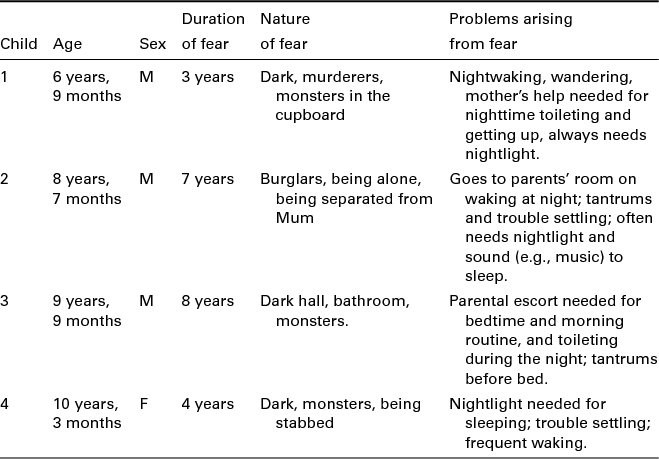
University ethical approval was granted. Participation in the study was voluntary. Recruitment was conducted via newsletter advertisement at three state primary schools located within 5 km of Monash University, Clayton, Australia. A total of four interested mothers participated in a telephone screening interview. Inclusion criteria were based on those used by Graziano and Mooney (Reference Graziano and Mooney1980): (a) child's inability to sleep in his or her own bed for the entire night; (b) wandering or calling out during the night; (c) disruptive or avoidance behaviour associated with bedtime routines; and/or (d) inability to sleep with all sources of light and sound turned off. Severe nighttime fear was identified by two or more of the above being present for at least 6 months, in conjunction with at least one of the following: (a) fear was concerning for mother and/or child, and/or (b) fear was interfering with children's overall adjustment, and/or (c) fear was disruptive to family life. Additional inclusion criteria were that children had no known physical causes for sleep disturbance or comorbid psychological disorders, and were not taking psychotropic medication or undergoing other psychological treatment while participating in the study. Written informed consent was given by mothers on behalf of their children. Demographic information about the children is presented in Table 1.
Demographic Information About Children

Families were assigned to two treatment groups (Group 1 and Group 2) with two families in each group. A multiple baseline across subjects design enabled experimental control of external factors (e.g., the release of the latest Harry Potter movie) and non-specific treatment effects (i.e., expectancy). The inclusion of three or more baselines represents a robust design (Kazdin, Reference Kazdin1982). All four families participated individually in five weekly treatment sessions. Telephone and email support was available for the duration of the study. Average session length was 75 minutes. Mothers were seen alone for approximately 20 minutes of each session. All families completed a 1-month follow-up.
A modular treatment manual, comprising a 20-page Parent Manual and a 23-page Children's Workbook, was designed. The manual was based on clinical studies of nighttime fear (Friedman & Ollendick, Reference Friedman and Ollendick1989; Graziano and Mooney, Reference Graziano and Mooney1980; Graziano et al., Reference Graziano, Mooney, Huber and Ignasiak1979) and evidence-based CBT manuals for children's anxiety (Chorpita, Reference Chorpita2007; Rapee et al., Reference Rapee, Wignall, Hudson and Schniering2000; Lyneham, Abbott, Wignall, & Rapee, Reference Lyneham, Abbott, Wignall and Rapee2003a, Reference Lyneham, Abbott, Wignall and Rapee2003b, Reference Lyneham, Abbott, Wignall and Rapee2003c).
Session 1 comprised welcome, assessment, and orientation. All measures were administered and families received the first treatment module and baseline home-monitoring materials. Training in home monitoring was undertaken and questions were answered. Families were thanked for their attendance and reminded about the availability of telephone or email support.
In Session 2, in order to implement the multiple baseline design, Group 1 received the treatment and Group 2 continued baseline home-monitoring for a further week. Session 2 for Group 2 thus comprised a placebo session in which parents and children received an alternate weekly module. Further questions about the program were answered and home-monitoring procedures reviewed. Minimal information about treatment criteria was revealed to participants. Session 2 for Group 1 comprised the administration of treatment in three stages: (1) individual ‘bravery statements’ based on Kanfer, Karoly, and Newman (Reference Kanfer, Karoly and Newman1975) were developed (e.g., ‘I am brave in the bathroom’); (2) a muscle relaxation exercise was taught; and (3) a material reward was negotiated between child, mother and therapist. Children selected a trip to Luna Park, a new Playstation, the Lego Complete Aqua Raiders Collection, and four new video games. Consistent with Graziano and Mooney (Reference Graziano and Mooney1980) and Graziano et al. (Reference Graziano, Mooney, Huber and Ignasiak1979), children could earn 1 point for each of the five ‘independent nighttime behaviours’ displayed per night. A total of 50 points, or 10 ‘independent nights’ (nights in which 5 points were scored) in a row were required to earn their reward. Families received the second treatment module, mothers received a set of home-monitoring forms, and children received a sleep diary. Mothers received psychoeducation about the importance of social reinforcement of children's approach behaviours and were reminded about the safety and efficacy of the program. Mothers were inducted as ‘fear-fighting coaches’, and all parties signed a contract of commitment.
Sessions 3 and 4: In Session 3, Group 2 received the treatment in the same manner as Group 1 in the previous week. The staggered starting times meant that Group 2 had fewer nights in treatment than Group 1 (21 vs. 14 respectively). Thus, points required for Group 2 children to earn their reward were proportionately reduced to 35, or seven independent nights in a row. For Group 1, Sessions 3 and 4 included a progress review and practice. Individual graded exposure hierarchies were developed. Families received the third and fourth treatment modules, and home monitoring materials were checked. Children were praised for their bravery and commitment. Because of the shorter time in treatment, the same content was condensed into Session 4 for Group 2. Thus, Group 1 received two 10- to 15-minute in vivo exposures (Sessions 3 and 4), whereas Group 2 children received only one (Session 4).
Session 5: For both groups, Session 5 comprised evaluation, psychoeducation about coping with setbacks and maintaining gains, and post-treatment assessment. The Child Interview and the PNFQ were modified slightly to elicit post-treatment information. Completed home-monitoring materials were collected, and revision of graded exposure was undertaken.
Follow-up comprised assessment, evaluation, and future planning. All measures were readministered. In addition, mothers completed the Parent Satisfaction Questionnaire, and children were presented with a certificate.
Results
Numerical data (i.e., ratings and test scores) were analysed using descriptive and inferential statistics (Gravetter & Wallnau, Reference Gravetter and Wallnau2004). Behavioural data (from monitoring materials) was analysed using visual inspection of multiple baseline graphs (Kazdin, Reference Kazdin2001).
Diagnostic Indicator
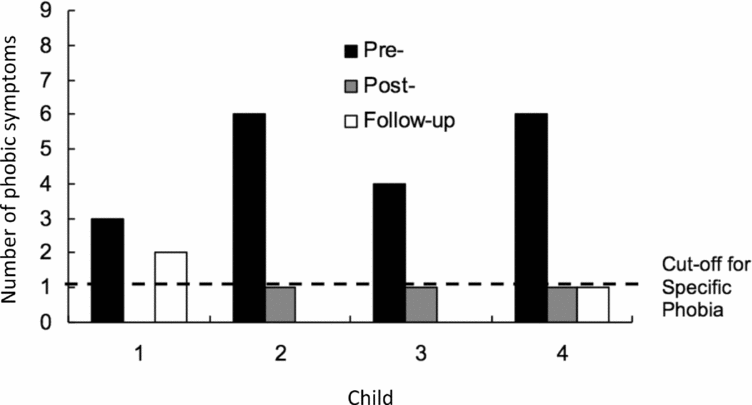
Figure 1 shows the number of phobic symptoms displayed by children pre- and post-treatment and at follow-up, as rated by mothers. The presence of two or more symptoms is consistent with a DSM-IV-TR diagnosis of specific phobia. As predicted, all children displayed a reduced number of phobic symptoms following treatment. This was maintained at 1-month follow-up, with three children no longer exhibiting diagnostic status.
Number of phobic symptoms as rated by mothers.
Note: Bars exceeding the line are consistent with a DSM-IV-TR diagnosis of Specific Phobia. If no bars are shown, no symptoms were present.
Overall Fear
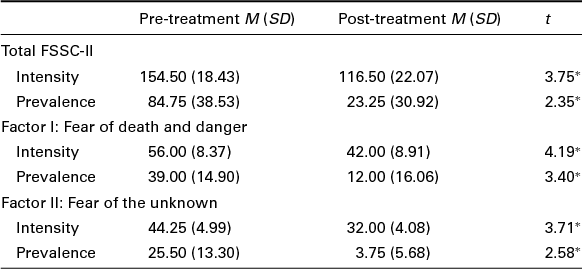
Pre- and post-treatment and follow-up Intensity and Prevalence scores for the Total FSSC and each of the five factors were compared using a series of repeated measures t tests. Significant results only are shown in Table 2.
Pre- and Post-Treatment Fear Intensity and Prevalence Scores
Note: *Significant pre- to post-treatment decreases (p < .05).
As predicted, significant reductions were observed for Total Intensity (i.e., children endorsed significantly lower levels of fear averaged over all items) and Prevalence (i.e., children endorsed significantly fewer items with the highest possible score: very scared) following treatment. A further significant reduction in Total Intensity was observed when post-treatment and follow-up scores were compared, t(3) = 3.40, p < .05. This result implies that improvement continued after the treatment concluded.
Significant reductions were also observed in Factor Intensity and Factor Prevalence scores for Factor I, ‘Fear of Death and Danger’, and Factor II, ‘Fear of the Unknown’. These results are consistent with a reduction in nighttime fear.
Nighttime Fear
Comparison of children's Fear Thermometer ratings pre-treatment (M = 6.50, SD = 4.36) and post-treatment (M = 1.50, SD = 2.12) revealed a significant reduction, t(3) = 2.71, p < .05, as predicted. These results indicate a reduction in children's subjective experience of nighttime fear. Comparison of mother's Fear Thermometer ratings pre-treatment (M = 5.63, SD = 3.09) and post-treatment (M = 2.25, SD = 1.71) also revealed a significant reduction, t(3) = 2.78, p < .05. This indicates concordance between mothers’ and children's ratings. No significant differences were observed when post-treatment and follow-up ratings for children (M = 0.25, SD = 0.29) or mothers (M = 2.43, SD = 1.59) were compared, thus indicating maintenance of gains.
Overall Behaviour
Children's CBCL Competence Scale scores were the same in all three assessments (T = 59, 47, 79, 42 respectively) indicating that all children were normally adjusted. Pretreatment T scores for Child 3 and Child 4 fell in the clinical range: Child 3's highest scores were on Scale IV: Social Problems and Scale VIII: Aggressive Behaviour. Child 4's highest scores were on Scale I: Anxious/Depressed and Scale V: Thought Problems. These scales may be related to nighttime fear.
As predicted, there was a significant reduction when pre-treatment T scores (M = 59.00, SD = 7.39) and post-treatment T scores (M = 53.75, SD = 10.72) were compared, t(3) = 2.67, p < .05). No significant differences were found when post-treatment and follow-up T scores (M = 50.75, SD = 11.18) were compared, indicating maintenance of gains. Child 3's T scores reduced to ‘borderline clinical’ at post-treatment (T = 62) and ‘normal’ at follow-up (T = 39), consistent with a loss of diagnostic status for this child. Child 4's T scores are noteworthy in that they remained within the clinical range throughout.
Home-Monitoring
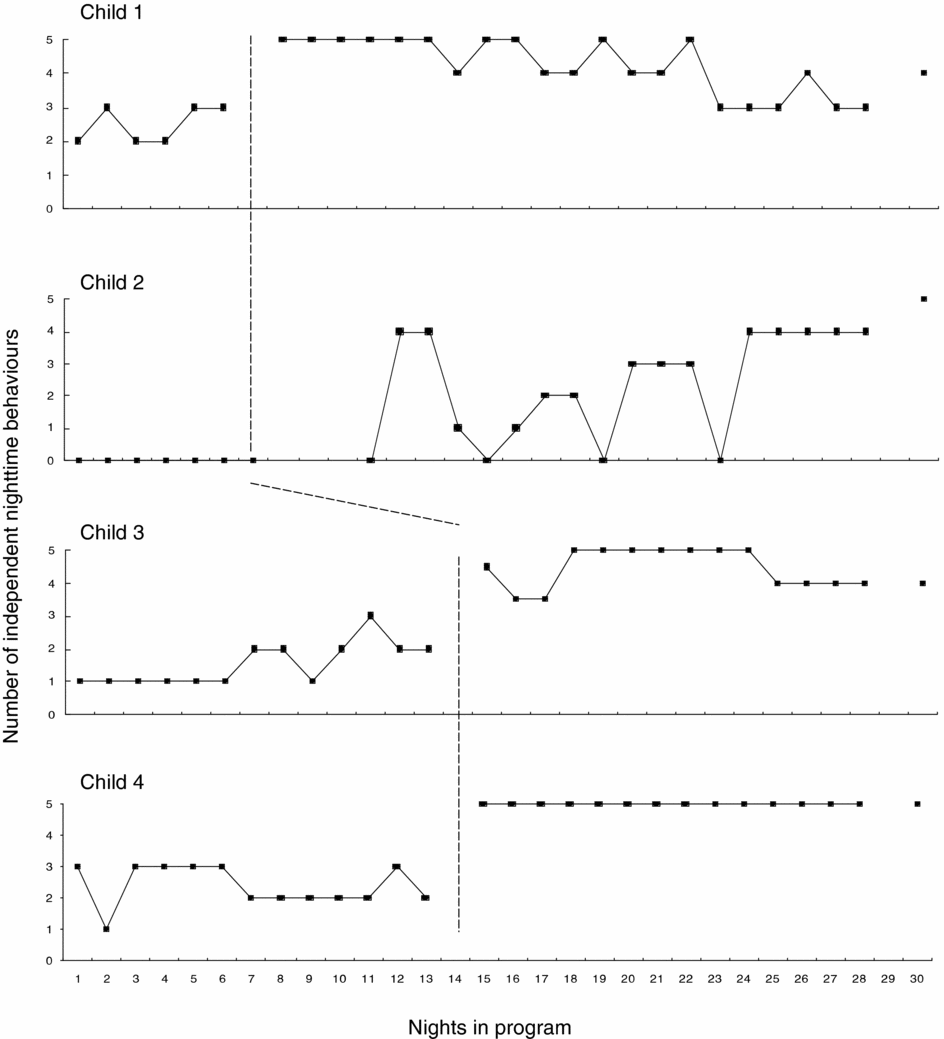
Figure 2 shows the multiple baseline analysis of children's Independent Nighttime Behaviour scores for each of the 28 nights in the program. Follow-up scores are the single points above day 30. The missing data for Child 2 (days 8–10) represent a lapse in treatment adherence caused by the father's unexpected trip to hospital. Visual inspection of the graphs reveals a clear improvement in children's nighttime behaviour following treatment, as predicted. Follow-up scores indicate maintenance of gains for three of the four children.
Independent nighttime behaviours for each night in the program and follow-up (day 30), as measured by mothers and children.
Inspection of extended baselines revealed only a slight increase in independent nighttime behaviour for Child 3 and no increase for Child 4, indicating that neutral wording on home monitoring materials may be adequate to control for expectancy.
Discussion
In the present study, the effectiveness of parent-assisted delivery of a CBT treatment manual for severe nighttime fear in four children aged 6 to 10 years was evaluated. The effectiveness of neutral wording on baseline home-monitoring materials to address the methodological issue of expectancy was also evaluated. As predicted, all children showed changes consistent with reduced nighttime fear following treatment. These changes were maintained at 1-month follow-up. Four relatively stable baselines permit a reasonable degree of confidence in the effectiveness of the treatment. The present results are thus consistent with previous studies that demonstrate the effectiveness of CBT for nighttime fear in a few sessions (e.g., Friedman & Ollendick, Reference Friedman and Ollendick1989; King et al., Reference King, Cranstoun and Josephs1989; McMenamy & Katz, Reference McMenamy and Katz1989). Tentative support was also provided for the proposition that neutral wording on home-monitoring materials may be sufficient to control for expectancy in children on extended baseline.
The present study differed from most previous studies in that multiple outcome measures were used. Of particular interest was the inclusion of a diagnostic indicator, parent-report ratings, and a measure of overall behaviour. In addition, the FSSC-II was used instead of the FSSC-R because the sample comprised Australian children. A brief discussion of the utility of each of these measures in the assessment of nighttime fear follows. The diagnostic indicator, based on DSM criteria for specific phobia, was quick to administer, simple, and user friendly. The results on this measure were consistent with the results on other measures indicating reduced nighttime fear following treatment. For these two reasons, such a checklist is recommended as a useful inclusion in the assessment of nighttime fear.
The parent-report ratings indicated a degree of concordance between mothers’ and children's estimates of severity of fear. In addition, mothers tended to underestimate the initial severity of their child's anxiety and the magnitude of improvement following treatment. Mothers’ reflections (e.g., ‘I didn't realise he was that scared’) support this. Parents’ underestimation of children's distress is consistent with the more general literature on children's anxiety. Clinically, it is important that parents become more aware of their children's distress because accurate parental perception increases treatment effectiveness (Silverman & Treffers, Reference Silverman and Treffers2001). For this reason, parent-report measures are an important component in the assessment of nighttime fear.
The results from the FSSC-II in the present study compare favourably with large-scale normative fear studies based on the FSSC-II (e.g., Gullone & King, Reference Gullone and King1993). Thus, the present findings support the use of the FSSC-II as an acceptable substitute for the FSSC-R for Australian children.
Finally, improved overall behaviour was associated with reduced nighttime fear. These findings are consistent with the literature about the impact of nighttime fear (e.g., Gordon & King, Reference Gordon and King2002; Kushnir & Sadeh, Reference Kushnir and Sadeh2010). A measure of overall behaviour provides information about the broader impact of nighttime fear, and is thus a valuable addition to a comprehensive assessment of nighttime fear.
Clinically, a number of important aspects of treatment for nighttime fear are provided through detailed examination of the graphs for each child. Child 1 showed marked improvement in the first week of treatment (days 8–14) but returned to near baseline levels during the next 2 weeks (days 15–28). About this, his mother commented: ‘It is important to keep encouraging him, rather than thinking that 2 weeks of effort is enough’. This need for consistency in creating lasting behaviour change is also highlighted in the literature (Kazdin, Reference Kazdin2001) and has wider application to the treatment of children's anxiety (Chorpita, Reference Chorpita2007).
There were significant obstacles to treatment for Child 2. One was that the child's nighttime fear was deeply entrenched. Most nights he would go to sleep in his own room. Then he would wake, become afraid, and go his parents’ room where there was a mattress permanently set up for him, and sometimes he would insist on sleeping in his parents’ bed. Although the child's behaviour was disturbing his parents’ sleep and impinging on their relationship, removal of the mattress presented a particular challenge for this mother. Another obstacle was parental illness during the treatment period that disrupted treatment adherence. Despite these obstacles, by follow-up, the mattress had been removed and the child was able to sleep comfortably in his own bed all night.
The need for therapist involvement in cases of severe nighttime fear is highlighted by this case. Extensive therapist intervention was required to support the mother through the process of removing the mattress and encouraging the child to sleep in his own bed. Consistent with the literature regarding the treatment of anxiety (e.g., Rapee et al., Reference Rapee, Wignall, Hudson and Schniering2000), the child protested with crying and great reluctance for the first few nights. This behaviour was difficult for the mother to tolerate because she believed she was causing her child greater distress by ‘forcing’ him to behave differently, and sometimes she gave in to him. However, with therapist encouragement, the mother was able to overcome her reservations and persist. The child's protests lessened and he became used to the new expectation that he should be brave and sleep in his own bed all night.
Disruption and parental illness are a normal part of family life. Thus, this case highlights that successful treatment for severe nighttime fear can be possible despite the unpredictable nature of family life. In addition, the case demonstrates one of the important principles of behaviour change: less-than-perfect, but nevertheless consistent, adherence over time can be sufficient (Kazdin, Reference Kazdin2001).
The graph for Child 3 shows a relatively stable baseline, with a slight improvement in nighttime fear in the second week of home-monitoring. This increase was likely due to the presence of non-fearful role models: in the second week of monitoring, the child was at a family holiday where his same-age cousins were encouraging him to be more independent at night (e.g., going to the toilet without his parents in the dark). This finding is consistent with the literature indicating that exposure to credible, non-fearful role models (in this case, the child's cousins) can reduce fear (e.g., Bandura, Reference Bandura1977; Silverman & Treffers, Reference Silverman and Treffers2001).
The graph for Child 4 revealed clear improvements in nighttime behaviour. However, her scores on other measures reflected clinical levels of fear and anxiety that persisted despite treatment. Moreover, the child reported ‘still feeling terrified at night’. Clearly, the present treatment was only partially effective for this child; although change did not occur in the physiological level, it did occur on the behavioural level. King et al. (Reference King, Cranstoun and Josephs1989) suggest that a greater focus on classical conditioning techniques, rather than operant factors, may be required when anxiety levels are high. Speculatively, adjusting the focus of treatment for this child according to King et al.'s recommendations may have been more effective.
In sum, from the preceding discussion the following points regarding successful treatment for night-time fears are highlighted: (a) consistency over time is more important than perfect treatment adherence; (b) parental persistence despite children's initial protests is essential; (c) non-fearful, credible role models can encourage approach behaviour; (d) therapist support is necessary in cases of severe nighttime fear; (e) disruptions in family life do not necessarily preclude effective treatment; and (f) a greater focus on classical conditioning procedures may be required if anxiety levels are high. This final point underscores findings that nighttime fear impacts on multiple domains of children's functioning, and highlights the importance of individual tailoring of treatment for each child.
One final point regarding parental operant factors in the treatment of nighttime fear was raised by the present sample. More specifically, all three boys were either youngest or only children and all three mothers reported reluctance to encourage independence in their sons. One mother said, ‘I wanted to hold onto my youngest child, because I won't be a mother any more when he grows up’, indicating that mothers may recognise their own role in maintaining their children's anxiety.
Speculatively, it may be that nighttime fear in boys is more strongly determined by mother–son relational patterns. In support of this point, Carillo et al. (Reference Carillo, Amoros and Alacazar2005) indicated that treatment for nighttime fear was more effective for boys when parents were involved. The potential importance of birth order is also raised, particularly that youngest or only children may be more prone to anxiety; an idea that has some support in the literature (Gates, Lineberger, Crockett, & Hubbard, Reference Gates, Lineberger, Crockett and Hubbard1988). Given these considerations, the present findings provide further support for the premise that family CBT may be more effective for children's anxiety (e.g., Wood, Piacentini, Southam-Gerow, Chu, & Sigman, Reference Wood, Piacentini, Southam-Gerow, Chu and Sigman2006)
Despite the challenges, mothers endorsed the highest possible level of satisfaction with the program and would recommend it to other families. They all reported a dislike of home-monitoring, but also that weekly treatment modules were helpful for revision, and for increasing their confidence.
Although the present findings provide a good deal of support for the effectiveness of the treatment package, some limitations need to be acknowledged. It is uncertain whether the results from this small sample are generalisable to other than white, middle-class educated children and families. Second, long-term effectiveness could not be gauged because only a 1-month follow-up was possible. However, given the long-term maintenance of gains in comparable studies, treatment gains for the present sample would likely be maintained.
In summary, the present findings underscore the importance of a comprehensive assessment for nighttime fear. Further research from a family systems perspective may also be fruitful. Comparative study of the relative efficacy of group versus individual treatment is also required. Finally, comparative investigation of the relative efficacy of treatment delivery with and without therapist involvement is warranted.
In conclusion, the findings of the present study lend further support to the body of evidence demonstrating the efficacy of CBT for nighttime fear in as few as three sessions. Children responded preferentially to various aspects of treatment. Thus, individualised, parent-assisted treatment delivery via manuals appears promising, but the efficacy of treatment delivery for severe nighttime fear without therapist involvement remains less clear.