Introduction
Traumatic brain injury (TBI) is a major cause of childhood death and disability in the United States (Centers for Disease Control, 2004). Given the high incidence of trauma to orbitofrontal and anterior temporal regions, moderate to severe TBIs are most commonly associated with neurobehavioral sequelae, reduced attention and processing speed, impaired learning and retrieval, and executive dysfunction (Lucas & Addeo, Reference Lucas and Addeo2006). Significant variability in the capabilities of severely injured children implicates environmental, developmental, and familial correlates of recovery (Fletcher & Levin, Reference Fletcher and Levin1998; Papero, Prigatano, Snyder, & Johnson, Reference Papero, Prigatano, Snyder and Johnson1993; Yeates et al., Reference Yeates, Swift, Taylor, Wade, Drotar, Stancin and Minich2004, Reference Yeates, Taylor, Wade, Drotar, Stancin and Minich2002). While pediatric TBI undoubtedly exerts an impact on families, it has also been argued that the family environment itself can affect child functional outcomes post-injury (Taylor et al., Reference Taylor, Yeates, Wade, Drotar, Stancin and Burant2001). It has been postulated that (1) neurocognitive and functional impairments following TBI make children more vulnerable to family influences, (2) healthy family environments facilitate recovery, and (3) children and their families exert a dynamic and bidirectional influence upon one another; however, researchers continue to face several challenges associated with sorting out the nature and direction of these relationships (Taylor et al., Reference Taylor, Yeates, Wade, Drotar, Klein and Stancin1999).
Wade, Taylor, Drotar, Stancin, and Yeates (Reference Wade, Taylor, Drotar, Stancin and Yeates1998) demonstrated that family burden following pediatric TBI includes stress associated with managing medical conditions, friends and family members’ reactions to the injury, and disruptions to family processes. One of the greatest stressors faced by parents relates to the management of novel emotional and behavioral sequelae in the child with the injury (Taylor et al., Reference Taylor, Yeates, Wade, Drotar, Stancin and Burant2001). Daily accumulation of minor stressors and major crises affect the parent–child relationship and parents’ ability to effectively cope and address child rearing issues (Patterson, Reference Patterson1983). Parental distress has been found to correlate with a reliance on authoritarian parenting practices, which are characterized by higher levels of control and directiveness and lower levels of warmth and nurturance (Baumrind, Reference Baumrind1991; Chapieski et al., Reference Chapieski, Brewer, Evankovich, Culhane-Shelburne, Zelman and Alexander2005; Whaley, Pinto, & Sigman, Reference Whaley, Pinto and Sigman1999).
Wade et al. (Reference Wade, Taylor, Drotar, Stancin, Yeates and Minich2003) examined the notion that children with TBI, relative to those with OI, may be more vulnerable to the negative effects associated with maladaptive parent–child interactions. While these researchers found no difference in overall parenting and problem solving orientations across groups, poor parent/family functioning was associated with a higher degree of criticism/coldness, perceived conflict, and reduced joint problem-solving in the TBI group only (Wade et al., Reference Wade, Taylor, Drotar, Stancin, Yeates and Minich2003). Furthermore, parent ratings of perceived conflict accounted for a significant amount of the variance in child adaptive and behavioral functioning in the TBI group. Similarly, Chapieski et al. (Reference Chapieski, Brewer, Evankovich, Culhane-Shelburne, Zelman and Alexander2005) demonstrated that maternal anxiety about childhood epilepsy was significantly associated with increased reliance on overprotective and overly-directive parenting practices at one year post-diagnosis. Parental overprotectiveness was negatively correlated with child daily living and socialization skills. These studies were among the first to replicate and extend the link between familial distress, parenting practices, and long-term child adjustment in samples of children with neurological conditions.
More recently, Yeates, Taylor, Walz, Stancin, and Wade (Reference Yeates, Taylor, Walz, Stancin and Wade2010) demonstrated that (1) authoritative parenting practices predicted improved social competence, and (2) permissive parenting practices predicted reduced social competence in a sample of 3- to 6-year-old children with TBI or OI. While higher levels of authoritarian and permissive parenting were found to moderate child behavioral adjustment following TBI, the relationship between these variables changed as a function of time since injury (Yeates et al., Reference Yeates, Taylor, Walz, Stancin and Wade2010). Specifically, a greater reliance on authoritarian parenting practices was associated with reduced behavior problems in the initial 6 months following TBI, but were associated with increased behavior problems by 18 months post-injury (Yeates et al., Reference Yeates, Taylor, Walz, Stancin and Wade2010). Parenting practices were not found to correlate with child adaptive functioning in the 6–18 months post-injury. These results highlight that the relationship between family environment and child outcomes may (1) be indirect and potentially mediated by parenting practices, and (2) vary as a function of time since injury (Yeates et al., Reference Yeates, Taylor, Walz, Stancin and Wade2010).
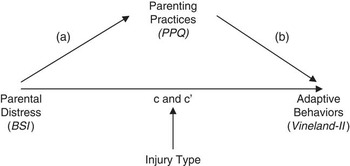
Previous research has demonstrated a relationship between the family environment and child functioning following neurological diagnosis (Chapieski et al., Reference Chapieski, Brewer, Evankovich, Culhane-Shelburne, Zelman and Alexander2005; Yeates et al., Reference Yeates, Taylor, Walz, Stancin and Wade2010). Examining parenting practices is arguably the next step toward elucidating the nature of the relationship between parent and child functioning after TBI. Research of this type may provide important considerations that assist with the development of family-based interventions in this population (Taylor et al., Reference Taylor, Yeates, Wade, Drotar, Stancin and Burant2001). The current study sought to provide further support for the relationship between parental psychological distress, parenting practices, and child adaptive functioning following moderate to severe TBI or OI. Injury type was proposed to moderate, or alter the strength, of the relationship between parental distress and child adaptive functioning. Specifically, we hypothesized that higher levels of parental psychological distress would be associated with lower levels of child adaptive functioning, with a stronger association following pediatric TBI relative to OI (see Figure 1, path c for moderation hypothesis). Furthermore, parenting practices were proposed to mediate the relationship between parental distress and child adaptive outcomes in the two injury groups. Specifically, it was hypothesized that higher levels of parental psychological distress would be associated with a greater reliance on authoritarian parenting practices and reduced child adaptive functioning across groups (see Figure 1, paths a, b).
Proposed moderation and meditational models represented together, hypotheses tested separately.

Method
Participants
Children and adolescents with moderate and severe closed and non-penetrating open head injuries were recruited from the Day Rehabilitation Program of a large southeastern children's hospital system. All participants received inpatient care on a Comprehensive Inpatient Rehabilitation Unit before their release to Day Rehabilitation. A sample of children and adolescents who were treated/triaged in the Emergency Department for orthopedic injuries requiring inpatient observation, treatment (e.g., set fracture, cast), or surgery (e.g., procedures requiring an IV or sedation) served as the comparison sample. Participants were not excluded from participation based on the type of orthopedic injury sustained. Common orthopedic injuries in this sample included tibia-fibia, radius, and femur fractures.
A HIPAA Waiver of Authorization for Research granted by the IRBs allowed the review of medical records before recruitment. This was done to ensure that all participants met inclusionary criteria before initiating contact. All participant data was obtained in compliance with institutional regulations. To be eligible for recruitment, potential participants were required to (1) be between the ages of 8–17 at the time of injury, and (2) able to participate 12–36 months post-injury. Additionally, participants with TBIs were required to have a Glasgow Coma Scale (GCS) score between 3 and 12T (T denotes tracheal intubation). GCS scores are typically assigned at the time of a traumatic injury or hospital/ER admission. GCS scores are calculated by rating the patient across three domains; eye opening, verbal, and motor responsivity (McNett, Reference McNett2007). Glasgow Coma Scale score ratings may be taken when children are both intubated and medicated/sedated. The lowest post-resuscitation Glasgow Coma Scale score on file in participants’ medical records was used to quantify brain injury severity. Children/adolescents were classified in the severe brain injury group if their lowest Glasgow Coma Scale score was between 3 and 8 (T) and into the moderate brain injury group if was between 9 and 12 (T).
Following the medical record review, 72 patients with TBI and 251 patients with OI injuries were deemed eligible for recruitment (N = 323 met inclusionary criteria). Given that we had access to many fewer children with TBIs relative to OIs, the families of children with TBIs were initially contacted via letter and telephone calls. All eligible and consenting families of children with TBI were enrolled in the study. Acknowledging previous work that has demonstrated a relationship between age at injury and recovery trajectories, we recruited our OI sample to have a similar age range as our TBI sample (Anderson & Moore, Reference Anderson and Moore1995; Ewing-Cobbs et al., Reference Ewing-Cobbs, Fletcher, Levin, Francis, Davidson and Miner1997; Taylor & Alden, Reference Taylor and Alden1997). Specifically, we attempted to obtain an equal distribution of TBI and OI participants across two pre-defined age ranges (i.e., pre-adolescents ages 8–12 and adolescents ages 13–17). As a result of this approach, the two groups did not differ significantly on age at injury (χ2(1,42) = .32; p = .57). The mean age at injury was 13.5 (SD = 2.64) for children with TBIs and 14.1 (SD = 2.41) for children with OIs.
Contact was established with 40 of 72 eligible families in the TBI group and 106 of 251 eligible families in the OI group. Six families in the TBI group (15%) and 58 families in the OI group (54.7%) declined participation in the study. No significant differences were observed in the gender (χ2 = 1.56; p > .05) or racial (χ2 = 9.78; p > .05) composition of participants in the no contact, declined participation, and study groups. However, a significant difference was observed across groups in mean age at the time of injury (F(1,299) = 7.4; p = .001). Post hoc tests revealed that children in the declined participation group were significantly older (M = 14.3; SD = .25) than those in the no contact (M = 13.1; SD = .17) and study (M = 13.4; SD = .33) groups.
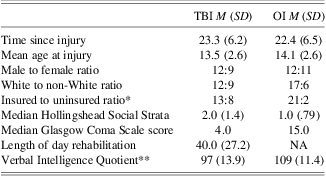
At the time of recruitment and initial contact, families were screened and participants were excluded based on the presence of preexisting (1) DSM-IV diagnoses of mental retardation or a pervasive developmental disorder, or (2) neurological or serious medical conditions/treatments with CNS implications. Orthopedic participants were excluded if they sustained a co-morbid brain injury. With the exception of one participant whose GCS was documented as “14-15,” all participants in the orthopedic group had documented lowest GCS scores of 15. Participants were also excluded if they were non-native English speakers. This additional telephone and record screening resulted in the exclusion of 3 families in the TBI group and 19 in the OI group. Furthermore, 10 participants in the TBI group and 6 participants in the OI group failed to attend their research appointment. Forty-four participants with TBI (n = 21) or OI (n = 23) were included in the analyses. Child/adolescent participants in the TBI and OI groups did not differ significantly on age at the time of injury, time since injury, race, sex, or socio-economic strata (see Table 1).
Procedure
All but three of the study participants arrived to their research appointment accompanied by their biological mother. Two children were accompanied by their biological father, and one was accompanied by his step-mother (legal guardian). All adult participants identified themselves as one of their child's primary caregivers. The research appointment was conducted at the children's hospital where the participants were treated following their injury. Participation in the study took approximately 2 h for parents and 45 min for child/adolescent participants. A few of the families of children with TBIs were unable to participate in person (n = 3) and were allowed to participate via mail if their child had pre or post-injury neuropsychological data on-file in the Department of Neuropsychology. Thirty dollars compensation was provided to families upon completion of the study.
Measures
Parents completed demographic questionnaires, the Hollingshead Four Factor Index of Social Status, the Brief Symptom Index, the Parenting Practices Questionnaire, and the Vineland Adaptive Behavior Scales-II. Following assent, child/adolescent participants completed a demographic questionnaire and were administered the Wechsler Abbreviated Scale of Intelligence (WASI).
Socio-economic strata
The Hollingshead Four Factor Index of Social Status has been widely validated in psychological research and estimates family SES based on the education and occupation of each employed person who shares the financial responsibility of maintaining the home and supporting the family (Bornstein, Hahn, Suwalsky, & Haynes, Reference Bornstein, Hahn, Suwalsky and Haynes2003; Hollingshead, Reference Hollingshead1975). Raw scores on the Hollingshead can range from 8–66 and are converted to 1 of 5 social strata scores (Hollingshead, Reference Hollingshead1975). Participants with TBI and OI did not differ significantly on family social strata scores on the Hollingshead. Family economic resources were also assessed by asking parents to report on their insurance status at the time of their child's injury. Family insurance status was a dichotomous variable that represented whether or not the medical costs associated with their child's injury were covered by personal/private health insurance or governmentally funded insurance (Medicare/Medicaid). Family insurance status was examined for (1) differential representation across the two injury groups, and (2) a significant relationship with the Vineland-II Adaptive Behavior Composite.
Parental distress
The Brief Symptom Inventory (BSI) is a widely used and standardized, 53-item, self-report measure designed to reflect psychological symptom patterns in a variety of populations including community dwellers (Derogatis, Reference Derogatis1993). The measure has been shown to be highly reliable and valid and has been widely used in research examining parental distress following pediatric TBI (Derogatis, Reference Derogatis1993; Yeates et al., Reference Yeates, Taylor, Walz, Stancin and Wade2010). The Global Symptom Index is the summary score that reflects distress across all of the symptom dimensions by summing the scores and dividing the sum by the total number of responses. Scores on the GSI of the BSI were converted to Z-scores and were used as a measure of parental psychological distress in the 12–36 months post-injury.
Parenting practices
The Parenting Practices Questionnaire (PPQ) is an empirically designed 62-item parent report measure that assesses parenting practices and styles associated with Baumrind's parenting typology (Robinson, Mandleco, Frost Olsen, & Hart, Reference Robinson, Mandleco, Frost Olsen and Hart1995). For each item parents decide whether they 1 = never, 2 = once in awhile, 3 = approximately half of the time, 4 = very often, or 5 = always engage in that practice with their child. The PPQ, which has also been referred to as the Parenting Styles and Dimensions Questionnaire (PSDQ), was praised in Locke and Prinzs’ (Reference Locke and Prinz2002) review of parenting measures as one of the few instruments available with psychometrically defendable subscales relating to both parental nurturance and discipline. Cronbach's alphas have been found to be robust for the authoritative and authoritarian domains (r = 0.86–0.91) (Robinson et al., Reference Robinson, Mandleco, Frost Olsen and Hart1995). Reliability estimates have been shown to be strong (r = 0.73–0.89) in an ethnically and socially diverse population and examinations into the convergent validity of the measure have indicated otherwise sound psychometric properties (Gamble, Ramakumar, & Diaz, Reference Gamble, Ramakumar and Diaz2007; Winsler, Madigan, & Aquilino, Reference Winsler, Madigan and Aquilino2005).
The four subscales comprising the authoritative parenting scale are warmth and involvement (11 items), reasoning/induction (7 items), democratic participation (5 items), and good natured/easy going (4 items). The three subscales comprising the permissive parenting scale are lack of follow-through (6 items), ignoring misbehavior (4 items), and self-confidence (5 items). The four subscales comprising the authoritarian parenting scale are verbal hostility (4 items), corporal punishment (6 items), non-reasoning punitive strategies (6 items), and directiveness (4 items). Four items from the authoritarian domain that focused on corporal punishment were excluded for ethical reasons. Given that a belief in and the use of corporal punishment are consistent with an authoritarian parenting style, eliminating these items likely reduced the range of scores on this measure and may have attenuated our effects somewhat (by reducing the reliability of the measure and its associations with other study variables). However, despite these minor alterations, the alpha coefficient for the total PPQ remained very good in our sample (α = 0.79). Alpha coefficients were also adequate in the authoritarian (α = 0.75), permissive (α = 0.70), and authoritative (α = 0.89) parenting domains. For the purposes of the current study, participants’ mean item responses on the authoritarian, authoritative, and permissive domains of the PPQ were used a measure of parenting practices.
Child adaptive functioning
The Vineland Adaptive Behavior Scale II (Vineland-II) is the second generation of a widely standardized parent report measure that uses a rating scale to assess child communicative, social and daily living skills, and physical functioning (Sparrow, Cichetti, & Balla, 2005). The second edition of the Vineland is supported by psychometric data in the technical manual (Sparrow et al., Reference Sparrow, Cicchetti and Balla2005). The manual reports good split half reliability coefficients for children and adolescents ages 9–19 on the adaptive behavior composite (r = 0.94 to 0.97). Test–retest reliabilities are provided by age, with subdomain reliabilities ranging from (r = 0.74 to 0.93) for ages 7 to 21. Test–retest reliability for the adaptive behavior composite was good for children/adolescents ages 7 to 13 (r = 0.93) and 14 to 21 (r = 0.83). A great deal of pediatric brain injury research has used the Vineland as an outcome measure due to its applicability to children of all ages and developmental levels (de Bildt, Kraijer, Sytema, & Minderaa, Reference De Bildt, Kraijer, Sytema and Minderaa2005; Papero et al., Reference Papero, Prigatano, Snyder and Johnson1993; Taylor et al., Reference Taylor, Yeates, Wade, Drotar, Stancin and Minich2002). For the purposes of the current study, the adaptive behavior composite which reflects an individual's capabilities across domains was used as the best estimate of overall adaptive functioning. Adaptive behavior composite and domain standard scores generated by the Vineland computer scoring program were converted to Z-scores for analysis (Sparrow, Cicchetti, & Balla, Reference Sparrow, Cicchetti and Balla2005).
Child intellectual functioning
Verbal Intellectual Quotient (VIQ) scores on Wechsler scales of intelligence (WISC-III, 2/4 subtest WASI) were used to estimate participants’ level of intellectual functioning. WISC-III and WASI VIQ subtests are reliable and valid, assess similar content areas, and correlate (r = 0.82) highly (Sattler & Hoge, Reference Sattler and Hoge2006). None of the participants’ pre- (n = 1) or post-injury (n = 43) neuropsychological testing indicated VIQ scores below 70.
Results
Data Analysis
T tests and χ2 analyses were used to determine if the two injury groups differed significantly on the demographic variables, BSI, PPQ, or Vineland-II (see Tables 1 and 2). Participant insurance status was a confounding variable and was entered as a covariate into all analyses. Hierarchical multiple regression was used to test the moderation hypotheses. Bootstrapped estimates of the indirect effect/association were used to test the meditational models given criticisms of (1) the traditionally low power in the Baron and Kenny model (Reference Baron and Kenny1986), and (2) the questionable validity of the Sobel test in small samples with non-normal sampling distributions (Preacher & Hayes, Reference Preacher and Hayes2004). The significance of indirect effects is determined by examining (1) the strength of the relationships among variables (i.e., significance of unstandardized regression coefficients), and (2) the 95% confidence intervals for the exclusion of zero between the upper and lower bounds (Preacher, Rucker & Hayes, Reference Preacher, Rucker and Hayes2007). One-tailed tests of significance were completed to test our directional hypotheses.
Sample characteristics and medical data by injury group (N = 44)

Note. Time since injury in months. Age at the time of injury in years. Insurance status is a dichotomous variable representing whether or not participants had privately funded insurance at the time of their injury. Length of day rehabilitation stay in days between admission and discharge. Verbal Intelligence Quotient reported in standard scores (M = 100, SD = 15).
*p < .05; **p < .01.
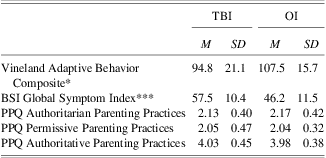
Descriptive statistics and examination of mean differences between the TBI and OI groups on measures of adaptive functioning, parental distress and parenting practices

Note. Vineland-II Adaptive Behavior Composite reported in standard scores (M = 100, SD = 15). BSI reported in T-scores (M = 50, SD = 10), PPQ reported in mean item ratings.
*p < .05; ***p < .001.
Injury type moderates the relationship between parental distress and child adaptive functioning
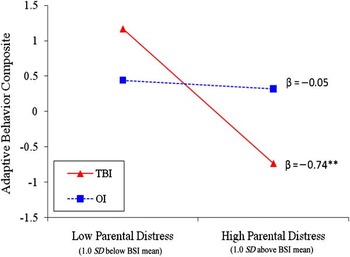
A hierarchical multiple regression was completed to examine the hypothesis that injury type moderates the relationship between parental distress and overall child adaptive functioning. After controlling for insurance status (β = 0.22; p = .13) and parental distress (β = −0.74; p < .01), no significant main effect was observed for injury type (β = 0.07; p > .05) on overall adaptive functioning. The interaction between injury type and parental distress was significant (β = 0.49; p = .01). Specifically, a significant relationship between parental distress and overall child adaptive functioning was observed in the TBI (β = −0.74; p = .001), but not in the OI (β = −0.05; p > .05) group (see Figure 2).
The relationship between parental distress and overall child adaptive functioning by injury type.

Parenting practices
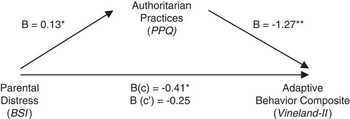
Bootstrapped estimates revealed the presence of a significant indirect association between parental distress (B = −.17; SE = .10) and child adaptive functioning through authoritarian parenting practices (95% CI, −.38, −.007) and demonstrated that the indirect effect differs significantly from zero at p < .05 (two-tailed) (see Figure 3). An examination of the unstandardized regression coefficients revealed that (1) higher parental distress was associated with a greater reliance on authoritarian parenting practices and (2) authoritarian parenting practices were associated with lower child adaptive functioning. The total relationship (B = −.41; p < .05) between parental distress and child adaptive functioning decreased notably (c-c’ = .16; B = −.25; p = .11) and was no longer significant after controlling for the influence of authoritarian parenting practices.
Indirect and direct associations between parental distress, authoritarian parenting practices, and child adaptive functioning.

Bootstrapped estimates did not support the presence of a significant indirect association between parental distress (B = .00; SE = .07) and child adaptive functioning through permissive parenting practices (95% CI, −.10, .22). Bootstrapped estimates also did not support the presence of a significant indirect association between parental distress (B = .00; SE = .02) and child adaptive functioning through authoritative parenting practices (95% CI −.07, .04).
Discussion
The current study examined the association between parental psychological distress, parenting practices, and adaptive functioning 12–36 months following pediatric traumatic brain or orthopedic injury. Consistent with previous research, parents of children with TBI reported significantly higher rates of psychological distress than parents of children with OI (Wade et al., Reference Wade, Taylor, Drotar, Stancin and Yeates1998). We focused primarily on parent ratings of emotional distress; however, it is quite possible that child-rearing challenges that emerged following TBI at least partially accounted for elevated distress levels. While our TBI and OI samples did not vary greatly across demographic variables at baseline, we also cannot rule out the potential influence of pre-injury parental burden on post-injury ratings of stress or coping difficulties (Wade et al., Reference Wade, Taylor, Drotar, Stancin and Yeates1998).
Our results demonstrate that higher levels of parental distress were significantly associated with lower child adaptive functioning in the 12–36 months following TBI but not OI. While our findings demonstrate an association between parental psychological distress and child adaptive functioning following TBI, the cross-sectional nature of our study precludes us from making assertions about causality or the direction of this relationship. From a directionality standpoint, there is the potential for there to be a reciprocal or mutual influence among these variables (Patterson, 1982; Taylor et al., Reference Taylor, Yeates, Wade, Drotar, Stancin and Burant2001). It is possible that (1) higher parental distress contributes to lower child adaptive functioning, or alternatively, (2) that adaptive limitations in children with TBIs result in increased levels of parental distress and burden (Aitken et al., Reference Aitken, McCarthy, Slomine, Ding, Durbin and Jaffe2009).
Level of parental psychological distress was not significantly associated with child adaptive functioning following orthopedic injury. If this finding were to be replicated prospectively it would lend further support to the notion that children with TBIs are more vulnerable than children with OIs to the negative effects of maladaptive familial and social environments (Taylor et al., Reference Taylor, Yeates, Wade, Drotar, Klein and Stancin1999; Wade et al., Reference Wade, Cassedy, Walz, Taylor, Stancin and Yeates2011, Reference Wade, Taylor, Drotar, Stancin, Yeates and Minich2003). In terms of the current study, we must also consider several other factors that might account for the absence of a significant relationship among these variables in the OI group. First and foremost, there was a greater degree of variability in child adaptive functioning in the TBI group. Greater variability in the TBI sample, and therefore greater variance to be accounted for by the variables of interest, may have contributed to our ability to detect a significant association despite the rather small sample size. A stronger association between parental distress and child adaptive functioning may be seen in a larger or more demographically heterogeneous OI sample, or in a group of children/adolescents who sustained more severe physical injuries.
Our second aim was to examine whether the association between parental psychological distress and child adaptive functioning is mediated by authoritarian, permissive, or authoritative parenting practices. Consistent with our mediation hypothesis, results revealed that authoritarian parenting practices partially account for the relationship between parental distress and child functioning across injury groups. Specifically, higher levels of parental distress were associated with a higher endorsement of authoritarian parenting practices. Authoritarian parenting practices were associated with lower levels of child adaptive functioning. Furthermore, the relationship between parental distress and child adaptive functioning decreased notably and was no longer significant after controlling for authoritarian parenting practices. Permissive and authoritative parenting practices were not significantly associated with parental distress or child adaptive functioning following traumatic injury. Overall, these findings appear largely consistent with recent research that has denonstrated that 1) parental negativity is closely related to the emergence of child behavioral difficulties following severe TBI, and 2) that the influence of parental harshness following TBI may be more potent than that of parental warmth (Wade et al., Reference Wade, Cassedy, Walz, Taylor, Stancin and Yeates2011).
The question of causality and whether parental distress and authoritarian parenting practices contribute to lower child adaptive functioning, or whether lower child adaptive functioning results in greater parental distress and reliance on authoritarian parenting practices (i.e., directive, hostile, non-reasoning/punitive), cannot be known by looking at the relationship among these variables cross-sectionally. Several potential explanations for our results could be proposed including the possibility that higher parental distress results in the adoption of a more directive parenting approach that functions to restrict child autonomy and the development of adaptive living skills. Alternatively, it may be that a greater degree of child sequelae (in the form of behavioral and adaptive limitations) contributes to greater distress for parents and elicits authoritarian parenting behaviors. Previous researchers have proposed that a reciprocal process exists, whereby child behavior/sequelae elicits an aversive parental response (i.e., distress, authoritarian parenting) or vice versa. Regardless of directionality, these processes may contribute to maladaptive interactions and reduced functioning in both parties (Patterson, Reference Patterson1983; Taylor et al., Reference Taylor, Yeates, Wade, Drotar, Stancin and Burant2001). These alternative explanations, as well as the Yeates et al. (Reference Yeates, Taylor, Walz, Stancin and Wade2010) finding that the relationship between parenting and child functioning changes over time, highlight the need for more longitudinal studies of parenting following pediatric TBI.
Our findings fit nicely alongside previous studies that have examined discrete aspects of the family environment as mediators and moderators of the relationship between parent/family functioning and child outcomes following TBI. Wade, Taylor, Drotar, Stancin, and Yeates (Reference Wade, Taylor, Drotar, Stancin and Yeates2004) have highlighted the influence of the quality (supportive vs. stressful) and nature of interpersonal relationships (friend, family, spouse) on parental functioning and child outcomes following traumatic injury. Furthermore, research over the past decade has focused on the myriad challenges facing families of children with TBIs and has led to a greater focus on the development of family-based interventions to decrease parental distress and facilitate positive psychosocial outcomes (Wade, Michaud, & Brown, Reference Wade, Michaud and Brown2006). In 2006, Wade and colleagues examined the efficacy of a family problem-solving intervention for children with TBIs. Following this 6-month intervention, these researchers found significantly reduced child internalizing symptoms, depression/anxiety, and withdrawal in the intervention group. Unfortunately, there was no evidence of reduced parental distress or parent-child conflict in the intervention group. Wade et al. felt that their intervention may have benefitted from equalizing the focus on both parent and child problem solving and stress management skills. They also highlighted the continued need for researchers to examine parenting practices and parent functioning/adaptation beyond psychiatric symptomatology.
Strengths of the current study include the use of TBI and OI samples that did not differ significantly in demographic variables, our consideration of neurodevelopmental variables, and the use of a sound statistical approach. By excluding children who sustained injuries at very young ages, we were able to (1) examine the effect of TBI on adaptive outcomes in children who developed typically for the first 8 years of life, and (2) reduce the amount of variance that could be accounted for by large differences in the timing of the disruption to neurocognitive development. Furthermore, assessing participants 12–36 months post-injury allowed us to examine their functioning following the acute recovery period.
Inferences drawn from the current study are limited by several factors including the small sample size, which reflected low rates of recruitment in both the TBI and OI samples. With the exception of a slightly higher age at injury among the children comprising the “declined participation” group, there was no evidence of selectivity in terms of demographic and background characteristics. Nonetheless, unknown factors that influenced whether families chose to participate might also have affected the pattern of relationships that emerged in the study. Shared method variance and retrospective recall biases, may have also introduced an unknown degree of variability into the ratings of parental distress, parenting practices, and child adaptive functioning. Specifically, premorbid parental psychological functioning, family stress, or child behavioral or psychiatric difficulties may have served to influence parents’ ratings of their children in the 12–36 months post-injury. Additionally, our study is somewhat limited by its focus on adaptive functioning to the exclusion of behavioral problems and social competence. These limitations, as well as the previously discussed potential for a reciprocal relationship among the variables of interest, should be taken into account in the design and implementation of family-focused studies of pediatric TBI.
Potential avenues for future endeavors include longitudinal examinations of the relationship between distress, parenting practices and child behavioral difficulties, social problem solving skills, and adaptive functioning following brain injury. The nature of the relationship among these variables likely varies over the course of recovery and development (Yeates et al., Reference Yeates, Taylor, Walz, Stancin and Wade2010). Replication and extension of Yeates et al.'s (Reference Yeates, Taylor, Walz, Stancin and Wade2010) recent work in a pre-adolescent/adolescent sample could explore whether the authoritarian parenting practices, that may have been useful for parents initially following their child's injury, correlate with reduced exposure to the activities that support the development of necessary competencies later in recovery. Future work could also focus on determining whether parents who initially engage in more authoritarian practices become more permissive over time as a result of feeling overwhelmed or worn down by child-rearing challenges. Comprehensive, prospective studies are needed to determine the strength and direction of the relationship among these variables over time, as this may assist in the development of targeted family-based interventions for facilitating child outcomes and quality of life following traumatic brain and orthopedic injury.
Acknowledgments
We are greateful to our participants and their families who gave their time to make this research possible. The research described in this study was supported by dissertation grants to Jackie Micklewright from the American Psychological Association and Georgia State University Research Foundation. Funding for Jackie Micklewright was also provided by the Georgia State University Brains & Behavior Research Fellowship. This research was also recognized by Division 22 of the American Psychological Association, the Department of Veterans Affairs Rehabilitation Research and Development Service, and the North American Brain Injury Society's Charles W. Haynes Fellowship Award. There are no conflicts of interest associated with the current study.