Introduction
Numerous researchers have found that bilinguals score below monolingual age-based expectations on receptive vocabulary tests in one (Allman, Reference Allman2005; Ben Zeev, Reference Ben-Zeev1977; Bialystok, Craik & Luk, Reference Bialystok, Craik and Luk2007; Bialystok, Luk, Peets & Yang, Reference Bialystok, Luk, Peets and Yang2010; Doyle, Champagne & Segalowitz, Reference Doyle, Champagne, Segalowitz and Paradis1978; Pearson, Fernández & Oller, Reference Pearson, Fernández and Oller1993) or both of their languages (Oller, Reference Oller, Cohen, McAlister, Rolstad and MacSwan2005; Oller & Eilers, Reference Oller and Eilers2002; Oller, Pearson & Cobo-Lewis, Reference Oller, Pearson and Cobo-Lewis2007; Uchikoshi, Reference Uchikoshi2006) (see Bialystok, Reference Bialystok2009, for a review). The bilingual receptive vocabulary disadvantage has been found among preschool children (aged 3–5 years) (Allman, Reference Allman2005; Bialystok et al., Reference Bialystok, Luk, Peets and Yang2010; Doyle et al., Reference Doyle, Champagne, Segalowitz and Paradis1978), early-elementary children (aged 6–8 years) (Ben Zeev, Reference Ben-Zeev1977; Bialystok et al., Reference Bialystok, Luk, Peets and Yang2010; Uchikoshi, Reference Uchikoshi2006), late-elementary children (aged 9–12 years) (Bialystok et al., Reference Bialystok, Luk, Peets and Yang2010; Oller et al., Reference Oller, Pearson and Cobo-Lewis2007), and adults (Bialystok et al., Reference Bialystok, Craik and Luk2007). This trend is of particular concern since vocabulary size correlates strongly with cognitive and academic achievement. Vocabulary size is associated with the Wide Range Achievement Test–Revised (WRAT–R) and the Weschler Intelligence Scale for Children–Revised (WISC–R) (Smith, Smith & Dobbs, Reference Smith, Smith and Dobbs1991). Vocabulary size is also associated with reading skills. Researchers have found a positive association between receptive vocabulary in kindergarten and reading comprehension in grade 2 (Muter, Hulme, Snowling & Stevenson, Reference Muter, Hulme, Snowling and Stevenson2004). Furthermore, when controlling for parent education, parent and child literacy, and phonological awareness, receptive vocabulary (measured in kindergarten) predicts 4% of the unique variance in reading comprehension in grade 3 (Sénéchal, Ouellette & Rodney, Reference Sénéchal, Ouellette, Rodney, Neuman and Dickinson2006). Since the academic progress of children is strongly influenced by their reading comprehension abilities (Alvermann & Earle, Reference Alvermann, Earle, Sweet and Snow2003), further investigations into bilingual children's performance on tests of receptive vocabulary would have strong relevance to the field of education.
The accumulation of literature suggesting a bilingual receptive vocabulary disadvantage indicates a need for the identification of factors that lead to optimal bilingual vocabulary development. In one exceptional study, Thordardottir (Reference Thordardottir2011) found that French–English bilingual children in Montreal did not show a receptive vocabulary deficit. In this study, French and English monolingual children and French–English bilingual children with varying amounts of exposure to each language were assessed on measures of expressive and receptive vocabulary. These children ranged in age from 4 years 6 months to 5 years (i.e., from 4;6 to 5;0 years) and resided in a bilingual context supporting both French and English (Montreal, Canada). The results indicated that children who were equally exposed to both languages did not differ from monolinguals with respect to receptive vocabulary. Thordardottir (Reference Thordardottir2011) notes that this finding contrasts sharply with many other studies that show a bilingual vocabulary disadvantage, and attributed this positive outcome to the “favorable language learning environment for French and English” (p. 426) present in the region of testing. Indeed, both French and English are constitutionally official languages in Canada, and French–English bilingualism receives more governmental support in terms of legal, educational and cultural language policies than multiculturalism/multilingualism involving non-official languages (see Canadian Charter of Rights and Freedoms, 1982; http://laws-lois.justice.gc.ca/eng/Const/). A large proportion of studies reporting depressed vocabulary scores among bilinguals have not been conducted in a context supporting the learning of both a bilingual's languages. For example, many of these studies have been conducted in the United States (e.g. Allman, Reference Allman2005; Hoff, Core, Place, Rumiche, Señor & Parra, Reference Hoff, Core, Place, Rumiche, Señor and Parra2012; Junker & Stockman, Reference Junker and Stockman2002; Oller & Eilers, Reference Oller and Eilers2002; Oller et al., Reference Oller, Pearson and Cobo-Lewis2007; Pearson et al., Reference Pearson, Fernández and Oller1993; Pearson, Fernández, Lewedeg & Oller, Reference Pearson, Fernández, Lewedeg and Oller1997; Ucelli & Páez, Reference Ucelli and Páez2007; note that these studies used receptive and/or productive measures of vocabulary) where most of the bilingual children speak a minority language at home, typically Spanish, whose sociocultural status varies by region (see Oller & Eilers, Reference Oller and Eilers2002), but is not a constitutionally official language on a par with French in Canada. In addition, research with bilinguals in Canada from recent immigrant groups with diverse first languages show similar findings for English vocabulary development as the studies with Spanish–English speakers in the United States (Bialystok et al., Reference Bialystok, Craik and Luk2007; Bialystok et al., Reference Bialystok, Luk, Peets and Yang2010). In short, Thordardottir's (Reference Thordardottir2011) exceptional findings suggest that the French–English sociocultural context in Canada might support both languages to the extent that bilingual children can score comparably to monolinguals on receptive vocabulary tests. However, further research with French–English bilinguals is needed to understand whether Thordardottir's (Reference Thordardottir2011) findings extend to other French–English bilinguals in Canada.
Language input factors and bilingual vocabulary achievement
Bilingual children's vocabulary performance is modulated by factors like the amount of input they receive in each language (Aukrust, Reference Aukrust2007; Hammer, Davison, Lawrence & Miccio, Reference Hammer, Davison, Lawrence and Miccio2009; Hoff et al., Reference Hoff, Core, Place, Rumiche, Señor and Parra2012; Mancilla-Martinez & Lesaux, Reference Mancilla-Martinez and Lesaux2011; Pearson et al., Reference Pearson, Fernández, Lewedeg and Oller1997; Scheele, Leseman & Mayo, Reference Scheele, Leseman and Mayo2010) and socio-economic status (SES) of the family (Cobo-Lewis, Pearson, Eilers & Umbel, Reference Cobo-Lewis, Pearson, Eilers and Umbel2002a, Reference Cobo-Lewis, Pearson, Eilers and Umbelb; Scheele et al., Reference Scheele, Leseman and Mayo2010).
With respect to language input, bilingual vocabulary attainment is strongly influenced by differential amounts of language input both at home (Cobo-Lewis et al., Reference Cobo-Lewis, Pearson, Eilers and Umbel2002b; Mancilla-Martinez & Lesaux, Reference Mancilla-Martinez and Lesaux2011), and at school (Cobo-Lewis et al., Reference Cobo-Lewis, Pearson, Eilers and Umbel2002a, Reference Cobo-Lewis, Pearson, Eilers and Umbelb; Lawrence, Reference Lawrence2012; Tagoilelagi-LeotaGlynn, McNaughton, MacDonald & Farry; Reference Tagoilelagi-LeotaGlynn, McNaughton, MacDonald and Farry2005). Furthermore, the influence of these language input factors seems to vary according to whether a language has minority or majority sociocultural status. For example, in a study by Gathercole and Thomas (Reference Gathercole and Thomas2009), Welsh–English bilingual children completed a receptive vocabulary assessment in each of their languages. Children in Wales performed similarly on the English vocabulary assessment regardless of how much Welsh and English were spoken at home and school; however, their performance on the Welsh (the minority language) vocabulary assessment was strongly contingent upon the amount of Welsh language input at home and school. Furthermore, in a study by Gutiérrez-Clellen and Krieter (Reference Gutiérrez-Clellen and Krieter2003) with Spanish–English bilingual children living in California, input in Spanish at home was strongly predictive of grammatical ratings in Spanish, however this was not true for English. Similarly, Hammer et al. (Reference Hammer, Davison, Lawrence and Miccio2009) found that vocabulary development and preliteracy skills in the Spanish and English of bilingual children in Pennsylvania were differentially affected by language use at home. Specifically, mothers’ increasing use of English at home over time did not improve children's test scores in that language, but did negatively affect their Spanish test scores. Note that English was the majority sociocultural language in Gathercole and Thomas (Reference Gathercole and Thomas2009), Gutiérrez-Clellen and Krieter (Reference Gutiérrez-Clellen and Krieter2003) and Hammer et al. (Reference Hammer, Davison, Lawrence and Miccio2009). Thus, it could be the case that home language input factors are stronger predictors of vocabulary outcomes in the minority language of a bilingual. In other words, minority language vocabulary development might be more sensitive to variation in home language input because the sources of input for that language outside the home are more limited (see Hammer et al., Reference Hammer, Davison, Lawrence and Miccio2009).
With respect to SES, monolingual and bilingual vocabulary acquisition can be strongly influenced by family SES (Oller & Eilers, Reference Oller and Eilers2002). Children from high SES families tend to receive a greater amount of language input and the type of input that they receive tends to stimulate language development more than the type of input in lower SES homes (Hart & Risley, Reference Hart and Risley1995; Scheele et al., Reference Scheele, Leseman and Mayo2010). Maternal education has previously been used as a measure of SES in research investigating vocabulary outcomes (e.g. Hoff, Reference Hoff2003). College-educated mothers tend to use richer vocabulary, and to ask more questions in comparison to high-school-educated mothers (Hoff-Ginsberg, Reference Hoff-Ginsberg1991). Whether the influence of maternal education on vocabulary outcomes interacts with minority/majority language status has yet to be assessed.
Relatively few studies have been conducted addressing receptive vocabulary outcomes among adults. The first language of an adult would be expected to be associated with their language of higher input and output. Since language input factors seem to have a stronger impact upon vocabulary outcomes in the minority language it may be the case that first language of an adult bilingual has a stronger effect upon their vocabulary outcomes in the minority language in comparison to their vocabulary outcomes in the majority language. Research has yet to investigate this possibility.
The present study
The primary purpose of this study was to investigate whether French–English bilingual children and adults in a French minority/English majority context in Canada showed the same pattern of vocabulary development, vis à vis monolinguals, as the five-year-olds in the study by Thordardottir (Reference Thordardottir2011). We also investigated the extent to which children's vocabulary scores were modulated by the amount of input they received at home in each language and maternal education levels. It is important to note that the bilingual children included in this study were enrolled in an education system where French is the medium of instruction and where English Language Arts is introduced in grade 3 (when children are eight or nine years of age). Since language input at school plays an important role in vocabulary attainment (Cobo-Lewis et al., Reference Cobo-Lewis, Pearson, Eilers and Umbel2002a, Reference Cobo-Lewis, Pearson, Eilers and Umbelb; Lawrence, Reference Lawrence2012; Tagoilelagi-LeotaGlynn et al., Reference Tagoilelagi-LeotaGlynn, McNaughton, MacDonald and Farry2005), this shift in instruction may have an important role in vocabulary outcomes, a possibility we will return to in the discussion.
Three research questions were addressed.
-
1. Do bilingual children and adults’ vocabulary scores differ from age-expected norms for vocabulary tests? Does this change across different age groups?
When assessing English and French vocabulary ability among monolingual and bilingual children alike, standardized assessments such as the English Peabody Picture Vocabulary Test (PPVT) (see Bialystok, Reference Bialystok2009; Bialystok, Craik & Luk, Reference Bialystok, Craik and Luk2008; Bialystok et al., Reference Bialystok, Craik and Luk2007; Bialystok et al., Reference Bialystok, Luk, Peets and Yang2010; Thordardottir, Reference Thordardottir2011; Thordardottir, Rothenberg, Rivard & Naves, Reference Thordardottir, Rothenberg, Rivard and Naves2006) and the French adaptation, Échelle de vocabulaire en images Peabody (EVIP), are often used (see Majerus, Poncelet & Greffe, Reference Majerus, Poncelet and Greffe2006; Thordardottir et al., Reference Thordardottir, Rothenberg, Rivard and Naves2006; Thordardottir, Reference Thordardottir2011). To address this question, receptive vocabulary measures among bilinguals in the different age groups were compared to standardized norms. Based on Thordardottir (Reference Thordardottir2011), it was predicted that bilingual vocabulary outcomes from all age groups would align with the standardized norms.
-
2. Do bilingual children and adults’ vocabulary scores differ from scores of monolingual peer groups? Does this change across different age groups?
Sampling bias in both our participant groups and in the participant groups used for vocabulary assessment norming may exist. Therefore, to supplement the analyses aimed at addressing Question 1, we also included analyses with both monolingual and bilingual participants who were recruited using similar methods. In this way, any of the biasing characteristics of our samples could be assumed to apply to both language groups to a similar extent, and therefore, more valid vocabulary comparisons could be made between monolingual and bilingual vocabulary outcomes. It was predicted that bilingual vocabulary scores among both children and adults would not differ from age-matched monolingual participants.
-
3a. What are the effects of home language and maternal education on bilingual children's vocabulary scores, in the minority language in particular?
Home language and maternal education were assessed as predictors of bilingual vocabulary outcomes in both languages. It was predicted that home language and maternal education would be significant predictors of receptive vocabulary outcomes among bilinguals in both languages. Since some research suggests that language input factors are more robust predictors of vocabulary outcomes in the minority language of a bilingual, it was predicted that home language and maternal education would be stronger predictors of French vocabulary outcomes in comparison to English vocabulary outcomes.
-
3b. Does the first language of an adult bilingual affect their vocabulary scores?
First language is most likely to represent the language of greater input and output for adult bilinguals.Footnote 1 It was predicted that adult bilinguals’ first language would have a stronger effect on (minority) French vocabulary outcomes in comparison to (majority) English vocabulary outcomes, for the same reasons as those above in the Question 3a passage.
Method
Bilingual participants in this study were residing in Edmonton, Canada, a majority English-speaking city with a minority French-speaking community (Statistics Canada, 2011). In spite of being a French minority context, Edmonton can be considered a positive sociocultural context for the development and use of both languages because there is institutional support for French in the domains of media, education and government. The child bilinguals were all attending daycares, preschools or schools where French was the medium of instruction. Unlike French immersion programs, which are designed for English-speaking children, these schools, daycares, and preschools target children from homes where French is spoken exclusively or at least regularly in conjunction with English. Only French is used for conversation and instruction in these programs. English Language Arts as a subject begins at grade 3 (age 8 to 9), for approximately three hours per week.
The child and adult data from this study come from a variety of already-completed studies where vocabulary measures were recorded, but were not the primary focus of analysis (Paradis, Reference Paradis2009, Reference Paradis2010; Paradis, Nicoladis, Crago & Genesee, Reference Paradis, Nicoladis, Crago and Genesee2011; Smithson & Nicoladis, Reference Smithson and Nicoladis2013). The use of a compilation of samples of monolinguals and bilinguals, for the purposes of vocabulary analysis, has been applied previously (see Bialystok et al., Reference Bialystok, Luk, Peets and Yang2010). Outliers were identified as values with Z > ±3.29 (Tabachnick & Fidell, Reference Tabachnick and Fidell2007). Two participants were removed completely from the analyses (representing 0.005% of the database).
Participants: Bilingual and monolingual children
For each of the studies from which the vocabulary data were compiled, information letters and consent forms were sent to all the parents of children of the relevant ages. We told parents that we were seeking typically developing children who spoke both French and English or solely French or English for the bilinguals and monolinguals respectively. We included in these studies all the children for whom we received written consent from the parents and verbal assent from the children themselves.
Bilingual children
One hundred and seventy-three bilingual children (59 males and 114 females; the relatively high number of girls was simply chance) were recruited through French language schools, daycares, and preschools for participation in a variety of language-related research. Children with a vocabulary score missing in either French (N = 8) or English (N = 5) were excluded from the analyses; the sample size of 173 has taken these exclusions into account. According to parental report, the children's onset of exposure to both languages was birth or before two years of age, thus, as a group, these children can be classified as simultaneous bilinguals (Paradis, Genesee & Crago, Reference Paradis, Genesee and Crago2011). The children ranged in age from 37 to 149 months with a mean age of 82.16 months (SD = 28.94).
For the analyses, the children were separated into three different age groups including preschool (aged 3–5 years), early-elementary (aged 6–8 years) and late-elementary (aged 9–12 years). Seventy-seven preschool children (M = 58.32, range = 37–67 months), 65 early-elementary children (M = 84.75, range = 74–106 months), and 31 late-elementary children (M = 135.90, range = 108–149 months) were included in this study. The male-to-female ratio in these groups was 24/53, 26/39, and 9/22 respectively. Age was analyzed as a categorical rather than continuous variable. Similar age groupings have been used in research addressing language skills among children (e.g., Durik & Eccles, Reference Durik and Eccles2006; Storch & Whitehurst, Reference Storch and Whitehurst2002).
For 76 of the children, we had parental reports of the number of years of the mothers’ education and the language(s) spoken at home (i.e., mainly French, mainly English or English and French equally). Maternal education has an influence upon the type of vocabulary mothers use with their children (Hoff-Ginsberg, Reference Hoff-Ginsberg1991). Among the bilingual children for whom we have information pertaining to maternal education, their mothers ranged from having eight years to 22 years of education with a mean of 15.39 years (SD = 2.59) (N = 76). Of the 76 mothers included in these analyses, 14 had completed high school or less and the remaining 62 had completed at least one post-secondary diploma or degree. These maternal education measures were only taken as part of one study (Paradis, Reference Paradis2009) and not the others. In order to ensure that the 76 children were representative of the larger study, comparisons between these children and children without this information available were compared. There were 20 participants from the early- and late-elementary school bilingual groups who did not have information available regarding their home language and maternal education. These 20 children were matched on age to the 20 children who had parental reports available concerning home language and maternal education. Independent samples t–tests were conducted and revealed that the samples did not differ significantly according to age t(26.220) = 0.915, p = .368 (equal variances not assumed), PPVT scores, t(38) = 1.697, p = .098, or EVIP scores t(38) = 0.750, p = .458.
With respect to language(s) spoken at home, home language was reported as mainly French among 27 of the children, mainly English among 16 of the children, and English and French equally among 33 of the children. The average age for these 76 children was 101.37 months (SD = 28.27), so they were among the older children of the entire sample.
English monolingual children
One hundred and eight English monolingual children were included as a monolingual comparison group in this study (54 males and 54 females). The children ranged in age from 48 to 121 months (M = 71.03, SD = 22.10). In order to be included as a monolingual participant within this study, children had to be functionally monolingual, meaning that they knew no more than a few words from any language other than English. These children were also separated into three different age groups: (i) 75 preschool children (M = 57.09, range = 48–67 months), (ii) 26 early-elementary school children (M = 99.46, range = 90–106 months), (iii) seven late-elementary school children (M = 114.71, range = 110–121 months). The male to female ratio in these groups was 42/33, 9/17, and 3/4 respectively. There were no significant differences with respect to age (t(102.685) = 1.565, p = .121) or PPVT scores (t(106) = 0.216, p = .830) according to gender (note: equal variances were not assumed for the age comparison).
French monolingual children
Thirty-six French monolingual children were included as a monolingual comparison group in this study (18 males and 18 females). The children ranged in age from 39 to 93 months with a mean age of 67.31 (SD = 17.41). All participants either lived in Montreal or in a suburb of Montreal, Canada. The same recruitment methods and inclusionary criteria were used as for the English monolingual children. These children were separated into two different age groups: (i) 18 preschool children (M = 51.50, range = 39–63 months), (ii) 18 early- elementary school children (M = 83.11, range = 75–93). The male to female ratio in these groups was 9/9 and 9/9. There were no significant differences by gender with respect to age (t(34) = 0.198, p = .844), however there were significant differences with respect to EVIP scores (t(34) = 2.902, p = .006). Males (M = 115.22, SD = 11.82) had significantly higher EVIP scores than females (M = 103.00, SD = 13.40).
Participants: Bilingual and monolingual adults
The adult participants were recruited from the University of Alberta in Edmonton, Canada. These participants gave informed consent to participate in the study. Participants were offered an honorarium of ten dollars for their participation.
Bilingual adults
Thirty French–English bilingual adults were included in this study (6 males and 24 females). The first language (L1) of nine of the participants was English (the English L1 group), the first language of 13 of the participants was French (the French L1 group), and the first language of eight of the participants was simultaneous acquisition of French and English (the bilingual L1 group). The French–English bilinguals ranged in age from 18 to 34 years with a mean age of 22.83 (SD = 4.97). There were no significant gender differences with respect to age (t(28) = 0.090, p = .929), PPVT scores (t(28) = 0.268, p = .791), or EVIP scores (t(28) = −0.946, p = .352).
English monolingual adults
Thirty English monolingual adults were included as a monolingual comparison group in this study (11 males and 19 females). The English monolinguals ranged in age from 18 to 75 years with a mean age of 28.20 (SD = 14.94). There were no significant differences by gender with respect to age (t(28) = 0.622, p = .539) or PPVT scores (t(28) = 0.989, p = .331).
Materials
The Peabody Picture Vocabulary Test – Third edition (PPVT–IIIA) was used to assess the monolingual English receptive vocabulary and to assess bilinguals’ English receptive vocabulary (Dunn & Dunn, Reference Dunn and Dunn1997). The French adaptation, Échelle de Vocabulaire en Images Peabody (EVIP), was used to assess monolingual French receptive vocabulary and to assess bilinguals’ French receptive vocabulary (Dunn, Thériault-Whalen & Dunn, Reference Dunn, Thériault-Whalen and Dunn1993).
Procedure
The vocabulary tests were administered according to the procedure in the tester's manual. The PPVT was administered by a native speaker of English; the EVIP was administered by a native or highly fluent speaker of French. Throughout the test administration, the examiner said a word and showed the participant a set of four pictures. The participant was asked to point to the picture among an array of four that best represented the word's meaning. The participants’ standardized scores were used in all analyses.
For information on maternal education and bilingual children's home language, a parent questionnaire was used. With respect to home language categorization, the questionnaire included questions about which language each parent used with the child more often at home, what language was used more often among all members of the household, what language media was most often in, etc. These questions had 0–4 rating scales from “only English” to “only French”. The results from this questionnaire were used to categorize the children into “mainly English”, “English and French” and “mainly French” groups for home language. See Paradis (Reference Paradis2010) for more details.
Multiple regression analyses were conducted in order to investigate the influence of maternal education and home language upon PPVT and EVIP scores among the bilingual children. One-way between-groups ANOVAs were conducted in order to investigate the influence of first language upon PPVT and EVIP scores among bilingual adults.
Results
Bilingual vocabulary scores compared to age-expected norms
One-sample t-tests were used to compare vocabulary scores with the normative mean of 100. As a group on the PPVT, the bilingual children's overall standard score (M = 101.49, SD = 19.59) was not significantly different from 100, t(172) = 0.998, p = .320, Cohen's d = 0.09. On the EVIP, the bilingual children's overall standard score (M = 104.79, SD = 17.56) was statistically above the standard mean, t(172) = 3.589, p < .001, Cohen's d = 0.29. Turning to scores according to age categories, the preschool group scored significantly above the standard mean in both languages (PPVT (M = 107.17, SD = 13.67): t(76) = 4.601, p < .001, Cohen's d = 0.50 and EVIP (M = 106.22, SD = 15.23): t(76) = 3.583, p = .001, Cohen's d = 0.41). The early-elementary children scored significantly below the standard mean on the PPVT (PPVT (M = 93.48, SD = 25.00): t(64) = −2.103, p = .039, Cohen's d = 0.32 but did not differ significantly from the standard mean on the EVIP (M = 103.86, SD = 20.95): t(64) = 1.486, p = .142, Cohen's d = 0.21). The late-elementary children scored marginally higher than the standard mean on the PPVT (M = 104.16, SD = 12.78) (t(30) = 1.813, p = .080, Cohen's d = 0.30) but did not differ from the standard mean on the EVIP (M = 103.19, SD = 15.29) (t(30) = 1.163, p = .254, Cohen's d = 0.21). The adult bilinguals’ scores on the PPVT (M = 115.00, SD = 10.07) were significantly above the standard mean (t(29) = 8.163, p < .001, Cohen's d = 1.17) and those on the EVIP (M = 105.53, SD = 13.11) were also significantly above the standard mean (t(29) = 2.312, p = .028, Cohen's d = 0.39).
Since there was a great deal of variability in the vocabulary outcomes among our samples, additional analyses were conducted to determine what proportion of individual bilinguals and monolinguals from each age range tested fell within one standard deviation above (+1 SD) or below (−1 SD) the standardized mean of 100. Among bilinguals, the following percentages of participants scored lower than −1 SD below the standard mean in at least one of their two languages: 16% of preschool children, 45% of early-elementary children, 16% of late-elementary children, and 7% of adults. Only 3% of all children and 0% of adults scored lower than –1 SD below the standard mean in both languages, however. Also among bilinguals, the following percentages of participants scored higher than +1 SD above the standard mean in at least one of their languages: 40% of preschool children, 46% of early-elementary children, 32% of late-elementary children, and 53% of adults. Seventeen percent of all children and 20% of adults scored higher than +1 SD above the standard mean in both languages. In sum, a clear majority of individual bilingual children (73%) and adults (93%) scored either within or above the normal range in both of their languages. Regarding the English monolingual children, 1% scored −1 SD below the standard mean and 34% scored higher than +1 SD above the mean. Among the French monolingual children, 6% scored –1 SD below the mean and 39% scored +1 SD above the mean. Regarding the English monolingual adults, 0% scored −1 SD below the standard mean and 47% scored higher than +1 SD above the mean.
Bilingual vocabulary scores directly compared to monolingual vocabulary scores
We next compared bilinguals’ scores directly to scores from monolinguals in French and English, as opposed to published norms for the tests.
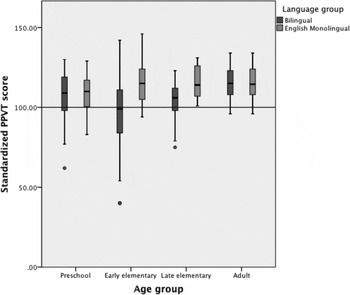
For the PPVT overall, the English monolingual children's scores (M = 110.56, SD = 12.44) were significantly higher than bilingual scores (M = 101.49, SD = 19.59), t(278.901) = −4.746, p < .001, Cohen's d = 0.55 (note: equal variances were not assumed for this comparison). To further investigate this comparison, the bilinguals were compared with monolinguals for each age group. Regarding the preschool children, PPVT scores among the English monolinguals (M = 108.13, SD = 10.95) were not significantly different from the bilinguals (M = 107.17, SD = 13.67). Among the early-elementary children, PPVT scores among the English monolinguals (M = 116.08, SD = 14.69) were significantly higher than the scores of the bilinguals (M = 93.48, SD = 25.00), t(76.428) = −5.339, p < .001, Cohen's d = 1.10 (note: equal variances were not assumed for this comparison). Among the late-elementary children, PPVT scores among the English monolinguals (M = 116.00, SD = 12.01) were also significantly higher than those of the bilinguals (M = 104.16, SD = 12.78), t(36) = −2.235, p = .032, Cohen's d = 0.95. With respect to the adults, on the PPVT, the English monolinguals’ scores (M = 114.93, SD = 11.01) were not statistically different from the bilinguals’ scores (M = 115.00, SD = 10.07).
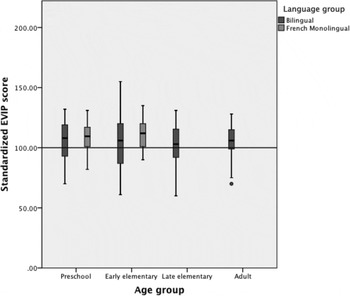
On the EVIP, the French monolingual children's scores (M = 109.11, SD = 13.91) were not statistically different from the overall bilingual children's scores (M = 104.79, SD = 17.56). To further investigate this comparison, the bilinguals were compared with monolinguals according to age group. Among the preschool children, the EVIP scores from the French monolinguals (M = 107.83, SD = 14.33) were not significantly different from those of the bilinguals (M = 106.22, SD = 15.23). Among the early-elementary children, the EVIP scores of the French monolinguals (M = 110.39, SD = 13.77) were also not significantly different from those of the bilinguals (M = 103.86, SD = 20.95). No late-elementary French monolingual children and no French monolingual adults were tested, and therefore, bilingual–monolingual comparisons could not be conducted for these age groups.
Box-plots illustrating the monolingual and bilingual comparisons on the PPVT and EVIP can be found in Figures 1 and 2, respectively.
Bilingual scores in comparison to monolingual scores on the PPVT.

Bilingual scores in comparison to monolingual scores on the EVIP.

The influence of home language and maternal education on children's bilingual vocabulary scores
In order to explore the influences of maternal education and home language on vocabulary outcomes, multiple regression analyses were conducted. Since home language is a categorical variable, effect coding was used for this analysis.
For the purposes of this coding, home language groups were assigned to particular effect values (E1 , E2 ): in the mainly French group (1, 0), in the French and English group (−1, −1) and in the mainly English group (0, 1). The French and English group was designated as the reference group for this independent variable (−1, −1).
First, a forward multiple linear regression analysis was conducted using maternal education and home language as predictor variables and PPVT as the dependent variable in order to assess whether maternal education and home language were significant predictors of PPVT scores. F change statistics were used in order to determine the best fitting model using these predictors. Table 1 summarizes the results for this regression analysis.
Coefficients included within the forward regression analysis predicting PPVT.

Note: The French and English home language group was the reference group for this analysis.
Since this was a forward linear regression analysis, only significant predictors are included in this table. The results indicated that home language explained a significant amount of variance in PPVT scores (Adjusted R2 = .324, F(2,73) = 19.013, p < .001). The intercept for this model was B0 = 94.845 and the estimated regression equation using the effect-coded data is:
 \begin{equation*}
Y^{\prime} = 94.845 - 18.919(E_{\it 1} ) + 12.218(E_{\it 2} )
\end{equation*}
The regression coefficient associated with E1 (B = −18.919) was negative indicating that the PPVT score of the mainly French home language group is 18.919 points lower than the grand mean of all groups. The contribution of mainly French home language to PPVT scores was statistically significant (t(73) = −6.155, p < .001). The regression coefficient associated with E2 (B = 12.218) was positive, indicating that the PPVT score of the mainly English home language group was 12.218 points higher than the grand mean of all groups. Maternal education did not emerge as a significant predictor in the best fitting model.
Second, a forward multiple linear regression analysis was conducted using maternal education and home language as predictor variables and EVIP as the dependent variable in order to assess whether maternal education and home language were significant predictors of EVIP scores. F change statistics were also used in order to determine the best-fitting model using these predictors. Table 2 summarizes the results for this regression analysis.
Coefficients included within the forward regression analysis predicting EVIP.

Note: The French and English home language group was the reference group for this analysis.
The results indicated that maternal education and home language explained a significant amount of variance in EVIP scores (Adjusted R2 = .328, F(3,72) = 13.193, p < .001). The intercept for this model was B0 = 70.029 and the estimated regression equation using the effect-coded data is:
 \begin{equation*}
Y^{\prime} = 70.029 + 2.040(M_{\it 1} ) + 11.839(E_{\it 1} ) - 13.899(E_{\it 2} )
\end{equation*}
In contrast to the findings for the PPVT, the regression coefficient associated with maternal education was significant and positive (B = 2.040), indicating that an increase in maternal education of one year adds approximately 2.040 points to a child's EVIP score (t(72) = 2.718, p = .008). The regression coefficient associated with E1 (B = 11.839) was also positive indicating that the EVIP score of the mainly French home language group was 11.839 points higher than the grand mean of all groups. The contribution of mainly French home language to EVIP scores was statistically significant (t(72) = 4.491, p < .001). The regression coefficient associated with E2 (B = −13.899) was negative, indicating that the EVIP score of the mainly English home language group was 13.899 points lower than the grand mean of all groups. The contribution of mainly English home language to EVIP scores was statistically significant (t(72) = −4.427, p < .001).
The influence of first language on adult bilingual vocabulary scores
When considering only the PPVT scores of the bilinguals, the English L1 participants had a mean of 112.67 (SD = 9.55, N = 9), the French L1 participants had a mean of 115.31 (SD = 9.50, N = 13), and the bilingual L1 participants had a mean of 117.13 (SD = 12.18, N = 8). A one-way, between groups ANOVA was used to analyze PPVT standard scores between these first language groups. No significant effects were found, F(2,27) = 0.409, p = .668.
When considering only the EVIP scores of the bilinguals, the English L1 participants scored a mean of 95.33 (SD = 14.37, N = 9), the French L1 participants scored a mean of 112.38 (SD = 8.06, N = 13), and the bilingual L1 participants scored a mean of 105.88 (SD = 11.97, N = 8). A one-way, between groups ANOVA was used to analyze EVIP standard scores between these first language groups. A significant effect was found, F(2,27) = 6.084, p = .007, ηp 2 = .311. Tukey's HSD comparisons revealed that the English L1 participants performed more poorly than the French L1 participants, but importantly, the bilingual L1 participants did not perform differently from either the English L1 or French L1 participants.
Discussion
A substantial body of research has found that bilinguals consistently attain poorer receptive vocabulary scores in comparison to their monolingual counterparts in one (Allman, Reference Allman2005; Ben Zeev, Reference Ben-Zeev1977; Bialystok et al., Reference Bialystok, Craik and Luk2007; Bialystok et al., Reference Bialystok, Luk, Peets and Yang2010; Doyle et al., Reference Doyle, Champagne, Segalowitz and Paradis1978; Hoff et al., Reference Hoff, Core, Place, Rumiche, Señor and Parra2012; Pearson et al., Reference Pearson, Fernández and Oller1993) or both of their languages (Oller, Reference Oller, Cohen, McAlister, Rolstad and MacSwan2005; Oller & Eilers, Reference Oller and Eilers2002; Oller et al., Reference Oller, Pearson and Cobo-Lewis2007; Uchikoshi, Reference Uchikoshi2006) (see Bialystok, Reference Bialystok2009, for a review). However, the bulk of the studies reporting bilingual vocabulary deficits in comparison to monolinguals, have been conducted with children from immigrant families who speak a minority language often unsupported by governmental institutions and the broader community (e.g. Allman, Reference Allman2005; Ben Zeev, Reference Ben-Zeev1977; Bialystok et al., Reference Bialystok, Craik and Luk2007; Bialystok et al., Reference Bialystok, Luk, Peets and Yang2010; Hoff et al., Reference Hoff, Core, Place, Rumiche, Señor and Parra2012; Oller et al., Reference Oller, Pearson and Cobo-Lewis2007; but see Oller & Eilers, Reference Oller and Eilers2002, for the special status of Spanish in Miami; Pearson et al., Reference Pearson, Fernández and Oller1993). In contrast to the majority of other studies, Thordardottir (Reference Thordardottir2011) found that 4;6–5;0 year-old French–English Canadian bilingual children scored comparably to monolingual children on vocabulary assessments. Thordardottir noted that these children were learning their languages in a sociocultural context that has had a longstanding bilingual community and that supported both languages relatively equally. The purpose of this study was to investigate whether this same pattern would emerge among French–English bilingual children in a French minority context in Canada, including bilingual children ranging in age from 3 to 12 years, as well as bilingual adults.
Bilingual vocabulary scores compared to age-expected norms
Previous studies have revealed that bilingual scores are often much lower than the normative mean (Oller & Eilers, Reference Oller and Eilers2002; Ucelli & Páez, Reference Ucelli and Páez2007; Uchikoshi, Reference Uchikoshi2006). With respect to the PPVT scores, the preschool children and adults scored significantly higher than the standardized mean, the late-elementary school children scored marginally higher than the standardized mean, however the early-elementary children scored significantly below the standardized mean. With respect to EVIP scores, the preschool children and adults scored significantly higher than the standardized mean whereas the early- and late-elementary children did not differ significantly from the standardized mean. In all cases except for early-elementary children on the PPVT, bilinguals across age categories did not have mean scores below the normative mean.
A brief comparison with the outcomes reported in Chapters 4 and 5 of Oller and Eilers (Reference Oller and Eilers2002) illustrate the difference between the bilinguals’ receptive vocabulary achievement in this study versus studies conducted in other sociocultural contexts. Cobo-Lewis et al. (Reference Cobo-Lewis, Pearson, Eilers and Umbel2002a) present vocabulary scores from 952 school-age children in Miami, attending English-only and Spanish–English two-way programs. Regarding the PPVT, mean standard scores for grade 2 children who spoke Spanish and English at home and who were attending Spanish–English schools, were 88 (SD = 16) and 81 (SD = 16) for the high and low SES groups respectively (Cobo-Lewis et al., Reference Cobo-Lewis, Pearson, Eilers and Umbel2002a, p. 75). Regarding the Spanish version of the PPVT, mean scores for the same grade 2 children were 92 (SD = 14) and 91 (SD = 13) for the high and low SES groups respectively (Cobo-Lewis et al., Reference Cobo-Lewis, Pearson, Eilers and Umbel2002b, p. 102). Recall that in the present study, the PPVT mean for the early-elementary group was 93.48 (SD = 25.00) for the PPVT and 103.86 (SD = 20.95) for the EVIP, and thus, higher in both languages than those children in the Miami study who had the most balanced exposure to both languages at home and at school.
Bilingual–monolingual vocabulary comparisons
Despite the promising findings from the normative analyses, it is important to note that the sample of bilinguals included in this study may differ slightly from the participants used as a norm for these vocabulary assessments. Similar sampling methods were used to recruit monolinguals and bilinguals for this study, and therefore, it was anticipated that any sampling biases that existed would be very similar across groups. With respect to the PPVT scores, analyses showed that bilingual preschool children and adults did not differ significantly from their age-matched monolingual groups. However, early-elementary and late-elementary bilinguals had significantly lower vocabulary scores than their monolingual counterparts. By contrast, bilingual and monolingual children did not differ significantly with respect to their EVIP scores at any age.
It is possible that the discrepancy between the PPVT and EVIP results for school-age children stems from the language of schooling being exclusively French, with English Language Arts being introduced as a subject in grade 3. The lack of English instruction in the early-elementary school years may mean that the bilingual children had insufficient exposure in English to the multiple contexts required to learn vocabulary items (Jacobson & Cairns, Reference Jacobson and Cairns2008). Similar results have been found among sequential Hmong–English bilinguals. In a study by Kan and Kohnert (Reference Kan and Kohnert2005), preschool children had Hmong as their primary home language (L1), and were English second language (L2) learners. Although both Hmong and English were used in the preschool setting, English was the dominant language for instruction. The older participants outperformed younger participants on vocabulary measures in English but not in Hmong, indicating that language of schooling resulted in a strong vocabulary boost in English. Importantly in the current study, the adult bilinguals scored comparably to the monolinguals on the English assessment, suggesting that vocabulary attainment may only be temporarily affected during the period of the elementary years when English input at school is limited. Longitudinal studies would be required to confirm this explanation.
Individual difference factors for children and adults
Multiple regression analyses revealed that both maternal education and language spoken at home predicted children's vocabulary scores on the EVIP; however, only language spoken at home was a significant predictor of vocabulary scores on the PPVT. Therefore, two factors predicted individual differences in the minority language, while one factor predicted the majority language. As mentioned earlier, in the region of Canada where the children were residing, French is the minority and English the majority language. Even though French is generally supported in this region because it is an official language in Canada, the overall demographics mean that fewer French than English language supports are available in the community. Thus, it is possible that home input factors affecting vocabulary acquisition and maintenance may have had a greater influence on this language in comparison to English. Prior research on Welsh–English and Spanish–English bilingual children also found differential effects of home language use for the minority versus majority language (Gathercole & Thomas, Reference Gathercole and Thomas2009; Gutiérrez-Clellen & Kreiter, Reference Gutiérrez-Clellen and Krieter2003; Hammer et al., Reference Hammer, Davison, Lawrence and Miccio2009). However, Gutiérrez-Clellen and Krieter (Reference Gutiérrez-Clellen and Krieter2003) and Hammer et al. (Reference Hammer, Davison, Lawrence and Miccio2009) found that home language use of English was not supportive of English development, while this study found English use at home to be helpful. One reason for this discrepancy could be that the parents who spoke English at home with their children were native-speakers of English (Paradis, Reference Paradis2009; see also Place & Hoff, Reference Place and Hoff2011).
Finally, it is also important to note that, even though they were sensitive to more home input factors, EVIP scores were more stable than PPVT scores among the bilinguals in the sense that fewer bilingual–monolingual differences were found for this test. It may be the case that strong French exposure in schools assists in reducing bilingual–monolingual differences on the EVIP. If this hypothesis is correct, it could have ramifications for educational considerations in the minority context, such as the choice between bilingual programs that include instruction in both English and French versus minority-language-only programs with French as the language of instruction.
Regarding the adult bilinguals, first versus second language was used to measure individual differences in vocabulary outcomes. First language had a significant impact on French vocabulary scores, however it did not have an impact on English vocabulary scores. As mentioned above for the bilingual children, fewer language supports in the community for French in the region in which the participants resided might have resulted in greater sensitivity to sources of individual differences in the minority language.
Limitations
One of the limitations of the current study is that we do not have exact information regarding the neighborhood of residence of our monolingual and bilingual participants. It may be the case that differences in neighborhoods contributed to some of the findings in our study. Another limitation of this study is that we do not have data regarding maternal education for the monolingual groups. It may be the case that this factor differed across language groups. However, since the sampling methods for monolingual and bilingual recruitment were very similar, we believe that these possibilities are unlikely. Finally, it is also possible that the norming groups for the vocabulary measures differed from the bilingual samples with respect to maternal education.
Conclusion
Determining whether or not bilinguals consistently achieve lower vocabulary scores in comparison to monolinguals is a very important matter to resolve. Vocabulary outcomes are strongly associated with both cognitive (Smith et al., Reference Smith, Smith and Dobbs1991) and academic (Sénéchal et al., Reference Sénéchal, Ouellette, Rodney, Neuman and Dickinson2006) achievement, and as a result, findings that demonstrate lower bilingual vocabulary outcomes are concerning in the educational domain. The current study provides evidence that bilinguals – the majority in our sample – can perform as well as their monolingual counterparts, challenging claims that monolinguals consistently outperform bilinguals on vocabulary assessments. It is important to note that these results only reflect receptive vocabulary scores. It may be the case that even in contexts that support minority language acquisition, bilingual productive vocabulary may still be significantly lower in comparison to monolinguals (Thordardottir, Reference Thordardottir2011). Future research is required in order to investigate the mechanisms underlying the differential effects of sociocultural support for languages on receptive and productive vocabulary. In conclusion, it appears to be important that bilingualism be understood within sociocultural context in order to gain an accurate understanding of how learning two languages truly influences vocabulary development.