INTRODUCTION
As fisheries decline and many stocks are overexploited, there is an increasing need to reduce fishing mortality to ensure sustainability (Hilborn et al., Reference Hilborn, Branch, Ernst, Magnussson, Minte-Vera, Scheuerell and Valero2003; Pauly et al., Reference Pauly, Watson and Alder2005). Larger and later maturing species are especially vulnerable to overfishing (Pauly et al., Reference Pauly, Christensen, Dalsgaard, Froese and Torres1998; Jennings et al., Reference Jennings, Greenstreet and Reynolds1999; Myers & Worm, Reference Myers and Worm2003). Fishing mortality is often highly size-selective, primarily targeting large individuals, thereby truncating age and size distribution (Haedrich & Barnes, Reference Haedrich and Barnes1997; Limburg et al., Reference Limburg, Walther, Hong, Olson and Stora2008). Age-truncation and decrease in age at maturation are known to increase variability in abundance and biomass of a stock (Longhurst, Reference Longhurst2002; Hsieh et al., Reference Hsieh, Reiss, Hunter, Beddington, May and Sugihara2006; Anderson et al., Reference Anderson, Hsieh, Sandin, Hewitt, Hollowed, Beddington, May and Sugihara2008). Changes in size and age at maturation have been observed in commercially important fish stocks which have been attributed to highly size-selective fishing mortality and indicate an evolutionary shift in these traits (Law & Grey, Reference Law and Grey1989; Barot et al., Reference Barot, Heino, Morgan and Dieckmann2005; Olsen et al., Reference Olsen, Lilly, Heino, Morgan, Brattey and Dieckmann2005). While size-dependent mortality targeting larger individuals induces maturation at smaller size, stage-dependent mortality targeting mature individuals has the opposite effect. Therefore, fishing on spawning grounds, on mature fish rather than both immature and mature fish, selects for later age, or larger size, at maturation (Law & Grey, Reference Law and Grey1989; Heino, Reference Heino1998). Targeting mature and immature fish alike on feeding grounds selects for smaller size, or younger age at maturation (Law, Reference Law2007; Dunlop et al., Reference Dunlop, Baskett, Heino and Dieckmann2009). Fisheries management should therefore consider evolutionary as well as ecological effects of fishing to sustain productive stocks (Heino, Reference Heino1998; Conover, Reference Conover2000; Ashley et al., Reference Ashley, Willson, Pergams, O'Dowd, Gende and Brown2003).
Marine reserves have been suggested as a fisheries management tool in addition to existing methods, such as quotas and size limits (Roberts, Reference Roberts1997; Horwood et al., Reference Horwood, Nichols and Milligan1998; Roberts et al., Reference Roberts, Hawkins and Gell2005). Theoretical studies of marine reserves have demonstrated protection of sedentary species both ecologically and evolutionarily (Baskett et al., Reference Baskett, Levin, Gaines and Dushoff2005; Miethe et al., Reference Miethe, Pitchford and Dytham2009, Reference Miethe, Dytham, Dieckmann and Pitchford2010). Baskett et al. (Reference Baskett, Levin, Gaines and Dushoff2005) and Miethe et al. (Reference Miethe, Dytham, Dieckmann and Pitchford2010) have shown the effect of a marine reserve in preventing evolution towards smaller maturation size, pointing out the importance of reserve size, retention rates and stage-specific movement patterns. Similarly, harvest refuges may protect size-selectively harvested terrestrial species (Tenhumberg et al., Reference Tenhumberg, Tyre, Pople and Possingham2004). However, these studies do not consider seasonal and stage-dependent migration patterns.
Migration is common in economically important species of fish (Hart & Reynolds, Reference Hart and Reynolds2002). Individuals alternate seasonally between areas most suitable for feeding, spawning and growth, leading to spatial segregation of life stages (Robichaud & Rose, Reference Robichaud and Rose2001; Solmundsson et al., Reference Solmundsson, Palsson and Karlsson2005; Loher, Reference Loher2008). For seasonally migrating stocks of Atlanic cod Gadus morhua, and capelin Mallotus villosus, strong unidirectional currents enhance the distribution of eggs and larvae, and favour migration to upstream spawning grounds (Vilhjalmsson, Reference Vilhjalmsson2002; Petursdottir et al., Reference Petursdottir, Begg and Marteinsdottir2006). Nursery grounds may be found overlapping with feeding grounds or spawning grounds or separate from both (Beck et al., Reference Beck, Heck, Able, Childers, Eggleston, Gillanders, Halpern, Hays, Hoshino, Minello, Orth, Sheridan and Weinstein2001). Migratory species may be particularly vulnerable to overexploitation as they inhabit large ranges and their seasonal change in location may expose them to exploitation in different areas. Fisheries usually target feeding and spawning aggregations (Jennings et al., Reference Jennings, Kaiser and Reynolds2001; Reynolds et al., Reference Reynolds, Mace, Redford and Robinson2001; Graham et al., Reference Graham, Carcamo, Rhodes, Roberts and Requena2008). Juveniles may also suffer high mortality as bycatch and in the course of habitat degradation, such that protection of nursery grounds is considered as a management tool, e.g. Alaska skate Bathuraja parmifera (Hoff, Reference Hoff2008) or European plaice Pleuronectes platessa (Pastoors et al., Reference Pastoors, Rijnsdorp and van Beek2000). In contrast, the fishery on European hake Merluccius merluccius targets juveniles, while adult mortality is low, facilitating sustainable exploitation (Abella et al., Reference Abella, Caddy and Serena1997).
The efficacy of marine reserves to enhance catches to ensure sustainability depends on fish dispersal, which leads to net transfer of individuals from the reserve to the fished zone (Gerber et al., Reference Gerber, Heppell, Ballantyne and Sala2005; Botsford et al., Reference Botsford, Brumbaugh, Grimes, Kellner, Largier, O'Farrell, Ralston, Soulanille and Wespestad2009). Fisheries-induced selection may act not only on life history traits but also on behavioural traits as shown in a whole-lake experiment on rainbow trout Oncorhynchus mykiss (Biro & Post, Reference Biro and Post2008). There is concern that reserve implementation will select for lower movement and higher site fidelity of individuals within the reserve, thus reducing effects of spillover (Travis & Dytham, Reference Travis and Dytham1998; Botsford et al., Reference Botsford, Micheli and Hastings2003; Baskett et al., Reference Baskett, Weitz and Levin2007b; Miethe et al., Reference Miethe, Pitchford and Dytham2009). Fraser & Bernatchez (Reference Fraser and Bernatchez2005) explain how divergent natural selection may lead to inter-population differences in migration which may reduce gene flow and facilitate local adaptation.
Fish stocks in coastal areas differ in their connectivity to ocean, freshwater and other coastal habitat, and these differences also affect management (Ray, Reference Ray2005). Anadromous fish, such as salmon, migrate from the sea into freshwater to spawn (McDowall, Reference McDowall2008). Marine reserves may also protect migratory species and improve yield (Apostolaki et al., Reference Apostolaki, Milner-Gulland, McAllister and Kirkwood2002, West et al., Reference West, Dytham, Righton and Pitchford2009). Dunlop et al. (Reference Dunlop, Baskett, Heino and Dieckmann2009) theoretically analysed the efficacy of marine reserves to protect against evolution towards smaller maturation size. They suggested that for migratory Atlantic cod G. morhua it is better to use a feeding ground reserve than a spawning ground reserve. We extend the analysis by considering several migratory strategies, for fish with oceanodromous as well as andromous migratory strategies.
A coastal area protected by a marine reserve may have the basic habitat functions of a nursery, spawning and feeding ground (Franco et al., Reference Franco, Elliott, Franzoi and Torricelli2008). A protected area was established in Gilbert Bay (Labrador, Canada), an inlet of about 60 km2, to protect a sedentary stock of Atlantic cod, as well as anadromous Atlantic salmon Salmo salar, and Arctic charr Salvelinus alpinus. Wroblewski et al. (Reference Wroblewski, Kryger-Hann, Methven and Haedrich2007) analysed the fish fauna of the Gilbert Bay Marine Protected Area and grouped 25 fish species into five ecological guilds which are used for the evolutionary analysis in our study. The first guild (i) includes species such as capelin M. villosus which enter the Bay to spawn. The Bay serves as a nursery ground (ii) for species spawning offshore along the continental shelf. For example, eggs and larvae of white hake Urophycis tenuis drift towards the coastline and juveniles settle in the Bay. Similarly, juvenile cod not belonging to the sedentary stock were found, possibly belonging to remaining offshore spawning groups. Another guild comprises fish that are permanently resident (iii), e.g. ‘Gilbert Bay’ cod Gadus morhua, sculpin Myoxocephalus scorpius and winter flounder Pseudopleuronectes americanus. Atlantic herring Clupea harengus and mackerel Scomber scombrus move into the Bay to feed (iv), as do anadromous Atlantic salmon and Arctic charr (v). After hatching, salmon spend their early life in freshwater before descending to the Bay after ice break. After 1–3 years at sea, mature fish ascend the rivers to spawn. In contrast, mature as well as immature charr perform seasonal migrations between river systems coastal areas (Klemetsen et al., Reference Klemetsen, Amundsen, Dempson, Jonsson, Jonsson, O'Connell and Mortensen2003).
Here we model the effect of a reserve on fisheries-induced evolution in size at maturation and site fidelity with respect to five different ecological guilds described by Wroblewski et al. (Reference Wroblewski, Kryger-Hann, Methven and Haedrich2007). We thereby extend previous evolutionary analyses by Baskett et al. (Reference Baskett, Weitz and Levin2007b), Dunlop et al. (Reference Dunlop, Baskett, Heino and Dieckmann2009) and Miethe et al. (Reference Miethe, Pitchford and Dytham2009, Reference Miethe, Dytham, Dieckmann and Pitchford2010). We find that reserves protecting feeding grounds of oceanodromous populations (iv) as well as of an anadromous stock (v, salmon) benefit both the protection of large maturation size and yield. We suggest that knowledge of ecology and life history of species should inform marine reserve design.
MATERIALS AND METHODS
Individual-based model
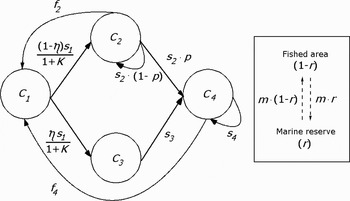
In this study we use a stage- and spatially-structured, individual-based model as in Miethe et al. (Reference Miethe, Pitchford and Dytham2009). A population is structured into three size-groups: early juveniles, small fish (juveniles and adults) and large adult fish (Figure 1). The classes C 1 to C 4 are characterized by the size and maturity status of individuals. Early juveniles of class C 1 grow to small size after one year. Depending on their maturation strategy, determined by the inherited trait value η, the probability to mature at large size, early juveniles may enter either class C 2, mature at small size (age 2) and reproduce, or enter class C 3, a sub-adult stage that matures one time step later at large size (age 3). With probability P individuals of class C 2 may also grow to large size and enter class C 4 once they have reached 4 years of age. Fecundity of large-sized fish (f 4) is assumed to be higher than that of small-sized fish (f 2) such that maturation at large size is favoured in the absence of fishing mortality. Density is limited at the juvenile stage using a carrying-capacity-related parameter K acting on juvenile survival, a setup based on a deterministic population model by Gårdmark et al. (Reference Gårdmark, Dieckmann and Lundberg2003) and analysed in the context of marine reserves in Miethe et al. (Reference Miethe, Pitchford and Dytham2009). The exact definition for K may differ for different ecological guilds and is scaled by the respective area size and the number of individuals in class C 1 (Table 1).
General model structured into 4 classes of three different size-groups: early juveniles C 1, small-sized individuals C 2 (mature) and C 3 (immature), large adults C 4. Each individual is assigned a location, fished or protected area. Changing location is possible and determined by probability of site fidelity (1 − m) and depends on the size of the respective areas. The specific set-ups for the different guilds are explained in Table 1. Parameters and trait values are listed in Table 2.

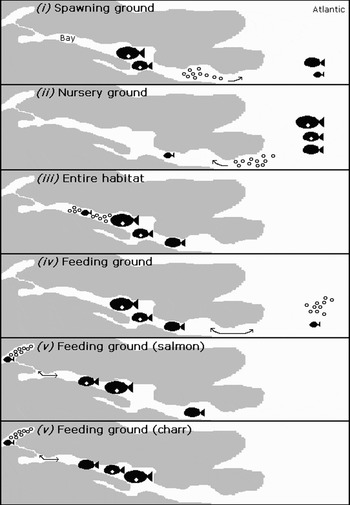
Scenarios for marine reserve implementation on different ecological guilds after the general model (Figure 1). Two harvesting events occur per year, during feeding and spawning seasons. Through a marine reserve certain classes of the protected population are protected from fishing (white circle) others are affected by one (half black circle) or two harvest events (black circle) depending on the migration patterns.

1common larval pool, number of recruits proportional to respective area size (r, 1 − r).
2number of recruits determined by offspring number produced in each area separately.
3K = k(C 1) the same carrying capacity K for fished and protected area.
4fished area: 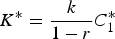 , marine reserve
 , which depend only on the local juvenile density and the relative area size.
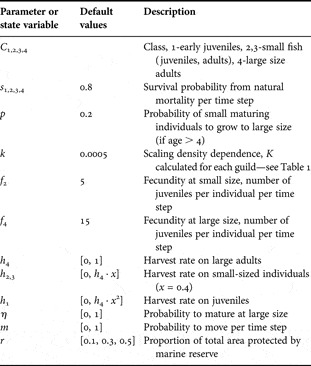
The population is divided into two subpopulations: one protected by a marine reserve, the other fished. Large individuals are subject to higher harvest rate (h 4) than small-sized fish and early juveniles (h 2,3 ,h 1). Even at maximum harvest rate, the stock does not collapse because we assume less than maximum harvest rates for small-sized individuals and early juveniles. Two harvest events occur per annual time step, one during each of the feeding and spawning seasons. Two traits are subject to variability, mutation and selection: (a) the probability η to mature at large size; and (b) the probability (1 − m) of site fidelity. Movement m between areas describes the probability that an individual switches areas between time steps, depending on the relative size of the respective areas (Figure 1). Parameter and trait values are listed and explained in Table 2.
Parameters and state variables used for simulations and illustrations.

As in the model by Miethe et al. (Reference Miethe, Pitchford and Dytham2009), reproduction occurs asexually at the beginning of each year, with offspring inheriting their movement behaviour and maturation strategy. Mutation is included by drawing a random trait value from a continuous uniform distribution with limits 0.1 and –0.1 centred on the parental strategy, leading to trait diversity in offspring (Dytham, Reference Dytham2003). Maximum and minimum values for the evolving traits are set to 0 and 1. At the start of each simulation the initial population of 10,000 individuals, has a uniform distribution in the evolving traits resulting in a mean of 0.5 for each trait. Individual fish are tracked by recording size-class, location, maturation size strategy, and their probability of site fidelity. The model is implemented and simulations run using C + +. Simulations are run for 200 annual time steps ensuring that evolutionary equilibrium was reached. There were ten realizations of each scenario, which was sufficient to characterize the variability between realizations in a similar model by Dytham & Travis (Reference Dytham and Travis2006). Yield describes the accumulated number of individuals caught over 200 time steps. This includes the total number of large individuals and the weighted number of intermediately sized individuals fished (i.e. multiplied by f 2/f 4), accounting for a biomass difference between the stages. We assume thereby a linear dependence between weight and fecundity (Beverton & Holt, Reference Beverton and Holt1957).
Modelling a reserve on spawning, nursery, feeding ground and entire habitat (guilds i–v)
Two harvesting events occur per year. Individuals without any protection from the reserve are exposed to both harvest events. Mature individuals are subject to harvesting while feeding and spawning. Immature individuals are affected by feeding ground mortality alone because they do not depart on a spawning migration. Individuals may suffer from either feeding or spawning ground mortality, or neither, or both, determined by the reserve status, maturity status and the ecological guild. For the sake of model parsimony, it is assumed that the fishing mortalities on spawning and feeding aggregations are equal.
The role of the reserve on each particular guild is detailed below:
(i) A reserve on a spawning ground protects only mature individuals. The movement between the fished and the protected parts of the spawning ground describes the degree of spawning site fidelity of repeat-spawning individuals returning seasonally from the feeding grounds. We assume that all larvae from the protected and fished area are transported to a nearby nursery ground (Wright et al., Reference Wright, Neat, Gibb, Gibb and Thordarson2006). Density-dependent survival is modelled acting on all juveniles simultaneously on the spatially segregated nursery grounds. On their first spawning event, mature individuals enter the reserve or the fished area randomly, with location only being dependent on relative reserve size. In an area that has only the function of a spawning ground and where nursery grounds exist separately, spawning site fidelity is acquired only at first reproduction, and natal homing is weak (McQuinn, Reference McQuinn1997; Robichaud & Rose, Reference Robichaud and Rose2001). While individuals belonging to the unprotected part of the population suffer from two harvest events per year, mature individuals in the protected population suffer only from one harvesting event during the feeding season. Immature individuals do not benefit from a spawning ground reserve because they are assumed not to migrate to spawning areas.
(ii) On a nursery ground larvae are assumed to arrive randomly with currents from a pool of larvae originating in distant spawning grounds. Density-dependent survival occurs on the nursery grounds, within each subpopulation. Individuals leave after one time step for feeding or spawning grounds. Within the nursery ground reserve only juveniles are protected, irrespective of their maturation strategy.
(iii) In a sedentary stock, all life stages inhabit the same area. A marine reserve may then protect fractions of the entire habitat. Reproduction occurs locally with larvae being retained in each subpopulation. Site fidelity and reserve size determine the location of each individual within reserve or fished area for the following time step. Individuals in the fished part of the area suffer two harvest events per year. All individuals are protected within the reserve irrespective of their maturity status.
(iv) A reserve may protect a feeding aggregation of a fish stock. Mature individuals leave the feeding grounds for reproduction and are therefore affected by fishing mortality on spawning grounds. Individuals return from their feeding location depending on their probability of site fidelity. In our model the larvae originating from external spawning and nursery grounds form a common pool where density-dependent survival acts on all juveniles. Individuals arriving for the first time on the feeding grounds choose their location randomly and enter the protected part with a probability that depends only on the reserve size.
(v) Different spawning grounds of anadromous species are isolated from each other. Freshwater spawning and nursery grounds may be coupled to adjacent inshore marine feeding grounds. Larvae grow into juveniles on local nursery grounds and enter the feeding grounds determined by feeding location of the parent before ascending the rivers to spawn. Feeding ground site fidelity may then support spawning ground fidelity and vice versa. The juveniles in each subpopulation are recruited locally within each subpopulation. Different anadromous species may differ in their return migration to the river. While in salmon only mature fish return to freshwater river for spawning, mature as well as immature charr migrate seasonally.
In both ecological guilds (iv) and (v, salmon) only part of the population is protected on the feeding grounds. Mature individuals always suffer from one harvesting event per year on the spawning grounds. Immature individuals are protected within the reserve from all fishing mortality. Stage-dependent harvest mortalities for modelling scenarios of the different ecological guilds are illustrated in Figure 2 and summarized in Table 2. The evolutionary effect of marine reserves on size at maturation and site fidelity is determined for the five different ecological guilds. We investigate the possibility of local adaptation with reserve implementation.
Scenarios for different ecological guilds (i–v) on the example of Gilbert Bay. Examples of species in Gilbert Bay: (i) capelin Mallotus villosus, (ii) white hake Urophycis tenuis, (iii) ‘Gilbert Bay’ cod Gadus morhua, (iv) Atlantic herring Clupea harengus, and (v) Atlantic salmon Salmo salar and Arctic charr Salvelinus alpinus. Four stages from the model are illustrated, the smallest black fish represent class C 1. Mature classes C 4 and C 2 indicated by a white spot. White circles represent spawned eggs. Location and direction of movement of classes are shown. Further details in Table 1.

RESULTS
Spawning (guild i) and nursery ground reserve (guild ii)
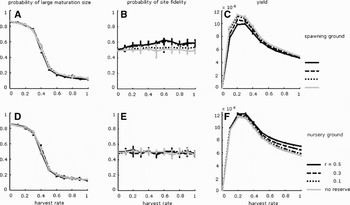
Without protection, harvest mortality induces a gradual switch from large to small maturation size with inflexion point at about h 4 = 0.4 (Figure 3A). At the end of the simulation site fidelity is close to 0.5 for all harvest rates, unchanged from the start of the simulation, indicating weak or no selection on site fidelity (Figure 3B). Yield decreases as the relative number of small-maturing individuals increases because smaller adults have lower biomass and lower fecundity contributing lower number of recruits per year. The implemented mutation size and probability do not affect the qualitative results. A marine reserve on a spawning ground or nursery ground does not prevent evolution towards small maturation size (Figure 3A, D). It occurs at the same harvest rate irrespective of reserve size. These results are also independent of site fidelity. At constant, non-evolving, high or low site fidelity evolution of maturation probability remains unaffected by reserve implementation (results not shown). While the probability of large maturation size stays the same for different harvest rates, yield decreases slightly with increasing reserve size because a smaller fraction of the population is exploited (Figure 3C). Site fidelity increases slightly for larger reserves with increasing harvest rate (Figure 3B). Individuals returning to a spawning area protected by a reserve have higher survival probability.
The effect of marine reserve (size r) on a spawning ground and nursery ground for a range of harvest rates. Simulation results for (A, D) probability of large maturation size and (B, E) site fidelity, which were calculated as the mean trait value of the juvenile class. (C, F) Yield accumulated over 200 time steps (mean of 10 realizations±SD).

Through protection of a nursery ground, mortality of juveniles is lowered. A higher number of fish survive to be fished at higher ages, which contributes to increased yield (Figure 3F). Site fidelity is a neutral trait because individuals spend only one time step on the nursery ground (Figure 3E). In this case parental location on the nursery ground does not determine the location of the offspring.
Entire habitat (guild iii) and feeding ground reserve (guild iv)
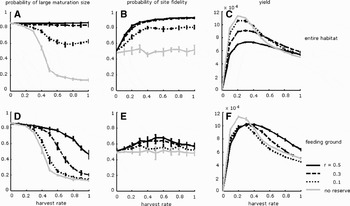
Protecting a fraction of the entire habitat of a sedentary population prevents evolution towards small maturation size (Figure 4A). With reserve implementation, yield is reduced at low harvest rate because a smaller fraction of the population is available for fishing (Figure 4C). An intermediate-sized reserve protecting 30% of the entire stock leads to full evolutionary protection and higher yield at high harvest rates (Figure 4A, C). At high harvest rate site fidelity increases limiting yield through decreased spillover from the reserve (Figure 4B, C). Larger reserves ensure evolutionary protection but result in lower yield because a smaller fraction of the population is fished.
The effect of a marine reserve (size r) on the entire habitat of a stock (A–C) or on the feeding ground of a migrating population (D–F). Simulation results for probability of large maturation size and site fidelity. Yield accumulated over 200 time steps (mean of 10 realizations ±SD).

A reserve on a feeding ground also weakens the selection pressure towards small maturation size (Figure 4D). The selection pressure towards stronger site fidelity is lower than for the guild where the entire habitat is protected (Figure 4E). Feeding ground fidelity of individuals within the reserve does not ensure protection from fishing mortality altogether. Individuals are still affected by spawning ground mortality. But because spawning ground mortality targets only mature individuals favouring the late-maturing strategy, reserve implementation on a feeding ground reduces the selection pressure towards small maturation size. Parental feeding ground location does not determine offspring feeding location, such that high site fidelity to the area of first feeding location increases fitness. With reserve implementation yield is higher at high harvest rates due to a higher proportion of large maturing individuals in the population and sufficient spillover (Figure 4F). Larger reserves are beneficial for yield as well as protecting individuals with large maturation size. Through protection of the entire feeding ground evolutionary protection in maturation size is ensured, with yield provided by the fishery on the spawning grounds.
Feeding ground reserve of anadromous species (guild v)
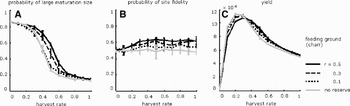
The evolutionary effect of a reserve on a feeding ground depends on the migratory pattern. Here, we analyse two examples of anadromy in a charr-like (Figure 5) and a salmon-like (Figure 6) species. In charr, both mature and immature fish migrate seasonally between spawning and protected feeding grounds. The evolutionary protection of large maturation size is low and increases only slightly with increasing reserve size (Figure 5A). Similarly, the reserve benefit to yield is small (Figure 5C).
The effect of a marine reserve (size r) on the feeding ground of an anadromous charr-like stock. Results modelling the evolution of large maturation size and site fidelity. Yield accumulated over 200 time steps (mean of 10 realizations ±SD).

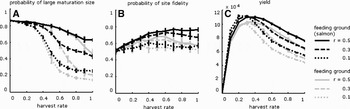
The effect of a marine reserve (size r) on the feeding ground reserve of an anadromous salmon-like stock (black) in comparison to the general case of feeding ground reserve (grey). Results modelling the evolution of large maturation size and site fidelity. Yield accumulated over 200 time steps (mean of 10 realizations ±SD).

In the case of a feeding ground reserve (previous section) and a reserve on a salmon-like population, the evolutionary protection resulting from a reserve is stronger (Figure 6A). This can be attributed to the higher protection of immature fish favouring the large maturing life history strategy. In contrast to charr-like population, only mature fish return to the spawning ground, while immature individuals remain in the feeding grounds until maturation. When comparing the results of a general feeding ground reserve to the special case of an anadromous salmon-like stock, we find protection from evolution towards small maturation size in both cases. But this protection is more effective for anadromous salmon resulting in higher probabilities of large maturation size and higher site fidelity at increased harvest rates (Figure 6A, B). Yield increases with reserve size and is also higher for the salmon population (Figure 6C). This difference is due to the local dynamics in recruitment and juvenile survival for the spawning subpopulations in anadromous salmon (described below).
Local adaptation through local recruitment
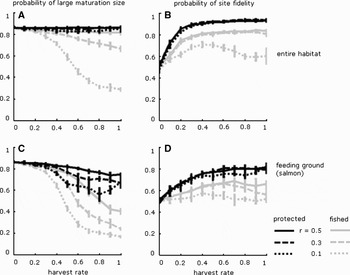
In the scenarios of a spawning, nursery or feeding ground reserve, individuals of the fished and protected subpopulations have the same mean maturation strategy and site fidelity, because individuals are recruited from a mixed pool. In the cases of sedentary and anadromous stocks, larvae are assumed to be retained on local spawning grounds and individuals are recruited locally. In both scenarios, we find high site fidelity or a strong response in evolution of site fidelity to reserve implementation. If the mean trait values of fished and protected parts of the population are calculated separately, we find that at high harvest rates the subpopulations differ in mean maturation strategy and mean site fidelity (Figure 7).
Local adaptation through a marine reserve (size r) protecting a fraction of the entire habitat (A, B) or the feeding ground of an anadromous salmon-like stock (C, D). Results are shown for fished (grey) and protected (black) parts of the population, separately. Results for the evolution of large maturation size (A, C), site fidelity (B, D) (mean of 10 realizations ±SD).

Through local adaptation the protected subpopulation has a higher probability of large maturation size than the fished population (Figure 7A, C). Increased harvest rate together with the local reproduction and recruitment leads to local adaptation facilitated by high site fidelity (Figure 7B, D). Some spillover from the reserve into the fished area occurs also at high harvest rates. The implemented mutation rate causes variability in offspring and prevents the evolving traits from reaching the extreme values 1 and 0 even at high harvest rates. From very small reserves, export of individuals is too low to prevent evolution to small maturation size in the fished population. The protection from evolution to small maturation size is strongest for the sedentary stock, where a fraction of the entire habitat is protected and all life stages benefit from lower mortality within the reserve during both feeding and spawning. In particular the protection of large mature individuals (C 4), which are most strongly affected by the size-selective harvesting, promotes the evolutionary effect of the reserve by reducing evolution towards small maturation size.
DISCUSSION
Size at maturation
The implementation of a reserve reduces fishing mortality and may protect against evolution towards small maturation size (Gårdmark et al., Reference Gårdmark, Dieckmann and Lundberg2003; Baskett et al., Reference Baskett, Levin, Gaines and Dushoff2005; Miethe et al., Reference Miethe, Pitchford and Dytham2009, Reference Miethe, Dytham, Dieckmann and Pitchford2010). We find that the degree to which marine reserves affect the evolution in size at maturation and site fidelity in different fish stocks is determined by the habitat function of the reserve. In this study we find that protection of the feeding ground of a stock reduces evolution towards small maturation size (Figure 4), supporting the conclusions of the evolutionary effect of a fishery exclusively targeting spawning fish obtained by Law & Grey (Reference Law and Grey1989), Heino (Reference Heino1998) and Dunlop et al. (Reference Dunlop, Baskett, Heino and Dieckmann2009). In this context one can trace the historic development of the north-east Arctic cod fishery (Godø, Reference Godø2003). Before 1920, the fishery targeted primarily coastal spawning aggregations, which would be selecting for delayed maturation. The development of the trawl fishery increased offshore exploitation on northern feeding grounds. Fishing pressure on feeding and nursery grounds may have caused the observed decrease in age at maturation (Jørgensen, Reference Jørgensen1990; Godø, Reference Godø2003; Marshall & McAdam, Reference Marshall and McAdam2007). Through the protection of feeding grounds with marine reserves historic developments in exploitation patterns may potentially be reversed, although such changes may occur at slower rates (Conover et al., Reference Conover, Munch and Arnott2009; Enberg et al., Reference Enberg, Dunlop, Jørgensen, Heino and Dieckmann2009).
Marine reserves on spawning grounds alone may not protect against evolution towards small maturation size (Figure 3). If a reserve on a spawning ground increases harvesting on feeding grounds through redistribution of fishing effort (Coleman et al., Reference Coleman, Baker and Koenig2004), then the evolutionary pressure towards small maturation size may even increase with reserve implementation. Similarly, the implementation of a nursery ground reserve, although reducing mortality and thereby slightly increasing abundances and yield, does not affect the evolution in maturation size. The ecological importance of protecting spawning grounds (Beets & Friedlander, Reference Beets and Friedlander1999; Mangel, Reference Mangel2000; De Mitcheson et al., Reference De Mitcheson, Cornish, Domeier, Colin, Russell and Lindeman2008) and nursery areas (Beck et al., Reference Beck, Heck, Able, Childers, Eggleston, Gillanders, Halpern, Hays, Hoshino, Minello, Orth, Sheridan and Weinstein2001; Burke et al., Reference Burke, Kenworthy and Wood2009) has been recognized. Furthermore, Apostolaki et al. (Reference Apostolaki, Milner-Gulland, McAllister and Kirkwood2002) found that it will be most efficient to protect the life stages mainly targeted by the fishery, particularly immature individuals on nursery grounds or adults on spawning grounds. The lack of such an ecological benefit to yield in our study is caused by evolution in size at maturation through harvesting. The fecundity of small-maturing individuals is lower and at high harvest rates the number of large-sized fish, that would otherwise contribute considerably to yield, is severely reduced.
Density-dependent survival was modelled at the juvenile stage and does not interfere with the evolutionary dynamics. Modelling density dependence at later stages would require detailed species-specific knowledge as it may affect the evolutionary outcome.
Site fidelity
With implementation of a reserve on the entire habitat of a sedentary population, mobility is an important factor influencing the evolution in maturation size (Miethe et al., Reference Miethe, Pitchford and Dytham2009). As abundance increases inside the reserve and fish are heavily exploited outside the reserve, the degree of site fidelity determines the net export of individuals from the reserve and thereby the yield from the fished area. Therefore selection for lower mobility with marine reserve implementation critically affects the attainability of conservation and fisheries goals (Baskett et al., Reference Baskett, Weitz and Levin2007b).
Similarly, we find that in migrating species selection on site fidelity is influenced by reserve design, although the selection is weaker than in sedentary stocks (Figures 3, 4 & 5). Site fidelity within the reserve does not ensure protection for offspring of migratory fish. In our model no imprinting occurs at the juvenile stage, such that newly recruited individuals arrive at a specific feeding or spawning location independent of their parental location. As harvest mortality increases precise return migrations are less important because the probability of survival until the following year decreases. Nevertheless, site fidelity plays an important role in the case of an anadromous stock, if spawning, nursery and feeding grounds are coupled (Klemetsen et al., Reference Klemetsen, Amundsen, Dempson, Jonsson, Jonsson, O'Connell and Mortensen2003). Our results show that high site fidelity leads to a rather localized effect of a marine reserve (Figure 7). Strong site fidelity to one location may even reduce the resilience of neighbouring populations due to environmental stochasticity and the lack of immigrants (Hauser & Carvalho, Reference Hauser and Carvalho2008). A more localized population structure of inshore stocks with limited larval and adult dispersal allows for local adaptation (Salvanes et al., Reference Salvanes, Skjæraasen and Nilsen2004). Protection of coastal areas was also found to be important for the long term conservation of anadromous ecotypes of salmon which face higher extinction risk than the non-anadromous types resident in freshwater lakes, and which are important for the wider population structure due to their higher level of straying (Wood et al., Reference Wood, Bickham, Nelson, Foote and Patton2008).
In sedentary stocks increased site fidelity reduces yield through reduced spillover (Figure 4). In contrast, reserves on feeding grounds of oceanodromous stocks lead to less selection for high site fidelity and offer protection of immature life stages. In this case high yield is ensured even at high exploitation rates.
Considering specific migration patterns
Here we considered changes in mobility only in relation to reserve implementation and the resulting implicit spatial heterogeneity in exploitation rates between two areas. In contrast, the migratory life history strategy itself may be subject to evolutionary change with a trade-off between anadromy versus residency as shown by Thériault et al. (Reference Thériault, Dunlop, Dieckmann, Bernatchez and Dodson2008) modelling brook charr evolution in age at migration and probability of migration.
Anadromous stocks differ in the specifics of their migration strategy; factors such as migration timing, degree of iteroparity and location of overwintering grounds (Klemetsen et al., Reference Klemetsen, Amundsen, Dempson, Jonsson, Jonsson, O'Connell and Mortensen2003; Quinn & Myers, Reference Quinn and Myers2004; Quinn et al., Reference Quinn, Hodgson, Flynn, Hilborn and Rogers2007). To form realistic expectations of marine reserve implementation it is important to consider details of the respective migration strategy. We find that, from an evolutionary perspective, it is important to determine whether mature and immature individuals separate in the course of seasonal spawning migrations. Differential mortality on individuals of the same age and size but different maturity status is likely to affect the evolution in maturation size. Reserves on feeding grounds of anadromous stocks were found to be very effective in preventing evolution of small maturation size because individuals close to reaching maturity are protected (Figures 4 & 6). In comparison, the evolutionary protection of feeding grounds of anadromous stocks, such as anadromous charr, can be weak if immature fish migrate seasonally together with mature fish between spawning and feeding grounds (Figure 5). Similarly, a feeding ground reserve may also be less effective in evolutionary protection of migrating stocks where immature individuals follow mature individuals to spawning grounds on so-called ‘dummy runs’ as observed in plaice (Arnold & Metcalfe, Reference Arnold and Metcalfe1996), herring (McQuinn, Reference McQuinn1997) and cod (Woodhead, Reference Woodhead1959; Rose, Reference Rose1993).
An increase in yield with marine reserve implementation can be expected from a feeding ground reserve on anadromous salmon (Figure 6). The combination of increased site fidelity, protection of the large-maturing life-history strategy, and harvesting on all mature fish during the spawning season allows for higher yield at all exploitation rates.
Conclusions for a marine reserve like Gilbert Bay
Since the collapse of offshore cod, inshore stocks such as the sedentary stock of Gilbert Bay have gained importance in fisheries. Management focuses on the sustainability of the remaining stock components and possibly recolonization of unoccupied offshore spawning grounds (Morris & Green, Reference Morris and Green2002; Wroblewski et al., Reference Wroblewski, Neis and Gosse2005). In the case of the Gilbert Bay reserve, ecological as well as evolutionary considerations justify the implementation of this reserve, which aims primarily to protect sedentary ‘Gilbert Bay’ cod and anadromous Atlantic salmon while allowing for subsistence fishery (Wroblewski et al., Reference Wroblewski, Kryger-Hann, Methven and Haedrich2007). Hu & Wroblewski (Reference Hu and Wroblewski2009) describe the zonation of the marine protected area with higher protection on spawning grounds. Small scale differential distribution of mature and immature fish within the Bay may then lead to lower evolutionary protection than expected for a sedentary stock like ‘Gilbert Bay’ cod. Depending on the fraction of feeding ground protected, the evolutionary effect on stocks such as Atlantic mackerel and Atlantic herring may be quite diluted. A small reserve like Gilbert Bay, with only 60 km2, may cover only a small fraction of the feeding range of a stock. Larger areas need to be protected for efficient protection from fisheries-induced evolution. In our models, population size and yield are similar for all guilds. In reality, migratory stocks are usually higher in abundance and larger in biomass than sedentary ones (Robichaud & Rose, Reference Robichaud and Rose2004). Migratory stocks inhabit larger areas so the size of a protected area covering 10% of the range will be very different area sizes for different guilds, which will influence the achievability of successful marine reserve design (Agardy et al., Reference Agardy, Bridgewater, Crosby, Day, Dayton, Kenchington, Laffoley, Mcconney, Murray, Parks and Peau2003). On the other hand, recent studies suggest higher population structuring and lower connectivity than previously assumed, which could facilitate management of locally exploited stocks even by the use of small reserves (Ruzzante et al., Reference Ruzzante, Taggart, Lang and Cook2000a, Reference Ruzzante, Wroblewski, Taggart, Smedbol, Cook and Goddardb; Knutsen et al., Reference Knutsen, Jorde, André and Stenseth2003; Salvanes et al., Reference Salvanes, Skjæraasen and Nilsen2004; Pampoulie et al., Reference Pampoulie, Ruzzante, Chosson, Jorundsdottir, Taylor, Thorsteinsson, Danielsdottir and Marteinsdottir2006; Bergstad et al., Reference Bergstad, Jørgensen, Knutsen and Berge2008).
We chose five distinct life history scenarios, but fish can be grouped into many guilds based on their habitat preferences, migration, feeding and reproductive mode (Elliott et al., Reference Elliott, Whitfield, Potter, Blaber, Cyrus, Nordlie and Harrison2007; Franco et al., Reference Franco, Elliott, Franzoi and Torricelli2008). Able (Reference Able2005) pointed out that there exists a continuum of strategies. It is important to determine whether sedentary fish leave for feeding, as this may expose them to fishing mortality despite local reserve implementation. For example eastern Newfoundland inshore cod stocks, which are considered to be sedentary, disperse temporarily along the coast to feed (Wroblewski et al., Reference Wroblewski, Neis and Gosse2005; Bradbury et al., Reference Bradbury, Laurel, Robichaud, Rose, Snelgrove, Gregory, Cote and Windle2008).
Protection can have indirect effects on the rest of the ecological community. For example, declines in top-predator abundances were found to cause cascade effects with increases in invertebrate and phytoplankton abundance (Worm & Myers, Reference Worm and Myers2003; Frank et al., Reference Frank, Petrie, Choi and Leggett2005). In contrast to the predominantly piscivorous offshore cod, resident cod of Gilbert Bay feed mainly on invertebrates (Morris & Green, Reference Morris and Green2002; Wroblewski et al., Reference Wroblewski, Neis and Gosse2005). Taking this interaction into account, it can be suggested that effective protection of sedentary cod as found in our analysis, causing their abundance to increase, is then likely to reduce invertebrate abundance within the reserve. Competitive, trophic and mutualistic interactions have all been observed and modelled, and are important for a ‘multi-species approach for marine reserve design’ (Baskett et al., Reference Baskett, Micheli and Levin2007a).
General conclusions
Depending on the life history strategy, the time individuals spend within a reserve varies. Our model confirms the result of Dunlop et al. (Reference Dunlop, Baskett, Heino and Dieckmann2009) that a reserve on a feeding ground helps to protect against evolution towards smaller maturation size. A reserve on a spawning ground reduces size-selective fishing mortality and reduces the selection pressure towards smaller and younger maturation. Nevertheless, reserve implementation creates a stage-dependent mortality pattern favouring the harvest of mature individuals migrating to the spawning grounds over immature individuals which stay behind. This favours earlier maturation. In our models these effects balance out and a spawning ground reserve does not affect fisheries-induced evolution in maturation size and age.
Implementation of a reserve may lead to increasing site fidelity in sedentary stocks and salmon-like anadromous stocks, supporting local adaptation. Although there is protection against evolution towards small maturation size within the reserve on the entire habitat of a sedentary stock, high site fidelity limits spillover and therefore yield. In contrast, a reserve on a feeding ground of an oceanodromous stock or of an andromous stock, where only mature individuals migrate to spawning grounds, can lead to both evolutionary protection and increased yield. As seen from the analysis of different ecological guilds, specific characteristics of a stock in life history, migration pattern and exploitation pattern affect ecological and evolutionary dynamics. Considering the diversity of fish stocks and fisheries, it is important not only to approach management questions strategically, but also tailor management plans to specific ecosystems and target species to formulate direct and useful management advice. Andersen & Brander (Reference Andersen and Brander2009) point out the priority of ecological considerations in fisheries management, because the expected rate of fisheries-induced evolutionary change may be slower than previously estimated. Although conclusive genetic evidence for fisheries-induced evolutionary changes is absent, possible adaptive or evolutionary changes do need to be considered in the management context (Jørgensen et al., Reference Jørgensen, Enberg, Dunlop, Arlinghaus, Boukal, Brander, Ernande, Gårdmark, Johnston, Matsumuru, Pardoe, Rabb, Silva, Vainikka, Dieckmann, Heino and Rijnsdorp2007; Kuparinen & Merilä, Reference Kuparinen and Merilä2007; Hutchings & Fraser, Reference Hutchings and Fraser2008). A precautionary approach is encouraged, especially as reversal of evolutionary changes may occur at a slow rate (Law, Reference Law2000; Conover et al., Reference Conover, Munch and Arnott2009; Dunlop et al., Reference Dunlop, Baskett, Heino and Dieckmann2009; Enberg et al., Reference Enberg, Dunlop, Jørgensen, Heino and Dieckmann2009). Marine reserves are a useful management tool supporting evolutionarily enlightened protection of migratory stocks.
ACKNOWLEDGEMENTS
This research was supported by the European Marie Curie Research Training Network FishACE (Fisheries-induced Adaptive Changes in Exploited Stocks), funded through the European Community's Sixth Framework Programme (Contract MRTN-CT-2004-005578). We would like to thank members of the FishACE network for their support. We are thankful to M. Heino, R. Law, C. Roberts, C. West and three anonymous referees for their helpful and constructive comments on earlier versions of the manuscript.