The breeding of goats has a rich tradition and history in Slovakia. The majority are dairy goats, predominantly the White Shorthaired, then the Brown Shorthaired breeds and finally the dual-purpose Anglo-Nubian breed (Oravcová, Reference Oravcová2013). Recently, the demand for goat milk and its products has increased, so attention is paid to the best nutritional, techno-functional and sanitary qualities of dairy goat products, all of them depending on the udder health (Kováčová et al., Reference Kováčová, Výrostková, Dudriková, Zigo, Semjon and Regecová2021). Mastitis, an intramammary inflammation mostly resulting of bacterial infection, is the most important disease of the udder in dairy animals. The health of the udder is critical for dairy farms and is correlated with milk yield, quality of milk and food safety (Spuria et al., Reference Spuria, Biasibetti, Bisanzio, Biasato, De Meneghi, Nebbia, Robino, Bianco, Lamberti, Caruso, Di Blasi, Peletto, Masoero, Dondo and Capucchio2017; Zigo et al., Reference Zigo, Farkašová, Výrostková, Regecová, Ondrašovičová, Vargová, Sasáková, Pecka-Kielb, Bursová and Kiss2022). Mastitis in goats is responsible for a drop in milk production and protein, lactose and fat contents (Novac and Andrei, Reference Novac and Andrei2020) as also observed in dairy ewes (Tvarožková et al., Reference Tvarožková, Tančin, Holko, Uhrinčať and Mačuhová2019). Intramammary infection is also the main cause of somatic cell count (SCC) increase in milk (Raynal-Ljutovac et al., Reference Raynal-Ljutovac, Pirisi, De Crémoux and Gonzalo2007) which is used for mastitis detection in goats as in other ruminants. However, other factors that also affect SCC in goat milk include parity, stage of lactation, oestrus cycle and breed (Paape et al., Reference Paape, Wiggans, Bannerman, Thomas, Sanders, Contreras, Moroni and Miller2007; Persson et al., Reference Persson, Larsen and Nyman2014). Udder and teat morphologies, milking frequency, grazing management, milking machine equipment and settings (Marnet et al., Reference Marnet, Dzidic, Le Caro and Hubert2018) and viral co-infection with CAEV (Sanchez et al., Reference Sánchez, Contreras, Corrales and Marco2001) can all influence SCC, making high SCC difficult to interpret in goats, compared with cows and ewes (Persson and Olofsson, Reference Persson and Olofsson2011). Further, subclinical mastitis is a problem in goats where prevalence rates are important (reported as 35% to 70%: Leitner et al. Reference Leitner, Merin, Glickman, Weisblit, Krifucks, Shwimmer and Saran2004a; Hall and Rycroft, Reference Hall and Rycroft2007). The major types of pathogens causing subclinical mastitis in dairy goats are coagulase-negative staphylococci (CNS) (Bergonier et al., Reference Bergonier, De Crémoux, Rupp, Lagriffoul and Berthelot2003; Dore et al., Reference Dore, Liciardi, Amatiste, Bergagna, Bolzoni, Caligiuri, Cerrone, Farina, Montagna, Saletti, Scatassa, Sotgiu and Cannas2016), in particular Staphylococcus caprae and Staphylococcus epidermidis (Leitner et al., Reference Leitner, Merin and Silanikove2004b). However, the main pathogens affecting goats in Slovakia and their effects on udder inflammation are still unknown.
The hypothesis of this work was that the high level of somatic cells in the milk of goats is caused by mastitis pathogens and that the increased SCC changes milk composition. Therefore, the aim of this study was to describe the frequency of distribution of SCC from half udder milk samples, identify causative bacteria of mastitis and evaluate effects on milk composition in dairy goats.
Material and methods
Sampling
The study was carried out on a goat dairy farm in northern Slovakia on dairy goats of the White Shorthaired breed. A total of 458 half udder milk samples from 129 goats (44 goats in their first lactation, 61 in second and 24 in third and higher lactations) were collected during evening milking in June (222) and July (236 samples). The goats had kidded from mid-February to mid-March, so the samples were from mid- to late lactation. Only 22 animals were not sampled in both months. Only clinically healthy goats without any visual abnormalities in udder or milk were included. The first squirts of milk from teats were discarded and subsequently the teat end was cleaned with 70% alcohol. Then the milk samples were collected for bacteriological cultivation using sterile tubes (5 ml) and followed by sampling for determination of SCC and milk composition (50 ml). Samples were frozen at −20°C until thawing and cultivation (Sánchez et al., Reference Sánchez, Contreras, Jiménez, Luengo, Corrales and Fernández2003).
Microbiological analysis
Milk samples (10 μl) were incubated aerobically on blood agar plates (MkB Test a.s., Rosina, SR) for 24 h at 37°C. Bacterial colonies were identified by haemolysis, a catalase test, aesculin hydrolysis, Gram staining and cell morphology. Presumptive Staphylococcus aureus were identified with the clumping factor test (DiaMondiaL Staph Plus Kit, Germany). Aesculin-positive streptococci were subcultured to identify Streptococcus uberis or Enterococcus sp. on modified Rambach agar (Watts et al., Reference Watts, Salmon and Yancey1993). Aesculin negative streptococci were characterised by Lancefield serotyping (DiaMondiaL Strept Kit, Germany). Gram and catalase positive small colonies were identified as coryneform bacteria. Large colonies, Gram and catalase positive, capable of forming endospores were identified as Bacillus sp. All Gram positive and Gram negative colonies were classified using MALDI-TOF MS (Bruker Daltonics, Bremen, Germany) (Tvarožková et al., Reference Tvarožková, Vašíček, Uhrinčať, Mačuhová, Hleba and Tančin2021). Presence of contagious pathogens (Staphylococcus aureus, Streptococcus agalactiae) was reported as positive if one or more colonies were found. Presence of other pathogens was reported as positive if at least five colonies were found. Samples were considered contaminated and removed from data analysis if more than two different colony types were isolated on blood agar.
Somatic cell analysis
SCC were determined using a Somacount 150 (Bentley Czech, USA). Milk composition was determined using MilkoScan FT 120 (Foss Electric, Hillerød, Denmark).
Statistical analysis
Milk samples were divided into four SCC groups on the basis of half udder SCC. Group SCC1 comprised samples of less than 500 × 103 cells ml−1. SCC2 ranged from 500 to 1000, SCC3 from 1000 to 2000 and SCC4 comprised samples above 2000, all × 103 cells ml−1. For statistical evaluation SCC were recalculated to SCS: LOG2 (SCC/100 000) + 3.
Relationships among traits were analysed using Pearson's correlation coefficients. Statistical analysis was performed using the GLM procedure in SAS9.2 (2009). The resulting models, based on preliminary analysis of possible sources of variability of investigated traits, are specified in the online Supplementary File. Results are presented as LSmeans ± standard error. The effects in the models were tested using the F-test. Differences between LSmeans were tested using multiple ranging Sheffes tests. The differences were considered statistically significant at P ≤ 0.05.
Results
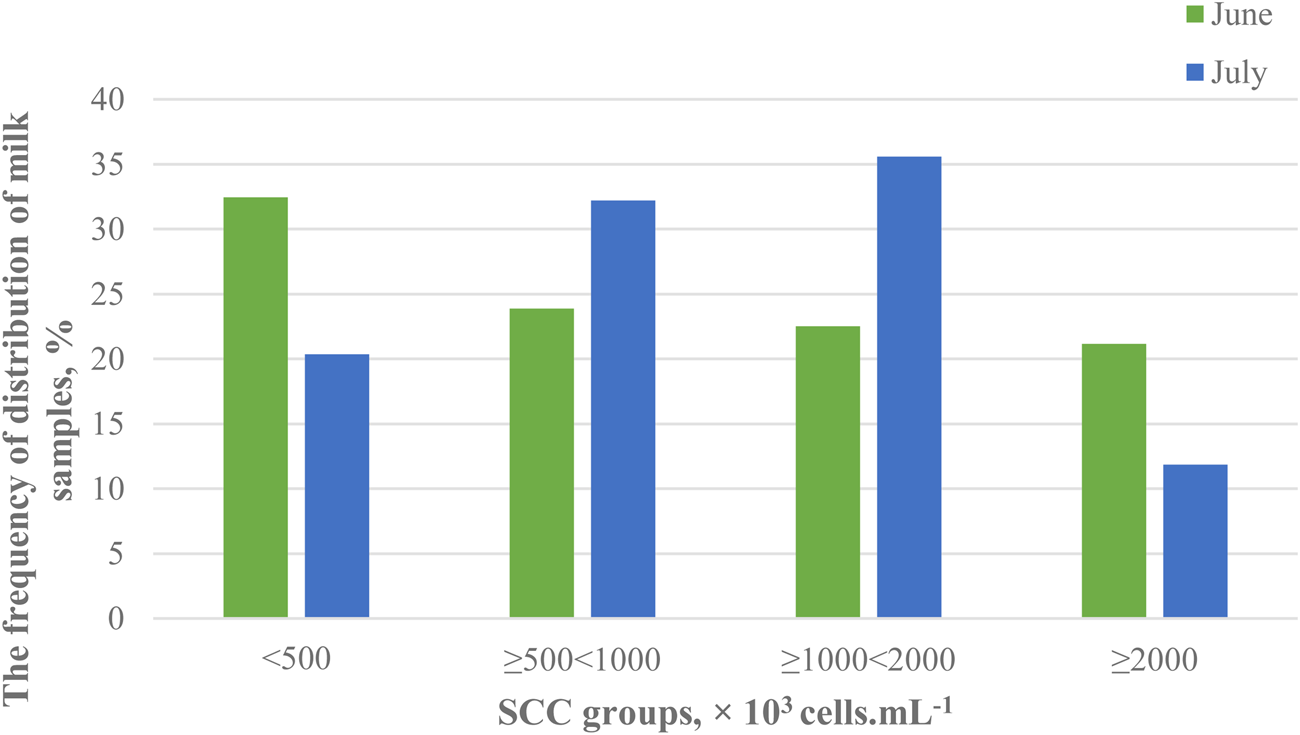
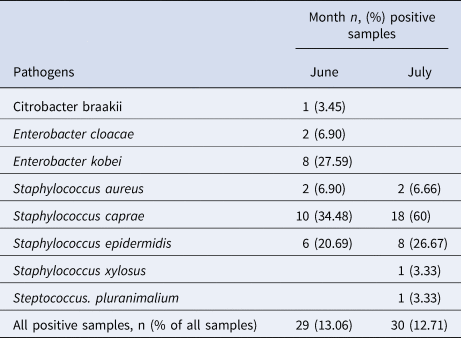
The overall mean SCC was 1250 ± 1265 × 103 cells mL−1 (SCS 6.10 ± 1.30). Classification by SCC groups is shown in Figure 1. More than 50% of individual samples were below 106 cells mL−1 and 32.43 and 20.34% of samples were classified in SCC1 group (< 500 × 103 cells ml−1) in the months June and July, respectively (Fig. 1). Bacteria presence was detected from 12.88% of milk samples, none of which were contaminated. The most common bacteria found were CNS (72.88%). The most common CNS was Staphylococcus caprae (65.12%) (Table 1). Staphylococcus aureus was isolated from 6.90% and 6.66% of samples taken in June and July, respectively (Table 1). Seven goats had the same pathogen in both halves of udder and four goats had different species of pathogens in the two udder halves. Bacterial positive samples were found only in 1.67%, 13.95%, 14.93% and 25.33% in SCC1, SCC2, SCC3 and SCC4, respectively.
Frequency of distribution of half udder milk samples for four SCC groups ( × 103 cells ml−1) in June and July.

The incidence of pathogens in goat milk samples taken in June and July

We compared bacteria positive and negative milk samples within the SCC3 and SCC4 groups. In total we observed significantly higher SCS in milk samples with a pathogen (7.48 ± 0.11) compared with no pathogen (7.16 ± 0.05, P < 0.001: model 2). We found no effect of the month of sampling on SCC (online Supplementary Table S1), with more milk samples in SCC2 and SCC3 and fewer in SCC1 in July compared to June (Fig. 1). However, the mean SCS when only SCC3 and SCC4 were analysed (model 2) dropped significantly (P < 0.05) from June (7.49 ± 0.09) to July (7.15 ± 0.08). Parity significantly influenced SCS, where SCS significantly increased from first (5.82 ± 0.10) to second (6.17 ± 0.08) and third and higher lactation (6.54 ± 0.16: P < 0.05, online Supplementary Table S2).
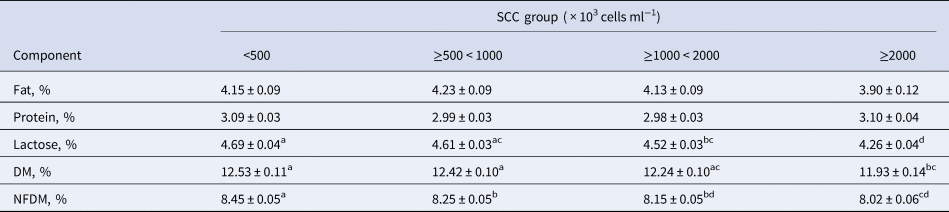
Significantly less protein, NFDM and lactose were found in July than in June, whereas fat content was the reverse (online Supplementary Table S1). Milk composition was not influenced by parity but SCS significantly increased with parity (5.82 ± 0.10, 6.17 ± 0.08 and 6.54 ± 0.16 for first, second and greater parities, online Supplementary Table S2). Milk composition in the four SCC groups is presented in Table 2. Statistically significant negative correlations were found between SCS and lactose content (−0.37), dry matter (−0.19) and non-fat dry matter (−0.30) (P < 0.001). The correlations between SCS and fat or protein were not significant.
Milk composition in the four SCC groups

Note: a,b,c,d LS Means and standard error within row with different letters are significantly different at P < 0.05, DM, dry matter; NFDM, non-fat dry matter.
Discussion
Our data confirm the presence of high SCC in goat milk samples, comparable to those of Moroni et al. (Reference Moroni, Pisoni, Antonini, Ruffo, Carli, Varisco and Boettcher2005), Gosselin et al. (Reference Gosselin, Dufour and Middleton2020) and Podhorecká et al. (Reference Podhorecká, Borková, Šulc, Seydlová, Dragounová, Švejcarová, Peroutková and Elich2021) but almost twice that reported by Persson and Olofsson, (Reference Persson and Olofsson2011). We observed more than 50% samples with SCC less than 106 cells ml−1 which we interpret as probably without infection. Albenzio et al. (Reference Albenzio, Santillo, Kelly, Caroprese, Marino and Sevi2015) reported SCC of 700 × 103 cells mL−1 as a threshold which represents changes in leucocyte distribution as a reflection of the immune status of the udder.
Persson and Olofsson (Reference Persson and Olofsson2011) and Bagnicka et al. (Reference Bagnicka, Winnicka, Jozwik, Rzewuska, Strzalkowska, Kościuczuk, Prusak, Kaba, Horbańczuk and Krzyzewski2011) reported the presence of pathogens in 18% and 35% of milk samples respectively, compared to our overall value of 15% and 25% in the highest SCC groups (SCC3 and SCC4, respectively). In our study CNS were the most common bacteria isolated. Our results also confirm the results of Leitner et al. (Reference Leitner, Merin and Silanikove2004b) and Persson and Olofsson (Reference Persson and Olofsson2011) who reported that CNS were the most frequent pathogens in milk of goats. Among these pathogens Koop et al. (Reference Koop, De Vliegher, De Visscher, Supré, Haesebrouck, Nielen and van Werven2012) and Gosselin et al. (Reference Gosselin, Dufour and Middleton2020) found Staphylococcus caprae as the second more frequent pathogen when we detected S. caprae as the most common pathogen. Staphylococcus aureus is considered the most important contagious pathogen in dairy goats, ranging from 4% to 40% of bacteriologically positive samples (Min et al., Reference Min, Tomita and Hart2007; Marogna et al., Reference Marogna, Rolesu, Lollai, Tola and Leori2010; Persson and Olofsson, Reference Persson and Olofsson2011; Dore et al., Reference Dore, Liciardi, Amatiste, Bergagna, Bolzoni, Caligiuri, Cerrone, Farina, Montagna, Saletti, Scatassa, Sotgiu and Cannas2016). Our data were at the bottom end of this range (7%). The number of same infection (7/129 goats) or dual pathogen infections (4/129 goats) in both half udder in our study is low, in agreement with Persson and Olofsson (Reference Persson and Olofsson2011) (9 and 3/111).
One of the main reasons for a high SCC in milk is the presence of mastitis pathogens, whether it be cows (Holko et al., Reference Holko, Tančin, Vršková and Tvarožková2019) or goats. Our findings confirm this result and seem to be different from a previous study done in dairy ewes in which we did not find effect of different pathogens on SCS over the range 6.68 ± 0.41 to 8.11 ± 0.63 (Tvarožková et al., Reference Tvarožková, Tančin, Uhrinčať, Hleba and Mačuhová2020). Various observations have reported the effect of different pathogens on SCC in milk of goats (Moroni et al., Reference Moroni, Pisoni, Antonini, Ruffo, Carli, Varisco and Boettcher2005; Koop et al., Reference Koop, De Vliegher, De Visscher, Supré, Haesebrouck, Nielen and van Werven2012; Gosselin et al., Reference Gosselin, Dufour and Middleton2020). Staphylococcus caprae was associated with higher SCC compared to other CNS (Moroni et al., Reference Moroni, Pisoni, Antonini, Ruffo, Carli, Varisco and Boettcher2005). Koop et al. (Reference Koop, De Vliegher, De Visscher, Supré, Haesebrouck, Nielen and van Werven2012) recorded a higher SCC in milk samples with S. aureus compared to milk samples infected by CNS. The low number of S. aureus infections meant that we could neither confirm nor refute this observation. In another study S. caprae, S. epidermidis, S. simulans and S. xylosus were associated with higher SCC than other CNS species (Gosselin et al., Reference Gosselin, Dufour and Middleton2020). We have considered the possibility that our high SCC values might indicate infection by microorganisms other than those we could detect using the methods employed (Mycoplasma, for example). Given the high number of such samples (high SCC in the absence of an identified pathogen) we consider this unlikely. Accordingly, it may be that the diagnostic value of SCC is lower in goats than in cows. Our data could also be interpreted as indicating that animals with a SCC ≥ 106 cells ml−1 have subclinical mastitis and those with a SCC < 500 × 103 cells ml−1 indicate absence of infection, as suggested by Persson and Olofsson (Reference Persson and Olofsson2011) who reported that the SCC of uninfected udder halves had a mean SCC of 478 × 103 cells ml−1. So far, the SCC threshold indicating mastitis in the udder of goats has not been agreed.
We did not observe an effect of month/stage of lactation on SCS contrary to other studies (Paape et al., Reference Paape, Wiggans, Bannerman, Thomas, Sanders, Contreras, Moroni and Miller2007; Persson et al., Reference Persson, Nyman, Söderquist, Tomic and Persson Waller2017; Smistad et al., Reference Smistad, Sølverød, Inglingstad and Østerås2021) but the relative proximity of our two samples, both in mid lactation when milk production was stabilized, could explain this observation. On the other hand, we detected a significant influence of parity on SCS, as did Smistad et al. (Reference Smistad, Sølverød, Inglingstad and Østerås2021).
The milk composition of uninfected udder halves is similar to those described by Currò et al. (Reference Currò, Manuelian, De Marchi, Claps, Rufrano and Neglia2019). Yakan et al. (Reference Yakan, Ozkan, Sakar, Ates, Kocak, Dogruer and Ozbeyaz2019) reported an increase in protein content in late lactation, which we did not observe at the earlier lactation stage we used. A statistically significant but weak negative correlation was observed between the content of lactose and SCS (−0.37, P < 0.001). Similar relationship between SCC and milk lactose content was reported by Ying et al. (Reference Ying, Yang and Hsu2004) in goats and by Oravcová et al. (Reference Oravcová, Mačuhová and Tančin2018) in dairy ewes. Such a relationship is to be expected on the basis of tight junction integrity, ‘leaky’ tight junctions (as a consequence of infection and inflammation) allowing partial equilibration between plasma and milk such that somatic cells enter milk and lactose exits (Ben-Chedly et al., Reference Ben-Chedly, Lacasse, Marnet, Wiart-Letort, Finot and Boutinaud2009).
In conclusion, as in other goat studies, a high occurrence of milk samples with high somatic cell count at the half udder level was observed. Nevertheless, we also confirmed that only low percentage of samples with high somatic cell count were bacteriologically positive. Even if the bacteriologically positive samples had higher SCC in groups with high SCC (SCC3 and SCC4) we assume that SCC should not be regarded as a gold standard of infection in goats. More intensive study of the relationship between somatic cell count and caprine udder health status is needed.
Supplementary material
The supplementary material for this article can be found at https://doi.org/10.1017/S0022029923000237
Acknowledgement
The research was supported by the APVV-21-0134 ‘Subclinical mastitis in ewes and goats farms: pathogens, somatic cells and udder morphology’ and by the VEGA 1/0597/22 ‘Aetiology of somatic cell counts changes in the mammary gland of goats: physiological and pathological aspects’.