




No CrossRef data available.
Article contents
The influence of sampling effort and the performance of the Kato-Katz technique in diagnosing Schistosoma mansoni and hookworm co-infections in rural Côte d'Ivoire
Published online by Cambridge University Press: 19 January 2004
Abstract
The Kato-Katz method is widely used for diagnosing helminth infections in epidemiological surveys, but is known to have a low sensitivity. In the case of Schistosoma mansoni, statistical methods have been developed to compensate for the poor sensitivity, but the same is not true of any other helminth parasite, or infections with multiple-helminth species. We screened 101 schoolchildren from a rural area of Côte d'Ivoire over 5 consecutive days and made 5 Kato-Katz readings from each stool specimen. We estimated single and dual-species infections with S. mansoni and hookworm based on raw egg count data and after developing a latent-class model. The cumulative prevalence of co-infections was estimated at 9·9% after reading slides on the first day, and 57·0% after reading all 25 slides per person. The latent class model yielded a co-infection prevalence estimate of 79·6%, with marginal prevalence estimates for hookworm and S. mansoni infections of 83·9% and 91·6% respectively. The sensitivities of a single Kato-Katz thick smear for detection of S. mansoni alone, hookworms alone, or S. mansoni plus hookworms were 22·4%, 8·0% and 17·7%, respectively. In the current setting this could be attributable to low infection intensities of both parasites, combined with intra-specimen and day-to-day variation in egg output. If confirmed in other settings, these findings have implications for estimating the prevalence of multiple species helminth infections, and hence the design and implementation of efficacious and cost-effective control programmes.
Keywords
Information
- Type
- Research Article
- Information
- Copyright
- 2003 Cambridge University Press
INTRODUCTION
Schistosoma mansoni and the hookworms (Ancylostoma duodenale and Necator americanus) are common helminth infections of school-age children in much of the developing world, disproportionately affecting the rural poor (WHO, 2002). They are often endemic in the same communities (Brooker, Booth & Guyatt, 1999; Keiser et al. 2002 a), but do not necessarily infect the same individuals due to their independent modes of transmission. People become infected with S. mansoni after contact with freshwater bodies inhabited by cercariae that are shed by intermediate host snails of the Biomphalaria genus. The most important route of transmission for hookworms is via L3 larvae that reside in the soil and penetrate the skin of passing individuals. The probability of co-infection is therefore primarily driven by a combination of behavioural, environmental and socio-economic factors.
The value of accurate diagnosis is reflected in the weight given to the prevalence of infection in the field of helminth epidemiology and control. The WHO issues guidelines which recommend control strategies based on estimates of prevalence and mean egg counts (Montresor et al. 2002). Estimates of the national or global burden of morbidity associated with parasitism, including disability adjusted life years (DALYs) lost, rely on meta-analysis of existing data (Murray & Lopez, 1997; Ezzati et al. 2002). The prevalence of infection is a crucial parameter in these analyses, since it sets the upper limit for the prevalence of any morbidity currently associated with the infection. In the absence of survey data in which individual diagnosis of co-infections has been made, it is possible to apply statistical models to marginal prevalence data to estimate the prevalence of co-infections (Booth & Bundy, 1995; Howard, Donnelly & Chan, 2001). The precision of these estimates largely depends on accurate diagnosis of co-infections within the surveys used to develop the models.
A common diagnostic tool for helminth infections in community-based epidemiological surveys and monitoring of control programmes is the Kato-Katz technique, which detects the presence of parasite ova in stool samples (Katz, Chaves & Pellegrino, 1972) However, the sensitivity of a single examination may be very low, due to a combination of small amounts of stool in each examination, variation in the distribution of eggs within a single stool specimen and variation in egg output from one day to another (Hall, 1981; De Vlas et al. 1992; Engels et al. 1997; Utzinger et al. 2001, 2002). Screening individuals several times therefore yields the most precise diagnosis of both infection status and intensity. To make use of existing data where this protocol has not been followed, it is possible to statistically model the within- and between-individual variation of S. mansoni infections (De Vlas et al. 1992), but until now this has not been attempted for hookworm infections, let alone co-infections with S. mansoni plus hookworm.
Previously, we have observed that estimating the prevalence of infection of both S. mansoni and hookworm infections among schoolchildren in a rural area of Côte d'Ivoire was dependent on the sampling effort (Utzinger et al. 2001, 2002). In this paper, we extend the analysis by presenting estimates of the prevalence of dual infections from raw egg count data collected over 5 consecutive days, and then after applying a newly developed latent class model designed to estimate true infection prevalences as well as the sensitivity of the Kato-Katz technique in diagnosing both single- and dual-species infections.
MATERIALS AND METHODS
Study population, field and laboratory procedures
Data for the present analyses came from an epidemiological survey conducted amongst children from grade 3 in 2 primary schools in a rural area of western Côte d'Ivoire. Characteristics of the villages, and operational aspects, are given in detail elsewhere (Utzinger et al. 2001, 2002). From the 107 children who attended grade 3 and from whom consent was received, 6 were not included in the present analysis, as they did not provide stool specimens on all sampling days. The remaining 101 children had complete data sets, namely 25 Kato-Katz thick smears, consisting of 5 randomly selected samples taken from each of 5 stool specimen collected over consecutive days.
We prepared 42 mg Kato-Katz thick smears on microscope slides following standardized, quality-controlled procedures (Katz et al. 1972). The slides were allowed to clear for 30–45 min, and then they were quantitatively examined under light microscopes (Wild Heerbrugg) by experienced microscopists. The numbers of ova of hookworms and S. mansoni were counted and recorded separately. Since hookworm eggs are rapidly over-cleared on the slides following the Kato-Katz method, great care was taken to complete the readings within 45 min after the clearing time (Martin & Beaver, 1968). Egg counts were multiplied by a factor 24 to express the number of eggs per gram of stool (e.p.g.).
Statistical analysis
The statistical analysis was carried out in STATA v7.0 (Stata Corporation, College Station, Texas, USA) and Winbugs v1.3 statistical software (MRC Biostatistics Unit). The main objectives of the analysis were to (i) investigate the relationship between sampling effort and the extent of S. mansoni–hookworm co-infection; (ii) assess the sensitivity of a single Kato-Katz thick smear to diagnose S. mansoni, hookworms and co-infection; and (iii) estimate the prevalence of S. mansoni and hookworm co-infection, by taking into account the sensitivity of the test.
Descriptive summary measures were calculated in order to obtain unadjusted estimates of single and dual-species infection prevalences and the average intensity (expressed as e.p.g.) for each one of the 25 sampling efforts. Daily and overall prevalences were calculated from the raw data.
To facilitate estimation of the diagnostic error, as well as the prevalence of the 4 different infection types under the condition of low detectability of infection, a latent class multinomial model was developed (Goodman, 1974). This form of model assumes that the ‘true’ infection status of each individual is unobserved (latent) and arises from a multinomial distribution with probabilities equal to the underlying prevalence of each infection and co-infection in the population. Individual and day-to-day variations of egg counts were also modelled on the logit transformation of the infection probabilities considering absence of either infection as the baseline category. The observed data were assumed to be independent conditionally on the latent data, arising from a multinomial distribution with probabilities related to the sensitivity of the test to diagnose an infection with S. mansoni only, hookworms only, or co-infection. The model assumed that the test was 100% specific; hence the probability of false positives was zero. A Bayesian approach was adopted for model fitting, using Markov chain Monte Carlo (MCMC) simulation methods (Gelfand & Smith, 1990). Detailed specifications of the model and the fitting procedure are given in the Appendix. Marginal prevalence estimates of hookworm and schistosome infection prevalences were obtained by inverse transformation of the logit estimates and were compared with those obtained from independent latent class logistic models for the prevalence of each type of infection (Utzinger et al. 2002).
RESULTS
Figure 1 depicts how the observed prevalence of dual-species infections in the study villages was related to sampling effort. After reading the Kato-Katz thick smears from the first day, the prevalence of dual-infections was 9·9%. The marginal prevalence of hookworm infection was 22·8% and that of S. mansoni infection was 41·6%. After having read all 25 slides per person, the observed prevalence of co-infections was 57·4%. The marginal infection prevalences of hookworms or S. mansoni from the raw data were 65·4% and 86·1%, respectively.

Fig. 1. Observed infection prevalence of co-infections involving Schistosoma mansoni and hookworms, estimated across 1–25 stool readings, with 5 readings from 5 stool specimens collected over consecutive days.
Results obtained from the latent class model that explicitly modelled the sensitivity of the diagnostic test for each infection status are given in Table 1. Estimates of the prevalences of each one of the infection categories were as follows (95% credible intervals in parentheses): hookworm infection only=4·3% (1·1–10·6%); S. mansoni infection only=12·0% (3·8–23·2%); dual infections=79·6% (65·0–90·9%); and no infection=4·1% (1·5–8·7%). The sensitivity parameters of a single stool reading for diagnosing the above infections were: hookworm infection only=8·0% (2·4–21·1%); S. mansoni infection only=22·4% (12·9–34·1%); dual infections=17·7% (12·7–23·5%). The model indicated that age and sex were not related to infection of any category. The marginal estimates of each type of infection arising from the above latent multinomial model were 91·6% for S. mansoni infection, and 83·9% for hookworm infection. These values are very close to those obtained from separate latent logistic models for each infection type (Tables 2 and 3), where the marginal prevalence of hookworm infection was estimated as 79·3% (68·9–89·8%), and that of S. mansoni infection was estimated as 87·8% (79·9–94·3%). The marginal models overestimate the sensitivity parameters (Tables 2 and 3) because they assume that this parameter is the same irrespective if an infection appears alone or together with the other type.


Figure 2 illustrates the relationship between hookworms and S. mansoni egg counts after the maximum sampling effort of 25 samples. Most individuals excreted only a low number of eggs of either species, and there was a strong tendency for high egg counts of one species to be disassociated from high counts of the other. Nonetheless, we observed a weak positive correlation between egg counts of S. mansoni and hookworm infections when compared on a rank scale (Spearman rank correlation=0·229, P=0·025).
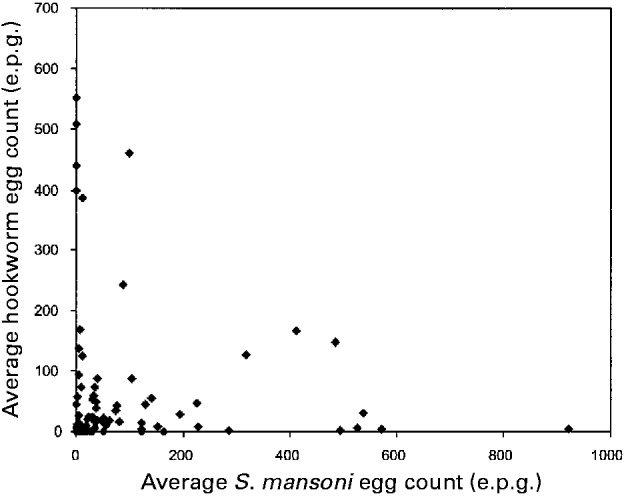
Fig. 2. Scatter plot of hookworm and Schistosoma mansoni egg counts, arithmetically averaged from 25 stool readings.
DISCUSSION
The purpose of the epidemiological survey reported in this paper was to assess the effect of repeated sampling on the cumulative prevalence of dual-species infections. We thereby showed that the prevalence of co-infections with S. mansoni and hookworms increased monotonically with increased sampling effort. This observation, although not inevitable, reflects the increases in the marginal prevalence of each infection previously reported in this cohort, and can be partially attributed to the low level of association in the population distribution of these two infections (Howard et al. 2001). We then proceeded to comprehensively assess the diagnostic performance of the Kato-Katz technique in the diagnosis of multiple-species helminth infections during field surveys. This was achieved through the application of a latent-class statistical model developed for the analysis of co-infection data. The sensitivity of the test in relation to infection intensity was beyond the scope of the present model, and will be the focus of further developments. Nonetheless, we have demonstrated that due to the low sensitivity of the test for detecting the presence of hookworms and S. mansoni infections, an extensive sampling effort may still considerably underestimate the prevalence of dual-species infections.
Previous efforts at statistically compensating for the poor diagnostic performance of the Kato-Katz test under field conditions have focused on S. mansoni (De Vlas et al. 1997). However, in many communities schistosome infections are endemic along with other important helminth infections including hookworms, Ascaris lumbricoides and Trichuris trichiura (Brooker et al. 1999). The Kato-Katz method is routinely used in research and control programmes to simultaneously diagnose the prevalence and egg counts of each of these parasite species. The information is then used to generate maps of the distribution of each type of infection and to set priorities and strategies for intervention, which may include mass treatment for more than one species of parasite. The latent-class statistical model developed here is the first attempt to partition the performance of the Kato-Katz during simultaneous diagnosis of multiple species infections, and offers a framework for estimating the performance of other diagnostic tests for different combinations of parasite species.
A 6-fold increase in prevalence of co-infection was observed between the first and last samples based on raw egg counts, and the latent multinomial model results indicate that the true prevalence was another 22·2% higher. An important factor related to this increase was the day-to-day variation in egg excretion associated with each infection. Another factor related to the dramatic increase in prevalence of co-infection, as well as the low sensitivity values for both parasites individually, is likely to be that egg counts of both infections were low. According to WHO guidelines, light infections of hookworm are those below 2000 e.p.g., whereas light infections of S. mansoni infection are below 100 epg. The majority of individuals in our cohort were therefore classified as lightly infected for both parasite species. The Kato-Katz technique relies on the presence of eggs at a certain density within the stool sample (at least 1 egg per 42 mg of stool), and the sensitivity of the technique is related to the egg density. Low-intensity infections will require a greater sampling effort than high-intensity infections, and when attempting to diagnose the prevalence of 2 or more infections of low intensity, it is therefore not surprising that a substantial sampling effort may be required to approach ‘true’ estimates.
We observed that the sensitivity of a single Kato-Katz thick smear for diagnosing infection was considerably lower for hookworm infections than that for S. mansoni. This is likely to be related to the fact that hookworm eggs overclear or collapse rapidly once the slide has been prepared. Only a short clearing time is therefore recommended when diagnosing hookworm infections, and we ensured that all slides were read within 30–90 min of preparation. Conversely, S. mansoni eggs become more visible if the slides are left to clear for a longer time. Since we observed only a small rise in prevalence across stool readings on the first day, it is possible that even with experienced technicians a period of familiarization with the technique is required in situ before each survey. This problem needs addressing whenever the two infections are endemic in the same community, and they are being diagnosed simultaneously using the Kato-Katz technique. Such observations reinforce the necessity of repeated sampling, or combining diagnostic methods such as the Kato-Katz technique and a formol-ether concentration method (Allen & Ridley, 1970), whenever parasitological surveys of these two infections are being undertaken in the same community (Keiser et al. 2002 b). However, since repeated sampling on a large scale may introduce substantial costs in terms of labour and reagents, it may be appropriate to assess the sensitivity of a single reading on a small cohort initially, and use that estimate for determining the required sampling effort at the larger scale.
A secondary aim of these analyses was to examine the relationship between mean egg counts of individuals infected by both species after 25 Kato-Katz readings. Although a weak positive correlation was observed, relatively high egg counts of hookworm infections were disassociated from high egg counts of S. mansoni infections, even after intensive sampling effort. A likely explanation stems from the idiosyncrasies of egg excretion patterns associated with each species. Given that egg counts of each species may be overdispersed both within and between stool specimens, the probability that a heavily infected individual will excrete large numbers of eggs of both species within the period of sampling is relatively low compared to the probability of excreting high numbers of eggs of either species.
Our observations also have strong implications for the design and implementing of control strategies at the community level. WHO has recently issued some guidelines for control programme managers where the prevalence of infection is a crucial parameter for determining the choice of strategy (Montresor et al. 1998, 2002; WHO, 2002). Mass treatment of school-age children 2–3 times a year with one of the benzimidasole derivatives is recommended when the infection prevalence of hookworms, or overall prevalence of geohelminth infections, is greater than 70%. Yearly mass treatment of school-age children with praziquantel is recommended when the overall prevalence of schistosome infections in schools is above 50%. Below these thresholds, the prevalence of ‘intense’ infections determines the choice of a strategy. The number of stool readings required is not specified for geohelminths, whereas 2 stool readings, 24 h apart, are recommended for diagnosis of S. mansoni infections. As we have observed in the present study, the prevalence of infection of S. mansoni and hookworms may continue to rise even after an extensive sampling effort of 25 stool readings. The choice of strategy, therefore, is critically dependent on the sampling effort. This is an issue that has yet to be addressed in WHO guidelines.
There are numerous published comparisons of the Kato-Katz technique with other methods, or modified versions of the same test, for schistosomes and geohelminths (Engels, Nahimana & Gryseels, 1996; Hamilton, Klinkert & Doenhoff, 1998; Polman et al. 2001). However, the low cost of the Kato-Katz technique, together with its suitability for rapid use under field conditions, have been cited as important features of this method (Carabin, Guyatt & Engels, 2000) and ensured its long-term popularity. Since it is unlikely that other methods will be recommended for wide-scale application, there is an inherent value in statistical models that adjusts for a combination of low sampling effort and low sensitivity. The model presented here did not adjust for infection intensity, and the sensitivity estimates are therefore indicative of a situation where the mean egg count of each type of infection is low. In areas with more intense transmission the sensitivity of the test will be higher. It is nonetheless likely that the prevalence of multiple-species infections involving both hookworms and S. mansoni, from the community level upwards, has been consistently and grossly underestimated elsewhere. In the light of our results, large-scale estimates of the distribution of helminth infection, together with estimates of the extent of helminth associated morbidity, may require revision.
Our thanks are expressed to the village chiefs, school directors, teachers and schoolchildren of grade 3 from the villages of Gbatongouin and Mélapleu for their commitment in the present study. We thank L. A. Ahiba for assistance during the epidemiological surveys and A. Allangba, A. Fondio, L. K. Lohourignon and M. Traoré for preparation and microscopical examination of Kato-Katz thick smears. E. K. N'Goran is grateful to the Swiss Academy of Science, and J. Utzinger to the Centre for Health and Wellbeing at Princeton University and the Swiss Tropical Institute for sustained financial support. M. Booth was supported by the Medical Research Council.
APPENDIX
Statistical model
Let Yijr(k) denote the observed infection status k, for individual i, day j and stool specimen r and ξi(l) be the true (unobserved) infection status l for individual i. We assume that the infection status corresponds to one of the following four categories: no infection, hookworm infection only, S. mansoni infection only, and co-infection respectively. Yijr(k) is equal to 1 if individual i, at day j, and in stool specimen r, has observed infection status k, otherwise is equal to 0. Similarly ξi(l) is equal to 1 if the true status of individual i is l, otherwise ξi(l) is equal to 0. We further assume that ξi(l) arises from a multinomial distribution with multinomial probabilities, pi(l) representing the prevalence of infection status l in the population, that is, ξi~Mult(1, pi), where ξi=(ξi(1), ξi(2), ξi(3), ξi(4))T and pi=pi(1), pi(2), pi(3), pi(4))T and that the observed data Yijr=(Yijr(1), Yijr(2), Yijr(3), Yijr(4))T conditional on the unobserved infection status, ξi, follows a multinomial distribution, Yijr|ξi~Mult(1, πijr), where

,

and I(ξi(l)) is an indicator function taking the value 1 if ξi(l)=1, otherwise I(ξi(l))=0.
The parameters πi(l) are related to the sensitivity of the test to diagnose the infection status l. In particular, we assume that the test is 100% specific; hence there is zero probability to diagnose an infection status k>1 when there is no infection. We also assume a zero probability that the test diagnoses hookworm (or S. mansoni) infection when the underlying infection is S. mansoni (or hookworm). These assumptions lead to the conditional probabilities πi(l), l=1,…, 4, shown in Table 4. The parameters

,

and

represent the sensitivity of the test to diagnose correctly the three types of infections.

We model the individual variation, ai, on the log-transformed odds of the prevalence pi(k), that is log(pi(l)/pi(1))=β1(l)+ai, l>1 and introduce the effect of day-to-day variation on the πi(l) parameters, that is,

, for k=l and k=2, 3 and log(πijr(k|4)/πijk(1|4))=β20(k|4)+εij where

. We estimate the parameters of this model following Bayesian inference implemented by Markov chain Monte Carlo (MCMC) simulation carried out in Winbugs v1.3. We adopt Normal prior distributions for the random effects ai and εij parameters, that is ai~N(0, σ12) and εij~N(0, σ22), and inverse gamma priors for the variance components parameters σ12 and σ22 corresponding to the individual and day-to-day within individual variation. We also adopt vague Normal distributions for β1(l) and β0(k|l).
The latent class model estimates the diagnostic error together with covariate effects (if any). This model is equivalent to standard multinomial model with sensitivity parameters, Sijr(k|l)=1, that is, log(πijr(k)/πijr(1))=β1(k)+ai+εij. The later model estimates the risk of each type of infection and co-infection at the individual level but it is unable to estimate these parameters at the population level as the mean structure of the model assumes independence of the sampling efforts.
The MCMC algorithm run with a single chain for 500000 iterations and estimated the parameters from a sample of size 1000 collected every 50th additional iteration from a total of 10000. Convergence was assessed empirically using plots of ergodic averages of selected parameters.
References
REFERENCES
ALLEN, A. V. &
RIDLEY, D. S.
(
1970).
Further observations on the formol-ether concentration technique for faecal parasites.
Journal of Clinical Pathology 23, 545–546.CrossRefGoogle Scholar
BOOTH, M. &
BUNDY, D. A.
(
1995).
Estimating the number of multiple-species geohelminth infections in human communities.
Parasitology 111, 645–653.CrossRefGoogle Scholar
BROOKER, S.,
BOOTH, M. &
GUYATT, H.
(
1999).
Comparisons of schistosome and geohelminth infection prevalences in school-aged children from selected areas of Africa: implications for rapid assessment and combined control.
Transactions of the Royal Society of Tropical Medicine and Hygiene 93, 125–126.CrossRefGoogle Scholar
CARABIN, H.,
GUYATT, H. &
ENGELS, D.
(
2000).
A comparative analysis of the cost-effectiveness of treatment based on parasitological and symptomatic screening for Schistosoma mansoni in Burundi.
Tropical Medicine and International Health 5, 192–202.CrossRefGoogle Scholar
DE VLAS, S. J.,
ENGELS, D.,
RABELLO, A. L.,
OOSTBURG, B. F.,
VAN LIESHOUT, L.,
POLDERMAN, A. M.,
VAN OORTMARSSEN, G. J.,
HABBEMA, J. D. &
GRYSEELS, B.
(
1997).
Validation of a chart to estimate true Schistosoma mansoni prevalences from simple egg counts.
Parasitology 114, 113–121.CrossRefGoogle Scholar
DE VLAS, S. J.,
GRYSEELS, B.,
VAN OORTMARSSEN, G. J.,
POLDERMAN, A. M. &
HABBEMA, J. D.
(
1992).
A model for variations in single and repeated egg counts in Schistosoma mansoni infections.
Parasitology 104, 451–460.CrossRefGoogle Scholar
ENGELS, D.,
NAHIMANA, S. &
GRYSEELS, B.
(
1996).
Comparison of the direct faecal smear and two thick smear techniques for the diagnosis of intestinal parasitic infections.
Transactions of the Royal Society of Tropical Medicine and Hygiene 90, 523–525.CrossRefGoogle Scholar
ENGELS, D.,
SINZINKAYO, E.,
DE VLAS, S. J. &
GRYSEELS, B.
(
1997).
Intraspecimen fecal egg count variation in Schistosoma mansoni infection.
American Journal of Tropical Medicine and Hygiene 57, 571–577.CrossRefGoogle Scholar
EZZATI, M.,
LOPEZ, A. D.,
RODGERS, A.,
VANDER HOORN, S.,
MURRAY, C. J. L. &
COMPARATIVE RISK ASSESSMENT COLLABORATING GROUP (
2002).
Selected major risk factors and global and regional burden of disease.
Lancet 360, 1347–1360.CrossRefGoogle Scholar
GELFAND, A. E. &
SMITH, A. F. M.
(
1990).
Sampling based approaches to calculating marginal densities.
Journal of the American Statistical Asscociation 85, 389–409.CrossRefGoogle Scholar
GOODMAN, L. A.
(
1974).
Exploratory latent structure analysis using both identifiable and unidentifiable models.
Biometrika 61, 215–231.CrossRefGoogle Scholar
HALL, A.
(
1981).
Quantitative variability of nematode egg counts in faeces: a study among rural Kenyans.
Transactions of the Royal Society of Tropical Medicine and Hygiene 75, 682–687.CrossRefGoogle Scholar
HAMILTON, J. V.,
KLINKERT, M. &
DOENHOFF, M. J.
(
1998).
Diagnosis of schistosomiasis: antibody detection, with notes on parasitological and antigen detection methods.
Parasitology 117 (Suppl.), S41–S57.Google Scholar
HOWARD, S. C.,
DONNELLY, C. A. &
CHAN, M. S.
(
2001).
Methods for estimation of associations between multiple species parasite infections.
Parasitology 122, 233–251.CrossRefGoogle Scholar
KATZ, N.,
CHAVES, A. &
PELLEGRINO, J.
(
1972).
A simple device for quantitative stool thick-smear technique in schistosomiasis mansoni.
Revista do Instituto de Medicina Tropical de Sao Paulo 14, 397–400.Google Scholar
KEISER, J.,
N'GORAN, E. K.,
SINGER, B. H.,
LENGELER, C.,
TANNER, M. &
UTZINGER, J.
(2002 a).
Association between Schistosoma mansoni and hookworm infections among schoolchildren in Côte d'Ivoire.
Acta Tropica 84, 31–41.Google Scholar
KEISER, J.,
N'GORAN, E. K.,
TRAORÉ, M.,
LOHOURIGNON, K. L.,
SINGER, B. H.,
LENGELER, C.,
TANNER, M. &
UTZINGER, J.
(
2002 b).
Polyparasitism with Schistosoma mansoni, geohelminths, and intestinal protozoa in rural Côte d'Ivoire.
Journal of Parasitology 88, 461–466.Google Scholar
MARTIN, L. K. &
BEAVER, P. C.
(
1968).
Evaluation of Kato thick-smear technique for quantitative diagnosis of helminth infections.
American Journal of Tropical Medicine and Hygiene 17, 382–391.CrossRefGoogle Scholar
MONTRESOR, A.,
CROMPTON, D. W. T.,
BUNDY, D. A. P.,
HALL, A. &
SAVIOLI, L.
(
1998).
Guidelines for the Evaluation of Soil-Transmitted Helminthiasis and Schistosomiasis at Community Level.
World Health Organization,
Geneva.
MONTRESOR, A.,
CROMPTON, D. W. T.,
GYORKOS, T. W. &
SAVIOLI, L.
(
2002).
Helminth Control in School-Age Children. A Guide for Managers of Control Programmes.
World Health Organization,
Geneva.
MURRAY, C. J. L. &
LOPEZ, A. D.
(
1997).
Global mortality, disability, and the contribution of risk factors: Global Burden of Disease Study.
Lancet 349, 1436–1442.CrossRefGoogle Scholar
POLMAN, K.,
DE VLAS, S. J.,
VAN LIESHOUT, L.,
DEELDER, A. M. &
GRYSEELS, B.
(
2001).
Evaluation of density-dependent fecundity in human Schistosoma mansoni infections by relating egg counts to circulating antigens through Deming regression.
Parasitology 122, 161–167.CrossRefGoogle Scholar
UTZINGER, J.,
BOOTH, M.,
N'GORAN, E. K.,
MÜLLER, I.,
TANNER, M. &
LENGELER, C.
(
2001).
Relative contribution of day-to-day and intra-specimen variation in faecal egg counts of Schistosoma mansoni before and after treatment with praziquantel.
Parasitology 122, 537–544.CrossRefGoogle Scholar
UTZINGER, J.,
VOUNATSOU, P.,
N'GORAN, E. K.,
TANNER, M. &
BOOTH, M.
(
2002).
Reduction in the prevalence and intensity of hookworm infections after praziquantel treatment for schistosomiasis infection.
International Journal for Parasitology 32, 759–765.CrossRefGoogle Scholar
WORLD HEALTH ORGANIZATION (2002).
Prevention and control of schistosomiasis and soil-transmitted helminthiasis: report of the WHO expert committee. WHO Technical Report Series, No. 912. World Health Organization, Geneva.
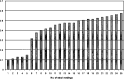
Fig. 1. Observed infection prevalence of co-infections involving Schistosoma mansoni and hookworms, estimated across 1–25 stool readings, with 5 readings from 5 stool specimens collected over consecutive days.
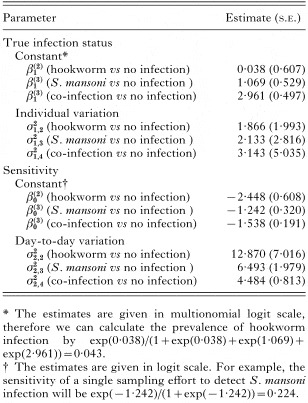
Table 1. Estimates, with their standard errors (in parentheses), arising from a multinomial latent model with random effects for individual and day-to-day variation of hookworm, Schistosoma mansoni egg counts and co-infection, using Markov chain Monte Carlo simulation to assess possible interaction between hookworm and S. mansoni infection
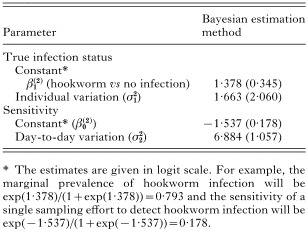
Table 2. Estimates, with their standard errors (in parentheses), arising from a logistic latent model with random effects for individual and day-to-day variation of hookworm egg counts, using Markov chain Monte Carlo simulation
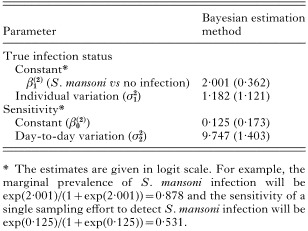
Table 3. Estimates, with their standard errors (in parentheses), arising from a logistic latent model with random effects for individual and day-to-day variation of S. mansoni egg counts, using Markov chain Monte Carlo simulation

Fig. 2. Scatter plot of hookworm and Schistosoma mansoni egg counts, arithmetically averaged from 25 stool readings.
 You have
Access
- 190
- Cited by