Introduction
Cs+ is relatively rare in natural systems, especially in the soil environment (Groenewold et al., Reference Groenewold, Ingram, McLing, Gianotto and Avci1998). Since the Tohoku Earthquake of 2011, the subsequent meltdown of the Fukushima Daiichi Nuclear Power Plant, and the introduction of radioactive 133Cs and 137Cs (radiocesium) to surface soils in Fukushima Prefecture in Japan (Weiss & Bourgeois, Reference Weiss and Bourgeois2012), there has been increased interest in a better understanding of the behavior of Cs+. A recent report (Fuji et al., Reference Fuji, Ikeda, Akama, Komatsu, Takahashi and Kaneko2014) demonstrated that 2:1 clays such as vermiculite and other similarly structured minerals have an unusually high affinity toward Cs+. That affinity is largely responsible for the sequestration of radiocesium in the top 5 cm of the surface soil (Tanaka et al., Reference Tanaka, Takahashi, Sakaguchi, Umeo, Hayakawa, Tanida, Saito and Kanai2012). When Cs+ is adsorbed in the interlayer space of 2:1 clays such as vermiculite, the Cs+ can collapse the interlayer space of those clays and become non-exchangeable. The trapped radiocesium in the collapsed interlayer space cannot be removed chemically without dissolving the mineral structure (Sawhney, Reference Sawhney1964, Reference Sawhney1972; Lomenick & Tamura, Reference Lomenick and Tamura1965; Comans & Hockley, Reference Comans and Hockley1992; Missana et al., Reference Missana, Garcia-Gutierrez and Alonso2004; Iijima et al., Reference Iijima, Tomura and Shoji2010; Kogure et al., Reference Kogure, Morimoto, Tamura, Sato and Yamagishi2012; Dzene et al., Reference Dzene, Tertre, Hubert and Ferrage2015; Fuller et al., Reference Fuller, Shaw, Ward, Haigh, Mosselmans, Peacock, Stackhouse, Dent, Trivedi and Burke2015). Given these issues, an improvement in our understanding of the interaction between radiocesium and vermiculite in those soils is vitally important.
The mechanism of irreversible Cs+ adsorption on vermiculite and other similar 2:1 clays in Japanese surface soils is very similar to the irreversible adsorption of potassium ions (K+) on micas, about which much research has been published (Gaines Jr., Reference Gaines1957; Dolcater et al., Reference Dolcater, Jackson and Syers1972; Perkins & Tan, Reference Perkins and Tan1973; Sparks et al., Reference Sparks, Zelazny and Martens1980; Martin & Sparks, Reference Martin and Sparks1985; Sparks & Carski, Reference Sparks and Carski1985; Sparks, Reference Sparks and Stewart1987; Pal & Durge, Reference Pal and Durge1989; Osman et al., Reference Osman, Caseri and Suter1998, Reference Osman, Moor, Caseri and Suter1999). The adsorption of Cs+ on vermiculite and other similar 2:1 clays has been explored to a lesser extent, however. When K+ is adsorbed in the interlayer space of 2:1 clay minerals, it prompts the collapse of the interlayer space, trapping the K+ inside and rendering the K+ non-exchangeable. The surfaces of the tetrahedral sheets of these clay minerals contain numerous ditrigonal siloxane cavities. These cavities form due to the inability of the electron clouds of adjacent oxygen atoms to overlap at the base where the two neighboring silica tetrahedra meet. The Cs+ radius is ~1.8 Å, which is close to the size of the ditrigonal siloxane cavity, 2.6 Å (Sato et al., Reference Sato, Fujimoto, Dai and Hunger2013). Thus, Cs+ fits into the cavity tightly, with one cavity encapsulating the top half of the Cs+ and another cavity encapsulating the bottom half of the Cs+(Fig. 1). This tight fit prompts the cesium ions to adsorb inside the interlayer spaces of certain 2:1 clay minerals such as vermiculite using a robust inner-sphere mechanism (Bostick et al., Reference Bostick, Vairavamurthy, Karthikeyan and Chorover2002; Okumura et al., Reference Okumura, Nakamura and Machida2013). Once the inner-sphere adsorption prompts the interlayer to collapse, the ions can act as a glue and seal the interlayer shut, preventing re-expansion and trapping the adsorbed ions inside. Research has shown that Cs+ can collapse clay interlayers in the same way and seal the interlayer even more tightly, causing the trapped Cs+ to become even more challenging to desorb than K+(Coleman et al., Reference Coleman, Craig and Lewis1963).
Schematic representation of Cs+ being adsorbed on vermiculite: a side view of Cs+ dehydrating as it moves from the bulk solution to adsorb in the vermiculite interlayer space and collapse it; and b top view of one ditrigonal siloxane cavity with Cs+ ion surrounded by O atoms of the tetrahedral sheet (Huang et al., Reference Huang, Hu, Wang, Liu and Mu2017; Yamamoto et al., Reference Yamamoto, Takigawa, Fujimura, Shimada, Ishida, Inoue and Takagi2019)

A recent study examining the interaction between Cs+ on vermiculite elucidated a very unusual phenomenon when adsorption envelopes for Cs+ on vermiculite were generated (Ferreira et al., Reference Ferreira, Thornhill, Roderick and Li2018). Adsorption envelopes have long been used to compare the adsorption of different ions on the same mineral and to compare the affinity of different minerals for particular ions (Cabrera et al., Reference Cabrera, Madrid and De Arambarri1977; McKenzie, Reference McKenzie1983; Sposito et al., Reference Sposito, de Wit and Neal1988; Schulthess & Huang, Reference Schulthess and Huang1991; Manning & Goldberg, Reference Manning and Goldberg1996; Raven et al., Reference Raven, Jain and Loeppert1998; Arai & Sparks, Reference Arai and Sparks2001; Lafferty & Loeppert, Reference Lafferty and Loeppert2005; Schulthess et al., Reference Schulthess, Taylor and Ferreira2011; Ferreira & Schulthess, Reference Ferreira and Schulthess2011). Adsorption edges, which are revealed by adsorption envelopes, can be used to understand the strength with which a particular ion adsorbs on the surface of a mineral. The adsorption edge is where the amount of the ion adsorbing changes dramatically over a relatively small pH range. Adsorption edges are characterized by a sharp vertical drop in the adsorbing ion concentration (y-axis) as the pH (x-axis) decreases. Adsorption edges represent a pH range where the increasing concentration of H+ (decreasing pH) increases the competitiveness of H+ for adsorption sites, allowing H+ to prevent the ion of interest from adsorbing on a particular surface. Typically, the lower the pH at which these adsorption edges occur, the stronger the adsorption of the ion on that particular mineral is considered to be; a greater concentration of H+ is required to prevent the ion from adsorbing.
For the adsorption envelope of Cs+ on vermiculite (Ferreira et al., Reference Ferreira, Thornhill, Roderick and Li2018), a pH as low as 1.01 failed to elucidate an adsorption edge that would reduce the adsorption of Cs+ to zero. In fact, at a pH of 1.01, the amount of Cs+ being adsorbed was decreased by only 35% from its maximum at pH 8.39. Increasing the concentration of H+ in the system by more than seven orders of magnitude was able to decrease the amount of Cs+ being adsorbed by only 35%. Even at a concentration of 0.1 M, the H+ was unable to reduce the adsorption of Cs+, which was present at a concentration of only 0.02 M, to zero. This unusual occurrence raises the question of whether this phenomenon is unique to Cs+ adsorption on vermiculite or whether other minerals that are known to adsorb monovalent ions strongly would also demonstrate this sort of behavior. This could be addressed through a study of adsorption envelopes for cesium on other minerals known to adsorb monovalent ions strongly to determine whether the behavior of cesium on vermiculite is, in fact, unique to vermiculite.
An exploration of the Nanopore Inner-Sphere Enhancement (NISE) effect has shown that ions which typically adsorb weakly on external surfaces, such as monovalent ions, can be bound tightly to mineral surfaces through inner-sphere adsorption mechanisms when placed into confining environments such as the nanoporous channels of zeolite minerals (Ferreira & Schulthess, Reference Ferreira and Schulthess2011; Ferreira et al., Reference Ferreira, Schulthess and Giotto2012, Reference Ferreira, Schulthess and Kabengi2013). Zeolites are aluminosilicate minerals with crystalline structures that create nanopore channels. Zeolite minerals, of which 241 are known to exist, each has its own unique structure and nanoporosity (Baerlocher & McCusker, Reference Baerlocher and McCusker2020), of which 50 are natural (Flanagan & Crangle Jr, Reference Flanagan and Crangle2017) and 191 are synthetic. Due to their very large surface area, zeolites can be used as catalysts in chemical reactions such as petroleum refining, as separation membranes, or as photochemical hosts (Song et al., Reference Song, Justice, Jones, Grassian and Larsen2004). Their nanoporosity also makes them interesting substrates for the study of the adsorption of ions. The NISE effect may explain the strong adsorption of monovalent ions such as K+ and Cs+ in a confining environment such as a collapsed 2:1 clay interlayer, which can reach the dimensions comparable to zeolite nanopores or even smaller. Recent research into the adsorption of Cs+ on vermiculite showed that the interlayer of vermiculite collapses to a dimension of 0.12 nm (Ferreira et al., Reference Ferreira, Thornhill, Roderick and Li2018), which is small enough to trigger the NISE effect and prompt strong inner-sphere adsorption of monovalent cations. If the unusually strong adsorption of cesium on vermiculite is, in fact, due to the small size of the interlayer dimension after it collapses, that behavior should also occur on zeolite minerals with small nanopore dimensions that would trigger the NISE Effect. The objective of the current study, therefore, was to determine whether the adsorption envelopes for cesium on zeolite minerals would mimic the behavior that was observed for cesium on vermiculite.
Materials and Methods
The zeolite minerals used in the present study were purchased from Zeolyst International (Conshohocken, Pennsylvania, USA). Their nanopore dimensions and chemical properties are listed in Table 2. The nanopores in these zeolites are interconnected, allowing for free movement of ions within the interior of the minerals. Zeolite Y (CBV901) [(NH4)3.5[Al7Si17O48]·32(H2O)] was purchased as a hydrogen-form, meaning that its surfaces had only H+ adsorbed. ZSM-5(CBV8014) [H n Al n Si96–n O192·16H2O (0<n<27)] and ferrierite (CP914C) [(NH4)(Si,Al)18O36·9(H2O)] were purchased as ammonium forms and were converted into H forms by placing them in a muffle furnace at 550oC for >18 h, allowing the NH4 adsorbed to volatilize as NH3 gas, leaving an adsorbed H+ behind. This method has been used successfully to convert NH4-forms to H-forms in previous studies (Ferreira & Schulthess, Reference Ferreira and Schulthess2011). The stability of these zeolites at low pH values has also been determined in previous studies. Analyses of Si concentrations in supernatant solutions from zeolites exposed to highly acidic solutions showed dissolution of 0.22% for zeolite Y at pH 1.10, 0.12% dissolution of ZSM-5 at pH 1.61, and 0.05% dissolution of ferrierite at pH 1.06 (Ferreira & Schulthess, Reference Ferreira and Schulthess2011). Analyses of Al concentrations in these solutions were below the detection limits of the instrument in most cases; dissolution was calculated based on the Si concentration, therefore, which provided measurable results for all samples. Thus, the decrease in adsorption of Cs+ for these zeolites at low pH in this study are due to desorption by competing H+ ions (the only other cation in the system) and not due to dissolution of the mineral.
Adsorption experiments were carried out in 50-mL nominal Oak Ridge centrifuge tubes. Approximately 0.5030 g of zeolite solid (± 0.0030 g) at room temperature and humidity were added to each centrifuge tube along with 7.000 mL of 0.1 M CsOH for a concentration of 20 mM Cs+. This brought the pH of all samples to the maximum pH values (ranging from 9.64 to 11.36). Varying amounts of 1.21 M HCl were then added to bring the pH of the samples down to allow measurement of the adsorption of Cs+ at various pH values. An amount of deionized water was then added to bring the total volume of each centrifuge tube to 35.000 mL. Centrifuge tubes were allowed to equilibrate on a hematology mixer for >18 h, ensuring that the environment reached an equilibrium condition. After equilibrating, the centrifuge tubes were centrifuged for 10 min at 7800×g to separate the solid and liquid phases. An aliquot of the supernatant was extracted and set aside for pH measurement. Another aliquot was set aside for [Cs+] measurement. For ion-exchange experiments with Mg2+ and Ca2+, the experiments were carried out as described above except that either 10 mM Mg2+ or 10 mM Ca2+ was added to each centrifuge tube to act as a competitor for the 20 mM Cs+. The results of the ion-exchange experiment are based on three samples of each zeolite equilibrated with Cs+ and Mg2+ and three samples of each zeolite equilibrated with Cs+ and Ca2+. A small amount of acid was added to each of the centrifuge tubes for the ion-exchange experiment in order to prevent any possible precipitation of the divalent ions.
Cesium concentrations were determined via ICP-OES spectroscopy using a Perkin Elmer (Waltham, Massachusetts, USA) Avio 200 instrument. Cesium was measured using a wavelength of 894.353 nm with an axial view. Quality control procedures for the analysis were used every 10 samples to ensure that the calibration curve was still accurate. Calibration solutions were analyzed as samples and analysis was allowed to continue only if the calculated value for the calibration solution was within ±5% of the original value used to generate the calibration curve. Values for all measurements were calculated as the average of the light intensity for five replicate measurements of each sample.
For each set of samples prepared, one blank was created with the same amount of CsOH but without any zeolite solid added. The concentration of Cs+ in this blank was recorded as the initial [Cs+] added. The [Cs+] remaining in the supernatant of each sample was considered to be the final concentration of Cs+ in the system after adsorption of Cs+ onto the zeolite mineral. The amount of Cs+ adsorbed was then calculated per the following equation: [Cs+]ads = [Cs+]initial– [Cs+]final.
Adsorption envelopes were generated by plotting the [Cs+]ads for each zeolite as a function of pH. An adsorption model was created to fit the data for each zeolite using IExFit software version 3.3, distributed by Alfisol.com (Coventry, Connecticut, USA). The model parameters are given in Table 1. The parameter Γmax represents the maximum adsorption capacity of each adsorption site. Goodness of fit of the model for the adsorption data was determined by calculating Efron’s pseudo R2 value using the following equation: R2 = 1 – [Σi(y i–πˆi)2]/[Σi(y i–ȳ)2], where πˆi are the model’s predicted values. The pseudo R2 values for each model are also included in Table 1.
Parameters for models of Cs+ adsorption on the zeolite Y, ZSM-5, and ferrierite

RESULTS AND DISCUSSION
When comparing the adsorption envelopes for Cs+ on the three zeolite minerals to each other, the adsorption envelope for Cs+ on zeolite Y (Fig. 2) differs in shape and size from the adsorption envelopes for ZSM-5(Fig. 3) and ferrierite (Fig. 4). Characteristics of these zeolites are provided in Table 2. The adsorption edges for Cs+ on zeolite Y are more gradual than the other two zeolites, and the amount of Cs+ adsorbing at each site is much smaller. This behavior indicates that Cs+ is adsorbing more strongly on ZSM-5 (medium pores) and ferrierite (smallest pores) than Cs+ is on zeolite Y (largest pores), which is the behavior that the NISE effect predicts for monovalent cations. A study of Cs+ adsorption preferences by different zeolite minerals also found that the two zeolite minerals with the smallest pore dimensions (mordenite and clinoptilolite) adsorbed more Cs+ than the other two zeolites in the study (zeolite A and zeolite X) (Johan et al., Reference Johan, Yamada, Munthali, Kabwadza-Corner, Aono and Matsue2015). The same pattern of preferential adsorption of Cs+ by the zeolite with the smallest pore occurred in a study of Cs+ adsorption by chabazite vs zeolite A (Mimura & Kanno, Reference Mimura and Kanno1985); zeolite Rho vs zeolite A and faujasite (Lee et al., Reference Lee, Kim, Jeong, Park, Chung, Lee, Lee and Kim2017); and for chabazite vs heulandite and stilbite (Baek et al., Reference Baek, Ha, Hong, Kim and Kim2018). Research into the NISE effect showed that the adsorption of monovalent cations increases in strength when the environment in which the cation is adsorbing is ~0.5 nm or smaller in diameter (Ferreira & Schulthess, Reference Ferreira and Schulthess2011; Ferreira et al., Reference Ferreira, Schulthess and Giotto2012, Reference Ferreira, Schulthess and Kabengi2013). This has implications for the strong Cs+ adsorption in collapsed vermiculite interlayers, because the interlayer space reaches a dimension of <0.5 nm after adsorbed Cs+ causes it to collapse (Ferreira et al., Reference Ferreira, Thornhill, Roderick and Li2018).
An adsorption envelope for Cs+ on zeolite Y. The primary adsorption edge is centered at ~pH 2.5, but has a gentle slope and a low adsorption capacity. A second adsorption edge is centered at ~pH 5, followed by a very slight inflection at ~pH 5.8, followed by a third adsorption edge centered at ~pH 7

An adsorption envelope for Cs+ on ZSM-5. The primary adsorption edge is steep and centered at ~pH 3.5, showing a strong adsorption mechanism for Cs+ on that surface, which is presumed to be the internal sites within the zeolite nanopores. A second adsorption edge is present, centered at ~pH 8.5, and may represent adsorption of Cs+ at the intersection of the nanopores

An adsorption envelope for Cs+ on ferrierite. The primary adsorption edge is steep and centered at ~pH 3, showing a strong adsorption mechanism for Cs+ on that surface, which is presumed to be the internal sites within the zeolite nanopores. A second adsorption edge is present, centered at ~pH 9, and may represent adsorption of Cs+ at the intersection of the nanopores

Properties of zeolite minerals. Pore dimensions were taken from the database of zeolite structures (http://www.iza-structure.org/). Surface areas were provided by Zeolyst International (Conshohocken, Pennsylvania, USA)

*N/A: not applicable
The model used to fit the adsorption data for zeolite Y was a 3-site model, which was needed to support the inflection in the large, gentle adsorption edge between pH 4 and pH 8. While the inflection around pH 5.5 is subtle, a study investigating the adsorption of Co2+ on zeolite Y also found three different adsorption sites (Seo et al., Reference Seo, Kim, Chung, Suh and Lim2014). These three sites are the double 6-ring hexagonal prism, the sodalite cavity, and the supercage, for which experimental data on Co2+ showed an adsorption capacity ratio of 1:2:3 (Seo et al. Reference Seo, Kim, Chung, Suh and Lim2014). This matches well with the model established for Cs+ on zeolite Y, which showed Γmax values of 0.3240 μmol/m2, 0.5319 μmol/m2, and 0.8298 μmol/m2 for the three modeled sites. The difference in shape and extent between the adsorption envelope for zeolite Y and the other two zeolites further emphasizes the difference in the adsorption mechanism between the larger-pore zeolite Y, the smaller-pore ZSM-5, and ferrierite.
While the literature also indicates three separate adsorption sites for both ZSM-5 (Rudziński, et al., Reference Rudziński, Narkiewicz-Michalek, Szabelski and Chiang1997) and ferrierite (Pulido et al., Reference Pulido, Nachtigall, Zukal, Domínguez and Čejka2009), the fit of the 2-site adsorption model for the adsorption data on both of these zeolites was excellent. The adsorption sites available within the nanopores are the straight channel, the intersection, and the zigzag/perpendicular channel. The adsorption envelope may not have the resolution necessary to distinguish between the adsorption taking place at the three different sites. Indeed, the inflection in the zeolite Y model that necessitated using a third site to fit the data is very subtle. Two of the sites in ZSM-5 and ferrierite, probably the straight and zigzag/perpendicular channels, may have blended together and became indistinguishable in the adsorption envelopes (Figs 3, 4).
The adsorption envelopes for ZSM-5 and ferrierite are remarkably similar in shape to each other. However, they do differ slightly in the pH of the adsorption edges and the height of the central adsorption plateau. While both zeolites have smaller nanopores than does zeolite Y, the nanopores in ferrierite are smaller than those in ZSM-5(Table 2). This may explain the fact that the adsorption envelope for ferrierite has a low-pH adsorption edge occurring at a slightly lower pH than that for ZSM-5 (centered at ~pH 3 vs. ~pH 3.5) and a slightly greater adsorption capacity for its two sites (2.7 μmol/m2 and 3.9 μmol/m2) than the two sites for ZSM-5 (2.3 μmol/m2 and 3.4 μmol/m2). This difference may also, however, be due to the fact that ferrierite has a lower Si:Al ratio than ZSM-5(Table 2). Other experiments have also noted that ferrierite demonstrated a strong selectivity for Cs+(Mimura et al., Reference Mimura, Tachibana and Akiba1992a, Reference Mimura, Tachibana and Akiba1992b; Seliman, Reference Seliman2012).
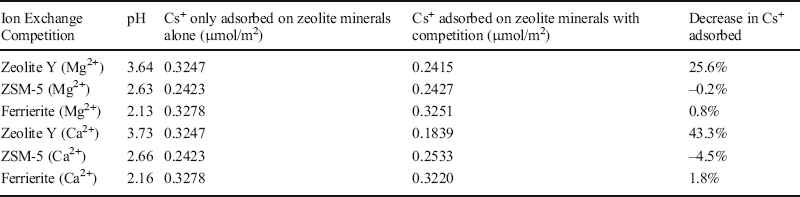
To characterize further the strength of the Cs+ adsorption on these zeolites, an ion-exchange experiment was carried out to determine whether competition with divalent ions Mg2+ or Ca2+ would affect significantly the amount of Cs+ being adsorbed. The results of this experiment are presented in Table 3. The addition of Mg2+ and Ca2+ as ion-exchange competitors for Cs+ yielded very different results depending on the zeolite in which the competition was taking place. For zeolite Y, which has the largest nanopores, the addition of Mg2+ or Ca2+ to the system severely decreased the amount of Cs+ adsorption taking place. However, the Mg2+ and Ca2+ were both ineffective competitors against Cs+ for adsorption sites on ZSM-5 and ferrierite, with the amount of Cs+ adsorbing on those minerals remaining essentially the same despite the addition of the divalent competitors. This is further confirmation of the strong affinity of the two zeolites with smaller nanopores for Cs+ and matches data collected for competition between Na+ and Ca2+ on these zeolites (Ferreira & Schulthess, Reference Ferreira and Schulthess2011). While Mg2+ may be small enough to access easily confining environments such as the nanopores of zeolite minerals or the collapsed interlayers of 2:1 clay minerals such as vermiculite, these results cast doubt on the ability of Mg2+ to act as an effective ion-exchange agent to remove adsorbed Cs+ in those environments because the equilibrium appears to favor Cs+ in such competitions.
Comparison of Cs+ adsorption on zeolite Y, ZSM-5, and ferrierite alone vs. in the presence of an equivalent concentration of Mg2+ or Ca2+ showing that divalent ions are able to reduce Cs+ adsorption by a sizable amount on zeolite Y, but are ineffective at reducing Cs+ adsorption in ZSM-5 and ferrierite

Adsorption envelopes for the monovalent ions Na+ and K+ on zeolite Y, ZSM-5, and ferrierite showed that both ions adsorbed more weakly on zeolite Y and more strongly on ZSM-5 and ferrierite (Ferreira and Schulthess, Reference Ferreira and Schulthess2011). Subsequent NMR analyses of Na+ on zeolite Y and ZSM-5 confirmed that Na+ was adsorbing through an outer-sphere mechanism on zeolite Y and through an inner-sphere mechanism on ZSM-5(Ferreira et al., Reference Ferreira, Schulthess and Giotto2012). This was further confirmed by a calorimetry study of the heat of adsorption on zeolite Y and ZSM-5(Ferreira et al., Reference Ferreira, Schulthess and Kabengi2013). The difference in the adsorption mechanism between these zeolites was attributed to the fact that zeolite Y contained nanopore channels with larger dimensions than the nanopore channels of ZSM-5 and ferrierite (Table 2).
Because Cs+ is also monovalent, it was expected to follow the same pattern of adsorption mechanisms on these zeolites as was demonstrated for Na+ and K+. The presence of K+ decreased significantly Na+ adsorption on all three zeolites when added as a competitor at an equal concentration (Ferreira & Schulthess, Reference Ferreira and Schulthess2011). This was attributed to the fact that K+ has a considerably larger ionic diameter than Na+(Table 4). Thus, K+ could fit more snugly in the nanopore channels of the zeolites, allowing K+ to adsorb more closely to the mineral surface and form a stronger electrostatic attraction to the adsorption sites available. The fact that K+ has lower hydration energy than Na+(Table 4) also means that K+ can dehydrate in confined environments more easily since its bond with its hydrating water molecules is weaker than the bond between Na+ and its hydrating water molecules (Teppen & Miller, Reference Teppen and Miller2006). This is also reflected in the fact that K+ has a smaller hydrated diameter than Na+(Table 4) despite its larger ionic diameter.
Characteristics of monovalent ions compared in this study. Ionic diameters are from Schulthess (Reference Schulthess2005) and enthalpy of hydration values were compiled by Smith (Reference Smith1977). A range of enthalpy of hydration values is presented to account for different methodologies for determining these values

Based on the trends established for Na+ and K+, it was expected that Cs+ would adsorb more strongly because Cs+ has a larger ionic diameter and lower hydration energy than either Na+ or K+(Table 4). A recent study investigating the impact of adding K+ as an ion-exchange competitor for Cs+ on the 2:1 clay mineral vermiculite showed that K+ had almost no effect on the ability of Cs+ to adsorb in vermiculite interlayers (Ferreira et al., Reference Ferreira, Thornhill, Roderick and Li2018). Other studies have also found that K+ is ineffective in ion-exchange competitions with Cs+ on vermiculite (Sikalidis et al., Reference Sikalidis, Misaelides and Alexiades1988; Akalin et al., Reference Akalin, Hiçsönmez and Yilmaz2018). These data support further the idea that Cs+ adsorption in confined environments should be stronger than both Na+ and K+. The adsorption envelopes for Cs+ on zeolite Y, ZSM-5, and ferrierite (Figs 2–4) did indeed confirm this hypothesis.
While Cs+ and Na+ are both monovalent, Cs+ should be expected to bond more strongly than Na+ because Cs+ has a larger ionic diameter and a lower hydration energy (Table 4). When comparing the adsorption of Cs+ alone (Figs 2–4) to Na+ alone on the three zeolites (Fig. 5), this pattern is confirmed. While the shapes of the adsorption envelopes for Na+ and Cs+ on the three zeolite minerals are very similar, the initial adsorption edge occurs at least half a pH unit lower for Cs+ than for Na+ on all three of the zeolites. This indicates that Cs+ is adsorbing more strongly because a higher H+ concentration (lower pH) is required to desorb Cs+ than is required to desorb Na+ from the same adsorption sites. The amount of Cs+ adsorbed by the zeolites is also significantly larger than the amount of Na+ adsorbed by the same zeolites, which is another indication of the much stronger affinity of these minerals for Cs+ compared to Na+.
Adsorption envelopes for Na+ on zeolite Y, ZSM-5, and ferrierite. Each envelope has two distinct adsorption edges, with Na+ showing much stronger adsorption on ZSM-5 and ferrierite than on zeolite Y (adapted from data published by Ferreira & Schulthess, Reference Ferreira and Schulthess2011)

Analysis of the adsorption envelopes for the three zeolites indicated that as the size of the environment in which Cs+ is adsorbing decreases, the strength with which Cs+ bonds to the adsorption sites in those environments increases. Zeolite Y (largest nanopores) shows the weakest Cs+ adsorption. Ferrierite (smallest nanopores) shows the strongest, with ZSM-5 (medium nanopores) falling somewhere in between. The vermiculite interlayer space reduced to a distance of 0.12 nm after the adsorption of Cs+, as evident from XRD analysis (Ferreira et al., Reference Ferreira, Thornhill, Roderick and Li2018). This collapsed distance is smaller than any dimension of the nanopores for ferrierite. The adsorption of Cs+ on vermiculite (Fig. 6) should, therefore, be more robust than on any of the zeolite minerals presented in this study. When comparing the adsorption envelopes of Cs+ on the three zeolite minerals used in the current study (Figs 2–4) to an adsorption envelope generated for Cs+ on vermiculite (Fig. 6), major differences are noted. The low-pH adsorption edge for Cs+ on vermiculite occurs at ~pH 2.5, which is lower than the pH for either ZSM-5 or ferrierite. This demonstrates that Cs+ is adsorbing more strongly on vermiculite than either of the zeolite minerals with nanopores small enough to trigger the NISE effect. One of the most remarkable differences between the adsorption of Cs+ on vermiculite and the zeolite minerals used in this study is that even at pH 1.0, the H+ concentration was not high enough to desorb fully 100% of the Cs+ adsorbed in the vermiculite interlayers. In contrast, the zeolite models show that Cs+ adsorption drops to zero at ~pH 1.5 for ZSM-5 and ~pH 1.0 for ferrierite. On vermiculite, the total amount of Cs+ adsorbed at pH 1.0 is only 35% lower than the maximum amount of Cs+ adsorbing at pH 7.0. This is another remarkable difference between the behavior of Cs+ adsorbing on vermiculite compared to its adsorption in the nanopore channels of the zeolite minerals. Increasing the concentration of H+ in solution from 10–7 M to 10–1 M causes all adsorbed Cs+ to be desorbed in the zeolite minerals, where the Cs+ is adsorbed quite strongly via an inner-sphere mechanism. This same change in aqueous H+ concentration only reduces the concentration of adsorbed Cs+ on vermiculite by a little over a third. This clearly supports the inverse relationship between the adsorption strength of Cs+ and the size of the environment in which Cs+ is adsorbing established by the zeolite adsorption envelopes and emphasizes why its removal from the contaminated soil in Fukushima Prefecture has proven so challenging given the tiny 0.12 nm interlayer dimension of the vermiculite clay after Cs+ has adsorbed.
Adsorption envelope for Cs+ on vermiculite. Two adsorption edges are present, one centered at ~pH 2.5 and another centered at ~pH 5 (adapted from Ferreira et al., Reference Ferreira, Thornhill, Roderick and Li2018)

Conclusions
Adsorption envelopes showed that Cs+ adsorbed more strongly on all three zeolite minerals than Na+ did in previous experiments. This is probably because Cs+ has a weaker bond to its hydrating water molecules than Na+ and a larger ionic radius. Analysis of the adsorption envelopes for Cs+ on the three minerals established an inverse relationship between the adsorption strength of Cs+ and the diameter of the nanopore channels in the mineral caused by the NISE effect. The zeolite with the largest nanopores showed the weakest adsorption, and the zeolite with the smallest nanopores showed the most substantial adsorption. This pattern was further confirmed by comparing the adsorption strength of Cs+ on these zeolite minerals to its adsorption strength on vermiculite, shown by XRD to have a collapsed interlayer dimension even smaller than the sizes of the zeolites’ nanopores. The strength of the adsorption of Cs+ on vermiculite is responsible for the difficulty in removing radiocesium from soil contaminated after the meltdown of the Fukushima Daiichi Nuclear Power Plant in Japan in 2011. In the current study, the fact that Cs+ is adsorbing so much more strongly on vermiculite than on these zeolite minerals emphasizes how difficult the removal of that radiocesium contamination from the impacted soil is likely to be.
ACKNOWLEDGMENTS
This research project benefitted from internal funding by the College of Science and Mathematics at Kennesaw State University.
Funding
Funding sources are as stated in the Acknowledgments.
Declarations
Conflict of Interest
The authors declare that they have no conflict of interest.