

1. Introduction
Secret languages, also known as ludlings, argots, or language games, are a phenomenon in which speakers of a language modify words in some way in order to disguise their meaning from uninitiated listeners (Bagemihl Reference Bagemihl and Goldsmith1995).Footnote 1 Examples of such modifications include syllable swaps, as in Dhochi (Borowsky and Avery Reference Borowsky and Avery2009), and the addition of nonsense material, as in Javanais (Bullock Reference Bullock1996). A wide variety of secret languages has been described (see Bagemihl Reference Bagemihl1989 for a typology), and a growing body of literature has studied how they can be analyzed theoretically, as well as what they can tell us about language (Bagemihl Reference Bagemihl and Goldsmith1995, Itô et al. Reference Itô, Kitagawa and Mester1996, Borowsky and Avery Reference Borowsky and Avery2009, Vaux Reference Vaux, Goldsmith, Riggle and Yu2011).
In this article, we add to this literature with a novel Optimality-Theoretic analysis of a 19th-century French secret language known as Largonji des loucherbems (Largonji). The name of this secret language comes from applying the rules to the French phrase jargon des bouchers (butchers’ jargon). While Largonji is no longer used as a secret language, two versions of a Largonji-French dictionary exist from the period in which it was used (Larchey Reference Larchey1883, Reference Larchey1889). Some examples of the Largonji pattern are shown in (1).Footnote 2
(1) French Largonji English
a. camion → lamioncem ‘truck’
b. parole → larolepès / larolepuche ‘word’
c. branche → lanchebrem ‘branch’
d. ardent → arlendé ‘ardent’
e. laver → lalervem ‘wash’
A previous analysis of Largonji, undertaken by Plénat (Reference Plénat1985: 73; our translation), lists the rules of this secret language as: “For any given word: move the first consonant to the end of the word, replace it with [l], and add a suffix (any of: -é, -em, -ès, -oc, -ique, -uche; the choice is arbitrary)”.
This description, and very similar ones in Mandelbaum-Reiner (Reference Mandelbaum-Reiner1991) and Larchay (Reference Larchey1883), is not quite accurate, as the forms for branche, ardent, and laver in (1) illustrate. We argue that the movement in fact targets onsets: the moved element is the first onset of the base word that is not an [l]. Nonetheless, it is true that Largonji involves the movement of consonants, plus two Largonji-specific nonsense affixes, the [l-] and the arbitrary -V(C) suffix.Footnote 3 We analyze the former as a prefix that occasionally behaves as an infix due to interaction with other constraints (similar to the case of Tagalog -um-; see Klein Reference Klein2005).
The complex rules of Largonji offer useful insights into a number of theoretical issues. By targeting non-edge onsets, Largonji fills a gap hypothesized to be impossible within the typology of language games: Bagemihl (Reference Bagemihl1989) claims that ludlings never specifically target subsyllabic constituents like onset and coda, with the objection that they are not widely accepted constituents (e.g., Clements and Keyser Reference Clements and Keyser1983, Levin Reference Levin1985, McCarthy and Prince Reference McCarthy and Prince1986; see also Bagemihl Reference Bagemihl1989). However, while Largonji does target onset positions, we show that it can be analyzed without reference to onset as a constituent. Instead, we suggest that the Largonji pattern arises from a requirement that moraic structure be preserved between base and argot; onsets are targeted only because they are non-moraic. This analysis builds on known language-game patterns where suprasegmental structure is preserved (e.g., tone in Bakwiri; Hombert Reference Hombert1973), though this is the first time that such a pattern has been analyzed in Optimality Theory (OT).
Beyond mora preservation, we propose that the principal driving factors behind the pattern are alignment of the dummy prefixFootnote 4 /l-/ to the left edge, and a requirement to disguise the base word. We further show that existing OT analyses of exchange language games, such as cross-anchoring (Itô et al. Reference Itô, Kitagawa and Mester1996), cannot capture the Largonji pattern.
The paper is organized as follows. Section 2 provides background on the typology of secret languages. Section 3 gives the background on Largonji, illustrating the pattern, showing why it requires reference to moraic structure, and connecting it to the typology. Section 4 argues for and illustrates our analysis, while section 5 explains why previous analyses do not work for Largonji. Section 6 discusses implications, and section 7 concludes.
2. Typology of language games
Previous research, in particular Bagemihl (Reference Bagemihl1989, Reference Bagemihl and Goldsmith1995), has noted a wide range of ways in which language games are created in various languages. Bagemihl (Reference Bagemihl and Goldsmith1995) posits four categories, given in (2) with an example for each.
- (2)
a. Infixing/affixing: A nonsense affix is added (can be multiple times)
-gV affixed to each syllable: bɨt͡ʃa ‘yellow’ → bɨgɨt͡ʃaga (Tigrinya: Bagemihl Reference Bagemihl1989)
b. Templatic: Segments transferred onto a template specific to game words
Cs transferred to a C-ay-C-ə-C template: gɩn ‘but’ → gaynən (Amharic: McCarthy Reference McCarthy, van der Hulst and Smith1985)
c. Reversing: The order of some subset of segments/syllables in a word is reversed.
Complete reversal of segment order: bayawak ‘iguana’ → kawayab (Tagalog: Gil Reference Gil1996)
d. Replacing: Segments of a certain type are replaced by another segment.
All vowels replaced with [i]: nuka ‘name’ → niki (Cuna: Sherzer Reference Sherzer, Obler and Menn1982)
The four categories are not mutually exclusive. Pig Latin, for example, involves both type (2a), affixation of a suffix [-ej], and a variant of type (2c), with the word-initial consonant(s) moving to the opposite edge (Barlow Reference Barlow2001).
Within the category of reversal games (2c), there are four subcategories, outlined by Bagemihl (Reference Bagemihl1989) and Borowsky and Avery (Reference Borowsky and Avery2009) and given here in (3). Unless otherwise noted, the examples are from Bagemihl (Reference Bagemihl1989).
- (3)
a. Transposing: Syllables moved from one end of the word to the opposite end.
deftere ‘book’ → teredef (Fula)
b. Interchange: Positions of two adjacent syllables at one edge of the word are exchanged. ikumi ‘ten’ → imiku (Chasu)
c. Exchange: Constituents on both ends of a word (or in a phrase) are switched.
balaynun ‘domesticated’ → nulayban (Hanunóo)
d. Total reversal: Entire form (all segments) reversed.
bayawak ‘iguana’ → kawayab (Tagalog: Gil Reference Gil1996)
Bagemihl (Reference Bagemihl1989) notes that exchange games (3c) can involve consonants, vowels, CV sequences, or VC sequences. Most relevant to this paper, the exchange may also be between segments in the base word and those in a “following ludling ‘nonsense’ word” (Bagemihl Reference Bagemihl1989: 304). He suggests that different mechanisms are required for each variation, and that reversal games in general target peripheral positions (Bagemihl Reference Bagemihl1989: 306).Footnote 5 He further posits that reversing language games never require reference to subsyllabic constituents like onset, nucleus, or coda; instead, consonant exchange games typically reference the melodic tier, and he argues that games like Pig Latin that have been described as targeting onsets can be analyzed in other ways, such as reduplication with pre-specified templates (Yip Reference Yip1982, Bagemihl Reference Bagemihl1989).
Largonji does not fit nicely within any of these categories. Though the basic pattern in (1a–c), like Pig Latin, is an exchange with nonsense material, (1d–e) differ in that the moved segments are not at an edge; for example, the [d] in ardent is the third segment and second consonant of the base, so there is no coherent way to claim that it is at an edge. This pattern is at odds with Bagemihl's (Reference Bagemihl1989) claim that reversal games reference edge material.
3. Largonji
As noted in section 1, two versions of a Largonji-French dictionary exist from the period when it was used: one published in 1883 and a re-publication in 1889. Comparison of the two editions shows that they are mostly the same, with some differences. For example, eight entries that appear in the 1883 version are missing from the 1889 version, and typesetting errors are far more numerous in the 1889 edition. For this paper, we use the earlier 1883 corpus. However, we note that this version is also not without problems, including some typesetting errors (see Plénat Reference Plénat1985 on similar issues in the 1889 version).
In both corpora, Largonji forms are written in French orthography, not in transcription, making it difficult to know exactly how the words were pronounced. However, scholars have made assumptions, which is possible due to the relative consistency of the mapping from orthography to sound in French (e.g., Ziegler et al. Reference Ziegler, Jacobs and Stone1996). Plénat (Reference Plénat1985), for example, included IPA transcriptions that reflect his idea of how the words may have been pronounced. We consulted Plénat's transcriptions when making claims about pronunciations.
3.1 Basic pattern
As noted above, we consider Largonji to have two affixes: a prefix, /l-/, and a suffix, which takes the general form -V(C) and whose precise segmental content depends on the word.Footnote 6 The prefix sometimes surfaces as an infix, when other factors prevent it from appearing at the left edge. This assumption differs from that of Plénat (Reference Plénat1985), who suggests that the /l/ is underlyingly the onset of the Largonji dummy suffix.
Recall that Plénat (Reference Plénat1985) describes Largonji as moving the first consonant to the end, replacing it with [l], and adding an arbitrary suffix. The data in (4) illustrate this pattern. All examples show the French word, then the Largonji (in the orthography of the source), then an English gloss. The Largonji /l/ is aligned to the left edge of the word, French phonotactics are respected, and nothing is epenthesized or deleted; however, the initial consonant moves to the end of the base, meaning that the linear order has changed.
- (4)
a. camion → lamioncem ‘truck’
b. parole → larolepès / larolepuche ‘word’
c. décembre → lecembredique ‘December’
d. surpasser → lurpassersem ‘to surpass’
3.2 Cluster-initial forms
In the introduction, we claimed that Largonji moves onsets, but the data in (4) is consistent with several alternative analyses of the relevant segment: the first segment, the first consonant (as Plénat Reference Plénat1985 describes), or the first consonant cluster. These other possibilities are inconsistent with further data. Cluster-initial forms in (5) show that an entire cluster can be replaced by [l]. Nonetheless, these forms again illustrate that the game respects French phonotactics and alignment of the /l/ to the edge, at the expense of linearity of the base.
- (5)
a. branche → lanchebrem ‘branch’
b. graisse → laissegrem ‘fat’ (n.)
c. fracas → lacasfrem ‘fracas; crash’
d. fleur → leurflem ‘flower’
e. bloc → locblem ‘block’
3.3 Vowel-initial forms
In vowel-initial forms, the first consonant is moved, as shown in (6). In this case, we maintain the vowel in situ at the left edge of the base, at the expense of violating the alignment of /l/ with the left edge.
- (6)
a. accord → alordcé ‘agreement’
b. écarter → elartercès ‘to move apart’
c. ivoire → iloirevem ‘ivory’
d. opéra → olerapem ‘opera’
e. utile → ulilté ‘useful’
Crucially, in the Largonji forms in (6), the segment moved to pre-suffix position comes from a word-medial position, not an edge; it is the second segment. While replacing the initial segment with /l/ is phonotactically bad, moving multiple segments starting at the edge would be phonotactically permissible, as in the unattested form *lordacé. The forms in (6) therefore demonstrate conclusively that the Largonji pattern does not target word edges.
3.4 VCC-initial forms
As shown in (7), in words of form #VC.CV, only the second (onset) C is replaced with [l]; the first (coda) C remains in situ.Footnote 7
- (7)
a. ardent → arlendé ‘ardent’
b. asperge → aslergepe ‘asparagus’
c. ardoise → arloisede ‘slate’
d. orgue → orleguem ‘organ’
In (7), replacing the first consonant with [l] (e.g., *aldentré) would be phonotactically legal. Thus, these forms rule out an analysis of targeting edges even on a consonant tier. Instead, the coda stays in situ, preserving the moraic structure of the base.
It is useful to compare the VCCV forms in (7) and the one in (8). The French words in (7) are syllabified as VC.CV, while (8) is syllabified as V.CCV; word-internal obstruent-liquid clusters are syllabified as onsets except when the obstruent is a sibilant (Dell Reference Dell1995). In this latter case, the entire cluster is moved in the Largonji form, just as with an initial #CC cluster, as in (8). Since both consonants are onsets, moraic structure preservation is possible here even when both are moved.Footnote 8
(8) atroce → alocetré ‘atrocious’
3.5 [l]-initial forms
Moreover, it is not always the first onset in the word that is involved in Largonji, but rather the first onset that is not [l], as illustrated in (9).
- (9)
a. laver → lalervem ‘wash’
b. lapin → lalinpem ‘rabbit’
c. liqueur → lileurquem ‘liqueur’
d. lacet → laletcem ‘lace (e.g., shoe)’
e. limonade → lilonademique ‘lemonade’
Based on the previous pattern, we would predict forms like *laverlem, in which the first onset is replaced with [l], causing no (phonetically apparent) surface manipulation. Instead, in (9), the first non-[l] onset, such as the [v] in laver and the [m] in limonade, is replaced by the dummy affix [l]. We suggest that the involvement of the non-initial onset here ensures that Largonji forms are not simply ordinary French words with an added suffix; rather, there needs to be a non-trivial movement to increase the comprehension difficulty for uninitiated listeners. Similar claims have been made in analyses of other language games (e.g., Borowsky and Avery Reference Borowsky and Avery2009).
3.6 octobre and espion
Two forms that appear to be inconsistent with these generalizations are octobre and espion; the clusters ct and sp are syllabified as [k.t] and [s.p] respectively in French (Dell Reference Dell1995), and so we would predict these words to pattern like other #VC.CV forms (e.g., ardent) in (7). However, in the attested Largonji forms, both consonants are moved, as illustrated in (10).
- (10)
a. octobre → olobrectès ‘October’
b. espion → elionspem/elionspuche ‘spy’
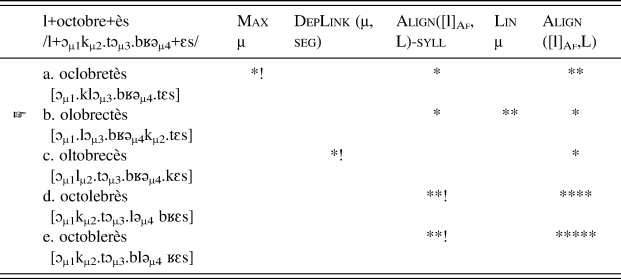
For octobre, the expected Largonji output form is *oclobretes, in which only the first onset moves. This form contains a [kl] cluster in place of the original [kt] cluster. French syllabifies all [kl] clusters as onsets, but [kt] clusters are coda+onset (Dell Reference Dell1995). Thus, the [k] in the expected Largonji form is in an onset, while it is a coda in the original French. We suggest that codas in the base, which we assume to be moraic, cannot lose their moras in the argot. Moving the [k] along with the [t] in octobre allows it to remain moraic. Given that we argue that the targeting of onsets in Largonji is fundamentally driven by mora preservation, this type of requirement is expected.
Similar syllabification changes cannot happen in any of the coda+onset forms in (7), where the coda is a consonant like [ʁ] or [s]; these can never be the initial consonant in (word-internal) CC onset clusters in French (Dell Reference Dell1995). Resyllabification would therefore be impossible in (7); the standard Largonji pattern applies without changing moraic structure.
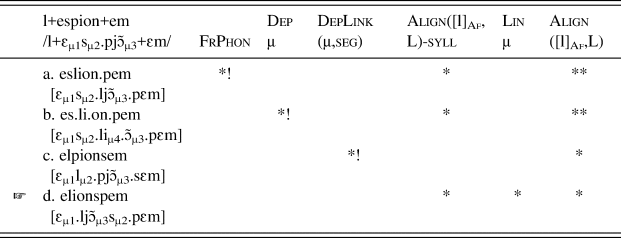
Espion is slightly more complicated. While Lyche (Reference Lyche1993) claims that espion just demonstrates variation in the treatment of sC clusters in Largonji, espion is the only sC cluster in the corpus that behaves this way. We propose a principled explanation, involving the interaction of French phonotactics and syllabification. The base French form of espion has a [spj] sequence, while the expected Largonji form (*eslion) involves [slj], which is phonotactically prohibited; the ban on C+liquid+glide sequences is known in the literature on French phonology (e.g., Tranel Reference Tranel1987, Reference Tranel, Authier, Bullock and Reed1999; Côté Reference Côté2000; Côté and Morrison Reference Côté and Morrison2007).
The fix for forbidden CC+glide clusters in real French morphology, as in entrions (with an underlying /j/ in the -ions suffix), is to resyllabify the glide /j/ as its own vowel nucleus [i] (Noske Reference Noske, van der Hulst and Smith1982). However, doing so in Largonji would add a mora, by making a consonant /j/ into a vowel nucleus [i] (see the moraic structure of glides in Hayes Reference Hayes1989, for example). Thus, by appealing again to moraic faithfulness and to French phonotactics, we can explain why espion patterns differently from other forms with sC clusters.
3.7 Glide-vowel sequences
Glides in Largonji are treated as part of complex nuclei, not as onsets (Bullock Reference Bullock, Wiltshire and Camps2002), and so we assume them to be non-moraic. Some examples are shown in (11).
- (11)
a. ardoise → arloisedé ‘slate’ [w]
b. emploi → emloipluche ‘job’ [w]
c. juillet → luilletjem ‘July’ [ɥ]
d. bruit → luibrès ‘noise’ [ɥ]
e. viande → liandevé ‘meat’ [j]
f. pied → liedpem ‘foot’ [j]
In (11), based on the orthographic representations, the glides remain in situ in the Largonji forms; for example, oi orthographically represents [wa]. If the glides were in the onset, we would expect them to pattern like the second consonant in the CC-initial forms in (5); we would predict forms like *landevié for ‘meat’, where the [j] moves together with the [v].Footnote 9 This is incorrect, suggesting that glides instead behave as part of the vowel nucleus in Largonji. Thus, we do not predict a possible form for espion in which the [pj] sequence is targeted.
3.8 Summary
Based on these arguments, we propose the following motivations for the Largonji pattern. First, the affix /l/ must be as close as possible to the left edge of the word, even at the expense of changing the linear order of the base. Second, French phonotactics must always be respected, and deletion and epenthesis are not allowed. Third, bases that are vowel-initial must remain vowel-initial in the argot, and moraic structure must be preserved as much as possible. When moraic structure must change, the preference is to change the linear order of moras rather than their associations to segments or their existence (epenthesis or deletion). Finally, the game form must not be simply an affixed version of the base, in order to sufficiently obfuscate the words.
This description differs from that of Plénat (Reference Plénat1985) in that these generalizations can capture the onset-related behaviour, the [l]-initial forms, and the matching syllabification between the French base word and the Largonji form.
There is a crucial distinction here between Largonji and a game like Pig Latin, which also moves the first onset of the word to pre-suffix position, but only when the first onset is word-initial. Unlike in the Largonji forms in (6–8), the Pig Latin forms of vowel-initial English words never transpose word-medial onsets (Schwartz Reference Schwartz1982, Davis and Hammond Reference Davis and Hammond1995). This property allows Pig Latin to have an account that references edges in a way not possible for Largonji.
4. Analysis
We now turn to our formal account, which is situated in Optimality Theory (Prince and Smolensky Reference Prince and Smolensky2004). In this section, we discuss the background to our analysis of Largonji, lay out our constraints, and illustrate with tableaux. We suggest that the basic pattern in Largonji arises from competing pressures to make the argot form distinct from the base and to keep the Largonji affix /l-/ as close as possible to the left edge of the word. We argue that the decision about which segments from the base are moved in Largonji is determined by French phonology, and by faithfulness to moraic structure. Crucially, while onsets are what move in the Largonji pattern, our analysis uses mora preservation to capture why, and thus does not require direct reference to onsets as constituents.
In our analysis of Largonji, we have a game-specific constraint, as well as rankings that will not apply to normal French phonology. We presume that games are constructed as a co-phonology (Inkelas et al. Reference Inkelas, Orhan Orgun and Zoll1996) that re-ranks non-game constraints, adds Base-Argot as a type of faithfulness, and includes a single game-specific constraint that requires a game manipulation to occur. The issue of how such co-phonologies and game-specific constraints are constructed is beyond the scope of the paper, but we speculate that all of the aspects could be innate. Independently, languages require the ability to construct co-phonologies and various types of output-output correspondence. Moreover, the game-specific constraint is simply a formal way of obfuscating the base word, which is the principle behind all language games. It therefore seems reasonable that this is a universal constraint that exists in order to use language for secrecy and amusement.
4.1 Base-argot faithfulness
Optimality Theory analyses of language games (e.g., Itô et al. Reference Itô, Kitagawa and Mester1996) typically involve a version of Correspondence Theory (McCarthy and Prince Reference McCarthy, Prince, Beckman, Dickey and Urbanczyk1995) for evaluating the connection between a base form and its corresponding secret language form. Such a relationship, known as Base-Argot (BA) correspondence, is part of a more general theory of Output-Output (OO) correspondence. Itô et al. (Reference Itô, Kitagawa and Mester1996) employ a correspondence model in their analysis of the Japanese secret language zuuja-go; we adopt this model here. The correspondence of the Largonji form lamioncem to the word camion ‘truck’ is shown in (12).

The Largonji word forms the argot aspect of this correspondence, and by “base”, we mean the fully syllabified form of the original French word (i.e., the output of the normal, non-game computation of French words). For example, the base for the Largonji form lamioncem [la.mjɔ̃.kεm] is camion [ka.mjɔ̃]. It is crucial that the French base form be syllabified (or at least that it have moraic structure), in order to refer to moraic faithfulness. This is possible because Base-Argot correspondence is between outputs.
4.2 Align and Linearity
As noted, we consider the basic Largonji pattern to be the result of conflicting pressures to keep the Largonji affix /l-/ as a prefix and to disguise the base form. In this subsection, we outline the constraints used to capture the basic principles of this competition. Specifically, we introduce Align, which prefers the /l/ to be at the left edge, as well as the faithfulness constraints and other markedness constraints with which it conflicts in the basic case.
The Largonji affix /l-/ surfaces sometimes at the left edge, like a prefix, but other times word-medially, like an infix. This behaviour is similar to that of infixes in non-game languages, such as -um- in Tagalog (e.g., McCarthy and Prince Reference McCarthy, Prince, Booij and van Marle1993, Klein Reference Klein2005). Following this literature, we capture this pattern by adopting a gradient Align constraint that is violated for every segment intervening between the output correspondent of the Largonji /l-/ affix and the left edge of the output word (see McCarthy and Prince Reference McCarthy, Prince, Booij and van Marle1993 on gradient alignment). When independent constraints prevent the affix from surfacing as a prefix, it will instead surface as an infix as close as possible to the edge, to minimize violations of Align. This constraint is defined formally in (13).
(13) Align([l]Af,L): Assign a violation for every segment intervening between the Largonji morpheme [l-] and the left edge of the word in the output.
This specific constraint is one of many constraints from the family Align that we presume exist in French; Align(Af,L) is necessary for all prefixes in French, while Align(Af,R) is necessary for all suffixes, including the Largonji suffix. These other Align constraints are not crucial to our analysis of Largonji, and so we will not discuss them further.
Align constraints can refer only to prosodic or grammatical categories; edges of such categories are aligned to each other (McCarthy and Prince Reference McCarthy, Prince, Booij and van Marle1993). Here, the grammatical category is the affix /l-/, while the prosodic category is the word. Under Plénat's (Reference Pater, Kager, van der Hulst and Zonneveld1985: 83) assumption that the /l/ is part of the suffix, the /l/ alone is not a specific grammatical or prosodic category, and hence could not be referred to by an alignment constraint.
In cases such as Tagalog, the prefix/infix does not displace material from the stem; this property is unique to game languages such as Largonji.Footnote 10 This movement violates a constraint of the family Linearity, defined in (14). Note that Linearity is always violated in the game form; this is what makes it a game.
(14) Linearity-BA: For each pair of segments X and Y in the base and their correspondents X′ and Y′ in the argot, assign a violation if X precedes Y in the base but Y′ precedes X′ in the argot. For example, for an input /x1x2x3x4x5/ and output candidate [x4x2x3x1x5], this constraint is violated five times, once for each of the pairs: (x1,x2), (x1,x3), (x1,x4), (x2,x4), (x3,x4).
Table 1 illustrates the basic conflict between these constraints; Align>>Linearity prefers to maintain the Largonji /l/ at the left edge, even at the cost of changing the base order. Candidate (a), with suffixation of the /l/, is severely penalized on Align; candidate (b) wins despite violating Linearity. Linearity is violated in every argot output form due to the reversal nature of Largonji, so it must be very low-ranked. It also never decides between candidates. Thus, we omit it from further tableaux. We will also not show candidates where the Largonji /l/ becomes a suffix as in the (a) form in Table 1; such outputs will always be ruled out by Align.
Tableau for camion

This conflict between Align and Linearity cannot explain the entire pattern, as there are a number of other options that violate neither of these constraints. For example, both the [l] and [k] could remain in situ, forming an [lk] cluster, or epenthesis could occur within this cluster, or the [k] could delete. We therefore need three additional constraints to rule out such candidates: FrPhon, MaxIO, and DepIO.
Respecting the phonotactics of the base language is a common property of language games. For example, Itô et al. (Reference Itô, Kitagawa and Mester1996) discuss this property for a Japanese language game. This generalization is also true in Largonji; all Largonji words are phonotactically permitted in French. As in previous language game research, we will use a general phonotactic constraint, FrPhon, as shorthand for the many individual constraints that comprise French phonotactic restrictions, including both segmental and syllabification properties. Crucially, onset clusters in French can never begin with a liquid like [l] (Dell Reference Dell1995); any such clusters violate FrPhon. The relevant constraint is defined in (15).
(15) FrPhon: Observe French phonotactics.
We also require ordinary faithfulness constraints, defined in (16a–b), which protect against deletion and epenthesis. As long as these constraints outrank Linearity, it will be preferable to align the Largonji /l/ and satisfy French phonotactics by changing the linear order of the base, as opposed to by deleting or epenthesizing.
- (16)
a. MaxIO: Every segment in the input must have a corresponding segment in the output
b. DepIO: Every segment in the output must have a corresponding segment in the inputFootnote 11
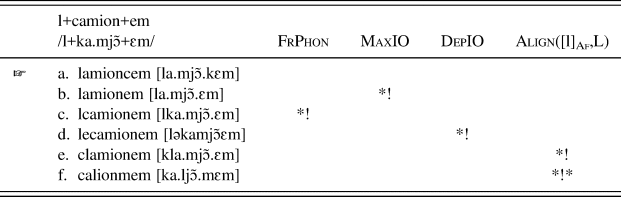
Table 2 again presents the basic Largonji form from Table 1. Candidate (a) is the correct form; candidates (b–d) show the additional candidates for which we needed FrPhon, MaxIO, and DepIO; candidates (e–f) show additional possible positions for the Largonji /l/ that are ruled out by Align.
Tableau for camion

Candidate (a), the winning candidate, violates only low-ranked Linearity (not illustrated here). Candidate (b) deletes the [k] of the base form; it fatally violates MaxIO. Candidate (c) creates an initial [lk] cluster; [lk] onsets are not allowed in French, causing a fatal violation of FrPhon. Candidate (d) epenthesizes a [ə] as an attempt to resolve the forbidden [lk] cluster, and therefore fatally violates DepIO. Candidates (e) and (f) move the [l] to non-initial positions, fatally violating Align.
Subsequent tableaux will not show candidates with deletion and epenthesis like the (b) and (d) forms in Table 2, since they are always ruled out by high-ranked constraints and not central to our further arguments. We will also omit MaxIO and DepIO from future tableaux.
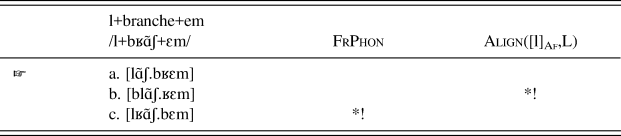
Table 3 shows how we capture the fact that both consonants move in CC-initial forms, using the example branche. This behaviour is due to a combination of Align, which makes it preferable to move both consonants rather than only the second, and FrPhon, which rules out moving only the first consonant because a liquid can never be initial in an onset cluster (Dell Reference Dell1995).
Tableau for branche

In Table 3, candidate (a) violates only low-ranked Linearity. Candidate (b) creates a [bl] cluster, which is phonotactically legal but fatally violates Align. Candidate (c) has an initial [lʁ] cluster that fatally violates FrPhon.
4.3 GAME
We turn now to cases where Largonji violates Align, beginning with the /l/-initial forms that switch the second onset. In these cases, the Largonji /l/ is an infix. While in Tagalog, the constraint NoCoda is what forces -um- to sometimes become an infix (Klein Reference Klein2005), this is accomplished in Largonji with a game-specific constraint.
Borowsky and Avery (Reference Borowsky and Avery2009), Borowsky (Reference Borowsky, Baker, Gardner, Harvey and Mushin2010), and others use a constraint MorphReal to enforce game violations of Linearity. Kurisu's (Reference Kurisu2001) RealizeMorpheme constraint is similar. The definition from Borowsky, who cites DeLacy (Reference De Lacy2002), is given in (17).
(17) MorphReal: In any concatenation of affix and base, the affix must be realised in a way that is distinct from the form of the unaffixed base. Borowsky (Reference Borowsky, Baker, Gardner, Harvey and Mushin2010: 374)
Borowsky (Reference Borowsky, Baker, Gardner, Harvey and Mushin2010) notes that, in combination with a phonologically null game-specific affix, this constraint prevents vacuous movement. The fundamental idea is that game forms must be realized distinctly from the base morpheme. Given phonotactic constraints and faithfulness constraints against deletion and epenthesis, as discussed above, they propose that this requirement results in movement of base material to fill the null game morpheme.
However, the languages for which Borowsky (Reference Borowsky, Baker, Gardner, Harvey and Mushin2010) and Borowsky and Avery (Reference Borowsky and Avery2009) use the constraint MorphReal have no overt game-specific affixes; the games involve only manipulations of base segments rather than added material. Therefore, we cannot directly apply this constraint to Largonji, which adds the phonologically overt dummy affixes /l-/ and -V(C); there is no way for the grammar to determine whether the distinctness between base and affixed form was caused by the phonologically overt Largonji affixes.
Moreover, the meaning of “distinct” requires clarification. In OT correspondence theory, two forms may be distinct despite being phonetically and featurally identical, by having distinct subscripts. For example, for an input /l1a1l2a2/, the output [l2a1l1a2] is distinct from the input, because the two /l/ segments have switched order; this output is nonetheless featurally and phonetically identical to the input. In Largonji, we want to consider such forms identical, in order to explain why /l/-initial forms behave differently. If we based our definition solely on correspondence, we would expect the /l/-initial words to pattern the same way as other C-initial words, except that the manipulation would not be surface apparent.
To avoid these complications with MorphReal, we suggest that Largonji requires a game-specific constraint that forces the manipulation to occur. This constraint is defined in (18); we refer to it as Game to emphasize its distinctness from MorphReal and Anti-Ident. Our constraint is game-specific, unlike MorphReal; future work should look at whether a non-game constraint could work in this case. Game is similar to anti-faithfulness constraints (Alderete Reference Alderete2001), and such constraints may be a non-game-specific option.
(18) Game: Assign a violation if the phonetic form of the base is a contiguous substring of the argot.
This constraint does not reference Base-Argot correspondence, in order to avoid the aforementioned problem with correspondence in this case. Effectively, it is a formal way of saying that the base cannot appear as-is in the argot. We assume a high-ranked Ident-IO constraint in Largonji to prevent feature changes as a way of satisfying this constraint.
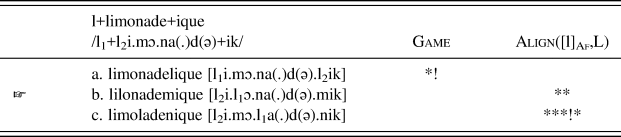
We illustrate with an [l]-initial word in Table 4. Candidate (a) is the normal Largonji pattern, but here fatally violates Game; [limɔnad(ə)] is the base and this string appears in the argot. Candidate (b), the winning candidate, switches the second onset; this violates Align, but the candidate wins because Game>>Align. Candidate (c) switches a later onset, and is ruled out by additional violations of Align.Footnote 12
Tableau for limonade

4.4 Vowel anchoring
The preceding constraints alone cannot capture precisely which segments from the base are moved in vowel-initial words in Largonji. First, in a basic vowel initial word like accord, the correct Largonji form violates Align, replacing the cc [k] with the Largonji /l/ and moving it to the end. A strictly prefixing candidate would violate Game, but it is unclear why the /l/ cannot be initial with some other manipulation. For example, *[la.ʁɔ.ke], in which word-internal consonants are switched, and *[lɔ.ʁa.ke], in which the base syllables are switched, would both satisfy FrPhon, Game, and Align. Thus, we would predict that we would prefer them to the correct form [a.lɔʁ.ke].
To explain this discrepancy, we propose an Anchor constraint specific to vowels. Hartkemeyer (Reference Hartkemeyer, Dworkin and Wanner2000) proposes a vowel-specific anchoring constraint, though his formulation differs from ours in not directly referencing edges. However, standard Anchor constraints, like the Base-Argot ones adopted by Borowsky (Reference Borowsky, Baker, Gardner, Harvey and Mushin2010), require edges to be aligned. We combine these two formulations into an Anchor constraint, defined in (19), that applies only to vowels and references edges. Such a constraint might exist in order to preserve word identifiability; base words beginning with vowels must begin with vowels in the argot. An alternative way of looking at this constraint is as an Anchor-BR constraint on the CV tier, which forces C-initial and V-initial words to remain C-initial and V-initial in the argot.
(19) Anchor-V-BA: Assign a violation for every vowel at the left edge of the base that does not have a correspondent at the left edge of the argot.
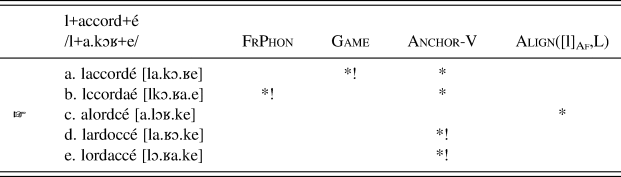
With this constraint, we can now capture the basic pattern of vowel-initial words. Table 5 illustrates. Candidate (a) keeps the affix [l] at the left edge of the word, which is a fatal violation of Game. Candidate (b) has an initial [lk] cluster, which is a fatal violation of FrPhon. Candidate (c), the winning candidate, only violates low-ranked Align. Candidates (d) and (e) satisfy Align, but are ruled out by higher-ranked Anchor. Further tableaux will not consider candidates that violate Anchor; this constraint will be omitted.
Tableau for accord

4.5 Moraic structure
It remains unclear why, in most cases of #VC.CV words (as in (7)), only the second consonant is moved; moving the first or moving both would be both phonotactically legal and better on Align. To deal with such cases, we introduce moraic structure. We assume, following Scullen (Reference Scullen1993, Reference Scullen and Zagona1996), that French coda consonants are always moraic; we also assume, following standard literature (e.g., McCarthy and Prince Reference McCarthy and Prince1986, Hayes Reference Hayes1989) that onset consonants never are.Footnote 13 Further, we assume that onset consonants attach directly to the syllable, not to the vowel's mora, following Hayes (Reference Hayes1989), Scullen (Reference Scullen and Zagona1996), and others. With this moraic structure, we can invoke additional faithfulness constraints so that moving onsets, which are not moraic, is preferable to moving codas (or vowels), which are.
Before dealing with the specifics of our mora preservation constraints, it is worth noting that this type of suprasegmental structure preservation is common in language games. For example, in several cases of games in tonal languages, such as Bakwiri (Hombert Reference Hombert1973), the tones remain in situ when the vowels switch; the tonal structure is independent of the segmental structure, and remains faithful. Similar properties have been noted with length contrasts, for example in a language game in Hanunóo (McCarthy Reference McCarthy, van der Hulst and Smith1982), where vowel length (presumably a moraic tier) remains in situ while the vowels exchange. To our knowledge, such patterns have not yet been dealt with in OT, nor have they been used to explain games that appear to involve reference to onsets.
With this in mind, we propose the constraint Linearity-μ, which is from the Linearity family and operates on the moraic tier; it could also be used for games that maintain vowel length, while a similar constraint on the tonal tier could capture patterns like those of Bakwiri. We assume that moras are indexed and our constraint prevents changing their order; combined with additional constraints discussed below, this prevents codas from moving to fulfill the movement requirement of Largonji. For instance, with input μ1, μ2, μ3, where μ2 is a coda, moving the coda to the end produces μ1, μ3, μ2, which violates Linearity-μ. This constraint is defined in (20).
(20) Linearity-μ: For each pair of moras μ1 and μ2 in the input and their correspondents μ1′ and μ2′ in the output, assign a violation if μ1 precedes μ2 in the input but μ2′ precedes μ1′ in the output.
However, there is a crucial difference between linearity preservation in the games in Bakwiri and Hanunóo compared to Largonji. In Largonji, it is not only the moraic structure that remains constant, but also the content of the moras, or the mora-segment link. Indeed, replacing a base coda with [l] and associating the [l] to the coda's mora would maintain the linear order of moras, but not their associations. For example, *aldentré for ardent still maintains the same moraic order (a vowel, then a coda, then another vowel), but the segment associated with the second (coda) mora has changed from r to l. We therefore need an additional constraint to ensure faithfulness to the association between mora and segment. This type of moraic faithfulness has been used previously in the literature on non-game languages (e.g., Shaw Reference Shaw, Schardl, Walkow and Abdurrahman2008) in the form of a DepLink(μ, seg) constraint, defined in (21).
(21) DepLink (μ, seg): If a segment x and a mora μ in the base have correspondents x′ and μ′ that are linked in the output, then x and μ must be linked in the input.Footnote 14
With these additional constraints, we can demonstrate, as in Table 6, why only the second consonant moves in ordinary #VC.CV forms, using the example ardent. Since the moraic structure of the Largonji suffix is irrelevant to the analysis, it is omitted.
Tableau for ardent

Candidate (a) makes the [l] a coda, fatally violating DepLink(μ, seg). Candidate (b) violates Align twice, more than the other candidates, but it wins due to the low ranking of Align. Candidate (c) moves both consonants in the CC cluster, which fatally violates FrPhon. Even in cases without the FrPhon violation, Linearity-μ would be fatally violated, and so this pattern would not be expected to win.
4.6 octobre and espion
A final remaining issue is the cases in which codas do move, together with the following onsets, as in (10). In the case of espion, not moving the coda would have created a violation of French phonotactics or added a mora by forcing a change from glide to vowel. In the other, octobre, not moving the coda [k] would result in it becoming part of a complex onset, deleting its mora. We therefore account for these patterns using general faithfulness constraints against addition and deletion of moras, Max-μ and Dep-μ, defined in (22), which outrank the constraint on their linear order. Dep-μ has been used previously in the language game literature for truncation games (Borowsky Reference Borowsky, Baker, Gardner, Harvey and Mushin2010).
- (22)
a. Max-μ: Every mora in the input has a corresponding mora in the output
b. Dep-μ: Every mora in the output has a corresponding mora in the input
Since Linμ>>Align, it is unclear from the present analysis why we would ever choose to move a coda, rather than moving an onset that comes later in the word. We argue that the reason is still due to the preference for keeping the /l/ at the left edge. In addition to the standard version of gradient Align, which counts violations for segments intervening between the affix and the left edge, we add an additional version that counts intervening syllables, defined in (23). Ranked below Anchor, this constraint will not affect previous vowel-initial words; all relevant candidates violate Align-syll once. As such, syllable-counting alignment can outrank Linμ, motivating coda movement in words like octobre. The idea that alignment constraints can count syllables is not new; it is common, for example, in analyses of foot structure, as in McCarthy and Prince (Reference McCarthy, Prince, Booij and van Marle1993).
(23) Align([l]Af,L)-syll: Assign a violation for every syllable intervening between the Largonji morpheme [l-] and the left edge of the word in the output.
We still need a segment-counting Align constraint, in order to rule out candidates like *[kla.mjɔ̃.εm] in Table 2. This candidate is equal to the correct [la.mjɔ̃.kεm] on Align-Syll and all higher-ranked constraints, but better on Linearity; only segment-counting Align can rule it out. These two constraints combined express different aspects of the preference for the Largonji /l/ to appear as a prefix.
Table 7 illustrates the example octobre. Candidate (a) is consistent with words like ardent; however, it fatally violates Max-μ, because the [k] that is a coda in the base French word is resyllabified as an onset in the [kl] cluster. Candidate (b), the winning candidate, allows the [k] to remain as a coda. It violates the lower-ranked Linearity-μ. Candidate (c) preserves mora linearity, but fatally violates DepLink(μ, seg) by replacing the moraic coda [k] with the [l]. Candidates (d) and (e) also preserve mora linearity, but have a second violation of syllable-based Align, which is fatal.
Tableau for octobre

Similarly, Table 8 shows espion, which involves an interaction between French phonotactics and the mora preservation constraints. Candidate (a) follows the normal Largonji pattern, but the [s]+liquid+glide cluster fatally violates FrPhon. Candidate (b) does the normal French fix for such sequences, in which the glide becomes a vowel [i]; this adds a mora, fatally violating Dep-μ. Candidate (c) switches the moraic coda [s] with the [l], thereby fatally violating DepLink(μ, seg). Candidate (d), the winning candidate, violates only the lower-ranked Linearity-μ. We have not shown a candidate in which the [pj] cluster switches, since the data suggests that the glide is part of the nucleus.
Tableau for espion

4.7 Summary
Largonji can be analyzed as a simple interaction of several types of constraints: basic faithfulness, moraic faithfulness, alignment of the prefix, phonotactics, anchoring of the vowel, and a game-specific constraint requiring manipulations to occur.
5. Problems with existing analyses
We now demonstrate why more standard accounts of reversal-type language games will not work for Largonji. In OT, the best-known way of analyzing language games involving reversal is cross-anchoring (Itô et al. Reference Itô, Kitagawa and Mester1996); pre-OT accounts include Yip's (Reference Yip1982) reduplicative template and Bagemihl's (Reference Bagemihl1989) minimal/maximal line crossing. In this section, we address each of these approaches and show that none of them work for Largonji.
5.1 Cross-anchoring
A typical cross-anchoring constraint is defined in (24), following Itô et al. Reference Itô, Kitagawa and Mester1996:
(24) An argot form A is cross-anchored to a base B iff there exist strings x, y, x′, y′ such that
(i) x ∈ beginnings(B), y ∈ endings(B), x ′ ∈ endings(A), y ′ ∈ beginnings(A)
(ii) x R S x′ and y R S y′
(iii) x ′, y′ ≠ A, x ′, y′ ≠ Ø (Itô et al. Reference Itô, Kitagawa and Mester1996: 251)
Beginnings is defined as a continuous string starting at the beginning of the word, while endings is defined as a continuous string starting at the end. Other versions of the cross-anchoring constraint (e.g., Harrikari Reference Harrikari1999) use beginnings of distinct prosodic words instead of beginnings and endings. However, all cases refer to continuous strings from the edge.
Either definition could work for simple forms like camion and branche. However, edge material is not moved in vowel-initial and [l]-initial Largonji words. Moreover, in [l]-initial and #VC.CV words, the moved consonant is not initial even on a consonant tier; in [l]-initial words it is not initial even if we permitted an onset tier. Since cross-anchoring crucially refers to edges, no such constraint can capture Largonji. This movement of non-edge material is exactly what makes Largonji distinct from previously analyzed reversal games.
Trying to specify cross-anchoring to non-[l] onsets would be stipulative, especially given that even onset is a controversial category (e.g., Clements and Keyser Reference Clements and Keyser1983, Levin Reference Levin1985, McCarthy and Prince Reference McCarthy and Prince1986; see also Bagemihl Reference Bagemihl1989). Our constraints accurately capture the data without reference to onsets.
5.2 Reduplicative templates
Yip (Reference Yip1982) develops a reduplicative template account of language games that involve both reversal and nonsense affixation; a similar approach is adopted by McCarthy and Prince (Reference McCarthy and Prince1986). In this approach, a language game has a template pre-specified with its nonsense material, and the remainder of the template is filled through reduplication of the normal language form. Bagemihl (Reference Bagemihl1989: 333) provides the following illustration of how this account could be applied to the English game Pig Latin.

This idea cannot be extended to Largonji, again because of the behaviour of words in which the first consonant is not the one to undergo the reversal (i.e., [l]-initial words and #VC.CV words). There are in fact two problems here: the inability to establish a consistent pre-specified location of the Largonji /l/ in the template, and the prediction that the first base consonant should always be the one to occupy the pre-suffix consonant position, as it will associate there in the second reduplicative copy. Instead, we would require distinct templates for different types of Largonji words, which is not explanatory.
5.3 Line crossing
Finally, we must also reject the line-crossing approach developed for reversal-type games by Bagemihl (Reference Bagemihl1989). Given his account of games involving both reversal and nonsense affixation, he would consider the Largonji affix to be -l(V)C, and reversal would occur between the base word and the affix /l-/. Bagemihl (Reference Bagemihl1989) posits that reversal language games involve either minimal or maximal line crossing, followed by uncrossing of lines that causes movement of segments or syllables. For example, reversals of adjacent syllables (e.g., interchange in Chasu, see (3b)) involve minimal line crossing, while moving a syllable from one edge to another (e.g., transposing in Fula, see (3a)) involves maximal line crossing. Intermediate levels of line crossing, such as switching the first and penultimate syllable (when they are not adjacent), are not permitted.
In basic Largonji forms like lamioncem for camion, maximal line crossing occurs; a base-initial segment moves all the way to base-final position. Bagemihl (Reference Bagemihl1989) also makes allowances for line crossing to specifically target syllable-initial positions, meaning that the behaviour of vowel-initial words is potentially unproblematic.Footnote 15 However, [l]-initial forms remain a problem; there is no sense in which moving the first non-[l] onset of an [l]-initial word is a maximal (or minimal) line crossing.
Bagemihl (Reference Bagemihl1989) does allow for a default procedure when reversing segments are identical, as is the case in the problematic Largonji forms. He considers a case in Fula, where an [n] is inserted in game forms of words with identical consonants; he suggests that one stage of the derivation involves an Obligatory Contour Principle (OCP) violation, which is resolved through a default insertion process. However, this fix is the only one permitted by his framework; resolving the violation by instead reversing different, non-identical consonants with non-maximal line crossing is not possible for him.
6. Discussion
Our novel analysis raises some interesting questions and implications for language games, syllable structure, and infixation. This section discusses these issues. We also illustrate some further Largonji data that previous research has considered problematic, and contextualize it within our analysis.
6.1 Implications for language games
Our analysis of Largonji has many implications for language games. Most crucially, Largonji is a reversal game that does not reference edges, a property that required us to reject existing analyses of reversal-type games. We demonstrated that the targeting of onsets in Largonji does not necessitate treating onsets as phonological constituents to which the grammar can refer. Instead, it is illustrative of a variation on the common cross-linguistic tendency to maintain suprasegmental structure in reversal language games. In the case of Largonji, the game maintains not only linearity of base moras, but also mora/segment relationships, leaving onsets as the only segments that can be targeted for the movement.
This analysis is important because it contradicts some of Bagemihl's (Reference Bagemihl1989) claims about language games while reinforcing others. He says that onsets cannot be targeted by language game reversals, noting that, while “several instances of what seem to be reversals of onsets are attested” (Bagemihl Reference Bagemihl1989: 309), alternative analyses are available. The clear evidence in Largonji for the targeting of onsets, as opposed to other types of consonants and/or strings from the left edge, demonstrates that reversals of onsets do, in fact, exist. Nonetheless, we concur with him that onsets are not constituents referred to by the process of reversal; we suggest instead that the motivation behind onset reversals is that moraic linearity and associations can be maintained when moving onsets.
Instead of cross-anchoring (e.g., Itô et al. Reference Itô, Kitagawa and Mester1996), which fails to account for the Largonji pattern, we used constraints applicable outside the scope of language games, such as Align. While it is possible that cross-anchoring remains the best solution for other games, the complexity of this constraint, its lack of applicability outside of language games, and its inability to account for Largonji all suggest that we may want to reconsider its necessity.
However, we needed a game-specific constraint for analyzing Largonji, which operates quite differently from the normal language. We suggested that the movement in Largonji is driven by a requirement of distinctness between the base French word and its argot correspondent. This specific constraint is novel, but its simplicity and the wide variety of possible solutions to a violation of it suggest that it might be worthwhile to explore its applicability in other language games.
Moreover, it is worth noting that this Largonji analysis requires very limited game-specificity, because Game is crucial only for the non-canonical cases, such as [l]-initial words. Earlier language game analyses often require a more complex game-specific mechanism to trigger the process. As mentioned, further research may determine alternatives to Game that are not game-specific.
Our analysis of Largonji is based on the maintenance of moraic relationships, in that the linear order of moras and mora/segment links cannot change between base and argot. Other previously studied games have shown preservation of suprasegmental structure, such as tones and vowel length, but to our knowledge, this kind of faithfulness within a language game has not previously been implemented in OT. To accomplish this task, we adopted faithfulness constraints about moras from other, non-game OT analyses; similar constraints could be extended to deal with the cases of tone and vowel length.
We also adopted non-game constraints with our use of Align, which was based on accounts of prefix/infix alternations like Tagalog -um-. In analyzing the Largonji /l-/ as a prefix that sometimes surfaces as an infix, we have shown a new way in which language games can reflect patterns not otherwise operative in a given language, but existing cross-linguistically. Non-game French has no prefix/infix alternations, and so the existence of such a pattern in a French language game provides support for both the universality of linguistic principles and the grammatically constrained nature of language games.
6.2 Implications beyond language games
As described in Vaux (Reference Vaux, Goldsmith, Riggle and Yu2011), language games have frequently been used as evidence for properties of language more broadly, beyond games. While Vaux (Reference Vaux, Goldsmith, Riggle and Yu2011) also notes that this usage is controversial, we consider here some implications that our analysis has to syllable structure and infixation beyond language games.
6.2.1 Implications for syllable structure
Our analysis of Largonji relied heavily on moraic structure. We argued that the Largonji pattern requires a distinction between onset and non-onset consonants, in order to explain the difference between V.CCV forms like atroce (8), in which both consonants undergo the reversal, and VC.CV forms like asperge (7), in which only the second (onset) consonant does. We argued that Largonji involves the exchange of non-moraic segments only, except when other constraints require moraic consonants to move. In terms of French syllable structure, this analysis requires that onsets never be moraic, which is consistent with standard assumptions in moraic theory (e.g., Hayes Reference Hayes1989), but inconsistent with Scullen (Reference Scullen1993), who claims that liquids are always moraic in French, even in onset position.
Notions of moras were also relevant for forms like octobre, where the choice generally made by Largonji, to move only the first onset, is overridden by the desire to avoid creating onsets in the argot from consonants that were not onsets in the base. This pattern lacks explanation unless a distinction is made between onset and non-onset consonants, but fits nicely within the mora-preserving nature of the rest of the Largonji pattern.
Largonji forms for words like espion, emploi, pied, and bruit in (10) and (11) have additional implications for syllables: the glide in these C+glide+V sequences is never treated as part of the onset. If it were, we would expect these words to pattern like #CC clusters as in branche. Instead, the glide always remains in its base position. Thus, in Largonji, glides are treated as part of the syllable nucleus, not as part of an onset.
This patterning is particularly interesting given that a number of authors (e.g., Dell Reference Dell1995, Noske Reference Noske, van der Hulst and Smith1982) claim that French treats most glides as onsets. While Noske (Reference Noske, van der Hulst and Smith1982) does admit the possibility of complex nuclei, he does so only for a small number of rising diphthongs, which include [wa], [ɥi], and [jε], but not [jɑ̃]. However, in Largonji, all glide+V sequences behave identically. Under the analysis of French where most glides belong to the onset, there is no explanation of why C+glide clusters like the [vj] in viande consistently behave differently in Largonji than do CC clusters like the [bʁ] in branche. Complex nuclei and a special status for glides must be an option in all glide+V sequences in order for these forms to pattern as they do. A similar argument about glide+V sequences being treated as single units has been made for Verlan (Weinberger and Lefkowitz Reference Weinberger, Lefkowitz, Laeufer and Morgan1992).
Overall, Largonji has implications for syllabic structure cross-linguistically, in terms of the necessity of a separation between onset and non-onset consonant positions, as well as specifically in French, with the behaviour of pre-vocalic glides.
6.2.2 Implications for infixation
A final implication comes from our analysis of the Largonji /l/ as a prefix that surfaces as an infix when other constraints prevent it from surfacing at the left edge. This type of phonologically motivated analysis has been proposed for other cases of infixation, but it is controversial, with some researchers arguing that infixation should be treated morphologically (see e.g., Klein Reference Klein2005 on Tagalog -um- about this issue).
The patterning of Largonji [l] differs from normal language infixation in several ways: it replaces (or displaces) base consonants, the anchor point is inconsistent and dependent on phonological content, and its position is motivated by different types of constraints. Its behaviour, in particular its anchoring in the position of the first onset that is not [l], is highly suggestive of a phonological rather than morphological phenomenon. If this language-game pattern can be used as an argument about normal language infixation, then Largonji has implications for the phonological versus morphological divide on infixation.
As noted, the “anchor point” for the Largonji /l/ is the first onset that is not [l], which differs from the known class of anchor points for phonological phenomena, including infixation (see Vaux 2011 for discussion). In fact, even setting aside the qualifications about [l], the first onset is not an existing anchor point. Vaux (Reference Vaux, Goldsmith, Riggle and Yu2011) notes that anchor points in language games fall into the same set as in normal language patterns, so Largonji has major implications, requiring either additional anchor points in ordinary language patterns, or a more complex, less parallel relationship between phenomena in normal language and in language games.
6.3 Issues for future research on Largonji
Finally, we present some additional Largonji data that brings up issues for further research, specifically re-initial forms and what Plénat (Reference Plénat1985) calls “bumper cars”. While previous research considers these cases problematic, we argue that there are principled reasons for re-initial forms to behave as they do, and that the “bumper cars” are likely typographical errors.
6.3.1 Prefixed and re-initial forms
In the forms discussed so far, the Largonji process operates on the entire French base. However, this is not always the case: some prefixes, particularly re-, are excluded from the domain of application of Largonji, while others, such as dé- and sur-, are included. This is illustrated in (26) and (27).
- (26)
a. regagner → relagnergem ‘to win back’
b. refaire → relairefem ‘to redo’
c. redire → reliredem ‘to repeat’
d. refondre → relondrefem ‘to recast/revise’
e. refermer → relermerfem ‘to shut again’
f. entresol → entrelolsoc ‘mezzanine’
- (27)
a. défaire → lefairedem ‘undo’
b. débarquer → lébarquerdem ‘to unload’
c. débarbouiller → lebarbouillerdès ‘to wash’
d. surpasser → lurpassersem ‘to surpass’
We suggest that the distinction between prefixes relates to their separability from the root, and hence to whether they are morphologically analyzed as part of it. Kallel (Reference Kallel1999) notes that French dé- is considered an “inseparable prefix”. That study does not mention re-, but work on Old French suggests that re-, unlike dé-, was a separable prefix there (Dufresne et al. Reference Dufresne, Dupuis and Tremblay2003). Thus, the forms in (26) and (27) could be accounted for in our analysis by modifying the Align constraint to be sensitive to the left edge of stems (defined as the root plus inseparable prefixes), rather than words.
There are, in addition, some forms beginning with re that are not prefixed, but behave like the prefixed forms. These examples are shown in (28). Other forms beginning with re undergo the normal Largonji pattern, as in (29).
- (28)
a. régal → relalgem ‘regal’
b. religion → reliliongem ‘religion’
c. redingote → relingotedem ‘frock coat’Footnote 16
- (29)
a. recevoir → lecevoirem ‘to receive’
b. régie → légierique ‘control’
One possibility is that forms with non-prefix re exhibit variation. This option seems likely, because in the corpora, régie is listed with both the expected (l é gierique) and unexpected (réliegem) Largonji forms. It remains an open question why variation exists for these forms but not others; incorrect analysis of re as a prefix and the phonetic and phonological properties of [ʁ] and [l] as the two liquids in French are potential explanations to explore. Regardless of whether it is a prefix, re is claimed to behave differently in schwa deletion and epenthesis in French, suggesting it has special status in the language that may also extend to Largonji (see Gess et al. Reference Gess, Lyche and Meisenburg2012).
6.3.2 Bumper cars
Plénat (Reference Plénat1985) notes four words in the 1889 corpus in which the [l] occurs at the beginning of the word and all of the consonants move one place down. These are shown in (30).
- (30)
a. brebis → lebribes ‘ewe’
b. chancre → lanchecrem ‘canker’
c. claquer → lacleques ‘to slam / to flap’
d. abîme → alibemé ‘abyss’
However, a comparison of the two Largonji sources suggests that these forms may not be legitimate. Printers’ errors abound in the 1889 version of the corpus (Plénat Reference Plénat1985); many are apparent when comparing that version of the corpus with the earlier 1883 version. The data in (30) is called into question by the fact that the Largonji form for chancre is listed in the 1883 edition as lancrechem, which is the normal pattern. Closer examination of the words in (30) also shows that they exhibit characteristics that make copying errors more likely. In (30a-c), there is a repetition of orthographic character (b, l, and c respectively), which connects to a common print-setter error known as parablepsis, where the copyist's eye skips inadvertently from one letter or word to another similar or identical letter or word (Black Reference Black1994). Metathesis is another frequent type of copying error (Black Reference Black1994), and again is potentially relevant here. Given these similarities to common printing errors and the established existence of a normal Largonji form for one of the four cases, we suggest that these “bumper car” forms are not actual Largonji forms but errors in the source.Footnote 17
7. Conclusion
To conclude, this paper has presented a novel analysis of Largonji, a 19th century French secret language. We have shown that the pattern is difficult to capture with standard argot constraints, but can be accounted for in a way similar to OT accounts of infixation, using an alignment constraint that prefers for the dummy affix [l] to be as close as possible to the left edge of the word. Combined with other constraints requiring game manipulations to occur and preventing deletion of base material, this alignment constraint forces the first non-[l] onset of the word to move to the end, before the dummy suffix. Crucially, while the manipulation targets onsets, we argue that it is driven by mora preservation. Thus, while Largonji is a novel type of onset-targeting language game, it fits within accepted notions of syllable constituency. In dealing with mora preservation in OT, we have shown how to implement suprasegmental Base-Argot faithfulness, which is relevant to several previously described language games that have not been analyzed in OT. This aspect of our analysis, as well as our use of Align and our novel game-specific constraint, offer several directions for future research on other types of language games cross-linguistically.