INTRODUCTION
Veterans of recent wars are frequently exposed to blasts (Gondusky & Reiter, Reference Gondusky and Reiter2005), yet little is known about the effects of blast injury on the central nervous system. Far from an esoteric academic question, the lack of knowledge about the long-term consequences of blast-related mild traumatic brain injury (mTBI) could potentially leave patients with heightened anxiety regarding their prognoses. Most blast injury research has focused on the impact of barotrauma on air and fluid filled organs (e.g., lung and ear; DePalma, Burris, Champion, & Hodgson, Reference DePalma, Burris, Champion and Hodgson2005; Mayo & Kluger, Reference Mayo and Kluger2006). Several carefully controlled animal studies, however, do indicate that drastic changes in pressure caused by blasts can cause neuronal injury (Cernak, Wang, Jiang, Bian, & Savic, Reference Cernak, Wang, Jiang, Bian and Savic2001a,Reference Cernak, Wang, Jiang, Bian and Savicb; Kaur, Singh, Lim, Ng, Yap, & Ling, Reference Kaur, Singh, Lim, Ng, Yap and Ling1995), including neuropathological changes in regions critical for neurobehavioral regulation (Cernak et al., Reference Cernak, Wang, Jiang, Bian and Savic2001a,Reference Cernak, Wang, Jiang, Bian and Savicb). Furthermore, explosion force has been shown to be correlated with physiological changes (Säljö, Bao, Haglid, & Hansson, Reference Säljö, Bao, Haglid and Hansson2000) and functional impairments in coordination, balance, and strength (Moochhala, Md, Lu, Teng, & Greengrass, Reference Moochhala, Md, Lu, Teng and Greengrass2004).
While animal research on blast injury has provided strong evidence of neuropathological and neurobehavioral changes caused by blast exposure, interpretation of observational studies of humans exposed to blasts has been complicated by the multiple mechanisms of injury associated with uncontrolled blasts. Blast waves can cause four types of injury. Primary blast injury results from rapid and drastic changes in pressure. Secondary injuries are caused by projectiles set in motion by the blast. Tertiary injuries occur when individuals are thrown into stationary objects by the explosion, and quaternary injuries result from associated burns, radiation, and toxin exposures (DePalma et al., Reference DePalma, Burris, Champion and Hodgson2005). Other blast injury factors that are challenging to measure in observational studies, such as proximity to blast and the number of blasts to which an individual has been exposed, may also serve to obscure the relation between blast injury and the neurobehavioral correlates of the injury.
Given the complexity of blast-related injury in humans, little is known about the acute and chronic neurobehavioral sequelae associated with rapid pressure change and related injuries. The need to accurately characterize the acute and chronic sequelae associated with blast-related mTBI is especially salient at this time, given its high frequency in the recent wars (Defense and Brain Injury Center, 2009). Additionally, concern has been expressed that education programs intended to provide information on mTBI are based partly on knowledge regarding recovery from more severe traumatic brain injury (TBI), potentially creating false expectations of long-term disability following combat-related mTBI (Hoge, Goldberg, & Castro, Reference Hoge, Goldberg and Castro2009). Expectations for long-term disability may be further amplified following blast-related mTBI, given the considerable media attention regarding this mechanism of injury in the absence of clear scientific consensus regarding effects of blast exposure. The lack of scientific data on the long-term effects of blast-related mTBI leaves little to combat the negative expectations the media may present. The most prudent approach to examining the effects of blast-related mTBI is to first review the large body of literature regarding the effects of nonblast-related mTBI.
Cognitive effects (i.e., neuropsychological performance) typically associated with nonblast-related mTBI generally resolve within several weeks to 3 months post-injury (Belanger, Curtis, Demery, Lebowitz, & Vanderploeg, Reference Belanger, Curtis, Demery, Lebowitz and Vanderploeg2005; Binder, Rohling, & Larrabee, Reference Binder, Rohling and Larrabee1997; Carroll et al., Reference Carroll, Cassidy, Peloso, Borg, von Holst and Holm2004; Frencham, Fox, & Mayberry, Reference Frencham, Fox and Mayberry2005; Schretlen & Shapiro, Reference Schretlen and Shapiro2003). In one prospective study of collegiate athletes, cognitive functioning returned to baseline functioning within 5 to 7 days post-injury (Guskiewicz et al., Reference Guskiewicz, McCrea, Marshall, Cantu, Randolph and Barr2003). The most frequently identified cognitive effects in the acute period of recovery include problems recalling material, slowed processing speed, and decreased attention (Carroll et al., Reference Carroll, Cassidy, Peloso, Borg, von Holst and Holm2004). Self-reported affective, cognitive, and somatic complaints, collectively known as postconcussive (PC) symptoms, resolve within 2 weeks following a sports related mTBI, but elevated rates of symptom report following mTBI may persist in general adult samples 1 year post-injury or longer (Carroll et al., Reference Carroll, Cassidy, Peloso, Borg, von Holst and Holm2004). Of note, considerable debate exists over the etiology and persistence of PC symptoms, as the symptoms are non-specific and are frequently reported by individuals with other types of injury (Lees-Haley, Fox, & Courtney, Reference Lees-Haley, Fox and Courtney2001), chronic pain (Iverson & McCracken, Reference Iverson and McCracken1997), chronic headache (Hollnagl & Norrelund, Reference Hollnagl and Norrelund1980), and depression (Iverson, Reference Iverson2006).
While the recovery course of neuropsychological performance, and to a lesser extent symptom report, following civilian nonblast-related mTBI have been described, it is unclear to what extent this knowledge can be generalized to self-reported symptoms secondary to blast-related mTBI in veterans. Blast injury does not appear to differentially affect neuropsychological performance in comparison to other mechanisms of TBI (Belanger, Kretzmer, et al., Reference Belanger, Kretzmer, Yoash-Gantz, Pickett and Tupler2009), and posttraumatic stress symptoms may account for a majority of PC symptoms regardless of mechanism of TBI (Hoge, McGurk, Thomas, Cox, Engel, & Castro, Reference Hoge, McGurk, Thomas, Cox, Engel and Castro2008). Furthermore, recent evidence suggests that self-report of individual PC symptoms (e.g., headache, memory problems, dizziness) does not differ in soldiers with histories of TBI secondary to blast injury compared with those with histories of TBI secondary to nonblast mechanisms within the first 3 to 6 months post-deployment (Wilk, Thomas, McGurk, Riviere, Castro, & Hoge, Reference Wilk, Thomas, McGurk, Riviere, Castro and Hoge2010). The possibility, however, that blast-related mTBI is associated with a unique constellation or profile of self-reported PC symptoms in veterans seeking outpatient treatment through the Veterans Affairs (VA) in the years following their deployments has yet to be explored.
The current study evaluates the relation of mechanism of injury (blast vs. nonblast) to PC symptom report in a group of Operation Enduring Freedom/Operation Iraqi Freedom (OEF/OIF) veteran outpatients with remote histories of mTBI at two VA medical centers. In addition to examining the PC symptom cluster profile and PC symptom severity by injury mechanism, analyses were conducted to test the hypotheses that increased number of blast exposures and decreased proximity to blasts are associated with increased PC symptom severity. The purpose is to better evaluate how available clinical information, such as mechanism and injury descriptions, time since injury, and common comorbidities, influence symptom presentation in individuals presenting to the VA for services.
METHODS
Participants
The charts of 529 OEF/OIF veterans from two VA medical centers were reviewed in compliance with the regulations of and following approval by the institutional review boards at each institution. Participants presented at two VA medical centers in the southeast and northwest for a comprehensive TBI evaluation. All patients included in this study were referred for evaluation through a nationwide VA TBI screening process. A referral for evaluation is automatically generated if the veteran endorses each of the following items: (1) Did you have any injury(ies) during your deployment from any of the following (check all that apply: fragment, bullet, explosion, etc), (2) Did any injury you received while deployed result in any of the following (check all that apply: being dazed, confused, or “seeing stars,” not remembering the injury, losing consciousness, head injury, etc), (3) Did any of these begin or get worse afterward? (check all that apply: dizziness, headaches, memory problems, balance problems, ringing in the ears, irritability, sleep problems), and (4) In the past week, have you had any of the above symptoms? (check all that apply: dizziness, memory problems, etc). Although based on commonly accepted criteria for the diagnosis of mTBI, the reliability and validity of this screening measure remain unknown (Belanger, Uomoto, et al., Reference Belanger, Uomoto and Vanderploeg2009). It should be stressed that only patients with both a possible history of TBI and current symptoms were referred for evaluation; patients with histories of TBI who did not report current symptoms were not referred for evaluation, and therefore, were not included in this study. Data were obtained from self-report forms completed at the evaluation, which were subsequently reviewed with each patient in a semi-structured interview conducted by a medical provider. Veterans completed the following forms.
Injury History
On an injury questionnaire, veterans reported the date(s), mechanism(s) of injury (i.e., fall, motor vehicle, bullet, blast, or a combination of these), and number of deployment-related injuries. Information regarding the presence and length of alteration in mental status [i.e., disorientation, posttraumatic amnesia, and loss of consciousness (LOC)] associated with each injury type was also recorded. Alteration of mental status was confirmed by the clinician only for the most recent and/or most severe blast and nonblast injuries, due to veterans’ difficulties estimating alteration of mental status associated with each injury. For this study, a history of mTBI was operationalized as a period of self-reported LOC no longer than 30 min or disorientation no longer than 24 hr following a credible injury mechanism (Centers for Disease Control and Prevention, 2003). Imaging was not available for review and was, therefore, not used for inclusion/exclusion decisions. Veterans who reported no periods of disorientation and no LOC, or periods of alterations of consciousness longer than the criteria above, were excluded from the study. Participants were separated into three groups: history of blast-related mTBIs only, nonblast-related mTBIs only, and both blast- and nonblast-related mTBIs. In the analyses examining the effect of blast injury characteristics on PC symptom report, participants with blast-related mTBIs were divided into groups based on their self-reported proximity to the closest blast (i.e., less than 10 ft, 10–30 ft, or greater than 30 ft), and the number of blasts they reported (i.e., 1, 2–4, or 5 or more).
Postconcussive Symptoms
The Neurobehavioral Symptom Inventory (NSI; Cicerone & Kalmar, Reference Cicerone and Kalmar1985) is a 22-item questionnaire of PC symptoms. Participants are asked to rate symptoms on a 5-point Likert scale ranging from 0 (none) to 4 (very severe). Cluster analyses performed on the NSI revealed four factors comprised of affective, cognitive, somatic, and sensory symptoms and five individual items (i.e., headaches, hearing loss, sleep problems, changes in taste/smell, and numbness), which did not load on the clusters (Cicerone & Kalmar, Reference Cicerone and Kalmar1995). Of these items, only the headache item was included in the current study’s analyses given the results of prior studies demonstrating a relation between combat-related mTBI and headaches (Hoge et al., Reference Hoge, McGurk, Thomas, Cox, Engel and Castro2008; Ruff, Ruff, & Wang, Reference Ruff, Ruff and Wang2008). As the NSI clusters and headache symptoms were our dependent variables of interest, when one or more items were unanswered on the NSI, the patient was excluded from the study.
Posttraumatic Stress Symptoms
Posttraumatic Stress Disorder (PTSD) symptoms were measured using the National Center for PTSD 17-item checklist (PCL; Blanchard, Jones-Alexander, Buckley, & Forneris, Reference Blanchard, Jones-Alexander, Buckley and Forneris1996; Bliese, Wright, Adler, Cabrera, Castro, & Hoge, Reference Bliese, Wright, Adler, Cabrera, Castro and Hoge2008; Weathers, Huska, & Keane, Reference Weathers, Huska and Keane1991). Items on this checklist were designed to mirror the diagnostic criteria for PTSD as defined in the American Psychiatric Association’s Diagnostic and Statistical Manual-Fourth Edition (1994). As such, the items measure PTSD symptoms in the domains of re-experiencing, avoidance/numbing, and hypervigilance. Each item was rated on a 1 (not at all) to 5 (extremely) Likert scale. When one or two items were unanswered on the PCL, the scores for these particular items were estimated from mean filling procedures based on the other items comprising the factor from which the missing items originated. Rather than creating diagnostic groups using recommended cut scores, total scores on the PCL were used to better illustrate the association of severity of posttraumatic stress symptoms to other variables of interest. The civilian version of the PCL was used at one VA medical center, while the military version was used at the other. These forms vary only in that the phrase “stressful experience” in the civilian version is replaced by “stressful military experience” in 8 items of the military version. Of the 518 participants with interpretable PCL scores at both study sites, there was no significant difference in the raw PCL scores between the two study sites (p = .30), with a mean difference of only 1.61 points. The forms were treated as parallel in the remaining analyses.
Statistical Analyses
One-way analyses of variance (ANOVAs) were conducted to examine differences in demographics and injury characteristics between the three participant groups. The Brown-Forsythe correction was used when assumptions of homogeneity of variance were violated. When the ANOVA omnibus test was significant, post hoc pair-wise comparisons with Fisher’s least squared difference (LSD) corrections for multiple comparisons were conducted (Levin, Serlin, & Searman, Reference Levin, Serlin and Searman1994).
Mixed model repeated measures multivariate ANOVAs (MANCOVAs) were conducted with and without covariates to evaluate the profile of symptoms across diagnostic groups on four PC symptom clusters and the individual symptom of headache on the NSI. Repeated measures in this case refer to the multiple dependent variables within each group, rather than a single measure administered at multiple time points (see Tabacknick & Fidell, Reference Tabacknick and Fidell2001, p. 440–442). Postconcussive symptoms (cognitive cluster, affective cluster, sensory cluster, somatic cluster, and headache item) were the dependent variables. Rather than summing scores, the items comprising each cluster were averaged, so that all clusters and the individual headache item were on a 0–4 scale. Level of posttraumatic stress (defined by PCL total score), injury severity (defined as positive or negative LOC), and time since injury (defined as the number of months between their most recent injury and the interview) were used as covariates, as these have been shown to influence PC symptom report. Age was also included as a covariate. Potential violations of the assumption of sphericity were evaluated with Mauchly’s Test of Sphericity. The corrected Greenhouse-Geisser Epsilon was used when assumptions of sphericity were violated.
RESULTS
Participants
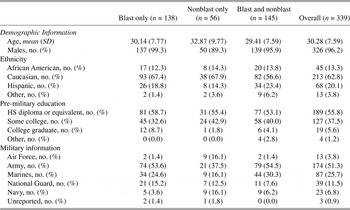
Of the initial 529 veterans considered for inclusion in this study, 105 veterans did not report altered mental status or LOC post-injury (i.e., no clear indication of history of mTBI) and 54 participants reported altered mental status for over 24 hr post-injury or LOC for over 30 min (i.e., indication of moderate or severe TBI), and, therefore, did not meet inclusion criteria. Of the remaining 370 eligible participants, 31 were excluded due to incomplete data, leaving 339 participants for the analysis of the effect of injury mechanism on PC symptom report. The 31 eligible participants excluded for missing data had shorter time since injury (mean = 26.32 months; SD = 17.34) than included participants (mean = 36.72 months; SD = 19.15 months); p = .004. Excluded participants were also more likely to be White (91.2%) than included participants (62.8%), p = .03. Demographics, military service, and injury severity characteristics of the final sample are found in Tables 1 and 2.
Demographics of the study population

Note
Age is in years.
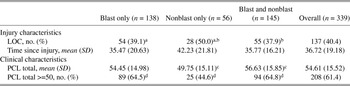
Injury and clinical characteristics of the study population

Notes
LOC = positive loss of consciousness; PCL = posttraumatic stress disorder checklist; Time since injury was calculated as the number of months between the date of evaluation and the date of the last reported injury.
a the difference between the groups is significant, p < .05
b the difference between the groups is significant, p < .005
c the difference between the groups is significant, p = .005
d the Pearson chi square test indicates these values vary significantly from what is expected, χ2(2, N = 339) = 7.91, p < .05
Demographics and Injury Characteristics
One-way ANOVAs were conducted to examine possible differences in time since injury, age, posttraumatic stress symptom report, LOC, and missing PCL data between the three participant injury mechanism groups (i.e., blast-related mTBIs only, nonblast-related mTBIs only, and both blast- and nonblast-related mTBIs). Age differed significantly between injury mechanism groups (F(2,336) = 4.33; p = .01). Fisher’s LSD post hoc analyses indicated that participants with histories of blast-related mTBIs only and those with histories of both blast- and nonblast-related mTBIs were significantly younger than participants with histories of nonblast-related mTBIs only (p = .02 and p = .004, respectively). Posttraumatic stress symptoms (F(2,336) = 4.06; p = .02) also differed significantly between the groups. Participants with histories of both blast- and nonblast-related mTBIs had significantly higher PCL scores than those with histories of nonblast-related mTBIs only, p = .005. The difference in PCL score between participants with histories of blast-related mTBI only and participants with histories of nonblast-related mTBI was marginally significant, p = .054. Missing PCL data differed significantly between injury mechanism groups χ2(2, N = 339) = 7.22; p = .03). One participant in each of the blast only and nonblast only groups had missing PCL data, while nine participants in the both blast- and nonblast-related mTBI group had missing PCL data. Time since injury (F(2,336) = 2.81; p = .06) and the presence of LOC (χ2(2, N = 339) = 2.60; p = .27) did not significantly differ between the groups.
Postconcussive Symptom Report by Injury Mechanism
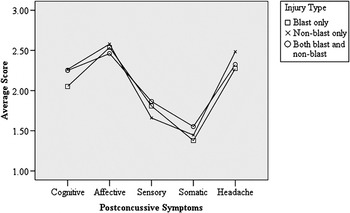
To determine the equivalency of overall severity of PC symptom report and PC symptom cluster profile across the three previously defined injury mechanism groups, a mixed model repeated measures MANCOVA was conducted with the affective, cognitive, sensory, and somatic PC symptom clusters and the individual headache item as dependent variables. The PCL total score, presence or absence of LOC, time since injury, and age were included as covariates. The results of the mixed model repeated measures MANCOVA showed no group by symptom cluster interaction, indicating no statistically significant profile difference across groups, nor any main effect of group, indicating no differences in overall PC symptom severity (p > .05 for all comparisons; see Figure 1). The test of levels indicated that posttraumatic stress symptoms and presence of LOC were significantly associated with total PC symptom report. Posttraumatic stress symptoms were positively associated with and uniquely accounted for 46.6% ( ; F(1,332) = 289.36; p < .001) and presence of LOC uniquely accounted for 1.6% (
 ; F(1,332) = 5.42; p = .02) of the variance in total PC symptom report. Age was not associated with total PC symptom report,
 , F(1,332) = 1.34, p = .25. To determine whether accounting for covariates attenuated a relation between injury mechanism and PC symptom report, the above analysis was conducted without covariates. Again, the results of the mixed model repeated measures MANCOVA showed no group by symptom cluster interaction, indicating no statistically significant profile difference across groups, nor any main effect of group, indicating no differences in overall PC symptom severity (p > .05 for all comparisons)Footnote 1.
Injury type. Note: After accounting for covariates (i.e., post-traumatic stress symptom severity, time since injury, age), these are the corrected mean scores for each self-rated symptom cluster according to a 5-point scale ranging from 0 (none) to 4 (very severe).

Postconcussive Symptom Report and Blast Injury Characteristics
The analyses examining the effect of blast-injury characteristics (i.e., proximity to blast and number of blasts) excluded the 56 participants who did not have histories of blast-related mTBI. Of the remaining 283 participants, 78 reported history of one blast injury, 103 reported between two and four blast injuries, and 102 reported five or more blast injuries. An additional 56 participants who did not provide an estimate of distance from blast were excluded from the analysis of the effect of proximity to blast on PC symptom report. Of the remaining 227 participants, 102 reported being less than 10 feet from the closest blast, 80 reported being 10–30 feet from the closest blast, and 45 reported being more than 30 feet from the blast.
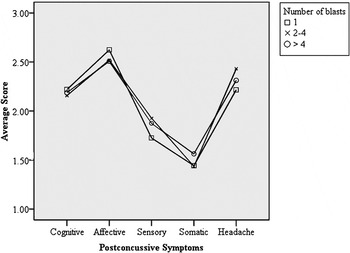
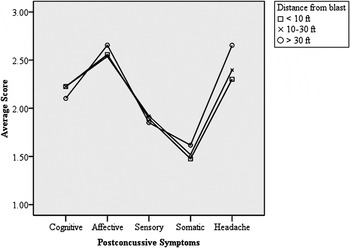
Of the individuals with blast-related mTBIs, two similar mixed model repeated measures MANCOVAs were conducted with identical dependent variables and covariates, but with number of blasts (1, 2–4, or 5 or more) and distance from the blast (<10 ft, 10–30 ft, or >30 ft) as independent variables. The results of the mixed model repeated measures MANCOVA showed no group by symptom cluster interaction indicating no statistically significant profile difference across groups, nor any main effect of group, indicating no differences in overall PC symptom severity (p > .05 for all comparisons), demonstrating that PC symptom severity and PC symptom cluster profiles did not differ by number of blast exposures (see Figure 2) or distance from the blast (see Figure 3). To examine the possibility that the relation between blast injury characteristics and PC symptom report was substantially attenuated by the inclusion of multiple covariates, mixed model repeated measures MANOVAs were conducted without covariates. Again, no statistically significant effects of injury mechanism were found (p > .05 for all comparisons)Footnote 1.
Number of blasts. Note: After accounting for covariates (i.e., post-traumatic stress symptom severity, time since injury, age), these are the corrected mean scores for each self-rated symptom cluster according to a 5-point scale ranging from 0 (none) to 4 (very severe).

Distance from blast. Note: After accounting for covariates (i.e., post-traumatic stress symptom severity, time since injury, age), these are the corrected mean scores for each self-rated symptom cluster according to a 5-point scale ranging from 0 (none) to 4 (very severe).

Given the significant finding of increased posttraumatic stress symptoms in patients with histories of both blast- and nonblast-related mTBIs, and the marginally significant finding of increased posttraumatic stress symptoms in patients with histories of blast-related mTBIs only relative to patients with histories of nonblast-related mTBIs only (p = .054), additional one-way ANOVAs were conducted to investigate whether specific blast injury characteristics (i.e., number of blasts and proximity to blasts) were related to total posttraumatic stress symptom report. Number of blast injuries was not related to total posttraumatic stress symptom report, p = .18. Similarly, distance from the blast was not related to total posttraumatic stress symptom report, p = .46.
DISCUSSION
This study investigated differences in PC symptom report in symptomatic veterans with histories of blast- and nonblast-related mTBI presenting for outpatient evaluation at VA medical centers on average 3 years after their most recent injuries. Veterans with histories of blast-related mTBI were significantly younger than veterans with histories of nonblast-related mTBI only. Also, veterans with any blast-related mTBI history reported higher posttraumatic stress symptoms than veterans with nonblast-related mTBI histories, with a marginally significant difference in posttraumatic stress symptom report between veterans reporting blast-related mTBI only and those with nonblast-related mTBI. There were no differences, however, in PC symptom severity or PC symptom cluster profiles between participants with histories of blast-related mTBIs only, nonblast-related mTBIs only, or both blast- and nonblast-related mTBIs. Similarly, there were no differences in PC symptom severity or PC symptom cluster profiles based on the number of blasts or proximity to blast. Of note, the lack of association between injury characteristics and PC symptom report remained regardless of whether posttraumatic stress symptom report, presence of LOC, time since injury, and age were included in the models as covariates. The findings suggest that PC symptom report does not vary by injury mechanism, and that PC symptom report is not moderated by self-reported number of blast injuries or proximity to blast in veterans with remote histories of mTBI.
Our findings bolster those of Belanger, Kretzmer, et al. (Reference Belanger, Kretzmer, Yoash-Gantz, Pickett and Tupler2009), who found no significant difference in neuropsychological performance between veterans with histories of blast-related and nonblast-related TBI. Taken together, these findings suggest that blast-related mTBIs do not necessarily result in unique neurobehavioral sequelae as measured by the NSI relative to other causes of mTBI (e.g., falls, motor vehicle collisions). Furthermore, the results of the current study add to the growing literature, which suggests a strong relation between mental health factors and PC symptom report in returning veterans with remote histories of mTBI (Belanger, Kretzmer, et al., Reference Belanger, Kretzmer, Vangerploeg and French2010; Benge, Pastorek, & Thornton, Reference Benge, Pastorek and Thornton2009; Hoge et al., Reference Hoge, McGurk, Thomas, Cox, Engel and Castro2008; Schneiderman, Braver, & Kang, Reference Schneiderman, Braver and Kang2008). Whereas injury mechanism and blast characteristics did not affect PC symptom report in our sample, report of posttraumatic stress symptoms accounted for a significant portion of the variance (46.6%) in reported PC symptoms, with presence or absence of LOC accounting for a significant but much smaller portion of the variance (1.6%) in PC symptom report. It is noteworthy that, when posttraumatic stress symptoms were not included as covariates, the lack of association between injury mechanism and PC symptoms remained. Given the associations identified between posttraumatic stress and injury mechanism, and posttraumatic stress and PC symptom report, it was reasonable to expect that removal of posttraumatic stress as a covariate would result in a significant statistical relation between injury mechanism and PC symptom report. The fact that this did not occur in the current analyses was likely explained by the relatively small difference in posttraumatic stress report between injury mechanism groups (i.e., approximately 0.5 standard deviations).
The current study also provides further insight into the potential impact of specific blast injury characteristics (i.e., number of blasts and proximity from blast) on PC symptom report several years post-mTBI. Our hypothesis that increased number of blast exposures and decreased proximity to blasts would be associated with PC symptom report was not supported. The sports concussion literature shows mixed findings regarding number of concussions and severity of neurobehavioral sequelae. Some studies have found that multiple concussions increase PC symptom report and decrease performance on memory testing days after a concussion (Iverson, Gaetz, Lovell, & Collins, Reference Iverson, Gaetz, Lovell and Collins2004), and increase recovery time (Guskiewicz et al., Reference Guskiewicz, McCrea, Marshall, Cantu, Randolph and Barr2003). In a recent meta-analysis, Belanger, Spiegel, and colleagues (Reference Belanger, Spiegel and Vanderploeg2010) found that a history of multiple concussions was related to poorer performance on measures of delayed memory and executive functions. Others have found no relation between number of concussions and differences in cognitive test performance (Collie, McCrory, & Makdissi, Reference Collie, McCrory and Makdissi2006; Guskiewicz, Marshall, Broglio, Cantu, & Kirkendall, Reference Guskiewicz, Marshall, Broglio, Cantu and Kirkendall2002; Iverson, Brooks, Lovell, & Collins, Reference Iverson, Brooks, Lovell and Collins2006; Pellman, Lovell, Viano, Casson, & Tucker, Reference Pellman, Lovell, Viano, Casson and Tucker2004). It is also noteworthy that reported proximity to the blast did not affect PC symptom report, as animal studies have shown that increased blast pressure is related to increased cognitive and physiological changes (Moochhala et al., Reference Moochhala, Md, Lu, Teng and Greengrass2004; Säljö et al., Reference Säljö, Bao, Haglid and Hansson2000). It is possible that the long time since injury and the reliance on self-report data to measure the blast injury characteristics and to diagnose mTBI contributed to the null findings between blast injury characteristics and PC symptom report in this study. In contrast, Belanger, Kretzmer, et al. (Reference Belanger, Kretzmer, Yoash-Gantz, Pickett and Tupler2009) did find limited evidence of a relation between severity of TBI and cognitive test performance in veterans recovering from blast exposure. If we had included veterans sustaining moderate and severe TBIs secondary to blast (presumably due to the short distance from the blast) in the present study, it is possible we may have found an association between blast injury characteristics and PC symptom report. Conversely, our failure to identify differences in PC symptom report may reflect a clinical reality that the similarities between blast and nonblast injury mechanisms (i.e., being hit in the head by flying debris, acceleration/deceleration injuries from being thrown against stationary objects) are much greater than the differences.
This study’s participants represent a unique but large group of veterans that are presenting to VA hospitals for treatment of symptoms possibly related to remote TBIs, usually secondary to blast-related mTBI. Given that cognitive effects are generally expected to resolve within several weeks to 3 months (Belanger et al., Reference Belanger, Curtis, Demery, Lebowitz and Vanderploeg2005; Binder et al., Reference Binder, Rohling and Larrabee1997; Carroll et al., Reference Carroll, Cassidy, Peloso, Borg, von Holst and Holm2004; Frencham et al., Reference Frencham, Fox and Mayberry2005; Schretlen & Shapiro, Reference Schretlen and Shapiro2003) and PC symptoms are expected to resolve within a year post-injury (Carroll et al., Reference Carroll, Cassidy, Peloso, Borg, von Holst and Holm2004), it is noteworthy that these veterans, evaluated an average of 37 months after their last injury, reported a significant number of PC symptoms. The combination of mTBI and posttraumatic stress symptoms may be producing this unusually large amount of PC symptom report so long after the injury. Other factors, such as the availability of financial compensation for residual effects of mTBI, may also contribute to persistent symptom report. Given the long time since injury of the veterans included in this study and the finding of Belanger, Kretzmer, et al. (Reference Belanger, Kretzmer, Yoash-Gantz, Pickett and Tupler2009) that posttraumatic stress symptom report was positively associated with time since injury, the small relation between presence/absence of LOC and PC symptoms relative to the large association between posttraumatic stress symptoms and PC symptoms was, perhaps, to be expected. One possible explanation for these findings is that as time since injury increases, proximal factors (e.g., psychological and environmental stressors) begin to strongly influence PC symptom report, while more distal factors (e.g., injury mechanism, number of blast injuries, proximity to blast) become less related to symptom report. Future studies must investigate the impact of potentially important proximal factors on the symptom report and overall well being of returning veterans (e.g., family support, physical health, and other mental health issues) to determine which, if any, may be important intervention targets.
In the current study, younger age and increased posttraumatic stress symptom report was associated with blast-related mTBI. In agreement with our findings, Belanger, Kretzmer, et al. (Reference Belanger, Kretzmer, Yoash-Gantz, Pickett and Tupler2009) and Cernak, Savic, Ignjatovic, and Jevtic (Reference Cernak, Savic, Ignjatovic and Jevtic1999) both found that posttraumatic stress is more common in people with histories of blast TBI than nonblast TBI. One hypothesis that might explain the apparent relation between age, posttraumatic stress, and blast-related mTBI is that blast exposure serves as a proxy for combat intensity, with younger service members possibly more likely to be exposed to blasts and involved in life-threatening situations, subsequently affecting the development of posttraumatic stress. Indeed, the relation between combat intensity and reported history of TBI has already been demonstrated (Hoge et al., Reference Hoge, McGurk, Thomas, Cox, Engel and Castro2008). In this respect, history of blast injury may be viewed as a risk factor for posttraumatic stress in clinical settings.
It is crucial that diagnosticians consider that posttraumatic stress may be playing a large role in the presenting symptoms of their patients with histories of mTBI. Veterans with posttraumatic stress symptoms have been shown to have worse functioning than veterans without posttraumatic stress symptoms across a multitude of outcomes (Hoge et al., Reference Hoge, McGurk, Thomas, Cox, Engel and Castro2008; Jakupcak, Luterek, Hunt, Conybeare, & McFall Reference Jakupcak, Luterek, Hunt, Conybeare and McFall2008; Kashdan, Uswatte, Steger, & Julian, Reference Kashdan, Uswatte, Steger and Julian2006; Vasterling, Schumm, Proctor, Gentry, King, & King, Reference Vasterling, Schumm, Proctor, Gentry, King and King2008; Yehuda et al., Reference Yehuda, Keefe, Harvey, Levengood, Gerber, Geni and Siever1995). This has important diagnostic and treatment implications for the veteran population. Concluding a patient is currently being affected by their past mTBI(s) based solely on his/her endorsement of PC symptoms is not sufficient. Self-reported PC symptoms are not specific to histories of mTBI in this population, but are most highly related to posttraumatic stress symptoms. The misattribution of PC symptoms to a remote history of mTBI could essentially delay treatment of posttraumatic stress symptoms or other underlying conditions (e.g., depression, posttraumatic stress disorder, substance abuse), for which empirically supported interventions are widely available. Shifting the focus of treatment may help reduce the number of unneeded tests and procedures, thus avoiding the reinforcement of negative perceptions of illness in this population (Hoge et al., Reference Hoge, Goldberg and Castro2009).
Several noteworthy limitations of the current study must be considered. The data were based on self-report instruments and were collected an average of 37 months after the most recent injury. In addition, there was no way to validate their self-reported injury characteristics. Also, for patients with multiple blast injuries, we were unable to verify that all blast exposures were associated with alteration of consciousness. While this study is certainly limited by its utilization of self-report data, it is important to note that rarely, if ever, is additional information about combat-related mTBI injury characteristics available for review in clinical settings. In addition, the examination of self-reported PC symptoms allowed us to examine cognitive, affective, and somatic problems, rather than focusing only on cognitive functioning through neuropsychological test performance. Nevertheless, problems with self-report include differences in willingness to admit problems, symptom exaggeration, and the fallibility of memory (Loftus, Levidow, & Duensing, Reference Loftus, Levidow and Duensing2002). It is unclear to what extent the use of semi-structured interviews in the current study helped to augment the reliability of data on injury history and current symptom report.
That the evaluations were conducted an average of 37 months after veterans last reported injury precluded evaluating whether blast-related mTBIs produce unique symptom profiles closer to the time of injury. These limitations are endemic in the study of blast-related mTBI, as careful documentation of acute injury characteristics may not be a priority in the theater of combat. Additionally, we did not consider how other proximal factors, including mood disorders, substance abuse, service-connection status, physical health, and social support affect PC symptom report. Also, all of the veterans in the study endorsed current symptoms at the time of screening, so it should be noted that these results cannot be generalized to all veterans with histories of mTBI, and are limited to those veterans experiencing symptoms years after their mTBI. It is important to note that we did not investigate the differences between veterans with and without histories of mTBI; therefore, this study does not suggest that there is no relation between remote history of combat-related mTBI and PC symptom report. Brenner and colleagues (Reference Brenner, Ivins, Schwab, Warden, Nelson and Jaffee2009) evaluated soldiers an average of 6 months post-injury (as described in Terrio et al., Reference Terrio, Brenner, Ivins, Cho, Helmick and Schwab2009) and found that those with mTBI or PTSD were at increased risk of PC symptoms compared with those with neither mTBI nor PTSD. In addition, the authors found that those with both mTBI and PTSD had a greater risk of PC symptoms than those with mTBI or PTSD alone. Therefore, it appears that mTBI does affect PC symptom report in soldiers evaluated an average of 6 months post-injury.
The results indicate that injury mechanism, number of blast injuries, and distance from the blast are not clearly associated with the report of PC symptom in veterans with remote histories of mTBI. This study also supports the growing evidence that posttraumatic stress is strongly associated with the endorsement of PC symptom in combat veterans with a remote history of mTBI. Assessment and treatment of current comorbid conditions, such as posttraumatic stress, may be more beneficial for the treatment of PC symptom than narrowly focusing on the remote history of mTBI.
ACKNOWLEDGMENTS
The authors thank the Veterans who participated in this study. We also acknowledge the efforts of the Polytrauma Network Site team members at the Michael E. DeBakey VA Medical Center and the George E. Wahlen VA Medical Center for their assistance with data collection, especially Jennifer Romesser, Psy.D., and Maija Reblin, Ph.D. This material is based on work supported by the Office of Academic Affiliations, Department of Veterans Affairs. This work was supported in part by a Department of Veterans Affairs Center of Excellence grant (H.S.L., Grant number B6812C), Neurorehabilitation: Neurons to Networks Center for Rehabilitation Research. Dr. Pastorek had full access to all of the data in the study and takes responsibility for the integrity of the data and the accuracy of the data analysis. The information in this manuscript and the manuscript itself has never been published either electronically or in print. No grant, pharmaceutical, or corporate funding was used in the preparation of this manuscript or collection of data. No conflicts of interest exist that might affect this manuscript. Portions of this study were previously presented at the Department of Veterans Affairs Evolving Paradigms II: The Journey Home Conference in Las Vegas, NV in September 2009.