Introduction and background
Since the 1960s, the Food and Agriculture Organization of the United Nations (FAO) has worked on genetic resources for food and agriculture. Initially, it focused on plant genetic resources, but since 1990 it has been increasingly involved in the area of animal genetic resources for food and agriculture (AnGR). The FAO Commission on Genetic Resources for Food and Agriculture (CGRFA) is a permanent intergovernmental forum, which has developed several international agreements, voluntary undertakings and codes of conduct to promote and facilitate the wise management, access to and benefit-sharing of genetic resources. The CGRFA collaborates with other international organizations, including the Convention on Biological Diversity (CBD) and the World Intellectual Property Organization. FAO leads the CBD's programme on agricultural biodiversity (CBD, 2006, 2008a, 2008b).
Under the guidance of the CGRFA, the first International Technical Conference on Animal Genetic Resources for Food and Agriculture, organized by FAO in collaboration with the Government of Switzerland, took place from 3 to 7 September 2007 in Interlaken, Switzerland. The preparation of the Interlaken Conference comprised a two-pronged approach aimed at achieving both the technical and the policy outcomes requested by the CGRFA. Both elements involved broad stakeholder involvement at national and regional levels. These processes are described in detail by Hoffmann, Boerma and Scherf (Reference Hoffmann, Boerma and Scherf2010).
Technical outcome
The State of the World's Animal Genetic Resources for Food and Agriculture (FAO, Reference Rischkowsky and Pilling2007a), which was based on 169 country reports, 9 reports from international organizations, scientific literature and FAO's Domestic Animal Diversity Information System (DAD-IS) and statistical database, was launched at the conference. It provides the first comprehensive global assessment of the roles, values, status and trends of AnGR, and of capacity at both country and international levels to manage these resources. It highlights the importance of the livestock sector within agriculture, the importance of AnGR to rural development and food security, and the nature and gravity of the threats to these resources. It also provides an overview of the state of the art in the management of AnGR and identifies areas for capacity building and research. The preparation of the report enhanced worldwide interest in AnGR and recognition of their importance. At the Interlaken Conference, governments stressed that the preparation of this authoritative survey was an important step in achieving the improved management of AnGR, and that it enhanced the basis for further policy development.
Policy outcome
The main achievement of the Interlaken Conference was the adoption of the Global Plan of Action for Animal Genetic Resources. It represents a milestone for the livestock sector and a major building block in the development of a coherent international framework for the wise management of agricultural biodiversity. It provides an international framework to support and increase the overall effectiveness of national, regional and global efforts for the sustainable use, development and conservation of AnGR. The Global Plan of Action was adopted through the Interlaken Declaration on Animal Genetic Resources, in which governments affirmed their commitment to its implementation (FAO, 2007e).
The Global Plan of Action for Animal Genetic Resources consists of three parts:
I. Rationale;
II. Strategic Priorities for Action; and
III. Implementation and Financing of the Global Plan of Action for Animal Genetic Resources.
The Global Plan of Action contains 23 Strategic Priorities for Action, clustered into 4 Priority Areas:
Area 1: Characterization, inventory and monitoring of trends and associated risks (two Strategic Priorities);
Area 2: Sustainable use and development (four Strategic Priorities);
Area 3: Conservation (five Strategic Priorities); and
Area 4: Policies, institutions and capacity building (12 Strategic Priorities).
These Strategic Priorities for Action were developed on the basis of national strategic priorities expressed in the country reports submitted during the preparation of the State of the World report, the outcomes of various regional consultations and the conclusions of expert studies and meetings. Current and emerging policy issues and challenges in the field of conservation and sustainable use of AnGR and in the livestock sector more broadly, as identified during this reporting and consultation process, were taken into consideration.
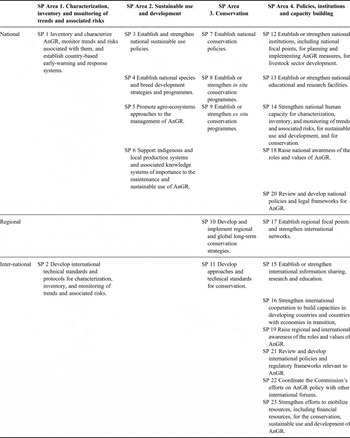
Table 1 presents the Strategic Priorities, grouped according to the level at which they are to be implemented. Most of the implementation of strategic priorities in the areas of characterization, monitoring, sustainable use and conservation will take place at national level, whereas the international community will support countries through the development of standards, guidelines and protocols, and through institutional development and capacity building. International actors, particularly FAO, are also expected to contribute further to the generation of global public goods related to AnGR, through the development of international policies. There are significant linkages between the various strategic priorities and between the various levels of implementation.
Levels for the implementation of the strategic priorities.

Source: Derived from FAO (2007e).
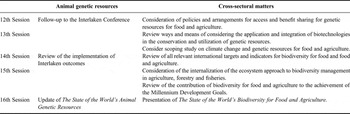
Regarding financing and monitoring of the implementation of the Global Plan of Action, the 34th FAO Conference requested the CGRFA to oversee the implementation of the Global Plan of Action within the context of the commission's multi-year programme of work (MYPoW), in an organized and focused manner (FAO, 2007b, 2009c). Table 2 provides an overview of sectoral and cross-sectoral matters of relevance to AnGR as they will be addressed in the MYPoW. Both the MYPoW and the Global Plan of Action are intended to be rolling and evolving in 10-year programmes, which facilitate their integration. The CGRFA was also requested to agree on the modalities for the presentation of progress reports, as well as the criteria and parameters for evaluating progress in the implementation of the Global Plan of Action.
Multi-year programme of work of the CGRFA on matters related to animal genetic resources.
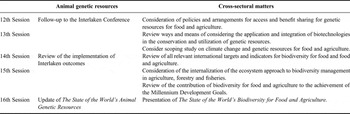
Source: FAO (2007c – Annex E) and updated 2009 in CGRFA-12/09/Report.
At its 12th session, the CGRFA decided on two lines of reporting on the implementation of the Global Plan of Action at national, regional and global levels: one on the process of implementation and the other on the impact that implementation has made on the AnGR themselves – a reduction in the loss of AnGR and a better management of these resources are the final measurable indicators of the success of the Global Plan of Action. Countries will report on progress in the implementation of the Global Plan of Action at 4-year intervals, starting from 2011. FAO will prepare a synthesis report based on the country reports; the second synthesis report will be made available to the CGRFA in 2017, as part of the updated The State of the World's Animal Genetic Resources on Food and Agriculture (FAO, 2009c) (Table 2). With respect to monitoring the status of the genetic resources, FAO has been requested to prepare biennial reports on status and trends of animal genetic resources (FAO, 2009d) based on the national breed population data reported to the breed database of the DAD-IS. Unfortunately, population data for 36 percent of breeds are still missing; this situation has not been improved significantly since 2007. The scarcity of data will also affect the indicator of trends in the genetic diversity of domestic animals that is currently being developed by FAO and which will be included in future status and trends reports. Countries have not agreed on specific targets for livestock genetic diversity or ex situ collections.
While the main responsibility for implementation rests with national governments, the Global Plan of Action calls upon the governments of developed countries to “attach due attention, including funding, to the implementation of activities within the Strategic Priority Areas of the Global Plan of Action through bilateral, regional and multilateral cooperation”. The implementation of the Global Plan of Action will require substantial and additional financial resources and long-term support for national, regional and international AnGR programmes and priority activities. Countries should make every effort to provide support to the implementation of the Global Plan of Action. International cooperation should be strengthened and major multilateral and bilateral funding and development institutions should facilitate the implementation of the Global Plan of Action, in particular to support and complement the efforts of developing countries and countries with economies in transition. The CGRFA, at its 12th session in 2009, adopted a Funding Strategy for the Global Plan of Action (www.fao.org/fileadmin/templates/nr/documents/CGRFA/FundingStrategy_E.pdf), including the establishment of a trust account for the support of national projects.
What happened after the Interlaken Conference?
The Global Plan of Action is the only internationally agreed comprehensive framework for the livestock sector that addresses the management of genetic diversity in an ecosystem approach and takes poverty alleviation and food security into account. It was endorsed by FAO membership at the 34th Session of the FAO Conference. It was welcomed by the Ninth Conference of the Parties to the CBD as the internationally agreed framework for the management of AnGR. The Global Plan of Action was also welcomed by the Governing Body of the International Treaty on Plant Genetic Resources for Food and Agriculture and the Seventh Session of the UN Permanent Forum on Indigenous Issues.
FAO is involved in several national, regional and global initiatives to implement the Global Plan of Action. In partnership with governments, international organizations, research organizations and NGOs, FAO continues to facilitate global and regional collaboration and networks; supports the convening of intergovernmental and technical meetings; maintains and further develops DAD-IS; develops communication products; provides technical guidelines and assistance; coordinates capacity-building and training programmes; and promotes the transfer of technologies related to sustainable use, development and conservation of AnGR. It has developed several guidelines to assist countries in the implementation of the Global Plan of Action, two of which have already been endorsed by the CGRFA: Preparation of national strategies and action plans for animal genetic resources (FAO, 2009e) and Breeding strategies for sustainable management of animal genetic resources (FAO, 2010). FAO's biennial progress reports to the CGRFA give detailed accounts of these activities (e.g. FAO, 2009f).
There are many activities at the national level in which FAO is not involved. In order to obtain a first glimpse of such activities, FAO developed a simple electronic questionnaire, which was widely disseminated in March 2010. Thirty countries – spread across all geographical regions – replied. The results, therefore, provide only a very incomplete snapshot. The official country progress reports to be prepared in 2011 will provide wider coverage and more in-depth reporting. Development of a national strategy and action plan is seen as the first step in the implementation of the Global Plan of Action. More than 80 percent of the responding countries indicated that they are either planning, currently developing, have already endorsed or are implementing their national action plans. Countries were also asked to indicate, for each of the four strategic priority areas, activities that are currently being undertaken in research and capacity building, institutional and technical support and awareness raising and information. Table 3 shows that a large percentage of the 30 countries that responded to the questionnaire are undertaking such activities and that these are quite equally distributed across the four Strategic Priority Areas.
Country activities undertaken to implement strategic priority areas of the Global Plan of Action.

Source: FAO questionnaire: responses from 30 countries, multiple replies allowed.
In addition to the questionnaire described above, annual reports provided by the officially nominated National Coordinators for the management of animal genetic resources of 25 European countries (Annual Country Reports, 2010) were analysed.
The Global Plan of Action and the State of the World report have been published in all UN languages, and several National Coordinators have prepared national language versions of the State of the World “in brief”, the Global Plan of Action and the Interlaken Declaration for awareness raising and policy-making at national level (Austria, Denmark, Germany, Japan, Norway, Poland and Switzerland). A further 17 countries are in the process of preparing local language versions of one or both documents.
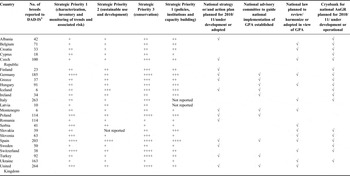
Since 2007, several countries have undertaken one-off or regular awareness raising activities, such as expositions and fairs, workshops, web sites and publications for the general public and policy-makers: Albania, Austria, Bhutan, Burundi, China, Croatia, Germany, Hungary, Iceland, Nepal, NORDGEN (an institution under the Nordic Council of Ministers covering Denmark, Finland, Iceland, Norway, and Sweden), Poland, Slovakia, Slovenia, Spain, Sweden, Switzerland, Turkey, Ukraine and United Kingdom. National workshops with the participation of stakeholders have taken place in many countries, including Armenia, Angola, Chile, China, Cuba, Denmark, Ethiopia, Fiji, Hungary, India, Ireland, Malawi, Malaysia, the Netherlands, Nicaragua, Pakistan, the Plurinational State of Bolivia, Poland, Slovakia, Switzerland and Thailand. Countries have continued to develop institutions for national implementation of the Global Plan of Action. For example, France has established a national commission for genetics, which brings together stakeholders from the Ministry of Agriculture and Fisheries, research and technical institutes, companies and breeders, organized by species or group of species (see also Table 4). Its national agricultural research institute (INRA) and the French Foundation for Research on Biodiversity work jointly on AnGR, especially on characterization.
Summary of annual reports provided by 25 European countries reporting on their activities implementing the Global Plan of Action from September 2009 to August 2010.

+ = Actions initiated; +++++ = all actions fully implemented and monitoring regularly ongoing.
1Extracted from DAD-IS (www.fao.org/dad-is/) on 8 September 2010.
Strategic Priority Area 1: Characterization, inventory and monitoring of trends and associated risks
National activities under Strategic Priority Area 1 are diverse, encompassing inventories, censuses and phenotypic and molecular genetic characterization. In most countries, work on inventories has been staggered, either by species (e.g. Belgium surveyed endangered sheep breeds in 2008–2010, cattle in 2010 and pigs in 2011, with a view to selecting donors for a cryobank; the Plurinational State of Bolivia started with camelids and guinea pigs, which will be followed by criollo cattle, sheep, goats and pigs; Chile started with cattle in 2009, followed by sheep and goats) or by activity (Ukraine agreed on breed definitions first and is planning inventory and monitoring). China has completed its second national breed census, the results of which will be published in 2010. In Spain, breeds have been inventoried and described in the official catalogue of Spanish breeds (currently 178 breeds, covering breeding programmes of 159 associations) (Ministerio de Medio Ambiente y Medio Rurale y Marino, 2008).
Kenya included livestock species in its last human population census and plans for a breed survey in 2010. It has already characterized some ruminant breeds. The Plurinational State of Bolivia has undertaken a national mapping of production systems and the related AnGR. Montenegro is working on breed morphological characterization and investigation of some productive traits, the identification of breeds at risk and their geographical distribution and population size. Slovakia is conducting research on molecular characterization of breeds, and its central livestock register and pedigree systems are operational. It is currently developing a national inventory of AnGR, linked to regional and global information systems. Oman and Nepal have phenotypically characterized their local breeds; Oman is now planning for molecular characterization, whereas in Nepal research projects are already underway for the molecular characterization of some breeds. Costa Rica has set up a biotechnology laboratory to advance molecular characterization. Ghana now considers breed characterization an important area for which students are being trained at national universities. The Secretariat of the Pacific Community coordinated the genetic characterization of pigs and chickens in six countries (Fiji, Niue, Samoa, Solomon Islands, Tonga and Vanuatu). Sixteen European countries (Austria,Footnote 1 Cyprus,Footnote 2 Estonia,Footnote 3 Finland,Footnote 4 Georgia,Footnote 5 Greece,Footnote 6 Hungary,Footnote 7 Iceland,Footnote 8 Ireland,Footnote 9 Italy,Footnote 10 the Netherlands,Footnote 11 Poland,Footnote 12 Slovakia,Footnote 13 Slovenia,Footnote 14 SwitzerlandFootnote 15 and the United KingdomFootnote 16) maintain operational national information systems, both in their respective local languages and in English, within the European Farm Animal Biodiversity Information System (EFABIS) network, and automatically exchange data with the European regional information system EFABISFootnote 17 and DAD-IS. In addition, Romania and Republic of Moldova have requested installation of national systems.
Strategic Priority Area 2: Sustainable use and development
The results of the questionnaire also show a wide range of activities in this strategic priority area. While developing countries aim to strengthen the linkages between genetic diversity, livelihoods and food security, several developed countries highlighted the links between genetic diversity and landscapes, and focus their activities on development, labelling and marketing of high-value products.
Togo has set targets for productivity increases in its livestock sector, and evaluated the status of its national ranches and livestock stations in 2009 with the aim of their future rehabilitation. Nepal prepared a draft national animal breeding policy and initiated a dairy cattle cross-breeding scheme, including performance recording and semen collection, with FAO support. It now plans for the collection and processing of semen from goats and pigs to support the sustainable use of these species. In Kenya, the national livestock extension services promote the sustainable use and development of AnGR; the East African Semen and Embryo Transfer Association was formed to promote these biotechnologies. Various cross-breeding programmes are underway for dairy cattle.
Chile and Costa Rica involve the livestock industry in the national livestock genetic improvement plans. Costa Rica has a national programme for beef cattle evaluation, including testing of cross-breeding for dual-purpose breeds. Chile has developed different approaches for commercial and subsistence sectors: the national policy for cattle and sheep genetic improvement aims at improving the competitiveness of beef and lamb production along the whole value chain. The goal is to increase productivity and generate higher value-added animal products by improving management, production and manufacturing practices as well as facilitating access to new and competitive markets. The main strategies are (a) developing an institutional framework to coordinate and address the national plan of action on livestock genetic improvement, including the implementation of breeding and marker-assisted selection mechanisms for different production systems and products, and (b) implementing a national capacity-building strategy to promote the development of human resources and institutional capabilities on animal breeding and genetics. For the subsistence sector, Chile works on the development of participatory programmes to improve local breeds in poor communities to contribute to food security and poverty alleviation strategies, as well as initiatives that promote the trade of local and underutilized products from indigenous communities in the south of Chile.
The Plurinational State of Bolivia links breed characterization with community mobilization, and focuses its breeding efforts on camelids and guinea pigs; both play a crucial role in the livelihoods of poor indigenous communities. Bhutan is implementing a link between breeding and conservation activities.
In Zimbabwe, research institutions are currently busy in maintaining breeding animals at hand. Resources are needed to increase the population of purebred animals for distribution to farmers. Nucleus herds are also being established in Oman.
In Europe (Annual Country Reports, 2010), the work focuses rather on marketing and labelling of high-value products than on genetic improvement. Several countries have programmes that promote local breeds through special products, landscape valuation and agritourism (Montenegro, Slovakia and Spain), special and geographical indication products (Austria, Belgium and Spain). In 2009, Slovakia endorsed legislation to promote direct sale of local livestock products to consumers as long as veterinary requirements are respected. Austria holds annual national information workshops for breeding organizations that are in charge of local endangered breeds. Spain has put in place specific legislation supporting native breeds in extensive production systems that fulfil certain environmental prerequisites, and supporting the development of quality products, in particular from native breeds, to improve their competitiveness. It also monitors the implementation of breeding programmes for native breeds. It plans to support companies that produce local and traditional products and to encourage the use of native breeds for maintaining ecosystems.
Strategic Priority Area 3: Conservation
Conservation measures taken by countries encompass in situ and ex situ measures. The results of an FAO questionnaire on conservation are reported in detail by Boettcher et al. (Reference Boettcher and Akin2010).
China publicly announced 138 indigenous breeds as national key-protected breeds. It further certified and made public 119 conservation farms/areas/gene banks at the state level and allocated 30 million yuan (app. 3 million euro) regular budget for AnGR conservation. Ghana makes conscious efforts to recruit and train people for the conservation of indigenous breeds. Six national breeding stations are involved in the conservation of indigenous breeds (cattle, sheep, goats and pigs). Nucleus herds, partially on government farms, have also been established for in situ conservation in the Islamic Republic of Iran, Montenegro, Oman, the Russian Federation, Rwanda and Zimbabwe. The Plurinational State of Bolivia focuses on in situ conservation of native camelids, guinea pigs and criollo breeds of the other main species because of their crucial role in food security, and therefore stresses community involvement into conservation activities. It charged a newly established research institute with AnGR conservation.
Among 25 European countries (Annual Country Reports, 2010), 72 percent have established cryobank(s) for national AnGR or have planned their establishment for 2010/11. In general, the work of the 25 reporting countries focuses mainly on indigenous breeds, particularly on breeds with small populations. Activities focus on the creation or completion of gene banks, either at national level or distributed across the country, and on subsidy schemes to support rare breeds. In connection to the national information systems established in European countries, national gene bank documentation systems are operational in 11 countries (Austria, Estonia, Finland, Georgia, Greece, Iceland, Italy, the Netherlands, Slovakia, Slovenia and Switzerland).
National cryobanks that already existed in France, the Netherlands and Austria are kept updated. A cryobank will be set up in Belgium progressively from April 2010; breeding organizations are associated with the cryobank project in order to raise their awareness of AnGR conservation. The establishment of a reserve collection of semen and embryos is also underway in Ukraine (cattle, pigs, sheep, horses and fish) and Slovakia. Costa Rica has prepared a feasibility study for a cryobank of semen and embryos and prepared a project proposal for donors. The animal gene bank of Bhutan has started the process of cryoconservation of sheep, poultry and cattle and envisions working with other species such as horses, pigs and yak.
Many European countries use the national allocation from the European Union Rural Development Programme (RDP) (Council Regulation 1698/2005) to support conservation of animal breeds within their jurisdiction. A survey undertaken by the United Kingdom, which covered 21 European countries, showed that only five of them do not have RDP measures for the support of AnGR. Most counties paid on a headage (11 schemes) or livestock unit (5 schemes) basis. They pay breeders of breeds at risk, but the breeders may have to fulfil criteria such as being a member of the relevant breed society or participating in approved breeding programmes. Some countries fund breed societies or rare breed conservation organizations, again linked to approved breeding programmes. The United Kingdom is unique in linking support for AnGR to agri-environment schemes; thus support is only provided for grazing animals (cattle, sheep, equines and goats) (Small and Hosking, Reference Small and Hosking2010).
The Annual Country Reports (2010) from Europe mentioned repeatedly that erosion of indigenous breeds has been slowed down; the ongoing updating of breed data in DAD-IS will help to verify the situation.
Strategic Priority Area 4: Policies, institutions and capacity building
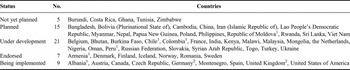
Several countries are currently revising their livestock or breeding policies and strategies (Table 5). Regional organizations, for example in Africa, have included use and conservation of genetic resources in their newly developed strategic plans (AU-IBAR, 2009). Bhutan has developed, involving all relevant stakeholders, a biodiversity policy with a specific chapter on AnGR. Three European country reports (Greece, Ireland and Serbia) (Annual Country Reports, 2010) mentioned the involvement of the national coordinators in updating their respective national biodiversity plans. Nepal has developed an agricultural biodiversity policy and reviewed its national agricultural policies; it has also proposed an animal breeding policy for the sustainable use of AnGR.
Countries that are developing and implementing national strategies and action plans for the management of animal genetic resources.

Source: FAO questionnaire and technical reports.
1With FAO support as TCPF or TCP.
2Developed prior to the endorsement of the Global Plan of Action.
Ghana included indigenous breeds in a widely circulated livestock development policy document and in its five-year national agricultural development document, which also serves as a national strategy for donor investment. Chile, Colombia and Peru have started the development of national strategies and action plans with FAO support, and Republic of Moldova requested FAO's assistance in the development of a national information system on animal genetic resources that will start later this year.
Sixty percent of the 25 European countries (Annual Country Reports, 2010) have either adopted their national strategy and action plan or have its development planned for 2010/11; 40 percent have established a national advisory committee to guide the national implementation of the Global Plan of Action; 46 percent have adopted a national legal instrument reflecting the needs of AnGR management or planned to review or harmonize such a legal instrument in 2010/11.
The Plurinational State of Bolivia plans to develop a national conservation strategy as the first crucial step in the development of a national action plan for AnGR. In Burkina Faso, the national strategy for the management of AnGR is currently under development and will cover the period from 2010 to 2025. It is intended that the strategy will be reviewed and updated based on the results achieved.
A number of countries have or are in the process of reviewing and harmonizing their legislative frameworks to reflect the Global Plan of Action (Bangladesh, Belgium, China, Croatia, Czech Republic, Germany, Greece, Hungary, India, Italy, Montenegro, the Philippines, Serbia, Slovakia, Slovenia, Spain, Switzerland, Thailand, Ukraine and the United Kingdom). China is currently drafting its 12th national five-year plan (2011–2015), which will include a strategic plan for conservation and sustainable utilization of AnGR. Nigeria is formulating policy guidelines for the use of livestock species nationwide and in particular production systems, focusing particularly on breeding, selection and multiplication of indigenous breeds of cattle, sheep and goats in the ecological zones to which they are adapted. In Slovakia, the agenda on AnGR has been clarified in the latest amendments of the animal breeding act (not yet in force).
Some national funding has been secured in China, the Islamic Republic of Iran and Togo. Several countries mentioned AnGR policies that take into account their many linkages to other sectors: Oman stressed links with trade and zoosanitary issues. Ghana and the Plurinational State of Bolivia emphasized links with poverty reduction policy. Togo has defined a production increase target for its livestock sector, evaluated the functioning of its markets and is developing transhumance codes. Nigeria is reviewing policies that positively affect the use of AnGR, such as establishment of parks, game and grazing reserves and protected grazing in reserves, and places AnGR in a broad livestock-policy context. Some European countries emphasize the links between AnGR and rural development (Austria, Montenegro, Slovakia and Spain).
The Annual Country Reports (2010) from Europe also revealed the differences between the activities undertaken by National Coordinators based in ministries and those based in universities or research institutes. The latter clearly focus on research, whereas the group working in ministries work more strategically for the country.
Under the aegis of the CGRFA and other relevant bodies, governments will further consider measures that affect access to and benefit sharing from genetic resources for food and agriculture. The CBD is committed to finalizing the elaboration and negotiation of an international regime on access to genetic resources and benefit sharing at its Tenth Conference of the Parties in October 2010 in Nagoya, Japan. Access and benefit sharing in the field of the exchange and use of AnGR are a matter of increasing international debate, the outcomes of which will have a large impact on the willingness of various states, agencies, institutions and the private sectors to invest in the conservation and further development of AnGR (FAO, 2009a, 2009b). It will also have major implications for the ability of farmers and livestock keepers, individually and collectively, to continue to play their key roles as custodians of AnGR and innovators in the management of these resources. The need for and potential impacts of frameworks for access and benefit sharing of AnGR need to be carefully assessed. The 36th FAO Conference, in Resolution 18/2009, therefore, invited the CBD to consider adequate treatment of genetic resources for food and agriculture in the international regime, for example, through sectoral approaches that allow for differential treatments of different sectors or subsectors of genetic resources, different kinds of genetic resources for food and agriculture, different activities or different purposes for which activities are carried out. As access and benefit sharing were not covered by our survey, no overview of national activities is available as yet.
Conclusion and outlook
The technical and policy achievements of the Interlaken Conference – the result of over a decade of intergovernmental work – have significantly advanced the AnGR agenda and increased recognition of the crucial role that these resources play in food security and rural development. The Global Plan of Action provides an opportunity for all stakeholders to ensure that their efforts converge around an agreed set of common goals and to share experiences. Although only the country progress reports to be prepared in 2011 and information reported to DAD-IS will give a full picture of activities undertaken and their outputs and impacts, the informal questionnaire results reported in this paper indicate that there is new and unprecedented momentum to enhance the wise management of AnGR as a means to promote food security and sustainable development worldwide. Several national and international actors in relevant areas have started to reflect on how their programmes can contribute to the implementation of the Global Plan of Action, and are adjusting their agendas where needed. The activities reported in this paper show that different countries are taking steps at different speeds and with different priorities, suited to their own particular conditions and capacities, based on national funds and other funding sources. Flexibility in national approaches while aiming at a common outcome is an inbuilt strength of the Global Plan of Action. Sharing experiences and learning from each other are important components of such a flexible but outcome-oriented process.
Implicitly, the achievements described above reflect passionate efforts to use and conserve AnGR in a sustainable way – by people who depend on them in their daily lives and by people who care about them. At the time of the Interlaken Conference, Kubbinga, Hoffman and Scherf (Reference Kubbinga, Hoffman and Scherf2007) wrote in this journal about “passing on the fire – to further inspire people to contribute in the management of animal genetic resources”. Three years later, we can again highlight the importance of passionate people in the implementation of the Global Plan of Action. However, providing adequate support to livestock keepers and breeders, particularly in developing countries, will continue to be central to this endeavour.