Introduction
Tinnitus is a common otological complaint and can be defined as the perception of sound in the head or ears without a corresponding external acoustic source. The reported prevalence of tinnitus in adult populations is high, with estimates ranging between 4.6 and 30 per cent.Reference Jalessi, Farhadi, Asghari, Kamrava, Amintehran and Ghalehbaghi1–Reference Sindhusake, Mitchell, Newall, Golding, Rochtchina and Rubin4 Despite heterogeneity in study populations and diagnostic criteria, the accepted consensus is that the prevalence of tinnitus increases with age.Reference McCormack, Edmondson-Jones, Somerset and Hall5
In the vast majority of cases, tinnitus is regarded as a subjective phenomenon and can only be evaluated and monitored on the basis of patient-reported responses.Reference Holgers6 This necessitates clinical assessment of tinnitus-related distress and impact on quality of life, for which validated self-report questionnaires are routinely used in specialist settings.Reference Fackrell, Hall, Barry and Hoare7 Such tools can also be used to estimate changes in tinnitus percept over time and provide a responsive measure of intervention-related change.Reference Meikle, Henry, Griest, Stewart, Abrams and McArdle8,Reference Fackrell, Hall, Barry and Hoare9
Perceived tinnitus severity can depend on laterality, loudness and type of sound.Reference Hiller and Goebel10 In turn, the impact of tinnitus on quality of life varies hugely. Cognitive problems, such as attention difficulties, impaired working memory and irritability, are common.Reference Lynn, Bauch, Williams, Beatty, Mellon and Weaver11–Reference Tegg-Quinn, Bennett, Eikelboom and Baguley13 Severe tinnitus is associated with psychological and psychiatric comorbidity,Reference Pinto, Marcelos, Mezzasalma, Osterne, de Melo Tavares de Lima and Nardi14 especially mood and anxiety disorders.Reference Gül, Özkırış, Aydin, Şimşek and Saydam15,Reference Malakouti, Mahmoudian, Alifattahi and Salehi16
In the past, media reports on isolated cases of completed suicide highlighted the presence of severe tinnitus as a major precipitant.Reference Pridmore, Walter and Friedland17 Indeed, several studies have investigated the incidence of attempted or completed suicide in people with tinnitus,Reference Frankenburg and Hegarty18–Reference Lewis, Stephens and McKenna20 with a previous review of the literature asserting that concomitant psychiatric illness is the precipitating factor.Reference Jacobson and McCaslin21 However, examination of the direct relationship between tinnitus and suicidality in the medical literature is limited. Such investigation is important, as it may help identify warning signs and risk factors that warrant early intervention.
Suicidal behaviour is usually preceded by suicidal ideation, which includes both passive and active thoughts of ending one's own life without preparatory actions.Reference Posner, Oquendo, Gould, Stanley and Davies22 Suicidal ideation is helpful for identification of at-risk patients, and it may also be useful in quantifying the degree of psychological distress in the tinnitus-affected population. Therefore, in this study, we conducted a systematic review to: (1) investigate the prevalence of suicidal ideation in adult tinnitus populations; (2) determine the association between tinnitus severity and frequency of suicidal thoughts; and (3) characterise variation in prevalence estimates by population characteristics and methodology of suicidal ideation assessment.
Materials and methods
Study registration
The protocol for this systematic review has been registered in the Prospero database (Centre for Review and Dissemination number: 42020165033).Reference Tailor, Thompson, Nunney, Agius and Phillips23 This work adheres to the Preferred Reporting Items for Systematic Reviews and Meta-analyses statementReference Moher, Liberati, Tetzlaff and Altman24 and Meta-analysis of Observational Studies in Epidemiology guidelines.Reference Stroup, Berlin, Morton, Olkin, Williamson and Rennie25
Search strategy
A systematic search of Medline, Embase and PsychInfo (database inception to 13 August 2020) was undertaken to identify all English language published records investigating the prevalence of suicidal ideation in tinnitus-affected populations. References cited in identified publications, relevant books and Google ScholarTM were also reviewed for retrieval of further records. Iterations of the Medline search strategy are provided as a table in Appendix 1.
Inclusion and exclusion criteria
Studies were included in this systematic review according to the following criteria: (1) patients (aged 16 years or more) were suffering from subjective tinnitus; (2) studies were cross-sectional or baseline surveys of longitudinal studies; and (3) suicidal ideation was stated as an outcome.
Studies were excluded if they met any of the following criteria: (1) patients with a diagnosis of psychotic or personality disorders (high-risk groups for suicidality);Reference Bachmann26 (2) findings based on qualitative methodology; (3) did not include experimental analyses (i.e. review articles, case reports, book chapters, letters to the editor, or commentary); (4) published abstracts and conference papers; and (5) papers published in languages other than English if a translation could not be found.
Screening
Articles identified during the search were independently screened by two authors (BVT and RET) for inclusion using Rayyan web and mobile application systematic review tool software (Qatar Computer Research Institute, Doha, Qatar).Reference Ouzzani, Hammady, Fedorowicz and Elmagarmid27 Any discrepancies in study selection were resolved through discussion. All studies included after full-text screening were carefully evaluated for overlap in study population. If overlap was found, only data from the study with the largest sample size was included.
Data extraction
Two authors (BVT and RET) independently performed data extraction before meeting to produce and finalise a summary of findings table. The following data were extracted from included studies: author(s), year of publication, country of origin, study design, study population (number, gender, age), clinical characteristics (including co-morbidities and inclusion and exclusion criteria), method of tinnitus evaluation, method of psychiatric evaluation for suicidal ideation and prevalence data (either directly obtained or derived from published data). If available, prevalence of suicidal ideation in healthy control (non-tinnitus) populations was also extracted or derived from published data.
Quality assessment
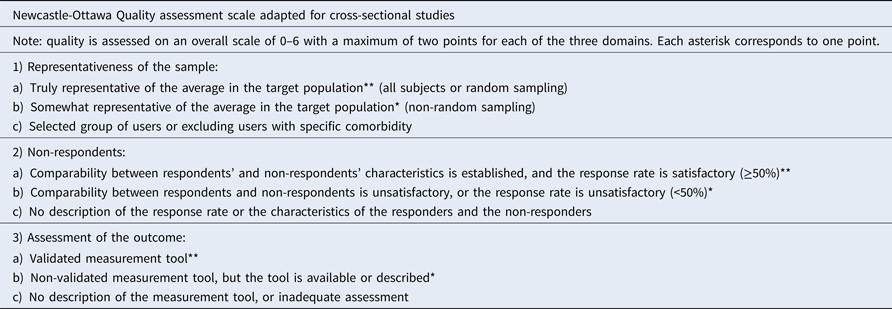
Quality assessment of included studies was performed using a modified form of the Newcastle–Ottawa scale adapted for cross-sectional studies.Reference Herzog, Álvarez-Pasquin, Díaz, Del Barrio, Estrada and Gil28 Risk of bias was assessed in three domains: (1) representativeness of the sample, (2) non-respondents and (3) outcome measurement, with each domain allocated a numerical score of 2, 1 or 0 (indicating low, moderate or high risk of bias, respectively). A full version of the modified criteria is available in Appendix 2. Scores were tabulated, providing an overall quality score (0–6) for each included study. Quality assessment was performed independently by two authors (BVT and RET) with disagreements resolved through discussion before a consensus was reached. No studies were excluded on the basis of quality assessment in order to be inclusive and reflect the state of the existing literature in this field.
Data analysis
A descriptive synthesis of included studies was performed and structured around the review objectives. In a change to the planned data synthesis as registered in Prospero, a meta-analysis was performed. For the 6 studies included in the meta-analysis, the prevalence of suicidal ideation in tinnitus sufferers with their respective 95 per cent confidence intervals (CIs) have been reported. The overall prevalence was calculated using the standard inverse variance method, and between-study heterogeneity was assessed using the I 2 statistic. There were insufficient data to perform subgroup analyses. Statistical analyses were conducted using SAS version 9.4 software (SAS Institute, Cary, USA).
Results
Study selection
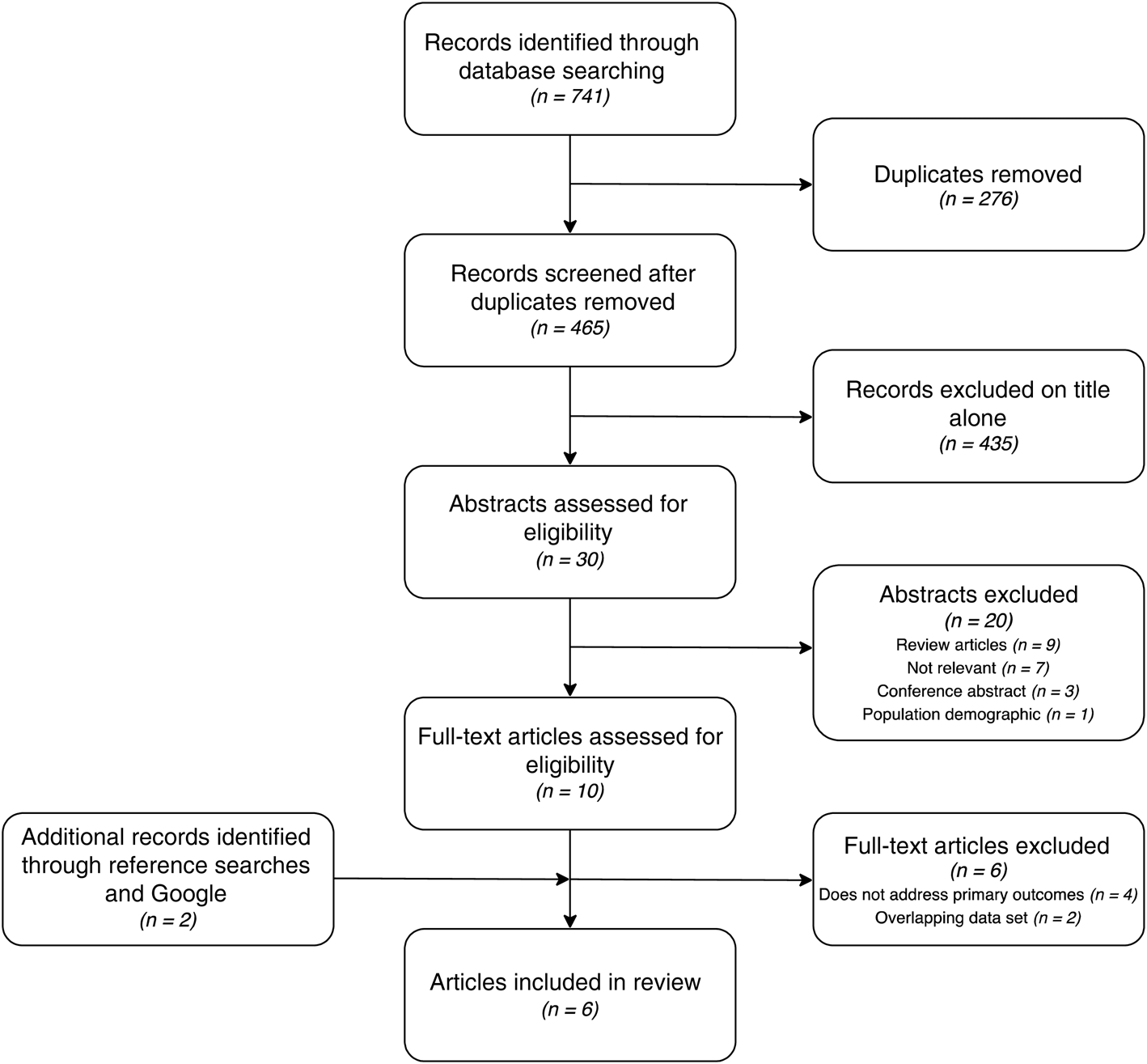
A total of 741 potentially relevant records were identified from the database searches. After initial screening, 10 studies were retained for full-text evaluation. Full-text screening resulted in the exclusion of six further studies. After two additional records were sourced, six full-text studies were eligible for inclusion (Figure 1).
Search strategy flow diagram.

Within full-text evaluation, potential overlap in study populations was identified in three cross-sectional studies which were based on the Korean National Health and Nutrition Examination Survey dataset.Reference Han, Ko, Shin, Lee, Choi and Kwon29–Reference Lee, Kim, Chae and Han31 The study with the largest sample (Korean National Health and Nutrition Examination Survey 2008–2012) was selected for inclusion.Reference Han, Ko, Shin, Lee, Choi and Kwon29
Study characteristics
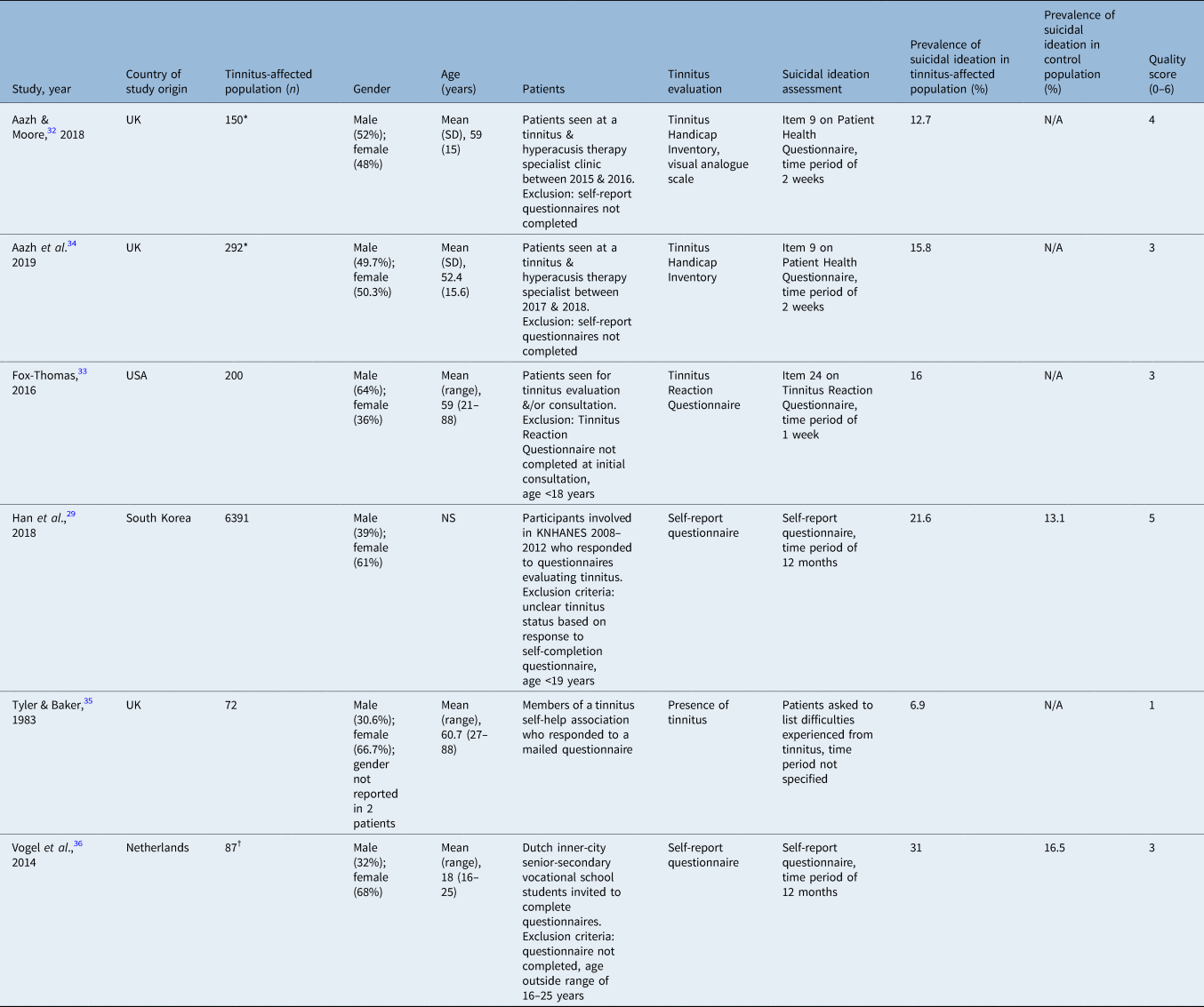
Included studies (n = 6) were published between 1983 and 2019, with a total of 7192 tinnitus sufferers across 4 countries (3 studies from the UK and 1 each from the Netherlands, South Korea and the USA). There were 2896 (40.3 per cent) male patients. It was not possible to calculate a weighted average age of the study population because one study, with the largest sample, did not specify the mean age of participants.Reference Han, Ko, Shin, Lee, Choi and Kwon29 A full description of the included studies and a summary of findings is provided in Table 1.
Summary of included studies

*Population consists of patients with tinnitus and hyperacusis; †population consists of patients with chronic tinnitus as well as other permanent hearing-related symptoms (muffled sounds, distortion, hyperacusis or hearing loss). SD = standard deviation; N/A = not applicable; NS = not specified; KNHANES = Korea National Health and Nutrition Examination Survey
Assessment of suicidal ideation
The time period for assessment of suicidal ideation differed between studies and depended on the questionnaire employed: item 9 on the Patient Health Questionnaire specifies the preceding 2 weeks (2 studies); item 24 on the Tinnitus Reaction Questionnaire specifies a 1-week time period (1 study); and the 2 studies utilising custom measures specified the previous year.
Quality assessment
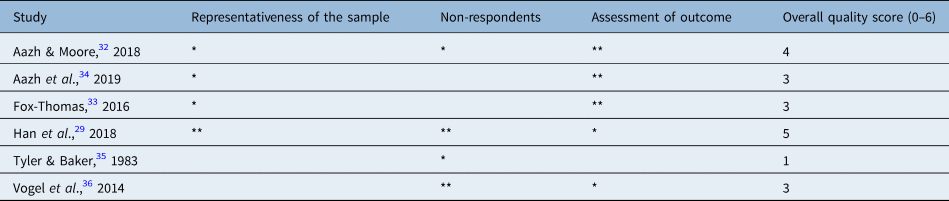
All six studies used a cross-sectional study design. Quality scores ranged from 1 to 5 out of a possible 6 points, with a mean score of 3.2 (standard deviation, 1.3). A risk of bias summary for the three domains examined in quality assessment is provided in Table 2.
Critical appraisal of included studies using Modified Newcastle-Ottawa Scale

For each domain, possible scores are 0 to 2 asterisks. No asterisk indicates high risk of bias, 1 asterisk indicates moderate risk and 2 asterisks indicate low risk of bias in any given domain. Overall quality scores per study are calculated as the total asterisks across all three domains.
Four studies were considered to be at low or moderate risk of bias in the representativeness domain. Of these, Han et al.Reference Han, Ko, Shin, Lee, Choi and Kwon29 was based on a nationally representative cohort, and the three other studiesReference Aazh and Moore32–Reference Aazh, Landgrebe and Danesh34 recruited patients by using non-random sampling of tinnitus patients in a clinical setting. Two studies were deemed to have a high risk of bias in this domain; the study by Tyler and BakerReference Tyler and Baker35 suffers from self-selection bias because of the inherent nature of survey-based studies, and the study by Vogel et al.Reference Vogel, Van de Looij-Jansen, Mieloo, Burdorf and de Waart36 employed substantial inclusion criteria to select a very specific subset of people suffering from tinnitus and other permanent hearing-related symptoms.
With respect to the response domain, two studies did not record a response rate.Reference Fox-Thomas33,Reference Aazh, Landgrebe and Danesh34 Aazh and MooreReference Aazh and Moore32 had an inadequate response rate (37 per cent), and Tyler and BakerReference Tyler and Baker35 recorded an adequate response rate (74 per cent), but there was a lack of information on non-respondents. Of the studies with a low risk of bias in the response domain, Han et al.Reference Han, Ko, Shin, Lee, Choi and Kwon29 used a nationally representative cohort, and Vogel et al.Reference Vogel, Van de Looij-Jansen, Mieloo, Burdorf and de Waart36 recorded an adequate response rate (77.9 per cent) with sufficient comparability between respondents and non-respondents.
When evaluating the presence of tinnitus and suicidal ideation, three studies used validated questionnaires and were considered to be at low risk of bias in the outcome measurement domain. Two studiesReference Aazh and Moore32,Reference Aazh, Landgrebe and Danesh34 utilised the Tinnitus Handicap Inventory and Patient Health Questionnaire, whereas Fox-ThomasReference Fox-Thomas33 used the Tinnitus Reaction Questionnaire. Two studiesReference Han, Ko, Shin, Lee, Choi and Kwon29,Reference Vogel, Van de Looij-Jansen, Mieloo, Burdorf and de Waart36 devised custom single-item questionnaires to ascertain the presence of suicidal ideation and provided descriptions of the tools. However, the remaining study by Tyler and BakerReference Tyler and Baker35 used an imprecise instrument (open-ended questioning) to measure suicidal ideation, which is susceptible to non-response bias.
Findings
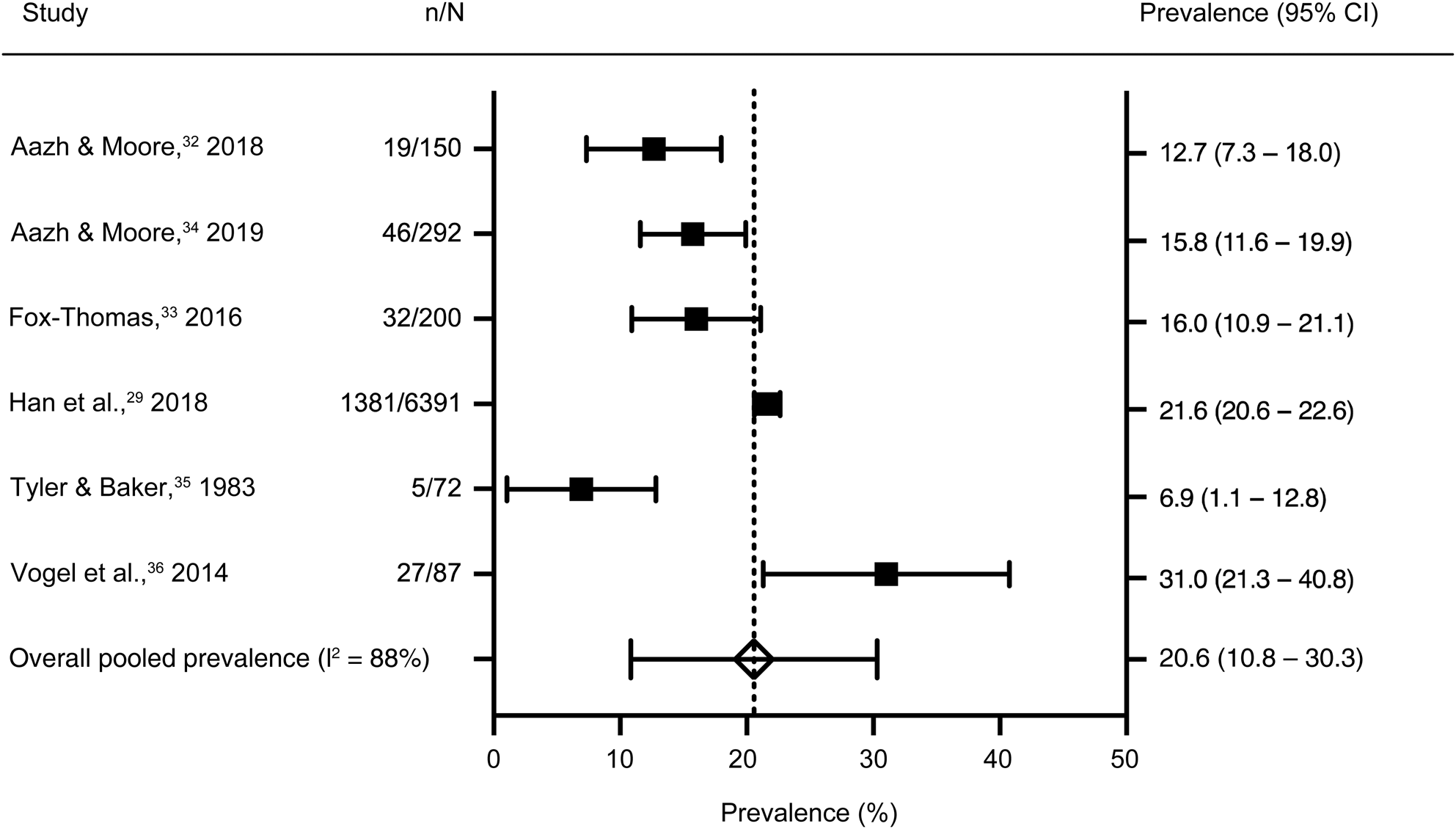
Prevalence estimates ranged from 6.9 per cent in a sample of members from an English tinnitus self-help associationReference Tyler and Baker35 to 31 per cent for inner-city senior school students in the Netherlands.Reference Vogel, Van de Looij-Jansen, Mieloo, Burdorf and de Waart36 The pooled prevalence of suicidal ideation in the tinnitus-affected population was 20.6 per cent (95 per cent CI, 10.8–30.3 per cent) with a high level of heterogeneity (I2 = 88 per cent) (Figure 2). Two studiesReference Han, Ko, Shin, Lee, Choi and Kwon29,Reference Vogel, Van de Looij-Jansen, Mieloo, Burdorf and de Waart36 included a control population (no tinnitus), for whom the prevalence of suicidal ideation was significantly lower (13.1 per cent versus 21.6 per cent (p < 0.001) and 16.5 per cent versus 31 per cent (p < 0.01), respectively). In three studies,Reference Aazh and Moore32–Reference Aazh, Landgrebe and Danesh34 the degree of tinnitus severity was found to be positively correlated with prevalence of suicidal thoughts.
Forest plot for the prevalence (percentage) of suicidal ideation. n = number of patients reporting suicidal ideation; N = total number of patients with tinnitus; CI = confidence interval

Discussion
Tinnitus is known to be associated with psychological distress and psychiatric co-morbidity.Reference Pinto, Marcelos, Mezzasalma, Osterne, de Melo Tavares de Lima and Nardi14 To our knowledge, this is the first study to systematically review the prevalence of suicidal ideation among people with tinnitus. In view of the lack of quality studies in this area, it is not possible to arrive at any reasonable conclusion, and so the following synthesis should be interpreted with caution.
Tinnitus and suicidal ideation
The pooled data in this study represents over 7000 people with tinnitus across four countries, giving an overall prevalence for suicidal ideation of 20.6 per cent (95 per cent CI, 10.8–30.3 per cent). The cross-national 12-month period prevalence and lifetime prevalence for suicidal ideation have been estimated to be 2 per cent and 9 per cent, respectively, for the general population.Reference Nock, Borges, Bromet, Alonso, Angermeyer and Beautrais37,Reference Borges, Nock, Haro Abad, Hwang, Sampson and Alonso38 This would suggest that suicidal ideation may be more prevalent in tinnitus sufferers. The control populations of two included studies also appear to support this.Reference Han, Ko, Shin, Lee, Choi and Kwon29,Reference Vogel, Van de Looij-Jansen, Mieloo, Burdorf and de Waart36
Chronic medical illness is an independent risk factor for suicidal ideation, especially in the elderly population.Reference Druss and Pincus39,Reference Harris and Barraclough40 The pooled prevalence of suicidal ideation in tinnitus sufferers (20.6 per cent) is comparable to that of people with traumatic brain injury (3–33 per cent),Reference Simpson and Tate41 chronic pain (13.5 per cent)Reference Calati, Laglaoui Bakhiyi, Artero, Ilgen and Courtet42,Reference Stubbs43 and general medical conditions including cancer (0.7–46.3 per cent),Reference Kolva, Hoffecker and Cox-Martin44 Parkinson's disease (30 per cent),Reference Shepard, Perepezko, Broen, Hinkle, Butala and Mills45 diabetes mellitus (16.2 per cent),Reference Elamoshy, Bird, Thorpe and Moraros46 rheumatic diseases (26 per cent),Reference Li, Yang, Dong, Li, Cui and Zhao47 coronary artery disease (14 per cent)Reference Lehmann, Kohlmann, Gierk, Murray and Löwe48 and insomnia (25–32 per cent).Reference Drapeau and Nadorff49 A greater disease burden (more than one medical illness) is also shown to increase the odds of suicidal ideation; this relationship persists after adjusting for moderating factors such as heavy alcohol use and depression.Reference Druss and Pincus39 Comparatively, we found a higher prevalence of suicidal ideation with increasing tinnitus severity.Reference Aazh and Moore32–Reference Aazh, Landgrebe and Danesh34 Furthermore, the analysis in Han et al. indicated that the association between tinnitus and suicidal ideation persists after adjusting for concomitant depression.Reference Han, Ko, Shin, Lee, Choi and Kwon29 Further work assessing the relationship between tinnitus severity and suicidal ideation should attempt to control for comorbid depression and other moderating factors.
We are able to comment on the gender profile of suicidal ideation in the tinnitus-affected population in three of six included studies. In the study by Fox-Thomas, it was possible to derive prevalence figures by gender based on the summary data reported in the study: prevalence of suicidal ideation in women with tinnitus was 18.1 per cent compared with 14.8 per cent in men with tinnitus.Reference Fox-Thomas33 The adjusted analysis in Han et al. identified female gender as a risk factor for tinnitus, depressive mood and suicidal ideation in Korean adults.Reference Han, Ko, Shin, Lee, Choi and Kwon29 However, Aazh and Moore did not report significant gender differences in suicidal ideation.Reference Aazh and Moore32 Even in adult general populations, the association between gender and suicidal ideation is not well characterised. One cross-national study demonstrated higher rates of suicidal ideation in women compared with men, but the analyses did not adjust for sociodemographic factors and psychiatric illness.Reference Weissman, Bland, Canino, Greenwald, Hwu and Joyce50 In contrast, there is a recognised gender difference in lethality of suicidal behaviour; men have a lower rate of suicide attempts, but a higher rate of suicide completion compared with women.Reference Mergl, Koburger, Heinrichs, Székely, Tóth and Coyne51 It is also important to consider the prevalence of suicidal ideation across different age groups. Aazh and Moore found a small negative correlation between suicidal ideation and age in patients recruited from a specialist tinnitus clinic (r = −0.19; p = 0.02),Reference Aazh and Moore32 suggesting that suicidal ideation may be more frequent in younger tinnitus sufferers. This concurs with the findings of a large national cross-sectional study of suicidal ideation across different age groups.Reference Dennis, Baillon, Brugha, Lindesay, Stewart and Meltzer52
The variation in reported prevalence of suicidal ideation among included studies is likely because of methodological factors, such as population setting, demographic characteristics and criteria for suicidal ideation assessment.
Firstly, there was a high level of heterogeneity in population characteristics. As an example, Vogel et al.Reference Vogel, Van de Looij-Jansen, Mieloo, Burdorf and de Waart36 reported the highest prevalence for suicidal ideation (31 per cent), but participants were limited to Dutch students (mean age of 18 years) from low educational backgrounds. The population also consisted of patients with chronic tinnitus as well as other permanent hearing-related symptoms (muffled sounds, distortion, hyperacusis or hearing loss). The complexity of presentation hinders generalisability of the data because degree of hearing loss is a potential moderator of tinnitus distress,Reference Andersson and Westin53 which the original study has not accounted for.Reference Vogel, Van de Looij-Jansen, Mieloo, Burdorf and de Waart36 In addition, three included studies recruited participants from specialist tinnitus clinics.Reference Aazh and Moore32–Reference Aazh, Landgrebe and Danesh34 This sample may not be representative of tinnitus sufferers in the general population because such participants have sought help for their symptoms, which implies a pre-existing degree of distress. Furthermore, the study sample in Tyler and Baker was self-selected because it consisted of members of a tinnitus self-help association who responded to a mailed questionnaire.Reference Tyler and Baker35 This form of sampling is susceptible to voluntary response bias from people with a greater degree of tinnitus-related distress taking part in the study. Thus, the prevalence of suicidal ideation within each of these studies (6.9–16 per cent) may be an overestimation. Interestingly, the study by Han et al. which used data from the Korean National Health and Nutrition Examination Survey dataset to obtain a representative South Korean population sample reported a higher prevalence of 21.6 per cent,Reference Han, Ko, Shin, Lee, Choi and Kwon29 although the general prevalence of suicidal ideation in South Korea appears higher than in other developed countries.Reference Choi and Lee54–Reference Olfson, Weissman, Leon, Sheehan and Farber57
Secondly, the variation in prevalence data may be related to differences in methodology of suicidal ideation assessment. The lowest prevalence (6.9 per cent) was reported by Tyler and Baker,Reference Tyler and Baker35 who used an open-ended questionnaire to elucidate negative effects of tinnitus. Although closed questioning (as commonly encountered in self-report questionnaires) is potentially leading, individuals are likely to need prompting to report distressing symptoms. For studies that asked participants whether they had experienced thoughts of suicide within the previous year,Reference Han, Ko, Shin, Lee, Choi and Kwon29,Reference Vogel, Van de Looij-Jansen, Mieloo, Burdorf and de Waart36 the reported prevalence was greater than that reported in studies specifying a time interval of week(s).Reference Aazh and Moore32–Reference Aazh, Landgrebe and Danesh34 A shorter time period may not identify people with less frequent or episodic, and possibly less severe, thoughts of suicide. This highlights the importance of mandating a single, specific period interval when screening patients in clinical and research settings. Another consideration is that simplified screening tools (using a single question as criteria for determining suicidality) are unlikely to capture the complexity and spectrum of suicidal ideation (passive and active), which represents a broad continuum of distress.
Implications for clinical practice
Recent guidelines recommend the use of tinnitus questionnaires, such as the Tinnitus Functional Index and Tinnitus Questionnaire or mini-Tinnitus Questionnaire, to assess the impact of tinnitus and psychological effects.58 For adult patients with distressing tinnitus, psychological therapies should be offered in a stepped approach.58 Routine use of antidepressant medication in managing tinnitus is not evidenced.Reference Baldo, Doree, Molin, McFerran and Cecco59 Although high-risk patients may benefit from antidepressants, this is outside the scope of practice of an otolaryngologist and should only be considered following guidance from a mental health professional.
Our findings suggest that suicidal ideation may be elevated in the tinnitus-affected population, specifically for individuals with a higher degree of tinnitus-related distress. Clinicians should therefore be assessing suicidality as standard. A history of suicidal ideation in the absence of a plan or attempt does not increase the risk of future suicidal behaviour.Reference Borges, Angst, Nock, Ruscio and Kessler60 However, if suicidal ideation is present, formal suicide risk assessment and appropriate referral to mental health services is important. Clinicians may feel they have insufficient expertise to make such an enquiry or risk exacerbating negative mood states; however, the general consensus is that asking about suicidality does not increase subsequent suicidal thoughts or behaviour.Reference Mathias, Furr, Sheftall, Hill-Kapturczak, Crum and Dougherty61 ENT and audiology services may require additional training and support from mental health services in risk assessment and initial management.
Study limitations and future work
We aimed to conduct a comprehensive review through an inclusive search query. However, the existing literature forming the data for this study has significant issues, meaning that the quantitative analysis of the dataset must be interpreted cautiously. These limitations can be summarised as follows: lack of literature in this topic with one studyReference Han, Ko, Shin, Lee, Choi and Kwon29 driving the weighted meta-analysis findings; between-study heterogeneity; sampling and possible response biases; the lack of a control (no tinnitus) population in four of six studies; variable study quality; and the fact that the majority of studies did not control for known moderating factors when assessing the relationship between tinnitus and suicidal ideation. However, by presenting a careful qualitative synthesis, we hope to draw attention to this important topic as well as promote understanding of psychological sequelae of tinnitus among the tinnitus research community and members of the broad multidisciplinary team involved in patient care.
All of the included studies rely on single-item measures for assessing suicidal ideation. Clinical interviews, although time-consuming, are effective in discriminating patients and more reflective of routine clinical practice, whereas single items from validated measures or custom self-report questionnaires are likely to result in inflation of prevalence data.Reference Walker, Hansen, Hodges, Thekkumpurath, O'Connor and Sharma62 Further study should include the use of full (multi-item) validated questionnaires, of which there are many, and clinical interviews. Similarly, despite the existence of validated patient-reported tools relating to impact or severity of tinnitus,Reference Hall, Haider, Szczepek, Lau, Rabau and Jones-Diette63 only three studies incorporated such instruments in tinnitus evaluation. These tools are helpful in distinguishing clinically significant tinnitus from patients who do not find their tinnitus bothersome. Our findings support a potential association between tinnitus severity and suicidal ideation. Future research within routine clinical practice, possibly evaluating a combination of validated tools or development of a new tool, will therefore be of value.
We are unable to comment further on the underlying association and potential moderating or mediating factors between tinnitus severity and suicidal ideation because of a lack of data on temporality of symptom onset (an inherent weakness of cross-sectional research) and limited data on the co-existence of psychiatric illness. Furthermore, this study only assessed suicidal ideation. There is a growing body of literature examining the factors that may increase the risk of transition from suicidal ideation to suicidal behaviour, including substance misuse, severity of comorbid anxiety or depression, and types of personality disorder.Reference Bolton, Pagura, Enns, Grant and Sareen64–Reference May, Klonsky and Klein66 Although suicidal ideation is a key contributing factor and is a very distressing experience, there is a need to further evaluate what else might predict suicidality in tinnitus sufferers before suicidal ideation can be considered an appropriate proxy for studying suicidal behaviour in this population. Longitudinal follow up of tinnitus sufferers with suicidal ideation will be beneficial, with particular reference to socioeconomic factors, psychiatric co-morbidity, life events, and subsequent attempted and completed suicide rates.
Conclusion
In view of the lack of quality studies investigating suicidal ideation in adult tinnitus-affected populations, it is not possible to arrive at any reasonable conclusion based on the meta-analysis performed. These data suggest that the prevalence of suicidal ideation may be higher in people with tinnitus than in the general population. Variation in reported prevalence figures is likely because of heterogeneity in population characteristics, criteria for suicidal ideation assessment and possible sampling and response biases. With increasing public interest concerning suicidality in tinnitus sufferers, further large-scale epidemiological studies across a greater geographical reach are needed to substantiate this relationship. This may lead to a better understanding of the psychopathological profile of tinnitus sufferers and improve psychiatric risk stratification in this population.
Competing interests
None declared
Appendix 1. Detailing the search strategy
Medline search iterations – 13 August 2020

Appendix 2. Newcastle–Ottawa Scale adapted for cross-sectional studies