Implications
Low birth weight is associated with intra-uterine growth restriction (IUGR), which causes large economic losses due to lower postnatal growth performance, efficiency of feed utilization and high mortality rate. However, it seems that birth weight may have a minor impact on meat quality. Segregated management of low birth weight piglets might be beneficial to counteract the deleterious effects of IUGR on meat quality, but further studies are necessary to properly address this question.
Introduction
During the last decades, the intensive selection for increasing litter size in pig production has resulted in larger litter variation in birth weight, leading to an increase in the number of stillborn and small piglets with low survival rate (Milligan et al., Reference Milligan, Fraser and Kramer2002). These small piglets suffer from IUGR, which occurs naturally in pigs, and causes large economic losses worldwide due to lower postnatal growth potential and efficiency (Wu et al., Reference Wu, Bazer, Datta, Johnson, Li, Satterfield and Spencer2008). There is evidence that birth weight affects postnatal development and fat content in the carcass (Gondret et al., Reference Gondret, Lefaucheur, Juin, Louveau and Lebret2006; Alvarenga et al., Reference Alvarenga, Chiarini-Garcia, Cardeal, Moreira, Foxcroft, Fontes and Almeida2013) through the impairment of muscle accretion (Alvarenga et al., Reference Alvarenga, Chiarini-Garcia, Cardeal, Moreira, Foxcroft, Fontes and Almeida2013), and may also have negative effects on meat quality traits, such as pH (Rehdfeldt et al., Reference Rehfeldt, Tuchscherer, Hartung and Kuhn2008), drip loss (Rehdfeldt and Kuhn, Reference Rehfeldt and Kuhn2006), tenderness (Gondret et al., Reference Gondret, Lefaucheur, Juin, Louveau and Lebret2006) and meat color (Bérard et al., Reference Bérard, Kreuzer and Bee2010). Moreover, elevated intrauterine crowding impaired hyperplasia and growth of myofibers along with delayed myofiber maturation (Pardo et al., Reference Pardo, Bérard, Kreuzer and Bee2013).
Modern contemporary consumers have guided the production of pork toward leaner and healthier meat (Cardenia et al., Reference Cardenia, Rodriguez-Estrada, Cumella, Sardi, Casa and Lercker2011). In this regard, many studies have been done to investigate the impact of meat quality and consumption on health status. For instance, studies have demonstrated that high concentrations of saturated fatty acids (SFA) and a high ratio between n-6 and n-3 polyunsaturated fatty acids (PUFA) seem to be associated with a high prevalence of cardiovascular diseases, due to their contribution to platelet aggregation (Simopoulus, Reference Simopoulus2002).
In contrast, the health supporting role of meat has also been documented, as reviewed in the case of dry cured ham by Jiménez-Colmenarejo et al. (Reference Jiménez-Colmenarejo, Ventanas and Toldrá2010). Lower frequencies of meat consumption and consumption of meat products that underwent little processing have been reported as key protective factors of desirable health outcomes (Kristensen et al., Reference Kristensen, Hels, Morberg, Marving, Bügel and Tetens2005). Specifically, controlled pork consumption reduced low-density lipoprotein cholesterol levels and was a component of therapeutic diets in the study of Rubio et al. (Reference Rubio, Rubio, Cabrerizo, Burdaspal, Carretero, Gomez-Gerique, Montoya, Maestro, Sanz and Fernández2006).
Even though the effects of birth weight on postnatal growth performance and carcass quality have been extensively studied, its implications on fatty acid (FA) profile, lipid oxidation and overall health indicators, still remain unclear. As demonstrated previously, birth weight may influence fat content in the carcass (Gondret et al., Reference Gondret, Lefaucheur, Juin, Louveau and Lebret2006; Alvarenga et al., Reference Alvarenga, Chiarini-Garcia, Cardeal, Moreira, Foxcroft, Fontes and Almeida2013), which in turn may directly affect the FA profile, that is higher fat content increases SFA synthesis (mainly C16:0 and C18:0), and consequently decreases PUFA (Guillevic et al., Reference Guillevic, Kouba and Mourot2009). In addition, greater intramuscular fat content as well as greater SFA and MUFA content positively affected the technological quality and oxidation stability of meat (Corino et al., Reference Corino, Musella and Mourot2008). As pork is the most consumed protein source in the world, and given the higher incidence of low birth weight piglets on commercial farms, the present study aimed to test the hypothesis that meat from low birth weight pigs will have increased intramuscular fat content which will alter the FA profile and directly affect lipid peroxidation.
Material and methods
Animals and treatments
Forty new-born male pigs (DanBred X PIC terminal line), born to 4th to 6th parity sows and in litters of 10 to 15 pigs, were individually identified as falling into two birth weight groups: high (HW: 1.8 to 2.2 kg) and low (LW: 0.8 to 1.2 kg) and one piglet was taken from each litter. The criteria of high parity sows and litters of 10 to 15 pigs were consistent with the hypothesis that these pigs had been subjected to negative effects of IUGR, according to the recent studies conducted at the University of Alberta (Town et al., Reference Town, Putman, Turchinsky, Dixon and Foxcroft2004; Smit, Reference Smit2007), and were confirmed in the recent study of Alvarenga et al. (Reference Alvarenga, Chiarini-Garcia, Cardeal, Moreira, Foxcroft, Fontes and Almeida2013). All sows were maintained under identical feeding conditions from mating to parturition. All experimental procedures involving animals were approved by the Ethics Committee in Animal Experimentation (CETEA/UFMG).
The HW and LW piglets were reared separately in collective pens until slaughter (~150 days of age) to avoid competition among them, which would be harmful to the LW group. Management was typical of a commercial Brazilian swine production protocol throughout all phases of production, and feed and water were provided ad libitum. Pigs were fed standard nursery and growing-finishing diets formulated to meet National Research Council (1998) requirements. Weaning was performed at 23.1 days old on average, and the nursery period lasted 6 weeks, and the growing-finishing phase lasted 12 weeks. In the nursing and growing-finishing periods, pigs were allocated in pens of 20 animals each, according to the treatment group, and their growth performance data have already been published (Alvarenga et al., Reference Alvarenga, Chiarini-Garcia, Cardeal, Moreira, Foxcroft, Fontes and Almeida2013). Pigs were slaughtered at 149±2.7 days old after an overnight fast by electrical stunning and exsanguination in compliance with the Brazilian national regulations applied in slaughter houses.
Meat quality indicators
Just after slaughter, the hot carcasses were weighed and kept in the cooler (4°C) for 24 h. After this cooling period, measures of loin area (between the last thoracic and the first lumbar vertebra), and backfat depth (at the last rib, 6.5 cm from the dorsal line – P2 position) were taken. The pH measurements were performed in the Longissimus dorsi muscle of the left carcass, between the 12th and 13th thoracic vertebrae, 45 min and 24 h postmortem with a portable pH meter (model PH-710, Instrutherm, São Paulo, SP, Brazil). The temperature was also measured 45 min postmortem, using a digital portable thermometer (Instrutherm, model TE300), specifically for meat temperature measurements. After measuring pH and temperature, the Longissimus dorsi muscles were excised (~30 cm length) from all carcasses, and two consecutive cranial chops, of ~3.0 cm thickness, were taken for meat color and water-holding capacity analysis, the later measured as the drip loss percentage. Color was measured using a Colortec PCM (Clinton, NJ, USA), which had a D-65 light font and an observation angle of 10°. The corresponding values were calculated according to a color scale of lightness (L*), redness (a*), and yellowness (b*) established by the Commission Internationale de l’Eclairage (CIE). Measurements were determined in triplicate at one point of the chop. Drip loss was measured over 24 h in a cylinder of ~2.5 cm in diameter maintained at 4°C, according to standard methods (Association of Official Analytical Chemists (AOAC), 1995). Then, the remaining chops were wrapped in plastic bags, and stored in the freezer at −20°C for subsequent meat quality analyses (thaw loss, cooking loss, shear force, chemical and sensory analyses).
In addition, one frozen vacuum-packaged chop from each sample was kept for 24 h at 4°C and then weighed for thaw loss determination. The chops were then kept at room temperature for 1 h, weighed, and cooked up to an internal temperature of 40°C, then turned and cooked again up to a final internal temperature of 71°C. Raw and final chop weights were used to determine cooking loss as described by AOAC (1995). Shear force was determined in the cooked samples using a TA-XT2i Texture Analyzer (State Micro System, Survey, UK). A total of six sample cylinders (diameter of 1.27 cm) per chop were used for the analysis. The results were expressed as the maximum force (kg) needed to cut the samples. Mean values for each animal were obtained by averaging all the samples per animal.
Chemical analyses
Samples were minced in a commercial mix-blender until a homogeneous mass was obtained, and chemical analyses were carried out in triplicate. CP was estimated by the method of Kjeldahl and intramuscular fat by Soxhlet (AOAC, 1995). Moisture was determined in an oven at 105°C for 18 h, and ash concentration was determined in the residual samples after drying for 12 h at 550°C. All chemical components were expressed as percentages of the dry matter, except moisture. Cholesterol analyses were determined by lipid extraction (Folch et al., Reference Folch, Less and Stanley1957), and subsequent colorimetry (Bragagnolo and Rodriguez-Amaya, Reference Bragagnolo and Rodriguez-Amaya1995).
Lipid oxidation (thiobarbituric acid-reactive substance (TBARs)) and FA profile
The extent of lipid oxidation was measured as TBARs. The TBARs values were determined by the extraction method described by AOAC (1995). Triplicate samples from each chop were averaged and expressed as milligrams of malonaldehyde per kilogram of dry matter.
For the analysis of FA profile, total lipids were extracted according to the procedures described by Folch et al. (Reference Folch, Less and Stanley1957), and the preparation of FA methyl esters was carried out according to Hartman and Lago (Reference Hartman and Lago1973). Briefly, FA were saponified with a methanolic NaOH solution and methylated under acid conditions by adding a solution of ammonia chloride, methanol, and sulphuric acid. The FA methyl esters were submitted to gas liquid chromatograph in a GC-17A model chromatograph (Shimadzu Corporation, Kyoto, Japan), equipped with a flame ionization detector and a 30 m capillary column of polyethylene glycol (DB-WAX, 30 m×0.25 mm×0.25 µm), coupled to a software developed by the manufacturer. The oven temperature was programmed to increase from 180°C to 230°C (3°C/min) and held isothermally at 230°C for 20 min. A 1 : 20 split injection ratio was used. Hydrogen and synthetic air were used for flame formation, and nitrogen was used as the carrier gas at a constant flow rate of 2.75 ml/min, pressure of 15.5 psi and linear velocity of 53.26 cm/s. The injection system was held at 230°C and the flame ionization detector system at 250°C. The identification of FA was performed by comparing the retention time of the FA methyl ester standard PUFA 2 (Supelco Inc., Bellefonte, PA, USA), composed by a mixture of 14 FA. Individual FA was expressed as a percentage of the total identified FA, then grouped as SFA, MUFA and PUFA.
Furthermore, the analysis of the FA profiles led to the determination of the atherogenic index (AI), considered as a health indicator related to the risk of cardiovascular disease, which was calculated according to Ulbricht and Southgate (Reference Ulbricht and Southgate1991) as:
 $${\rm AI}=\left[ {4({\rm C14}:{\rm 0}){\plus}{\rm C16}:{\rm 0}} \right]/\left( {\mathop{\sum}{{\rm SFA}} {\plus}\mathop{\sum}{{\rm PUFA}} } \right)$$
where C14:0 is myristic acid, C16:0 the palmitic acid, SFA the saturated fatty acids, PUFA the polyunsaturated fatty acids.
Sensory test analyses
The preparation procedures for the sensory test analyses were described by Bridi and Silva (Reference Bridi and Silva2007). Several chops from the loin of each birth weight group were cooked, without any seasoning, in an oven until the internal chop temperature reached 40°C. Then, the roasted side was turned down and cooked again until an internal temperature of 71°C. They were cut into 1.3-cm cubes (taken in the middle of each chop) and were randomly assigned to the members of the taste panel.
A descriptive test was carried out by a selected and trained sensory panel consisting of volunteers from the University professional staff. Preliminary training sessions on pork cuts (loin and ham), which did not belong to the experimental animals, were performed by 40 volunteers. Six sessions were performed per person, and tenderness was scored. Two triangle tests were done using ham v. loin as follows: three 1.3 cm cubes were randomly assigned to the volunteers, and the sessions covered the ability to identify, among the three samples (two similar and one different), which one was the different sample. Therefore, the panelists were trained to distinguish loin from ham samples based on tenderness. Panelists who got 80% of right answers were selected to the Paired Comparison Test. The Paired Comparison Test indicated if the loin samples from both experimental groups were different for tenderness. All panel evaluations were conducted in well-ventilated, partitioned booths, under fluorescent red light. Water was provided to eliminate residual flavor notes between samples (Larmond, Reference Larmond1977).
Statistical analysis
All variables measured were tested for normality before analyses, using the univariate procedure of the Statistical Analysis System (SAS Institute, 2001). Data were analyzed as a randomized design, and the statistical model included birth weight class as fixed factor and piglet as random factor. Treatment effects on meat quality traits, chemical analyses, and FA profiles were analyzed using the GLM procedure of SAS (v. 8.2; SAS Institute Inc., Cary, NC, USA). Least square means were compared using the Student’s t-test with P<0.05 being considered significant. In the tables, data are reported as least-square means and the residual standard deviation. For the sensory tests, the table of Bicaudal Paired Test (Bridi and Silva, Reference Bridi and Silva2007) was used for the comparison of the experimental groups.
Results
Meat quality indicators
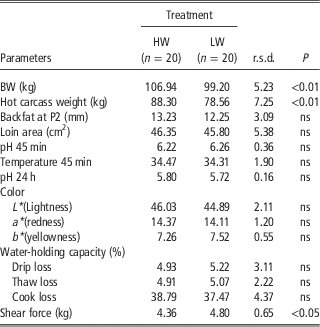
Our results show that birth weight affected BW at slaughter, which was higher in HW compared with LW pigs (P<0.01). Even though BW was different, measures of backfat and loin area were similar between both experimental groups (Table 1). Birth weight had a minor impact on meat quality traits. Temperature, pH, color, and water-holding capacity were not affected by birth weight, as shown in Table 1. However, shear force was higher in the low birth weight pigs (P<0.01), suggesting lower meat tenderness in this experimental group.
Meat quality indicators evaluated in the Longissimus dorsi muscle of high (HW) and low (LW) birth weights pigs at 150 days of age

ns=not significant.
Chemical analyses, lipid oxidation (TBARs), FA profile, and atherogenic index
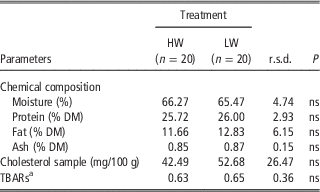
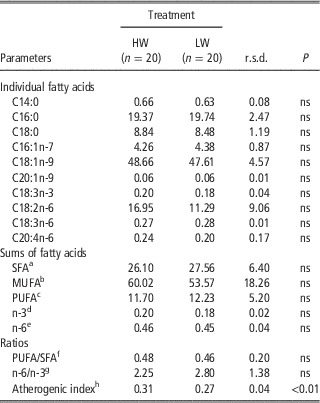
The chemical analyses performed in the Longissimus dorsi muscle showed that the contents of moisture, protein, fat, and ash were similar in both HW and LW animals (P>0.05; Table 2). Interestingly, cholesterol levels and the extent of lipid oxidation, measured as TBARs values, were also not affected by birth weight (P>0.05), as shown in Table 2. Regarding FA profile analysis, it was shown that birth weight had no effects on individual FA contents, sums of FAs groups and relevant FAs ratios of pork (Table 3). Even though the atherogenic index was higher in HW compared with LW pigs, both values were still in the safe range of low risk of cardiovascular disease (P<0.05 – Table 3).
Birth weight effects on meat chemical composition, cholesterol levels and lipid oxidation measured in the Longissimus dorsi muscle of HW (high) and LW (low) birth weight pigs at 150 days of age
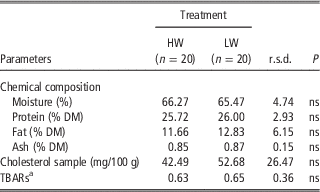
NS=not significant
a Thiobarbituric acid-reactive substance (mg of malonaldehyde/kg DM).
Fatty acids profiles, saturated, monounsaturated and polyunsaturated fatty acids and relevant fatty acids ratios measured in the intramuscular fat of the Longissimus dorsi muscle of HW (high) and LW (low) pigs at 150 days of age

ns=not significant; SFA=saturated fatty acid; MUFA=monounsaturated fatty acid; PUFA=polyunsaturated fatty acid.
a Sum of SFA (C14:0+C16:0+C18:0).
b Sum of MUFA (C16:1n-7+C18:1n-9+C18:1n-7+C20:1n-9).
c Sum of PUFA (C18:2n-6+C18:3n-6+C18:3n-3+C20:4n-6+C20:5n-3+C22:4n-6+C22:6n-3).
d Sum of PUFA of the n-3 series (C18:3n-3+C20:5n-3+C22:6n-3).
e Sum of PUFA of the n-6 series (C18:2n-6+C18:3n-6+C20:4n-6+C22:4n-6)
f Ratio PUFA/SFA (C18:2n-6+C18:3n-3)/(C14:0+C16:0+C18:0).
g Ratio n-6/n-3 (∑ n-6/∑ n-3).
h Atherogenic index=[4(C14:0)+C16:0]/(∑ SFA+∑ PUFA).
Sensory test analyses
Out of 36 panelists, 20 chose the meat from the HW group as the tenderest, whereas 16 chose the meat from the LW group as the tenderest. Notwithstanding the higher shear force presented by the lower birth weight pigs, the panelists did not observe any differences in the tenderness of pork from HW and LW animals (Supplementary Table S1). Therefore, the absence of significant effects of birth weight on meat quality was confirmed by the sensory test.
Discussion
Several studies have reported the impacts of either birth weight or litter size on postnatal development and meat quality in pigs (Rehfeldt et al., Reference Rehfeldt, Tuchscherer, Hartung and Kuhn2008; Bérard et al., Reference Bérard, Kreuzer and Bee2010). Although birth weight has been related to the number of muscle fibers (Kuhn et al., Reference Kuhn, Rehfeldt, Hartung and Ender2002; Alvarenga et al., Reference Alvarenga, Chiarini-Garcia, Cardeal, Moreira, Foxcroft, Fontes and Almeida2013), muscle fiber diameter and density (Alvarenga et al., Reference Alvarenga, Chiarini-Garcia, Cardeal, Moreira, Foxcroft, Fontes and Almeida2013) in pigs, the relationship between birth weight and meat quality is still controversial.
In the present study, birth weight had a minor impact on meat quality indicators, as only shear force was affected by the experimental treatment. All the other parameters analyzed, such as pH, temperature, color, and drip loss were similar between experimental groups. In contrast, Rehfeldt et al. (Reference Rehfeldt, Tuchscherer, Hartung and Kuhn2008) observed a lower pH value at 45 min postmortem, as well as a tendency for higher drip loss in animals of low compared with animals of medium and high birth weights. In relation to drip loss, a normal loss should be <5% of water (Warner et al., Reference Warner, Kauffman and Greaser1997). In the present study, as noted in Table 1, both experimental treatments were within the normal value (4.8 for both HW and LW groups). Bérard et al. (Reference Bérard, Kreuzer and Bee2008) reported that the effects of litter size and birth weight on meat quality characteristics were minimal. According to these authors, the differences observed among studies may be attributed to differences between genders and the genetic strains used. In addition, according to the methodology used for the classification of meat, based on pH (initial and final), color (parameter L* – brightness) and drip loss, it can be seen in Table 1 that the animals of both experimental treatments presented meat classified as normal, because they showed initial pH above 5.8, final pH below 6.0, L* value >43 and lower than 49, and drip loss <5%. According to the classification described by Warner et al. (Reference Warner, Kauffman and Greaser1997), neither experimental treatments presented pale, soft, exudative or dark, firm, dry carcasses.
Concerning shear force, values were lower in the HW animals compared with the LW group. Thus, this result suggests that meat of HW animals showed a better texture, or tenderness, as less force was needed to break the meat fibers, compared with the LW group (4.36 v. 4.80 kg, respectively). In a similar way, Gondret et al. (Reference Gondret, Lefaucheur, Juin, Louveau and Lebret2006) found that meat from low birth weight animals (0.75 to 1.25 kg) was classified with a low score for tenderness. These authors suggested that low birth weight piglets, which have low growth rates, would present lower turnover of muscle proteins, which possibly resulted in a decreased amount and activity of proteolytic enzymes such as calpain and calpastatin (Kristensen et al., Reference Kristensen, Therkildsen, Riis, Sørensen, Oksbjerg, Purslow and Ertbjerg2002), and in turn, would exert negative effects on final meat tenderness.
As shown in Table 2, there was no effect of birth weight on the cholesterol content of loin. According to the USDA National Nutrient Database for Standard Reference (2011), the cholesterol value for loin is 55 mg/100 g. Thus, it seems that the levels of cholesterol in both experimental treatments were within an appropriate range. Although no treatment effect was observed, the cholesterol value found in the HW group was numerically lower than the value found for the samples from the LW group. In this sense, Bragagnolo and Rodriguez-Amaya (Reference Bragagnolo and Rodriguez-Amaya2002) found cholesterol levels in samples of pork loin similar (42 mg/100 g) to the one found in the present study in samples from the HW group (42.49 mg/100 g). On the other hand, the value found in the LW group (52.68 mg/100 g) was equivalent to the levels of cholesterol found in samples of pork fat (53 mg/100 g) (Bragagnolo and Rodriguez-Amaya, Reference Bragagnolo and Rodriguez-Amaya2002).
Table 2 also showed the levels of lipid peroxidation of the samples stored at −20°C, through the analyses of the TBARs, and no treatment effects were observed. This measure, which is a product quality indicator, is very important for the evaluation of the so called ‘shelf life’ of the product (Warnants et al., Reference Warnants, van Oeckel and de Paepe2001). These authors also demonstrated that meat containing increased levels of polyunsaturated FAs and their derivatives, especially meat products cured or fermented, suffered oxidative damage that resulted in serious defects in their organoleptic characteristics. It is important to highlight that the values obtained for both HW and LW animals were within safe levels relative to rancidity detection (Sheard et al., Reference Sheard, Enser, Wood, Nute, Gill and Richardson2000). This may be due to the quality of the packaging used (aluminum and plastic bags), which had low oxygen permeability.
Among the 14 FAs that may be detected with standard chromatographic procedures, 10 FAs were identified in the present study (Table 3), and the FAs C18:1n9 (oleic acid), C16:0 (palmitic acid) and C18:0 (stearic acid) were found in greater proportions in both experimental groups. These results are consistent with previous studies that also reported the pattern of FA composition of pork (Bragagnolo and Rodriguez-Amaya, Reference Bragagnolo and Rodriguez-Amaya2002).
Given the considerations presented above, our results provide evidence of the benefits of pork as a healthy protein source, since nearly 50% of its FA profile were composed of oleic acid, regardless of birth weight. Moreover, the FA (C20:4) plays an important role in the development of meat flavor (Mottram, Reference Mottram1998). In this study, the values found for the FA C20:4n-6 were similar between the two experimental groups, suggesting that birth weight may not have caused changes in meat flavor.
Regarding the profile of intramuscular fat, the percentage of SFA, MUFA, and PUFA did not differ between treatments (Table 3). According to Associação Brasileira da Indústria Produtora e Exportadora de Carne Suína (2011), pork FAs consists of 40% saturated FAs, 46% to 49% monounsaturated FAs, mainly oleic acid, and 8% to 12% polyunsaturated FAs, especially linoleic acid. These values are close to those found in the present study, excluding the percentage of saturated FAs, probably because the data reported by ABIPECS (2011) refer to samples obtained from different points of the carcass (different muscles) and not only from the loin, which was the cut used in the present study, and is certainly a leaner meat.
In respect to the atherogenic index, which is a measure of the quality assessment and comparison of different foods and is also related to the risk of cardiovascular disease, it was higher in the HW animals. Studies have suggested that the type, not the amount of FAs consumed, is related to the concentration of cholesterol in the blood and the risk of coronary diseases (Hu et al., Reference Hu, Manson and Willet2001). However, it is still unclear the real effect of FAs on human health, for example, saturated FAs, which atherogenic action is questionable (German and Dillard, Reference German and Dillard2004).
By observing the Bicaudal Paired Test (Supplementary Table S1), it is clear that at least 25 people should have chosen the meat of either HW or LW animals as the most tender to obtain a significance level of 0.05. As this choice was made by only 20 people, there was no statistical difference between HW and LW groups. On the other hand, Gondret et al. (Reference Gondret, Lefaucheur, Juin, Louveau and Lebret2006) showed that low birth weight animals had lower scores (4.0 points) for softness (range 1.0 to 10.0 points) compared with animals that were born heavier (4.7 points). Thus, the sensory test did not confirm the shear force results, as the panelists had classified both experimental groups as having similar tenderness.
Overall, the experiment described herein was performed under commercial conditions, where LW and HW pigs were reared in separate pens, and the postnatal growth performance of these animals was previously reported (Alvarenga et al., Reference Alvarenga, Chiarini-Garcia, Cardeal, Moreira, Foxcroft, Fontes and Almeida2013). Although birth weight generates a significant impact over several important economic characteristics in commercial swine production systems (Beaulieu et al., Reference Beaulieu, Aalhus, Williams and Patience2010; Alvarenga et al., Reference Alvarenga, Chiarini-Garcia, Cardeal, Moreira, Foxcroft, Fontes and Almeida2013), our results suggest that its effects on important meat quality traits are minor. This raises the hypothesis that segregating different birth weight animals may be beneficial to LW animals. However, further studies are necessary to address this question.
Acknowledgements
The authors gratefully acknowledge CNPq and Fapemig for funding this work, Fazenda São Paulo where the experiment was conducted, and Dr Guilherme Barcellos Corrêa, for his great assistance at the slaughter house.