INTRODUCTION
In South Africa, climate change is truly a cross cutting issue that affects the entire economy as well as many specific sectors, including energy, transport, agriculture, forestry, water resource management, and provision of water services, and health.Footnote 1 A national climate change response strategy has evolved, which promotes and strengthens integration between the programmes of the various government departments to maximize the benefits to the country as a whole, while minimizing negative impacts.Footnote 2
Many of the factors that make climate change unique also make it complex. It is a multi-scalar environmental and social problem, which affects different sectors.Footnote 3 Consequently, the policy focus of most of the governments of the world and other stakeholders have now shifted from “what is the likelihood of climate change?” to “what are the most appropriate responses to climate change in case the predicted impacts manifest?”Footnote 4 The growing concern is that various scientific research results have confirmed that climate change is now real, as it has started affecting the atmosphere and, in particular, the African continent.Footnote 5 If the warming continues,Footnote 6 there is growing consensus that the prospect of adverse climate change is not going to diminish in the near future, unless dramatic mitigation and adaptation measures are adopted and implemented.Footnote 7
South Africa, a developing country, is mainly vulnerable to climate change due to its energy intensive industrial and economic activities, making it the highest emitter of greenhouse gases (GHGs) in Africa.Footnote 8 Electricity generation and transmission in South Africa is mostly derived from the national power utility, Eskom. This company generates over 90 per cent of its electricity using technology which is based largely on coal-fired power stations.Footnote 9 Production and consumption of coal in South Africa have grown steadily over the past two and a half decades, at an average annual rate of 2.7 per cent. In 2007, approximately 125 million tons of coal (64 per cent of the total) were burned by Eskom in its power stations, with Sasol consuming another 47 million tons, with industry and small consumers accounting for the remainder.Footnote 10 It is therefore apparent that mitigation and adaptation strategies in South Africa are primarily an energy issue.Footnote 11
The Stern Report warns that the cost of inaction will far outweigh the cost of taking action.Footnote 12 Acknowledging South Africa's overall vulnerability to the impact of climate change, it is necessary to embark on stringent mitigation and adaptation measures in the country.Footnote 13 Government, stakeholders, role players and the business community are now being proactive and taking drastic measures and actions to reduce the threat of large scale adverse impacts of climate change by strengthening mitigation and adaptation strategies.Footnote 14 Fortunately, positive steps have begun with Eskom, which plans to reduce the coal component of its generating capacity to 70 per cent within 20 years. In the same vein, both industry and government have implemented various measures and strategies to address the issues of climate change and global warming in order to foster sustainable development.Footnote 15
THE ARGUMENT FOR STRENGTHENING MITIGATION AND ADAPTATION IN SOUTH AFRICA
The argument for mitigation and adaptation is related to the extent of current vulnerability and the potential impact of climate change. South Africa is more dependent on climatic resources and has a low mitigation and adaptive capacity at present. With regard to vital industries, the mining and energy sectors are particularly susceptible to climate change mitigation measures.Footnote 16
There is a need to strengthen adaptation and mitigation, because climate change will still occur even if emission reductions are successful, albeit at a reduced rate and magnitude. This is because the credibility of coordinated global emission reductions is low.Footnote 17 More importantly, successful adaptation will improve South Africa's international negotiating position; it will also yield benefits against existing climate related hazards and South Africa will derive economic benefits from the international industry in environmental services, such as water management.Footnote 18 Last but not least, a credible and successful mitigation and adaptation policy coupled with a justified image of a long term climate strategy will increase South Africa's attractiveness to investors as a stable environment.Footnote 19
More importantly, it is increasingly recognized that adaptation and mitigation to climate change have become unavoidable.Footnote 20 Different activities have various blends of adaptive and mitigative capacity. However, there is synergy between adaptation and mitigation in managing the risks associated with the enhanced greenhouse effect.Footnote 21 First, they each manage different components of future, climate related risk. Mitigation reduces the number and magnitude of potential climate hazards, thus reducing the most severe changes first. Adaptation increases the ability to cope with climate hazards by reducing system sensitivity or by reducing the consequent level of harm. Secondly, they manage risks at different extremes of the potential range of future climate change.Footnote 22 These are the two foremost strategies used in restricting the impact of climate change.Footnote 23
Some of the challenges relating to climate change are brought about by issues related to the rate and magnitude of change of climate, the potential for non-linear changes and the long term horizons.Footnote 24 All these issues are plagued with substantial uncertainties, which make anticipatory adaptation and mitigation difficult but inevitable. The fact that we have partial knowledge of future climate is in itself a new challenge.Footnote 25 This challenge is currently being addressed by the South African government embarking on the implementation of stringent policies, strategies and measures that would curtail activities which promote GHG emissions. Toward this end, South Africa aims to maximize the benefits of managing climate risks by integrating adaptation and mitigation measures at their various scales of operation.
It is against this background that South Africa's former environmental affairs and former tourism minister, Marthinus van Schalkwyk, described the overall approach to climate change mitigation and adaptation as “progressive, ambitious and far-reaching”Footnote 26 as well as focused on protecting South Africa from the “onslaught” of global warming.Footnote 27 He added that the goal is for carbon dioxide (CO2) emissions to “stop growing by 2020–2025 at the latest, stabilize for up to ten years, and then decline in absolute terms.”Footnote 28 Toward this end, the government has started implementing stringent policies and measures, as well as enforcing laws relating to the environmentFootnote 29 and pollution.Footnote 30 This approach is now shifting the country's development path to become more sustainable and should gradually reduce CO2 emissions.Footnote 31
Mitigation strategy in South Africa
Mitigation is used in the sense of reducing GHG emissions. South Africa has initiated a number of actions that will reduce the pace of carbon emissions. These include policies to restructure the energy sector, stimulate economic development, increase access to affordable energy services, manage energy related environmental impacts, and secure energy supply through diversification, as articulated in the government's 1998 energy white paper.Footnote 32
There is wide consensus amongst climate experts and policy makers that mitigation of climate change (ie the reduction of GHG emissions) is and should remain the prime focus of climate policy.Footnote 33 Mitigation potential in South Africa will stimulate economic growth and renewable energy sources, and will diversify energy sources, remove trade barriers, facilitate energy sector investment and promote demand-side management. It will also eliminate subsidies. Furthermore, the government has introduced a renewable portfolio standard target of 5 per cent of electricity generation by 2010, and 20 per cent by 2025. In 2010, natural gas will replace four million tons of coal used to produce synthetic petroleum; this figure will rise to between five and ten million tons if the entire capacity is switched from coal to natural gas and renewable energy.Footnote 34
The two key policies that focus explicitly on climate change mitigation are the National Climate Change Strategy (NCCS) (2004) and the more recent Long Term Mitigation Scenario (LTMS) (2007) released by the government in 2008.Footnote 35 The NCCS was designed to address priority issues in terms of climate change in South Africa; a rare climate change strategy amongst developing nations, it helped place South Africa in a strong position in international climate change negotiations.Footnote 36
The LTMS was defined in two stages. First, the scenario building phase centred on research relating to carbon emissions, the potential for reductions and the economic implications defined in terms of the impact on GDP growth, employment and equity.Footnote 37 Second, the “high level group” process promoted a “dialogue” of the inter-ministerial committee on climate change and leaders from business, labour and civil society. The main focus of the LTMS is on how South Africa can reduce GHG emissions.Footnote 38
The LTMS includes different scenarios of mitigation action for South Africa and a technical report that is underpinned by technical inputs and research on energy emissions, non-energy emissions, and a macro-economic analysis.Footnote 39 The combination of the scenario document and the technical reports serves to inform long-term national policy and provides South Africa with a position in multilateral climate negotiations on a post-2012 climate regime.Footnote 40 The LTMS starts from a base year of 2003 and continues to a horizon in 2050. It proposes two scenarios with regard to GHG emission: growth without constraints (GWC); and required by science (RBS).Footnote 41 It has been projected that GWC would lead to an almost four-fold increase in GHG emissions from 446 million tons of CO2 equivalent in 2003 to 1,640 million tons by 2050.Footnote 42 The RBS scenario shows South Africa's emissions peaking and then declining. The question is what would happen if South Africa reduced emissions by 30 to 40 per cent from 2003 levels by 2050? Current scientific thinking is that industrialized countries need to institute 90 per cent emissions cuts by 2050 from 2003 levels. The RBS scenario paints a very different picture of South Africa in 2050. It assumes investment in new technologies, such as renewables, hydrogen based transport and changes in human behaviour patterns.Footnote 43
The LTMS presents four strategic priorities which, when implemented together, would allow South Africa to achieve the RBS scenario. These options are: start now; scale up; use the market; and reach for the RBS goal.Footnote 44 The national government set up a roadmap for the national process going forward from 2009 to 2012, comprising: a national climate change response policy development summit in March 2009 (to adopt the LTMS findings); sectoral policy development work (February – June 2009); post-2012 negotiation positions (up to July 2009); conclusion of UN Framework Convention on Climate Change (UNFCCC) post-2012 negotiations (Copenhagen, December 2009); updating national policy for implementation of international commitments (March 2010); publication of green paper for public comment (April 2010); publication of final national climate change response policy (end 2010); and translation of policy into legislative, regulatory and fiscal package (2010 to 2012).Footnote 45
Adaptation strategy in South Africa
It has been generally recognized that global initiatives to reduce CO2 emissions will take many decades. As such, the negative impacts of climate change will become a reality to which mankind must adapt in order for the planet to continue to be sustainable.Footnote 46 Adaptation to climate change has now become inevitable and unavoidable.Footnote 47 The Intergovernmental Panel on Climate Change (IPCC) has defined adaptation as an adjustment in ecological, social or economic systems in response to actual or expected climatic stimuli and their effects or impacts.Footnote 48 Adaptation is therefore made up of actions throughout society, by individuals, groups and government.Footnote 49 In essence, adaptation is a complex societal process of activities, actions, decisions and attitudes that reflect existing social norms and processes.Footnote 50 Adaptation is often reactive, induced by observed extreme weather events and their impacts.Footnote 51
In South Africa there is massive promotion of adaptation measures that require the development and implementation of low GHG emitting technologies and waste strategies, localization of production, creation of sustainable and adaptable livelihoods, and benchmarks and targets for progress to a less carbon and energy intensive economy.Footnote 52
For instance, Eskom, the highest emitter of CO2 in South Africa, has identified short-term adaptation measures to include dry-cooling in its new power stations, which can reduce water consumption by approximately 90 per cent.Footnote 53 Medium to long-term considerations include improving the resilience of its infrastructure and staff, by incorporating adaptation issues into long-term planning and risk mitigation strategies. As one of its future plans,Footnote 54 Eskom will also develop an adaptation strategy that will be effected with input from local and international experts.Footnote 55
STRENGTHENING MITIGATION AND ADAPTATION: POLICIES, MEASURES, STRATEGIES AND IMPLEMENTATIONS
Renewable energy
South Africa is one of the leading industrial countries on the African continent in terms of its climate change and related energy policies.Footnote 56 This statement applies not only to South Africa's reduction in GHG emissions but also to its development of a high level of overall institutional, informational, cognitive, technological and scientific capacities.Footnote 57 Recently, the government has enhanced the diffusion of South Africa's policy instruments; for example, the renewable energy feed-in tariffs and technologies (especially for wind and solar power) illustrate the leading role South Africa is taking concerning climate change.Footnote 58
Eskom is developing over 100 MW of wind and solar thermal power. These would be the largest renewable energy investments ever in South Africa.Footnote 59 The electrification program goes beyond grid electricity, with an off-grid rural concessions programme that is to provide 350,000 solar home systems in seven concession areas.Footnote 60 It is pertinent to point out that Eskom's total capacity is 43,000 MW, so 100 MW of renewable energy is very small in comparison.
In 2006, the then environment minister, van Schalkwyk, demonstrated the energy efficiency conversion of his home, which consisted of the installation of “energy-efficient lighting, solar water heating, better insulation, and a range of other measures”.Footnote 61 Minister van Schalkwyk stressed that, although government action draws attention to these issues, individuals in South Africa must also take steps to save energy in their homes.Footnote 62 The minister also stated that replacing one normal light bulb with a compact fluorescent bulb could result in savings of ZAR18.50 per year, as well as a total of 430 kilograms of coal and 1,100 litres of water.Footnote 63
There are also five combined bagasse and coal fired power stations run by private sugar companies, primarily using sugar cane residues with coal as a back-up.Footnote 64 There has been an aggressive approach towards the promotion and production of environmentally friendly biodiesel and bioethanol fuels manufactured from crops such as canola, soya, sunflower, sugar beet, maize, sorghum, wheat and sugarcane.Footnote 65 This will create new jobs, protect the country from volatile oil prices and decrease damage to the environment.Footnote 66
Renewable energy tariffs
South Africa's new renewable energy tariffs are a breakthrough in the country's efforts towards a more sustainable climate and energy agenda, proclaimed by analysts and environmentalists.Footnote 67 South Africa is the largest emitter on the continent, depending on coal for 90 per cent of its electricity needs. The country's power regulator recently set renewable energy tariffs to boost investment in the sector and to meet South Africa's target of generating 2 per cent of its power output (10,000 GWh) from renewables by 2013. The country will pay ZAR1.25 ($0.14) for a kilowatt hour produced from wind, ZAR0.94 from hydro, ZAR0.90 from landfill gas and ZAR2.10 for power from concentrated solar.Footnote 68 The tariffs surpassed the expectations of even the most optimistic industry players and will drive the industry forward, especially in respect of wind. There have already been enough large scale renewable projects announced to overshoot the annual 10,000 GWh goal substantially. The tariffs will now make those projects feasible and economically viable. These tariffs create an economically viable environment for independent power producers making use of renewable energy technologies.Footnote 69 The market is expected to be driven by joint ventures between project developers with local knowledge and private equity investments, backed by international wind turbine manufacturers.Footnote 70
The main aim of the target is progressively to reduce carbon based power generation, and start to move towards sustainable energy sources. Renewable energy feed-in tariffs are common in many countries and are aimed at encouraging renewable energy generation and making it financially viable for renewable energy generators.Footnote 71
Energy efficiency
Introducing adaptation and mitigation measures in South Africa is of crucial importance, because all available indicators suggest that the country will be one of the hardest hit in the event of any significant change in climate.Footnote 72 When the South African government used internationally agreed scientific computer models to explore the potential impact of climate change on South Africa over the next 50 years, it predicted:
• continental warming of between 1 and 3 degrees centigrade;
• broad reductions of approximately 5–10 per cent of current rainfall, but with higher rainfall in the east and drier conditions in the west of South Africa;
• increased summer rainfall in the northeast and the southwest, but a reduction of the duration of the summer rains in the northeast, and an overall reduction of rainfall in the southwest of South Africa;
• increased rainfall in the northeast of the country during the winter season;
• increased daily maximum temperatures in summer and autumn in the western half of the country; and
• wetter conditions with a reduction in frost, which could see malaria mosquitoes expand their range into the Highveld.Footnote 73
More importantly, it should be pointed out that, as South Africa's climate changes because of rising global emissions of GHGs, the worst effects will be in already degraded local environments. Consequently, it is South Africa's poor, the majority of the population, who will be the hardest hit.Footnote 74 Climate change worsens existing vulnerabilities and adds to pressures on the environment and natural resources on which so many South Africans directly rely. Climate change could increase the prevalence and distribution of vector-borne diseases such as malaria and dengue fever and water-borne diseases such as cholera and dysentery. This would mean that people living with HIV and AIDS in particular would experience increased risks.Footnote 75
The precautionary principle and common sense of preservation would therefore suggest that South Africa should be among the most prepared adaptation-wise.Footnote 76 Additionally, some of the required mitigation and adaptation measures to respond to climate change may actually yield some developmental benefits that are not related to reducing vulnerability.Footnote 77 Energy efficiency and the expansion of renewables, for instance, is one of the mitigation and adaptation measures required to reduce South Africa's dependence on coal to generate electricity and power, an industry expected to be severely disrupted by climate change.Footnote 78
The developmental benefit of this will be an improvement in South Africa's energy outlook, especially by virtue of the fact that energy savings from greater efficiency could enhance supply opportunities to areas not yet serviced by the grid.Footnote 79 In the same vein, a switch to solar and wind-powered renewable energy would alleviate the epileptic nature of power supply experienced with a coal fired electricity supply which has led to massive power outages in the country in recent years.Footnote 80 It may also be a more suitable and cheaper alternative for rural dwellers where grid extension is too costly. All of these considerations serve to strengthen the argument that mitigation and adaptation is an attractive and cost-effective response to climate change for South Africa.Footnote 81 The government has started implementing policies on energy efficiency, which is assuredly the most effective and economically advantageous means of reducing CO2 emissions and other pollutants from energy production.Footnote 82 Efficiency measures have also drastically reduced the cost of electricity bills to industry and individuals. This is producing substantial economic benefits.Footnote 83
South Africa has several programmes addressing energy efficiency in energy production and the main energy-consuming sectors. Programmes in the electricity sector are largely oriented around load management at peak hours, introducing consumers to efficient equipment such as compact fluorescent lamps and power management practices.Footnote 84 Selected industries are involved with Eskom in trial programmes to introduce efficient motors and other equipment. These programmes are expected to reduce demand for electricity by around 1,000 MW within three years. A recent study showed that a 5 per cent increase in electricity efficiency in 2010 would lead to a net increase of some 39,000 jobs and income of about $80 million. A national drive toward energy efficiency of this scale would reduce CO2 emissions by roughly 1.5 million tons of carbon in 2010.Footnote 85
At the household level, a major initiative has disseminated compact fluorescent lamps to replace incandescent bulbs. The Global Environment Facility and Eskom targeted all households with the intention of installing around 18 million compact fluorescent lightings over 20 years.Footnote 86 Eskom estimates a total energy saving of 4 TWh per year, with CO2 savings of almost 1 million tons of carbon per year. The short term target for this nationwide demand programme is to save 3,000 MW by 2012 and 8,000 MW by 2025.Footnote 87
Other activities include installing insulation in inexpensive houses, as well as no cost measures, such as proper site orientation for taking advantage of passive solar energy. Efforts have encouraged the use of more efficient refrigerators and switching from paraffin to natural gas for cooking.Footnote 88 These initiatives aim to improve standards of living, reduce electricity bills and improve health. For example, harmful paraffin combustion products are a significant cause of death among South African children.Footnote 89
Energy efficient fuel
As energy is central to any analysis of trends relating to sustainable development,Footnote 90 energy efficiency depends both on the type of fuel used and on the characteristics of particular appliances. In South Africa's rural areas, traditional fuels, such as fuelwood, charcoal and agricultural waste, constitute a major portion of total household energy consumption.Footnote 91 The efficiency of a traditional fuelwood cooking stove is as low as 10 to 12 per cent, compared with a liquefied petroleum gas stove efficiency of more than 40 per cent.Footnote 92 Potential energy savings from the use of available efficient technologies for cooking, heating, lighting, electrical appliances and building insulation can reach as high as 75 per cent.Footnote 93 Unfortunately, diffusion of these technologies, especially in South Africa, is slow. However, there have been progressive attempts to ensure that they are made available. Hence, massive research into how to make them available at the lowest cost is ongoing. It is expected that breakthrough in the provision of these appliances would alleviate poverty in the country's rural and remote settings.
South Africa has set in motion changes that will replace coal-based synthetic fuel with cleaner regional sources, especially natural gas and hydroelectric power to be obtained from neighbouring members of the Southern African Development Community.Footnote 94 Sasol (South Africa's main synthetic fuel producer) has invested in large natural gas fields in Namibia and Mozambique, and South Africa and Mozambique have signed an agreement to build a gas pipeline to supply South Africa.Footnote 95 Sasol will build the pipeline and use the natural gas to replace the coal feedstock for making liquid fuels.Footnote 96
Energy efficient buildings
National conservation policies have also played their role in reducing household energy consumption. The most measurable effects were a result of strengthened building codes and boiler standards in South Africa, coupled with appliance efficiency standards.Footnote 97 The sharp reductions in energy consumption were initially due to cutbacks in energy services. Continued and more permanent reductions were due to technical improvements to buildings, electric appliances and other equipment.Footnote 98
The government plans to establish energy efficiency norms and standards for commercial buildings. Guidelines in place for energy efficiency in commercial buildings will, after a five year trial period, become mandatory.Footnote 99 The guidelines cover minimum energy conservation specifications for the building shell and major energy using services, including insulation for walls, roofs, ceilings and floors. The Department of Housing has also developed national standards for permanent residential structures, including low-cost housing.Footnote 100
Compliance with developmental plans
It is important to note that not all mitigation and adaptation measures are that costly. It is pertinent to point out that failure to mitigate and adapt today may actually entail greater costs in the long run.Footnote 101 For instance, policies that are targeted at changing behaviours and practices may actually entail little or no cost. A good example may be outlawing development for certain areas, such as particularly vulnerable coasts, in order to avoid huge impacts or asset protection costs in the future.Footnote 102
Energy efficiency in transportation sectors
In the transportation sector, efforts are being made to correct the effect of urban planning under apartheid, which forced low-income commuters to travel much further than high-income commuters.Footnote 103 The Department of Transport is addressing this legacy, in part, by trying to introduce clean energy systems for transportation, including converting internal combustion engines to natural gas, gas-to-liquids technology and fuel-cell technology.Footnote 104 Furthermore, transport fuels represent a significant portion of South Africa's imports into the economy. However, the government is concerned that the impact of crude oil imports on the economy should be contained by putting in place a regime of monitoring mechanisms together with penalties and rewards.Footnote 105 In order to achieve this, the government has designed public transport amenities to encourage and/or enforce transport fuel efficiency. The government also introduced fiscal policies, such as regulations, standards and codes of practice to stimulate demand for transport fuel efficiency, and the supply of energy efficient vehicle technologies such as fee bate.Footnote 106 The government has also embarked on public information programmes to sensitize the motoring public to the benefits of efficiency measures and to increase public knowledge and awareness of efficiency issues, including specific efficiency indicators, as well as the engendering of “civil responsibility” regarding environmental and sustainability issues.Footnote 107 In the longer term, the government will introduce complementary programmes to change the country's transport infrastructure (moving from road to rail), and the demand placed upon it by users (spatial planning).Footnote 108
Environmental fiscal measures
The former minister of finance, Trevor Manuel, declared in his budget speech of 2009 the intention and position of the government towards a commitment to curtail behaviours and activities that are creating GHG emissions resulting in climate change. It is proposed that a tax be imposed on incandescent light bulbs to encourage people to use compact fluorescent light bulbs and save energy.Footnote 109
The minister stated categorically that energy efficiency should be encouraged in activities which have tax implications in order to reduce harmful emissions. Consequently, an incentive for investments by companies in energy efficient equipment will be introduced in the form of a supplementary depreciation allowance. The levy on plastic shopping bags will be increased from 3 cents to 4 cents. An increase was proposed in the international air passenger departure tax, which was last raised in 2005/06. The existing excise duties on motor vehicles will be adjusted to take into account carbon emissions.Footnote 110
More importantly, the minister emphasized that South African companies should be encouraged to take advantage of the clean development mechanism (CDM) established by the Kyoto Protocol.Footnote 111 The CDM is often seen as providing the financial benefits and transfers of cutting-edge green technology that enable developing countries to reduce emissions and achieve their sustainable development goals set under the Kyoto Protocol.Footnote 112 To motivate non-annex I countries (or developing countries) to participate in the CDM, they are awarded technology transfer and foreign funding for projects and the possibility of trading the carbon credits gained from projects with annex I countries. The Kyoto Protocol classified South Africa as a non-annex I country and it is therefore eligible to implement CDM projects.Footnote 113 It is against this background that the former minister of finance said that “favourable tax treatment will therefore be introduced for the recognition of income derived from the sale of emission reductions, as certified through this mechanism”.Footnote 114
The role of the banks: Nedbank South Africa as a case study
Recently, Nedbank announced its commitment to go carbon neutral, making it the first South African bank and large corporate to take this remarkable step. The bank is duly recognized by the Carbon Disclosure Project as one of the local leaders in disclosing its carbon footprint. Currently, the bank is ranked as the top South African bank and fourth in low carbon-intensive sectors in 2008.Footnote 115 As a result of its remarkable activities in carbon emissions reduction, the bank's green leadership has put it on a par with that of prestigious international financial institutions such as HSBC and Deutsche Bank. This is a befitting achievement for the first South African bank to have joined the UN Environmental Programme Finance Initiatives and the only South African bank to be included in the Dow Jones World Sustainability Index.Footnote 116
The bank has initiated credible carbon neutrality in a bid to reduce the size of its carbon footprint through implementing behavioural change and operational efficiencies in all its branches, and offsetting residual carbon emissions through the purchase of carbon credits by using voluntary emission reductions for this purpose.Footnote 117 With regard to the bank's sustainability goals, the focus is on educating and informing staff, clients and suppliers in respect of social and environmental initiatives by empowering them to reduce their carbon footprints at home and in the workplace. To foster responsible behaviour among its numerous clients, the bank signed the Equator Principles in 2005 and has since developed best practice sector guidelines together with the World Wide Fund for Nature South Africa.Footnote 118
Another step towards addressing climate change by the bank was the formalization of its climate change position statement, which is supported by clearly defined targets for the reduction in usage of essential natural resources. This has been included in the group wide performance scorecard measurements in order to ensure carbon emission checks and compliance by all role players across the bank's 13 head office and regional office buildings. The base line was set using 2007 and 2008 measurements, where the reductions in emissions of 7 per cent per full time employee and 8 per cent per meter of occupied floor were derived. The report revealed that the group's CO2 emissions amounted to almost 131,310 metric tonnes in 2008. The bank's focus is to reduce this drastically in subsequent years in all its branches, in order to place it in a strategic imperative and achieve its vision of becoming the most highly rated and respected bank in South Africa.
The role of the insurance companies
Climate change could potentially threaten the widespread availability and affordability of insurance for people and their property in South Africa. Insurability depends on a number of criteria, including actuarial, market-based and societal factors, many of which may be affected by climate change.Footnote 119 Because of this, the role of the insurance sector in alleviating the impact of climate change is imperative.Footnote 120 Managing climate change risks requires urgent action in South Africa. This includes mitigating the build-up of atmospheric GHG levels through reducing emissions and adapting to the changes in climate locally to minimize harm and maximize potential opportunities. More importantly, adaptation, or failure to adapt, is particularly critical to the insurance industry as it directly affects the very core of property and casualty businesses, ie the risk landscape that is insured.Footnote 121
The insurance industry is now playing a potentially pivotal role in creating regulations and incentives which will persuade clients to place themselves in a better position to adapt and mitigate the effects of environmental changes.Footnote 122 In South Africa, insurance companies like Santam have now decided to factor climate change risk into their insurance premiums; Santam has appointed a task force to develop a business plan along this initiative. One of the tools the company is using to assess an individual's climate change risk is geographic information system mapping. This would allow the company to correlate a client's physical address with climate change predictions. In this regard, people who live in areas, particularly along the coast, that have recently been affected by significant flooding may find that they are viewed as high insurance risks.Footnote 123 It is against this background that the insurance industry is now designing its products to encourage clients, the policyholders, and the authorities to adopt precautionary measures, while at the same time reducing its own loss potential and the ensuing capacity problems.Footnote 124 To a greater extent, the insurance industry in South Africa is now living up to its responsibilities, by being very responsive to the insurance challenges of climate change and by increasing its level of knowledge about climate change.Footnote 125 In a nutshell, the investment and financial sectors such as banks and insurance companies are vital to leveraging an appropriate response to climate change, given their ability to specify the terms on which capital is made available.Footnote 126
Research, development and demonstration
Research is the key platform for the development and deployment of new carbon-reducing technologies that will result in reductions in GHG emissions in the long term.Footnote 127 Eskom has a proud record of cutting edge research and development. South Africa has taken a keen interest in research by engaging all relevant research institutes and centres of excellence to embark on technological innovations that would reduce South Africa's current carbon footprint. Technologies are the most promising path to a safe global climate.Footnote 128 It is against this background that various energy efficient technologies are being developed and quite a number of them are being demonstrated in all sectors nationwide.Footnote 129 More importantly, there has been a tremendous increase in the country's knowledge base.Footnote 130 There is a dearth of qualified researchers with the requisite expertise to study, gather and analyse climate data to serve the information needs for climate change mitigation and adaptation research and strategy development.Footnote 131
South Africa has embarked on a program for the monitoring, mapping and analysis of disaster incidents (MANDISA).Footnote 132 It is a core activity for the Disaster Mitigation For Sustainable Livelihoods programme of the University of Cape Town.Footnote 133 MANDISA began as a pilot programme from 1990 to 1999 in the Cape Town metropolitan area.Footnote 134 The programme evaluates socioeconomic and environmental risk factors that can affect the impact of disasters and allows for the tracking of the conditions that may cause disaster.Footnote 135 This requires cooperation between several agencies, “consultation and feedback, active sourcing of emergency and disaster information, strategic consolidation of information across agencies and robust geo-referencing”.Footnote 136 The project also includes an online database which provides information for disaster management workers, educational institutions and researchers.Footnote 137
In recent years, processes for strengthening mitigation and adaptation have led to seasonal climate forecasts being distributed to help farmers mitigate losses or optimize yields.Footnote 138 This is the current situation in the US. South Africa has adopted this mode of technology and it is currently having a positive impact on response options, while acting as a dynamic influence on climate change.Footnote 139
Clean coal technology research
Eskom has reported that it will continue its reliance on coal as its primary energy source for the foreseeable future, although it plans to reduce the coal component of its generating capacity to 70 per cent within 20 years. Clean coal technologies that use coal for power generation in more environmentally acceptable and economically viable ways will form part of this mix. A number of clean coal technologies exist now and are expected to be available over the next 20 years. Examples of these are supercritical pulverized fuel, coal beneficiation, subcritical and supercritical circulating fluidized-bed combustion, fluidized-bed gasification, integrated gasification combined cycle and underground coal gasification. All of these technologies have advantages and disadvantages that need to be understood. Clean coal technologies are thus part of the Eskom research programme that focuses on assessing the different technologies under local conditions.Footnote 140
Gaseous emissions
According to Eskom's 2008 annual report,Footnote 141 South African standards for emissions of sulphur dioxide (SO2) and nitrogen dioxides (NOx) were being formulated for incorporation into the Department of Environmental Affairs and Tourism's national framework for air quality management. Numerous removal technologies are available to reduce the quantities of these gases before their release, ranging from low NOx boilers and clean coal technologies to flue gas desulphurization (FGD) and flue gas denitrification. FGD and denitrification systems have not been installed at any existing power stations.Footnote 142 As regards the monitoring of emissions, Eskom calculates and records on a monthly basis the annual amounts of NOx, SO2 and CO2 emitted from power stations, based on the coal characteristics and power station design parameters. Each coal fired power station was due to install a continuous emissions monitoring system on one unit.Footnote 143 This system will provide a source of data and information on the GHG produced and is expected to show that efficient technology can be installed in order to reduce emissions.
Diversification of the energy mix
According to Eskom, every electricity generation technology has both positive and negative aspects. There is no “silver bullet”, hence the need for all available options to make significant cuts in GHG emissions in the longer term. Eskom has reiterated and confirmed that the amount of CO2 emission through its activities will increase in the short to medium term, but with the firm commitment to assessing options to slow that rate of increase and, ultimately, begin to decrease it. Eskom's intent, therefore, is to reduce its relative CO2 (Mt CO2/MWh) footprint until 2025 and, thereafter, continually to reduce absolute emissions in support of national and global targets. This will be done by investing in lower carbon emitting technologies as these technologies become available and meet the feasibility requirements. Eskom's capital plan provides a significant opportunity to change its energy mix and this can be achieved by increasing the renewable and clean coal components.Footnote 144 Plans include increasing the renewable component to at least 1,600 MW by 2025. Clean coal technologies are already being applied to the coal fired power stations under construction. In the longer term, its existing power stations will reach the end of their lives and be replaced with more advanced and less carbon emitting technologies, further changing the energy mix and carbon intensity.Footnote 145
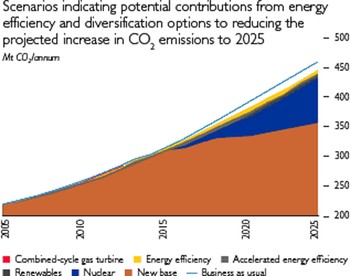
Eskom reported that it has modelled the potential contribution of demand-side and supply-side initiatives to the future reduction of CO2 emissions. A possible future scenario up to 2025 is illustrated in figure 1 below. With electricity supply growing at a potential 4.4 per cent per annum and traditional coal fired technologies remaining at a high percentage of the electricity generation mix (approximately 90 per cent), CO2 emissions from electricity generation would more than double over the next 20 years.Footnote 146 Through the implementation of several energy efficiency and diversification options, this increase can be limited. The potential contribution of the energy efficiency and diversification options, considered in this scenario, is indicated by the graph in figure 1. These options show how Eskom would slow the rate of emissions growth from the “business as usual” line to the new emissions base line, should the utility realise all the contributors.Footnote 147
Note that the technical and financial viability of these options is continually being re-assessed. (Source: Eskom Annual Report 2008)

The utility will continue to model scenarios based on technology choices to determine the optimal way of reducing emissions. This work will not abate but continue to inform the diversification strategy.Footnote 148
Rural community initiatives and measures
Adaptations undertaken at community level, making use of traditional knowledge to reduce the effects of climate related disasters can be translated or improved in the face of climate variability and change.Footnote 149 However, most of these examples are rural and include mechanisms for coping with droughts and floods. The agricultural sector has autonomously been adapting to climate variability, using different seed varieties and technologies, adjusting times of sowing and harvesting, and moving spatially.Footnote 150 In addition, poor and vulnerable communities in South Africa need the right help to adapt to the unavoidable consequences of climate change. Even if all emissions are stopped now, the cumulative impact of existing emissions will be felt for decades to come. People are developing their own mechanisms to adapt, but more assistance is needed from government. Communities facing rising temperatures, with associated stress on water supplies, crops and animals have benefited immensely from the policies that have been put in place by the government. Those policies have upheld the principles of economic, social and environmental justice. The essence of economy is to serve the needs of the people.Footnote 151 At this juncture, there is a need to give examples of how climate change is now having a negative impact on the poor and farmers in rural communities. For instance, the Richtersveld is a spectacular desert region in the north west of South Africa. The Goegap or Orange rivers separate the Richtersveld from southern Namibia. The trees in the forest are dying on daily basis. This is a worrying trend in the Kokerboom (quiver tree) Forest and may in part be a consequence of rapid climate change in this sensitive desert ecosystem.Footnote 152 Similarly, in 2007, South Africa experienced its worst drought in 50 years. The maize had been growing prolifically because rain was falling, but then the rain stopped and this affected the harvest for the year. The effect of maize shortages ripple throughout the country, leading to food price increases which are already outpacing inflation.Footnote 153 It is the economically marginal who feel the pinch. Even though there is food, staple foods are too expensive for the poor to buy.Footnote 154 This can be avoided through other sources of energy, reducing the use of fossil fuels and monitoring for adaptation.
South Africa's international obligations
South Africa has ratified the UNFCCCFootnote 155 and the Kyoto Protocol.Footnote 156 The major distinction between the protocol and the convention is that, while the convention encouraged industrialized countries to stabilize GHG emissions, the protocol commits them to do so.Footnote 157 As a non-annex I member, South Africa has no quantified emission limitations and no reduction commitments in terms of article 3 of the Kyoto Protocol. However, its high intensity of carbon emissions makes South Africa vulnerable to pressure to make some kind of commitment within the UN climate change negotiations.Footnote 158 South Africa has moral, scientific and administrative obligations to formulate and implement measures to mitigate climate change. The government has continuously been proactive in different dimensions to ensure that there is a progressive shift from fossil fuel to renewable energy in order to slow, reduce and retard GHG emissions. In this respect, South Africa is acting responsibly. It is expected that annex I members, mainly the industrialized developed countries should reciprocate by implementing stringent strategies and measures to retard their carbon emissions. It is against this background that Marthinus van Schalkwyk, the former minister of environmental affairs and tourism, clamoured for a binding and enforceable global agreement to be reached by the international community in Copenhagen, specifying absolute mitigation targets for the developed world and relative reductions for developing nations, combined with a technology transfer and financing plan.Footnote 159
CONCLUSION
A closer examination of the efforts undertaken explicitly to address climate change, such as establishing new focal points within government, developing partnerships with other governments or the private sector, or launching pilot projects, have contributed immensely to reducing GHG emissions in South Africa; the government is persistent in its quest to continue in this direction in the near future. Becoming a low carbon society is quite a challenge for South Africa, as its economy is highly dependent on fossil fuels, particularly coal. The sustainable development policies and measures built on the national development objectives and priorities are instrumental in moving South Africa toward a low carbon society. This is achieved by putting in place more stringent policies or by implementing new adaptation and mitigation measures that align the development path to follow a sustainable course.
The South African government is living up to its responsibility in this regard by taking a lead to develop and strengthen both mitigation and adaptation strategies by focusing on the ecological and economic aspects and, more importantly, the social impacts of climate change. The government realized that failure to focus on the social impact as well will result in increased poverty, malaria, water shortages, food insecurity, drought, floods and migration, and will harm those living with HIV and AIDS. The cost of government inaction will result in an even higher price later. There is strong political will on the part of the South African government to fight climate change, even though it is not under any obligation to reduce its GHG emissions. Realizing that economic growth, sustainable resource management and climate change are closely connected, the executive and legislative arms of the South African government have agreed on implementable and stringent policies, measures and strategies on climate change. This will ensure that the country reduces emissions to become a “low carbon” economy while also helping to limit the effects of global warming. South Africa should serve as an example to the other nations of Africa as the developing continent becomes a stronger and more effective player in the fight against global climate change.Footnote 160