The acquisition of restrictive relative clauses (hereafter, RCs) has been the center of a lively debate among researchers for at least the past two decades. Discordant findings from production and comprehension studies (and, very often, also within the same modality) have given rise to a number of questions regarding the time course of acquisition of these syntactically complex structures, the processing mechanisms underlying them and the linguistic theory that can account for such experimental findings. In particular, investigations of children's spontaneous speech (Diessel & Tomasello, Reference Diessel and Tomasello2000) and elicited production experiments (Crain, McKee & Emiliani, Reference Crain, McKee, Emiliani, Frazier and de Villiers1990; Diessel & Tomasello, Reference Diessel and Tomasello2005; Guasti & Cardinaletti, Reference Guasti and Cardinaletti2003; McKee, MacDaniel & Snedeker, Reference McKee, McDaniel and Snedeker1998) show that children can use RCs from at least ages three and four. Diessel & Tomasello (Reference Diessel and Tomasello2000) describe the earliest naturally occurring relative attempts as semantically simple, single-proposition or presentational sentences and find examples of their occurrence from two years onwards.
In early RC comprehension studies (de Villiers, Tager Flusberg, Hakuta & Cohen, Reference de Villiers, Tager Flusberg, Hakuta and Cohen1979; Sheldon, Reference Sheldon1974; Slobin, Reference Slobin and Dingwall1971; Tavakolian, Reference Tavakolian and Tavakolian1981), manipulation of toys was used (acting out task) and children performed at chance level until five years of age. This delay was explained by saying that children's grammar was different from that of adults, and different surface heuristics were hypothesized to be at play in the immature grammar system. These early accounts are known as the Interruption Hypothesis (Slobin, Reference Slobin and Dingwall1971), Parallel Function and Extraposition (Sheldon, Reference Sheldon1974), the Conjoined-clause analysis (Tavakolian, Reference Tavakolian and Tavakolian1981) and the Initial NVN schema heuristic (de Villiers et al., Reference de Villiers, Tager Flusberg, Hakuta and Cohen1979). However, methodological flaws in these early tasks have been pointed out (Corrêa, Reference Corrêa1995; Goodluck & Tavakolian, Reference Goodluck and Tavakolian1982; Hamburger & Crain, Reference Hamburger, Crain and Kuczaj1982).
Goodluck & Tavakolian (Reference Goodluck and Tavakolian1982: 20) suggest that there are at least three different levels at which children's interpretation errors may arise: competence grammar, processing or pragmatics. However, before making the claim that children's non-target responses are a consequence of a non-adult-like competence grammar, it becomes crucial to control for possible processing and/or pragmatics effects in experimental tasks. Stemming from a similar perspective, Hamburger & Crain (Reference Hamburger, Crain and Kuczaj1982) showed that when the experimental setting was pragmatically appropriate, four-year-old American children's comprehension and production were above chance. In a later study (Crain et al., Reference Crain, McKee, Emiliani, Frazier and de Villiers1990), two- and three-year-old Italian children were able to produce such sentences.
Lately, picture preference (instead of toy manipulation) has been widely used in experimental investigation because it allows for testing more items per condition, produces less between-subject variability and is more suitable for language disorder assessment. But in a number of recent studies (Arnon, Reference Arnon2005; Arosio, Adani & Guasti, Reference Arosio, Adani, Guasti, Belletti, Bennati, Chesi and Ferrari2005; Friedmann & Novrogodsky, Reference Friedmann and Novrogodsky2004), some of the ‘old’ methodological problems are still at play.
We present data from three- to seven-year-old Italian monolingual children who have been tested on right-branching subject and object RCs. Following the usual convention, each sentence type is labeled with a two-letter abbreviation, where the first letter is the grammatical role of the RC head within the main clause (i.e. O(bject) in our examples). The second letter indicates the RC head grammatical role within the embedded clause (i.e. S(ubject) for subject extracted RCs and O(bject) for object extracted RCs). Three sentence types were tested, subject RCs (OS, henceforth) and two types of object RCs (OO and OOp). As for the object RCs, OO are distinguished from OOp in that the RC subject is in a preverbal position in the former but in a postverbal position in the latter. An example is given in (1):
- (1)
a. Indica il cavallo [che sta inseguendo i leoni].
‘Point to the horse that is chasing the lions’
b. Indica il cavallo [che i leoni stanno inseguendo].
‘Point to the horse that the lions are chasing’
c. Indica il cavallo [che stanno inseguendo i leoni].
Point to the horse that are chasing the lions
‘Point to the horse that the lions are chasing’
The RC is indicated in square brackets. Italian is a language with relatively flexible word order that allows postverbal subjects in both main and embedded clauses. Children do not make agreement errors and therefore use both subject types correctly from their early productions (Guasti 1993/Reference Guasti1994). However, De Vincenzi et al. (Reference De Vincenzi, Arduino, Ciccarelli and Job1999) showed that the correct interpretation of object wh-questions with a postverbal subject is greatly delayed compared to the comprehension of subject wh-questions. Given the close similarity between object wh-questions and OOp (both in terms of structure representation and final word order), we decided to include this third condition in our experimental design. It is worthwhile mentioning that in Italian, the sentence in (2) is ambiguous between the subject and object reading:
(2) Indica il cavallo [che sta inseguendo il leone].
Point to the horse that is chasing the lion
‘Point to the horse that is chasing the lion’ or ‘Point to the horse that the lion is chasing’
Given that in (2) both RC head il cavallo and the embedded DPs il leone are singular, they are both potential subjects of the auxiliary verb sta, which shows third person singular morphology. The sentence becomes unambiguous when RC head DP and embedded DP have a different number value (one singular and the other plural). By doing so, the agreement morphology on the verb would then disambiguate the sentence towards one or the other reading. A similar study on the same structures in Italian was conducted by Arosio et al. (Reference Arosio, Adani, Guasti, Belletti, Bennati, Chesi and Ferrari2005) with five- to nine-year-old children. Notably, the present work distinguishes itself from the previous studies with respect to the methodology that we used (see next section). This new method allowed us to extend our investigation to three- and four-year-olds. This was done in order to address the current debate in the literature regarding the point at which relative clauses are acquired in a productive way.
The aim of this paper is twofold. First, we present a task for the assessment of RC comprehension which offers the advantages of using pictures (instead of toys) and at the same time overcomes a number of methodological shortcomings afflicting previous studies. Second, we will claim that children's data support the idea of continuity between early and adult grammars. In particular, we suggest that children access the operation of relativization from early on and that early difficulties with object RCs can be explained following recent proposals in terms of intervention, such as Grillo (Reference Grillo2009), Garraffa & Grillo (Reference Garraffa and Grillo2008) and Friedmann, Belletti & Rizzi (Reference Friedmann, Belletti and Rizzi2009).
The paper is structured as follows. First, a critical review of previous experimental designs is outlined and a solution is proposed. Second, we introduce a new experimental setting and procedure for testing restrictive RC comprehension with children. Third, our participants and results are presented and then the methodological and theoretical implications of our results are discussed.
Some theoretical and methodological observations
Going back to Quine (1960; quoted in Heim & Kratzer, Reference Heim and Kratzer1998), restrictive RCs are traditionally analyzed as predicates, i.e. they are noun modifiers in the same way as adjectival phrases and prepositional phrases are usually so considered. For instance, in order to interpret one of the RCs in (1a, b, c), the listener must understand that the embedded clause is a noun modifier and that the noun that is being modified is the NP, ‘horse’. The NP ‘horse’ is the head of the RC. Following Quine (1960), the correct interpretation is derived by predicate modification of ‘that is chasing the lion’ combined with the RC head ‘horse’. This operation restricts the referent set given in the context. Hence, in order for the RC in (1) to be pragmatically felicitous, it is presupposed that at least two or more horses are presented in the context. Furthermore, when ‘horse that is chasing the lions’ becomes the argument of the definite determiner ‘the’, it denotes that exactly one horse is chasing the lions in the given context.
As Hamburger & Crain's (Reference Hamburger, Crain and Kuczaj1982) seminal work pointed out, the matrix and embedded clauses in RCs are in an assertion–presupposition relation. Let us look at the example below, where (3a) is an OS and (3b) is an OO:
- (3)
a. The cow bumped the horse [that tickled the cat].
b. The cow bumped the horse [that the cat tickled].
The meaning asserted by both (3a) and (3b) is expressed by the matrix clause the cow bumped the horse, but it presupposes that either one of the horses in the context tickled the cat, i.e. (3a) or that one of the horses was tickled by the cat, i.e. (3b). Furthermore, the use of both examples in (3) is pragmatically felicitous when at least two horses are presented in the referent context. In fact, the RC function is that of restricting the set of potential referents for the definite expression the horse. Hamburger & Crain (Reference Hamburger, Crain and Kuczaj1982) show that once the experimental setting was modified (by adding an extra horse toy, in the example above), three- and four-year-old children performed above chance, contrary to previous studies. It may be worth noting that Eisenberg (Reference Eisenberg2002) showed that three- and four-year-olds' performance did not differ, or only minimally differed, when the same group of children was tested in felicitous and infelicitous context using an acting-out task. However, this work was subsequently criticized by Kidd (Reference Kidd2003), who showed that Eisenberg's (Reference Eisenberg2002) task still failed to satisfy the referential function of the RC in the discourse, in the sense of Corrêa (Reference Corrêa1995).
Goodluck & Tavakolian (Reference Goodluck and Tavakolian1982) showed that RCs were significantly easier to interpret at four years when the object of the RC was inanimate (4) rather than animate (5) (from Goodluck & Tavakolian (Reference Goodluck and Tavakolian1982: 4):
(4) The dog kicks the horse that knocks over the table.
(5) The dog kicks the horse that knocks over the sheep.
A further facilitation was attested with intransitive verbs, such as (6):
(6) The dog kicks the horse that hops up and down.
Whereas in languages such as English and Italian the subject/object asymmetry is a well-known and established phenomenon that has received a number of processing explanations (such as the Active Filler Hypothesis (Frazier & Fodor, Reference Frazier and Fodor1978), the Minimal Chain Principle (De Vincenzi, Reference De Vincenzi1991), the Dependency Locality Theory (Gibson, Reference Gibson1998), more recent studies on adult processing offer convincing evidence that the degree of difficulty in object RC can be modulated through factors such as animacy (Mak, Vonk & Schriefers, Reference Mak, Vonk and Schriefers2002; Traxler, Morris & Seely, Reference Traxler, Morris and Seely2002) and noun category (Gordon, Hendrick & Johnson, Reference Gordon, Hendrick and Johnson2004). Hence, striking similarities between children and adult response patterns weaken those explanations of early difficulties relying on a limited grammatical knowledge (or absence of some linguistic operations) and highlight the need to find a more comprehensive explanation of object RC difficulty as a grammatical phenomenon (Crain, Ni & Shankweiler, Reference Crain, Ni and Shankweiler2001).
In addition, current research on atypically developing populations has also focused on the acquisition of RCs. A number of studies have been carried out with children with specific language impairment (SLI) in Hebrew (Friedmann & Novrogodsky, Reference Friedmann and Novrogodsky2004), Greek (Stavrakaki, Reference Stavrakaki2001) and English (Adani, Guasti, Forgiarini & van der Lely, submitted). A common finding across these studies is that children with SLI show a significantly poorer performance on RC comprehension than their language and age peers. From a methodological perspective, we would like to discuss Friedmann & Novrogodsky's experimental design, noting that the same observations are also applicable to Arosio et al.'s (Reference Arosio, Adani, Guasti, Belletti, Bennati, Chesi and Ferrari2005) study.
Friedmann & Novrogodsky (Reference Friedmann and Novrogodsky2004) tested a group of 10 Hebrew-speaking children with (syntactic-)SLI (age range 7 ; 3–11 ; 2, mean age 9 ; 0) and two groups of typically developing children aged 4 ; 7 (age range: 4 ; 0–5 ; 0) and 6 ; 2 (age range: 5 ; 11–6 ; 5), using a binary picture–sentence matching task. They were tested using both subject and object right-branching RCs, such as (7) and (8), with two pictures as in Figure 1 (from Friedmann & Novrogodsky, Reference Friedmann and Novrogodsky2004: 670–71):
(7) Zot ha-safta she-menasheket et ha-yalda.
OS: This is the-grandmother that-kisses ACC the-girl
(8) Zot ha-safta she-ha-yalda menasheket.
OO: This is the grandmother that the girl is kissing
A sample of Friedmann & Novrogodsky's (Reference Friedmann and Novrogodsky2004) experimental pictures.

Children were asked to choose one of two pictures for each item of a 60-sentence list. They found that the comprehension of subject relatives (e.g. 7) was poorer in four-year-olds (85%) compared to six-year-olds and children with SLI (95% and 98·5%, respectively). Furthermore, they found that six-year-olds have an 86% accuracy rate for object relatives (e.g. 8), compared to four-year-olds and children with SLI, who were at chance (58% and 62%). The authors interpret these results by saying that children with SLI have problems with movement-derived sentences and, in particular, they fail to assign the thematic role of a moved constituent. We observe that chance performance at age four is an unexpectedly low rate of accuracy, and there are at least three reasons to believe that it may be related to some confounding factors in the experimental design. First, although the authors explicitly state (p. 672) that their experimental setting satisfies Hamburger & Crain's felicity requirements, we suggest that this is not the case, given that within one picture no other possible referent to restrict the set is presented (e.g. an extra grandmother). On the other hand, if both pictures have to be taken into account at the same time, a different problem arises, namely, the infelicitous use of the definite determiner ‘the’ to specify ‘girl’, in a context where in fact two girls are present.Footnote 1
We have seen that RCs are noun modifiers and, as such, being able to interpret an RC correctly means being able to understand (among other things) which NP it refers to. Hence, given (7) or (8), the child has to individuate which one is the correct grandmother. This is pragmatically different from choosing between the picture where the grandmother is kissing the girl or that where the grandmother is being kissed by the girl. In other words, the choice between two pictures such as Figure 1a and 1b is not the correct task requirement to individuate the referent of an RC head.
This observation about picture selection as an inappropriate task demand was also put forward by Arnon (Reference Arnon2005): ‘asking children to choose a picture rather than a referent might have hindered detection of the full performance range for the following reason: when a child points to the correct picture, we do not know whether he or she is indeed pointing to the correct or incorrect referent.’ So, Arnon modified Friedmann & Novrogodsky's task by asking children to choose a referent rather than a picture. By doing so, it is possible to pinpoint which character (out of four) the children are choosing; this will lead to the detection of a more fine-grained class of errors (if any), rather than just thematic-role inversion. In particular, it was possible to detect whether, when children are pointing to the correct picture for an object RC ‘This is the girl that the grandmother is kissing’, they are really pointing to the target (‘the girl’) or rather to the embedded-verb agent (‘the grandmother’). A different group of fourteen Hebrew-speaking children (age range 4 ; 5–5 ; 2; mean age 4 ; 7) revealed a new response pattern on OO: 51% correct, 27% Reversal error and 22% the novel Agent error (however, it is not indicated whether these two proportions are significantly different or not). For an OO, the Reversal error consisted of choosing the wrong token of the right type (the girl that is kissing the grandma, in the example above), whereas the Agent error consists of choosing the agent of the embedded verb (e.g. ‘the girl’ in (8)). Arnon uses these results to argue against a movement-based explanation of children's difficulty with OO. In particular, 51% correct responses are no longer at chance if children are considering four possible referents and adopting both theta-role inversion and Agent error strategies. As she suggests, whereas the Reversal error is associated with confusion with regard to the thematic role of the clausal head (by choosing a DP with the Agent role instead of the one with Patient role, for instance), the Agent error ‘seems to tap a more general misunderstanding with regard to the modifying nature of the clause: children do not grasp that the relative clause adds information about the clausal head’. In other words, the Agent error is the one that potentially informs us about children's misinterpreting the RC function.
Here, we assume Arnon's observation and we claim that Agent selection is the appropriate task to assess the constructions under investigation. However, 51% correct at 4 ; 7 is still unexpectedly low. We suggest that this could depend on an unnecessary complication (or a potential confound) which is still present in her study. Namely, there is no need to use two separate pictures if the task demands selection of a single referent among others. Moreover, the infelicitous use of a definite determiner, as pointed out earlier, also applies to Arnon's study. Stemming from these observations, we believe greater improvements can be made to the experimental setting with respect to those previously mentioned, and we have striven to make such improvements in the current study.
METHOD
Participants
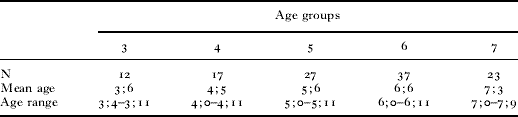
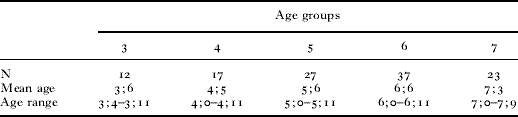
One hundred and sixteen Italian monolingual children participated in the study. They were recruited in kindergartens and primary schools in Sesto San Giovanni and surrounding areas, north of Milan. Parent consent forms were distributed and only those children whose parents said that they were not exposed to any language other than Italian at home were included in the subject pool. Ages range from 3 ; 4 to 7 ; 9, but see the Table 1 for more details.
Participant's age and details
Materials
The sentences under investigation are those reported in (1) and repeated in (9) below:
- (9)
a. Indica il cavallo [che sta inseguendo i leoni].
‘Point to the horse that is chasing the lions’
b. Indica il cavallo [che i leoni stanno inseguendo].
‘Point to the horse that the lions are chasing’
c. Indica il cavallo [che stanno inseguendo i leoni].
Point to the horse that are chasing the lions
‘Point to the horse that the lions are chasing’
As pointed out earlier, animate/inanimate referents seem to play a different role in both adult and children studies. Hence, unless animacy is taken as an experimental factor, it is necessary to control for these effects. In our experiment, we decided to neutralize animacy effects by using exclusively animate referents. For each trial, only transitive verbs were used. We used the following verbs: rincorrere ‘to run after’, tirare ‘to pull’, inseguire ‘to chase’, beccare ‘to peck’, seguire ‘to follow’, lavare ‘to wash’, guardare ‘to look at’, mordere ‘to bite’ and spingere ‘to push’.
Given that OS and OOp are potentially ambiguous in Italian between and subject or object reading (cf. (2)), each experimental trial was disambiguated through number agreement between the subject and auxiliary verb. In order to test exclusively unambiguous sentences, the RC head was always singular whereas the embedded noun was always plural. The verb could either refer to the RC head (OS) or to the embedded noun (OO and OOp).Footnote 2
The test was composed of picture/sentence pairs. The pictures were selected from those used by De Vincenzi (Reference De Vincenzi1996) to test subject/object wh-questions in Italian. Only part of the original pictures was used and some of them were slightly modified in order to make the image clearer. The pictures always had the same structure: animal X on the left, a pair of animals Y in the middle and animal X on the right. For example, a horse that is chasing two lions and these two lions are chasing another horse (Figure 2). So, Figure 2 was paired with one of the structures in (9). Hence, the correct answers were always on one of the peripheries of each picture. All sentences were recorded by a female voice and were administered using speakers connected to a laptop (cf. Procedure section for more details).
A sample of the experimental pictures.

Each structure (OS, OO or OOp) occurred 8 times in the list. In addition to the 24 experimental trials, 12 fillers sentences were introduced, yielding a list of 36 items in total. Filler sentences were used in order to introduce some correct responses corresponding to the character in the central position. We used sentences with either intransitive verbs or transitive verbs with inanimate objects (which are not reversible and therefore easier for children) (Goodluck & Tavakolian, Reference Goodluck and Tavakolian1982). An example of a filler sentence is (10), which is paired with Figure 3:
(10) Indica il bambino che sta mangiando il gelato.
‘Point to the boy who is eating the ice cream’
A sample of filler pictures.

Each picture was used only once within the list in order to avoid response priming effects. The same picture appears only once in the experimental lists and each picture was paired with only one sentence. The direction of the action in the experimental trial pictures was towards the left in 12 pictures and towards the right in 12 pictures. The position of the target was on the left 14 times, on the right 12 times and in the center 10 times. To control for potential order effects on trials, we created two lists (List 1 and List 2), in which the presentational order of trials was reversed (see Appendix).
Scoring
Children's responses were scored into one of three categories, one of which was the target response and the other two were non-target responses. Non-target responses were labeled as reversed errors and middle errors. A reversed error occurs when the other character corresponding to the head NP was chosen. For instance, given (11) and Figure 2:
(11) Indica il cavallo che i leoni stanno inseguendo.
‘Point to the horse that the lions are chasing.’
the Reversed error consisted of choosing the horse on the left (rather the one on the right-hand side). The horse on the left is the one that is chasing the lions, rather than being chased by the lions. Therefore, it looks as if theta-roles are reversed here, namely whereas in (11) the head NP is the Patient, the child interprets it as an Agent.
A Middle error occurs when the character in the middle is chosen. For instance, given (11) above, the child points to the lions in the middle. As already mentioned, the introduction of this response option is particularly relevant given that there is a claim in the literature (Arnon, Reference Arnon2005) according to which four- to five-year-old Hebrew-speaking children make the two errors at virtually the same rate in OO (22% Agent, 27% Reversed). We opted for the more general label of ‘Middle error’ in contrast to Arnon's ‘Agent’, given that, in our experimental design, the middle response is an option also for OS and OOp where the DP is not the Agent.
Procedure
A preliminary meeting in the classroom preceded the actual individual testing session. During this familiarization phase, we introduced ourselves and our puppet Camilla to the children. We told them that Camilla is a little snail who wants to learn Italian. So, she asked us if we could find some new friends who were keen to help her. The children generally enjoyed Camilla and they were all very happy to participate and engaged in the game. After the preliminary session, one child at a time went in a quiet room with the experimenter where the testing session took place.
We explained to each participant that he/she would be shown some pictures, and then he/she would hear a voice in the computer. Sentences were prerecorded by one of Camilla's friends in the computer. The child had to point to the right character referred to in the sentence. Camilla was next to the child for the entire session and was used to re-attract the child's attention when distracted.
We began with a verb comprehension test, in order to make sure that all children (especially the three-year-olds) were familiar with the lexical verbs that were used in the test. In order to make sure that participants knew all the characters, we began each trial by naming them aloud (or encouraging the child to do so). For example, for sentence (1), the preamble was: ‘Look, here there's a horse, here there are two lions and here there's another horse. Now, we will listen to a voice saying something and you will show Camilla which is the right character.’ We began with three practice sentences and then moved to the experimental trials.
We would like to emphasize once more that our claim the greater appropriateness of this method (with respect to previous ones) does not solely rely on those methodological factors that have been pointed out in the previous section, namely the presence of two candidates for the RC head, the felicitous usage of the definite determiner in the given context (this point is not directly addressed in Hamburger & Crain's (Reference Hamburger, Crain and Kuczaj1982) work) and that the Agent selection task is a more appropriate task demand than picture selection. Rather, other important improved factors are the following. First, before the sentence started, we gave a preamble where all characters were named aloud (either by the experimenter or by the child). This allows the child to scan the whole experimental setting, minimizing lexical access load (besides making both RC head candidates not just present but also salient in the context). Second, the use of pictures and prerecorded sentences rather than toys makes the assessment of these constructions more homogeneous across subjects and more suitable to be used with children with language disorders. The first point addresses a problem shared by Friedmann & Novrogodsky (Reference Friedmann and Novrogodsky2004), Arosio et al. (Reference Arosio, Adani, Guasti, Belletti, Bennati, Chesi and Ferrari2005) and Arnon (Reference Arnon2005); as for the second point, given that one of the aims of this study was to provide a baseline for the age of acquisition of subject and object RCs in Italian that could be then compared with the performance of children affected by language disorders, we have preferred the use of pictures rather than toys.
RESULTS
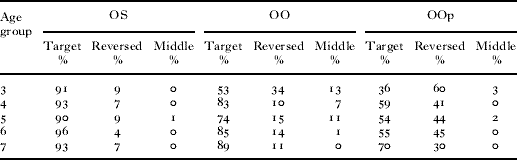
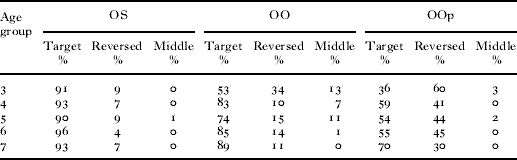
Response type percentages for each group are summarized in Table 2 (percentages are indicated because group sizes differ; in the statistical analysis raw scores were used).
Correct response percentages for each response type in each group
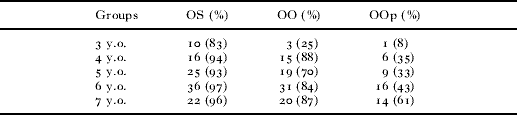
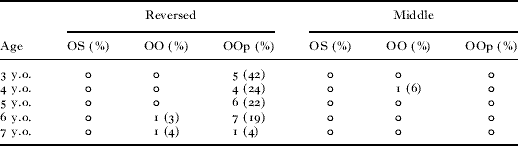
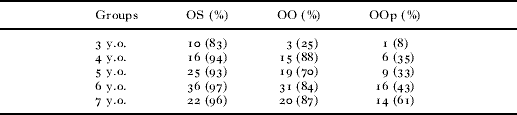
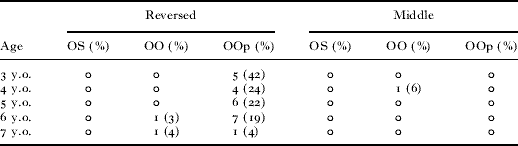
Tables 3 and 4 indicate how individual performances are distributed. We considered an above chance performance when the child chooses at least six answers (out of eight conditions) of the same kind as predicted by the binomial distribution (p=0·01) (e.g. six target responses, six Reversed errors or six Middle errors).Footnote 3 Again, since group sizes differ, we indicated the actual number of children who performed above chance on a particular condition and also the percentage with respect to the group size. These percentages are indicated in brackets (Table 3). Using the same criterion, we also calculated the number of children who consistently chose a non-target response. Table 4 indicates their distribution.
Number of children who performed above chance
Number of children who chose each error at least six times
Two statistical analyses were performed on the group data (Table 2) in order to determine which differences were statistically significant using a repeated-measure Logistic Regression. Recent works on psycholinguistic research methods (Dixon, Reference Dixon2008; Jaeger, Reference Jaeger2008) show that commonly used generalized linear models (such as Analysis of Variance) are (often) incorrectly applied to accuracy data, which ‘are discrete rather than continuous and proportion correct is constrained to the range 0–1. This can lead to averaging artifacts and distortions in the means, standard errors and other statistics’ (Dixon, Reference Dixon2008: 447). Both Dixon and Jaeger recommend Logistic Regression as the (currently) most appropriate alternative to analyze such data. Logistic models calculate the experimental factor effects on the odds of an event over the non-event. The odds are the ratio between the event probability and the non-event probability. We take this ratio as the dependent variable of the logistic models. As for the first analysis, the ratio under investigation is Non-target responses (event) rather than Target responses (non-event). We want to see how children's non-target responses vary, with respect to Sentence type (within-subject factor) and Age group (between-subject factor).
Target response analysis
The main results of the target response analysis confirm that subject relatives produce greater accuracy rates than object relatives. As for the two object relatives, OO produce greater accuracy rates than OOp. Accuracy rates increase with Age.
It is important to determine whether language performance on List 1 or List 2 was significantly different. Fifty-seven children were exposed to List 1 and fifty-nine children were exposed to List 2. As expected, no significant main effect of List was attested (χ2(1)=2·06, p<0·15). Hence, we can safely assume that children's response behavior was not influenced by the list to which they were exposed.
We found significant main effects of Age (χ2(4)=10·98, p=0·026) and Sentence (χ2(2)=49·39, p<0·001). Contrast estimate results show that, from age three to age four, the odd Non-target/Target significantly decreases at a 0·42 rate (p=0·02); this means that errors (rather than correct responses) are 2·38 times more frequent in three-year-olds than four-year-olds. From age five to age six, the odd Non-target/Target significantly decreases at a 0·54 rate (p=0·02); this means that errors (rather than correct responses) are 1·85 times more frequent in five-year-olds than six-year-olds. As for the main effect of Sentence, contrast estimate results show that from OS to OO, the odd Non-target/Target significantly increases at a 3·57 rate (p<0·001); this means that errors (rather than correct responses) are 3·5 times more frequent in OO than in OS. From OS to OOp, the odd Non-target/Target significantly increases at a 10·77 rate (p<0·001); this means that errors (rather than correct responses) are 10 times more frequent in OOp than OS. From OO to OOp, the odd Non-target/Target significantly increases at a 3·01 rate (p<0·001); this means that errors (rather than correct responses) are 3 times more frequent in OOp than in OO. As the reader may have noticed, five-year-olds show lower accuracy than four- and six-year-olds across sentence types. Given that no outliers were detected in the sample, the source of this discrepancy remains unclear.
In summary, subject relatives produce greater accuracy than object relatives, as found in other cross-linguistic studies and in a variety of populations. Therefore, the Subject/Object asymmetry is confirmed. As for the two object relatives, OO produced greater accuracy rates than OOp, as also found in Arosio et al. (Reference Arosio, Adani, Guasti, Belletti, Bennati, Chesi and Ferrari2005). Nevertheless, it is important to point out that overall target response rates are consistently extremely accurate and, crucially, substantially higher than in previous studies (Arnon, Reference Arnon2005; Arosio et al., Reference Arosio, Adani, Guasti, Belletti, Bennati, Chesi and Ferrari2005; Friedmann & Novrogodsky, Reference Friedmann and Novrogodsky2004).
Once we have established how accurate children are in the task, we can now explore how they perform when a non-target response is provided. In other words, what do they do when they do not get it right? Do children behave differently at different ages? These questions will be addressed in the non-target response analysis. In this analysis, the ratio under investigation is Reversed Responses (event) compared to Middle responses (non-event). As we did before, we want to see how children's non-target responses vary, with respect to Sentence type (within-subject factor) and Age group (between-subject factor). We address this issue in the following section.
Non-target response analysis
First, let us consider non-target response percentages as they appear in Table 2. We can see that the Reverse Error is much more common than the Middle Error overall, especially for object relatives. Furthermore, the Middle Error is almost only attested in OO relatives but is, nevertheless, virtually absent from age six years on. Given that it is possible to measure the event/non-event ratio only if both the event and non-event assume values different from zero, the whole model could not be explored. Hence, only the relevant comparisons are reported below.
In the first part of the analysis, the Age factor was collapsed and we calculated the change of probability of choosing Reversed Error rather than Middle Error, for each Sentence type. We found a significant main effect of Sentence (χ2(2)=17·56, p<0·001). Contrast estimate results show that, from OS to OO, the odd Reverse/Middle significantly decreases at a 0·11 rate (p=0·02); from OO to OOp, the odd Reverse/Middle significantly increases at a 14·74 rate (p>0·001); from OS to OOp, the odd Reverse/Middle increases at a 1·68 rate (p=0·6). This means that in OO, the Middle error (rather than Reverse) is 9 times more frequent than in OS; in OO, the Middle error (rather than Reverse) is 14 times more frequent than in OOp; no significant difference in Errors is attested between OS and OOp. Crucially, our analysis confirms that the Middle Error is somehow only relevant for OO sentences (regardless of Age).
As for the factor Age, we could not run the analysis for OS and OOp given that several groups do not show any Middle Error in these constructions (this is consistent with the result of the above analysis). Hence, we calculated the change of probability of choosing Reversed Error rather than Middle Error in OO for three-, four-, five- and six-year-olds (Middle Error for seven-year-olds does not occur). We found a significant main effect of Age (χ2(3)=14·13, p=0·002). Contrast estimate results show that, from three to four, the odd Reverse/Middle decreases at a 0·6 rate (p=0,48); from four to five, the odd Reverse/Middle, decreases at a 0·6 rate (p=0·56); from five to six, the odd Reverse/Middle increases at a 16 rate (p<0·001). This means that from three to five years, both Middle and Reverse errors have an impact (although the latter is overall more frequent). After age five, the error Middle drops dramatically.
In summary, the group analysis of non-target responses revealed that when children do not get the target response, they show two distinct response patterns: as for OOp, they tend to choose the interpretation where arguments are reversed. On the other hand, two different responses are attested in OO: three-year-olds show 34% of reversed interpretations, but this error drastically drops to 10–15% from four years onwards. Furthermore, we have shown that another non-target response appears in OO, namely, three- to five-year-old children choose the embedded NP rather than the head NP between 7–13% of the time. After five, this error virtually disappears. As shown in Tables 3 and 4, the Middle error is even less prominent at the individual level. This point will be addressed in the Discussion section.
Our response pattern corresponds with Arnon's findings. However, four- to five-year-old Hebrew children were observed to choose one error over the other with nearly the same frequency (22% Middle, 27% Reversed). Conversely, the group of Italian children tested in our study show an asymmetry in their non-target responses: on average, 20% Reversed and 10% Middle from age three to five. Interestingly, in Italian there are fewer errors overall, but especially fewer Middle type errors. The different behavior between Italian and Hebrew children could be influenced by the different methodology that was used in the two tasks.
DISCUSSION
It has been proposed that children's non-target early productions are repercussions of a not fully developed performance system (Rizzi, Reference Rizzi, Cinque and Kayne2005; Reference Rizzi, Deen, Nomura, Schulz and Schwartz2006a). In particular, whereas most parameters seem to be successfully fixed by the third year of life, some child inconsistencies in the use of the A'-syntax (RCs, wh-questions) are attested even after three years of age. Given that this applies to production, there is no principled reason why similar patterns should not be found in comprehension. In this paper, we argue that children's non-target early comprehension of RCs exemplifies one such case.
Following recent proposals coming from psycholinguistic research in agrammatism (Grillo, Reference Grillo2009; Garraffa & Grillo, Reference Garraffa and Grillo2008) and language development (Friedmann, Belletti & Rizzi, Reference Friedmann, Belletti and Rizzi2009), we propose that three-year-olds' difficulty in object RCs can be explained as an intervention effect due a temporary computation overload of the immature language system. The term intervention refers to the difficulty in establishing an (otherwise correct) dependency when the two terms of the relation are separated by an intervener. A nominal constituent that could be a potential bearer of this relation (e.g. a full DP or a pronoun) qualifies as a potential intervener. In our case, the two bound elements are the RC head and its copy/gap, whereas the intervener is the embedded subject DP. The difficulty due to intervention can manifest itself in either higher occurrence of non-target responses (e.g. children) or slower timed responses (e.g. adults).Footnote 4
Intervention is not expected in OS, as no intervener occurs between the moved subject (RC head) and its gap, as (12) illustrates:
(12) Indica il cavallo [CP che [IP <e>sta [VP <e> inseguendo i leoni]]].
Our results show that three-year-olds already perform 90% correct and there is not statistical difference across ages. This finding is also confirmed by the analysis of individual performances. However, it could be argued that no real knowledge of RC function is necessary to interpret an OS, given that the linear order of constituents would trigger the target response. However, 53% accuracy on OO at three years is certainly a hint that three-year-olds also understand these structures, although not yet in a consistent way. This observation is confirmed by examining three-year-olds' individual performances: 3 children out of 12 consistently choose the correct answer on this structure. We take these results as evidence that the operation of relativization is available in child grammar from at least three years of age. Children start off with relativizing subjects (and they continue to have this preference into adulthood). This entails that they are able to represent an empty category in Spec,IP that is bound by the DP to which the CP is adjoined (cf. (13a)). However, the child grammar is also able to represent a bound category in object position (cf. (13b)), although it is not the default option and this is the context where intervention effects arise:
- (13)
a. DP [CP che [IP <e> [VP …]]]
b. DP [CP che [IP DP [VP … <e>]]]
An anonymous reviewer suggests that an alternative way to capture the extra difficulty with OO with respect to OS is to say that structures with relatively long chains and/or multiple chains (such as OOp, see below) are harder to process than structures with only one and/or a shorter chain. This suggestion also underlies a number of existing proposals coming from the adult processing literature (Frazier & Fodor, Reference Frazier and Fodor1978; Gibson, Reference Gibson1998; De Vincenzi, Reference De Vincenzi1991). However, this observation provokes another question, namely ‘What makes a chain/movement longer?’. In current syntactic theory, a property of movement upon which there is generally consensus is ‘its fundamentally local character and its mode of application in recursive (successive-cyclic) steps’ (Rizzi, Reference Rizzi, Cheng and Corver2006b, inter alia). Hence, movement is local (short) but what makes it longer is its successive applications. It is during this recursive process that different properties associated with constituents are checked and, crucially, other constituents are crossed (as happens in object relatives or object wh-questions). In this perspective, a longer chain is a chain that involves the crossing of one constituent by another one. In other words, those contexts where extra linguistic difficulty is predicted under both accounts are the same.
Further evidence that performance factors do indeed show an impact in the early stages of development is provided by the presence of Middle errors on OO, although these are much less frequent compared to Reversed errors. We suggest that two different processes underlie the two errors. Whereas Middle errors involve a genuine problem in deriving the correct representation of a RC, in the Reversed error the entire necessary structure is projected. In other words, given an OO, the Middle error consists of interpreting only the embedded IP:
(14) … .[IP the lions are [chasing __ ]].
Although in the group analysis the Middle error turned out to be significantly more prominent in OO, at the individual level this significance is not attested (cf. Table 4): three-year-olds chose the Middle error but none of them did it systematically; only one four-year-old chose it above chance level. This unsystematic behavior could be the outcome of a pointing strategy, hence supporting the claim that children are able to project the entire syntactic structure involved in an RC.
What seems to be more challenging for Italian children is the interpretation of OOp. This construction requires the simultaneous computation of RCs and inverted subjects. In fact, whereas three-year-olds perform below chance (36%), from age four to six, the accuracy rate is around 50%. However, at age seven, accuracy rates rise to 70%. We suggest that, in a subordinate clause, the computation of the additional chain <pro, i leoni>, which connects the null pronoun in preverbal position and the overt DP in post-verbal position (Rizzi, Reference Rizzi1986), is even more taxing for the child's system. The relevant structure is illustrated in (15):
(15) Indica il cavallo [CP che [IP [VPpro stanno inseguendo <e> i leoni]]]
As for the child's representation, we suggest that the interpretation of a null pro in a subordinate clause is even more taxing than the interpretation of a full DP, as happens in OO. Children's performance is disrupted when they have to connect the RC head to its copy/gap and at the same time to connect pro to the postverbal subject. As a consequence, the final DP i leoni fails to be interpreted as the subject of stanno, but it is interpreted as its object.
This fragility of postverbal subject agreement has been recently pointed out in both adult and developmental psycholinguistic work (Guasti & Rizzi, Reference Guasti, Rizzi and Cinque2002; Guasti, Branchini & Arosio, submitted; Franck, Lassi, Frauenfelder & Rizzi, Reference Franck, Lassi, Frauenfelder and Rizzi2006; Volpato & Adani, in preparation). According to these authors, what makes agreement with postverbal subjects prone to disruption is that verb agreement features are checked only once through the operation of AGREE (Chomsky, Reference Chomsky1995) between the subject in Spec,VP and the verb under I (cf. step 1 in Figure 4). In contrast, (preverbal) subject–verb agreement is more robust, being a two-step process that involves both AGREE and Spec-Head checking (Guasti & Rizzi, Reference Guasti, Rizzi and Cinque2002) between the subject raised to Spec,IP and the verb under I (steps 1 and 2 in Figure 4).
Pre- and postverbal subject agreement configurations.

Hence, guided by general strategies of economy and due to the fragility of agreement processes, our prediction is that children will opt for a representation of an OOp which is different from the adult representation but is permitted by child grammar. Our data confirm that three-year olds prefer to interpret an OOp as an OS 60% of the time. However, they seldom access the target interpretation, given that both representations in (13) are available. By age seven, children provide a more stable representation of agreement that allows them to block the representation in (13a), adjust (13b) by interpreting pro, and thus the adult interpretation is derived.
However, an additional observation is in order. In the production domain, there is evidence that children produce postverbal subjects with RCs (Guasti & Cardinaletti, Reference Guasti and Cardinaletti2003; Utzeri, Reference Utzeri2007). In her production task, Utzeri found a discrepancy in the use of pre- and postverbal subjects between the two tasks she used. In particular, the Preference Task (as opposed to the Picture Description Task) elicited more postverbal subjects. This difference was explained by saying that, whereas children had to choose in which situation (out of two options) they preferred to be, the degree of involvement was higher (compared to the other task, where they were talking about other characters). In syntactic terms, we can say that they were more focused on the subject. In our task, this condition was not tested and therefore, it could be argued that poor comprehension of OOp could be influenced by the fact that information structure requirements fail to be satisfied for this condition. This possibility is completely open and a specific experiment to tackle this research question is required.
CONCLUSIONS
We have presented a comprehension study on restrictive right-branching RCs with Italian children aged from three to seven years. In contrast to previous cross-linguistic findings, we found that the target interpretation is certainly available around three–four years. We consider this to be evidence that supports continuity between the child's and adults' competence grammars. Importantly, this result does not exclude the possibility that evidence of RC understanding can be detected at an even earlier stage of development, using a less demanding method than our pointing task. This issue remains open for further investigations.
It is well known in the experimental literature that subject performance varies significantly depending on the task in which they are engaged. This is true not only for children but also for adults. Furthermore, it is reasonable to conjecture that for atypical populations (again, both children and adults) task-dependent effects can be somehow amplified by a difficulty in accessing a full set of computational resources. A direct consequence of this would be that at least some of the findings presented in the literature showing below and/or at chance performance in children and various patients in a given task could depend on the task itself, rather than on their language impairment.
Hence, while these results give reliable evidence for the existence of grammatical knowledge from early on, they are most notable for their methodological implications. We presented a new experimental design for the assessment of RC comprehension which overcomes a number of methodological problems which have elsewhere been pointed out in the literature. Furthermore, we suggest that our task represents a valid and theoretically adequate tool for language assessment for both typically and atypically developing populations.
APPENDIX