Introduction
The genus Melanelixia O. Blanco et al. was recently erected to accommodate a small number of species formerly belonging to the genus Melanelia (Blanco et al. Reference Blanco, Crespo, Divakar, Esslinger, Hawksworth and Lumbsch2004) and before that to Parmelia (e.g. Esslinger Reference Esslinger1977). One of the species of Melanelixia, M. fuliginosa (Fr. ex Duby) O. Blanco et al., has for a long time been the subject of discussion as to whether it should be regarded as comprising one or two species. It is at present commonly recognized as one species, M. fuliginosa (Fr. ex Duby) O. Blanco et al. with two subspecies: fuliginosa and glabratula (Lamy) J. R. Laundon (Purvis et al. Reference Purvis, Coppins, Hawksworth, James and Moore1992; Nimis Reference Nimis1993; Santesson et al. Reference Santesson, Moberg, Nordin, Tønsberg and Vitikainen2004; Laundon Reference Laundon2006; Smith et al. Reference Smith, Aptroot, Coppins, Fletcher, Gilbert, James and Wolseley2009). According to Laundon (Reference Laundon1965), the two taxa differ by choice of substratum as well as morphology but can, however, be found on the other substratum with constant morphology. The taxon fuliginosa, which is mainly saxicolous, is dark brown and glossier than the lighter glabratula, which is mainly corticolous. However, the variability within the taxa is considerable and Esslinger (Reference Esslinger1977) mentions M. fuliginosa as one of the more variable species in the subgenus Melanoparmelia Essl. To which taxonomic level the taxa fuliginosa and glabratula belong have been thoroughly discussed by different authors who have treated them as a single species (Wirth Reference Wirth1995), two species (Anders Reference Anders1928; Poelt Reference Poelt1969; Ozenda & Clauzade Reference Ozenda and Clauzade1970), subspecies (Laundon Reference Laundon1965, Reference Laundon2006) or varieties (Grumman Reference Grumman1963).
Both Laundon (Reference Laundon1965) and Esslinger (Reference Esslinger1977) consider the variability between the two taxa to be genetically, rather than ecologically (substratum induced), based, as they can be found growing side-by-side on the same substratum and still be distinguishable. More recently, Guzow-Krzemińska & Węgrzyn (Reference Guzow-Krzemińska and Węgrzyn2003) analyzed one saxicolous and one corticolous specimen of M. fuliginosa and found their LSU sequences to differ from each other. In addition, molecular data indicates that M. fuliginosa is paraphyletic (Blanco et al. Reference Blanco, Crespo, Divakar, Esslinger, Hawksworth and Lumbsch2004). This raised the question whether the molecular and morphological data combined would be enough to define the two taxa as separate species. In order to answer that question, a systematic study of M. fuliginosa material from Europe was carried out using nuclear rDNA and morphological characters.
Materials and Methods
The molecular study was based on fresh material collected in Skåne, in southern Sweden in 2009, as well as some data available in GenBank. The morphological study was based on dry material in LD, mainly from northern Europe but also from other parts of Europe. A total of 94 specimens was used.
Morphological characters were measured on dry material using a dissecting microscope (×40). No anatomical characters in the apothecia were measured since very few fertile specimens were found.
DNA-extraction, PCR-amplification and sequencing
PCR-amplification of the ITS regions including the 5.8S gene of the nuclear rDNA was made without an extraction step, but using Direct PCR on small pieces of the thallus as described by Arup (Reference Arup2006). Primers for amplification were ITS1F (Gardes & Bruns Reference Gardes and Bruns1993) and ITS4 (White et al. Reference White, Bruns, Lee, Taylor, Innis, Gelfand, Sninsky and White1990). The PCR settings used followed the manufacturer's recommendations (5 Prime).
PCR cycling parameters included an initial hold at 94°C for 5 min, then denaturing at 94°C for 1 min, annealing at 56°C for 1 min, decreasing 1°C per cycle from 62°C for the first 6 of the 39 cycles (touchdown), and extension at 72°C for 3 min. Products were cleaned using E.Z.N.A. Cycle-Pure Kit (Omega Bio-Tech). Both complementary strands were sequenced by Macrogen Inc. using the same primers as in the PCR.
Sequence alignment and phylogenetic analyses
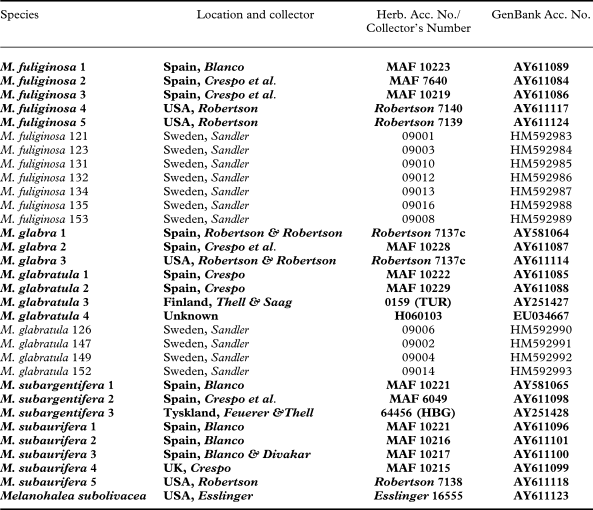
A total of 31 ingroup taxa and one outgroup taxon were aligned by hand. Data for 21 of these sequences were available from GenBank (Table 1). The alignment included the ITS1, 5.8S, and ITS2 regions for a total of 509 bases. Melanohalea subolivacea (Nyl.) O. Blanco et al. was used as outgroup since this species has been shown to be fairly closely related to the ingroup of Melanelixia, but not too closely related (Blanco et al. Reference Blanco, Crespo, Divakar, Esslinger, Hawksworth and Lumbsch2004).
Location, collector, herbarium accession number/collector's number, and GenBank accession numbers of sequences of Melanelixia species and Melanohalea subolivacea used in the analyses. Specimens in bold were already available from previous studies

A phylogenetic analysis was carried out using PAUP*4.0b10 (Swofford Reference Swofford2002) under the maximum parsimony optimality criterion. The characters were given equal weight and gaps were treated as missing data. A heuristic search was performed using tree bisection-reconnection (TBR) branch swapping. Bootstrap proportions were estimated using 10 000 bootstrap replicates, each with 10 random addition sequence replicates.
Morphological characters
Several morphological characters were measured or evaluated, all chosen on the basis of being used for description of the taxa in the literature.
Thallus marginal zone. Measurements of the thallus marginal zone free of isidia were made to the closest 0·125 mm, on five representative places on each specimen.
Isidia. The quantity of isidia were indicated by one of the following values: 1, very sparse, many undeveloped isidia; 2, sparse, thallus clearly visible between isidia; 3, numerous, thallus somewhat visible between isidia; or 4, abundant, isidia growing in lumps.
Colour. The colours were defined using a Colour Identification Chart (Royal Botanical Garden Edinburgh 1969) primarily based on the thallus marginal zone. Some specimens were given a combination of two colours, one indicating the main colour and one indicating a complementary tone often occurring at the very margin of the lobe. The colours and colour combinations were then given a value in relation to darkness that made it possible to order all the 19 colours from the lightest to the darkest.
Shine. Under the microscope the shine of the marginal zone and isidia were given a combined value of 1, matt; 2, shiny; and 3, glossy, reflecting light.
Lobe width. Maximum and minimum lobe widths were measured to the nearest 0·125 mm at representative places on each specimen (whenever possible 5 measurements were taken per specimen). Lobes with a width of less than 0·625 mm were considered to be lobules.
Fertility. By occurrence of any number of apothecia a specimen was considered fertile, otherwise it was considered sterile. Apothecia were generally rare.
Principal Component Analysis
To evaluate if the forms of Melanelixia fuliginosa were separable on morphological grounds, principal component analyses (PCA) were conducted on a total of 94 European specimens using the program PAST v.1.77 (Hammer et al. Reference Hammer, Harper and Ryan2001). A PCA is, in short, a way of interpreting complex datasets by combining the variation of several observed or measured characters into so-called principal components. The first few components are assumed to contain most of the variation and when plotting them together trends and patterns in the dataset may be revealed (Glen et al. Reference Glen, Dunn and Scott1990). After evaluating the variation in all the analyzed characters we narrowed the number of characters used in the analyses down to four, one quantitative and three qualitative (colour, shine, isidia and thallus marginal zone). However, used together the four characters gave a poorer division than if two different sets of three characters were used in separate analyses.
Results
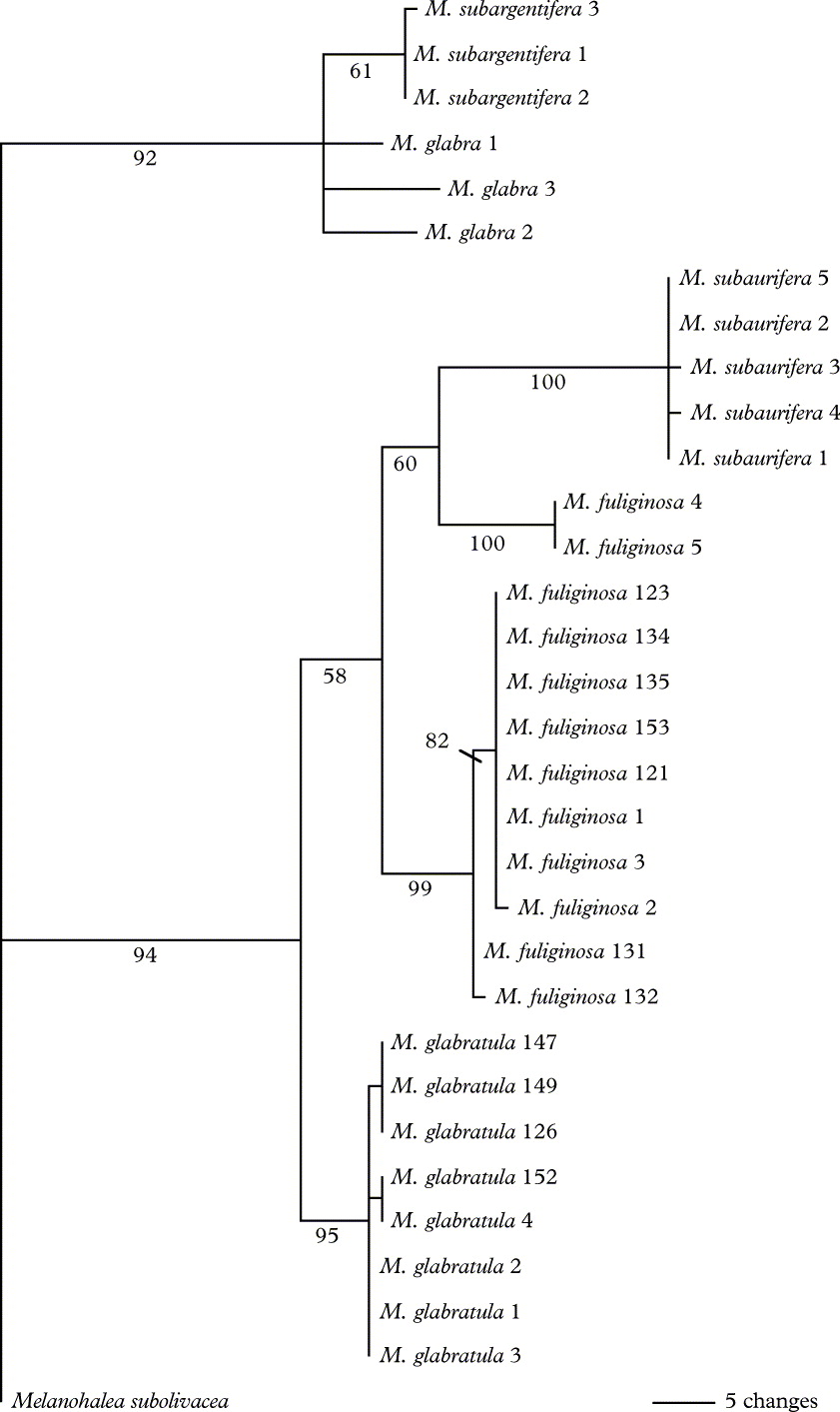
For this phylogenetic analysis, 11 new ITS sequences were produced and 21 were already available (Table 1). Of 509 aligned characters, 74 were parsimony-informative and used in the analysis, which resulted in 16 most parsimonious trees 170 steps long, CI = 0·776, RI = 0·922, HI = 0·224. Of the 74 parsimony-informative characters 20 were informative analysing only M.glabratula and M. fuliginosa. The consensus tree of these is shown in Figure 1. Using Melanohalea subolivacea as outgroup the ingroup splits into two main clades; one with Melanelixia glabra and M. subargentifera and one with M. fuliginosa s. lat. and M. subaurifera. Both these clades are well supported by bootstrap values of 92 and 94 respectively. However, M. fuliginosa s. lat. appears paraphyletic because it is split on three branches, each with good bootstrap support (100, 99 and 95 respectively) with M. subaurifera nested between them. A closer look reveals that one of these clades corresponds to M. glabratula and another monophyletic branch corresponds to European samples of M. fuliginosa s. str. A clade with two American representatives of M. fuliginosa branches as a sister group to M. subaurifera, although this relationship is not well supported (BS=60). In the tree M. fuliginosa s. str. is sister species to M. subaurifera and the American samples of M. fuliginosa, but this relationship is not strongly supported (BS=58) and the possibility that M. fuliginosa s. str. and M. glabratula are sister species cannot be ruled out.
The consensus tree of 16 most parsimonious trees from the phylogenetic analysis based on nrDNA ITS data from Melanelixia using Melanohalea olivacea as outgroup. Numbers below branches are bootstrap values.

Morphological analyses
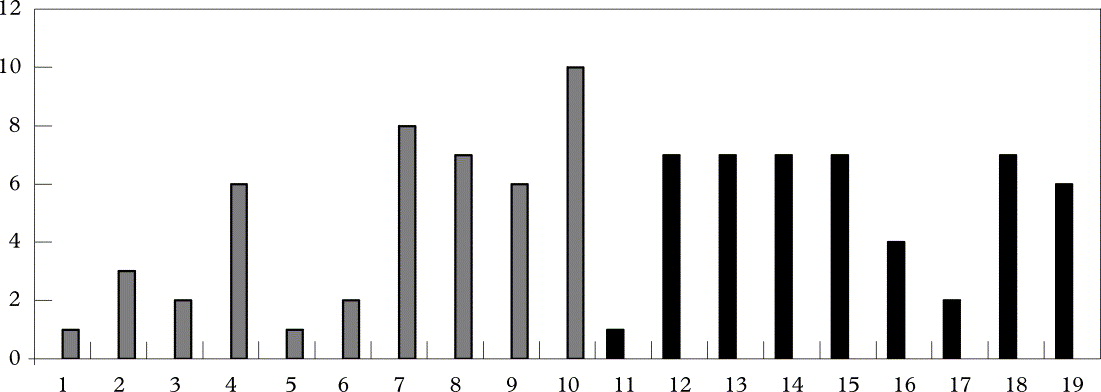
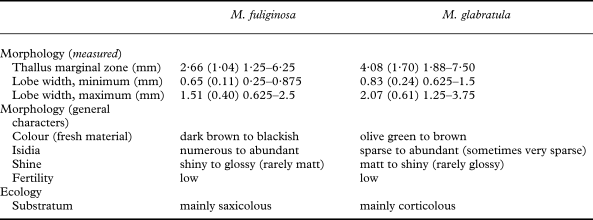
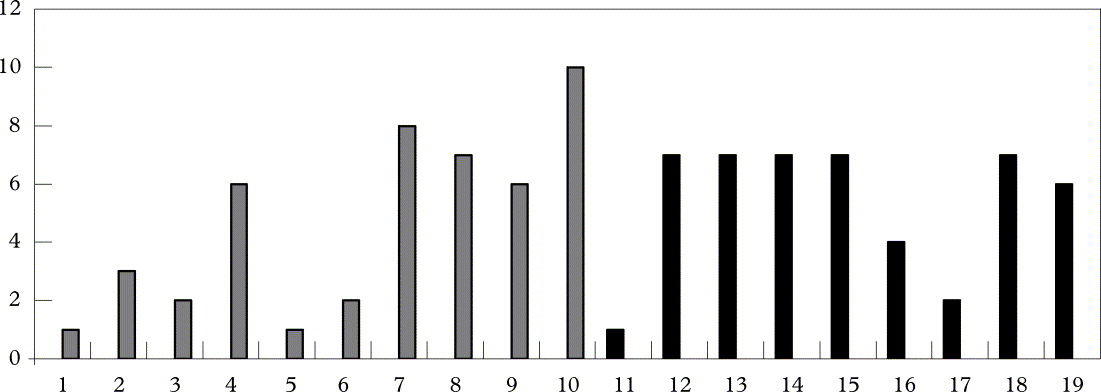
Results of the morphological study are presented in Table 2. The colour distribution for each species is shown in Figure 2.
Colour distribution of M. glabratula (grey) and M. fuliginosa (black). Each value corresponds to a specific colour, ranging from the lightest (1) to the darkest (19). The size of the bars represents the number of specimens with that specific colour.
Comparison of morphological characters of Melanelixia fuliginosa and M. glabratula. The measured morphological characters shown as following: mean (standard deviation) and range from lowest to highest mean value measured for each species. The differences between the two species in the three numerical characters are all significant (t-test: P <0·001)

PCA analyses
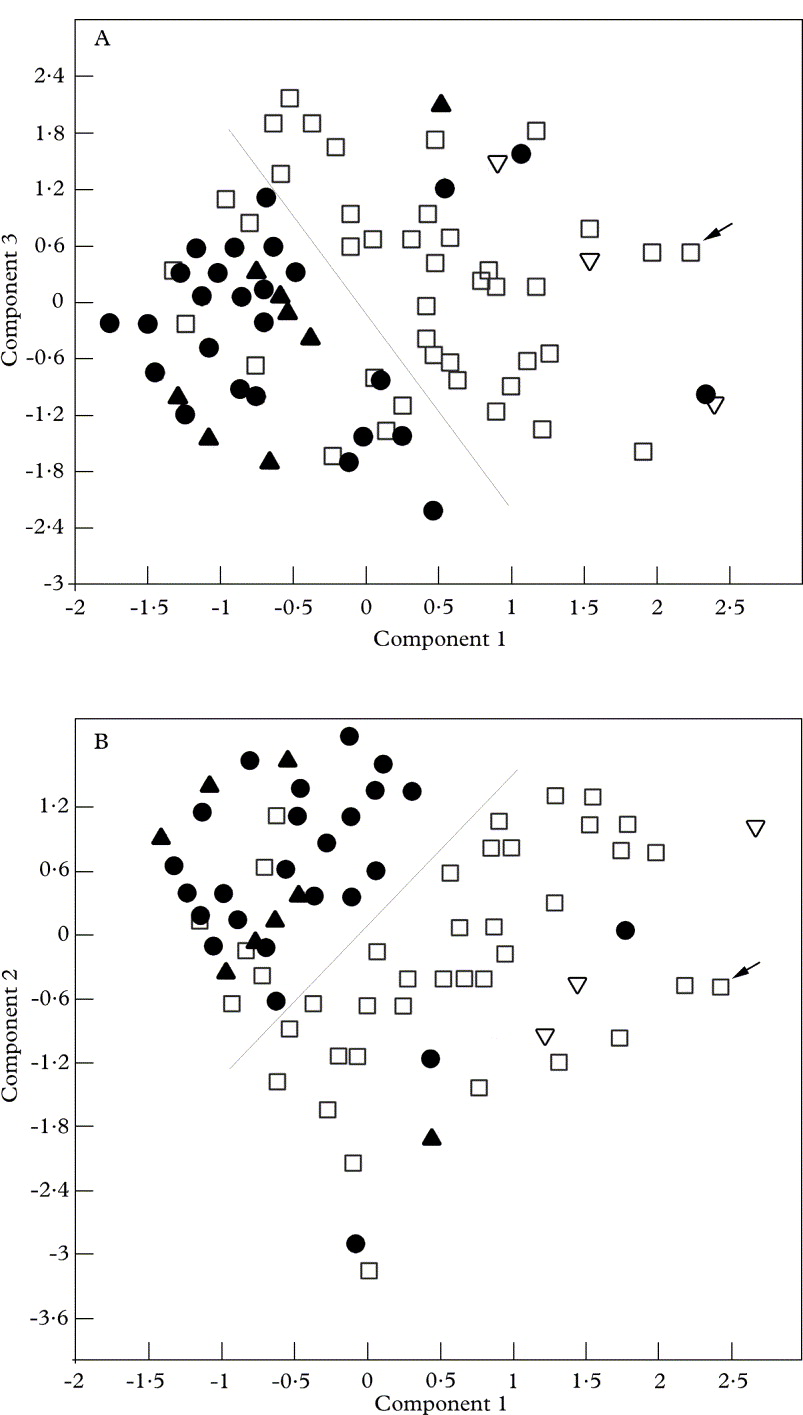
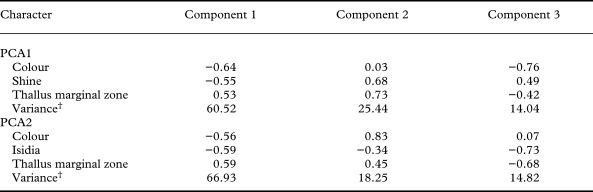
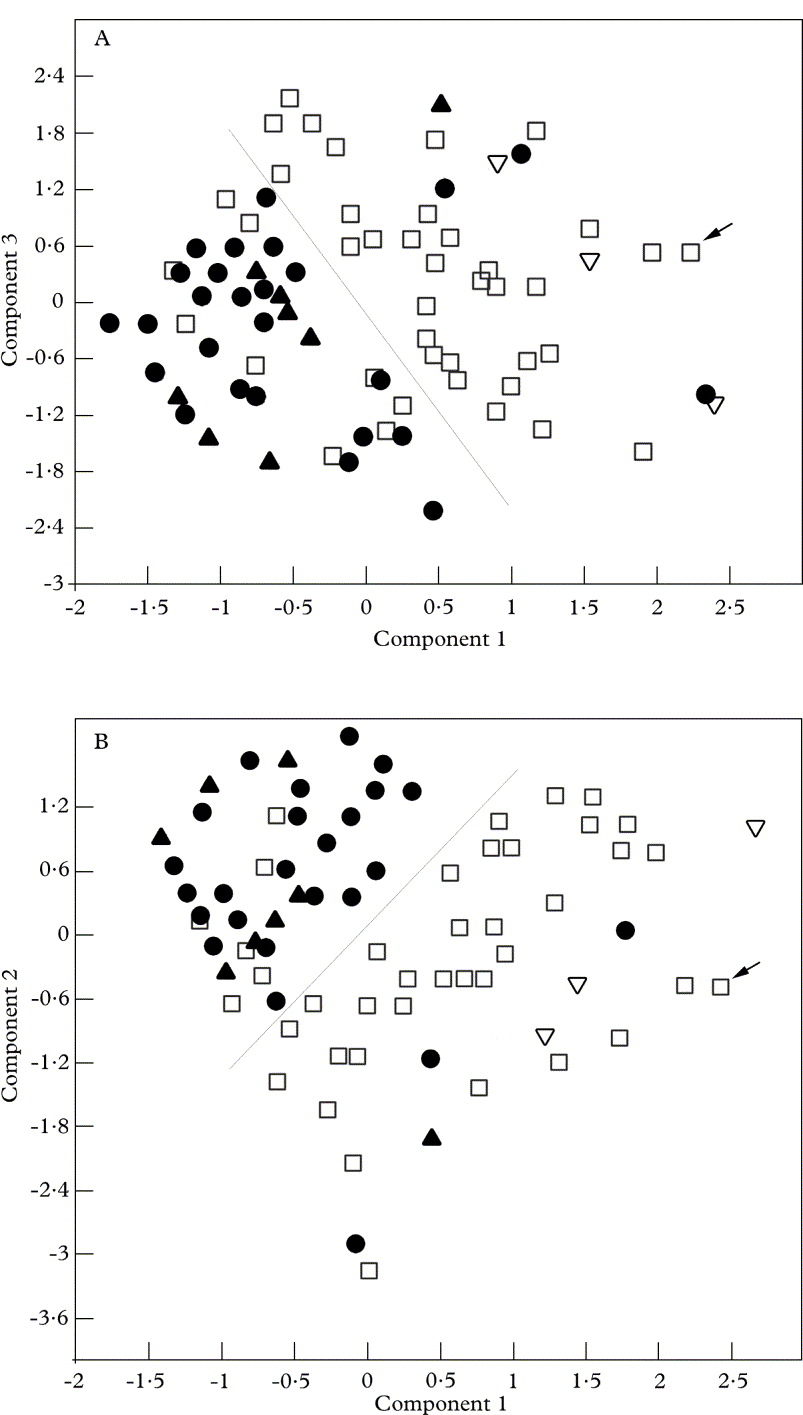
When using all studied characters in the PCA analysis the result gave no clear division of the two taxa. However, when limiting the number of characters, two different character combinations (PCA1 and PCA2) gave a rather clear separation of M. fuliginosa and M. glabratula. In the two analyses the specimens were coded according to the substratum from which they were collected (Fig. 3). In PCA1, colour, shine and thallus marginal zone were used and in PCA2 colour, abundance of isidia and the thallus marginal zone were used. The analyses gave similar separation of the specimens, although component 1 and 3 gave the best separation in PCA1 and component 1 and 2 the best in PCA2. Specimens used in the genetic analysis are marked as triangles. In Figure 3A, seven triangles in the lower left part represent M. fuliginosa and four in the upper right part represent M. glabratula. In Figure 3B, the seven M. fuliginosa triangles are in the upper left part and the four M. glabratula triangles are in the lower right part. Character loadings for the three given components in each PCA analysis are presented in Table 3.
Principal component analysis. A, PCA1, projection of specimens onto the first and third components, using colour, shine and marginal zone free of isidia as characters; B, PCA2, projection of specimens onto the first and second components, using colour, isidia and marginal zone free of isidia as characters. Solid symbols are saxicolous while open symbols are corticolous specimens. Triangles are molecularly investigated specimens. Arrow indicates the type of M. glabratula. The line separates the two species from each other. Some symbols represent 2–5 specimens of the same species and with the same ecology, but have equal loading values.
Character loadings for the three given components of the Principal Component Analyses

† The variance explained by each of the components given in percent.
Discussion
Over the years the taxonomic treatment of the taxa M. fuliginosa and M. glabratula has varied from no recognition of separate taxa, to two varieties, two subspecies and, finally, to acknowledge two separate species. However, during the last decades there has been a fairly good consensus, at least about the recognition of either varieties or subspecies within M. fuliginosa and that there are differences in ecology as well as in morphology. Both Laundon (Reference Laundon1965) and Esslinger (Reference Esslinger1977) also considered the variability between the two taxa to be genetically based, but there was too much overlap in the variation to warrant the recognition of two separate species. Our genetic analysis clearly shows that there is a genetic difference between the two taxa in Europe and that the morphological variation recognized previously by several authors corresponds well with the two genetic entities. The morphology of the American populations, as well as populations from other parts of the world, was not evaluated in this paper and must be studied further. Our conclusion is that the European taxa are best recognized as two separate species, based both on genetic, ecological and morphological differences.
Initially, all characters were used when conducting the PCA, to produce a combined description of all measured characters. However, this gave no clear division or good polarization of any of the taxa. This is because many specimens display a typical appearance in some of the characters analyzed but an atypical appearance in one or two of them. All the three characters measured differ significantly between the species, but there is a large overlap in them all (Table 2). As neither lobe width nor fertility seemed to be of any importance in describing the taxa, we chose to focus on the characters that do help to separate the specimens. Using colour, shine, isidia and the isidia-free zone, most specimens can be placed in the correct taxon. Fresh specimens are generally easier to distinguish than herbarium material, as the coloration changes substantially when the lichen dries and the photobiont dies. In both PCA1 and PCA2 the specimens representing each taxon are separated, but without a clear gap between them. The figures show that these character combinations are correlated with the genetic differences, all the genetically analyzed specimens clustering together with their morphologically corresponding group (Fig. 3). There are also several specimens collected on rock with the morphology corresponding to M. glabratula. One of these, which was sequenced, confirms its placement in this group.
The two species are often difficult to separate based on only one character, instead it requires a combination of all characters. Even though colour stands out as the single most important character, and there are no overlaps, it cannot be used entirely on its own, as it is hard to differentiate among all nuances. Thallus marginal zone, shine and abundance of isidia have to be taken into consideration as well. Except for colour, none of the above-mentioned characters clearly differentiate between M. fuliginosa and M. glabratula; all display considerable overlap. On the other hand, when using all these characters together and including colour, only a small percentage of the specimens are hard to distinguish.
When comparing the two species, M. fuliginosa is generally darker than M. glabratula, though it can be difficult to tell them apart only on colour, as it is a gradual shift between light and dark. Melanelixia fuliginosa is generally more isidiate with dense isidia, whereas M. glabratula is usually less covered, though densely covered M. glabratula do occur. The thallus marginal zone free of isidia is a difficult character to use, as there is large overlap. Melanelixia fuliginosa usually has a narrower isidia-free zone than does M. glabratula. Shine is the hardest character to use, as it is difficult to distinguish the level of shine. Yet, M. fuliginosa is usually glossier and rarely matt as M. glabratula can be.
Furthermore, substratum can provide an indication as to which species a specimen belongs to, but it is not entirely reliable. Nevertheless, when finding the two species growing next to each other it is usually easy to distinguish them.
The North American sequences of M. fuliginosa branch into a highly supported monophyletic clade. It would be interesting to evaluate whether this is yet another different species. However, the American material in LD was not suitable for use in this study as it is in poor condition and too old.
Taxonomy
Melanelixia fuliginosa (Fr. ex Duby) O. Blanco, A. Crespo, Divakar, Essl., D. Hawksw. & Lumbsch
Mycol. Res. 108: 881 (2004).—Parmelia olivacea *fuliginosa Fr. ex Duby, Bot. Gall. 2: 602 (1830); type: France (specimen not located despite inquiries).
Syn. Melanelia fuliginosa (Fr. ex Duby) Essl., Parmelia fuliginosa (Fr. ex Duby) Nyl.
Specimens studied (all specimens in LD with their herbarium accession number). Belgium: Spa, 1904, de Lesdain 1260791.—Denmark: Jylland: 1969, Svane 1029601; 2008, Thell 1276867.—Finland: Regio aboensis: 1963, Kärenlampi 1039809.—France: Aix les Bains, 1949, Almborn 1260491.—Germany: Stetten, 1950, Putzler 1261451.—Italy: Spotorno, 1951, Sbarbaro 1260911.—Norway: Sør-Trøndelag: 1875, Kindt 1039553.—Sweden: Blekinge: 1944, Almborn 1010817; 1937, Almborn 1011137; 1879, Falk 1018433; 1874, Svanlund 1054642; 1938, Almborn 1054962. Bohuslän: 1952, Almborn 1028769. Dalarna: 1879, Indebetou 1041921. Gotland: 2009, Sandler 1330743, 1323142, 1362618, 1323022. Halland: 1943, Almborn 1021826; 1947, Almborn 1060130. Närke: 1947, Kjellmert 1023330; 1899, Vrang 1058466. Skåne: 1938, Almborn 1010882; 1989, Johansson & Olsson 1022498; 1990, Arup & Ekman 1022690; 1948, Almborn 1035425; 1902, Nilson 1054386; 2009, Sandler 1364785, 1363333, 1362196, 1316491, 1362625, 1316431, 1362498 1362558; 1947, Almborn 1009281; 1942, Almborn 1009985; 1943, Almborn 1010113. Småland: 1983, Nicklasson 1023553; 1918, Vallquist 1023681. Stockholm: 1910, Hülphers 1029409. Södermanland: 1890, Blomberg 1033346. Västergötland: 1914, Rydén 1042881; 1917, Vallquist 1042945. Öland: 1867, Zetterstedt 1023169. Östergötland: 1905, Westerberg 1023074; 1932, Santesson 1023202.
Melanelixia glabratula (Lamy) Sandler & Arup comb. nov
Parmelia fuliginosa * P. glabratula Lamy, Bull. Soc. Bot. France 30: 353 (1883); type: France, récolté dans la sapinère du Riou, Lamy de Chapelle, 1883 (H-Nyl 34501 syntype!).
Syn. Melanelia glabratula (Lamy) Essl. nom. illegit., Parmelia glabratula (Lamy) Nyl.
Specimens studied (all specimens in LD with their herbarium accession number). Austria: Tyrol: 1900, Arnold 1262111.—Denmark: Fyn: 1939, Almborn 1032898. Jylland: 1967, Svane 1051218. Själland: 1848, Lange 1029793.—Estonia: Viiresti Nat. Res., 2008, Thell 1278988.—Germany: Halsbeck, 1890, Sandstede 1256651. Stetten, 1950, Putzler 1264211.—Norway: Hordaland: 1978, Wahab 1039425. Troms: 2003, Westberg 1189129.—Poland: Walbrzych, 1991, Koziol 1260371.—Portugal: Braga: 1921, Sampaio 1261031.—Sweden: Blekinge: 1945, Almborn 1010433; 1943, Almborn 1010945; 1934, Almborn 1022977. Dalsland: 1936, Svensson 1028705. Gotland: 1977, Kärnefelt 1023297; 2009, Sandler 1323202. Göteborg: 1926, Degelius 1029089. Halland: 1942, Almborn 1009666; 1943, Almborn 1040705; 1947, Almborn 1057250. Skåne: 1943, Almborn 1009025; 1935, Almborn 1011010; 1942, Almborn 1020417; 1936, Almborn 1022370; 1935, Almborn 1034977, 1035233; 1990, Arup & Ekman 1035489; 1944, Almborn 1054130; 2009, Sandler 1333435, 1323370, 1362256, 1337028, 1337088, 1362378, 1333623, 1311871, 1362438, 1323082. Småland: 1926, Haglund 1075345. Södermanland: 1963, Sundin 1040641. Uppland: 1909, Malme 1041985. Västmanland: 1947, Kjellmert 1058530.—Switzerland: Ütliberg, 1949, Almborn 1261811.—Ukraine: Alushta, 1957, Kopachevska 1262471.
This project was supported by grants from Lunds Botaniska Förening.