Introduction
Fruit flies (Diptera: Tephritidae) are the most important pests on fruit orchards worldwide for causing direct production damages and increasing costs for monitoring, control or even eradication of these insects (Malavasi and Zucchi, Reference Malavasi and Zucchi2000). Pest incidence is considered a limiting factor to the international fruit market, as importing countries started imposing severe phytosanitary requirements (Santos et al., Reference Santos, Fernandes, Araujo, Ferreira and Lacerda Filho2013).
Among the tephritid species, Ceratitis capitata Wiedemann (Diptera: Tephritidae) is one of the most important species in the Brazilian agricultural scenario and worldwide (Dias et al., Reference Dias, Silva, Lima, Petitinga, Hernández-Ortiz, Laumann and Joachim-Bravo2016; Perre et al., Reference Perre, Faria, Jorge, Rocha, Torres, Souza-Filho and Zucchi2016). One suitable choice to control native or introduced pest species is the use of toxic baits (Härter et al., Reference Härter, Grützmacher, Nava, Gonçalves and Botton2011, Reference Härter, Botton, Nava, Grützmacher, Gonçalves, Machota, Bernardi and Zanardi2015), aiming to reduce infestations by adults that come from surrounding orchards (Kovaleski et al., Reference Kovaleski, Sugayama and Malavasi1999). When choosing attractive baits, two factors must be borne in mind, their attractive capacity that favours insect lure and their phagostimulant effect or food response (Vargas et al., Reference Vargas, Miller and Prokopy2002; Pelz et al., Reference Pelz, Isaacs, Wise and Gut2005) that lead to the target pest intoxication.
A proper formulation for toxic baits is obtained by mixing hydrolysed proteins or sugarcane molasses with insecticides, mostly organophosphates (Härter et al., Reference Härter, Grützmacher, Nava, Gonçalves and Botton2011). This control system has the following advantages: small area applications, early pest control, and damage reductions by avoiding egg laying and spray residues on fruits (Botton et al., Reference Botton, Arioli, Machota, Nunes and Rosa2016). Additionally, since proteins are essential nutrients for adult insects, they are easily controlled by using it in lure formulations (Prokopy et al., Reference Prokopy, Papaj, Hendrichs and Wong1992).
Furthermore, parasitoids are widely used to reduce fruit fly populations, acting as biological control agents at diverse pest developmental stages (Nicácio et al., Reference Nicácio, Uchôa, Faccenda, Guimarães and Marinho2011; Gonçalves et al., Reference Gonçalves, Nava, Pereira, Lisbôa, Grützmacher and Valgas2013; Poncio et al., Reference Poncio, Nunes, Gonçalves, Lisboa, Manica-Berto, Garcia and Nava2016). In Brazil, the main tephritid parasitoid species belong to the families Braconidae, Figitidae, Eulophidae, Pteromalidae, and Diapriidae, among which the first is the most effective (Bittencourt et al., Reference Bittencourt, Santos, Brito, Araújo and Marinho2012; Souza et al., Reference Souza, Lopes-Mielezrski, Lopes, Querino, Corsato, Giustolin and Zucchi2012).
Among the exotic parasitoids that have been released in many countries, Fopius arisanus (Sonan) (Hymenoptera: Braconidae) is widely used to control C. capitata, Bactrocera carambolae (Drew & Hancock) (Diptera: Tephritidae) and Bactrocera dorsalis (Hendel) (Diptera: Tephritidae). This hymenopteran species is a solitary living endoparasitoid from the Indo-Pacific region, widely used in biological control programs for fruit flies, widely found in Hawaii, Israel, French Polynesia, Pakistan and Fiji (Rousse et al., Reference Rousse, Harris and Quilici2005; Harris et al., Reference Harris, Bautista, Vargas and Jang2007). In Brazil, this species was introduced to control B. carambolae, which is a quarantine pest restricted to the states of Amapá and Roraima. Given its fast colonization and larval restocking, this parasitoid has succeeded in controlling fruit flies and has become a promising biological control agent against B. carambolae (Vargas et al., Reference Vargas, Leblanc, Putoa and Eitam2007, Reference Vargas, Stark, Banks, Leblanc, Manoukis and Peck2013; Manoukis et al., Reference Manoukis, Geib and Vargas2014).
Nevertheless, parasitoids should be released in association with selective insecticides and toxic baits, so they could be a suitable alternative in an integrated pest management program for fruit flies (Ruiz et al., Reference Ruiz, Flores, Cancino, Arredondo, Valle, Díaz-Fleischer and Williams2008; Härter et al., Reference Härter, Grützmacher, Nava, Gonçalves and Botton2011). Therefore, there is still a need to develop studies on the effects of different attractants for toxic-lure formulations and commercially ready-to-use mixtures on organisms used as biological control agents for fruit flies. Having said that, this study focused on evaluating the effects of different food-based attractants, insecticide-based lures, and a ready-to-use bait on the biological parameters such as number of offspring, longevity, percentage of parasitism, sex ratio and classification of toxic baits according to the International Organization for Biological and Integrated Control (IOBC) of F. arisanus.
Materials and methods
C. capitata and F. arisanus rearing
Individuals of C. capitata and F. arisanus were obtained from stock colonies maintained in the laboratory of Embrapa Clima Temperado, in the city of Pelotas – RS, Brazil. These rearings were stored in air-conditioned rooms (25 ± 2°C; 70 ± 10% RH; and 12 h photophase).
Adults of C. capitata were kept in plastic cages (48 × 30 × 30 cm, length × width × height) with water and food (refined sugar, wheat germ, and brewer's yeast; 3: 1: 1) (Nunes et al., Reference Nunes, Müller, Gonçalves, Garcia, Costa and Nava2013). Eggs were collected, aerated, and sowed following the method proposed by Gonçalves et al., (Reference Gonçalves, Nava, Pereira, Lisbôa, Grützmacher and Valgas2013). About 9200 eggs per container (0.5 ml solution) were sowed into 300 ml artificial diet. Larval development diet and insect reproduction at pre-pupal and pupal stages followed the proposal of Salles (Reference Salles1992).
Individuals of F. arisanus were also reared in plastic cages (37.7 × 25.0 × 21.0 cm, length × width × height) with side and top openings, onto which were fixed anti-aphid screens (50 mesh) for ventilation. Pure water and honey were offered through the top of the cage. Twenty-four-hour-old eggs of C. capitata were deposited on a filter paper disk (7 cm diameter), placed on an acrylic plate (8 cm diameter) containing agar gel (0.6%). Then, these eggs were exposed to parasitoid females for 24 h, inserted through an opening in the bottom of cages (10 cm diameter). The eggs were offered to females parasitoids aged in the period from 10 to 19 days, when the fecundity is highest. This opening was closed using a screen of fine netting to prevent parasitoids from escaping and parasitizing the other C. capitata eggs. After exposure, these eggs were placed on a 200 ml artificial diet, inside a 500 ml pot. After 9 days, hatched larvae were collected and placed in vermiculite for pupation. After pupae formation, vermiculite was sieved to remove them, being subsequently stored in plastic pots (13.5 × 12.5 × 6.5 cm, length × width × depth) until emergence.
Effects of toxic-baits and attractant sources on F. arisanus parasitism and offspring survival
The experiment was conducted in a completely randomized block design with five replicates per treatment, which comprised the experimental units, with ten pairs of F. arisanus. The treatments consisted of toxic baits formulated with either corn-hydrolysed protein (Biofruit® 3%) (Biocontrol, São Paulo, Brazil) or sugarcane molasses (7%). The insecticides used in baits were Tracer® 480 SC (spinosad, 0.096 g a.i. l−1) (Dow®, São Paulo, Brazil) and Malathion® 1000 CE (malathion, 2.0 g a.i. l−1) (Cheminova®, São Paulo, Brazil). The treatment using a ready-to-use formulated bait consisted of the commercial product Success 0.02 CB® (spinosad, 0.096 g a.i. l−1) (Dow®, São Paulo, Brazil).
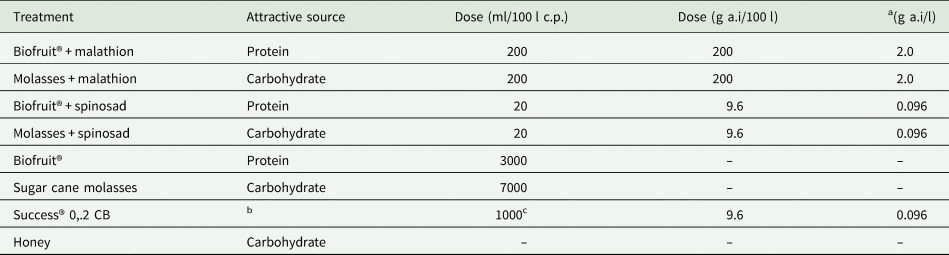
Thus, the treatments consisted of: (T1) Biofruit® 3% + malathion; (T2) sugarcane molasses 7% + malathion; (T3) sugarcane molasses 7% + spinosad; (T4) Biofruit® 3% + spinosad; (T5) Biofruit® 3%; (T6) sugarcane molasses 7%; (T7) commercial bait Success 0.02 CB®; and (T8) honey (80%) (table 1). From T1 to T6, lures were prepared using a 100 ml syringe, while T7 bait was prepared by diluting the product in water (1: 1.5). The bait treatments formulated with malathion (T1 and T2) were used as references for mortality (positive control), while the honey (T8) was used as a negative control.
Treatments used in bioassay of toxic bait effects on F. arisanus

a Concentration of a.i. in the mix.
b Mixture: sugar, protein, oil, potassium sorbate, ammonium acetate.
c ml c.p./2.5 l.
Each experimental unit consisted of a plastic cage (1000 ml) containing 10 pairs of F. arisanus, with presumably mated eight-day-old females. After being transferred to cages, parasitoids were only supplied with water for 24 h by capillarity, using a plastic microtube (2 ml) filled with filter paper. Subsequently, treatments were applied by offering only two drops of the toxic-baits and attractant sources (~4.0 mm in diameter) with a micro-applicator (5 ml) served on a Parafilm® plastic plate (2.5 × 2.5 cm), the parasitoids were maintained in the treatments for 24 h; afterwards, they were removed and then two drops of honey (~4.0 mm) (80%) were served on a Parafilm® plastic plate (2.5 × 2.5 cm), for feeding.
Three hundred eggs of C. capitata (24 h age) were offered daily for seven days to each experimental unit. These eggs were deposited on a filter paper (7 cm diameter) and arranged on an acrylic plate (8 cm in diameter) (0.6%). Then, they were exposed to the parasitism of F. arisanus for 24 h and later placed in plastic pots (300 ml) containing artificial diet (100 ml).
At nine days of development, larvae were removed from the diet and packed in plastic pots (300 ml) containing vermiculite for pupation. The vermiculite was sieved, and pupae were stored in plastic pots (300 ml). From the total number of pupae recovered from each treatment, 100 were placed in plastic containers until parasitoid emergence. On the eighth day after the emergence, the food was withdrawn and 24 h later the treatments were offered and a plastic syringe of 5 ml, two drops (about 4.0 mm diameter) were placed on parafilm plastic plate. After 24 h of exposure the treatments were removed, and food was again offered. Mortality was assessed every day.
After that, the variables parasitism percentage (%P), offspring number (ON), and sex ratio (SR) were evaluated. In addition, the toxic baits were classified according to selectivity to the parasitoid F. arisanus, by means of the classification proposed by the IOBC (International Organization of Biological and Integrated Control of Noxious Animals and Plants) (Boller et al., Reference Boller, Vogt, Ternes and Malavolta2006).
Effect of food-based attractants on adults of F. arisanus
Newly emerged adults were separated by sex based on ovipositor presence. Pairs were individualized in plastic cup cages (500 ml) covered with nylon fabric for aeration and placed on a Gerbox type box lid (11.5 × 11.5 × 3.5 cm) as a base. Inside the cages, water and food were offered to test the effect on parasitoids. In this case, treatments consisted of: (i) Biofruit® (3%); (ii) sugarcane molasses (7%); (iii) honey (80%); (iv) distilled water, and (v) no-food and water supplies. Honey was used as an attractant, being dropped onto a Parafilm® plastic plate (2.5 cm diameter), forming a 4.0 mm diameter deposition per point. Distilled water was provided in a flask (15 ml), and insects had access to it by capillarity.
Thirty eggs of C. capitata (24 h age) were deposited every day from emergence to death of females, on filter paper (4 × 4 cm), which was placed on an acrylic plate (4 cm diameter) containing agar (0.6%). After a 24 h exposure period, the eggs were removed and placed in a plastic pot (50 ml) containing an artificial diet layer (25 ml). At nine days of development, larvae were removed from the diet and stored in acrylic bottles (2.5 cm diameter × 4.5 cm height) containing vermiculite for pupation. After pupation, the vermiculite was sieved, and pupae were removed and stored until parasitoid emergence for further evaluations.
This bioassay was conducted in a completely randomized block design, with 20 replicates per treatment, consisting of a pair of F. arisanus. Again, the biological parameters evaluated were: offspring number (ON), parasitism percentage (%P), and sex ratio (SR). In addition to these parameters, male and female longevity was also determined. SR was calculated using the following equation: SR = (number of females)/(number of females + number of males); ON was obtained by the equation: ON = number of emerged parasitoids + number of non-emerged parasitoids (pupae dissection); and %P was determined by the following equation: %P = (number of descendants)/(total number of pupae obtained) × 100 (Poncio et al., Reference Poncio, Nunes, Gonçalves, Lisboa, Manica-Berto, Garcia and Nava2016).
Statistical analysis
Data regarding %P and ON underwent analysis of variance (ANOVA), when significant, averages were compared by the Tukey's test (α = 0.05) (Mendiburu, Reference Mendiburu2016). For SR, treatment means were compared by the Pearson Chi-square test, in which the relationship between observed frequency of females and the entire population (males + females) was considered. All these data were analysed using the R statistical software package (R Development Core Team, 2016). The longevity curves were plotted using the Kaplan-Meier method, and the parasitoid survival curves were compared by the log-rank test, also using the R software package (R Development Core Team, 2016). Each bait was assessed for reduction in parasitism by comparisons with control (honey 80%), calculated by the following formula: %PR = [1 – (%P/p) × 100], wherein %PR is the percentage of parasitism reduction, %P is the average value for each parasitism toxic bait (treatment), and p is the parasitism rate for the control. Based on these percentage reductions, the baits were ranked according to the IOBC/WPRS classification system as: (1) innocuous (<30%), (2) slightly harmful (30–79%), (3) moderately harmful (80–99%), and (4) harmful (>99%) (Boller et al., Reference Boller, Vogt, Ternes and Malavolta2006).
Results and discussion
Effect of toxic baits on adults of F. arisanus
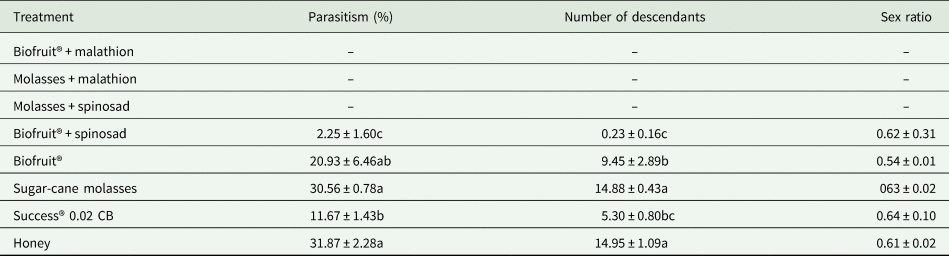
Among the treatments using only attractants, T6 and T5 showed no significant differences from T8. For the toxic baits, T3 and T7 had a low parasitism rate, differing significantly from T8 (table 2). Moreover, no parasitism was observed in T1, T2, and T3, which presented no significant differences among each other differing significantly of treatment T8 and the treatments using only attractants. (F = 29.54; df = 7, 24; P < 0.001) (table 2).
Percentage of parasitism mean number of descendants and sex ratio of F. arisanus after 24 h of offering different toxic baits for the control of C. capitata

Means followed by the same letter in the column, do not differ by Tukey test (α = 0.05).
* Significant (in the column) by Pearson's Chi-square test (α = 0.05).
– Refers to death of all specimens.
During the four host exposure intervals, ON in T6 was comparable to that of T8 but differed significantly from the other treatments (F = 34.13; df = 7, 24; P < 0.001) (table 2). Regarding the SR, the treatments T4, T5, T6, and T7 showed no significant differences with control (honey) but differed significantly from T2, T1, and T3 (χ2 = 126.15; df = 7; P = 0.02) (table 2).
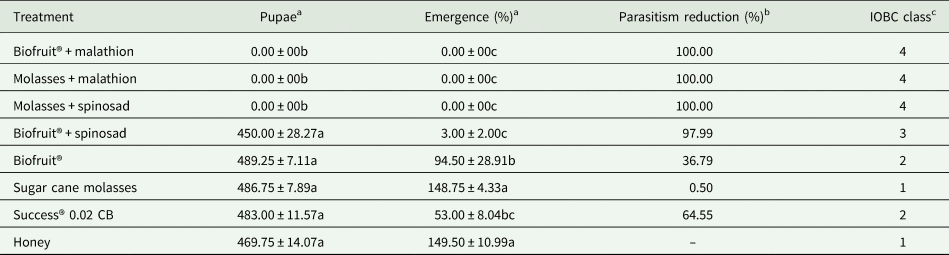
Parasitism of C. capitata eggs decreased for each formulation, among which T2 and T1 showed reductions of 100% when compared to T8 (table 3), being thus classified as harmful according to the IOBC classification (class 4). The findings also show the major role of attractants in toxic-bait formulations since differences were observed when using the same active ingredient (spinosad) for each source. For example, in T3, parasitism reduced 100%, being therefore classified as harmful (class 4), whereas, in T4, this reduction was 97.99%, being then classified as class 3, or moderately harmful (table 3).
Parasitism reduction percentage and IOBC class for F. arisanus after 24 h of offering different toxic bait formulations

a Averages followed by the same letter in the column, do not differ by the Tukey test at 5% of significance.
b Reduction in the parasitism capacity compared to control (honey 80%) and calculated by RP = [1 – (P/p) × 100] formula.
c IOBC classes for initial toxicity test on adults: 1 = innocuous (<30%), 2 = slightly harmful (30–79%), 3 = moderately harmful (80–99%), 4 = harmful (>99%).
Despite a fall of 36.79% after 24 h, parasitism in T5 was classified as slightly harmful – class 2 (table 3), as it only reached levels of 20.93% with a mean of ON of 9.45 per female (table 2). In T6, this reduction was only 0.50%, being considered as innocuous – class 1 (table 3). In T7, this reduction was of 64.55%, being thus classified as slightly harmful (table 3), with an ON of 5.3 (table 2). Despite being toxic baits with biological insecticide (spinosad) in the formulation, the results of T3 and T4 regarding parasitism reduction were inferior.
Effect of food-based attractants on adults of F. arisanus
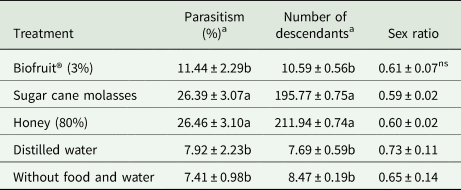
Females fed sugarcane molasses (7%) presented high rates of %P (26.39%), which did not differ significantly from the control (26.46%). However, they showed significantly different results when compared to Biofruit® (3%), distilled water, and no-food treatments, which presented %P of 11.44, 7.92, and 7.41% respectively (F = 23.64; df = 4, 24; P < 0.001) (table 4).
Percentage of parasitism, offspring and average sex ratio of F. arisanus reared on C. capitata with different sources used as an attractant

a Means followed by the same letter in the column, do not differ by Tukey test (α = 0.05).
nsnot significant (in the column) by Pearson's Chi-square test (α = 0.05).
Parasitism reached the maximum level between the tenth and sixteenth days, being of 60% for treatments with honey (80%) and sugarcane molasses (7%) (fig. 1). Similarly, ON in C. capitata eggs was higher for sugarcane molasses (7%), not differing significantly from honey. However, these treatments differed significantly from the treatments Biofruit® (3%), distilled water, and no-food (F = 22.84; df = 4, 24; P < 0.001) (table 4). The number of F. arisanus female progenies in treatments with honey (80%) and sugarcane molasses (7%) were 211.94 and 195.77, respectively (table 4).
Parasitism (%) of F. arisanus in C. capitata larvae with different attractant sources. Temperature of 25 ± 2°C, relative humidity 70 ± 10% and 12 h photo phase.

The treatments with honey (80%) and sugarcane molasses (7%) showed the highest ON on day 13, averaging 14.7 and 13.6 descendants, respectively. The SR of F. arisanus in C. capitata eggs was above 0.5 for all treatments, and a significant difference was observed among them (χ2 = 146.32; df = 4; P = 0.05) (table 4).
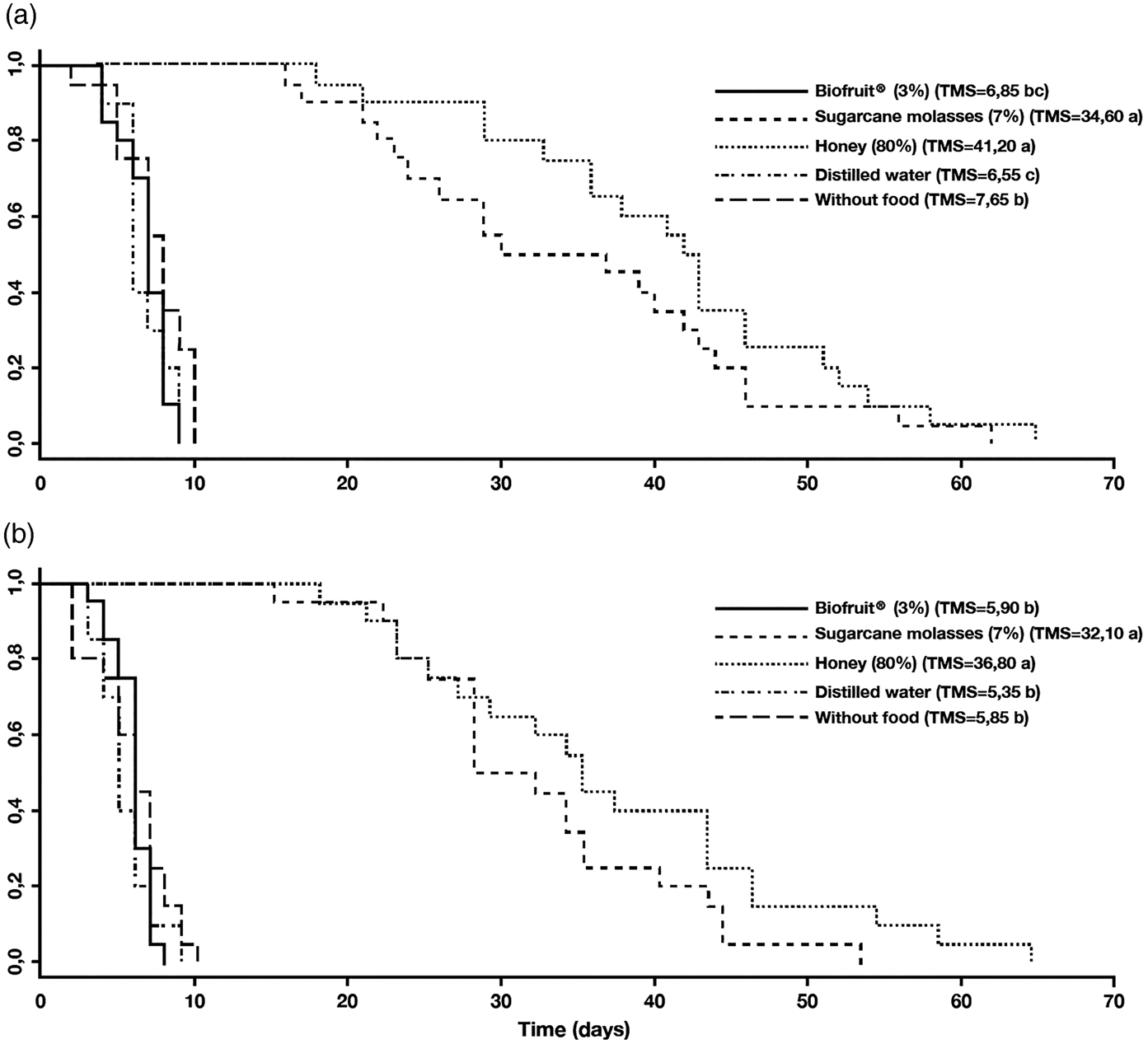
Regarding longevity, females fed treatments with honey (80%) and sugarcane molasses (7%) had the longest survival times, being of 41.20 and 34.60 d, correspondingly. Conversely, the treatments using Biofruit® (3%), distilled water, and no-food presented survival times of 6.85, 6.55, and 7.65 days, respectively (fig. 2a).
Female (a) and male (b) survival curves of F. arisanus reared on C. capitata with different attractant sources. Curves identified with the same letters do not differ significantly from each other. Temperature of 25 ± 2°C, relative humidity 70 ± 10% and 12 h photo phase.

The longest longevity of male parasitoids was observed for individuals fed treatments with honey (80%) and sugarcane molasses (7%), being of 36.80 and 32.10 d, respectively. By contrast, the shortest survivals were registered for males fed Biofruit® (3%), distilled water, and no-food treatments, which were of 5.90, 5.35, and 5.85 d, respectively (fig. 2b).
Several studies have classified malathion-based insecticides as harmful to different species of natural enemies (Castilhos et al., Reference Castilhos, Grützmacher, Nava, Zotti, Siqueira and Spagnol2013; Beloti et al., Reference Beloti, Alves, Araújo, Picoli, Moral, Demétrio and Yamamoto2015; Souza et al., Reference Souza, Sarmento, Venzon, Santos, Silveira and Tschoeke2015; Bhargavi, Reference Bhargavi2016). After ingestion and contact toxicity tests, Purcell et al. (Reference Purcell, Groth and Messing1994) inferred that bait formulations with malathion and hydrolysed protein are harmful to the fruit fly parasitoid Diachasmimorpha longicaudata (Ashmead) (Hymenoptera: Braconidae). Studying different formulations of malathion-based toxic baits against C. capitata, Vargas et al. (Reference Vargas, Peck, Mc Quate, Jackson, Stark and Armstrong2001) noted a harmful effect on the parasitoid F. arisanus. Likewise, our findings on spinosin corroborate the results encountered in the literature, being an insecticide class considered as harmful to many species of parasitoids from the Hymenoptera order (Costa et al., Reference Costa, Moscardini, Gontijo, Carvalho, Oliveira and Oliveira2014; Blibech et al., Reference Blibech, Ksantini, Jardak and Bouaziz2015).
The results obtained from treatments using Biofruit® (3%) and sugarcane molasses (7%) may be related to nutritional needs of adult parasitoids, as carbohydrate-rich sources may increase parasitism potential for being essential to egg survival, production, and maturation (Benelli et al., Reference Benelli, Giunti, Tena, Desneux, Caselli and Canale2017). In the case of Success 0.02 CB®, the results may be related to its composition (sugar, protein, oil, potassium sorbate, and ammonium acetate), which might have had a repulsive or unattractive effect on parasitoids. Ruiz et al. (Reference Ruiz, Flores, Cancino, Arredondo, Valle, Díaz-Fleischer and Williams2008) observed that when offered a ready-to-use toxic bait (GF-120), mixed with honey, the mortality of D. longicaudata females and males was lower compared to contact and no-food treatments. Wang et al. (Reference Wang, Jarjees, McGraw, Bokonon-Ganta, Messing and Johnson2005) reported that adults of F. arisanus did not feed diets with or without honey and water. The same authors reported that parasitoids exposed to these baits moved away from them (<1 s) without feeding; therefore, the mortality was attributed by bait contact or food abstinence.
The diverse effect of each food-based attractant may be related to the different nutritional demands of F. arisanus adults for carbohydrates, which are considered the main food sources for numerous species of parasitoids (Wakefield et al., Reference Wakefield, Bell and Gatehouse2010). Carbohydrates have a high nutritional value and are able to improve some biological characteristics of parasitoids (Hogervorst et al., Reference Hogervorst, Wäckers and Romeis2007; Tompkins et al., Reference Tompkins, Wratten and Wäckers2010). Our findings on attractants are lower than those described by Groth et al. (Reference Groth, Loeck, Nörnberg, Bernardi and Nava2016), where parasitism was of 42% when pure honey was offered as food for the parasitoid F. arisanus. In this study, the maximum parasitism level was similar to those reported by Zenil et al. (Reference Zenil, Liedo, Williams, Valle, Cancino and Montoya2004) and Appiah et al. (Reference Appiah, Ekesi, Salifu, Afreh-Nuamah, Obeng-Ofori, Khamis and Mohamed2013), who found 60 and 71% parasitism of F. arisanus on C. capitata eggs, respectively.
Regarding offspring, our results for F. arisanus were higher than those reported by Groth et al. (Reference Groth, Loeck, Nörnberg, Bernardi and Nava2016), who observed an offspring of nearly 123 descendants during female lifecycle. However, they were close to those obtained by Manoukis et al. (Reference Manoukis, Geib and Vargas2014), who reported 215 descendants from females of F. arisanus in eggs of B. dorsalis, and with 16 descendants per female of F. arisanus in B. dorsalis eggs. ON of F. arisanus females was 10.6, 7.7, and 8.5 parasitoids for Biofruit® (3%), distilled water, and no-food treatments, respectively.
Concerning SR and longevity, our results were similar to those reported by Groth et al. (Reference Groth, Loeck, Nörnberg, Bernardi and Nava2016), who observed a SR of 0.63 for F. arisanus in C. capitata when 100% honey was offered to the parasitoid. The same authors observed that F. arisanus females and males fed 100% honey had an average survival time of 25.2 and 50.70 d, respectively, being higher than those obtained in the present study. Instead, Wang and Messing (Reference Wang and Messing2008) obtained females of 27.50 d longevity and Zenil et al. (Reference Zenil, Liedo, Williams, Valle, Cancino and Montoya2004) corroborated longevity of 29.60 d for F. arisanus females reproduced in C. capitata. The positive effect of sugar sources on biological traits has already been demonstrated for several parasitoid species, among them female fecundity and longevity (Harvey et al., Reference Harvey, Cloutier, Visser, Ellers, Wäckers and Gols2012; Narváez et al., Reference Narváez, Cancino, Canal and Wyckhuys2012).
The selectivity of a bait mixture varies with the food-based attractant used. In this study, we could observe that baits formulated with the same active ingredient, such as spinosad, presented dissimilarities depending on the attractant used, where baits formulated with molasses were less selective. Furthermore, the biological parameters evaluated in parasitoids fed molasses did not differ from those observed in the control (honey). Moreover, Biofruit® formulated baits presented greater selectivity and adverse effects on the biological parameters of F. arisanus. Thus, the use of protein attractants or commercial baits should be prioritized due to their greater selectivity in relation to molasses for parasitoids.
Acknowledgments
We thank the Organization of American States (OAS) and National Council for Scientific and Technological Development (CNPq) for the scholarship grated to the first author, and the Ecuadorian Agency for Quality Assurance (Agrocalidad) for the fellowship and support.