Introduction
Mental health is one of the core public health challenges in collective emergencies such as war (Mollica et al., Reference Mollica, Cardozo, Osofsky, Raphael, Ager and Salama2004). Mass human displacement and disruption of families and communities is a global burden of modern armed conflict, with approximately 37 million displaced people worldwide today (USCR, 2002). Although most researchers agree on the fact that forced displacement is associated with an elevated risk of developing mental disorders there still remains debate over the degree to which displaced people are affected (Hollifield, Reference Hollifield2005; Miller et al., Reference Miller, Elbert and Rockstroh2005). Owing to several methodological pitfalls concerning research in conflict-affected settings there is a lack of representative studies on the mental health outcomes of war (Hollifield, Reference Hollifield2005). As most of the available studies focus on recent conflict settings (Roberts et al., Reference Roberts, Ocaka, Browne, Oyok and Sondorp2008), research on the long-term effects of war trauma and particularly the late-life effects of forced displacement are scarce (Kuwert et al., Reference Kuwert, Spitzer, Traeder, Freyberger and Ermann2007). Given the aging populations of industrialized countries, research into all aspects of war trauma in the elderly is overdue and could make a substantial contribution to the ongoing debate mentioned above.
The devastating effects of the Second World War (WWII), orchestrated by Nazi Germany, were felt around the world, culminating in the mass murder of 6 million Jews and other crimes against humanity. In the last years of the war, German civilians increasingly became victims of the war too, finally leading to the flight and forced displacement of an estimated 12–14 million people from Eastern Prussia, Pomerania, Silesia and other former parts of Germany (Benz, Reference Benz1985). The displacement was accompanied by multiple traumatic events such as air raids, combat exposure, looting, mass rape and other life-threatening incidents, and about 600,000 people died (Benz, Reference Benz1985). Despite the number of German civilians who finally became victims of their own war of annihilation (although the former warchildren had no responsibility in this context) little research has so far been carried out on their experiences. In recent years, however, there is growing evidence of elevated rates of psychiatric disorders in the elderly German population, most probably due to the war (Kuwert et al., Reference Kuwert, Spitzer, Traeder, Freyberger and Ermann2007; Spitzer et al., Reference Spitzer, Barnow, Voelzke, John, Freyberger and Grabe2008). To our knowledge no representative survey of mental health outcomes has yet been published concerning the late-life effects of displacement worldwide and in particular those of the displaced German people of WWII. In international war trauma research some scientists emphasize that the strength and resilience of displaced people are often overlooked (Hollifield, Reference Hollifield2005). Taking these considerations into account, our survey sought to examine whether current depressive symptoms, anxiety symptoms, resilience and life satisfaction are significantly associated with forced displacement in WWII.
Methods
Study design and study population
This study was part of a nationwide representative face-to-face household survey conducted in Germany. Study participants were interviewed using a structured self-report questionnaire. The survey was carried out in 2006 by professional interviewers from a demographic consultancy firm (USUMA, Berlin). A representative sample of the German population aged 14 years or older was approached using 258 sample points. Addresses were selected following the random-route procedure.
Measurements
Questions on life satisfaction (FLZM)
The participants were asked to fill out the FLZM questionnaire (Henrich and Herschbach, Reference Henrich and Herschbach2000), which assesses “General Life Satisfaction” with reference to the past four weeks. Each respondent was first asked to rate the “subjective importance” of a given domain of life, e.g. “How important to you is your income?”, on a five-point scale from “not important” to “extremely important.” The respondent is next asked to rate his/her satisfaction in this domain, e.g. “How satisfied are you with your income?”, again on a five-point scale from “dissatisfied” to “very satisfied.” The General Life Satisfaction score comprises the mean value of eight domains of life: “friends/acquaintances,” “leisure activities/hobbies,” “health,” “income/financial security,” “occupation/work,” “housing/living conditions,” “family life/children,” and “partner relationship/sexuality.” The reliability in our sample was good (Cronbach's α = 0.83).
Generalized Anxiety Disorder (GAD-7)
The GAD-7 (Spitzer et al., Reference Spitzer, Kroenke, Williams and Loewe2006), which was designed as a screening instrument for generalized anxiety disorder and to assess symptom severity, has high reliability and validity in primary care patients (Spitzer et al., Reference Spitzer, Kroenke, Williams and Loewe2006; Kroenke et al., Reference Kroenke, Spitzer, Williams, Monahan and Loewe2007). Subjects are asked how often, over the past two weeks, they have been bothered by each of the seven core symptoms of generalized anxiety disorder defined in DSM-IV (American Psychiatric Association, 1994). Response options are “not at all,” “several days,” “more than half the days,” and “nearly every day,” scored as 0, 1, 2 and 3, respectively. Therefore, GAD-7 scores range from 0 to 21, with scores of ≥5, ≥10 and ≥15 representing mild, moderate and severe anxiety symptom levels. These cut-points were chosen based on ROC analyses in the GAD-7 primary care validation study (Spitzer et al., Reference Spitzer, Kroenke, Williams and Loewe2006; Kroenke et al., Reference Kroenke, Spitzer, Williams, Monahan and Loewe2007). Internal consistency is good (Cronbach's α = 0.89).
Patient Health Questionnaire Depression Module (PHQ-2)
As an indicator of depressive symptoms, the survey included the validated German version of the depression module from the Patient Health Questionnaire (Kroenke et al., Reference Kroenke, Spitzer and Williams2003; Loewe et al., Reference Loewe, Kroenke and Graefe2005). The core question is, “Over the last two weeks, how often have you been bothered by any of the following problems?” The two response items are “little interest or pleasure in doing things” and “feeling down, depressed, or hopeless.” For each item, the response options are “not at all,” “several days,” “more than half the days,” “nearly everyday,” scored as 1, 2, 3 and 4, respectively. Thus, the PHQ-2 score can range from 2 to 8. Internal consistency is good (Cronbach's α = 0.78); the inter-item correlation, r, is 0.67.
Resilience Scale (RS-11)
The purpose of the Resilience Scale is to identify the degree of individual resilience, considered a positive personality characteristic that enhances individual adaptation (Wagnild and Young, Reference Wagnild and Young1993). RS-11 is an 11-item self-report measure with a scale ranging from 1 to 7. It is conceptualized as a unidimensional scale and has been shown to be a reliable and valid instrument in a large community sample of the German population (Leppert et al., Reference Leppert, Gunzelmann, Schumacher, Strauss and Braehler2005). Internal consistency is good (Cronbach's α = 0.91).
Other variables
Those participants born before 1946 were additionally asked the following questions:
• “Did you experience forced displacement from the former eastern territories in WWII (e.g. Eastern Prussia, Pomerania, Silesia etc.)?” (yes/no).
• “Was your house destroyed by bombing in WWII?” (yes/no)
• “Was your father absent during your childhood and youth because of the war?” (yes/no)
Statistical analysis
Data were analyzed using SPSS Version 15.0 for Windows. Data were screened for outliers. We applied χ2-tests and multivariate analyses of variance (MANOVA). Finally, to assess the impact of displacement in WWII on current anxiety and life satisfaction, we performed stepwise linear regression analyses (forward inclusion) with the global scores of the GAD-7, the total score of the RS-11 and of FLZM as dependent variables. Significance level was established at p < 0.05.
Results
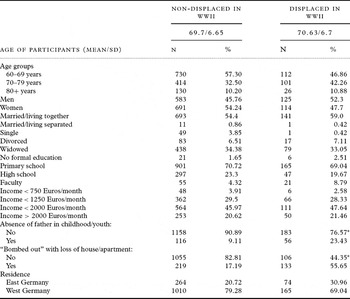
Of the 8106 valid addresses generated for the household survey, 1199 persons (14.8%) were ineligible at the time of the three visits by the interviewers, 1806 persons (22.3%) refused to participate, and 65 persons (0.8%) were not able to complete the study questionnaire due to severe illness. A total of 5036 persons agreed to participate, provided informed consent, and completed the study questionnaire. The response rate among all subjects who met the interviewers was 72.9% (5036/6907) while the participation rate among all eligible subjects was 62.1% (5036/8106). For the purpose of our research question we focused on all participants born before 1946 (N = 1513 participants). The participants were assigned to the following groups: (1) subjects without experience of forced displacement in WWII (N = 1274; 84.2%) = “non-displaced”; and (2) subjects who were displaced in WWII (N = 239; 15.8%) = “displaced.” Their descriptive characteristics are shown in Table 1. The characteristics of the study sample closely match those of the total German elderly population (Statistisches Bundesamt, 2005). Significantly more displaced participants reported the absence of their father during childhood and having been “bombed out” with loss of housing than non-displaced subjects.
Descriptive characteristics of the sample (N = 1513)

*p < 0.001
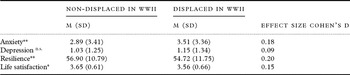
Table 2 compares current anxiety (GAD-7), depression (PHQ-2), resilience (RS-11) and life satisfaction (FLZM) in displaced and non-displaced participants. As can be seen, displaced participants significantly reported more anxiety, less resilience and life satisfaction at the time of the study. They also scored higher in terms of depressive symptoms (PHQ-2), but this trend was not statistically significant.
Comparison of current anxiety (GAD-7), depression (PHQ-2), resilience (RS-11) and life satisfaction (FLZM) in displaced and non-displaced participants (N = 1513)

*p < 0.05; **p < 0.01; n.s. = not significant
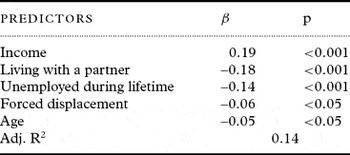
To explore whether or not forced displacement in WWII is a predictor of current life satisfaction, we performed a linear regression analysis with the total score of the FLZM as the dependent variable. Forced displacement significantly predicted current life satisfaction, besides the other variables shown in Table 3.
Hierarchical regression analysis predicting the current life satisfaction (FLZM), N = 1513

Not significant: sex, education, city dweller
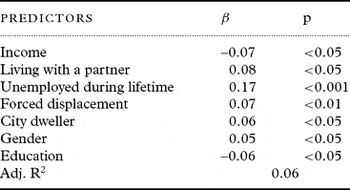
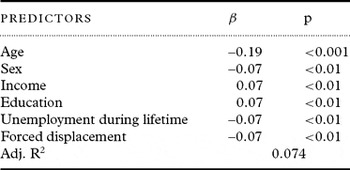
Table 4 shows the linear regression analysis with the total score of the GAD-7 as dependent variable. As can be seen, forced displacement significantly predicted current anxiety, besides the other variables mentioned in the table.
Hierarchical regression analysis predicting current anxiety symptoms (GAD-7), n = 1513

Not significant: age
Table 5 shows the linear regression analysis with the total score of the RS-11 as the dependent variable. Forced displacement significantly predicted current resilience, besides the other variables mentioned in the table.
Hierarchical regression analysis predicting resilience (RS-11), N = 1513

Not significant: city dweller, living with a partner
Discussion
To our knowledge, this is the first population-based representative survey investigating the mental health outcomes of people who experienced forced displacement during WWII in comparison to the non-displaced population. The main finding of our study is that, even sixty years later, displaced individuals showed significantly more anxiety symptoms, less resilience and less life satisfaction than non-displaced participants. Additionally, forced displacement in WWII significantly predicts current life satisfaction, anxiety symptoms and resilience. This is consistent with a previous study by Steel et al. (Reference Steel, Silove, Phan and Bauman2002) which showed an elevated risk for mental illness in displaced people, directly linked to the amount of traumatic stress they had experienced. However, the time since displacement even in this study of long-term effects was only about 12 years.
Another important finding of our study was that displaced individuals reported more frequently the experience of having lost their homes through bombing and the absence of their father during childhood than non-displaced participants. This illuminates a central conceptual problem in the scientific debate on displacement-related stress: displacement in itself does not necessarily fulfil the DSM-IV criteria of a traumatic event (American Psychiatric Association, 1994) and could therefore be cautiously classified as a severe, but not a traumatic, life event. On the other hand, displacement is frequently accompanied by a broad range of additional traumatic events, such as combat exposure, violence from occupation forces (e.g. rape of relatives, looting) and war-related loss of relatives. Besides that, displaced people frequently describe chronic feelings of homesickness and the impossibility of ever returning home as some of their central sorrows (Kuwert et al., Reference Kuwert, Spitzer, Traeder, Freyberger and Ermann2007). The absolute “traumatic load” and additional grief have to be assessed in the individual person and warrants clinical attention in all settings which treat and take care of elderly people affected by mass displacement.
Our study showed no significant association between displacement and depression. This differs from previous work in war trauma research which usually reports depressive comorbidity (Loncar et al., Reference Loncar, Medved, Jovanovic and Hotujac2006). As we performed no longitudinal study the interpretation of this finding remains presumptive. Concerning the well-replicated higher mortality of people with major depression (Schoevers et al., 2008), it might be the case that people with a longer history of depressive episodes had died before the survey was undertaken, or suffered from diseases severe enough to prevent them from participating, as the survey was attempting to evaluate a traumatic condition that happened more than six decades ago.
In addition, further methodological limitations have to be considered. Concerning the many confounding variables more than 60 years after displacement, all interpretations have to be stated cautiously. Future studies should enrich self-report data with formal clinical diagnoses of anxiety and depression. Related to this, another limitation was the reliance on only a small number of psychological disorder indicators – only two items and seven items to measure depressive symptoms and anxiety respectively. Furthermore, we did not measure symptoms indicating a post-traumatic stress disorder (PTSD), which is discussed as one of the mediating variables linking war trauma to general psychopathology (Kuwert et al., Reference Kuwert, Spitzer, Traeder, Freyberger and Ermann2007; Reference Kuwert, Spitzer, Dudeck, Vogel, Freyberger and Ermann2008a; Reference Kuwert, Spitzer, Rosenthal and Freyberger2008b).
Notwithstanding these limitations, the results of our population survey highlight the long-lasting impact of forced displacement on mental health in the now elderly German population. There is an urgent need to determine the diagnostic and therapeutic needs of those elderly patients affected by war trauma. Finally, the long-lasting psychological scars of WWII provide strong evidence for the need for prevention and treatment in current conflict-affected settings. Mental health must be one of the central issues in collective and complex emergencies such as war (Mollica et al., Reference Mollica, Cardozo, Osofsky, Raphael, Ager and Salama2004).
Conflict of interest
None.
Description of authors' roles
Philipp Kuwert wrote the article, Elmar Brähler and Oliver Decker were responsible for designing the study and the statistics, Heide Glaesmer helped revising the manuscript and Harald J Freyberger assisted writing the article.
Acknowledgments
This study was supported financially by Friedrich-Ebert-Stiftung, Germany.