Introduction
The growing need and interest in measuring, tracking and guiding progress toward achieving sustainability goals has stimulated the development of sustainability assessment approaches (Belcher et al., Reference Belcher, Boehm and Fulton2004). Sustainability in agricultural systems incorporates concepts of both resilience (the capacity of systems to buffer shocks and stresses) and persistence (the capacity of systems to continue over long periods), and addresses many wider economic, social and environmental outcomes (Pretty, Reference Pretty2008). However, the definition of sustainability is still a subject of discussions and competing concepts (Lien et al., Reference Lien, Hardaker and Flaten2007). The often quoted definition comes from the World Commission on Environment and Development Brundtland report: ‘development that meets the needs of the present generation without compromising the ability of future generations to meet their own needs’ (WCED, 1987). However, it is also believed that individual and societal views of sustainability change over time (Pretty, Reference Pretty1995). With changes emerge new pressures and expectations, and thus new choices to be made. Cornelissen et al. (Reference Cornelissen, Van den Berg, Koops, Grossman and Udo2001) defined sustainability as an ongoing dynamic development, driven by human expectations about future opportunities based on economic, social and ecological information. Sustainability has become a topic of policy, business and science (Kuhlman and Farrington, Reference Kuhlman and Farrington2010); however, consensus in the definition and measurement of sustainability goals is often challenging as stakeholder needs and interests usually diverge (Bouni, Reference Bouni1998). Sustainability measurements should help to evaluate not only the status quo, but also the effectiveness of a transition toward more sustainable farming systems.
Sustainability literature proposes two main approaches in identifying sustainability assessment criteria, i.e. reductionist or top-down and participatory or bottom-up approaches (Bell and Morse, Reference Bell and Morse2001, Reed et al., Reference Reed, Fraser, Morse and Dougill2005, Khadka and Vacik, Reference Khadka and Vacik2012). The top-down approaches are expert-led where already developed themes or indicators are adapted and modified according to local situations (McDougall et al., Reference McDougall, Pandit, Banjade, Paudel, Ojha, Maharjan, Rana, Bhattarai and Dangol2009). These approaches commonly lack legitimacy by local stakeholders and thus need to be complemented by consultations to define themes and indicators that are closer to the local needs and expectations (Chamaret et al., Reference Chamaret, O'Connor and Gilles2007). In contrast, the bottom-up approaches emphasize user-perspectives in setting goals and establishing priorities, recognizing that the process of identifying sustainability themes and indicators can be as important as their application (Innes and Booher, Reference Innes and Booher1999). Although participatory approaches can generate diverse ideas and insights, there is need to validate some of the results with ‘expert-led’ technical knowledge. Convergence of approaches is being sought in recent studies, for example, van Calker et al. (Reference van Calker, Berentsen, Giesen and Huirne2005) in dairy farming, Chamaret et al. (Reference Chamaret, O'Connor and Gilles2007) in mining, Khadka and Vacik (Reference Khadka and Vacik2012) in forestry, Bal et al. (Reference Bal, Bryde, Fearon and Ochieng2013) in construction and Oltean-Dumbrava et al. (Reference Oltean-Dumbrava, Watts and Miah2014) in engineering, but lacking for smallholder production systems especially in the tropics.
In this paper, we demonstrate how to design and implement sustainability assessment for smallholder production systems, based on a coffee sustainability assessment project in Uganda. We use the Sustainability Assessment of Food and Agriculture systems (SAFA) framework, developed by The Food and Agriculture Organisation of the United Nations (FAO), which proposes themes, sub-themes and indicators as guides in assessing agricultural sustainability (FAO 2014). We facilitate a stakeholder engagement process to prioritize the SAFA themes according to importance and feasibility for smallholder production. Subsequently, we identify relevant sub-themes, and explore broader sustainability barriers and opportunities for improvement of the coffee sector in Uganda. We apply the nominal group and Delphi techniques to collect both qualitative and quantitative data, supplemented with a system analysis and expert interviews.
The next section describes the SAFA framework, then the data collection process and empirical methods used for stakeholder engagement. This is followed by the presentation and discussion of descriptive and empirical results as well as by conclusions in the last section.
The SAFA Framework
Many sustainability assessment frameworks (SAFs) have been developed in recent years. Schader et al. (Reference Schader, Meier, Grenz and Stolze2014) conclude that these SAFs vary in scope and precision and no single SAF can serve all purposes of a sustainability assessment. The SAFA, the latest version published in 2014, aims at harmonizing sustainability assessments and making methods and results of sustainability assessments in the food sector transparent and comparable. The framework provides a standard set of sustainability goals, themes, sub-themes and indicators by covering four dimensions—good governance, environmental integrity, economic resilience and social well-being—as well as assessment procedures (FAO, 2014). These dimensions are translated into 21 core sustainability issues or universal themes with associated sustainability goals, which provide a common understanding of ‘sustainability’ in agricultural and food systems. The 21 sustainability themes are detailed into 58 sub-themes, or individual issues within SAFA themes, which are specific to the value chain under article, each with an explicit sustainability objective. The SAFA also defined default indicators within each sub-theme to make the criteria measurable. However, the practical applicability of the SAFA framework still needs to be tested and evaluated under a diversity of conditions (Schader et al., Reference Schader, Jawtusch, Emmerth, Bickel, Grenz and Stolze2012). The SAFA emphasizes that sub-themes and default indicators should be relevant to the circumstances surrounding the entity being assessed. In contrast to the WCED (1987) and OECD (1995) classical SAF, the SAFA also introduced ‘good governance’ as a fourth dimension for farm assessment. However, most themes and sub-themes under this dimension need reinterpretation as they were formulated with respect to larger farms rather than smallholder production systems (Schader et al., Reference Schader, Meier, Grenz and Stolze2014).
Coffee Production in Uganda
Uganda produces both Robusta (Coffea canephora) and Arabica coffee (Coffea arabica), of which 90% is produced by smallholder farmers (UCDA, 2012), either in groups, cooperatives or the few large-scale plantations. Arabica coffee is found in the high-altitude areas of the eastern, western and southern regions of the country, while Robusta coffee is a native plant commonly grown in Uganda. The Robusta and Arabica coffee production systems differ and are highly dynamic, co-evolving with the social, economic, ecological and political conditions (Norman et al., Reference Norman, Siebert, Modiakgota and Worman1994; Collinson, Reference Collinson2000; and Dixon et al., Reference Dixon, Gibbon and Gulliver2001). Both production systems are characterized by small farm sizes averaging between 0.5 and 2.5 ha, low coffee yields, aging trees and poor management practices, which make the systems very susceptible to a number of risks including pest and disease outbreaks (UCDA, 2012).
Arabica coffee is usually wet processed, while most Robusta coffee is dry-processed. Farmers may sell dried coffee as individuals at the farm gate directly to local traders (middlemen) or through the group and cooperatives to exporters and other coffee processors. Most of Ugandan coffee is exported, while a small portion is traded on the domestic market. Some traders are vertically integrated and managing the respective chains from input-supply to final marketing. Traders take a central role in the Uganda coffee value chain especially in terms of quality assurance and certification (UNDP, 2012). Other facilitators such as non-governmental organizations (NGOs) and projects are also important in supporting access to information, new technologies, finance and markets.
Coffee exports are estimated at 3.8 million bags in the 2014/2015 season (GAIN, 2014). According to a study by Technoserve and IDH/Sustainable Trade Initiative (2013), about 2% of the coffee exports are certified under different sustainability-oriented certification schemes (e.g. organic, fair trade and UTZ). Although the adoption of these certification schemes is growing, there are equally increasing concerns about the multiplicity of certification schemes on the market, seemingly addressing different dimensions of sustainability.
Data and Methods
Stakeholder engagement techniques
The nominal group technique (NGT) and the Delphi technique were applied to collect data. These were supported by specific interviews with key informants, most of which were recommended by the participating stakeholders. The NGT, developed by Delbecq et al. (Reference Delbecq, Van de Ven and Gustafson1975), is a structured process of generating a large number of ideas from a diverse group pertaining to an issue and prioritizing them accordingly while giving everyone an equal chance to participate in the process. The NGT approach was selected for this paper because it allows direct participant involvement, in a way that is non-hierarchical. Participants have equal voice and all responses to the posed questions have equal validity (Harvey and Holmes, Reference Harvey and Holmes2012). It is particularly useful for groups in which status differences among participants can inhibit open discussion, as it is in the case of focus groups. In this paper, participants worked in sub-groups to avoid status difference effects. Secondly, the technique is not only helpful to generate a large number of ideas, but also to prioritize these ideas. Thirdly, the NGT is a time efficient method of collecting data, as a session usually takes 1.5–2 h, and participants are only required to attend one session (Potter et al., Reference Potter, Gordon and Hamer2004). This was particularly important considering the diversity of stakeholders involved and the usually limited time for their availability and attention to such engagements. Given the potential limitations of NGT findings, for example, the composition of the group involved (Peña et al., Reference Peña, Estrada, Soniat, Taylor and Burton2012), the single topic meeting (Davidson and Glasper, Reference Davidson and Glasper2005), the size of the group (Harvey and Holmes, Reference Harvey and Holmes2012; and Tuffrey-Weijne et al., Reference Tuffrey-Weijne, Bernal, Butler, Hollins and Curfs2007), the rigidity and formality of the process (Steward, Reference Steward2001) and the time availability (Thomas, Reference Thomas1983), we complemented our NGT findings with a Delphi process. The Delphi process was helpful to generate inputs from other key stakeholders who could not participate in the NGT workshop but agreed to participate remotely.
The Delphi technique is a method for consensus-building during an iterative process using a series of questions to collect data from a panel of selected participants in a remote setting (Dalkey and Helmer, Reference Dalkey and Helmer1963). The technique gives equal weight to each panelist's judgment thus avoiding power imbalances, influences of dominant individuals, noise and group pressure for conformity (Dalkey, Reference Dalkey, Dalkey, Rourke, Lewis and Snyder1972). Panelists are able to adapt their scores based on arguments from the other equally anonymous panelists. However, clarity of the research subject, time frames, the possibility of low response rates, and unintentionally guiding feedback from panelists can be challenges in designing and implementing a successful Delphi (Hsu and Sandford, Reference Hsu and Sandford2007). Multiple iterations were thus required to achieve consensus. In this paper, the consensus building process for the relevant sustainability sub-themes was done in three rounds.
The stakeholder engagement process
The idea of stakeholder engagement echoes back to the first formulation of the ‘stakeholder’ approach by Freeman (Reference Freeman1984) who defined a stakeholder as any group or individual who is directly or indirectly affected by a given activity or activities. This can be expanded to include anybody who may have interest in the activity or activities and or the ability to influence its outcome, either positively or negatively. ‘Stakeholder engagement’ is an umbrella term encompassing a range of activities and interactions, including ‘participation’. However, the term ‘participation’ may have many semblances with regard to indicator development (Reed et al., Reference Reed, Fraser, Morse and Dougill2005). From Arnstein's (Reference Arnstein1969) classic ‘ladder of citizen participation’, several approaches have been suggested to define possible levels or scales of participation. Commonly participation is based on the moral belief that stakeholders should be represented in decision-making processes (Shepherd and Bowler, Reference Shepherd and Bowler1997). However, the level of participation is often influenced by many factors such as who funds or controls the process, the availability of resources, the time scale for outputs to be achieved, the desires and wishes of those involved (Reed et al., Reference Reed, Fraser, Morse and Dougill2005) or the characteristics of participants such as number and composition or the nature and duration of the process (Ross et al., Reference Ross, Buchy and Proctor2002) as well as their knowledge and level of organization. Cuéllar-Padilla and Calle-Collado (Reference Cuéllar-Padilla and Calle-Collado2011) presented eight typologies of participatory models: the participatory approach adopted for this paper belongs to the ‘participation through consultation’. In this type, participation is facilitated through consultation, usually in the form of responses to certain questions, where the method of obtaining information and performing the analysis are both externally defined as it is the case in this paper.
Mathur et al. (Reference Mathur, Price and Austin2006) argued that a deliberative process of stakeholder engagement starts with the identification of relevant stakeholders, who trust and share values making it easier to align goals and objectives.
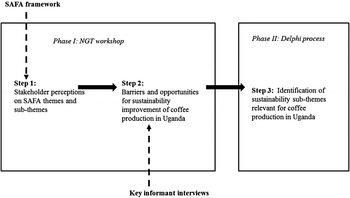
Thus, this was conducted in two phases (Fig. 1), a 1-day NGT workshop and a Delphi consultation process involving three steps: (i) stakeholder perceptions on SAFA themes; (ii) identification and mapping of barriers and opportunities for sustainability improvement; and (iii) identification of relevant sustainability sub-themes.
The stakeholder engagement process.

The NGT workshop
One effective way to engage with stakeholders is to facilitate a workshop (Kok et al., Reference Kok, Patel, Rothman and Quaranta2006). We used the workshop, following the NGT, to elicit stakeholder perceptions on the relevance and feasibility of SAFA sustainability themes (Step 1) as well as to identify barriers and opportunities for improving the sustainability of smallholder coffee production (Step 2). The workshop was conducted in January 2015 in Kampala, Uganda. A balanced representation of different stakeholder groups was essential for a proper participatory interaction in the workshop (Haatanen et al., Reference Haatanen, den Herder, Leskinen, Lindner, Kurttila and Salminen2014). The list of participants was selected from the National Coffee Platform through a consultative process based on stakeholder expertise, experience or general knowledge of coffee production as well as willingness and availability to attend. The National Coffee Platform is a forum for stakeholders active in Uganda's coffee sub-sector organized under four pillars (research, extension, farmer organizations and inputs and credit) to identify strategies for increasing sustainable coffee production in Uganda. The platform has members from government, coffee traders, NGOs, farmer-groups, development partners, input suppliers and stockists, and coffee processors and roasters. For the NGT Workshop, 35 members of the National Coffee Platform were invited, but only 20 members participated representing different stakeholder categories: farmer organization (6) of which three were certified to produce organic, fair trade and UTZ-certified coffee, respectively, coffee companies (3) all dealing in both certified and non-certified coffee, NGOs (4) supporting coffee development, coffee research institutions (4) and government (3) departments of agriculture and trade. The stakeholders who expressed interest but could not participate, were later interviewed as key informants sharing with them feedback from the workshop, while others were invited to participate in the second phase, the Delphi process.
The workshop opened with a general introduction to the purpose of the research as well as providing background information of the SAFA framework and the rules to be followed during the sessions. The participants were split into two groups for purposes of comparing results: practitioners (including farmer leaders, traders and input suppliers) and facilitators (including researchers, NGOs and government). SAFA themes and sub-themes and their respective goals and objectives, were provided to the participants. Using this list, each participant was asked to rate each theme and sub-theme for applicability to smallholder production with 1 or 0 scores to ‘yes’ and ‘no’ responses and related justifications for their respective choices. Though participants were divided into two sub-groups, scoring was done individually, with minimal interactions within sub-groups. All responses were collected, tallied and written on a chart in full view of all groups. This was followed with a validation session to highlight any emerging issues and to ensure that all participants approved the results.
The same process was followed for the ranking of the SAFA themes. In using interval ranking (Churchill, Reference Churchill1999) , a ranking sheet was provided where each participant independently scored the sustainability themes, on a Likert scale of 1 to 5 in terms of importance and ease of achievement (feasibility); one being least important (or feasible) and five being most important (or feasible) respectively, in consideration of the smallholder production. To compare the final rankings, the relative importance (and feasibility) weight w ij , for theme i and respondent group j, was calculated (van Calker et al., Reference van Calker, Berentsen, Giesen and Huirne2005) as:
 $$w_{ij} = X_{ij}/\Sigma X_j$$
where X ij is the average rank of theme i for respondent group j; X j is the average rankings of all themes for respondent group j. The analysis of variance (ANOVA) was used to compare the consistency of rankings between and within the two sub-groups.
The coffee system analysis matrix
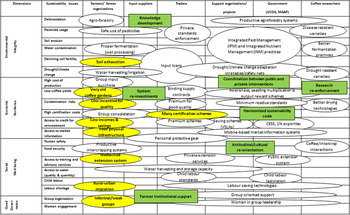
A system analysis matrix is a tool that allows one to link sustainability issues with stakeholder views on opportunities and barriers in transforming toward a sustainable production system (van Mierlo et al., Reference van Mierlo, Arkesteijn and Leeuwis2010). Hence, the aim of this session was to identify barriers and opportunities beyond the farm-level, which can impact the achievement of sustainability goals and objectives by smallholder coffee farmers. A system analysis matrix has rows, which comprise the key sustainability issues (themes and sub-themes) under each SAFA dimension, and columns which comprise the various stakeholders that perpetuate the system barriers and/or play a part in the creation of sustainability opportunities. Using a system analysis matrix chart (see Appendix 2) pinned-up on the wall, one participant at a time was allowed to either place their post-its or verbally contribute to filling out the matrix. In a validation session, all contributions were checked to ensure proper placing in the matrix grid and to generate consensus about the identified sustainability issues. The same process was repeated for system barriers and actions for improvement as well as the responsible stakeholders.
Expert consultation Delphi process
The selection of relevant sustainability sub-themes was conducted in a Delphi process involving a panel of 16 experts: farmers (5), coffee traders (1), NGO workers (4), researchers (4) and governmental agents (2). The experts were identified in consultation with the National Coffee Platform based on their technical expertise and experience with coffee production in Uganda. A Delphi questionnaire was developed from the list of sub-themes generated from the prioritized list of themes. In round one, the Delphi questionnaire was distributed by email to all panellists individually. Panellists were asked to review the list of sub-themes based on the set criteria—scientific validity, ecosystem relevance, data management and the sustainability paradigm (Becker, Reference Becker1997). A close-ended question was asked under each criterion; scientific validity (‘is it objectively verifiable—easy to determine consistently by different people?’), ecosystem relevance (‘is it applicable for smallholder coffee production in Uganda?’), data management (‘is it easy to measure quantitatively or qualitatively?’) and the sustainability paradigm (‘does it contribute to sustainability?’). These criteria were clearly explained with examples in a separate communication to all panellists before the exercise started. Panellists were asked to assign scores of 1 or 0 for ‘yes, it-meets-the-criterion’ or ‘no, it-does-not-meet-the-criterion’. A summary of responses was developed and shared independently with each panellist in round two, alongside all group scores from round one. They were asked to reconsider their scores and make changes if necessary. Through this iterative process, a consensual list of sub-themes was generated in round three.
Results
Perceptions on SAFA sustainability themes
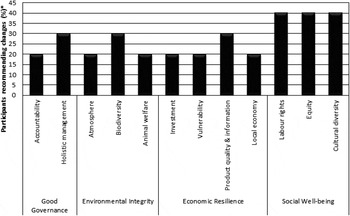
All SAFA themes were perceived as relevant but many require relevant adjustments as indicated in Fig. 2. Generally, stakeholders perceived the SAFA dimensions, themes and sub-themes as comprehensive and good benchmarks for sustainability assessment. However, it was suggested that the structure and scope of some themes and associated sustainability goals need to be adapted while considering the importance of collective action for the sustainability of smallholder production systems. ‘Farmer-groups’ refer to collective action on any agricultural activity along the value chain (Adong et al., Reference Adong, Mwaura and Okoboi2012). However, there are other terminologies used in literature: producer organizations, farmer organizations, groups of co-operative action. For example, most themes in the good governance dimension were perceived as applicable at ‘farmer-group’ level, while a few sub-themes are relevant at individual-farmer level. Some themes in the social well-being and economic resilience dimensions were also perceived as equally important at ‘farmer-group’ level, for example product quality and information, investment, vulnerability and labor rights.
Ratings of SAFA themes requiring revision to suit smallholder production according to stakeholders. *only themes which were mentioned by 20% and above of the stakeholders are considered.

Varied justifications were provided for the above ratings; accountability and holistic management themes under the ‘good governance’ dimension were perceived to be costly for individual smallholders, rather recommended for the ‘farmer-group’ level; animal welfare, atmosphere and biodiversity under the ‘environmental integrity’ dimension, were perceived as so detailed and yet commonly compliant in smallholder settings. Due to the extensive nature of smallholder production systems with little or no use of synthetic inputs, animal welfare, atmosphere (air pollution) and biodiversity risks are usually seen as not important. All themes under ‘economic resilience’ and the entire ‘social well-being’ dimensions simply require appropriate editing to expand the scope to smallholder production. For example, stakeholders took the view that the entire social well-being dimension needs adaptation to the farmers’ household well-being, not only to workers and community. This is because most smallholder farmers do not employ workers, and if any, only for a short time but they employ family members, which are usually informal and not remunerated.
As a result, several recommendations were made for specific improvements of selected themes, at both individual-farmer and ‘farmer-group’ levels in varying levels of detail. At ‘farmer-group’ level, record keeping, traceability and decision-making processes were recommended to be included in the ‘good governance’ dimension; investment, vulnerability, product information and quality to be included in the ‘economic resilience’ dimension; and labor rights to be included in the ‘social well-being’ dimension for groups employing workers. At farmer level, equally record keeping, traceability and decision-making processes were recommended to be included in the ‘good governance’ dimension; land fragmentation, afforestation and water conservation to be included in the ‘environmental integrity’ dimension; and farmer characteristics (age, education, farming experience, land ownership), household characteristics (size, alternative sources of income), plot characteristics (varieties, crop management measures including pest and disease control) could be included either as part of a new ‘productivity’ theme or together with total revenues and costs of production as part of the profitability sub-theme in the ‘economic resilience’ dimension.
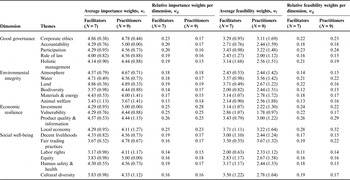
The SAFA themes were ranked for importance and feasibility for the smallholder coffee production in Uganda (Table 1). The average ranking for importance for each theme by each sub-group was computed as the total number of individual rankings, ranging between 1 and 5, averaged over the number of respondents in the sub-group. Corporate ethics (4.82) was ranked as the most important theme under the governance dimension by both sub-groups, however, taking into consideration that it needs to be adjusted to include aspects of leadership, record keeping and traceability. Least was holistic management due to requirements of holistic audits, sustainability management plan and full cost accounting, which as mentioned above were perceived as expensive requirements for most smallholders, and usually taken up by the associated traders or NGO facilitators. It was, however, suggested that if adequately supported, the ‘farmer-group’ can support smallholders to achieve the associated governance goals. Under the environmental integrity dimension, land was ranked as most important (4.88), considering the importance of soil fertility management for the sustainability of coffee production. Though integration of livestock at smallholder level is very important for manure, protein sources and income, the animal welfare theme ranked lowest. This is because as a separate theme, it is geared towards intensive animal production, not common among smallholders. Productivity was recommended as a theme on its own being ranked as the most important economic resilience theme with a score of 5 from both sub-groups. A closely related investment theme was equally ranked very high (4.65) by both sub-groups. The rankings of themes under the social well-being dimension varied widely between the two sub-groups, depending on the perceptions whether farmers’ well-being or the trade relationship with the buyers was most important. It was, however, clear that the fair trading practices theme was ranked most important because it considers both sides, i.e. the farmer and the trader.
Importance and feasibility weights of the SAFA themes in respective dimensions.

Figures in parentheses are standard deviations.
On average, good governance themes were ranked highest (4.49) followed by economic resilience (4.43), environmental integrity (4.32) and social well-being (4.22) themes in that order of importance. The respective importance and feasibility weight for each theme in a given dimension, w ij was computed for each respondent group, which by definition lies between 0 and 1 and the total weights per dimension equals to 1. The ANOVA) test revealed that average importance weights varied significantly (P < 0.05) between the two sub-groups, but followed consistent trends across the groups.
Cultural diversity, animal welfare and labor rights themes showed the greatest variation in opinions: some participants perceived them as important while others as simply compliant under smallholder settings.
In terms of feasibility for smallholder farmers, most themes ranked average (scores between 2.5 and 3.5) in both sub-groups. This is consistent with the earlier observation that most themes need adaptation to improve their applicability for smallholder production. The ANOVA test revealed that average feasibility weights varied significantly (P < 0.05) between and within the two sub-groups. Overall, there was better consistency among importance weights than feasibility weights within the sub-groups.
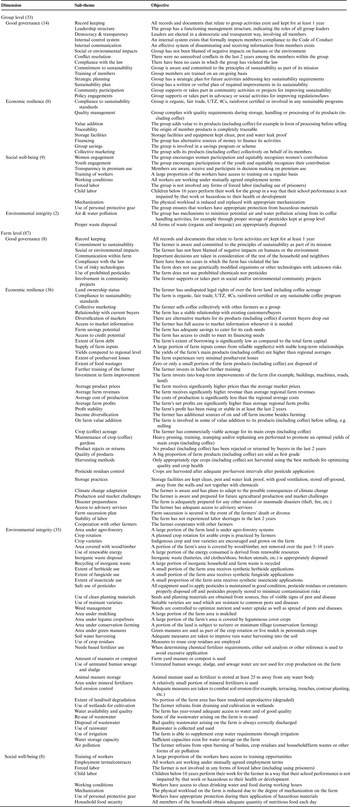
Following the Delphi process, relevant sustainability assessment sub-themes were identified by consensus in an iterative process. Consistent with the earlier recommendation from the workshop, of the 120 sub-themes selected by the expert panel, 30% were recommended for ‘farmer-group’ assessment, majority of which are good governance themes (Appendix 1). Each sub-theme was described in terms of the specific sustainability objective.
Mapping of barriers and opportunities for sustainability improvement
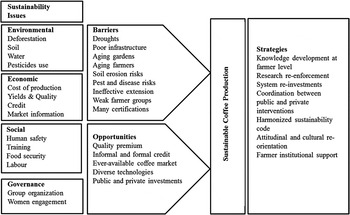
Using the system analysis matrix, stakeholders identified sustainability issues, barriers and required actions for sustainability improvement (Appendix 2). We summarize these issues, barriers, opportunities and policy strategies in Fig. 3.
Stakeholder perceptions on sustainable coffee production – Issues, Barriers, Opportunities and Strategies.

The strategies are further described below:
-
Knowledge development at farmer level: It was perceived that many sustainability-compromising farming practices are still prevalent among coffee farmers. Such practices include deforestation, inappropriate pesticide usage, neglected soil fertility and water management practices. Stakeholders recommended a number of actions geared towards raising awareness and building knowledge of farmers through appropriate training and demonstrations.
-
Research re-enforcement: It was equally perceived that there are many existing simple and sustainability-enhancing technologies that are not being adopted by coffee farmers. Action research was recommended to appropriately package these technologies in an easy-to-understand way. Specifically technologies associated with productive agroforestry systems, better coffee wet processing and fermentation, integrated pest and nutrient management were highlighted as very important for the sustainability of coffee production in Uganda.
-
System re-investments: It was widely recognized that one sustainability challenge in coffee production is the limited capacity and desire of farmers to re-invest back into production, postharvest handling and quality improvement at farm level. This has a direct negative effect on future productivity and profitability of coffee production. Stakeholders expressed concern that premiums from certified schemes are no longer a reliable source of funding for farm re-investments as the amount received currently varies widely depending on the sustainability scheme, local market and export market conditions and arrangements.
-
Coordination between public and private interventions: It was noted that NGOs, private companies and government institutions are running different coffee improvement programs independently. In order to optimize results and improve sustainability, the coordination and harmonization of such programs needs to be improved through public–private partnerships and forums such as the National Coffee Stakeholders Platform.
-
Harmonized sustainability code: The certification of farmers according to most schemes is commonly financed by NGOs and contracting companies in form of outgrower schemes. The challenge, however, is the need to acquire multiple certifications in order to compete favorably in the market. Besides certification, higher quality was recognized as a key market driver especially for specialty coffee, and yet most standards put little attention to these quality requirements.
-
Attitudinal and cultural re-orientation: Coffee in Uganda is generally grown in diversified systems, with other food and cash crops as intercrops. Coffee yields are thus far below (<30%) potential due to such management constraints (Wang et al., Reference Wang, Jassogne, van Asten, Mukasa, Wanyama, Kagezi and Giller2014). Awareness is thus needed on the importance of routine maintenance of coffee gardens to improve yields and ensure sustainability of coffee production.
-
Farmer institutional support: Over 98% of Uganda's coffee is grown on small farms (<2 ha) and coffee plots (0.1–1.0 ha). Most of the farmers are organized in groups with 25–30 members with varying capabilities. It was recognized that the sustainability of coffee production will thus depend on the proper functioning of these groups and higher level cooperatives, appropriately negotiating for and representing farmers’ interests.
Discussion
Applying universal sustainability assessment criteria in varying production systems can be challenging. This paper aimed at testing the applicability of the SAFA framework for smallholder production systems in the tropics by facilitating a stakeholder engagement process to prioritize sustainability themes according to importance and feasibility for this specific and underexplored context. This is applied to the case of coffee production in Uganda. Consistent with earlier pilot applications (Jawtusch et al., Reference Jawtusch, Schader, Stolze, Baumgart and Niggli2013), the SAFA framework provides a useful benchmark for selecting relevant sustainability themes and sub-themes, and makes assessments more comparable (Schader et al., Reference Schader, Meier, Grenz and Stolze2014). However, selected themes and sub-themes require appropriate modifications in terms of scope and objectives to suit the smallholder production in the tropics.
Moller and MacLeod (Reference Moller and MacLeod2013) also noted that SAFA is very strong at the generic level, but comparatively weak under specific and local conditions.
Consistent with earlier findings from Rigby et al. (Reference Rigby, Woodhouse, Young and Burton2001) that sustainability can be viewed quite differently, individual opinions about sustainability themes were diverse and varied significantly among the stakeholder sub-groups (practitioners and facilitators). There were, however, more detailed responses from the facilitator sub-group (government, researchers and NGOs), who seemed to have more experience, and certainly influence in studies of this nature. Although, having such ‘experts’ among the stakeholder group was a prerequisite to generate scientifically valid and comparable results, we used two sub-groups to provide an opportunity to the less-experienced participants to share their opinions without pressure from the rest of the group. This is consistent with findings from Reed et al. (Reference Reed, Fraser and Dougill2009) and Luyet et al. (Reference Luyet, Schlaepfer, Parlange and Buttler2012) who concluded that although methods to measure sustainability should be community-driven, the inclusion of experts is vital to provide a more nuanced understanding of all dimensions of sustainability. This, however, has to be done in an appropriate way to facilitate smooth learning and decision making processes. As a result, the relative weights allocated to the respective themes were significantly different among the sub-groups, but the order of ranking was consistent. In terms of importance, good governance themes ranked highest, followed by economic resilience, environmental integrity and social well-being themes, while the opposite was true, for feasibility rankings (Table 1). This implies that the most important themes, were perceived to be the most difficult to achieve in smallholder production. Usually smallholders not only differ in farm sizes, and plots under actual cultivation, they also differ in farming attitudes, existing land tenure regimes, and the presence or absence of other non-agricultural income and employment sources for themselves or family members (Guidi, Reference Guidi2011). It is therefore common that smallholders will organize themselves or with support from NGOs and companies to produce as a unit, in various forms of organizational structures. These group structures help in the sharing of fixed costs, economies of scale in the purchase of inputs and in marketing (Torero, Reference Torero2011). Godfray et al. (Reference Godfray, Beddington, Crute, Haddad, Lawrence, Muir, Pretty, Robinson, Thomas and Toulmin2010) highlights the need to address physical and institutional challenges, which limit smallholders access to the technical knowledge and skills required to increase production and raise the finances required to purchase production inputs (e.g. irrigation equipment, fertilizer, machinery, crop-protection products, soil-conservation measures, and crop and livestock varieties). The functioning of these group structures therefore has strong implications on the well-being and survival of smallholders, and thus need to be included in the sustainability assessment of smallholders.
Using the system analysis matrix, participants identified external factors outside the farm's boundaries and the farmer's direct control that could affect the farm's sustainability (Russillo and Pintér, Reference Russillo and Pintér2009). As a result, seven policy and investment strategies for coffee production in Uganda were identified (see Fig. 3), some of which are consistent with findings from other studies: knowledge improvement and appropriate research (Tilman et al., Reference Tilman, Cassman, Matson, Naylor and Polasky2002; The Future of Food and Farming, 2011), system re-investments and coordination (Guidi, Reference Guidi2011), harmonized sustainability code (Technoserve and IDH/Sustainable Trade Initiative, 2013), or attitudinal change and farmer institutional support (Hazell and Wood, Reference Hazell and Wood2008; Godfray et al., Reference Godfray, Beddington, Crute, Haddad, Lawrence, Muir, Pretty, Robinson, Thomas and Toulmin2010). Such strategies are critical to address the identified sustainability challenges in a pragmatic way that promotes smallholders’ resilience to shocks and future uncertainties.
It is worth noting that the wide diversity of stakeholder values and views on how to define and measure sustainability make stakeholder engagement processes critical (Moller and MacLeod, Reference Moller and MacLeod2013). Different approaches have been proposed from traditional mechanistic to the more deliberative democratic and iterative processes (Mathur et al., Reference Mathur, Price and Austin2006), as demonstrated in this paper. However, Collins et al. (Reference Collins, Kearins and Roper2005) highlights some risks of overly relying on stakeholder engagements in sustainability assessments: stakeholders have their own self-interests; their power, interest, time and resources vary, and some stakeholders may prefer to perpetuate the status-quo (‘business as usual’). Indeed, stakeholder engagement can be a very demanding process: responses can be very slow, while in other cases stakeholders may be totally unwilling to dedicate time to iterative processes. Moreover, certain criteria (e.g. scientific validity and sustainability paradigm) for sub-theme appraisal can be difficult to assess in stakeholder processes. Amidst these challenges some authors argue that it is still important that sustainability assessment reflects the specific views and values of relevant stakeholders (Gasparatos et al., Reference Gasparatos, El-Haram and Horner2008; Gasparatos and Scolobig, Reference Gasparatos and Scolobig2012). For example, Uganda has a highly liberalized but organized coffee value chain, relying on export markets. The value chain structure and organization are contingent on defined standards such as organic, fair trade, rainforest or other sanitary requirements. This means that specific stakeholders’ perceptions (especially practitioners) of sustainability along the value chain could be biased based on the content of these standards. However, the diversity of stakeholders that were involved, provided the opportunity to harmonize to a great extent the diverse views and aspirations related to sustainability, leading to stakeholder empowerment and education (Fraser et al., Reference Fraser, Dougill, Mabee, Mark and McAlpine2005). We therefore found that the selection of relevant stakeholders and their ultimate engagement needs to be done appropriately. For such decisions, certain trade-offs have to be made: (i) the trade-off between scientific-validity (comparability) of the indicators versus practicality and (ii) the trade-off between focusing on the specific enterprise (value chain), the location or both. In both cases, the number and type of stakeholders will differ and thus the final results.
Conclusions
This article contributes to the need for locally-adapted sustainability assessment criteria for tracking and comparing sustainability in diverse production systems. We used the SAFA framework as a widely accepted benchmark, testing its applicability to smallholder production in the tropics, using the case of coffee production in Uganda. From the results, we draw the following conclusions: (1) Although some sustainability themes, such as in SAFA, are considered universal, their structure and scope as well as related goals still require adaptation in order to address the social and structural heterogeneity of smallholder production systems. The adaptation can be done by engaging stakeholders in a contextually appropriate way, for example, through an innovative combination of applicable participatory approaches as demonstrated in this paper. (2) The prioritization of sustainability themes and identification of relevant sub-themes depends on which stakeholders are involved and how they are engaged in the process. We find that a heterogeneous group of stakeholders is needed, and where possible, utilizing sub-groups, key informants or experts to compare consistency of findings. For the smallholder production, stakeholders perceived governance and economic themes as most critical for achieving greater sustainability impacts. However, these were equally perceived as most difficult to achieve (least feasible) compared to environmental and social themes. (3) The inclusion of the ‘farmer-group’ structure as part of the SAF for smallholder production was perceived as necessary. Experts believed that the group structure is a useful conduit to the achievement of most governance theme goals and sub-theme objectives in many value chains involving smallholders. As a result of the 120 sub-themes identified for sustainability assessment of smallholder coffee production, 33 were recommended for ‘farmer-group’ level assessment. Based on these results, measurable indicators can easily be derived, to assess and track the progress of certification and other sustainability efforts. (4) By integrating a system analysis, the understanding of the sustainability agenda improved among stakeholders. As a result, relevant policy and investment strategies for sustainability improvement were derived from the identified system barriers and opportunities. The strategies are useful guides for policy makers and stakeholders for planning and decision making purposes. The findings presented in this paper are based on the smallholder coffee production in Uganda, however, the methods are applicable to other value chains and countries.
Acknowledgements
The authors thank Harriet Fowler of Café Africa and all members of the National Coffee Stakeholder Platform—Uganda for their contributions. The funding of this paper was made available by The funding of this paper was made available by the Mercator Foundation Switzerland through the Research Institute of Organic Agriculture (FiBL), Frick, Switzerland the Research Institute of Organic Agriculture (FiBL), Frick, Switzerland.
Appendix
List of sustainability sub-themes and respective objectives at both farm and group levels.

Coffee system sustainability analysis matrix. Legend: YELLOW OVALS – Sustainability Barriers; WHITE OVALS – sustainability-enhancing Interventions; GREEN BOXES – Sustainability Strategies.