Background
New medical technologies are an important part of delivering innovative and cutting-edge health care (Reference Chew and Sharrock1). They offer hope for improved diagnosis, patient outcomes, curing disease, and addressing health problems that lead to chronic illness, disability, and low quality of life (Reference Chew and Sharrock1). The advent of antibiotics systematically improved medicine, saved countless lives, and changed the leading cause of death from communicable disease to chronic illness in the United States (US) (Reference Adedeji2). However, the use of new medical technology is a major contributor to rising costs in health care (Reference Sorenson, Drummond and Khan3).
When advanced imaging (e.g., computed tomography, magnetic resonance imaging) was introduced, it was for specific organs, and the practice expanded to almost every part of the human body, resulting in increased spending (Reference Baker4). There is also evidence indicating advanced imaging does not improve patient outcomes or change clinical care for all areas (e.g., back pain), thereby incurring unnecessary costs (Reference Jarvik, Gold and Comstock5). There are other factors that can substantially increase the cost of new medical technologies. Patent protection and monopoly pricing often lead to higher market prices versus established technologies, and in some cases result in more overall costs when no efficiencies are achieved for the health system.
Sorenson, Drummond, and Khan summarized eighty-five studies assessing key drivers of medical costs with evidence suggesting that new technologies account for approximately 50 percent of the growth in healthcare spending in the US and other high-income countries (Reference Sorenson, Drummond and Khan3). Their review indicated new technologies are the largest contributor to increased medical spend when compared to other areas in health care such as life expectancy, aging, administration costs, and healthcare prices. The US Congressional Budget Office (CBO) conducted a study on the fiscal impact of new technology on healthcare spending in the US. The CBO concluded that about half of all growth in healthcare spending in the past several decades was associated with new technology (6).
Medical costs related to hospitals in the US are the single largest component of the overall US spend in health care, accounting for approximately 30 percent (Reference Hartman, Martin and Espinosa7). This has made hospitals a focus for cost-reduction strategies among the Centers for Medicare and Medicaid Services (CMS) (8). Another financial challenge with inpatient hospital reimbursement is diagnostic-related group (DRG) payment systems. DRGs are bundled payment systems that do not account for new and expensive devices, hardware, and diagnostics. Therefore, inpatient care in hospitals is reimbursed based on International Classification of Diseases (ICD) codes and not by line item. Approximately 60–85 percent of total hospital revenues are driven from DRG-based hospital payment systems (Reference Quentin, Scheller-Kreinsen and Blumel9).
CMS has led efforts to increase the proportion of health care being reimbursed by value-based systems, which are designed to incentivize patient outcomes as opposed to fee-for-service arrangements that favor utilization (8). One of the main drivers that has motivated hospitals to evaluate new medical technologies before they are adopted is an increased focus on making efficient use of limited resources (Reference Gagnon10). Even though this has been an issue over the last few decades, hospitals are increasingly developing hospital-level quality and efficiency initiatives based on fiscal efficiency (Reference McGregor and Brophy11).
Hospital-based health technology assessment (HB-HTA) was developed to improve the decision-making process for adopting new technologies at hospitals (Reference McGregor and Brophy11). Having a centralized and rigorous review of new technologies among hospitals prior to adoption is a relatively new phenomenon in the US, but it is becoming more important given payer reimbursement policy changes and hospital financial challenges.
Health technology assessment (HTA) has developed and evolved in response to the expansion of new medical technologies that have been incorporated into health systems with little evidence to support them. The process health systems use to determine adoption/coverage of new and emerging medical technologies varies greatly among payers, hospitals, and other medical providers in the US and among other high-income countries (12;13). Because insurers and single payer-national health systems ultimately pay for the majority of medical services, they have been more attuned to incorporate HTA into their policies. Therefore, HTA has become commonplace among many payers, and US public payers are likewise moving toward implementing HTA programs (12;13).
Hospital-Based Health Technology Assessment
The first published article describing a hospital committee evaluating a new technology was in 1986 (Reference Millenson and Slizewski14). Since then, HB-HTA programs have gained interest among policy makers because of its potential for improving new technology adoption decisions (Reference Gagnon10). There have been many published articles discussing the value of HB-HTA such as Coye and Kell's (Reference Coye and Kell15) article on how hospitals confront new technology (2006), as well as a book entitled, “Hospital-Based Health Technology Assessment” (2016) by Sampietro-Colom and Martin (Reference Sampietro-Colom and Martin12) that include descriptions of programs in Canada, Australia, the US, and abroad. The authors included twenty-five HB-HTA case studies including US-based Kaiser Permanente, Penn Medical Center for Evidence-Based Practice, programs from northern European countries, as well as other low-resource countries such as Brazil.
There are some US HB-HTA programs like the one at the University of California San Francisco (UCSF) that began implementing their HB-HTA in 2006 and described how they implemented their model and results in 2011 (Reference Gutowski, Maa and Hoo16). UCSF described how they emphasized the inclusion of physician leaders in their process. One of their key lessons learned was that instituting an HB-HTA created an evidence-based culture at their institution for new technology adoption. Their program resulted in a reduction of low value new technology adoption requests because the authors concluded that, for many providers, it was not worth going through the process. UCSF's approach offers a model for a hospital considering an HB-HTA program for a US hospital.
Finland has a well-established HTA program for its health system and began implementing an HB-HTA with its 100 province hospitals in 2006 (Reference Halmesmaki, Pasternack and Roine17). Despite many efforts to implement a successful HB-HTA program, Finland did not have the outcome they anticipated. They implemented a well-funded and comprehensive initiative, approaching each hospital from a collaborative perspective, but the impact of HB-HTA on hospital decision making remained low. The difficulties identified in the Finnish case study included lack of managerial and physician commitment to HTA in the hospital environment, as well as HB-HTA adoption decisions were inefficient (a year, on average) resulting in clinicians losing commitment and interest.
Based on these two case studies, key elements for a successful HB-HTA program can be inferred. The main three elements that appear to be critical for success include (1) having strong executive support (e.g., CMOs office), (2) organizational support (e.g., finance, specific hospital departments), and (3) developing a responsive decision process that can efficiently make decisions (e.g., within 3 months). UW Medicine had not routinely utilized evidence-based methods for making adoption decisions for new technologies until the implementation of Smart Innovation in 2017, an HB-HTA program.
About UW Medicine
UW Medicine is comprised of four large hospitals and other affiliates including Harborview Medical Center, UW Medical Center, Northwest Hospital & Medical Center, Valley Medical Center in Seattle Washington. In 2018, UW Medicine had 64,220 inpatient admissions, 1.6 million outpatient visits, employed over 30,000 employees, and had an annual revenue of $5 billion (18).
In 2015, UW Medicine's supply chain implemented a value analysis team to improve economic efficiencies in contracting and procurement for UW Medicine. The value analysis team utilizes evidence, data, and analytics to improve the pricing, contracts, and procurement of new medical supplies. UW Medicine's efforts to affect the cost curve in medical costs have brought tangible savings. However, it did not address new and emerging medical technologies, therefore Smart Innovation dovetailed well with supply chain efforts.
In 2015, UW Medicine was awarded a 4-year grant from The Center for Medicare and Medicaid Innovation (CMMI) totaling $32 million for care transformation that includes six main strategies, including Smart Innovation (19;20). The proposal was designed to incorporate the Affordable Care Act into UW Medicine's care transformation and help clinicians develop quality improvement strategies. The six strategies included (1) promoting effective, efficient, and high value care, (2) better use of data and patient voices to direct care, (3) populations as well as patients, (4) health care as well as sick care, (5) fully developed medical home, and (6) Smart Innovation.
Smart Innovation
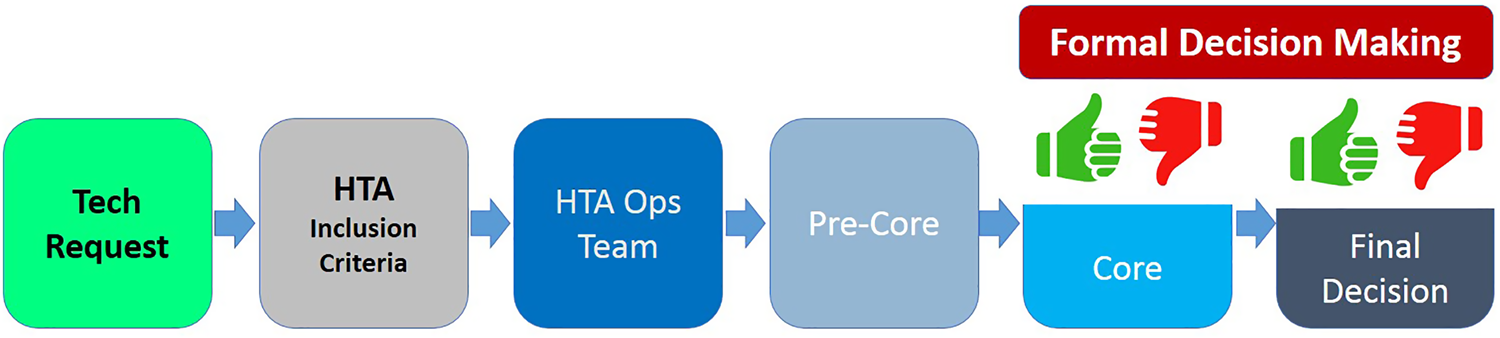
Smart Innovation is a HB-HTA program. The primary component of Smart Innovation is a comprehensive HB-HTA decision framework used to review and make policy decisions regarding medical technologies being considered for adoption at UW Medicine (Figure 1. Smart Innovation Decision Framework). Smart Innovation staff develop an HTA report for each medical technology being considered for adoption in collaboration with a clinician sponsor, hospital fiscal staff, and supply chain.
Smart Innovation Decision Framework.
(1) Tech Request is when a clinician requests the use of a new technology;
(2) HTA Inclusion Criteria is the fiscal threshold the new technology needs to meet before a review begins;
(3) HTA Ops Team is the Smart Innovation work group and staff that leads the program;
(4) Precore is the process Smart Innovation and the clinical sponsor gather evidence and develop the HTA report and presentation to the clinical committee;
(5) Core is the clinical committee that reviews the evidence and makes recommendations to the executive committee for adoption consideration;
(6) Final Decision is the final phase of the decision-making process and is conducted and executed by the executive committee.

Smart Innovation is one component of a larger hospital procurement division called Strategic Sourcing. Strategic Sourcing is comprised of approximately 175 staff that includes supply chain. Smart Innovation includes approximately two staff. One staff leads and conducts the operations of Smart Innovation and other staff contributes to the program that totals another full-time staff. The budget for Smart Innovation comes from the overall administration to operate Strategic Sourcing at UW Medicine.
Smart Innovation incorporates HTA methods and best practices that have been developed and established from US payers and European health systems as well as other HB-HTA programs (12;13;21). Smart Innovation is a comprehensive HB-HTA program and incorporates executive leadership, finance, and clinicians. The decision framework integrates physician-led committees as well as an executive committee that is multi-disciplinary. Smart Innovation's foundational principles are that healthcare technologies are assessed using an evidence-based approach to ensure they add value to patient care and respond to the needs of UW Medicine clinicians and patients. Smart Innovation approaches technology reviews through a broad healthcare system lens and acts as the single “front door” for new technology requests.
Smart Innovation Review Process
The technology assessment process can begin when a new technology has obtained United States Food and Drug Administration (FDA) or other appropriate regulatory bodies’ approval and a UW Medicine clinician decides they want to pursue its use. A UW Medicine clinician typically reaches out to procurement department, departmental clinical committees or Smart Innovation to begin the review process (Figure 1. Smart Innovation Decision Framework).
Although there is not a specified time period to conduct an assessment and complete the decision, new technology assessment decisions are completed within 45–90 days. These vary in time because of the range in complexity of the necessary analyses in the HTA reports. Other delays can include committee rescheduling and gathering data for fiscal analyses, and during the review process, technologies are not allowed to be used.
Smart Innovation covers all areas of medicine except pharmaceuticals. UW Medicine has a robust and well-developed pharmacy and therapeutics (P&T) committee that has been performing assessments for new medicines for many years. Once the new technology is received by Smart Innovation, it undergoes a first-level review that determines if it meets the annualized cost and/or the per procedure threshold. The financial thresholds include technologies for clinical screening, diagnosis, and treatment that constitute more than $50,000 annualized cost increase (aggregated across the system), more than $1,000 cost increase per procedure. Smart Innovation can also review a new technology that represents a new clinical treatment paradigm.
There is a monthly Smart Innovation meeting that reviews and considers what new technologies will be evaluated by the program. The Smart Innovation committee includes clinicians, leaders, and program staff. The committee considers each new technology request and if the financial threshold is not met, we will assess if the technology meets the new paradigm criteria. In order to meet the new paradigm criteria, it must offer a novel approach.
Smart Innovation's first course of action when the technology is approved for review is to assess the available evidence by (1) reviewing data from existing HTA reports if available (e.g., The National Institute for Health and Care Excellence [NICE], Emergency Care Research Institute [ECRI], and Agency for Healthcare Research and Quality [AHRQ]), (2) searching the published literature for available studies, (3) reviewing data from payers both public and private to ascertain any coverage policies and or HTA reports (e.g., CMS, Blue Cross Blue Shield), and (4) searching for any publicly available clinical guidelines. The next key piece of data needed for the review is fiscal data, which provides an estimated cost impact of implementing a new technology. Smart Innovation staff coordinate with the finance department to provide details about the new technology (e.g., current procedural terminology codes, DRGs).
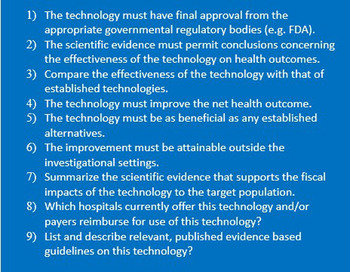
Smart Innovation staff contact vendors regarding their new technology as well as make an effort to identify the correct contact within their organization that has access and knowledge of the evidence relevant to the review. Smart Innovation also sends the vendor a questionnaire that includes the nine dimensions of evidence (Reference Landaas, Franklin and Thompson22) (Figure 2) and requests that they provide input for the review. This provides the manufacturer the criteria Smart Innovation uses in evaluating their technology and the opportunity for external stakeholder engagement.
Nine dimensions of evidence for health technology assessment (HTA).

Formal decision making can occur at the Core, and the Final Decision in Figure 1. However, the ability to approve the adoption of a new technology lies only with the Final Decision body (executive committee). The Core groups are authorized to make a noncover determination without escalating the decision to the Final Decision body.
HTA Report
The next key step in the process is to develop the HTA report. The report structure is based on HTA best practices (Reference Sullivan, Watkins and Sweet13) and includes specific UW Medicine information such as clinical rationale, utilization, current/existing technologies, patient care, and the estimated financial impacts of implementation; as well as payer coverage decisions and national clinical guidelines.
Depending on the type of technology, it may require different types of fiscal or patient quality of care assessment. For new devices or laboratory tests, the HTA report will include a budget impact analysis and clinical evidence review. For capital purchases, our fiscal office will complete a business plan, net present value (NPV) report, and/or return on investment report. Capital purchases are technologies that require significant funds to bring into the hospital. For example, multi-spot laser photocoagulation devices cost approximately $80,000 to purchase.
Smart Innovation staff review and synthesize available published scientific studies and exclude vendor marketing materials in the HTA reports. Smart Innovation designates and ranks the quality of evidence based on the GRADE guidelines by Balshem et al. (Reference Balshem, Helfand and Schünemann23).
Smart Innovation staff meet with clinical sponsors to review the HTA report and ensure it is clinically accurate. Once the HTA report is completed, the clinical sponsor and Smart Innovation staff co-develop a presentation for the appropriate clinical review committee. Smart Innovation staff finalize the HTA report and the chair of the clinical committee sends it out for review in advance of the meeting. Smart Innovation staff and the clinical sponsor present the HTA report to the clinical committee and lead a discussion regarding the published evidence and estimated impact of implementing the proposed new technology.
The HTA report will include a recommendation to adopt, do not adopt, adopt with conditions, or adopt with evidence. The clinical committee will consider the evidence in the HTA report and make a recommendation to UW Medicine's executive committee. The executive committee has broad representation and makes final adoption decisions for UW Medicine. If the clinical committee indicates the technology should not be adopted, that will be the final decision. If the clinical committee recommends to adopt, adopt with conditions, or adopt with evidence, the final decision lies with the executive committee.
For all HTA reports, Smart Innovation staff includes a methodology to monitor and evaluate postadoption impacts on estimated clinical and economic outcomes. Smart Innovation evaluates the implementation of a new technology decision following a year of implementation. Smart Innovation has an appeal process that offers the clinical sponsor a pathway to re-evaluate the technology if new evidence or pricing becomes available after 6 months of the decision. To date, there has not been an appeal.
Results
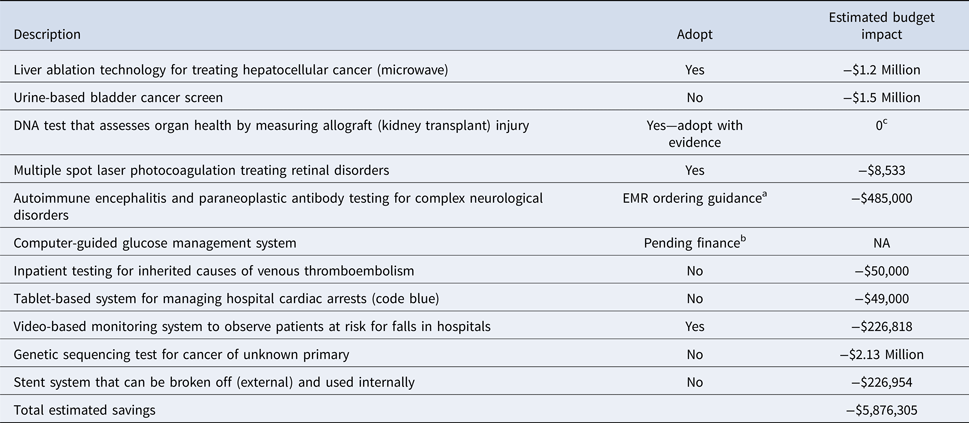
Between July 2017 and April 2019, Smart Innovation has reviewed a total of eleven medical technologies. These are comprised of five laboratory tests, three software-assisted systems, two surgical devices, and one capital purchase (Table 1). During this period, the total estimated cost savings was over $5 million dollars. Cost estimate methods included NPV for devices with capital expenses, and top-down cost estimation comprising unit price and annual utilization was used for new technologies being added to care regimes.
Budget Impact of Smart Innovation

a The HB-HTA policy was to develop and implement a new decision algorithm to optimize testing resources by delineating authorized testing based on types of patients and clinical utility of the testing panels.
b The recommendation was to adopt, however, there did not exist a budget to procure the technology.
c There is no direct cost to UW Medicine or patients for this test. Test company manages billing for hospital and its patients. Hospital nor patients will receive a bill for tests and or any losses that may accrue from nonreimbursed tests.
We describe three of the eleven HB-HTAs, whereas one was covered and adopted, one was covered with evidence, and one was not covered. Smart Innovation's first HB-HTA, completed in July 2017, was a liver ablation technology for treating hepatocellular cancer. The existing technology was radiofrequency ablation and the new technology for consideration was microwave ablation (MWA). MWA technology improves patient outcomes by reducing the number of procedures and adverse events such as bleeding. MWA also cost approximately $8,000 less per patient when incorporating disposables and other procedural elements. The liver ablation technology assessment provided clear evidence and was approved by the executive committee.
One of the five laboratory medicine technologies that Smart Innovation reviewed was a urine-based bladder cancer diagnostic and patient monitoring test. The technology was exciting for patients that would prefer to use a simple urine sample for screening as opposed to undergoing an invasive cystoscopy procedure and biopsy. UW Medicine conducts approximately 507 bladder cancer screens per year, and if adopted, it would total over $1.5 million in estimated increased costs annually. Smart Innovation's evidence review indicated that urologists would still need to confirm a high proportion of the urine-based results with cystoscopy because of the lack of specificity of the test (60 percent specificity). The average cost of cystoscopy and biopsy at UW Medicine is approximately $875 and the urine-based test is $2,900. The evidence was thus determined to be insufficient to adopt this technology based on both validity and cost-comparison concerns.
A key challenge to implementing Smart Innovation was how to address promising new technologies that lack a body of published evidence. Sorenson, Drummond, and Burns propose how Europe and the US could approve new technologies without clear evidence by introducing a few alternative approaches to address this difficulty (Reference Sorenson, Drummond and Burns24). One approach is to “adopt with evidence” which closely monitors promising new technologies via registries. For example, one of the laboratory medicine HB-HTAs was a promising new advance in DNA sequencing to identify allograft injury among patients with kidney transplants. If the test proves to be successful, it has the potential to improve survival among patients with kidney transplants.
Biopsy and serum creatinine results are the current standard approach for detecting allograft injury among kidney transplant patients. The new genetic test will be used in addition to the current diagnostic methods; however, it offers the ability to improve early diagnosis. It promises a more sensitive test to enable clinicians to detect allograft injury prior to the symptoms that can be detected by biopsy and serum creatinine.
For this allograft injury DNA test, the FDA required all laboratories and medical providers to participate in a CMS registry. This created a strategy for UW Medicine to support promising medical innovations and by monitoring them for safety and efficacy. If there are poor patient outcomes related to the technology, it can quickly be identified, and other patterns of care could be documented for review. Patient registries can provide the manufacturer and UW Medicine with the ability to demonstrate a technology's ability to deliver improved health outcomes by having details reported to a centralized monitoring system (Reference Paxton, Inacio and Kiley25).
Next Steps for Smart Innovation
Smart Innovation has evolved from a pilot project to an established initiative at UW Medicine. Smart Innovation will be developing a plan to scale the program and be incorporated into more clinical departments. This will allow Smart Innovation to identify key clinical partners at UW Medicine and further develop collaborations around new technology assessment and implementation. The program began as a system to review new technologies, but did not emphasize existing technologies or the review of capital purchases. Smart Innovation plans to expand into reviews of capital purchases and existing medical technologies that have indications of poor performance and high cost.
UW Medicine leaders are considering incorporating capital purchases and the review of poor performing technologies is being discussed by Smart Innovation and Supply Chain management. For the procurement or adoption of new medical technologies, it is mandatory for clinicians and departments to go through Smart Innovation. Because the program is relatively new, there exist clinicians that are not aware of this requirement. UW Medicine is currently implementing a new centralized procurement software that identifies new technologies (medical purchases) that need to be evaluated by Smart Innovation. This will provide Smart Innovation with a method to identify all new technologies that are being requested at UW Medicine and minimize any adoption/procurement of new technologies through alternative back channels.
Conclusion
Smart Innovation is a collaborative initiative and supports the interests of physicians, administrators, and patients. The program has demonstrated the value of implementing an HB-HTA at UW Medicine and the program will continue to grow and evolve. Smart Innovation has achieved cost savings, avoided uncertain or low-value technologies, and assisted in the implementation of new technologies that have strong evidence. The keys to its success have been the program's collaborative and efficient decision-making systems, partnerships with clinicians, executive support and proactive role with vendors.