

Implications
One of the strategic priorities about the development and the prospects of the sheep sector is the design of breeding programs of local sheep breeds. Key factor for an effective implementation of a balanced breeding program is the precise estimation of the economic value of the production and functional traits that have an impact on the performance and the productivity of the farms. The knowledge of the economic importance of these animal traits can be a useful tool for the adoption of innovative management strategies and policies.
Introduction
Breeding programs for livestock require clearly defined breeding objectives that focus on traits with the highest impact on farm management and economic performance. The effective definition of breeding goals should involve the determination of the economic values for the traits that have an impact on farm profitability (Ponzoni, Reference Ponzoni1986; Tozer and Stokes, Reference Tozer and Stokes2002). Dairy sheep farms mostly breed for high milk production to make their animals more profitable. However, high selection on production can decrease the robustness of animals (Rauw et al., Reference Rauw, Kanis, Noordhuizen-Stassen and Grommers1998). Therefore, breeding programs should also balance production with robustness, welfare and health.
To include several traits into an aggregate genotype (Hazel, Reference Hazel1943), economic values are needed for each trait. The economic values of production traits are relatively easy to estimate because they directly affect the productivity and profitability of farms. These methods generally require real-life data as arbitrary assumptions regarding the potential economic gain could be misleading (Groen et al., Reference Groen, Steine, Colleau, Pedersen, Pribyl and Reinsch1997). Conventionally, market-based methods have been used including optimization models and profit functions (Krupová et al., Reference Krupová, Oravcova, Krupa and Peskovicova2008; Tolone et al., Reference Tolone, Riggio, Maizon and Portolano2011). For dairy sheep, Ponzoni (Reference Ponzoni1986), Kominakis et al. (Reference Kominakis, Nitter, Fewson and Rogdakis1997) and Legarra et al. (Reference Legarra, Ramó, Ugarte, Pérez-Guzmán and Arranz2007b) reported economic values for Australian, Greek and Spanish sheep, respectively, while Krupová et al. (Reference Krupová, Wolfova, Wolf, Orancova, Margetin, Peskovicova, Krupa and Daňo2009) and Fuerst-Waltl and Baumung (Reference Fuerst-Waltl and Baumung2009) estimated economic values for sheep traits in Slovakia and Austria. Milk yield, milk composition and prolificacy are some of the production traits that have been included in breeding goals. In general, the estimation of economic values for traits that are associated with animal welfare, such as mastitis incidence, remains a relatively undeveloped part of the relevant literature, at least for sheep farming (Krupová et al., Reference Krupová, Oravcova, Krupa and Peskovicova2008).
The objective of this study is to estimate economic values for production and functional traits for dairy sheep. These economic values were estimated using a profit function. The profit equations included production and functional traits, including mastitis, so that the change in profit for change in traits could be estimated. Economic values of traits were estimated using primary economic and technical data collected from Greek Chios sheep farms. A sensitivity analysis was done to examine the stability of the breeding goal under potential changes in input and output prices.
Material and methods
Data
Data were collected by means of a farm management survey of 58 Chios sheep nucleus farms, members of the Chios Sheep Breeding Association. Farms were in Northern Greece, in the Regions of Macedonia and Thessaly. Over the last few years high-yielding breeds have been introduced in Greek sheep farms, but Chios remains the most popular and productive autochthonous one (Valergakis et al., Reference Valergakis, Arsenos, Basdagianni and Banos2008; Gelasakis et al., Reference Gelasakis, Valergakis, Arsenos and Banos2012) and is one of the most prolific worldwide (mean prolificacy 1.87 lambs/lambing) (Valergakis et al. Reference Valergakis, Arsenos, Basdagianni and Banos2008). These latter traits (milk production and prolificacy) are very important for intensive production. In fact farms rearing purebred Chios sheep are intensive and of entrepreneurial nature, while animals do not graze and are fed indoors throughout the year, which entails high feeding costs (Roustemis Reference Roustemis2012; Theodoridis et al., Reference Theodoridis, Ragkos, Roustemis, Arsenos, Abas and Sinapis2012 and Reference Theodoridis, Ragkos, Roustemis, Galanopoulos, Abas and Sinapis2014). For this reason they have structural and economic advantages compared with traditional production systems (Theodoridis et al., Reference Theodoridis, Ragkos, Roustemis, Arsenos, Abas and Sinapis2012). Nucleus farms rearing Chios sheep are part of a breeding association (Chios Sheep Breeding Association) which provides services to its members including milk yield monitoring (Valergakis et al., Reference Valergakis, Arsenos, Basdagianni and Banos2008; Gelasakis et al., Reference Gelasakis, Valergakis, Arsenos and Banos2012). Breeding mostly focuses on production traits and does not consider functional traits and mastitis important. The main descriptive statistics for the production and functional traits and the technical characteristics of these farms are reported in Table 1, while those for the economic characteristics are in Table 2.
Production and functional traits and technical characteristics of the Chios sheep farms

Economic characteristics of the Chios sheep farms

1 1 UFL=1700 kcal net energy for lactation (Jarrige, Reference Jarrige1989).
The average sampled farm managed 233 ewes, whose average productive life (longevity) was 3.66 years. Most of the reared ewes (93%) had at least one lambing annually. High milk yield (221.5 kg/ewe in 220 days of lactation) and high prolificacy (1.83 lambs/ewe) were reported. The average milk price was 0.82 €/l, lamb meat price was 49.48 €/lamb and price for culled ewes was 52.8 €/ewe (Table 2).
Work was mostly done by one or more members of the farm family, either full time or part time. Hired workers were employed by larger farms or when family members could not supply labor. To specify the profit function, human labor was split into maintenance, lambing, milking and ewe replacement labor (Table 3). The human labor required for farm management was 19 h/sheep per farm per year, the number of workers per farm was 2.34 and the average labor cost, which was calculated as the weighted mean of (implicit) family and hired labor wage, was estimated at 3.4 €/h (Table 2). This estimate is comparable with the minimum wage in Greece (586 €/month) whereas recent studies in Greek sheep farms have reported 2.27 and 3.21 €/h (Ragkos et al., Reference Ragkos, Siasiou, Galanopoulos and Lagka2016) for intensive and semi-intensive sheep farms and 0.09 €/h for transhumant farms (Ragkos et al., Reference Ragkos and Abas2014).
Allocation of yearly labor time and energy requirements in Chios sheep farms
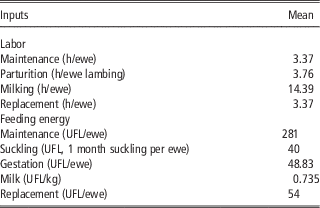
The work time needed for farm maintenance and ewe replacement is 3.37 h/ewe per year for each task separately (Table 3), which is much higher than the work needed for the same tasks in Latxa and Manchenga sheep flocks in Spain where the yearly labor time is estimated at 2.2 h/ewe for each task (Legarra et al., Reference Legarra, Ramó, Ugarte and Pérez-Guzmán2007a). The yearly work time was also higher for parturition, which required 1.76 h more than in the study of Legarra et al. (Reference Legarra, Ramó, Ugarte and Pérez-Guzmán2007a). Apart from the differences in the production patterns, the difference in work time requirements among these breeds can also be attributed to poor management of the workforce and to inadequate training and frequent replacement of managers and workers. Furthermore, the relatively small size of the Chios sheep flocks does not allow economies of scale in labor use.
An important task in farm management is milking, which requires on average 14.39 h/ewe annually (Table 3). The average milking time (milking speed) is 1.53 min/ewe-milking (Table 1); the milking speed for other autochthonous sheep breeds varies between 1.26 and 2.45 min/ewe depending on the type of the milking machine, while it was calculated at 2 min/ewe for Latxa and Machenga sheep in Spain by Legarra et al. (Reference Legarra, Ramó, Ugarte and Pérez-Guzmán2007a).
The exact energy requirements expressed in milk forage units (1 UFL=1700 kcal net energy for lactation (Jarrige, Reference Jarrige1989)) were calculated on the basis of the relevant literature for Latxa, Manchega (Legarra et al., Reference Legarra, Ramó, Ugarte and Pérez-Guzmán2007a) and Valle del Belice (Tolone et al., Reference Tolone, Riggio, Maizon and Portolano2011) sheep. The energy requirements for each production stage, which were calculated for each sample farm as shown in Supplementary Material S1, are also summarized in Table 3. The feeding cost for each production stage was calculated on the basis of the corresponding energy requirements, given an estimated feeding cost of 0.22 €/UFL (Table 2).
The high contribution of milk in total revenues of Chios breed farms renders the incidence of mastitis crucial for their economic performance and, consequently, for their resilience in an increasingly competitive environment. Clinical mastitis is costly to dairy sheep farmers since it decreases production and increases costs (Mavrogenis et al., Reference Mavrogenis, Koumas, Kakoyiannis and Taliotis1995; Barillet et al., Reference Barillet, Rupp, Mignon-Grasteau, Astruc and Jacquin2001). The financial losses from clinical mastitis incidences were estimated using farm data for mastitis occurrence. Financial losses included production losses from lower milk production, more milk discarded, lower producer price of milk and lower fertility. Additional costs for treatment included increased veterinary costs for drugs and labor, increased feed and management costs and higher culling rate that increases replacement costs (Barillet et al., Reference Barillet, Rupp, Mignon-Grasteau, Astruc and Jacquin2001; Legarra et al., Reference Legarra, Ramó, Ugarte and Pérez-Guzmán2007a; Gelasakis et al., Reference Gelasakis, Angelidis, Giannakou, Filioussis, Kalamaki and Arsenos2016). The economic impact of mastitis on farm profit was estimated following the approach developed by Wolfová et al. (Reference Wolfová, Štípková and Wolf2005) through the calculation of the economic losses. The costs of medical treatment were estimated at 4 €/mastitis case from the survey data, the period during which the produced milk is not sold due to illness of sheep was 8 days (Table 1) and the additional labor required for mastitis treatment was 1 h/incident (survey data).
The profit function
A profit function represents the difference between revenues and costs. It is a single equation designed to express the performance of animals in terms of economically important production and functional traits (Bourdon, Reference Bourdon1998). The marginal economic value of a trait in €/unit is estimated from the partial derivative of the profit function with respect to that trait evaluated at the average values for all other traits (Brascamp et al., Reference Brascamp, Smith and Guy1985; Wolfová et al., Reference Wolfová, Štípková and Wolf2005 and Reference Wolfová, Wolf, Kvapilík and Kica2007). Economic values are estimated by multiplying them with the genetic standard deviations (SDa) of the traits (Krupová et al., Reference Krupová, Wolfova, Wolf, Orancova, Margetin, Peskovicova, Krupa and Daňo2009), thus allowing the comparison of the economic importance of the traits. These standardized economic values are then expressed as percentages of their sum producing a relative economic value (Krupová et al., Reference Krupová, Wolfova, Wolf, Orancova, Margetin, Peskovicova, Krupa and Daňo2009; Wolfová et al., Reference Wolfová, Wolf, Kvapilík and Kica2007). All economic values are expressed per ewe and year. Values of genetic standard deviations were not available for the Chios sheep, hence, literature values from other populations were used (Table 4).
Genetic standard deviation (SDa) and marginal, standardized and relative standardized economic values of traits

The figures in the parentheses are standard deviations.
1 Fuerst-Waltl and Baumung (Reference Fuerst-Waltl and Baumung2009).
2 Legarra et al. (Reference Legarra, Ramó, Ugarte and Pérez-Guzmán2007a).
3 Gade et al. (Reference Gade, Stamer, Junge and Kalm2006).
4 O’Brien et al. (Reference O’Brien, McHugh, Wall, Pabiou, McDermott, Randles, Fair and Berry2017).
5 The numbers reported in this column account for the Total Merit Index for Chios sheep.
The profit function for Chios sheep is specified at the farm level and uses the approach of Ponzoni (Reference Ponzoni1986) and Goddard (Reference Goddard1998). The function includes all the components of total expenses and gross revenue that determine profit. According to Goddard (Reference Goddard1998) the traits in the profit equation must relate as directly as possible to sources of income and costs. The production and functional traits described in the previous section impact on productivity and economic performance of the sheep farms (milk yield, prolificacy, fertility, longevity, milking speed). These traits were incorporated in the profit function along with the frequency of the occurrence of mastitis. The selection of these production and functional traits was based on the literature review and the most important features of Chios sheep and the production system they are managed on.
The annual profit was estimated as the difference between revenues and expenses.
 $${\rm Profit}\,{\equals}\,{\rm revenues}-{\rm expenses} \qquad \ \quad\qquad$$
 $$\eqalignno{{\rm Revenues}\,{\equals}\, & {\rm number}\,{\rm of}\,{\rm ewes}{\times}[ {{\rm fertility}{\times} ( {( {{\rm milk}\,{\rm yield}}}} \cr&{{\times}{\rm milk}\,{\rm price}} ){\plus}\left( {{\rm prolificacy}{\times}{\rm lamb}\,{\rm price}} \right)} \right)-{\rm lamb}\,{\rm price}\,/\,{\rm longevity}{\plus}{\rm price}\,{\rm for}\,{\rm culled}\,{\rm ewes}\,/\,{\rm longevity})} \right]$$
Revenues include income from milk sales to dairies, the lamb meat sales, which in Greece are usually slaughtered at weaning (~10 kg carcass weight) and aged ewe sales, which are culled and replaced by lambs. In Greece, mutton is not appreciated much by consumers and its sales contribute insignificantly in the total revenues of the sheep farms.
 $$\eqalignno{{\rm Expenses}&\,{\equals}\,{\rm number}\,{\rm of}\,{\rm ewes }{\times} {\rm }\left[ {{\rm maintenance}\,{\rm cost}{\plus}{\rm fertility } } \right \cr &\quad{\times}{ {\rm }\left( {\rm gestation}\,{\rm cost}{\plus} \hfill \cr {\rm weaning}\,{\rm cost}{\plus}{\rm lambing}\,{\rm cost} \right} \cr \quad{\plus}{\rm milk}\,{\rm production}\,{\rm cost}{\plus}{\rm milking}\,{\rm cost} \hfill \cr \quad{\plus}{\rm mastitis}\, {\rm incidence} \cr\quad{\times}\left( {{\rm total} \ {\rm mastitis} \ {\rm occurrence} \ {\rm cost}} \right) \hfill \cr} \right){\rm }{\plus}{\rm replacement cost}} \right]$$
The calculation of all components of revenues and costs is presented in the Supplementary Material S2. Fixed costs (i.e. the annual expenses of the buildings and machinery and of the livestock capital) are not included in the profit function because they are considered sunk and unavoidable and cannot be allocated properly to production activities. Details of the derivations for each trait (marginal values) are included in the Supplementary Table S1.
Sensitivity analysis
Changes in farm revenues and costs may affect the relative importance of traits in the breeding goal because the impact of each trait on the economic performance of the farms varies. Breeding objectives aim for long-term genetic gain and profit; therefore, under volatile economic conditions the long-term trends need to be used to estimate economic values for traits. A sensitivity analysis was done to test the robustness of the results of the profit function model and to gain an accurate and deep knowledge of the relationships between input variables used for the calculation of profit and economic values for each trait. Sensitivity of economic values to different levels of inputs ensure feasible implementation of future genetic improvement programs (Kosgey et al., Reference Kosgey, Van Arendonk and Baker2004; Tolone et al., Reference Tolone, Riggio, Maizon and Portolano2011). Price of milk and meat (€/kg) and cost of human labor (€/hour) and feed (€/UFL) were adjusted by ±10% and the economic values for each trait were re-calculated (Haghdoost et al., Reference Haghdoost, Shadparvar, Nasiri and Fayazi2008).
Results
The results of the profit function are presented in Table 4. All marginal economic values refer to an improvement in the trait mean by one unit and they are expressed per ewe and year. The marginal economic value of milk was 0.62 €/kg per ewe and year (Table 4), which does not differ substantially from the findings of other Greek studies. For instance Kominakis et al. (Reference Kominakis, Nitter, Fewson and Rogdakis1997) reported similar economic values for the milk of Lesvos (0.66 €/kg) and Boutsiko (0.57 €/kg) breeds on Greek farms. In addition, Ragkos and Abas (Reference Ragkos, Koutsou and Manousidis2015) estimated a marginal willingness-to-pay of 0.63 €/kg by Greek sheep farmers for an additional kg of sheep milk using a choice experiment. The average price of milk in the sample is €0.21 higher (see Table 2), indicating that the milk pricing system in Greece is subject to serious distortions and does not reflect the actual market conditions or the intangible attributes of sheep farming that affect consumer preferences. This 33% premium on the marginal economic value of milk is too low to cover for taxes and transportation costs, not to mention the added value of the product. This is one of the reasons why sheep and goat farms in Greece have been reported to operate with net losses (Theodoridis et al., Reference Theodoridis, Ragkos, Roustemis, Arsenos, Abas and Sinapis2012; Ragkos et al., Reference Ragkos, Siasiou, Galanopoulos and Lagka2016). In Europe, substantially lower economic values have been reported for Friesian sheep in Austria (0.33 €/kg) (Fuerst-Waltl and Baumung, Reference Fuerst-Waltl and Baumung2009), for Valle del Belice sheep in Sicily (0.31 €/kg) (Tolone et al., Reference Tolone, Riggio, Maizon and Portolano2011), while Bytyqi et al. (Reference Bytyqi, Fuerst-Waltl, Mehmeti and Baumung2015) reported that the marginal economic values varied between 0.50 and 0.58 €/kg for sheep breeds in Kosovo. On the other hand, the marginal values of milk production were found higher in Spain for Manchega and Latxa breeds (1.18 and 0.73 €/kg, respectively) (Legarra et al., Reference Legarra, Ramó, Ugarte and Pérez-Guzmán2007a) and in Slovakia for improved Valachian sheep (0.898 €/kg) (Krupová et al., Reference Krupová, Wolfova, Wolf, Orancova, Margetin, Peskovicova, Krupa and Daňo2009).
The marginal economic value of prolificacy was 37.96 €/lamb. This value is between the estimated marginal values for Manchega (34.17 €/lamb) and Latxa (40.00 €/lamb) sheep (Legarra et al. (Reference Legarra, Ramó, Ugarte and Pérez-Guzmán2007a) and is higher than Friesian sheep (27.25 €/lamb; Fuerst-Waltl and Baumung (Reference Fuerst-Waltl and Baumung2009)).
Fertility had the highest marginal economic value (202.77 €/lambing per ewe; Table 4). This was expected because fertility affects both milk and meat production of farms. The value estimated here, however, is the highest among the estimates found in literature. Krupová et al. (Reference Krupová, Wolfova, Wolf, Orancova, Margetin, Peskovicova, Krupa and Daňo2009) estimated a marginal economic value of 94.6 €/lambing per ewe for Valachian sheep, Legarra et al. (Reference Legarra, Ramó, Ugarte and Pérez-Guzmán2007a) reported marginal values of 138.60 €/lambing per ewe for Laxta sheep and 137.66 €/lambing per ewe for Manchega sheep, while Tolone et al. (Reference Tolone, Riggio, Maizon and Portolano2011) estimated the marginal economic value of fertility to 185.37 €/lambing per ewe for Valle del Belice sheep.
The marginal economic value of longevity was the lowest among functional traits (4.53 €/lactation per ewe) of Chios sheep, but the highest among similar studies. Legarra et al. (Reference Legarra, Ramó, Ugarte and Pérez-Guzmán2007a) reported 1.66 €/lactation per ewe (median value) for Laxta sheep and 2.16 €/lactation per ewe for Machenga, whereas in Austria a negative value of −0.0015 €/lactation per ewe was calculated by Fuerst-Waltl and Baumung (Reference Fuerst-Waltl and Baumung2009). This negative value was because of lower milk production of older ewes suggesting that ewes were irrationally kept beyond their productive age. The economic value of longevity decreases as the trait improves. This is because the change in profit for change in longevity is not linear (Supplementary Table S1). The economic value is divided by the square of longevity. Therefore, as longevity increases, the value of improving longevity decreases.
The marginal economic value of milking speed is −22.92 €/hour per ewe and for mastitis occurrence −14.29 €/case per ewe. Both these values are negative because a marginal increase in milking speed increases labor expenses and a mastitis incidence decreases revenues and increases additional expenses. To our knowledge, the present study is the first dealing with the inclusion of clinical mastitis incidence in dairy sheep breeding objectives; only Legarra et al. (Reference Legarra, Ramó, Ugarte, Pérez-Guzmán and Arranz2007b) estimated the economic value for somatic cell count as an indicator of sub-clinical mastitis in dairy sheep; however, in their study the economic importance of mastitis was not evaluated jointly with other traits.
The estimated economic values for traits based on the current Chios sheep sector reflects the economic impact of these traits on the breeding goal for this specific system. Therefore, all comparisons with the findings of other relevant studies need to be treated with caution, as differences in the production system, management practices, market orientation and consumer preferences are reflected in the estimated values. In addition, the calculated relative economic values (in %) express the relative economic importance of traits on the breeding goal and depend strongly on the genetic standard deviations of the traits, which are reported in Table 4. In this study, the contribution of production traits to the breeding goal was 70.0% whilst functional traits contributed 30.0%. The last column in Table 4 reports the Total Merit Index (TMI) for Chios sheep.
Milk yield was the most important trait with a standardized economic value of 40.3 €/genetic standard deviation. This was expected because of the high fertility and low mastitis incidence of Chios sheep. Also, farms that have Chios sheep mostly specialize in milk production. This specialization has benefited by the development strategy of the Greek sheep farming sector to increase milk productivity to support cheese production, mainly of ‘feta’. Therefore, the economic value of milk production is high because milk prices are high relative to feed prices. The contribution of milk production to the definition of the breeding goal was important since its relative economic value was 56.18% of the whole trait complex. This result does not corroborate the study of Krupová et al. (Reference Krupová, Wolfova, Wolf, Orancova, Margetin, Peskovicova, Krupa and Daňo2009) for two Slovak dairy sheep breeds (improved Valachian and Tsigai), who reported a relative economic value of 26% and 32%, or to that of Fuerst-Waltl and Baumung (Reference Fuerst-Waltl and Baumung2009) who reported a relative economic value of 29.47%. For prolificacy, the standardized economic value is 4.18 €/SDa and its relative economic value at 5.83% of the total. A negative standardized economic value was calculated for milking speed (−5.73 €/SDa), which contributes 7.99% to the breeding goal.
For functional traits, fertility contributed to the sum of the absolute values of standardized economic values with 20.28% reaching about 50% of the importance of milk yield. The standardized economic values for longevity and mastitis incidence were 0.68 and −0.57 €/SDa, respectively, with shares of 0.94% and 0.79% to the breeding goal. The economic value for length of the productive life of ewes is similar to that of Legarra et al. (Reference Legarra, Ramó, Ugarte and Pérez-Guzmán2007a) who also reported positive, albeit low economic values for longevity. On the contrary, in the study of Krupová et al. (Reference Krupová, Wolfova, Wolf, Orancova, Margetin, Peskovicova, Krupa and Daňo2009), longevity had an economic value of 5.39 and 5.50 €/SDa, respectively, contributing by almost 16% in the breeding goal, while in the study of Fuerst-Waltl and Baumung (Reference Fuerst-Waltl and Baumung2009) longevity had a negative economic value of −0.28 €.
Sensitivity analysis
The results of the sensitivity analysis are presented in Table 5. The sensitivity of economic values of production and functional traits to milk and meat prices and cost per unit of inputs provides valuable insight on the feasible orientation of future genetic improvement and production system which has important implications for practical breeding programs (Kosgey et al., Reference Kosgey, Van Arendonk and Baker2003). The sensitivities are discussed relative to the base situation.
Sensitivity of economic values (€/SDa) to change (±10%) in price of milk and meat, labor and feeding cost

The sensitivity analysis does not change the relative importance of traits and milk yield still dominates all indices. As expected the economic values of prolificacy, milking speed and longevity are not sensitive to price levels of milk. The sensitivity analysis indicated that a change in milk price affects the contribution of milk yield, fertility and mastitis occurrence on the definition of the breeding goal. On the other hand, the economic value of mastitis is not very sensitive to output prices and to input costs. The economic values of prolificacy and fertility increased with 10% increase in meat price and vice versa. The change in labor cost had no effect on milk yield and prolificacy, and had only a trivial impact on the economic values of fertility, longevity and mastitis occurrence. However, a 10% increase of labor cost decreased the economic value of milking speed. Finally, the economic values of all traits except for mastitis and milking speed were sensitive to feeding costs. The variations reported here further support the argument that these estimates are breed- and system-specific and potential comparisons with other breeds in different settings could be misleading.
Conclusions
This study provides insight regarding the types of traits that should be included in breeding goals for sheep. There is considerable room for substantial growth in rearing autochthonous breeds and their development potential is linked to improvements which would render the rearing of these breeds a promising prospect for the livestock sector. Under these circumstances, the knowledge of the economic importance of traits is a practical tool for breeding organizations, farmers and practitioners for adopting management strategies, innovations and policies.
This study indicates that genetic and managerial interventions are both needed to achieve an overall improvement in the operation of sheep farms. The TMI shows that production and functional traits combined are important for balanced breeding goals. In economic terms, the relative importance of these functional traits could be increased using a desired gains index to make breeding programs more balanced. Nonetheless, this conclusion is only derived using the market approach of profit functions here. In fact, functional traits contribute indirectly to the economic performance of farms and to overall farm management, which is not always captured by market data. For instance, the ‘true’ contribution of functional traits is neglected in issues which are appreciated in markets, such as improved animal health and welfare (Olesen et al., Reference Olesen, Alfnes, Rora and Kolstad2010) and reduced greenhouse gas emissions (Van Middelaar et al., Reference Van Middelaar, Berentsen, Dijkstra, Van Arendonk and De Boer2015). Indeed, less mastitis incidents and increased longevity have positive effects in these aspects; however specific linkages among them have not been concretely defined, especially among consumers. Increasing public awareness regarding the benefits of functional traits would increase market information and would lead to market prices which would reflect better the whole range of their social and environmental contributions, thus increasing their share in the TMI. An alternative to that is the employment of non-market valuation techniques, such as the examples of Nielsen and Amer (Reference Nielsen and Amer2007) and Ragkos and Abas (Reference Ragkos, Koutsou and Manousidis2015) in Greece.
Focusing on traits other that milk production, as indicated by the TMI, would reduce the risk of reduced robustness from putting too much emphasis on production. Prolificacy is a production trait which adds directly to the economic performance of farms, but contributes low to the overall breeding goal. This was an expected result, since this study deals with dairy farms, where meat is not an important product for the overall economic outcome. This trait, however, should not be excluded from the breeding goal without further investigation because the response to selection of traits also depends on the genetic and phenotypic correlations between traits. The remaining functional traits which were taken into consideration only contribute to a small degree to the breeding goal; therefore, they should rather be treated through farm management interventions rather than through breeding. Milking speed can be improved with numerous management interventions and the use of novel technologies. Concerning longevity, precision feeding practices and animal welfare measures could be proven more efficient in allowing keeping animals longer in production. The inclusion of mastitis in the profit function equation should be further investigated, since it is a health and animal welfare trait that has a great impact on the profitability of the farms and is usually not included in such analyses due to lack of data. In general, the estimation of economic values for traits that are associated with animal welfare, such as clinical mastitis incidence, remains a relatively undeveloped part of the relevant literature, at least with respect to sheep farming. This study contributes to the existing literature with the inclusion of mastitis incidence in the breeding goal – a health indicator that has a great impact on the economic performance of farms – by calculating economic values with the use of primary, farm-level technical and economic data.
The results are further supported by the sensitivity analysis. The economic crisis in Greece has highly affected product prices and production costs and has brought considerable volatility in markets. Especially feedstuff prices have exhibited significant fluctuations over time (Karanikolas and Martinos, Reference Karanikolas and Martinos2012), for instance there was an increase of 31% from 2009 to 2012, followed by rational reductions in the consequent years (PASEGES, 2013). Furthermore, labor costs have been considered as a source of flexibility for farms (Ragkos et al., Reference Ragkos, Siasiou, Galanopoulos and Lagka2016) and this has led to a 4.6% reduction of permanent workers and a 13.6% reduction of seasonal workers in the primary sector. Nonetheless, the effects of these fluctuations on the expression of the breeding goal and on the TMI are not extensive. This ensures that a breeding program based on this breeding goal would not lose its relevance to the Greek livestock production context over time. This is particularly important for functional traits such as fertility and mastitis occurrence, as potential fluctuations in their importance in the breeding goal would jeopardize their ultimate inclusion.
Acknowledgment
The authors acknowledge the invaluable contribution of Dr Zaphiris Abas. We dedicate this paper his memory.
Supplementary material
To view supplementary material for this article, please visit http://dx.doi.org/10.1017/S1751731117003007



