INTRODUCTION
The rapid influx of Latino immigrants in the U.S. South is challenging the historically entrenched Black/White categories of race (Winders Reference Winders2008). This challenge involves the ongoing creation and contestation of new racial categories in a process of “racialization” (Omi and Winant, Reference Omi and Winant1994). In this paper we ask, “How are Latinos ‘racialized’ in the U.S. Southeast?” We focus on Atlanta, where the Latino population rose by over 780% in the past twenty years, transforming this Black/White “cradle of the Civil Rights Movement” into a multiethnic and multiracial city that has experienced a particularly strong “Latino backlash” at the local and state levels (Jonsson Reference Jonsson2006; Myrick-Harris Reference Myrick-Harris2006; U.S. Census Bureau 1990, 2011).
We compare Dominican and Guatemalan immigrants in the Atlanta metro area to demonstrate how two countervailing processes are racializing Latinos: 1) the homogenization of Latinos into a single “race” and 2) the diversified understandings of and responses to race and racial categorization among Latinos based on their national origin and ethnicity and the specific Atlanta context (De Genova Reference De Genova2004). We argue that in moving beyond the Black/White binary, state laws that racialize Latinos create a two-dimensional category, with a homogenized “Latino” category as one axis and an illegal/legal distinction as the second axis. Latinos derive distinct meanings from and experience distinct consequences of “race,” depending upon their perceived or actual legal status (Jiménez Reference Jiménez2010; Marrow Reference Marrow2011).Footnote 3
Yet, as we show, pushing against the homogenized version of “Latinos” implicated in state policies is the wide diversity among specific national and ethnic groups of Latinos, each with its own understanding and construction of “race.” To understand how racialization plays out for specific Latino groups in the face of the homogenizing tendencies of the state, we compare Dominican and Guatemalan immigrants in the Atlanta metro area. We find that the Atlanta context provides unique resources for racialization that are specific to each of these groups.
We rely on Omi and Winant's (Reference Omi and Winant1994) conception of “racial formation” when making our analyses (Aranda et al., Reference Aranda, Chang, Sabogal, Duany, Feagin and Cobas2009; Lippard and Gallagher, Reference Lippard and Gallagher2010; Rodriguez and Menjívar, Reference Rodriguez, Menjívar, Duany and Feagin2009). Rather than understanding race as a fixed characteristic of individuals, Omi and Winant contend that race is continually socially constructed at multiple levels—from individual interactions to state policies. The social construction of race signifies social conflicts and interests by referring to different types of human bodies. The content and importance of racial categories are determined by social, economic, and political forces. Omi and Winant argue that race plays a fundamental role in structuring and representing the social world, and that racial categories are created through the ongoing linkage of social structure and cultural representations via “racial projects” (Duncan et al., Reference Duncan, Hotz, Trejo, Mitchell and Tienda2006; López Reference López2002; Rugh and Massey, Reference Rugh and Massey2010; Tomaskovic-Devey et al., Reference Tomaskovic-Devey, Zimmer, Stainback, Robinson, Taylor and McTague2006). The categories of race created, reproduced, and contested by the state through racial projects produce particularly far-reaching consequences, institutionalizing and legitimating these categories within a status hierarchy, and distributing resources on the basis of these categories (Omi and Winant, Reference Omi and Winant1994; Winant Reference Winant1994).
Omi and Winant present two arguments about the “racial state” that are particularly relevant to our understanding of racialization of Latinos in Atlanta. First, the “racial state” is not a monolith. Categories of race and their meanings are contested from within the state. Despite these contestations, however, state hegemony prevails: “Overall unity of the state is preserved despite the disparate and conflicting demands” (Reference Omi and Winant1994, p. 84). Second, state racialization efforts generate responses from disadvantaged groups, who seek to redefine or redirect the unequal social relations that race categories sustain.
Applying Omi and Winant's theory of racial formation to understand the state's role in racializing Latinos in the Atlanta metro area, we focus on the two major Georgia anti-immigration laws—SB529 (passed in 2006) and HB87 (passed in 2011). These state laws represent the current battleground on which immigration reform is being fought through legislative action. In addition to the legislative arena, we also investigate how racialization processes operate at a local level through the implementation of Section 287(g) which was added to the Immigration and Nationality Act in 1996 (Delegation of Immigration Authority Section 287(g)). Section 287(g) allows state and local agents to directly enforce federal immigration laws, and exemplifies how the bidimensional racialization of Latinos through state policy is becoming institutionalized (Odem and Browne, Reference Odem and Browne2011).Footnote 4
THE LEGAL SYSTEM AND HOMOGENIZING RACIALIZATION PROCESSES IN THE ATLANTA METRO AREA
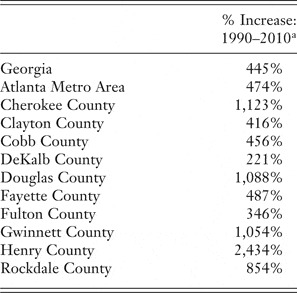
Considered the economic hub of the Southeast, Atlanta represents a key site for understanding racialization processes within the new immigrant destinations of the South (Odem Reference Odem, Singer, Hardwick and Brettell2008). Between 1990 and 2010, the foreign-born population in the Atlanta metro area climbed by over 360%, which was slightly higher than the increase of 445% among the foreign born in Georgia (Table 1). The growth was particularly rapid in Atlanta's northern White suburbs. As Table 1 shows, from 1990–2010, the number of foreign born rose over 1,123% in Cherokee County and 1,054% in Gwinnett county.Footnote 5 The majority of these immigrants came from Latin America, with Mexicans representing the largest proportion of newcomers (Browne and Odem, Reference Browne and Odem2011). All together, Latinos make up slightly over half (52%) of the total foreign born in Atlanta. Thus, the number of foreign born is strongly correlated with the number of Latinos, although immigrants from countries in Africa, Asia, and other parts of the world are also settling in the metropole. Slightly over half of Latinos (54%) in Atlanta are foreign-born (U.S. Census Bureau 2011).
Increase in the Number of Foreign Born by County in Atlanta Metro Area, 1990–2010

a U.S. Bureau Census Bureau, American FactFinder, 1990 Decennial Census, STF3 and 2000 Decennial Census, STF3, American Community Survey, 2010.
These foreign-born immigrants from Latin America and elsewhere arrive in Atlanta to find a metropolitan area with a vibrant, visible Black middle class and a city with displays of hard-won African American accomplishments. Driving down the main thoroughfares of Atlanta, visitors will see signs directing them to the Martin Luther King Center, the prestigious historically Black colleges of Spelman, Morehouse, and the Atlanta University Center, and the Ralph David Abernathy Freeway. Atlanta's “busiest airport in the world,” Hartsfield-Jackson, is named in honor of a White mayor and a Black mayor. Indeed, the very identity of Atlanta is rooted in its history of Black/White relations. A bastion of Jim Crow racism in the first part of the twentieth century, post–civil rights Atlanta has been dubbed the “Black Mecca,” “The City Too Busy to Hate,” and the “Cradle of the Civil Rights Movement” (Myrick-Harris Reference Myrick-Harris2006).
Although Black poverty still remains high and Black/White residential segregation persists, Atlanta continues to attract Black professionals with the promise of economic opportunity and a large home in a wealthy Black suburban community (Stafford and Schneider, Reference Stafford and Schneider2001). According to the Brookings Institution, Atlanta led all metro areas in the United States for Black population growth between 2000 and 2007 (Frey et al., Reference Frey, Berube, Singer and Wilson2009). Thus, Atlanta's African American population grew in the past decade, although at a rate much lower than that of the Latino immigrant population (Frey et al., Reference Frey, Berube, Singer and Wilson2009).
Racialization of Latinos in the Atlanta metro area through state policies transpires against a backdrop of a deeply entrenched Black/White binary and a strong African American political presence, two features that distinguish Atlanta from the traditional immigrant gateways of the United States. Responding to the sudden influx of Latino immigrants over the last decade, predominantly White state and local legislators in Georgia and metro Atlanta have enacted an array of laws and ordinances that restrict or deny Latino immigrants' access to health care, housing, education, and transportation and subject them to a high level of surveillance by law enforcement authorities. Some but not all laws specifically target unauthorized immigrants. The majority of Black legislators have opposed these laws. Yet, despite their opposition, the outcome has been to racialize Latinos in a way that casts them in a homogenized frame as “illegal,” “Mexican,” and unwanted (De Genova Reference De Genova2004; Lippard and Gallagher, Reference Lippard and Gallagher2010).
Journalist Roberto Lovato (Reference Lovato2008) compares these policies and laws to the legally sanctioned system of racial segregation that existed in the U.S. South from the late nineteenth century to the modern Civil Rights Movement of the 1960s. According to Lovato, Georgia legislators and officials have created and continue to expand “a legal regime of distinctions between the rights of undocumented immigrants and citizens,” what the author calls “Juan Crow.” “Georgia's lowest paid workers, the undocumented,” Lovato writes, “now occupy a separate, unequal, and clandestine place that has made it increasingly difficult for them to work, rent homes, or attend school.”
Unlike Jim Crow laws, which explicitly discriminated against African Americans on the basis of race, these recent measures do not mention race and do not explicitly target Latinos. A number of the laws are directed against undocumented immigrants but they also do not mention race, ethnicity, or country of origin. However, the rhetoric behind and the actual enforcement of these measures do indeed target Latino immigrants.
Hostility toward immigrants was not evident during the initial acceleration of Latino immigration to the Southeast in the 1980s and 1990s. At that time local authorities and the media paid only scant attention to the newcomers and more often than not depicted them as hard workers who helped the local economy in various ways. A series of articles that appeared in the Atlanta Journal Constitution in 1998 described the economic contributions of Latino immigrants and local efforts to integrate them into southern society. In an article about the carpet industry in Dalton, Georgia, the vice president of the Dalton-Whitfield Chamber of Commerce commented on the importance of Latino workers: “Our industry could not continue to grow and be strong without these folks coming in” (p. H4). Carpet industrialists provided English classes, job-training materials in Spanish, and even helped to create several soccer fields in the city for immigrant workers (Poole Reference Poole1998).
During the early twenty-first century, however, anti-immigrant rhetoric and exclusionary policies rose sharply in new immigrant destinations owing to declining economic conditions and the heightened national preoccupation with terrorism and “illegal immigration” following the attacks of September 11, 2001. Public outcry about “illegals” stealing jobs, burdening taxpayers, and increasing crime rates led state and local officials across the Southeast to pass laws and ordinances limiting unauthorized immigrants' access to housing, employment, driver's licenses, social services, and higher education (Lacy and Odem, Reference Lacy, Odem, Lacy and Odem2009). Southern locales were by no means alone in passing legislation targeting Latino and unauthorized immigrants. These regional trends were part of a national wave of anti-immigrant backlash, but the backlash proved most intense in areas with very high rates of recent migration, like the Southeast.
Georgia Security and Immigration Compliance Act (SB 529)
Much of the state and local legislative activity targeting unauthorized immigrants took place in the wake of rancorous discussions in the U.S. Congress and the national news media in 2006 over the problem of illegal immigration. The failure to enact immigration reform at the federal level strengthened the efforts of state and local lawmakers to take action against unauthorized immigrants, and a record number of immigration bills came before state legislatures in 2006. Across the nation, eighty-four such bills became law (more than double the number in 2005) out of 570 total pieces of legislation (National Conference of State Legislatures 2006).
At the time of its 2006 passage of the Georgia Security and Immigration Compliance Act (SB 529), the state of Georgia took the most aggressive and sweeping action of any state in the nation to control illegal immigration. Senate Bill 529 requires contractors and subcontractors doing business with the state to ensure that all of their workers have legal authorization to work; denies tax-supported benefits, including health care, to adults who cannot prove their legal residency; prohibits employers from claiming as a state tax deduction wages paid to undocumented workers; requires police to check the legal status of anyone who is arrested for a felony or for driving under the influence of alcohol, and to report any undocumented immigrants to immigration authorities; and authorizes the state to work with the federal government to train Georgia law enforcement officers to enforce immigration laws. The law reflects a compromise between politicians seeking aggressive action to end illegal immigration and business groups seeking to maintain an available pool of low-wage immigrant labor. After consulting with business lobbyists, Republican sponsor Chip Rogers crafted the bill so that companies would not be held responsible if an employee used false documents or if a subcontractor hired illegal workers without the knowledge of the employer (Campos Reference Campos2006; Moscoso Reference Moscoso2005; Tharpe et al., Reference Tharpe, Campos and Pickel2006).
While it is difficult to assess the full social and economic impact of the Georgia Security and Immigration Compliance Act, it is clear that the measure has created a climate of uncertainty and fear among Latino immigrants in the state. The parks and shopping plazas that had been social and recreational gathering places for Latinos in Atlanta have been noticeably less populated since the legislation went into effect. Police involvement in the enforcement of immigration law has made Latino immigrants even more fearful and less willing to notify law enforcement when they are victims of or witnesses to crime (Pérez Reference Pérez2007; Pickel Reference Pickel2007).
Georgia's Illegal Immigration Reform and Enforcement Act (HB 87)
The backlash against Latino immigrants in Georgia only intensified with the downturn in the economy and rising unemployment rates since 2008. Both the Republican and Democratic candidates for governor in the 2010 election promised to “get tough” on “illegal immigration” and expressed their support for the draconian law passed in Arizona the previous year (SB 1070). “We will take our stand and do what Arizona has done,” Republican candidate Nathan Deal announced at a candidates' forum (Suggs Reference Suggs2010). Soon after Deal took office, the Georgia House of Representatives followed Arizona's lead by passing House Bill 87, The Illegal Immigration Reform and Enforcement Act of 2011. Like the Arizona law, the Act authorizes state and local police to verify the immigration status of certain suspects and penalizes people who knowingly transport or harbor “illegal immigrants.” Additionally, HB 87 requires private employers to verify the legal status of their employees and empowers the public to sue local and state officials who do not enforce state laws aimed at unauthorized immigration. Governor Deal signed the bill into law on May 13, 2011, despite the strong opposition of not only immigrant and civil rights groups who predicted a rise in racial profiling of Latinos, but also many businessmen and employers who worried that the law would threaten key Georgia industries that depended on immigrant labor, such as the agricultural industry.
The dominant figure in the popular discourse about immigration is that of the “illegal Mexican,” typically imagined as a worker in construction, lawn maintenance, and other manual occupations. Such representations not only collapse the real differences in nationality, culture, class, legal status, and racial identification that characterize the Latin American population in Atlanta, but they also construct Latino immigrants as a foreign race that poses a danger to American society and is not suitable for full membership in the nation. “Illegals” have been variously portrayed as threats to the safety of neighborhoods, to the economic well-being of citizens, to the survival of American culture, and to national security. HB87 and other laws and policies that have emerged out of the anti-immigrant backlash reinforce and institutionalize the boundaries separating Latino immigrants from “real” Americans (Lippard and Gallagher, Reference Lippard and Gallagher2010).
Collaboration with U.S. Immigration and Customs Enforcement (ICE)
State legislative efforts have been bolstered by the collaboration of local law enforcement with federal immigration officials in the pursuit of unauthorized immigrants. ICE has encouraged state and local police to assist federal immigration enforcement through section 287(g) of the Immigration and Nationality Act. Section 287(g) authorizes state and local officers to screen people for immigration status, to hold them in detention for immigration violations until federal authorities assume custody, and to initiate the charges that can lead to deportation. ICE collaborates with state and local law enforcement agencies in several other programs, such as the Secure Communities and Criminal Alien Programs, but it is only through 287(g) that state and local agents can directly enforce federal immigration laws. Congress authorized 287(g) in 1996, but state and local authorities really began to get on board after the terrorist attack in 2001. As of September 2011, sixty-nine jurisdictions across the country were participating in 287(g) (U.S. Immigration and Customs Enforcement 2011). In the state of Georgia, sheriff's offices and police agencies in four counties (including Cobb, Gwinnett, Whitfield, and Hall) as well as the Georgia Office of Public Safety are currently cooperating with ICE through 287(g) (U.S. Immigration and Customs Enforcement 2011).Footnote 6
Though initially intended as a measure to combat violent crime and other felonies such as drug trafficking, the program “is not targeted primarily or even mostly at serious offenders” according to a recent study of the use of 287(g) by the Migration Policy Institute (MPI), published in January 2011 (p. 2). Nationally, half of those detained for ICE had committed misdemeanors or traffic offenses. The detention of Latino immigrants for misdemeanors and traffic offenses is particularly pronounced in the Southeast. In Cobb County, Georgia, where local authorities have aggressively pursued undocumented immigrants through 287(g) program, about 80% of those booked into the county jail and held for immigration authorities in 2008 had committed no crimes or violations more serious than misdemeanors or traffic offenses. In neighboring Gwinnett County, during the same time period, more than half of the people held for ICE in the county jail were detained for the same types of crimes (Capps et al., Reference Capps, Rosemblum, Rodriguez and Chishti2011).
Since the 287(g) agreement was first implemented in Cobb and Gwinnett Counties, police have stepped up the patrol of neighborhoods, roads, and commercial areas frequented by Latinos and in the process have arrested, detained, and initiated deportation proceedings against thousands of Latino immigrants. Although local authorities using 287(g) vigorously deny charges of racial profiling, nearly all of the immigrants detained under the program in metro Atlanta have been Latino immigrants. For instance, among the inmates with detainers under 287(g) in Gwinnett County between 1999 and 2011, 93% were Latino (Gwinnett County Sheriff's Department 2011). Similarly, the Georgia American Civil Liberties Union (ACLU) reports that Latinos have been specifically targeted in Cobb County in relation to the 287g program (ACLU Foundation of Georgia 2009).
The Racial State
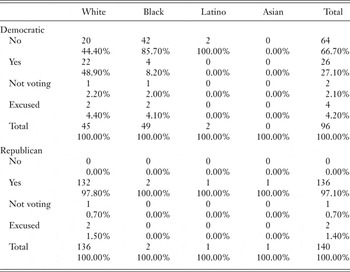
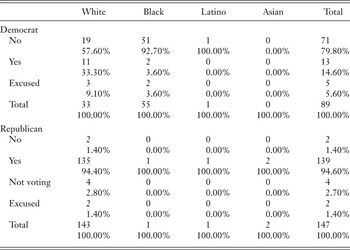
The opposition to SB529 and HB87 reveals how the anti-immigrant laws and ordinances have been contested from inside and outside the state. As Tables 2a and 2b show, African American state legislators overwhelmingly voted against both bills. The two Democratic Latino legislators also voted against SB529 and HB87.
Votes on SB529 by Party and Race/Ethnicity of Legislator

Votes on HB87 by Party and Race/Ethnicity of Legislator

In stark contrast to the Black legislators, White Democrats in the state legislature were almost evenly split on SB529, with twenty-two voting in favor of the bill and twenty opposed. The majority of White Democrats opposed HB87, but by a much smaller margin (56.7%) than did their African American colleagues (92.7%).
Republican votes for SB529 and HB87 showed virtually no difference across race and ethnicity; Republicans of all race/ethnic backgrounds overwhelmingly voted in favor of SB529 and HB87. Not one Republican representative opposed SB529. Two White Republican state representatives opposed HB87. The remaining Republican representatives, including the sole Latino Republican representative (David Casas), voted in favor of HB87.Footnote 7 U.S. Congressman and veteran civil rights activist John Lewis has called immigration “today's civil rights issue” (Ahmad Reference Ahmad2011). Despite these protests, the Republican majority in the Georgia state legislature has ensured that anti-immigration legislation passes.
Anti-immigrant Measures and Impact on Latinos
The racialization of Latinos through discriminatory laws and policies impacts all Latin American residents, but in different ways. Unauthorized immigrants face the most direct and harmful consequences. Denied access to health care, education, and other social services, they have also faced increased levels of police surveillance, arrest, detention, and deportation. Even Latinos who are legal residents and U.S. citizens have been seriously impacted by the anti-immigrant backlash. They too have experienced greater surveillance and harassment by the police. According to a recent study by the Pew Hispanic Center, nearly one in ten Latino adults (8% of native-born U.S. citizens and 10% of immigrants) reported that in the last year the police or other authorities had stopped them and asked about their immigration status (Bauer Reference Bauer2009).
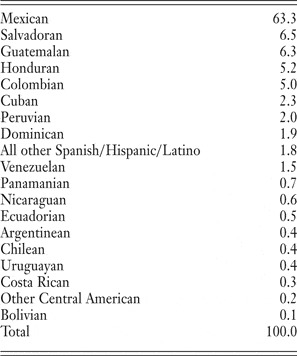
The majority of Latino immigrants who are detained, arrested, or deported under these laws and ordinances are most likely to be Mexican. Over two-thirds of all Latino immigrants in Atlanta are Mexican (Table 3). Guatemalans represent the next largest group of Latino immigrants with a representation of just 5.5%. Thus, in Atlanta, the homogenization of Latinos into a single category that is equated with Mexican and “illegal” is reinforced by the demographics of the metro area.
Percent Representation of Latino Immigrants in the Atlanta Metro Area by Country of Origin ACS 2007–2009 (Ruggles et al., Reference Ruggles, Alexander, Genadek, Goeken, Schroeder and Sobek2011)

The anti-immigrant measures represent a localized racial project of the state as defined by Omi and Winant (Reference Omi and Winant1994). Through targeting Latino immigrants, these measures fuse together the question of legal status with the category of “Latino” both symbolically and practically (the latter through direct actions by law enforcement officers). “Latino” becomes a “race” rather than an ethnicity within the domain of these laws and ordinances, as police and the public identify “Latinos” through particular types of bodies—those that appear “Mexican” and speak with an accent. According to Johnson (Reference Johnson1997), the state is creating and organizing the Latino category as a homogenized, alien, and unwanted race (Saito Reference Saito1997). Legal status thus becomes a second axis in the racialized category of “Latino”; Latinos must demonstrate to government agencies that they are not undocumented immigrants. “Illegal-Latino” and “Legal-Latino” represent two distinct, mutually exclusive and exhaustive categories in state policy and public representations, and Latinos are treated very differently depending on which category they are perceived to occupy.
DIVERSITY AND NEGOTIATING THE HOMOGENIZING FORCES OF RACIALIZATION
Given these expanding anti-immigrant measures, Latinos in Atlanta confront the homogenizing forces of racialization in a range of venues, including interactions with law enforcement officers as well as employees of federal, state, or local agencies that allocate resources on the basis of legal status (Marrow Reference Marrow2009). In addition, the homogenizing equation of “immigrant” with “illegal” and “Latino” (or “Mexican”) also emerges in public discourse. The harsh measures and rhetoric directed against “illegals” has created fear and uncertainty among all Latin American nationality groups in the Atlanta metro area and throughout the United States. For instance, poll data show that most people assume that the majority of Latinos who live in the United States are here illegally (Kaiser Family Foundation 2000). As authors Lopez and Minushkin (Reference Lopez and Minushkin2008) write, “A 2008 Pew Hispanic Center survey of Latinos, including U.S. citizens and immigrants alike, found that nearly one in ten Hispanic adults [in theU.S.]reported that they had been asked by police or other authorities about their immigration status in the past year. More importantly, the study found that 35% of native-born Hispanic citizens (who cannot be deported) worry a lot or some about deportation for themselves or their loved ones” (p. i). As we explain above, these national patterns of fear among Latinos are reflected in the Atlanta metro area (ACLU Foundation of Georgia 2011).
Guatemalan and Dominican immigrants provide a particularly illuminating contrast for understanding racialization, as these two groups come to Atlanta with unique conceptions of “race” from their respective countries of origin and possess different cultural and economic resources with which to negotiate Atlanta's racial hierarchy. The majority of Guatemalan immigrants in Atlanta are indigenous people, primarily Maya. With a population of over four million in Guatemala and Mexico, they form one of the largest indigenous groups in the Americas. Most come from impoverished rural towns and villages in the western highlands of Guatemala where they speak one of more than twenty different Maya languages and where families support themselves as small farmers, rural laborers, or market vendors. Centuries of discrimination and exploitation of their land and labor first by Spanish colonizers and later by the Ladino (European-descendant) elite have left indigenous people impoverished and marginalized within their countries. Pronouncements of Indian inferiority and backwardness by dominant groups have been used to justify and reinforce the subordination of indigenous peoples in Central America and Mexico from the colonial era to the present day.
In striking contrast to the Guatemalan racial project of constructing the “indio” category to signal exclusion, the racial category of “indio” involves a nationalist racial project in the Dominican Republic.Footnote 8 As an island country shaped by Spanish colonialism, the African slave trade, and years of dictatorship, the Dominican Republic engaged in a racial project that virtually eliminated the indigenous population (the Taíno). Dominicans represent a continuum of physical appearance, from dark skin and features that would be considered “Black” in the United States to individuals who would be considered “White” in the United States (Bailey Reference Bailey2001; Duany Reference Duany1998). Individuals in the same Dominican family can vary greatly in their skin tone. Although light skin is accorded higher status in the Dominican Republic, race does not play a strong role in organizing social life (Bailey Reference Bailey2001). Dominicans draw their sharpest racial boundary to distinguish themselves from Haitians (Bailey Reference Bailey2001; Candelario Reference Candelario2007; Duany Reference Duany1998). According to Duany (Reference Duany1998), racial categorization is based upon physical appearance and social status rather than biological heritage. Part of the racial project of the Dominican state under the dictator Trujillo was to vilify Haitians and reserve the racial category of “Black” to connote Haitians. After the death of Trujillo, the Dominican government officially adopted the category of “indio” (indigenous) to distinguish the Dominican Republic from Spain and from Haiti (Duany Reference Duany1998). Thus, unlike the situation in Guatemala, in the Dominican Republic the category of “indio” currently carries a proud, nationalist connotation (Roberts Reference Roberts and Haslip-Viera2001). This racial project is reflected in racial identity among Dominicans living on the island; Dominicans most often refer to themselves as “indio,” “mulato” (mixed) or “trigueño.” Dark-skinned Dominicans may refer to themselves as “indio oscuro” (dark Indian).
Guatemalan and Dominican immigrants in Atlanta also differ in their migration and settlement patterns. The majority of Guatemalans in Atlanta are Maya who come from rural areas. Most of Atlanta's Maya speak an indigenous language as their first language. Spanish is the second language for the majority of Maya, and is spoken with a range of fluency (Odem and Browne, Reference Odem and Browne2011). Other Latin American immigrants recognize—and some even ridicule—the way that the Maya speak Spanish. In contrast, many Dominicans in Atlanta come from cities in the Dominican Republic, Puerto Rico, or the United States. Irrespective of their local origin and migration patterns, Dominicans share the language of Spanish (unlike the Maya).
Once they arrive in Atlanta or other cities in the United States, Guatemalans and Dominicans encounter the category of “Latino” or “Hispanic” for the first time, and confront a conception of “race” very different from the one they experienced in their respective countries of origin (Arriaza Reference Arriaza2004; Bailey Reference Bailey2007). Guatemalans and Dominicans must therefore negotiate their way to their own understandings of “race” with those of other Latinos on the one hand and a homogenized view of “Latino” perpetrated by the state and U.S. public perception on the other hand. The Maya may appear “Mexican” to native Atlantans, but they are read as “indigenous” to other Latino groups, a designation which places them at the bottom of the status hierarchy. The skin color and physical appearance of many Guatemalans fit the stigmatizing stereotype of “illegal,” which holds the potential to trigger discriminatory remarks and behavior from White and Black native Atlantans (Rodriguez and Menjívar, Reference Rodriguez, Menjívar, Duany and Feagin2009).
One important strategy that Guatemalan Maya have mobilized to resist racial homogenization has been to create pan-Mayan community associations.Footnote 9 Drawing on a tradition of organizing religious community organizations in Guatemala, a group of Maya in north Georgia formed a Maya Catholic organization in 1999. At its inception, a small group of people met for a weekly prayer group. By the second year the group claimed approximately one hundred members and included Maya of diverse language groups (Mam, Quiché, Q'anjobal, Chuj) and regions (Huehuetenango, San Marcos, Quiché, Chimaltenango, and Quezaltenango). The group first called itself El Ministerio de Evangelización a la Virgen de Asunción (the Virgen de Asunción is the patron saint of Guatemala) and later changed its name to Proyecto Pastoral Maya (Maya Pastoral Project) when it joined a national network of Maya Catholic groups, supported by the U.S. Catholic Church. Pastoral Maya offers spiritual, social, and material support to the Maya migrants struggling to support their families in North Georgia through a range of programs. Activities aimed at enhancing social bonds among group members include a weekly Saturday evening meeting of prayer, singing, and socializing; the formation of two choirs; Spanish Mass on Sunday evenings in the parish church; regular house visits to Maya immigrants in need; religious services and cultural celebrations for Christmas, Holy Week, Mother's Day, and the feast day for Santa Eulalia, the patron saint who gave her name to the hometown of the original prayer group members.
Leaders of Atlanta's Pastoral Maya participate in a meeting of the national network that is held almost every year. At the national meeting in 2009, attendees discussed whether they should keep the current Catholic Church administrative category of “Migrants, Refugees, and Travelers” or change the category designation to either Hispanic or Native American. The approximately one hundred community leaders in attendance voted overwhelmingly for the Native American designation. In the discussion leading up to the vote, Maya participants expressed a desire to maintain ethnic distinctiveness in relation to the Hispanic population and to distance themselves from the category of “migrant.” As one of the speakers remarked, “The identity of the migrant is seen as destructive and illegal, I do not see myself this way…. We are discriminated in Guatemala for being Maya, and in the USA for being migrants. I know myself as Mayan, and whatever the United States does to me will not impact my sense of self” (LeBaron Reference LeBaron2009, p. 8).
Forming and sustaining Pastoral Maya have been facilitated by the geographic concentration of Maya in specific neighborhoods within the Atlanta metro area. This organization provides resources and support for Maya living in Atlanta and also asserts their specific Maya identity.
In contrast to the successful organizing strategy of the Maya, a few Dominican community leaders have created Dominican professional or community organizations but these organizations have not been sustained longer than a few years.Footnote 10 For instance, an aspiring Dominican community leader successfully spearheaded the effort to make the town of Salcedo in the Dominican Republic the Sister City of Atlanta.Footnote 11 The Sister City organization sponsors a celebration of Dominican Independence Day at the capitol building every year, but has not mobilized a large following and has not organized the many types of activities that Pastoral Maya offers. Many Dominicans belong to churches with large Latino constituencies. These churches offer social and material support to alleviate the negative effects of anti-immigrant policies but do not provide a unique “Dominican” identity. Symbolic resistance to the forces of homogenization at the organizational level is thus extremely limited among Dominicans.
In addition to their different organizational responses to racialiation, Guatemalan Maya and Dominicans also deploy different strategies to negotiate race through social interaction. Given that “racialization” involves assigning racial categories to particular types of bodies, it is significant that Guatemalans appear “Mexican” to non-Latinos, and most Dominicans do not (Itzigsohn Reference Itzigsohn2009; Omi and Winant, Reference Omi and Winant1994). In fact, some Dominicans find that they can “pass” as Black, which could engender race-based discrimination or enhance access to the resources enjoyed by Atlanta's large and vibrant Black middle class (González Reference González2006).
Dominicans may respond to the perceived lower status of Mexicans by distancing themselves from that group and asserting a racial identity that includes “not Mexican” (Browne and González, Reference Browne and González2010). For instance, in a study of discrimination among middle-class Dominicans in Atlanta, one respondent explained:
When we talk to people, we immediately clarify that we're Dominican. I'm being very honest; we don't like to be confused with Mexicans…. Because they immediately think that you might be illegal, that you might not speak English, or that you might not be educated
(Browne and González, Reference Browne and González2010, p. 14).The salience of the popular perception that “Hispanic” or “Latino” equals “Mexican” is illustrated in an interview with Felipe, a Dominican physician, who was asked by a native Atlantan, “What country are you from?” (You are Dominican.) “Ah … in which part of Mexico is that?”Footnote 12
Some Dominicans resist the notion or importance of “race” itself, emphasizing that this is a uniquely American concept and that in the Dominican Republic class is a much more salient status category than race. For instance, in an interview conducted by Browne (2009), one Dominican respondent living in Atlanta explained, “In the Dominican, we don't have a race issue at all. We have a class issue on the other hand. So we try to raise [the children to] have friends of any kind of race” (p. 12).Footnote 13
CONCLUSION
Our research demonstrates the complexity and constant ambiguity of social constructions of “race” in relation to Latinos. Given the diversity of the Latino population, debates over how “Latinos” will change or fit into existing race categories of Black and White often miss the contingent and complex dynamics of racialization. These debates focus on the question of whether the category of “White” or “Black” will expand to encompass Latinos, or whether Latinos will forge a middle, “Brown” category (Forman et al., Reference Forman, Goar and Lewis2002; Frank et al., Reference Frank, Akresh and Lu2010). But given the legal/illegal axis of the “Latino” category, they do not fit easily into the existing race schema as “White,” “Black” or “Brown” unidimensional categories. In addition, the categories of “race” play out differently for different groups of Latinos within the specific political, economic, social, and demographic context of place.
Comparing Guatemalan and Dominican immigrants in Atlanta highlights the importance of looking at the local and group-specific processes of racialization. Thus, although the state and popular discourse homogenize “Latinos” into a single group, social theory and empirical research must consider the specific national origin and ethnicity of Latino immigrants (and non-immigrants) within specific locales.
The Maya have access to faith-based community organizing that emphasizes their indigenous identity. Dominicans can rely on their physical and cultural dissimilarity to Mexicans (the default homogenized “Latino”) and their Afro Caribbean background which, in some cases, allows them to “pass” or identify as “Black.” Thus, “ethnicity” becomes a symbolic resource that a group uses to negotiate race.
In addition, the size of the national and ethnic Latino group and how the group is positioned vis-à-vis other Latin Americans are both important in local processes of racialization. Because of their small numbers and relative recent arrival in Atlanta, Dominicans in Atlanta encounter circumstances very different from those met with by Dominicans in New York, Providence, Boston, or Miami (Candelario Reference Candelario2007; Guarnizo Reference Guarnizo1994; Itzigsohn Reference Itzigsohn2009; Levitt Reference Levitt2004.) These circumstances affect how Dominicans are perceived by native Atlantans and influence the resources available to Dominicans with which to negotiate race (Guarnizo Reference Guarnizo1994).
We predict that social class and gender also influence the material and symbolic resources available to specific groups of Latinos as they negotiate categories of race. For instance, as day laborers, working-class Guatemalan men are vulnerable to anticongregating ordinances in ways that Guatemalan women and middle-class Guatemalan men are not.
Debates over whether Latinos will reproduce the Black/White binary or create a Black/Brown/White triad also fail to consider the multidimensional characteristic of “race” that is created through the current racial projects of state and local jurisdictions. Anti-immigration legislation fuses a homogenized category of “Latino” with the illegal/legal axis of distinction in its implementation and in public representations. Future research on Latinos and racialization should take into account how “unskilled illegal” becomes the unmarked Latino racial category, and explore the “work” that Latinos must do to mark themselves as “legal” (Bohon and Parrott, Reference Bohon, Parrott, Lippard and Gallagher2010). Analyzing these geographic and historically situated processes calls for expanded theories of “race” in the United States. Theories based on racialization of African Americans, in which the “one drop rule” reigns supreme, cannot adequately capture these multivalenced dynamics (Krysan and Lewis, Reference Krysan and Lewis2004; O'Brien Reference O'Brien2008).