Coronary artery disease (CAD) is the result of the accumulation of atherosclerotic plaques within the walls of the coronary arteries leading to narrowing of the blood vessels, heart failure, angina pectoris, and myocardial infarction. CAD has become most common cause of morbidity and mortality worldwide (Reference Deaton, Froelicher, Wu, Ho, Shishani and Jaarsma1). In addition to epidemiological challenges, there is growing concern about the increasing economic burden of CAD on health systems throughout the world (Reference Trogdon, Finkelstein, Nwaise, Tangka and Orenstein2). Coronary artery bypass graft (CABG) and percutaneous coronary intervention (PCI) are the most common revascularization procedures for patients with multivessel CAD. Up to now, clinical outcomes of the CABG and PCI over long-term follow-up have been compared in several studies and have demonstrated that the CABG and PCI provided a similar degree of protection against death and myocardial infarction (Reference Naik, White and Chakravarty3;Reference Hlatky, Boothroyd and Bravata4), although most of them also have shown that patients who underwent PCI are much more likely to require repeat procedures (Reference Hlatky, Boothroyd and Bravata4;Reference Takagi, Kawai and Umemoto5). The repeat revascularization is usually considered an adverse clinical and economic event, because it may be associated with short-term impairment in quality of life and higher cost.
Given similarity in clinical outcome of these treatment, other aspect including quality of life and cost-effectiveness become increasingly relevant in choosing the best strategy. Hitherto, several studies have been conducted to compare the cost-effectiveness of these interventions in developed countries (Reference Vieira, Hueb and Hlatky6–Reference Stroupe, Morrison and Hlatky8). Despite increasing burden of CAD in developing countries (Reference Morabia and Abel9) and severe shortage of resources, there is a limited knowledge about cost and effectiveness of these treatments in these countries.
The cost-effectiveness analysis is a multifactorial analysis, the results of which depend on several types of information, including disease prevalence, health service usage patterns, and cost and disease progression, which can be different between countries. For example, poor participation in cardiac rehabilitation programs after an invasive clinical procedure such as CABG in Iran compared with developed countries can affect total quality-adjusted life-years (QALYs) gained from CABG compared with other low invasive interventions and finally its cost effectiveness. Moreover, no simple rule is available to indicate how the results of cost-effectiveness studies in developed countries might translate to healthcare delivery settings in developing countries like Iran. Therefore, we designed this study to determine the cost-effectiveness of CABG versus PCI to assist decision makers in efficient use of limited health resources.
STUDY DESIGN AND SUBJECTS
This study was an economic evaluation conducted from Iran's society perspective. A Markov model has been developed to determine the cost-effectiveness of CABG compared with PCI. We used the model to calculate lifetime costs, life-years (LYs), and QALYs of each strategy. The incremental cost effectiveness of CABG versus PCI therapy was defined in terms of the ratio of the difference in lifetime costs to the difference in QALYs. The expected costs and consequences of two strategies were compared using a 5 years, 10 years, and life-time time horizon (modeling within patient's life expectancy). We used 5 percent and 3 percent annual discount rate to discount future costs and QALYs respectively (Reference Tessa, Baltussen and Adam10). We assumed that transitions between health statuses occurred annually and their probabilities were derived from previous studies.
To estimate direct medical cost and health-related quality of life (HRQoL), a follow-up study was conducted on patients with multivessel CAD who underwent coronary revascularization with either PCI with stents or CABG. Before enrollment, patients received detailed written and verbal information regarding the aims and protocol of the study and signed informed consent. If patients had the ability to answer the questions, they filled it out personally; otherwise a trained interviewer collected the necessary data through face-to-face interviews with respondents. The study has been approved by the Ethics Committee of the Isfahan University of Medical Sciences. Patients were excluded if they had prior PCI, CABG, or also required valve surgery and passed less than 6 months from their treatment.
Effectiveness
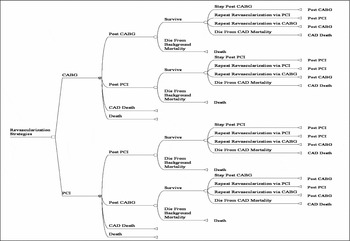
As mentioned, heretofore several randomized clinical trials have compared clinical outcome of CABG and PCI with or without stenting, but recently an outstanding study has been conducted by Hlatky et al. (Reference Hlatky, Boothroyd and Bravata4). They conducted a combined analysis of individual data from ten randomised trials of patients with multivessel CAD to assess clinical outcome of CABG and PCI over a median follow-up of 5.9 years. They found that death or myocardial infarction was not significantly different between two groups, but repeat revascularization was significantly lower in patients assigned to CABG. Also, Daemen et al. (Reference Daemen, Boersma and Flather11) performed a pooled analysis of 3,051 patients from four randomized trials to evaluate the relative safety and efficacy of PCI with stenting compared with CABG at 5 years for the treatment of multivessel CAD and found that incidence of death, myocardial infarction, and stroke was similar in two groups. Therefore, we constructed our Markov model with four health states: post CABG, Post PCI, CAD Death and Death from background mortality (Figure 1). We adopted different probability of CAD death for patients in different age group in CABG and PCI group (Reference Hlatky, Boothroyd and Bravata4).
Structure of the Markov model.

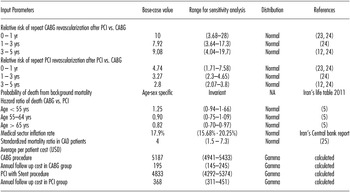
Hazard ratio of repeat revascularization by CABG or PCI in two groups during 5 years after first revascularization has been derived from previous studies and applied in the model. Annual transition probabilities of repeat revascularization for each cycle have been calculated using p = 1- e−rt formula: where p is probability, e is base of natural logarithm, r is event rate, and t is time period (Reference Gray, Clarke, Wolstenholme and Wordsworth12). The linear interpolation has been used to estimate interval probabilities where the studies reported cumulative event rate. We assumed probabilities of repeat revascularization after 5 years were same as fifth year in each group (Reference Investigators13;Reference Henderson, Pocock and Sharp14). Finally a cohort of patients with mean age of 53 years (mean age of our samples) was simulated through the model and expected cost and QALY was calculated.
The MacNew Heart Disease instrument, which is a disease specific questionnaire designed to measure HRQoL in patients with cardiac disease, has been used to assess how fast patients would be returned to a stabilized health status after two interventions. The MacNew consists of twenty-seven questions that inquire about symptoms like: angina/chest pain, shortness of breath, fatigue, dizziness, and aching legs and finally summarized into three main domains, emotional, physical, and social well-being. Because this instrument is not validated to be used in QALYs calculation, health utilities has been derived from local studies. In a study by Tofighi et al. (Reference Tofighi, Ahmad Kiadaliri, Sadeghifar, Raadabadi and Mamikhani15), health status of CAD patients after CABG and PCI has been reported with a 3 years follow-up. Health utilities has been estimated using an algorithm which created by Ara and his colleague (Reference Ara and Brazier16) to estimate preference-based SF-6D scores from the eight mean health dimension scores derived from the SF-36 questionnaire.
Costs
To estimate costs, medical records of the subjects were used to extract costs of physician services; pharmaceutical and device, laboratory or diagnostic tests, inpatient and other related resource which they received during initial revascularization in two groups. Out patients costs and frequency of subsequent hospitalizations for both groups were queried during 2 years of follow-up. We did not include the costs of informal care supplied by family members or time lost from work or usual activities (indirect cost). The total costs over this period were estimated by multiplying the number of each care by unit costs for each type of care and the resulting total cost was then annualized. With the occurrence of a new revascularization, the cost was added according to the standard cost of the each intervention. To have an international perspective, the costs were converted from Iranian Rials (IRR) into USD at an official currency exchange rate of 11,000 IRR/1 USD (2011) (17).
Statistical Analysis
We studied the association between the groups’ in qualitative variables by chi-squared test. The Wilcoxon signed ranks test was used to compare means between the two groups. All statistical tests were two-sided and the significance level was set at .05. Confidence intervals were calculated using the bias-corrected accelerated (BCA) percentile bootstrapping method for cost and HRQoL. For base case analysis the Markov model was simulated to calculate the expected proportion of patients who would repeat revascularization by means of PCI or CABG in two groups. The expected costs of each strategy, QALYs, incremental cost-effectiveness ratio (ICER), and net monetary benefit (NMB) have been estimated for 5 years, 10 years, and life-time time horizon. Because the ICER has poor statistical properties within the range of values relevant to this study, we calculated the NMB too by assigning a monetary value to a unit of effectiveness (ceiling rate [CR]), and multiplying it by the net number of units of effectiveness achieved. The value CR represents the maximum amount that society would be willing to pay for the incremental improvement in health. According to the world health organization guideline, medical interventions with an ICER of less than three times gross domestic product (GDP) per capita per QALY are generally considered to be cost-effective (Reference Fenwick and Byford18). The Model robustness was tested in a probabilistic sensitivity analysis (PSA) to determine the effect of all parameter uncertainty simultaneously within the model using Monte Carlo simulation, with a generation of 1,000 trials. Ranges and distributional assumptions for variables were based on actual data and literature values (Table 2). Cost and health utilities were varied on the basis of their actual 95 percent confidence intervals. We assigned normal distribution for hazard ratios and relative risks and health sector inflation rate, Gamma distribution for cost and beta distribution for transition probabilities and health utilities.
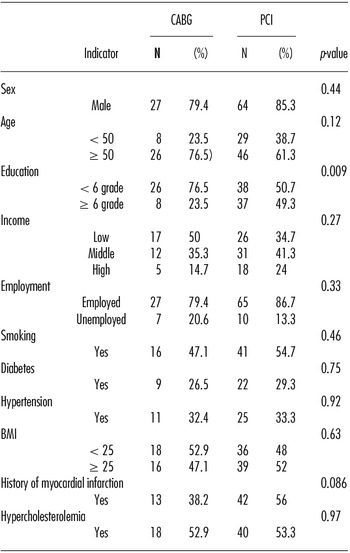
Characteristics of Patients in CABG (n = 34) and PCI (n = 75) Group

Input Parameter Values and Distributions

RESULTS
Patient Characteristics and Estimated HRQoL and Annual Cost
We identified 389 patients that underwent coronary revascularization at Chamran Heart Center of Isfahan, between March 2010 and September 2010. From them, 150 were eligible to enter into the study based on inclusion and exclusion criteria. Finally 109 (73 percent) patients (PCI [n = 75] and CABG [n = 34]) consented to enter the study. From all recruited patients, 109 and 106 completed the study in first and second year respectively (one patient in CABG and two patients in PCI group died during follow-up period). Baseline characteristics of the studied patients are summarized in Table 1. The two groups were tested for significant differences regarding socio-demographic and main comorbidity and clinical variables. As seen, the groups can be considered equivalent with no statistically significant differences between them (p > .05) except in education level (p = .009). The mean age of the patients in CABG and PCI group were 53.2 ± 5 and 51.2 ± 6.2 years, respectively, did not show a significant difference (p = .207).
HRQoL of patients in CABG and PCI group at the first year were 0.45 ± 0.13 and 0.53 ± 0.15, respectively (p = 0.02), reflecting the more invasive nature and prolonged recovery of the CABG compared with PCI. Although at the second year HRQoL of patients were 0.51 ± 0.14 and 0.49 ± 0.16 in CABG and PCI group and did not show a significant difference (p = .41). The annual direct medical cost per patient including initial revascularization and follow-up cost at the first year were significantly higher in patients who underwent CABG (USD 5,187 ± 733) than PCI (USD 4,833 ± 2,390) (p < .001). Also estimated annual per capita costs at the second year were USD 195 ± 149 and USD 368 ± 249, respectively, in CABG and PCI group (p < .001).
Base-Case Cost-Effectiveness Analysis
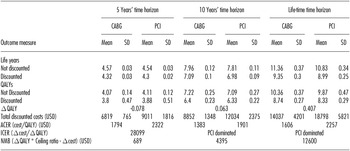
Our base-case analysis showed estimated total discounted life years lived per person in CABG group were (4.32 ± 0.03 in 5 years’ time horizon), (7.09 ± 0.1 in 10 years’ time horizon), and (9.35 ± 0.3 in lifetime time horizon) compared with 4.3 ± 0.02, 6.98 ± 0.09, and 8.99 ± 0.25 in three different time horizons in PCI group. When the health utilities added in survival analysis, we found that total discounted QALYs lived per person in three time horizons in CABG group compared with PCI group were (3.8 ± 0.13 versus 3.88 ± 0.14), (6.4 ± 0.23 versus 6.33 ± 0.22), and (8.74 ± 0.29 versus 8.33 ± 0.27), respectively (Table 3).
Results of Base-Case Analysis

Our results revealed that total cost per patient in the CABG group was lower than in the PCI group in all time horizons (USD 6,819 ± 765 versus 9011 ± 1816), (USD 8,852 ± 1,348 versus 12,034 ± 2,375), and (USD 14,037 ± 4,201 versus 18,798 ± 5,821), respectively. Also estimated average cost-effectiveness ratio (ACER) in three time horizons for CABG and PCI group were (1,794 versus 2,322), (1,383 versus 1,901), and (1,606 versus 2,257), respectively (Table 3). The ICER showed CABG is a dominant alternative in 10 years and lifetime time horizon.
Sensitivity Analysis
In the Monte Carlo simulation, we established a threshold of three times of the Iranian GDP per capita (2011), which represents USD 19,260 and evaluated how many simulations fell below this value. We simulated 1,000 sets of values of the input parameters and expected lifetime costs and QALYs for each strategy were calculated for each simulation. The result showed base case results did not change and the probability of being cost-effective was higher with CABG compared with PCI in each time horizon, although the probability will increase when we expand the time horizon (see Supplementary Figure 1, which can be viewed online at http://dx.doi.org/10.1017/S0266462314000439).
DISCUSSION
The CAD imposes high burden on communities in worldwide in terms of premature mortality, adverse effects on quality of life, and economic impacts on families and health systems (Reference Habib and Saha19). Therefore, economic evaluation of different mode of interventions is so important to defining a comprehensive and optimum plan of care. Although there are some studies which investigated the cost-effectiveness of CABG versus PCI in developed countries, there are many reasons that prevent results of them being fully applicable in developing countries, including healthcare system variables, relative cost of human resources and capital in developing countries compared with developed world, quality of life of patients, and so on. Therefore, we constructed a Markov model based on results of combined analysis of randomized trials and local data on cost and quality of life of multivessel CAD patients to compare cost-effectiveness of CABG versus PCI.
In this study, after proving similarity of socio-demographic and clinical characteristics in the two groups of patients, data analysis revealed, those who underwent PCI experienced significantly higher HRQoL in the first year after revascularization, but over 2 years of follow-up, there was no significant difference between two groups. Because of these early differences, QALY was lower in the CABG group than PCI after the first year and remained lower through the first 5 years of follow-up. Based on a study by Bravata et al. (Reference Bravata, McDonald and Gienger20) which assessed the effectiveness of CABG and PCI in patients with CAD using eleven randomized trials, HRQoL scores improved to a significantly greater extent after CABG than after PCI between 6 months and 3 years of follow-up but equalized thereafter.
We found that at the first year annual medical costs per patient in the CABG group were higher than in the PCI group, but during second year of follow-up, patients in the PCI group experienced higher rates of healthcare usage and cost. In accordance with our results, almost all the studies identified in our review reported higher initial cost of CABG compared with PCI (Reference Vieira, Hueb and Hlatky6;Reference Cohen, Lavelle and Van Hout7). However, due to lower relative cost of human resource compared with imported medical devices such as stents in Iran as a developing country, the difference between initial costs of two methods was lower than those reported in developed countries.
Our results indicated that CABG is a dominant revascularization method compared with PCI with stenting especially in long-term time horizon with lower total cost and higher QALY gained. Most recently, Vieira et al. (Reference Vieira, Hueb and Hlatky6) conducted a study to compare economic outcome of the three therapeutic strategies including CABG, PCI, and medical treatment at 5-year follow-up. They concluded that adoption of prompt revascularization, with PCI or CABG, is more expensive and less cost-effective than providing an initial optimal medical treatment but when revascularization becomes necessary, surgical therapy is the most cost-effective. Stroupe et al. (Reference Stroupe, Morrison and Hlatky8) conducted another study to investigate cost-effectiveness of PCI versus CABG. Total costs were assessed at 3 and 5 years from the third-party payer's perspective and effectiveness was measured by survival. They found PCI was less costly and at least as effective for the urgent revascularization of medically refractory high-risk patients.
Cohen et al. (Reference Cohen, Lavelle and Van Hout7) carried out another study from the perspective of the U.S. healthcare system to evaluate CABG versus PCI with drug-eluting stents in patients with three-vessel or left main coronary artery disease. In agreement with our finding, they found that total costs for the initial hospitalization were higher in CABG group, whereas follow-up costs were higher in the PCI. Total 1-year costs per patient were USD 3,590 higher with CABG, while quality adjusted life expectancy was slightly higher with PCI. They concluded PCI is an economically attractive strategy over the first year for patients with low and moderate angiographic complexity, while CABG is favored among patients with high angiographic complexity.
Hlatky et al. (Reference Hlatky, Rogers and Johnstone21) investigated cost and quality of life of 934 patients with CAD who underwent CABG or PCI, the patients randomized to CABG and PCI and followed up for 10 to12 years. They found that CABG had 53 percent higher costs initially, but the gap closed to 5 percent during the first 2 years and after 12 years, the mean cumulative cost of CABG and PCI were USD 123,000 and USD 120,750, respectively, yielding a cost-effectiveness ratio of USD 14,300 per life year gained. In agreement with our finding they concluded early differences between CABG and PCI in costs and quality of life were no longer significant at 10 to 12 years of follow-up and CABG was cost-effective revascularization procedure when compared with PCI. Our result highlighted that to minimize bias, it is necessary to make an economic analysis in a long-term time horizon.
Synthesis of literature showed that almost all of the previous studies which compared cost-effectiveness of CABG and PCI have been conducted alongside clinical trials. Given that clinical trials are usually too short in length of follow-up to capture economically important outcomes, and on the other hand, these studies have demonstrated that trend of overall cost and effect of each strategy changed and depended on follow-up length. Therefore, it will be important to incorporate long-term cost and effect of the CABG and PCI through appropriate models to make unbiased decision about cost-effectiveness of these interventions. Hence, we used a Markov model to capture future costs and events in evaluation of two strategies within a long-term time horizon. We used the MacNew Heart Disease HRQoL because it is disease specific questionnaire, and it is more sensitive than generic HRQoL measuring instruments to illustrate the impact of different treatment methods and disease's effect on HRQoL. Moreover, using local cost and health utilities data in our analysis has made our results more applicable in local health policy making.
Nonetheless some limitations of our modeling should be mentioned and considered in interpreting results. First, due to lack of local data, we obtained transition probabilities from the international literature. These parameters may therefore be different in Iranian patients. For example, some studies have shown that there is a higher short-term mortality following PCI among patients in developing countries compared with their counterparts in developed countries. One reason for this can be later arrival of patients to the healthcare centers, which can lead to less effectiveness of the procedures or more extensive myocardial damage at the time of the procedure, especially in PCI (Reference Ayanian22). A higher rate of repeated procedures after PCI can cause the CABG to be more cost-effective than PCI. Poor participation in cardiac rehabilitation programs after invasive clinical procedure such as CABG in Iran compared with developed countries can decrease total QALYs gained from CABG compared with PCI, the cost-effectiveness of CABG would be less favorable than suggested by our current data.
Second, we did not include myocardial infarction, presence or absence of angina symptoms, and stroke in the model, as we observed only a non-significant trend for them to be more frequent in the CABG or PCI method. Third, informal care and indirect costs were not included in the model, while this cost can be different in two groups. Fourth, one of the main limitations of the model is small sample size and the possibility that the included population may not be representative of the population of patients with CAD in Iran. Although our estimates of medical costs were based on data from a province in Iran. We do not believe that this approach detracts substantially from our findings, because most procedural costs were estimated using national average healthcare tariffs.
In general, this study demonstrated higher initial revascularization costs and lower HRQoL with CABG but due to the higher rate of repeat revascularization after PCI and regarding HRQoL scores improved to a significantly greater extent after CABG than after PCI, therefore CABG is a cost-effective alternative in Iran especially in long-term time horizon.
SUPPLEMENTARY MATERIAL
Supplementary Figure 1: http://dx.doi.org/10.1017/S0266462314000439
CONTACT INFORMATION
Mehdi Javanbakht, M.Sc, Ph.D., (m.javanbakht@abdn.ac.uk), Institute of Applied Health Sciences, University of Aberdeen, Polwarth Building, Foresterhill, Aberdeen, Scotland, AB25 2ZD
Razieh Yazdani Bakhsh, M.Sc, Isfahan University of Medical Sciences, Isfahan, Iran
Atefeh Mashayekhi, M.Sc, Tehran University of Medical Sciences, Tehran, Iran
Hossein Ghaderi, M.Sc, Ph.D., Health Economics Department, School of Health Management and Information Sciences, Iran University of Medical Sciences, Tehran, Iran.
Masoumeh Sadeghi, MD, Cardiac Rehabilitation Research Center, Isfahan Cardiovascular Research Institute, Isfahan University of Medical sciences, Isfahan, Iran
CONFLICTS OF INTEREST
The authors have declared that no competing interests exist.