




No CrossRef data available.
International Master's Program in health technology assessment and management: Assessment of the first edition (2001–2003)
Published online by Cambridge University Press: 02 March 2005
Abstract
Background: Despite a clear call for greater input from health technology assessment (HTA) in the areas of clinical practice and policy making, there are currently very few formal training programs. The objectives of our Consortium were to (i) develop a master's level program in HTA, (ii) test its content with a group of Canadian and European students, and (iii) evaluate the Program's strengths and weaknesses.
Objectives: This study presents the results of our evaluation of the first edition of the Master's Program (2001–2003).
Methods: The evaluation relied on (i) a self-administered student questionnaire for each course (n = 142), (ii) interviews with students (n = 10), and (iii) interviews with internship supervisors (n = 5).
Results: A vast majority of students were satisfied with the course content and particularly appreciated the exercises and materials presented in an intensive format. However, they needed more systematic feedback from faculty members and recommended increasing the methodology content. The six key characteristics of the program are (i) flexible format adapted to the needs of skilled professionals, (ii) continuous interaction between HTA users and producers, (iii) international academic and professional collaboration, (iv) partnership with HTA agencies, (v) global approach to evidence-based methods and practices, and (vi) multidisciplinary approach.
Conclusions: Despite the numerous organizational barriers inherent to creating an international program and several areas for improvement in the Program itself, the Ulysses Project was successful in attaining its objectives. Because there is a growing need for human resources with special training in HTA, further efforts need to be devoted to strengthening the international research capacity in HTA.
Information
- Type
- RESEARCH REPORTS
- Information
- International Journal of Technology Assessment in Health Care , Volume 21 , Issue 1 , January 2005 , pp. 104 - 112
- Copyright
- © 2005 Cambridge University Press
A NEED FOR HIGHER TRAINING IN HTA
Most industrialized countries have adopted a formal policy for promoting health technology assessment (HTA) (1). In Canada, the Romanow Commission Report, submitted in November 2002, stressed the importance of HTA in decision and policy making (16). In Europe, developments in HTA have occurred in several countries, including Spain (7) and Italy (5). Despite such a clear call for greater input from HTA in policy-making, there are, however, very few formal graduate programs in existence. Faculty members who teach HTA are spread over a large number of universities around the world, and very few universities possess the expertise needed to offer a complete graduate program (4). Nevertheless, there is an important and growing need for human resources trained in HTA. This need is particularly evident in HTA agencies, university teaching hospitals, and health-care planning and financing organizations (10). Indeed, analysts and policy-makers are being formally encouraged to use more input from HTA reports in their decision making (16).
These observations prompted a Consortium of five universities and five HTA agencies to apply, in 1999, for funding from the joint European Community–Canada Programme for Cooperation in Higher Education and Training. Our proposal was reviewed favorably and selected for funding. Between January 2000 and June 2003, our specific objectives were to (i) develop a master's level program in HTA, (ii) test its content with a group of Canadian and European students, and (iii) conduct a strategic and formative assessment of the Program.
In this study, our objective is to present the results of the Program's evaluation and to focus particularly on the students' perspectives. By highlighting the Program's strengths and weaknesses, we wish to share with the HTA community the lessons we have learned throughout this initiative.
OVERVIEW OF THE ULYSSES PROGRAM
Governance and development of the Program
The Master's Program is the product of a joint effort of an international consortium that combines the expertise of five universities and five HTA agencies in Europe and Canada:
- Department of Health Administration, Faculty of Medicine, University of Montreal, Quebec, Canada
- Departments of Epidemiology and Biostatistics, and Occupational Health, Faculty of Medicine, McGill University, Quebec, Canada
- Faculty of Medicine/Faculty of Administration, University of Ottawa, Ontario, Canada
- Department of Medicine, Faculty of Medicine, University of Barcelona, Spain
- Università Cattolica del Sacro Cuore (Catholic University of Rome; UCSC), Policlinico Universitario “Agostino Gemelli” (Agostino Gemelli Polyclinic), Italy
- Agence d'évaluation des technologies et des modes d'intervention en santé (Quebec Health Services and Technology Assessment Agency; AETMIS), Quebec, Canada
- Institute for Clinical Evaluative Sciences (ICES), Ontario, Canada
- Agència d'Avaluacio de Tecnologia i Recerca Mèdiques (Catalan Agency for Health Technology Assessment and Research; CAHTAR), Spain
- Agenzia per i Servizi Sanitari Regionali (Regional Health Care Agency; ASSR), Italy
- Agenzia di Sanità Pubblica della Regione Lazio (Agency for Public Health—Lazio Region; ASP), Italy
As required by the Canada–EC Programme guidelines, the list includes organizations from two different European member states and two Canadian provinces. The funds allocated could be used to cover coordination and curriculum development, the use of information technology, and faculty and student mobility.
Creation of Five Unique Administrative Solutions at the Participating Universities
It is not easy to harmonize a curriculum jointly offered by different universities (12). During the first 2 years of the Ulysses Project, Coordinating Committee members were responsible for locally negotiating official recognition of the Master's Program. In most institutions, this process proved to be a bureaucratically lengthy, time-consuming process. A new program has been established at the University of Montreal, the Catholic University of Rome, and the University of Barcelona, while both McGill University and the University of Ottawa have created a new option within an existing master's program. There is some variation between universities with respect to the total number of credits (45 versus 48) and the options offered to students. One issue on which our collaborators could not exert much influence was student tuition fees, which are usually set by the university's higher administration.
Target Clientele
Due to the multidisciplinary and action-oriented nature of HTA, physicians, nurses, health scientists, ethicists, lawyers, biomedical engineers, social scientists, administrators, and policy-makers are all potential candidates for a master's program in HTA. The needs of these candidates, who often work full-time and possess solid experience in their discipline, are not well met by traditional graduate programs (2). We targeted two groups of students: (i) evaluators who produce HTA reports, and (ii) decision-makers at all levels of the health-care system who use HTA reports. This specialized master's program enables all participants to grasp the fundamental principles behind HTA and to use scientific results more systematically. Furthermore, participation in the program should foster a long-overdue dialogue between health policy-makers and researchers (9;11).
Structure and Content of the Program
The Ulysses Program relies on four intensive modules that each comprises two courses. Each module lasts 13 days, including 1 day off, for a total of 40 hours of teaching per course. In addition to these course requirements, students complete an internship and/or a master's thesis, or a policy analysis project. The following topics are covered:
- Understanding what HTA is all about: Course 1 (Principles and Practice in HTA)
- Learning how to do HTA: Course 2 (Methods in HTA) & Course 3 (Economic Evaluation)
- Understanding the implications and role of HTA: Course 4 (Health Policy Analysis) & Course 6 (Ethical and Social Issues, Dissemination, and Impact of HTA)
- Learning how to use HTA: Course 5 (Management of Health Organizations) & Course 7 (Clinical Practice Guidelines and Decision Aids)
- Applying what has been learned: Internship & Course 8 (presentation of student project/thesis).
First Cohort of Students
A total of twenty-three students completed all course work. The academic backgrounds and employment status of the students were diverse: eight students were women (35 percent); four were 30 years of age or younger (17 percent); eight were trained in medicine (35 percent), four in engineering (17 percent), five in health sciences (22 percent), five in social sciences or administration (22 percent), and one in law (0.4 percent). Nineteen of the students (83 percent) were working full time in health-related institutions.
Pedagogical Activities between Modules: E-Debates
Given the spread of time zones between Canada and Europe, the Consortium decided to use asynchronous e-mail exchanges to initiate e-debates, a pedagogical activity whose purpose was to maintain links between students and faculty members and foster discussion of some of the policy and methodological issues taught in the modules (13). Two e-debates were organized (March 2002 and January 2003). The first debate examined the methodological challenges in assessing telemedicine, whereas the second debate focused on drug reimbursement policies. In both cases, reading material and a brief list of questions were sent to students. Faculty members moderated the discussions. A summary of the key points discussed and several take-home messages were provided at the end of each debate.
Internships
Some universities required students to complete an internship at either an HTA agency or relevant HTA-user unit. Participants doing an internship were expected to (i) learn how to plan, carry out, and present an HTA report or an HTA-based policy document; (ii) learn how to work in a team; (iii) learn how to apply and refine methodological tools; and (iv) have the opportunity to work in a different cultural and political environment. A total of eleven students completed an internship. These internships took different forms based on the level of intensity (part vs. full time): three Ontarians (4 months; 12 months; 6 months part-time), one Quebecer (8 months part-time), six Italians (2×4 months, and 4×24 months), and one Spaniard (4 months). The most common type of training site was an HTA agency.
METHODS
The data presented in this study comes from three sources: (i) an anonymous self-administered student questionnaire for each course (n = 142), (ii) interviews with students (n = 10), and (iii) interviews with internship supervisors (n = 5).
The self-administered questionnaire was inspired by instruments routinely used at McGill University and the University of Montreal for assessing graduate courses. We adapted some items and created new ones. In addition, two open-ended questions sought suggestions about how the course could be improved as well as general feedback. The student interview questionnaire, composed of open- and close-ended questions, was designed to gain a more in-depth understanding of students' experiences with the Program. We selected students from a range of countries, some performing very well in the Program and others less well (based on cumulative grades). The interviews with internship supervisors were composed of open-ended questions only. They were designed to identify the benefits and limitations of the training component, from the perspective of the training sites involved (15).
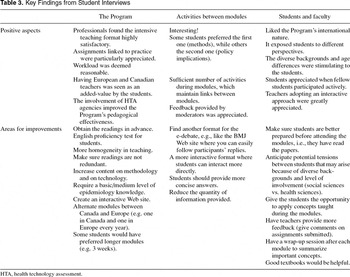
All interviews were conducted by phone by one of the authors (ST). They were tape recorded and transcribed (14). A summary table was drawn up to synthesize the qualitative findings pertaining to (1) the Program, (2) the pedagogical activities between Modules, and (3) interactions among students and between students and faculty members.
EVALUATION OF THE ULYSSES PROGRAM
Results from the Self-Administered Questionnaire
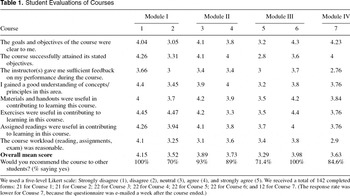
Seven of the eight courses were assessed using the standardized questionnaire. Table 1 gives the mean scores for close-ended items.

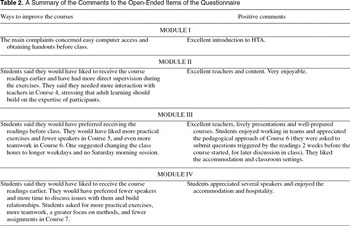
The highest scores were found for attainment of stated objectives in Courses 1, 3, 4, and 7 (mean score, respectively = 4.26, 4.1, 4, and 4); usefulness of readings in Courses 1, 3, and 6 (respectively, 4.26; 4.1, and 4); and usefulness of exercises in Courses 1, 2, and 6 (respectively, 4.45; 4.47, and 4.4). Six courses, thus, have been highly appreciated for at least one of three important pedagogical components: fulfillment of objectives, readings, and exercises. The lowest scores were found for level of feedback in Course 2 (3), attainment of stated objectives (2.8) and level of feedback (3) in Course 5, and level of feedback (2.76) and course workload (2.9) in Course 7. These weaker items were found in three courses and, in addition to “fulfillment of objectives,” they reflect the level of support (feedback) and learning efforts (workload) students expect. Finally, a very large majority of students (average, 87 percent) said they would recommend the courses to fellow students. Table 1, thus, indicates that students were satisfied with the course content and particularly appreciated the exercises and materials presented in an intensive format but needed more systematic feedback from faculty members. Students could also suggest ways to improve the course. A summary of the comments we received is shown in Table 2.

Results from the Interviews with Students
As described earlier, the first cohort was composed of students from a variety of disciplines—medicine, physics, economics, administration, epidemiology, health sciences, law, engineering, and political science. The cultural backgrounds of students varied as well. There were French- and English-speaking Canadians, Italians, Catalans and Spaniards, as well as a Columbian, Argentinean, and Latvian. On several occasions, we were struck by the cultural differences in both the pedagogical approaches of faculty members and the learning strategies of students. The interviews revealed differences in the preferences of full-time students vs. full-time working professionals, and in Canadian versus European students. In general, although the issue is complex and nuanced, Europeans tended to favor a lecture-based (expert–student) pedagogical approach, whereas Canadians felt more comfortable with an interactive (mentor–professional) approach.
The students believed that the pedagogical approach should be more homogenous across courses (see Table 3). As observed earlier, some students found that courses with several invited speakers (8–13) would benefit from a tighter common thread and were slightly less successful in meeting the pedagogical objectives. On the other hand, one student reported: “It's a really neat program. Some professors really brought good perspectives.” On some occasions, students found the readings to be somewhat redundant. Students requested that the final assignments be practice-oriented, so as to facilitate mastery of the concepts taught during the courses.

The international scope of the Program forced the students to adapt to different teaching styles and to the opinions of fellow students, which was perceived as both challenging and stimulating. One student appreciated the discussions with fellow students from other countries: “I found it very useful to have various viewpoints. It is interesting to see how other health-care systems are working and have various perspectives on that.” One student was confident that it would lead to future collaborations between alumni: “The international component of the Program is very important. It helps us create links with people from other countries and develop fruitful collaborations.” Hence, being exposed to various viewpoints and getting more familiar with other health-care systems were identified by several students as important advantages.
Canadian students requested that the courses be more interactive. The same comment applied to the e-debates, which were instrumental in maintaining contacts between modules. Responses to close-ended items in the interview questionnaire, indicate that 60 percent of students “agreed” or “strongly agreed” about their pedagogical value. All students agreed that two e-debates were enough. Full-time working professionals could not increase their involvement in pedagogical activities between modules. Some students believed that the format should be improved. They said they received too much information over too long a period of time, which resulted in their easily losing track of the debate. One student suggested using a Web site to post students' comments and organize them in a way that graphically shows the flow of responses and replies. Another student expected the debates to be more incisive and less of a collegial sharing of individual opinions. Up to 40 percent of interviewees “agreed” or “strongly agreed” that the format was too demanding. Full-time students mentioned that 2-week modules were too short and intense, saying 3-week modules would be preferable to maximize the learning process. However, professionals with full-time jobs liked the 2-week modules, which were more compatible with their professional obligations. Most of them received support from their employers, such as paid leaves. In some cases, the employer reimbursed the tuition fees or partially covered the travel expenses. Overall, 80 percent of the interviewees “agreed” or “strongly agreed” that the workload was reasonable.
In terms of career development, professionals who enrolled in the Program stressed that it would trigger a crucial shift in their career. Students mentioned that the training program would (i) help them to create an HTA Unit in their organization; (ii) acquire skills to more thoroughly assess technology and services; and (iii) provide them with tools to analyze and concretely manage clinical problems. For instance, one student stressed, “It's a total shift in my career—the opportunity to implement an HTA Unit in our hospital. It will enable us to gather and analyze evidence, which is lacking in our health-care system. My goal was to be able to coordinate an HTA Unit. The Ulysses Program made it possible by giving me the tools I needed.” For full-time students, career opportunities were not as clearly defined, although some were intending to enroll in a PhD program or medical school. The practical experience gained through internships was appreciated by the full-time students. According to one of them, “It gave me more of a perspective of what decision makers are looking for in terms of information on health technology.”
For the second edition of the Program, students recommended increasing the methodology content in the courses. They also suggested that the modules alternate between Canada and Europe. Finally, students recommended that an English proficiency test be a requirement for enrollment.
Results from the Interviews with Internship Supervisors
Although student satisfaction is a major dimension of the quality of a training program, other aspects should also be considered. Five interviews were conducted with HTA experts who had supervised trainees. Four of the training sites were HTA agencies (AETMIS, ICES, CCOHTA, and ASP) and one was a university-based research unit (Clinical Epidemiology Research Unit, University of Ottawa). All training sites provided trainees with a computer and workspace, and some provided a stipend. One training site signed a 6-month contract with its trainee. Opinions regarding the training experiences varied: Two agencies reported that it benefited their organization, whereas one answered that it did not. One supervisor said that “the trainee's job was useful for the Technology Assessment Unit because it was fully integrated into the Unit's work.”
All training sites mentioned that a 6-month period was needed to give the trainees time to adapt to the organization's culture. One supervisor suggested identifying goals and objectives before the start of the training period to optimize the experience. Finally, all supervisors agreed that an internship is a valuable pedagogical complement to a master's program because, as one of them put it, “the practical conducting of studies is the real way to demonstrate the usefulness of education.”
DISCUSSION
Key Features of the Program
This evaluation shows that students appreciated the course content and the international component of the Program. This evaluation also underscores the importance, for the broader HTA community, of developing and strengthening training initiatives in HTA. In developing such programs, particular attention should be paid to collaborative processes and the diversity of academic cultures.
To identify currently available training programs and educational resources in HTA, Douw et al. (4) surveyed forty-eight countries. They found only three master's programs (University of Birmingham, University of Santiago de Compostela, Ulysses Consortium). The Catalan Agency for Health Technology Assessment and Research, in conjunction with the Autonomous University of Barcelona, also ran a master's program in the late 1990s. Børlum Kristensen and colleagues (3) recently insisted on the need to strengthen HTA training in Europe. They created an outline for a European Master of Science in HTA (EMHTA), which includes five core areas: (i) HTA principles and practice; (ii) introduction to public health, epidemiology, and biostatistics; (iii) introduction to health economics; (iv) HTA methods; and (v) introduction to health policy (2002: 441). This outline is clearly convergent with five of the eight courses in the Ulysses Program. The other three courses cover key areas: (i) institutional management; (ii) social, ethical, and legal issues in HTA, and the dissemination of HTA; and (iii) clinical decision making. According to Douw and colleagues (4), future efforts should be directed toward consolidating HTA training and specific attention should be devoted, in particular, to “the synthesis of evidence of the medical, social, ethical, and economic implications of the diffusion and use of technology; and the multidisciplinary skill of drawing conclusions and presenting options tailor-made for practical policy-making” (4: 817).
However, the sustainability of such initiatives requires energy and constant financial support. We will now focus on six “institutional ingredients.” Although they are challenges we need to face and surmount, they are also exciting opportunities for growth (6).
Flexible Format for Skilled Professionals
By using an intensive course format, our objective was to offer more options and flexibility to Canadian, European, and foreign students who are working full-time as health-care managers or providers. These students are adults, skilled, and experienced. They require a special kind of learning environment and a time frame that fits with their busy schedules (12). Although it was not always easy for faculty members to adapt their regular course content, the quality and richness of on-site interactions with students proved highly rewarding.
Interaction Between HTA Users and Producers
Perhaps the needs of HTA producers could have been better served by a stronger emphasis on methods, and those of users, by a stronger emphasis on policy evaluation, management, and technology regulation. Nevertheless, each of these two groups will, as a result, be able to grasp the broader context in which evidence is being researched and translated into decisions (6). As observed above, delivering the teaching content within a short time frame and with an appropriate level of methodological details for both groups was a pedagogical challenge.
International Academic and Professional Collaboration
The courses offered in the Master's Program have been developed by at least two faculty members from different universities or countries. The students appreciated having both European and Canadian instructors. The examples and exercises used were relevant for the entire class (12). Students also enjoyed visiting other countries and building links with future colleagues. However, international collaboration requires establishing trust among partners, understanding the unique academic and cultural characteristics of each partner, and developing a shared vision. In our case, holding the two workshops during the first year, having regular phone conferences, and sharing responsibility for organizing the modules were pivotal.
Partnerships with Agencies
Partnerships with HTA agencies are an important asset, because students learn in an environment that is entirely relevant to their future career. They also generate indirect benefits by promoting the use of evidence in health-care management and by reinforcing the training mission of HTA agencies. That several faculty members were also close collaborators of the agencies facilitated bridging the two types of institutions. Nonetheless, further efforts will be required to establish collaborative relationships with a larger group of agencies and to make sure internships are mutually beneficial for both the students and agencies.
Global Approach to Evidence-Based Practice
Our team believes that HTA evaluators and producers should be knowledgeable about decision-making processes, as well as dissemination strategies that are likely to encourage the use of HTA in practice. This message was woven into all our training components, and space was devoted to teaching strategies for implementing HTA findings.
Multidisciplinary Nature
The Ulysses Project is multidisciplinary at three levels: (i) assessment of technology is, in itself, a multidisciplinary process because different dimensions are examined; (ii) each faculty member in our team brings a specific perspective from his/her discipline; and (iii) students with managerial, clinical or other relevant experience are recruited.
These six features, although valuable assets to the Program, also impose several pressures on the Program's delivery and financing. One issue we wish to explore further in the future is the use of distance learning tools. Replacing some of the onsite courses with Web-based courses could potentially reduce mobility costs.
CONCLUSION AND FUTURE PROSPECTS
Despite the numerous organizational barriers inherent to creating an international program and several areas for improvement, as identified by the students, the Ulysses Project reached its initial objectives. Although managing such a program is far from simple, it is clear to every partner involved that there is an important need for higher training in HTA. Currently, a total of 24 candidates are formally enrolled for the second edition. Major changes are currently affecting the way universities deliver training programs, and we believe the Ulysses Project reflects a willingness to be innovative in this respect (12;13). We hope that other initiatives will emerge in Europe (8) and North America and that the overall research capacity in this area will be increased.
CONTACT INFORMATION
Pascale Lehoux, PhD, Associate Professor (Pascale.Lehoux@umontreal.ca), Department of Health Administration, University of Montreal, P.O. Box 6128, Centre-Ville Branch, Montreal, Quebec H3C 3J7, Canada; Researcher, Quebec Health Services and Technology Assessment Agency, Montreal, Quebec H3A 2S9, Canada
Renaldo N. Battista, MD, ScD, Director (renald.battista@umontreal.ca), Department of Health Administration, University of Montreal, Montreal, Quebec H3C 3J7, Canada
Alicia Granados, MD, PhD, Associate Professor (aliciagranados@ub.edu), Faculty of Medicine, Department of Medicine, University of Barcelona, C/Casanova, 143, 08036 Barcelona, Spain; Member of the Board of Directors, Catalan Agency for Health Technology Assessment and Research, Recinte parc Sanitari Pere Virgili, C/Esteve Terradas, 39 Edifici Mestral, la planta, 08023 Barcelona, Spain
Pedro Gallo, MSc, PhD, Associate Professor (pgallodep@ub.edu), Department of Sociology and Organizational Analysis, University of Barcelona, Barcelona 08021, Spain
Stéphanie Tailliez, PhD, Research Assistant (Stephanie.Tailliez@umontreal.ca), Groupe Interdisciplinaire en Santé, University of Montreal, Montreal M3C 3J7, Quebec, Canada
Doug Coyle, PhD, Associate Professor (dcoyle@lri.ca), University of Ottawa Clinical Epidemiology Unit, The Ottawa Hospital, Civic Campus, 1053 Carling Avenue, Room F658, Ottawa, Ontario KIY 4E9, Canada
Marco Marchetti, MD (mmarchetti@rm.unicatt.it), Health Technology Unit, Agostino Gemelli Polyclinic, Catholic University of Rome, Rome 00168, Italy
Piero Borgia, MD, Head of Prevention Service (Borgia@asplazio.it.), Public Health Agency—Lazio Region (ASP), Rome 00198, Italy
Gualtiero Ricciardi, PhD, Director (wricciardi@rm.unicatt.it), Department of Hygiene and Public Health, Department of Hygiene and Public Health, Catholic University of Rome, Rome 00168, Italy
Initial funding for the Ulysses Project was provided by Human Resources Development Canada (HRDC), and the European Community Directorate General for Education, Training and Youth (DG-XXII) under their joint European Community-Canada Programme for Cooperation in Higher Education and Training (#EC-99/29; 1999–2003). The Canadian partners also received additional funding from the Canadian Foundation for Health Services Research (CHSRF) under its special training initiative (#DT1-0411-05; 1999–2000). The European partners received additional funding from the Italian Minister of Health and Research in the context of the “Italian Program for the Internationalization of Higher Education and Training” (#protII00577384; 1999–2003).
Besides the core group of faculty members and Health Technology Assessment (HTA) experts of the Ulysses Consortium, numerous individuals (researchers, teachers, 2 administrators and support staff) in three countries have been instrumental in making the Ulysses Project a reality. We wish to thank them for their expertise, support, and valuable in-kind contributions. More specifically, the European partners thank the Catalan Institute of Health for its most valuable in-kind contribution to the project throughout the period. Dr. Lehoux holds a career award from the Canadian Institutes of Health Research (CIHR).
References
Banta D,
Perry S.
1997;
A history of ISTAHC: A personal perspective on its first 10 years.
Int J Technol Assess Health Care.
13:
430–
453.Google Scholar
Blight D,
Davis D,
Olsen A.
1999:
The internationalisation of higher education.
In: Harry K, ed.
Higher education through open and distance learning.
New York:
Routledge;
15–
31.
Børlum Kristensen F,
Gabbay J,
Antes G, et al.
2002;
Education and support networks for assessment of health interventions.
Int J Technol Assess Health Care.
18:
423–
446.Google Scholar
Douw K,
Vondeling H,
Bakketeig LS, et al.
2002
HTA education and training in Europe.
Int J Technol Assess Health Care.
18:
808–
819.Google Scholar
France G.
2000
Health technology assessment in Italy.
Int J Technol Assess Health Care.
16:
459–
474.Google Scholar
Gibbons M,
Limoges C,
Nowotny H, et al.
1994.
The new production of knowledge.
London:
Sage Publications;
Granados A,
Sampietro-Colom L,
Asua J,
Conde J,
Vazquez Albertino R.
2000;
Health technology assessment in Spain.
Int J Technol Assess Health Care.
16:
532–
559.Google Scholar
Jonsson E,
Henshall C,
Banta DH,
Sampietro-Colom L.
2002;
Executive summary of the ECHTA/ECAHI project.
Int J Technol Assess Health Care.
18:
213–
217.Google Scholar
Lavis JN,
Ross SE,
Hurley JE, et al.
2002;
Examining the role of health services research in public policy-making.
Milbank Q.
80:
125–
154.Google Scholar
Lehoux P.
2002.
Could new regulatory mechanisms be designed after a critical assessment of the value of health innovations?
Discussion paper No. 37. Commission on the future of health care in Canada, chaired by R. Romanow,
Lomas J.
1993
Making clinical policy explicit.
Int J Technol Assess Health Care.
9:
11–
25.Google Scholar
Mason R.
1998.
Globalising education: Trends and applications.
New York:
Routledge;
Mason R.
1999:
The impact of telecommunications.
In: Harry K, ed.
Higher education through open and distance learning.
New York:
Routledge;
32–
47.
Murphy E,
Dingwall R,
Greatbatch D, et al.
1998
Qualitative research methods in health technology assessment: A review of the literature.
Health Technol Assess.
2:
1–
274.Google Scholar
Patton MQ.
1982.
Practical evaluation.
Beverly Hills, CA:
Sage;
Romanow R.
2002.
Building on values: The future of health care in Canada.
Saskatoon, Saskatchewan:
Commission on the Future of Health Care in Canada;
Student Evaluations of Courses
A Summary of the Comments to the Open-Ended Items of the Questionnaire
Key Findings from Student Interviews
 You have
Access
- 7
- Cited by