INTRODUCTION
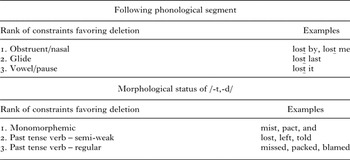
This paper explores when and how children acquire morphosyntactic patterns that are variable yet systematic. More specifically, the current study examines children's Spanish subject pronoun expression, which is variable in the sense that speakers can choose to either express a subject pronoun or omit it, and systematic in the sense that the choice is constrained and probabilistically predictable. In order to clearly illustrate systematic linguistic variation in general, let us first consider a widely studied case from English. English speakers do not always articulate the coronal stops /t/ and /d/ when they occur in word-final position and in a consonant cluster. That is, in words like mist, and, and kissed, speakers sometimes pronounce the final consonant, as in [mɪst], and sometimes omit it, as in [mɪs]. The variation between pronouncing or omitting -t/-d is probabilistically constrained by linguistic factors. Omission is most likely when -t/-d is followed by an obstruent or nasal, as in missedby / missedme, less likely when followed by a glide, and least likely when followed by a vowel or pause, as in missedit. Also, -t/-d is more likely to be omitted in monomorphemic words such as mist than in regular past tense verbs, like missed. While both of these constraints – the following sound and morphological status – impact the likelihood that a speaker will pronounce -t/-d, the former matters more than the latter. That is, a following obstruent or nasal increases the likelihood that a speaker will omit -t/-d more so than morphemic status does. Since the constraints affect -t/-d deletion to varying degrees, the pattern can by represented hierarchically with following phonological segment on top as in Table 1, based on Kiesling (Reference Kiesling2011, p. 20) and Tagliamonte (Reference Tagliamonte2012, pp. 180–182).
Hierarchy of variables predicting /-t,-d/ deletion in English

Patterns of structured linguistic variation like the one in Table 1 are probabilistic: /-d/ can be retained in contexts like and me, even though this environment favors deletion. Such probabilistic patterns of variation tend to be similar across adult speakers and communities (Carvalho, Orozco, & Shin, Reference Carvalho, Orozco and Shin2015; Croft, Reference Croft2010, pp. 20–21; Labov, Reference Labov2001, pp. 80–120; Otheguy & Zentella, Reference Otheguy and Zentella2012; Tagliamonte, Reference Tagliamonte2012, p. 55; Torres Cacoullos, & Travis, Reference Torres Cacoullos and Travis2011). Consistency of structured variation across communities suggests that these patterns are part of adults' linguistic repertoire. Note that I employ the term ‘linguistic repertoire’ because linguists disagree as to whether constraints on usage patterns should be included in conceptualizations of grammar. In usage-based formulations of grammar, which include probabilistic information about the likelihood of form–form and form–meaning pairs, constraints on variation would be considered part of grammar (Bybee, Reference Bybee2010; Croft, Reference Croft2010). In contrast, generative models draw a distinction between language structure and use, and syntactic variation in discourse is assumed to reflect variation between (not within) grammars (e.g., Kroch, Reference Kroch and Beals1994). The current paper is relevant regardless of whether constraints on variation are considered part of grammar or part of a performance system. Either way, it is clear that in order to use language like adults do, children's patterns of variation must at some point come to match those of adults.
Despite the abundant research demonstrating that linguistic variation is highly constrained among adults, it is not yet well understood when and how structured variation develops during childhood. This is not to say that acquisitionists have ignored variation. On the contrary, variation has played a central role in language acquisition theories (e.g., Hyams, Reference Hyams1986; Valian, Reference Valian1991; Yang, Reference Yang2002). For example, Yang's (Reference Yang2002) Variational Model depicts variation in child language as evidence of competition between grammars. The idea is that children entertain various grammars, and over time they come to prefer one grammar over another based on probabilistic cues in the input. Although Yang's model can account for gradual changes in rates of production of particular structures, he does not elaborate on how children become sensitive to linguistic constraints on variation. Most of what we do know about constraints on variation in child language comes from a growing body of research on ‘developmental sociolinguistics', which thus far suggests that children learn patterns of structured variation very early (e.g., Nardy, Chevrot, & Barbu, Reference Nardy, Chevrot and Barbu2013). Nevertheless, most of this research has focused on phonological and morphophonological variation. There is a dearth of research on the development of structured morphosyntactic variation in child language.
The current study aims to increase our understanding of the acquisition of constraints on morphosyntactic variation specifically, and of the development of probabilistic, structured variation more generally, by investigating Spanish-speaking children's subject pronoun expression. To illustrate the variable expression of subject pronouns in Spanish, consider (1). Pronoun omission is signaled by Ø in the Spanish citation and by parentheses in the English translation. The number in brackets at the end of each example is the participant identification number.
(1) …primero vino aquí mi hermano…y, y luego yo porque yo nací hasta el último. Ø Tengo dos hermanos. [109]
‘…first my brother came here… and, and later I because I was born last. (I) have two brothers.’
Expression or omission of yo ‘I’ is possible in both contexts in boldface in (1); that is, the speaker could have said porque nací, leaving out yo. Likewise, the speaker could have said Yo tengo dos hermanos.
Extensive research on Spanish pronoun expression has demonstrated that the same factors consistently constrain adults' usage (for overviews, see Carvalho et al., Reference Carvalho, Orozco and Shin2015, pp. xiv–xv; Otheguy & Zentella, Reference Otheguy and Zentella2012). For instance, adults are likelier to produce pronouns that are singular rather than plural, when switching reference than when maintaining it, and in particular tense/mood/aspect (TMA) contexts. Nevertheless, we still know very little about when and how pronoun expression patterns develop during childhood. The current study offers insight into the development of these patterns by examining 6,481 verbs in a corpus consisting of interviews conducted with 154 children in Mexico, ages 6;4 to 16;5. The study is cross-sectional: the children were divided into four age groups: 6–7, 8–9, 10–11, and 12+. Analyses of five linguistic predictors of subject pronoun expression indicate that even though children produce relatively few subject pronouns, their usage is constrained by several of the same variables that constrain adult usage. Furthermore, as children get older, they become sensitive to more constraints.
A question raised by the study is how patterns of structured morphosyntactic variation are acquired. Do children attend to the distribution of forms in the input? Recent experimental research on statistical learning demonstrates that part of language acquisition involves paying attention to statistical tendencies in the input (e.g., Aslin & Newport, Reference Aslin and Newport2012; Hudson Kam, forthcoming, Reference Hudson Kam2015). Thus, it is plausible that children observe in the input the statistical tendencies that characterize structured variation in order to formulate probabilistic patterns in their own language production. If this is accurate, then we can look to the input to explain why some constraints on subject pronoun expression take longer to emerge than others, especially in light of previous research that suggests that constraints on variation are generally acquired early. I suggest that frequency matters, including frequency of occurrence of the form that is subject to variation (e.g., subject pronouns in Spanish, coda -s in Spanish, word final -t/-d in English) and the frequency of the contexts that constrain variation. I also posit that patterns of structured variation emerge earlier with high-frequency lexical items, which can be interpreted as evidence of piecemeal learning (e.g., Tomasello, Reference Tomasello2003). Finally, I consider the role of pattern complexity, proposing that the more complex the pattern, the later it will be acquired.
PREVIOUS RESEARCH
Structured variation in child language
As mentioned above, what we currently know about how children acquire linguistic constraints on variation comes from research on developmental sociolinguistics, even though the primary questions explored in this field tend to relate to social factors influencing variation and sociolinguistic competence (e.g., Díaz-Campos, Reference Díaz-Campos and Eddington2005; Habib, Reference Habib2014; Nardy et al., Reference Nardy, Chevrot and Barbu2013; Roberts, Reference Roberts1997; Smith, Durham, & Fortune, Reference Smith, Durham and Fortune2007; Smith, Durham, & Richards, Reference Smith, Durham and Richards2013). One broad generalization that has emerged regarding linguistic constraints is that patterns of (morpho)phonological variation develop very early during childhood (Roberts & Labov Reference Roberts and Labov1995, p. 101). For example, Roberts and Labov (Reference Roberts and Labov1995) studied the production of short a among three- and four-year-olds in Philadelphia. Lexical and phonetic factors that condition adults' raising and tensing of short a also conditioned the children's production of short a. Both children and adults categorically tensed short a in the words mad and bad and never in the word sad, indicating a reproduction of lexically specific pronunciations of this vowel. Both also categorically tensed short a before a nasal and a syllable boundary (e.g., sandals), but never in initial position followed by a nasal and vowel (e.g., animal) (Roberts & Labov, Reference Roberts and Labov1995, p. 107), which demonstrates that the children's and adults' pronunciation was affected by the same phonetic conditioning. Early acquisition of phonological variation has also been found for Spanish -s lenition. Miller (Reference Miller2013, p. 324) found that the following contexts favored -s deletion among both children, ages 2;04–5;09, and their caregivers: occurrence in word-final position (e.g., más), when the following phonological segment was either a vowel or a +continuant consonant (e.g., másarroz vs. más fuerte), and when -s was a plural marker (e.g., carros). In fact, the children's rates of -s deletion in the various conditioning contexts closely matched those of their caregivers.
To date, the most widely studied pattern of structured variation in child language is English -t/-d deletion (see Table 1). The general finding is that very young children's variable production of -t/-d is constrained by the same articulatory factors that constrain adult usage, such as whether the following segment is an obstruent or nasal versus a vowel or pause (Roberts, Reference Roberts1997; Smith, Durham, & Fortune, Reference Silva-Corvalán2009). In contrast, the influence of the morphemic status of the word constrains -t/-d deletion among adults, but not children (e.g., Smith et al., Reference Smith, Durham and Fortune2009, p. 83). Children delete -t/-d just as often with semi-weak verbs such as lost, left, and told, as with monomorphemic words, such as mist (Roberts, Reference Roberts1997). In fact, Guy and Boyd (Reference Guy and Boyd1990) found that the pattern of excessive -t/-d deletion with semi-weak verbs persists into adolescence.
Morphosyntax has received very little attention in the literature on structured variation in child language. Thus far, the few studies that have included morphosyntactic features have yielded conflicting results regarding whether morphosyntactic variation is acquired early or late. Smith et al. (Reference Smith, Durham and Richards2013) studied conversations between twenty-nine children, aged 2;10 to 4;2, and their caregivers in Buckie, Scotland. In addition to phonological and lexical variation, two variable morphosyntactic features were examined: singular versus plural demonstratives in plural contexts, as in this jigsaws ~ these jigsaws; and third person singular verb forms in third person plural contexts, as in my trousersis falling down (also see Smith et al., Reference Smith, Durham and Fortune2007). In both cases, one variant represented the local, non-standard form, e.g., my trousers is, whereas the other was the standard form, e.g., my trousers are. The same linguistic factors constrained both the children's and the adults' variation between the standard and non-standard forms. For instance, both produced singular rather than plural demonstratives in distal contexts (that) more often than in proximal contexts (this). Likewise, both produced third person singular verbs in plural contexts (i) when the subject was a lexical noun phrase, as in the grapes is open, but not when the subject was the personal pronoun they; (ii) with existentials, as in there's jelly sweeties; and (iii) more often with interrogatives than with declaratives (Smith et al., Reference Smith, Durham and Richards2013, p. 314; Smith et al., Reference Smith, Durham and Fortune2007, pp. 83–88). The authors conclude that children acquire the linguistic constraints on morphosyntactic variation very early. Furthermore, given the close correlations between the children's and adults' rates of forms produced in each linguistic context, the results suggest that the children learn constraints on variation by attending to patterns of distribution in the input.
In contrast with Smith et al. (Reference Smith, Durham and Fortune2007, Reference Smith, Durham and Richards2013), Kovac and Adamson's (Reference Kovac, Adamson, Sankoff and Cedergren1981) study of variable finite be deletion suggests that some constraints on morphosyntactic variation can take a long time to acquire. In their study, children varied between expressing and deleting finite be, as in she going ~ she is going, but it wasn't until age seven that the patterns of variation were constrained by the same factors that constrain adult usage. To summarize, research on developmental sociolinguistics suggests that many probabilistic patterns are acquired early in childhood. Yet, given the lack of studies examining constraints on morphosyntactic variation in child language, we cannot yet state any clear generalizations regarding the development of these patterns in particular. Thus, the current study, which focuses on Spanish subject pronoun expression, should increase our understanding of when and how constraints on morphosyntactic variation develop during childhood. In order to understand children's variable use of subject pronouns, we first need to describe the adult pattern. I now turn to previous research on adults in order to outline the patterns that children must acquire.
Structured variation in Spanish subject pronoun expression: adult patterns
There have been over forty variationist studies of adult Spanish subject expression. This large body of research shows that many of the same constraints consistently impact adult pronoun expression (e.g., Carvalho et al., Reference Carvalho, Orozco and Shin2015, pp. xiv–xv; Otheguy & Zentella, Reference Otheguy and Zentella2012, p. 160). Five common trends found in the research are as follows:
(i) Person/number: Singular pronouns are expressed more often than plural pronouns.
(ii) Reference: Pronouns are expressed more often when switching reference than when maintaining it, as in (2):
(2) Yo me enojé porque Ø le dije que si él creía que era eso… [920]
‘I got mad because (I) told him that if he believed that it was that…’
The second clause is a same-reference context, that is, the subject of porque le dije is the same as in the previous clause. Here the speaker omits yo ‘I’. In the third clause, reference is switched and él ‘he’ is expressed.
(iii) Tense/mood/aspect (TMA): Verb forms with ambiguous person morphology, such as the imperfect, favor pronoun expression, while unambiguous forms, such as the preterit, disfavor it.
(iv) Verb type: Cognitive verbs like creer ‘to believe’ favor pronoun expression, whereas non-mental activity verbs like bailar ‘to dance’ favor omission. Several studies have also found that copula verbs ser and estar favor pronoun expression (Orozco, Reference Orozco, Carvalho, Orozco and Shin2015, p. 25; Travis, Reference Travis2007, p. 115).
(v) Clause type: Main and subordinate clauses favor pronoun expression, while coordinate clauses favor omission. Clause interacts with Reference: the tendency to express pronouns more often in switch-reference contexts than in same-reference contexts is particularly strong in coordinate clauses, as illustrated in (3), where the subject of the coordinate clause y adelante tiene un cochinito ‘in front (he) has a little pig’ is not expressed, and (4) in which yo represents a switch in reference from mi prima Gabriela.
(3) Ah, él tiene un coche amarillo y adelante Ø tiene un cochinito. [110]
‘Ah, he has a yellow car and in front (he) has a little pig.’
(4) Mi prima Gabriela … Apenas tiene seis, y, y yo voy a cumplir los ocho. [108]
‘My cousin Gabriela … (She) is only six, and, and I am going to be eight.’
Structured variation in Spanish subject pronoun expression: children's patterns
Very young Spanish-speaking children rarely express subject personal pronouns (Grinstead, Reference Grinstead, Domínguez and Guijarro-Fuentes2010). Between ages 2 and 5, pronoun expression increases, but that increase is mostly due to an increase in expression of the first person singular pronoun yo (Bel, Reference Bel2003; Paradis & Navarro, Reference Paradis and Navarro2003, p. 380; Silva-Corvalán, Reference Silva-Corvalán2014, p. 153). Even school-age children appear to express relatively few subject pronouns (Shin, Reference Shin, Geeslin and Díaz-Campos2012). Nevertheless, there is evidence that children's subject pronoun use, albeit scarce, adheres to some of the constraints that guide adult usage. Shin and Erker (Reference Shin, Erker, Carvalho, Orozco and Shin2015) examined Spanish subject pronoun expression in sociolinguistic interviews conducted with twenty-four children in Mexico, ages 6 to 8, and for purposes of comparison, nineteen Mexican adults living in New York City. Results showed that the NYC adults' pronoun expression patterns were constrained by Person, Reference, TMA, Clause type, and Verb type. The children's pronoun expression patterns, on the other hand, were constrained by Person and Reference, but not TMA, Clause type, or Verb type. Thus, Shin and Erker's findings suggest that patterns of morphosyntactic variation may take a long time to acquire. The current study includes more data and spans a wider age range, thereby allowing for a more precise account of when and how the constraints on Spanish subject pronoun expression are acquired.
METHOD
Participants
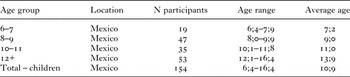
One hundred and fifty-four participants, aged 6;4 to 16;4, were recruited from two elementary schools in interior cities in Mexico. All were born in Mexico and reported speaking only Spanish in the home. The participants were divided into four age groups: 6–7, 8–9, 10–11, and 12+. There were two reasons for creating these age groups. First, Shin and Cairns (Reference Shin and Cairns2012) found that age 8–9 represents a milestone in children's developing abilities to appropriately select referring expressions based on referent accessibility. The second reason is methodological: the number of tokens was similar across the groups of children (see Table 3 in ‘Results’). For the statistical analyses employed in this study, having a relatively even distribution of tokens per group helps ensure that any differences between groups are not due to differences in dataset size. Information about the participant groups is provided in Table 2.
Participants

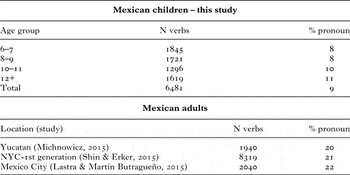
Subject pronoun expression rates, Mexican children and adults

Procedure
Sociolinguistic interviews were conducted with the children in a quiet room in their school. The children were also asked to tell stories and to narrate a picture book in a no-shared-knowledge context, that is, the researcher told the children she was unfamiliar with the pictures, and she did not look at the book while the children narrated.
Data compilation
The interviews were transcribed, and all tokens of tensed verbs that occurred with or without a subject pronoun were extracted. Contexts in which there is little to no variation between expression and omission were excluded from analyses of variation (for an overview of contexts of variation for Spanish subject pronoun expression, see Otheguy & Zentella, Reference Otheguy and Zentella2012, pp. 225–248). For instance, a context requiring pronoun expression is ser ‘to be’ followed by a pronoun and without a predicate noun or adjective as in Soy yo ‘It is I’. Two examples of this construction occurred in a seven-year-old girl's retell of the Beauty and the Beast (5). These were excluded from further analysis.
(5) [la bestia] dice “Bella, soy yo.” “¿Sí, eres tú?” [203]
‘[the beast] says “Beauty, it is I.” “Yes, it is you?”
There are also discourse markers that are fixed expressions and show little to no variation in subject pronoun expression (Posio, Reference Posio, Carvalho, Orozco and Shin2015; Travis & Torres Cacoullos, Reference Travis and Torres Cacoullos2012). One expression where a pronoun is required is yo qué sé / qué sé yo ‘What do I know’, but this expression did not occur in the current data set. Other combinations tend towards categorical omission of yo ‘I’, including no sé ‘I don't know’ and no sé qué. These constructions do exhibit variable expression of yo when they are followed by a complement clause, as in no sé qué voy a hacer ‘I don't know what I'm going to do’. In the current dataset there were forty-seven examples of no sé/no sé qué that were employed in isolation and thus were considered fixed expressions; all occurred without yo and were excluded from further analysis.
Other contexts in which subject pronouns almost never occur are: (i) subject-headed relative clauses, as in Vi a la chica que (?ella) está al lado de la puerta ‘I saw the girl that (?she) was next to the door’; (ii) inanimate subjects; and (iii) verbs that make reference to meteorological conditions. These were excluded from the analyses. Finally, there are contexts in which pronouns are rarely expressed, but are sometimes included in studies of variable pronoun expression, such as imperatives. In the current study, out of a total 172 imperatives, exactly five (3%) occurred with expressed subject pronouns. Given the near-categorical omission of pronouns with imperatives, all imperatives were excluded. Although the invariant contexts discussed above were excluded from analyses of structured variation, it is still worth noting that the children clearly mirror the typical adult behavior with respect to these contexts. This supports the idea that invariant contexts are acquired early, presumably due to their reliability.
Also excluded were cases that were either inaudible or so ambiguous that the researcher could not tell who the referent was and thus could not code for Reference, as in (6):
(6) Había una vez una niña llamada Caperucita. Y que su mamá le dijo “Hija, ve a dejarle esto a tu abuelita,” y Ø tenía de todo, jugo, agua, verduras, y fruta. Y después Ø le dijo “sí mami” [104]
‘There was once a girl named Little Red Riding Hood. And her mother said to her “Daughter, go give this to your grandma,” and ?had a bit of everything, juice, water, vegetables, and fruit. And after (she) said to her “yes, mommy.”’
In (6) the reference of the subject of the verb in boldface, tenía ‘had’, is ambiguous; we do not know whether the subject of tenía refers to Little Red Riding Hood or esto ‘this’, which presumably refers to a basket. Tenía is thus excluded from the study because it is possible that the subject is inanimate. The boldface token in the last sentence, Ø le dijo, on the other hand, would normally be included in the study because the subject referent is identifiable. Nevertheless, we cannot tell whether Ø le dijo represents a switch in reference from tenía because the subject of tenía is ambiguous. Thus, dijo was also excluded from the study. In contexts where switch-reference was impossible to analyze, pronoun omission was nearly categorical: only 3/65 such cases occurred with expressed subject pronouns. It is worth noting that 42 of the 65 cases of referent ambiguity were produced by the six- to seven-year-olds, 14 were produced by the eight- to nine-year-olds, 7 by the ten- to eleven-year-olds, and only 2 by the twelve+-year-olds. The fact that most of the cases of ambiguous reference occurred among the younger children is in keeping with previous research showing that children under age nine sometimes produce pronouns with unrecoverable referents (e.g., Shin & Cairns, Reference Shin and Cairns2012).
Data coding
After excluding contexts of little to no variation, the remaining tokens were coded for the values of the five predictor variables mentioned earlier. For each predictor variable I list its levels, which I subsequently refer to as ‘factors’ or ‘constraints’.
1. Person/number included five factors: 1sg (yo, ‘I’), 2sg (tú, ‘you-singular-informal’), 3sg (él/ella ‘he/she’), 1pl (nosotros, ‘we’), and 3pl (ellos/ellas, ‘they’). Note that cases of usted, ustedes (both ‘you-formal’) and uno ‘one’ were excluded from the study due to the scarcity of these forms in the children's data.
2. Reference included two factors: same- and switch-reference. These contexts are operationalized in terms of the relationship between two consecutive grammatical subjects. Reference to the same referent across subjects is considered ‘same-reference’, while a switch in reference is ‘switch-reference’.
3. TMA included four factors: (i) simple present indicative, (ii) perfective past (‘preterit’), (iii) imperfective past (‘imperfect’), and (iv) a category called ‘other’, which included futures, conditionals, subjunctives, and perfect compounds using haber ‘have’ (e.g., he bailado, había bailado, ‘I have danced’, ‘I had danced’). The first three categories (present indicative, preterit, and imperfect verbs) account for 91·5% of the children's data.
4. Verb type included three factors: (i) Copular verbs ser and estar ‘to be’ in non-periphrastic constructions; (ii) Cognitive verbs, such as querer ‘want’, saber ‘know’, creer ‘believe’, pensar ‘think’, and imaginar ‘imagine’; and (iii) all other verbs, which were primarily verbs denoting non-mental activities, such as bailar, cantar, caminar ‘dance, sing, walk’, and are thus labeled ‘Activity’ verbs.
5. Clause type included three factors: main, subordinate, and coordinate clauses.
RESULTS
Pronoun rates
Table 3 presents pronoun rates, which represent the number of expressed pronouns out of the total contexts in which pronoun expression was possible. For example, out of their 1,845 total number of verb tokens, six- to seven-year-olds expressed 149 pronouns; thus, their pronoun rate was 8%. For the sake of comparison, pronoun rates from studies of Mexican adults are also included.
In comparison to adults, the children's pronoun expression rates were low, which is consistent with previous research (Grinstead, Reference Grinstead, Domínguez and Guijarro-Fuentes2010; Shin, Reference Shin, Geeslin and Díaz-Campos2012). A chi-square analysis indicates a significant difference among the four groups of children [X 2 (3, N = 6481) = 17·62, p = ·001]. Also, the pronoun rate calculated for each child positively correlates with age calculated in years [Pearson correlation = ·201, p = ·012] and in months [Pearson correlation = ·203, p = ·012]. Thus we can conclude that pronoun rates increase with age, which is expected given the rates reported for Mexican adults, which are consistently around 20%. Since the children begin the language learning process producing few subject pronouns and eventually come to express more of them, we can infer that the task that faces Spanish-speaking children is to learn when to express pronouns. I now turn to the factors that constrain that choice.
Constraints on pronoun expression
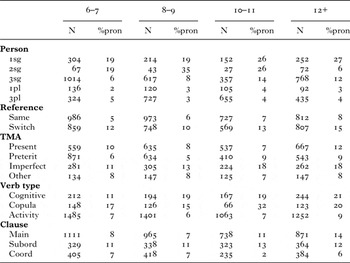
The pronoun rates reported above show that children express relatively few subject pronouns overall. Nevertheless, the question remains: Do the same factors that constrain adults' pronoun use also constrain the children's usage? To answer this question the five linguistic contexts listed above were analyzed. Table 4 includes the total number of tokens per context (tokens of expressed and omitted pronouns combined) in the columns labeled ‘N’. The percentage of expressed pronouns for each context appear in the columns labeled ‘%pron’. For example, the six- to seven-year-olds produced a total of 304 first person singular (1sg) verbs, 19% of which occurred with the pronoun yo ‘I’.
Observed pronoun rates by conditioning factors, Mexican children and adults

The pronoun expression rates in Table 4 indicate many similarities across age groups. All groups expressed 1sg pronoun yo at a high rate and the plural pronouns nosotros ‘we’ and ellos/ellas ‘they’ at low rates. Also, for all age groups, pronoun rates were higher in switch- than in same-reference contexts, and with verbs in the imperfect than in any other tense. The groups were also similar in that their pronoun rates were lower with activity verbs than with cognitive or copular verbs. At the same time, the rates in Table 4 reveal some differences between the groups. The younger children often expressed tú ‘you’, whereas the twelve+-year-olds did so rarely. With respect to clause type, the oldest children expressed the highest pronoun rate in main clauses, followed by subordinate clauses, and the lowest rate in coordinate clauses. In contrast, the younger children produced higher pronoun rates in subordinate than in main or coordinate clauses.
Although it is useful to note trends based on pronoun rates in each grammatical context, pronoun expression is influenced by several factors at the same time. For example, consider example (2), which was produced by a fifteen-year-old girl and is repeated here as (7):
(7) Yo me enojé porque Ø le dije que si él creía que era eso… [920]
‘I got mad because (I) told him that if he believed that it was that…’
Is él expressed because it is in a switch-reference context or because it occurs with a cognitive verb, or both? Due to the multifactorial nature of pronoun expression, the appropriate method of analyzing this phenomenon is logistic regression, which measures each predictor variable while controlling for the other variables (e.g., Gorman & Johnson, Reference Gorman, Johnson, Bayley, Cameron and Lucas2013, pp. 216, 220).
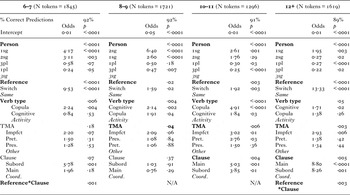
Four mixed-effects binary logistic regressions – one for each age group – were performed using the Statistical Package for the Social Sciences (SPSS). Mixed-effects models include both fixed and random effects. In the current study, the binary dependent variable was subject pronoun expression (expressed or omitted); the fixed effects were the aforementioned five predictors; and the random factor was ‘Participant’, that is, each individual child. Including Participant as a random factor bolsters our confidence that the results found for the fixed effects are generalizable to each age group, rather than attributable to individual children (Gorman & Johnson, Reference Gorman, Johnson, Bayley, Cameron and Lucas2013, pp. 223–224; Tagliamonte, Reference Tagliamonte2012, pp. 137–139). Interactions between fixed effects were only included in the final models if they were significant. The interaction between Reference and Clause was significant for the six- to seven- and twelve+-year-olds; as such, it was included in these age groups' regression models. The type of logistic regression reported here uses baseline-treatment contrasts, which requires that one level of a predictor variable be chosen as the baseline level. That level is automatically assigned a value of 0. The baseline or ‘reference levels’ selected were as follows: Person–3sg, Reference–Same-reference, Verb type–Activity, TMA–Other, and Clause–Coordinate. These reference levels are then combined to calculate the ‘intercept’, which in the current study is the expected rate of pronoun expression when all predictors are set to baseline. The intercept or ‘constant’ was low across age groups in the current study: 6–7: ·01; 8–9: ·05; 10–11: ·01; 12+: ·01.
The logistic regression analysis provides a probability measure for each factor as compared to baseline. The measure reported here in Figure 1 and Table A-1 (see ‘Appendix’) is the odds ratio, which indicates the likelihood that a pronoun will occur in that context as compared to baseline. Odds ratios above 1·0 indicate that a constraint favors pronoun expression; values below 1·0 indicate that a constraint favors pronoun omission. For example, among the twelve+-year-olds, the odds ratio for 1sg is 1·95, which means that the odds of a pronoun occurring with a 1sg verb are 1·95 times as great as the odds of a pronoun occurring in baseline condition. The further away from 1·0 – in either direction – the stronger the constraint. So, a constraint with an odds ratio of 2·0 more strongly favors pronoun expression than a constraint with a value of 1·5. Conversely, a constraint with a value of 0·2 more strongly favors pronoun omission than a constraint with a value of 0·5. For example, among the twelve+-year-olds, the Person constraint that most strongly favors pronoun expression is 1sg. At the opposite pole is 1pl, which is assigned an odds ratio value of less than 1·00 (0·22), indicating that it disfavors pronoun expression. Said differently, the odds of a pronoun occurring with a 1pl verb are 0·22 times less than the odds of a pronoun occurring in baseline condition. SPSS also assigns a p value to each predictor variable (e.g., Person, Reference, etc.) based on the Wald z-test.
Significant constraints on Spanish subject pronoun expression, four age groups of children in Mexico.

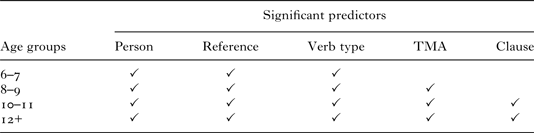
First I present in Table 5 results showing which overall predictor variables reach significance per the regression analyses. Exact p values appear in Table A-1 in the ‘Appendix’. The results in Table 5 suggest a developmental progression whereby children become sensitive to more predictor variables as they grow older: TMA is significant at age 8–9 and Clause at age 10–11.
Summary: significant predictors of subject pronoun expression, children in Mexico

Next I present in Figure 1 the odds ratios for significant factors, which were plotted using the ggplot2 package (Wickham, Reference Wickham.2009) in R (R Development Core Team, 2009). Age groups are listed at the top of the graph with ages 6–7 in the leftmost panel and 12 or older in the rightmost panel. Constraints are listed along the y-axis. On the x-axis are odds ratios. Recall that odds ratios greater than 1·0 favor pronoun expression. These appear to the right of the dotted vertical line in each age group's panel. For example, all of the 6–7's significant constraints favored pronoun expression and are thus to the right of the dotted line. In contrast, odds ratios less than 1·0 favor pronoun omission and appear to the left of the dotted line, as is the case with 2sg, 1pl, and 3pl in the 12 or older group. Note that reference levels do not appear in the graph. More detailed information appears in Table A-1 in the ‘Appendix’, including odds ratios for non-significant factors and percent correctly predicted by each model.
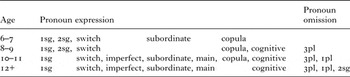
The results in Figure 1 demonstrate that for all age groups 1sg and switch-reference both significantly increase the likelihood that a subject pronoun will be expressed. On the other hand, other constraints that appeared to have a similar effect across age groups in terms of rates (Table 4) did not consistently reach statistical significance in the regression analyses. For example, all groups expressed pronouns with imperfect verbs more so than in the other TMA contexts (Table 4), but this trend was only significant for the ten- to eleven- and twelve+-year-olds (Figure 1). In order to more easily interpret the results in Figure 1, and to shed light on similarities and differences across age groups, a summary of the factors that significantly constrain subject pronoun expression is presented in Table 6.
Factors that significantly constrain pronoun expression by age group

Table 6 shows that 1sg and switch-reference significantly predict pronoun expression for all age groups. The results also indicate that the older the children get, the more factors constrain their pronoun use. The imperfect and main clauses significantly favor pronoun expression among the ten- to eleven- and twelve+-year-olds, but not among the younger children. Cognitive verbs favor pronoun expression among all groups except the six- to seven-year-olds. Table 6 also indicates that an increasing number of Person factors condition pronoun omission. 1pl significantly favors pronoun omission among the older children, but does not significantly differ from baseline for the younger children. 3pl favors omission among all groups, but for the six- to seven-year-olds it does not differ from baseline. An examination of the pronoun rates in Table 4 helps us understand these results: For the six- to seven-year-olds, pronoun rates are low with 1pl, 3pl, and 3sg verbs (2%, 5%, 6%). Thus it is no surprise that the plural verbs do not differ significantly from baseline, as the rate is already very low in the condition that is used to comprise the baseline. In contrast, among the older children we begin to see differentiation between 3sg and the plural contexts with pronoun rates being higher in the former than the latter for all groups.
In addition to illustrating that the number of factors constraining variation increases with age, Table 6 suggests that the developmental trajectory is not just a simple linear progression characterized by an increasing amount of constraints on variation. Two constraints favored pronoun expression among the younger, but not the oldest children: copular verbs and 2sg. Does this mean that there are constraints on younger children's usage that later disappear? With respect to the copular verbs, the likeliest answer is no. First, studies of adult Spanish have found that copular verbs favor pronoun expression (Orozco, Reference Orozco, Carvalho, Orozco and Shin2015; Travis, Reference Travis2007). Second, the youngest and the oldest children's rates of pronoun expression are in fact nearly identical with ser (13/67 or 19% and 12/64 or 19%, respectively), and the oldest children's pronoun rate for estar (13/58 or 22%) is slightly higher than that of the younger children (12/80 or 15%). Therefore, even though copular verbs did not have a significant impact on the older children's pronoun expression in the current dataset, the trend is the same. Furthermore, given the significant impact of the copular verbs in adult Spanish, we can surmise that the significant impact of copular verbs found among the younger children in the current study in fact persists into adulthood.
Another constraint that significantly favors pronoun expression among the younger children, but not the twelve+-year-olds, is 2sg. This difference between the age groups is explored further in Shin (forthcoming), where it is explained as an increased use of non-specific 2sg reference among the twelve+-year-olds, as in (8):
(8) Fuimos a unas como montañas así y nos pusimos a escalarlas las montañas y ya luego las Ø bajabas así esquiando y de repente había nieve y de repente había sol. O sea estaba padre entonces Ø bajabas con tu abrigo así de la nieve y ya nada más Ø te ponías el traje de baño y había una playa. [922]
‘We went to some like mountains and we set out to climb the mountains and then later (you) would go down them like that skiing and then all of a sudden there was snow and then all of a sudden there was sun. In other words it was cool so (you) went down with your ski jacket and then (you) put on your swim suit and there was a beach.’
In (8) the referent of bajabas and te ponías includes reference to the self (the girl is talking about her own experience), but also achieves a generic meaning (all the skiers) (Stewart, Reference Stewart2003, pp. 200–201). In Mexican Spanish, pronouns tend to be omitted in contexts like those in (8) where 2sg referents are non-specific. Thus, the results showing that 2sg favors expressed tú among the younger children but not among the older children (Figure 1) are most likely linked to the greater use of non-specific 2sg reference among the older children.
Interactions
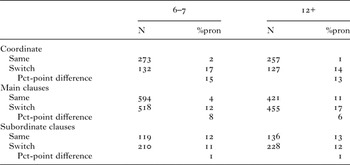
The results in Figure 1 and Table 6 highlight similarities and differences across age groups with respect to main effects. Now I delve into the interaction between Reference and Clause, which was significant for the six- to seven-year-olds (p = ·001) and the twelve+-year-olds (p = ·003). Pronoun rates in switch- and same-reference contexts in each of the three clause types are displayed in Table 7.
Pronoun rates by same- and switch-reference in three clause types

Bivariate analyses examining the influence of Reference on pronoun expression in each of the three clause types shed light on the interaction effects. Among both the six- to seven- and twelve+-year-olds, Reference effects are significant in main and coordinate clauses, but not subordinate clauses [6–7: Main: X 2 (1, N = 1112) = 20·14, p < ·0001; Coordinate X 2 (1, N = 405) = 31·47, p < ·0001; Subordinate: X 2 (1, N = 329) = 0·13, p = ·72]; [12+: Main: X 2 (1, N = 876) = 6·21, p = ·01; Coordinate: X 2 (1, N = 384) = 27·81, p < ·0001; Subordinate: X 2 (1, N = 364) = 0·15, p = ·70]. Examples (9)–(11) suggest that all types of subordinate clauses show resistance to Reference effects. More specifically, these examples show pronoun expression in same-reference contexts.
(9) Pero ellosi están imaginando como si ellosi fueran piratas [101]
‘But theyi are imagining as if theyi were pirates.’
(10) Después una noche este ellai tuvo una fiesta, en donde ellai estaba todo apenada porque estaba el chico que le gustaba. [927]
‘After one night um shei had a party, in which shei was all upset because the boy she liked was there.’
(11) Y la ranai se eno-, se enojó…con ellos. Y, ya estuvo triste porque ellai ya no podía salir. [112]
‘And the frogi got ma-, got mad… at them. And, (she) was sad because shei couldn't get out.’
Why is the subordinate clause–pronoun expression effect strong enough that it persists in same-reference contexts? Perhaps the increased level of processing difficulty associated with subordination (Townsend, Ottaviano, & Bever, Reference Townsend, Ottaviano and Bever1979) hinders reference tracking and, as such, children compensate by including more informative noun phrases. It is not yet clear whether the subordinate clause–pronoun expression effect revealed by the analyses in the current study is particular to children and adolescents, as it has not been explored in adult Spanish. Thus it merits attention in future research.
DISCUSSION: HOW ARE CONSTRAINTS ON VARIATION ACQUIRED?
Despite the abundant research demonstrating that linguistic variation in adult language is structured and systematic, few studies have investigated how children acquire constraints on morphosyntactic variation. In the current study, subject pronoun expression was examined in a corpus of Spanish spoken by 154 monolingual children in Mexico, divided into four age groups: 6–7, 8–9, 10–11, and 12+. Mixed-effects binary logistic regression analyses indicate that Spanish-speaking children's pronoun use is patterned and structured. Some factors were shown to significantly condition pronoun use across age groups, most notably 1sg contexts and a switch in reference between two consecutive clauses. At the same time, the study also provides evidence that children's pronoun expression is constrained by more linguistic factors as they grow older. In particular, verbs in the imperfect and cognitive verbs significantly favored pronoun expression among the older, but not younger, children. These findings raise questions about how structured variation develops during childhood. Are patterns that are frequent in the input learned earlier than infrequent patterns? Are more complex patterns acquired later than simpler patterns? In the following discussion I consider evidence that suggests that children's acquisition of patterns of structured variation are input driven and that frequency effects and complexity play a role in determining how quickly children detect and reproduce these patterns.
Detecting probabilistic patterns in the input
Do children learn patterns of structured variation by attending to probabilistic patterns in the input? Previous research suggests that the answer is affirmative (Kim, Reference Kim2000; Miller, Reference Miller2013; Smith et al. Reference Smith, Durham and Richards2013; Yang, Reference Yang2010, p. 1164). In Smith et al.'s (Reference Smith, Durham and Richards2013) study of conversational data between children and their caregivers in Buckie, Scotland, children's rates of use of local, non-standard forms closely matched those of their caregivers. Consider, for instance, their use of third person singular forms in plural contexts. What is particularly striking is that the children's and adults' rates of use of this non-standard form were nearly identical across conditioning contexts. For example, they all categorically produced singular forms with existentials, as in there's jelly sweeties. In contexts with more variation between singular and plural forms, the children's rate of singular forms still matched that of the adults, hovering at around 80% for interrogatives and 30% for declaratives (Smith et al., Reference Smith, Durham and Richards2013, p. 314). Further evidence that children's rates of use of forms match those of their caregivers comes from Miller's (Reference Miller2013) study of coda -s deletion in Spanish. For example, when -s was a plural marker, children and their caregivers deleted at a rate of 60% and 58%, respectively. When -s was the second person singular verbal morpheme, both children and caregivers deleted at a rate of 41%. In addition, in both Smith et al.'s (2007) and Miller's (Reference Miller2013) studies, logistic regression analyses confirmed that the children's patterns were similar to those of their caregivers.
Recent experimental research also supports the claim that children pay attention to probabilistic patterns in the input. Hudson Kam (forthcoming, Reference Hudson Kam2015) presented learners with three artificial languages in which determiners occurred with nouns 60% of the time in two languages, and 40% of the time in a third language. In order to simulate structured variation, another variable was included: in two of the languages, the distribution of the [determiner + noun] construction was conditioned by syntactic role, that is, determiners occurred more often with nouns in subject position in one language, and more often with nouns in object position in the other language. Results showed that adult learners were sensitive to the distribution of the [determiner + noun] construction. For example, if they were exposed to the language in which determiners occurred more often with nouns in subject position, then they were more likely to produce determiners with nouns in subject position. Unlike the adults, however, child participants, aged 5–7, did not match the [determiner + noun] pattern in the input. Nevertheless, six of the fifteen children who were exposed to conditioned variation reproduced a different pattern, which was also in the input: they produced determiners more often with intransitive subjects and transitive objects. Hudson Kam (forthcoming, Reference Hudson Kam2015) interprets this finding as evidence that the children were tracking the likelihood of the contexts in which the determiner would appear (even though it was not the pattern she had purposefully manipulated). This raises an interesting question about which patterns are learned first and why. Why did the children in Hudson Kam's study attend to the differential use of determiners in intransitive versus transitive constructions, but not subjects versus objects? If indeed children acquire structured variation by attending to patterns in the input, then it is plausible that the most frequent patterns are the ones that will be acquired first. The next part of this discussion addresses this possibility and proposes various ways that frequency effects may influence the trajectory of development of structured variation.
Frequency effects in the acquisition of structured variation
In a recent issue of this journal, Ambridge, Kidd, Rowland, and Theakston (Reference Ambridge, Kidd, Rowland and Theakson2015) claim that frequency effects are ubiquitous in child language acquisition. They also note that frequency effects interact with other factors that concomitantly impact learnability. For example, children learn high-frequency verbs before low-frequency verbs in general, but this tendency is even stronger for verbs that commonly occur in utterance-final position, most likely due to the saliency of final position. In other words, the sheer token frequency of a form is important and, all else being equal, the most frequent forms will be learned first. In addition, however, how often a form appears in a particular context is also relevant. How might frequency effects impact the acquisition of structured variation? I propose that frequency effects may be relevant in the following ways:
1. The more frequent the number of observations of variation (e.g., subject pronouns, coda -s, etc.), the earlier children will become sensitive to the factors that constrain its variation.
2. Children will become sensitive to more frequent conditioning contexts (e.g., switch-reference) before they become sensitive to less frequent conditioning contexts (e.g., imperfect verbs).
3. The impact of conditioning contexts will first be apparent in high-frequency items (e.g., high-frequency verb lexemes) and will later generalize across both frequent and infrequent items.
I now discuss each of these ways that frequency impacts acquisition of structured variation in turn.
1. Token frequency of variable contexts
The current study suggests that some patterns of structured morphosyntactic variation can take a long time to acquire. Evidence for this conclusion comes from the finding that more factors constrained variation among the older children as compared to the younger ones. Yet, most previous research on developmental sociolinguistics has suggested the very opposite conclusion, i.e., that children acquire constraints on variation very early (e.g., Miller, Reference Miller2013; Roberts & Labov, Reference Roberts and Labov1995; Smith et al., Reference Smith, Durham and Richards2013). What accounts for this discrepancy between previous research and the current study? One possible explanation lies in frequency of form that is subject to variation. It is possible that children must encounter a certain amount of the forms in question before converging on the patterns of variation. Consider the amount of tokens of expression or omission of pronouns versus coda -s in the following excerpt (12) produced by a fourteen-year-old girl. Tensed verbs that occur with or without a subject pronoun are underlined; coda -s is in boldface in the original Spanish version.
(12) Yo nada másvi cuando atropellaron a una persona aquí en el seguro. Estábamosnosotros en el semáforo parados, y así como unos veinte metros, este un, un señor iba cruzando así la calle pero un tipo se pasó el semáforo. Entonces el señor ya iba a llegar a la banqueta pero no alcanzó a llegar entonces así rebotó en el parabrisas y puesnosotros lo vimos todo.
‘I saw when they hit a person here at the clinic. We were standing at the stoplight, and like some twenty meters, um a, a man was crossing like that the street but a guy ran the stoplight. Then the man was going to get to the curb but he didn't make it so like that he bounced into the windshield and well we saw it all.’
In example (12) there are six pronoun expression/omission contexts and thirteen coda -s contexts. In other words, for a child learning Spanish, there are about twice as many contexts in which coda -s can be expressed or omitted as compared to contexts in which pronouns can be expressed or omitted. Thus, a frequency effect account predicts that constraints on coda -s deletion will be acquired earlier than constraints on pronoun expression. This prediction appears to be borne out (compare the results in Miller, Reference Miller2013, to the current study).
In addition to the overall number of tokens in which the variation in question can occur (e.g., six tokens of pronoun expression or omission in example (12)), the number of tokens of each of the variants may be important. If one of the variants is infrequent, then there are even fewer opportunities to note its distributional patterns. In Spanish, subject pronouns are more often omitted than expressed. The implication of the relative scarcity of expressed pronouns is that positive evidence in the input is limited, which in turn decreases the available data upon which children can formulate hypotheses regarding how and when to use pronouns. To summarize, the number of observations available in the input may contribute to how quickly patterns of structured variation are acquired. A prediction that follows from this line of reasoning is that structured phonological variation will be acquired earlier than morphosyntactic variation since in general there are more tokens of sounds than there are morphosyntactic structures. This prediction does not preclude patterns of morphosyntactic variation from being acquired early; high token frequency of a morphosyntactic structure and simplicity of its patterns of usage may render it more detectable, as discussed in more detail below.
2. Token frequency of conditioning contexts
Above I considered the possible effect of token frequency of the form that is subject to variation, and suggested that the more often that form occurs in discourse, the faster children will learn how and in what contexts it varies. Now I consider token frequency again, but this time I focus on frequency of the conditioning contexts themselves.
Frequency of the conditioning contexts provides an account of why children become sensitive to the impact of 1sg and switch-reference on pronoun use before they become sensitive to the impact of the imperfect tense. There is abundant evidence in Spanish discourse that 1sg and switch-reference are contexts that favor pronoun expression. Consider switch-reference. Given the formulation of this factor in the current study, every token was either a switch- or same-reference context. Furthermore, there was a nearly even number of tokens of both switch- and same-reference contexts. For example, 47% (859/1845) of the 6–7's and 50% (807/1619) of the 12+'s tokens were in switch-reference contexts. Therefore, potential observations showing the favoring of pronouns in switch-reference contexts and the disfavoring in same-reference contexts are abundant. The same is likely to be true for 1sg contexts. Previous research has shown that 1sg reference is highly frequent in conversational discourse (Scheibman, Reference Scheibman2002). In the current study there were more 3sg than 1sg contexts, and there were more 3pl than 1sg contexts, but this may be due to the inclusion of data from story-telling tasks in addition to sociolinguistic-style interview questions. The high frequency of 1sg contexts in natural discourse, then, most likely results in numerous opportunities for children to figure out that this context favors subject pronoun expression.
Now consider the imperfect, which was significant among the older children, but not the younger ones. Although the imperfect is the TMA context that significantly favors pronoun expression (see Figure 1 and also Shin, Reference Shin2014), it is the least common of the three most frequent tenses. The imperfect accounted for 17% of all the verb tokens (1072/6481). This distribution of TMA contexts was similar across age groups (from youngest to oldest: 15%, 18%, 17%, 16%). The low token frequency of the imperfect was not an artifact of a lack of past tense reference; in fact, the preterit was either the most frequent TMA context (for the 6–7s) or about as frequent as the present tense. Thus, the imperfect is a relatively low-frequency form. Its scarcity in the input may slow children's developing sensitivity to its impact on pronoun expression.
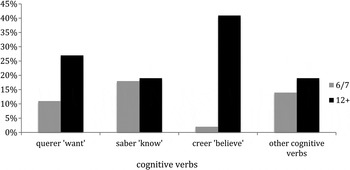
Similar to the imperfect, cognitive verbs significantly increased the likelihood of pronoun expression for all groups except the six- to seven-year-olds. The lack of a cognitive verb effect among the youngest children may be related to the token frequency of particular cognitive verbs, especially creer ‘to believe’. Consider Figure 2, which presents the youngest and oldest children's pronoun rates for cognitive verbs, highlighting in particular the three most frequent ones: querer, saber, creer, which account for 60% and 46% of the 6–7s' and 12+s' total number of cognitive verbs, respectively. Querer, saber, and creer are also the most frequent cognitive verbs in adult Spanish (Travis & Torres Cacoullos, Reference Travis and Torres Cacoullos2012, p. 739).
6-/7- and 12+-year-olds' pronoun rates with cognitive verbs.

Recall that the regression analyses showed that cognitive verbs increase the likelihood of pronoun expression among the older children, but not the six- to seven-year-olds. Figure 2 indicates that the youngest and oldest children differ especially in their use of the verb creer ‘believe’: 9/22 (41%) tokens of creer produced by the twelve+-year-olds occurred with an expressed pronoun. In stark contrast, only 1/41 (2%) of the younger children's tokens of creer occurred with a pronoun.
A further examination of creer suggests that the marked difference between these age groups' treatment of creer is concentrated in the use of 1sg pronoun yo in particular, that is, the production of yo creo. Among the twelve+-year-olds, 7/9 tokens of pronouns expressed with creer were yo. Put another way, 7/18 (56%) of their tokens of creo occurred with yo. Such a high rate of yo creo has also been reported for adult Spanish. Travis and Torres Cacoullos (Reference Travis and Torres Cacoullos2012, p. 739) find that yo is expressed with creo at a rate of 47% (24/51) in Travis' corpus of Colombian Spanish and at a rate of 45% (4,165/10,986) in the oral data from the Corpus del Español. Whereas adults and older children tend to produce yo + creo, the six- to seven-year-olds do not: only 1/36 (3%) of their tokens of creo occurred with yo. Thus, although yo creo may constitute a prefabricated unit in adult Spanish (Travis & Torres Cacoullos, Reference Travis and Torres Cacoullos2012, p. 739), the six- to seven-year-olds appear to avoid it and instead produce creo without a subject pronoun.
A definitive explanation for why the 6–7s say creo and not yo creo is beyond the scope of the current paper, but two possibilities should be explored in further research. First, perhaps the number of tokens of yo creo is too infrequent for children to recognize it as a prefabricated unit. After all, although creer occurred a total of 85 times in the corpus used for the present study, making it a relatively frequent verb compared to, say, extraviarse ‘to go astray’, other high-frequency verb lexemes occurred much more. For example, ser occurred 229 times and estar occurred as a main verb 228 times. Thus, relatively speaking, in terms of token frequency creer is not as frequent as other high-frequency verb lexemes. Furthermore, the pairing of yo with creo is far from categorical; creo occurs just as often as yo creo in adult Spanish. A second possible explanation for why the youngest children did not produce yo creo has to do with the pragmatic meanings associated with creo and yo creo. Whereas yo creo tends to be used to convey an argumentative or contentious position, creo tends to be used in hypothetical contexts (Aijón Oliva & Serrano, Reference Aijón Oliva and Serrano2010). It is possible that pragmatic meaning associated with yo creo is incompatible with children's discursive intent when using the verb creer. That is, it is likely that children employ creer not to indicate that their belief is in opposition to others' beliefs, but rather to express that they are not entirely certain of their proposition, as in (13), in which the names of the church and the location have been altered to protect the identity of the six-year-old girl who produced the excerpt.
(13) En Oaxaca hay una iglesia que se llama Santo Domingo. En un, creo que en un parque, o no sé, un centro creo, un parque que es de ángeles creo. [106]
‘In Oaxaca there is a church that is called Santo Domingo. In a, (I) believe that in a park, or (I) don't know, the city center (I) believe, a park that has angels (I) believe.’
However, the interpretation that children avoid expressing yo with creo because of its pragmatic meaning implies that children notice this subtle meaning difference between yo creo and creo. Research on children's understanding of the cognitive verbs ‘think’ and ‘know’ has shown that six-year-old children have difficulty perceiving these verbs' high-level meanings, such as the evaluation of others' belief systems (Booth & Hall, Reference Booth and Hall1995). This suggests that even school-age children may not perceive the argumentative or contentious meaning associated with yo creo. In summary, the contrast between younger and older children appears to be concentrated in the expression of pronouns with creer. At this juncture, a likely explanation of this contrast is the relatively low token frequency of the verb lexeme creer. Nevertheless, further research is needed to investigate exactly why the association between cognitive verbs – especially creer – and pronoun expression takes a long time to acquire.
The results for clause type raise a possible problem for the account that children will become sensitive to frequent conditioning contexts earlier than infrequent ones. In the current study, main clauses are highly frequent and favor pronoun expression among the older children but not the younger ones (see also Otheguy & Zentella, Reference Otheguy and Zentella2012, p. 164). To understand why children would not detect and learn that main clauses favor pronoun expression, we need to ask why older children and adults express pronouns more often in main than in coordinate clauses. At this juncture, the answer to that question and why younger children do not differentiate between these contexts remains elusive. The answer could be related to the interaction between Clause type and Reference. The pronoun rates in Table 7 suggest that for the 6–7s, when reference is maintained pronouns are rarely expressed, and this is true for both main and coordinate clauses (4%, 2%, respectively). On the other hand, for the twelve+-year-olds, pronouns are expressed more often in main than in coordinate clauses when reference is maintained across clauses (11%, 1%, respectively). Perhaps, then, the impact of Reference is somehow impeding the younger children's detection of any distinction between main and coordinate clauses with respect to pronoun use.
Underlying the prediction that frequency of conditioning contexts impacts the acquisition of structured variation is the assumption that linguists' categories actually represent heuristics that children construct and rely on to navigate the acquisition process. It stands to reason that some categories may more directly reflect these strategies. For example, it is possible that 1sg, 2sg, and switching reference are categories that closely approximate an actual distinction that children attend to. Seen this way, the impact of the frequency of the conditioning context relies on the identifiability of the context itself, for the number of times that context occurs will only be relevant once sensitivity to it emerges.
3. Piecemeal learning: structured variation emerges first in high-frequency items
It has been suggested that conditioning factors exert their impact more strongly on high-frequency forms than on low-frequency forms. Erker and Guy (Reference Erker and Guy2012) found that frequency mediated the impact of several predictor variables on Spanish subject pronoun expression. More specifically, morphological regularity, semantic class of the verb, and person/number of the verb significantly predicted pronoun expression of frequent verb forms, but not infrequent ones. In addition, they found that Reference and TMA significantly exerted a stronger impact on pronoun expression among the frequent verbs as compared to the infrequent ones. The idea that conditioning contexts exert more influence on high token frequency items can be applied to language acquisition. Perhaps structured variation is at first tied to particular lexical items and only later generalizes to both frequent and infrequent items (Chevrot, Beaud, & Varga, Reference Chevrot, Beaud and Varga2000; Díaz-Campos, Reference Díaz-Campos and Face2004). Thus far, there has been some evidence supporting this idea. Díaz-Campos (Reference Díaz-Campos and Face2004) found that children varied their pronunciation of intervocalic /d/ (sometimes expressing it, sometimes omitting it) more often in high-frequency than in low-frequency lexical items. He interprets this finding as evidence that sociolinguistic variation is acquired in a piecemeal fashion, first emerging in high-frequency words and only later generalizing across items.
Although the current study did not set out to test the hypothesis that structured variation emerges first with high-frequency items, a preliminary analysis of the 6–7's subject pronoun expression with frequent and infrequent verb lexemes lends support to this claim. To investigate differences between frequent and infrequent verbs with respect to pronoun expression patterns, I first counted the total number of occurrences of each verb lexeme (decir ‘to say’, ir ‘to go’, etc.) in the dataset (regardless of age group). Lexemes that comprised at least 1% of the data were considered frequent, and those that comprised less than 1% were considered infrequent (Erker & Guy, Reference Erker and Guy2012, p. 536). The six- to seven-year-old's data were then divided into frequent (N = 1285) and infrequent verbs (N = 560), and the same mixed-effects regression analysis performed earlier (see Figure 1 and Table A-1) was performed again, but this time separate analyses were performed for frequent and infrequent verbs. The results for frequent verbs show a significant effect of the imperfect (odds ratio: 5·33, p = ·02), whereas the results for infrequent verbs do not (odds ratio: 1·07, p = ·92). In contrast, the effects of 1sg, switch-reference, and subordinate clauses were significant for both frequent (1sg odds ratio: 3·95, p < ·0001; switch-reference: odds ratio 10·45, p < ·0001; subordinate clause odds ratio: 4·93, p = ·03) and infrequent verbs (1sg odds ratio: 441, p < ·0001; switch-reference odds ratio: 4·41, p = ·03, subordinate clause odds ratio: 4·93, p = ·03). These preliminary results indicate that the imperfect tense first exerts its impact on pronoun expression on frequently used verb lexemes and later generalizes to infrequent verbs. This finding supports the idea that structured variation develops in a piecemeal fashion, first appearing with high-frequency items and later generalizing over items.
Pattern complexity
In addition to the various frequency effects discussed above, it is very likely that other factors also impact when and how structured variation develops during childhood. Here, I suggest that the greater the complexity of the pattern of variation, the longer the pattern will take to acquire (Smith et al., Reference Smith, Durham and Richards2013, p. 319). I outline two ways that complexity may be relevant to how early structured variation is acquired. The first is that the more categorical a phenomenon is, the simpler it may be to detect in the input, and in turn the easier it will be to acquire. Consider, for example, constraints on short -a in Philadelphia. Recall that Roberts and Labov (Reference Roberts and Labov1995, p. 107) found that both children and adults categorically tensed short a (i) in the words mad and bad and never in the word sad, and (ii) before a nasal and a syllable boundary (e.g., sandals), and never in initial position followed by a nasal and vowel (e.g., animal). Similarly, in Smith et al.'s (Reference Smith, Durham and Richards2013) study of children in Buckie, Scotland, both the children and the adults categorically produced monophthong [uː] in the word anow and diphthong [ʌʉ] in the word now. They both also categorically produced singular forms with existentials, as in there's jelly sweeties. Since the adults' behavior was categorical in these contexts, the pairing of the form with the context should be easy to detect and learn. The pairing of short -a with mad and bad and before a nasal and a syllable boundary will always be supported by positive evidence and never contradicted by negative evidence in the input. The idea that more variability increases difficulty of acquisition could be considered an extension of Yang's (Reference Yang2002, pp. 26–27) Variational Model, according to which a possible grammar either gets rewarded each time positive evidence is encountered or punished when the input provides counter-evidence. In the current formulation it is the probabilistic pairings that get rewarded by positive evidence and punished by counter-evidence in the input. If there is no counter-evidence for a particular pairing, then learning that pairing should be easy and fast.
As noted earlier, there were some categorical contexts of pronoun expression or omission outlined in the current study. Although these contexts were not included in the analyses of structured variation, the children treated them the way adults generally do. For instance, the children expressed pronouns in the contexts where they were required (soy yo, eres tú). The children also categorically omitted yo ‘I’ with no sé ‘I don't know’ when this construction was not followed by a complement clause, and this was true across age groups. In addition, there was a near-categorical omission of subject pronouns with imperative verbs.
A second way that complexity may impact the acquisition of structured variation has to do with the number of factors that constrain variation. Shin (Reference Shin2014) offers an operationalization of linguistic complexity that draws on quantity of constraints on variation, with more constraints indicating a more complex pattern. According to this definition of complexity, the linguistic pattern examined in the current study is more complex than those explored in previous research on structured variation in child language. In the current study there were five fixed predictor variables, some of which had several factors, as well as a random variable. In total, for each logistic regression model there were at least seventeen linguistic factors (more than 17 for the models with the interaction term). In contrast, Miller (Reference Miller2013, p. 324) included eight linguistic factors in her study of Spanish -s deletion, and Smith et al. (Reference Smith, Durham and Fortune2007, p. 88) included four linguistic factors in their study of -s in third person verbs. Thus, the large number of constraints on Spanish subject pronoun expression may explain, in part, why the full pattern takes a long time to acquire.
The impact of internal, cognitive factors on the development of structured variation
Thus far I have suggested that constraints on variation are most likely learned by attending to probabilistic information in the input. Here, I consider the possibility that inherent functional and cognitive factors may also play a role in determining how sensitivity to constraints develops. Consider, for example, Reference. The results showed that across age groups children expressed subject pronouns more often when switching reference across two grammatical subjects than when maintaining it. I suggested that this constraint emerged early due to abundant evidence in the input. Here, I consider the possibility that that this tendency emerges as a result of a general drive to communicate clearly. First, it must be noted that there is a cross-linguistic tendency to omit NPs for referents that are highly accessible, and to produce more informative NPs, such as full lexical NPs, for less accessible referents (e.g., Ariel, Reference Ariel1990). The correlation between the use of informative NPs for less accessible referents indicates that the interlocutors' ability to locate a referent impacts which referring expression will be selected. There is evidence that children respond similarly to interlocutors' needs, as they, too, express NPs more often when the referent is inaccessible (e.g., newly introduced in the discourse, not present in the extralinguistic context, etc.), and they omit NPs more often when the referent is easily retrievable (e.g., Bel, Reference Bel2003; Hughes & Allen, Reference Hughes and Allen2015; Paradis & Navarro, Reference Paradis and Navarro2003; Serratrice, Reference Serratrice2005). Thus, perhaps the tendency to express Spanish subject pronouns more often when switching reference than when maintaining it emerges as a result of a more general drive to communicate clearly. On this account, children do not have to notice the distribution in the input; instead, they have to notice that pronoun omission in a switch-reference context could result in miscommunication.
Without discounting the possibility that the drive to communicate clearly may underlie, in part, the tendency to express more NPs in switch- than in same-reference contexts in general, I propose that this cannot fully explain how children learn the specific distributional patterns in their language. First, while it may be true that children are sensitive to the relative retrievability of referents and their expression and omission of NPs corresponds to that retrievability, personal pronouns in particular seem to pose more problems for children than lexical NPs do (Shin & Cairns, Reference Shin and Cairns2012, p. 26; Valian & Eisenberg, Reference Valian and Eisenberg1996, p. 126). Second, the probabilistic distribution of forms associated with various levels of accessibility is language-specific. That is, children do not only have to notice whether or not a referent is accessible, they also have to figure out which referring form to use. Spanish has the option of omitting and including subject pronouns, and thus including a pronoun can signal a higher level of inaccessibility. In contrast, in English subject omission is rare (e.g., Shin & Montes-Alcalá, Reference Shin and Montes-Alcalá2014, p. 88), and so expressed subject pronouns are less likely to be associated with referent inaccessibility in English. Thus, what is internally driven and language-independent is the need to produce more informative linguistic forms when referents are less accessible. Nevertheless, learning which form to produce depends on the language that is being acquired. It is most likely that children learn which forms to use and also learn how often to use them in various contexts by tracking distributional regularities in the input.
CONCLUSION
This study examined patterns of Spanish subject pronoun expression in interviews conducted with children in Mexico. The children were divided into four age groups. Mixed-effects binary logistic regression analyses were conducted to explore the impact of five linguistic factors that have been shown to impact adult pronoun use: Person/number, Reference, Verb type, TMA, and Clause type. Results showed that some constraints emerge early, but others take a long time to master. For example 1sg and switch-reference favored pronoun expression across age groups, while verbs in the imperfect and cognitive verbs favored pronoun expression among the older children, but not the younger ones. There are a number of questions raised by the study, in particular: What factors determine how early a pattern of structured variation will be acquired? If indeed children learn these patterns by attuning to statistical tendencies in the input, as suggested by previous research (e.g., Hudson Kam, forthcoming, Reference Hudson Kam2015; Miller, Reference Miller2013; Smith et al., Reference Smith, Durham and Richards2013), then it is reasonable to expect that more frequent and simpler tendencies will be easier to detect and learn. I propose in the ‘Discussion’ section that frequency impacts the timing of acquisition in various ways, including token frequency of the form that is subject to variation (e.g., subject pronouns, coda -s, etc.) and token frequency of conditioning contexts. I suggest that higher token frequency of both types may result in earlier pattern detection and, in turn, acquisition. I also explored the proposal that structured variation first emerges with high-frequency items (e.g., high-frequency verb lexemes) and later generalizes across both frequent and infrequent items. Evidence for this was found in the youngest children's sensitivity to the imperfect tense, which only emerged when frequent verb lexemes were isolated. Finally, I propose that pattern complexity may also impact the timing of acquisition, with simpler patterns being acquired earlier. Although support for the impact of these frequency effects can be found in the current study, future research that more directly compares the input children receive with the patterns they produce will help to confirm or disconfirm whether attending to the input is the primary mechanism underlying the acquisition of structured variation.
APPENDIX
Four mixed-model binary logistic regressions, subject pronoun expression, Mexican children