The purpose of this paper is to examine the use of verbs of motion by late Russian–English bilinguals.The Russian motion verb system encodes aspectual, directionality, manner, and path distinctions that are not encoded in English verbs. Second language (L2) influence on the first language (L1) in this case may result in simplification of the system. Such simplification has been documented in studies with heritage speakers of Russian, that is children from immigrant families, who were either born in the US or arrived there at an early age and for whom English is now the dominant language (Polinsky, n.d., Reference Pavlenko, Wei and Moyer2008a, Reference Pavlenkob; Bermel and Kagan, Reference Bermel, Kagan, Kagan and Rifkin2000; Andrews, Reference Andrews2001, Reference Andrews2004; Zemskaia, Reference Zemskaia2002, Reference Zemskaia2004). Notably, none of these studies focused on verbs of motion; instead deviations from standard usage in this area were noted among others. More importantly, these deviations are most likely evidence of incomplete acquisition, rather than of L2 influence on L1 or L1 attrition (Polinsky, Reference Polinsky, Corbett and Noonan2008b). In contrast, the study presented here will examine the motion lexicon of late or adult bilinguals who acquired English as L2 in late childhood or early adulthood.
Previous studies conducted with late Russian–English bilinguals have provided evidence of L2 influence on L1 in lexicalization of emotions, an area where the two languages differed, and space, an area where Russian lacks translation equivalents of the English notions “privacy” and “personal space” (Pavlenko, Reference Pavlenko2002b, Reference Pavlenko2003a, Reference Pavlenkob). In the first case I found that in contexts where monolingual Russian speakers appeal to emotion verbs, Russian–English bilinguals often favor adjectives and try to fit these adjectives into frames borrowed from English, displaying morphosyntactic and semantic transfer from L2 to L1 (Pavlenko, Reference Pavlenko2002a, Reference Pavlenkob, Reference Pavlenko2003a). In the second case, I found that to discuss the notions of “privacy” and “personal space”, which are not encoded in Russian, some of the same bilinguals appealed to lexical borrowing and loan translation (Pavlenko, Reference Pavlenko2002b, Reference Pavlenko2003a). I chose to characterize both cases as L2 influence on L1, rather than L1 attrition, because in the first case what changed was the pattern of preference, rather than the speakers’ ability to use and comprehend emotion verbs, and in the second case the speakers borrowed notions that did not have a counterpart in their L1 (for a discussion of L2 influence on L1, see Cook, Reference Cook2003; for a discussion of differences between L1 attrition and L2 influence on L1, see Pavlenko, Reference Pavlenko, Schmid, Köpke, Keijzer and Weilemar2004). In contrast to these two cases, systematic simplification of the motion verb system under the influence of L2 English would be considered evidence of L1 attrition.
1. Verbs of motion in Russian and English
Russian and English are commonly grouped together as satellite-framed languages, that is languages where the manner of motion is expressed by the main verb and the path by its satellite (Talmy, Reference Talmy1991). English marks path through prepositions and postpositions, and Russian through prepositions and prefixes (Slobin, Reference Slobin, Gumperz and Levinson1996). Despite this common grouping, the two verb systems also differ in a number of ways, with Russian motion verbs encoding distinctions in terms of aspect, directionality, manner, and path that are not encoded in English verbs.
1.1 Aspect
The category of aspect exists in both English and Russian, yet its encoding, functions, and meanings differ in the two languages. In English, syntactic aspect functions in combination with tense, presenting events as complete wholes (simple aspect; e.g., ‘I study at Yale’) or as actions in progress (progressive aspect; e.g., “I am studying for an exam right now”), and placing more or less completed (perfect aspect; e.g., “I have finished studying”) and incomplete events (perfect progressive aspect; e.g., “I was studying very hard”) at a prior point in time. Importantly, syntactic aspect is not an intrinsic characteristic of English verbs and is not marked in the infinitive.
In Russian, on the other hand, aspect is a syntactic category, independent of tense, and characterizes all forms of the verb, including infinitives, imperatives, and participles. This means that Russian speakers are required to mark verb aspect, regardless of whether the marking contributes to the meaning of the sentence (Zalizniak and Shmelev, Reference Zalizniak and Shmelev2000; Bondarko, Reference Bondarko2003). All Russian verbs, with the exception of быть (to be), belong to one of two aspectual categories: imperfective which refers to the process or state (e.g., идти [to be walking]) and perfective which refers to achievement or accomplishment (e.g., пойти [to start walking somewhere]). Many verbs constitute aspectual pairs, with one perfective and one imperfective member (e.g., идти–пойти). Perfective verbs are commonly used in two tenses (past and simple future) and imperfective verbs are used in all three tenses (past, present, and future with auxiliary verbs).
These aspectual differences do not correspond directly to tense–aspect distinctions encoded in English. For instance, Russian imperfective aspect encodes only some of the meanings of the English progressive, more specifically that of unfolding action either in the past or in the present. Russian also relies on imperfective verbs to describe repeated actions in the past (Мы ходили в школу [We walked/went to school]), whereas English in the same context relies on simple past tense markers or on additional lexical means (e.g. We used to walk/go to school).
As a result of these differences, each English motion verb may have at least two corresponding Russian verbs, a correspondence that creates major difficulties for English-speaking learners of Russian (Driagina, Reference Driagina2007). Polinsky's (n.d., Reference Polinsky, Brinton, Kagan and Bauckus2008a, Reference Polinsky, Corbett and Noonanb) studies of heritage speakers of Russian in the US identify aspectual distinctions as one area where simplification takes place in the Russian verb system.
1.2 Directionality
Directionality is a unique characteristic of Russian motion verbs indicating whether the action proceeds in a single or in multiple directions (Muravyova, Reference Muravyova1986; Mahota, Reference Mahota1996; Zalizniak and Shmelev, Reference Zalizniak and Shmelev2000). Unidirectional or determinate verbs refer to motion proceeding in a forward direction, from point A to point B (e.g., идти по улице [to be walking down the street]). Multidirectional or indeterminateverbs describe motion with more than one destination, aimless or random motion, and habitual or repeated motion (e.g., ходить по комнате [to walk back and forth around the room]; ходить в школу [to go to school every day]). As a consequence, a single English verb may have four corresponding Russian verbs, with a unidirectional and multidirectional verb in each aspect (e.g., идти-ходить [to walk somewhere – to walk back and forth, imperf], пойти–походить [to go/walk somewhere – to have walked back and forth, perf]). These differences are challenging for English-speaking learners of Russian who often confuse members of aspectual and directional pairs (Driagina, Reference Driagina2007). They also open up possibilities for simplification of the Russian system in contact with English documented in the speech of heritage Russian speakers (Polinsky, n.d., Reference Pavlenko, Wei and Moyer2008a; Bermel and Kagan, Reference Bermel, Kagan, Kagan and Rifkin2000).
1.3 Path
The two languages also differ in how they mark path of motion. In English, path is mostly marked through prepositions (e.g., climb in), in a few cases it is also encoded in the verb itself (e.g., enter). In Russian, path may be marked through both prepositions and prefixes. Frequently, the two perform the same function (e.g., влезть в [(in) climb into]). At times, however, prefixes and prepositions serve different functions, with the former marking aspect and the speaker's point of view and the latter path. This multifunctionality results in a very complex system of meanings whereby the meaning of one English utterance may be rendered in different ways, depending on the speaker's point of view:

The same Russian lemma with different prefixes and the same preposition may also require completely different verbs and prepositions in translation:
While there is some correspondence between prototypical or core meanings of the key Russian prefixes and prepositions and the English pre- and postpositions (e.g., в – in), this correspondence is limited, creating challenges for English-language learners of Russian and Russian-language learners of English, as well as opportunities for attrition and simplification.
1.4 Manner of motion
Despite their common categorization as satellite-framed languages, manner of motion is another area where the two languages differ in important ways. English has several high frequency generic verbs of motion, such as to go, to get, and to come, which are unmarked for manner. In Russian, on the other hand, there is a very limited number of verbs that are not marked for manner of motion, such as прибыть (to arrive) or отправиться (to set off). Russian lacks translation equivalents of to go, to come, and to get and requires its speakers to differentiate systematically between walking on foot (идти/ходить) and driving/riding (ехать/ездить). This difference also opens up possibilities for simplification, and both Polinsky (n.d.) and Andrews (Reference Andrews2001, Reference Andrews2004) noted that under the influence of English, heritage speakers of Russian may lose the obligatory distinction between walking and driving/riding and resort to one set of verbs, commonly идти/ходить (to walk), to refer to these motion events.
Given these differences between the two languages, we can now proceed to ask whether the Russian verb system remains intact or undergoes changes in contact with L2 English in late Russian–English bilinguals.
2. Research design and methodology
2.1 Participants
The narratives analyzed in the present study were collected from native speakers of Russian (L1 Russian corpus) and English (L1 English corpus) and from Russian–English bilinguals (Bilingual corpus). Clearly, contributors to both the L1 Russian corpus and the Bilingual corpus are native speakers of Russian. To differentiate between them the first group is labeled “L1 Russian speakers” and the second “bilinguals”. Contrary to the prevalent tradition, I decided not to refer to L1 speakers of English and Russian as “monolinguals” – all had exposure to foreign languages in secondary or higher education; some also had exposure to a second language in their environment. To minimize potential influence of these languages, only speakers who reported minimal competence in foreign or second languages were selected for participation in the study.
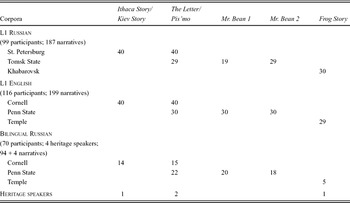
To take into account linguistic variation that stems from geographic, socioeconomic, and socioeducational factors, participants were recruited among students in two types of universities and in three geographic locations in each country: (a) prestigious elite universities (University of St. Petersburg in Russia; Cornell University in the US) and (b) large state universities (Tomsk State University and Khabarovsk State Pedagogical University in Russia; Pennsylvania State University and Temple University in the US). The three corpora were collected at these universities in the course of three studies (see Table 1 for an overview).
Distribution of participants across narrative tasks in the three corpora.

L1 Russian corpus
The L1 Russian corpus, consisting of 187 narratives, was collected from 99 native speakers of Russian. All participants reported that Russian was their native and dominant language; some had additional L2 knowledge of either Ukrainian, Kazakh or Tatar. All participants also had minimal (instructed) knowledge of German, English or French. None had ever lived in or even visited a foreign country, with the exception of post-Soviet countries. The following participants took part in the studies:
• Study 1. Eighty narratives were collected from 40 native speakers of Russian (20 females, 20 males), aged between 18 and 26 years (Mean age = 22.9 years, SD = 2.5), undergraduate and graduate students at the University of St. Petersburg, Russia.
• Study 2. Seventy-seven narratives were collected from 29 native speakers of Russian (21 females, 8 males), aged between 18 and 21 years (Mean age = 19.7 years, SD = 0.84), undergraduate students at Tomsk State University, Russia.
• Study 3. Thirty narratives were collected from 30 native speakers of Russian (16 females, 14 males), aged between 18 and 25 years (Mean age = 23.0 years, SD = 1.2), undergraduate students at Khabarovsk State Pedagogical University, Russia.
L1 English corpus
The L1 English corpus, consisting of 199 narratives, was collected from 116 native speakers of English who had only minimal (instructed) knowledge of languages studied in high school or in college (Spanish, French, Latin, Japanese, or Chinese). None had been on a study abroad or lived in a foreign country for an extended period of time. The following participants took part in the studies:
• Study 1. Eighty narratives were collected from 57 native speakers of English (27 females, 30 males), aged between 18 and 26 years (Mean age = 19.9 years, SD = 1.7), undergraduate and graduate students at Cornell University, Ithaca, NY.
• Study 2. Ninety narratives were collected from 30 native speakers of English (15 females, 15 males), aged between 18 and 22 years (Mean age = 20.2 years, SD = 1.4), undergraduate students at the Pennsylvania State University, State College, PA.
• Study 3. Twenty-nine narratives were collected from 29 native speakers of English (23 females, 6 males), aged between 18 and 22 years (Mean age = 19.8 years, SD = 1.3), undergraduate students at Temple University, Philadelphia, PA.
Bilingual Russian corpus
The Bilingual Russian corpus, consisting of 94 narratives, was collected from 70 late Russian–English bilinguals; in addition, four narratives were collected from four childhood bilinguals. All late bilinguals reported Russian as their native language and English as a second language. Some also reported basic knowledge of a second language (Kazakh, Ukrainian, or Latvian) and/or a foreign language (French or Spanish). The following participants took part in the studies:
• Study 1. Twenty-nine narratives were elicited from 27 bilinguals (14 females, 13 males), aged between 18 and 31 years (Mean age = 21.7 years; SD = 3.7), undergraduate and graduate students at Cornell University. Their age of arrival (AOA) in the US varied between 10 and 26.5 years (Mean AOA = 16.1 years; SD = 4.4). The length of exposure (LOE) to English in the US varied between 1 and 17 years (Mean LOE = 5.6 years; SD = 3.2). All participants learned their English upon arrival, some attended middle or high school in the US and others came directly to college. They used Russian with their families, relatives, and Russian-speaking friends, and English with English-speaking friends, as well as for educational and everyday interaction purposes.
• Study 2. Sixty narratives were elicited from 38 bilinguals (19 females, 19 females), aged between 17 and 34 years (Mean age = 25.1 years, SD = 4.8), undergraduate and graduate students at the Pennsylvania State University. Their AOA varied between 6 and 31 years (Mean AOA = 20.9 years; SD = 5.7). The LOE in the US varied between 6 months and 12 years (Mean LOE = 4.2, SD = 2.7). Most of the participants had studied English in secondary and higher education establishments in Russia and other post-Soviet countries (e.g., Ukraine, Kazakhstan) between 3 and 19 years (Mean = 8.9 years; SD = 4.2) and came to the US as students. All interacted in Russian and English on a daily basis and were recruited through the Russian club.
• Study 3 (in progress). Five narratives were elicited from five bilinguals (four females, one male), aged between 18 and 37 years (Mean age = 25.8 years; SD = 7.5), undergraduate and graduate students at Temple University. Their AOA varied between 6.5 and 25 years (Mean AOA = 15.9 years; SD = 7.3). The LOE varied between 6 and 14 years (Mean LOE = 10.3 years, SD = 3.2). All participants learned their English upon arrival, some attended middle or high school in the US and others came directly to college. They continued to use Russian with their families and, in two cases, for work-related purposes.
In all three studies, the participants were fluent enough in English to be enrolled in regular undergraduate and graduate classes; none were enrolled in the Intensive English Language Program.
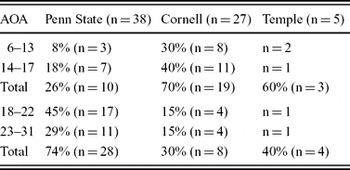
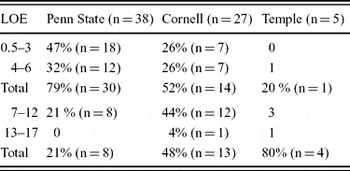
Given the large variation in the three bilingual groups in the age range, AOA and LOE, participants were further subdivided into four groups according to their AOA and LOE (see Tables 2 and 3). In terms of AOA, the groups were split as follows: (i) 6–13, participants who arrived as younger children and completed most of the secondary school in the US; (ii) 14–17, participants who arrived as teenagers and spent some time in a US high school; (iii) 18–22, participants who completed secondary school in Russian and attended college in the US; (iv) 23–31, participants who completed both secondary school and college in Russian and arrived in the US as graduate students.
Distribution of Russian–English bilinguals across four groups in terms of AOA.

Distribution of Russian–English bilinguals across four groups in terms of LOE.

The distribution of participants in Table 2 shows that the Cornell and Penn State corpora are distinct in terms of AOA (the Temple corpus is too small at this point to be included in this comparison): The majority of Cornell participants are early arrivals (ages 6–17, 70%), while the majority of Penn State participants are late arrivals (ages 18–31, 74%). The two groups are also distinct in LOE: Almost half of the Cornell corpus consists of participants who spent between 7 and 12 years in the US (44%), while in the Penn State corpus almost half of the participants spent between 6 months and 3 years in the US (47%). These differences were taken into consideration in the analysis.
Because I was interested in examining areas where L2 influence on L1 begins, I chose to focus on late bilinguals. To make my discussion comprehensive, however, I will also consider narratives elicited from four heritage Russian speakers who volunteered to participate in the study. Three of the participants were age 19 and one age 24. Their AOA varied between 6 months and 3 years (Mean AOA = 1.9; SD = 1.0) and LOE between 16 and 23 years (Mean LOE = 18.2; SD = 3.2). All four grew up speaking mostly Russian at home and mostly English outside the home. Their narratives were excluded from the bilingual corpus because as heritage speakers they may be incomplete acquirers.
2.2 Materials
All corpora in this study contain narratives elicited with the use of short films. Narratives have several advantages in this type of research (Pavlenko, Reference Pavlenko, Wei and Moyer2008a). On the one hand, just like conversations, they constitute language use in context and thus allow researchers to study how linguistic features are used in spontaneous speech. On the other hand, elicited narratives can be controlled for topic and, to a degree, for items and structures to be produced. Ideally, the findings from investigations of relatively naturalistic speech should be corroborated by means of more closely controlled tasks, e.g. grammaticality judgments. However, I decided not to include further experimental tasks, since the focus of this investigation was on language use in controlled contexts.
In Study 1, narratives were collected with two sets of films, created by the researcher in order to elicit emotion vocabulary and references to privacy and personal space (Pavlenko, Reference Pavlenko2002a, Reference Pavlenkob, Reference Pavlenko2003b; Pavlenko and Driagina, Reference Pavlenko and Driagina2007). The first film of each pair was made in the US, and the second in Kiev, Ukraine, to examine the influence of context on lexical selection. Ukraine, rather than Russia, was chosen for production cost reasons. As expected, although the films were actually made in Kiev, Russian participants inferred that the action was taking place in St. Petersburg, in Russia, or “somewhere in the former Soviet Union”.
The first pair of films, The Ithaca Story and Kiev Story, portrayed a young woman walking down a busy street and then sitting down on a bench. A young man sat down on the same bench within four feet of the woman. The woman shifted nervously several times and then got up and left. These films allowed me to examine how monolinguals and bilinguals structure space (Pavlenko, Reference Pavlenko2003b).
The second pair of films, The Letter and Pis'mo (The Letter), targeted emotion vocabulary. Both films portrayed a woman who got home and received and read an upsetting letter. Her roommate walked in and read the letter without permission. The protagonist noticed this and stomped out of the room. These films allowed me to examine lexicalization of emotions in monolingual and bilingual speech (Pavlenko, Reference Pavlenko2002a, Reference Pavlenkob; Pavlenko and Driagina, Reference Pavlenko and Driagina2007).
All four films elicited several references to motion, but since they were made for purposes other than the study of the motion lexicon, they portrayed a limited set of motion events. To elicit a larger variety of motion verbs, I conducted Study 2, using two segments from the popular Mr. Bean series as elicitation stimuli. The first segment portrayed Mr. Bean attempting to jump into a swimming pool (Mr. Bean 1), the second Mr. Bean trying to get out of a parking lot (Mr. Bean 2). To compare the performance of the new group of participants with those in the previous study, the participants were also asked to recall one film from the previous study, namely The Letter. These films also allowed me to examine lexicalization of emotions in monolingual and bilingual speech (Pavlenko, Reference Pavlenko2008b).
In Study 3, I elicited narratives with the help of Mayer's (Reference Mayer1969) book Frog, where are you? commonly used as a stimulus in the study of lexicalization of motion (e.g., Berman and Slobin, Reference Berman and Slobin1994; Slobin, Reference Slobin, Gumperz and Levinson1996; Strömqvist and Verhoeven, Reference Strömqvist and Verhoeven2004).
2.3 Procedure
Each participant was interviewed individually. In Study 1, L1 speakers were asked to recall two films with different contents (Ithaca Story/The Letter or Kiev Story/Pis'mo). They were shown the videos in randomized order and after each screening were asked to recall the film speaking directly into the taperecorder. Due to scheduling constraints, some L1 English speakers recalled only one film, which explains a higher number of participants in this group. Bilingual participants recalled one film in Russian and one in English. In all but two cases language order was randomized. Two participants expressed preference for Russian and produced both narratives in Russian, hence 29 Russian narratives were produced by 27 participants.
In Study 2, L1 speakers were asked to recall three films (The Letter/Mr. Bean 1/Mr. Bean 2), their recalls were taperecorded at the end of each screening. Unfortunately, a tape with ten L1 Russian narratives of Mr. Bean 1 was damaged prior to transcription, hence only 19 Mr. Bean 1 narratives were available for analysis. Bilingual participants were asked to recall two films in Russian and one in English or vice versa, with language choice and order randomized. Once again, however, some participant preferences were taken into account and the numbers of narratives elicited by each stimulus are somewhat different (22 narratives were elicited by The Letter, 20 by Mr. Bean 1, and 18 by Mr. Bean 2).
In Study 3, participants were asked to narrate the story portrayed in the picture book Frog, where are you (Mayer, Reference Mayer1969), as they looked at the pictures.
All recalls were taperecorded, transcribed in the original language and analyzed for the uses of verbs of motion.
2.4 Data analysis
To ensure that all corpora produced sufficient numbers of motion verbs, the narratives were first analyzed in terms of narrative length and proportion and number of motion verb tokens across the corpora. Then, two types of analysis were performed on the motion lexicon. The first involved identification of deviations from standard Russian usage. To do that, one first has to define what counts as standard Russian, as a verb of motion, and as deviation. Russian linguists working on L1 attrition, in particular Zemskaia (Reference Zemskaia2001, Reference Zemskaia2004) and Glovinskaia (Reference Glovinskaia2004), argue that literary Russian and the speech of educated inhabitants of Russian cities, and more specifically Moscow and St. Petersburg, constitutes the standard, while the speech of native Russian speakers born in Ukraine, Belarus, or Kazakhstan, diverges from the standard. Both dialectal variation and instances of code-switching and lexical borrowing are seen as deviations in this approach, with code-switching and lexical borrowing also taken as evidence of attrition.
Such a view of the standard is problematic for several reasons. First of all, linguists who adopt this approach draw on their own native speaker intuitions and on literary examples to judge whether particular usages conform to the standard. Yet, as Polinsky (Reference Polinsky2004) points out, codified standard literary Russian differs in several aspects from the spoken varieties and should not be used as a baseline comparison. Second, similar processes, in particular lexical borrowing from English, are now taking place both in diaspora and metropolis Russian (cf. Ryazanova-Clarke and Wade, Reference Ryazanova-Clarke and Wade1999), thus, lexical borrowings are not necessarily evidence of attrition – rather, they may be evidence of conceptual enrichment and expansion of the lexical repertoire (see also Pavlenko, Reference Pavlenko, Schmid, Köpke, Keijzer and Weilemar2004).
In the present study, the issue of the standard is resolved through the corpus-based approach, where lexical choices made by bilingual speakers are compared to those made by native speakers of Russian in the same context. This approach allows us to judge bilinguals against a real, rather than an idealized, reference group. To take into account geographic variation, both groups included some participants who grew up as native Russian speakers outside of Russia, in Belarus, Kazakhstan, Latvia, and Ukraine (on Russian in post-Soviet countries, see Pavlenko, Reference Pavlenko2006, Reference Pavlenko2008c).
Only verbs with inherent motion-related semantics referring to an agent or patient changing position or location counted as verbs of motion in the present corpus (e.g., to drop, to carry, to jump, to roll, to swim); verbs, such as to open or to close, that may or may not involve such change did not count as verbs of motion.
To decide on what counts as deviation, the stimuli were divided into segments with particular motion events (e.g., a woman sitting down, a deer throwing a boy off the cliff, etc.). These events were matched with lexical choices in the L1 Russian, L1 English and bilingual corpora. Items counted as deviations when they satisfied two conditions: (a) a morphosyntactic or pragmatic error was committed, and (b) no L1 Russian speakers made the same lexical choices. These instances further counted as evidence of L2 influence on L1 if they patterned with lexical choices made by L1 English speakers.
This corpus-based approach allowed me to eliminate some items that might otherwise have been judged as erroneous. For instance, one bilingual participant narrating the Frog Story stated that the characters махают [are waving], violating the standard Russian conjugation pattern (машут). This violation was not counted as a deviation because similar violations were also found in the L1 Russian corpus. On the other hand, morphosyntactically correct verb tokens counted as deviations if they diverged from L1 Russian speakers’ choices in a particular context and thus violated semantic and pragmatic constraints of Russian. For instance, lexical choice in the utterance она ходила по парку [she was walking around the park] was judged as erroneous because the speaker used a multidirectional verb in the context where L1 Russian speakers used unidirectional verbs to refer to the character walking in a specific direction.
The second analysis involved examination of lexical diversity in the motion lexicon of bilingual participants. As discussed earlier, because Russian makes distinctions that are not encoded in English, L2 influence on L1 may be displayed as the loss of lexical diversity. To examine this possibility, I first compared the corpora in terms of verb types, using the type–token ratio (TTR; on limitations of this approach, see Dewaele and Pavlenko, Reference Dewaele and Pavlenko2003). To equalize Russian and English, I counted as types only basic stems, that is motion verbs without prefixes, prepositions, and postpositions. Russian aspectual verb pairs, as well as directionality verb pairs, counted as a single stem in this analysis (e.g., to walk vs. идти/ходить/пойти/уйти/зайти, etc.).
To examine the use of aspectual, directionality, manner, and path distinctions, I then compared L1 Russian and bilingual corpora in terms of specific subsets of verbs, which included prefixed derivatives of the main verb pairs, such as идти/ходить [to walk], плыть/плавать [to swim], or ехать/ездить [to drive/ride]. Thus, if in a particular corpus L1 Russian speakers used a variety of prefixed derivatives of a particular set of verbs, these choices were compared to those made by bilingual speakers, looking for evidence of simplification of the motion verb repertoire.
3. Results
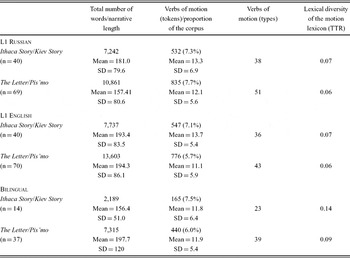
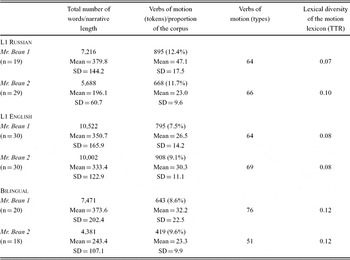
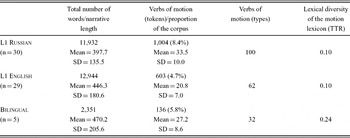
Tables 4, 5, and 6 present an overview of the corpora in terms of overall size, mean narrative length, size of the motion lexicon, proportion of the motion lexicon in the corpus, and lexical diversity. We can see that, despite the unavoidable differences between corpora elicited by different stimuli or from speakers with different language backgrounds, all stimuli have elicited significant numbers of motion verb tokens (L1 Russian range 532–1,004; L1 English range 547–908; bilingual range 136–643). In Study 1, the motion lexicon represents between 5.7% and 7.7% of the overall corpus, in Study 2, between 7.5% and 12.4%, and in Study 3, between 4.7% and 8.4%.
Study 1: size and lexical richness in the narrative corpora.

Study 2: size and lexical richness in the narrative corpora.

Study 3: size and lexical richness in the narrative corpora.

In terms of stimuli, in L1 Russian the highest number of motion verbs per narrative was elicited by Mr. Bean 1 (Mean = 47.1), followed by the Frog Story (Mean = 33.5) and Mr. Bean 2 (Mean = 26.5). In L1 English, the highest number was elicited by Mr. Bean 2 (Mean = 30.3), followed by Mr. Bean 1 (Mean = 26.5), and the Frog Story (Mean = 20.8). In the bilingual corpus, as in the L1 Russian corpus, the highest number was elicited by Mr. Bean 1 (Mean = 32.2), followed by the Frog Story (Mean = 27.2) and Mr. Bean 2 (Mean = 23.3). These three stimuli also elicited the highest numbers of different verb types. Together, these numbers suggest that Mr. Bean series are just as appropriate as Frog, where are you? for elicitation of motion verbs. Films may also constitute more ecologically valid elicitation stimuli than picture-books or cartoons.
To identify deviations from common motion verb usage in the bilingual corpus, in Study 1, I have analyzed the uses of 605 motion verb tokens and found only 8 instances of deviations in narratives by 6 participants (3 females, 3 males): 3 instances came from the Ithaca Story/Kiev Story corpus and 5 from The Letter/Pis'mo corpus. In Study 2, there were 5 instances of deviations out of 1,062 motion verb tokens, these instances came from Mr. Bean 1 narratives by 4 study participants (1 female, 3 males). In Study 3, I found 11 deviations out of 136 motion verb tokens in narratives by 4 study participants (3 females, 1 male). All four narratives contained two or more instances of deviation. Altogether, 14 study participants (7 females, 7 males) produced 24 instances of deviation from L1 Russian usage.
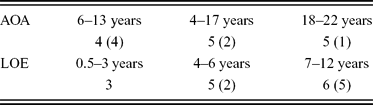
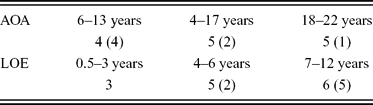
Table 7 demonstrates the distribution of these participants in terms of AOA and LOE. Not surprisingly, most participants who produced two or more erroneous instances are clustered among those who arrived earliest (between the ages 6 and 13 years) and among those who have been longest in the country (between 7 and 12 years). Interestingly, no errors were made by the two participants who have been in the US between 13 and 17 years.
AOA and LOE of participants with evidence of L2 influence (numbers in parentheses refer to participants who produced two or more erroneous instances).
Clearly, 24 instances out of a total of 1,803 tokens is too low a number to base any conclusions on. Furthermore, all of these instances were located in narratives that otherwise contained numerous, diverse, and correctly used verbs of motion. Thus, the results of corpus analysis suggest that Russian–English bilinguals in the three studies do not display systematic errors in terms of accuracy of use of the motion lexicon.
Next, I examined lexical diversity across the corpora. As seen in Tables 4, 5, and 6, in all three studies bilingual corpora are higher in lexical diversity (as measured by TTR) than respective L1 Russian and L1 English corpora. These results confirm the findings of Dewaele and Pavlenko's (Reference Dewaele and Pavlenko2003) analysis of narratives used in Study 1, which showed that Russian–English bilinguals are similar to relatively monolingual speakers of Russian in terms of overall lexical diversity in their narratives. These conclusions were also borne out in the analysis of the subcorpora, involving references to walking, riding/driving, swimming, climbing, and crawling. In all cases, bilinguals appealed to the same prefixed verbs as L1 Russian speakers. Thus, the results of the lexical diversity analysis suggest that Russian–English bilinguals in the three studies do not display any loss of lexical diversity in the motion lexicon.
These results are particularly interesting in view of the fact that participants in Study 1 have displayed systematic patterns of L2 influence on L1 in lexicalization of emotions (Pavlenko, Reference Pavlenko2002b). Furthermore, in all three studies, participants experienced lexical search difficulties and appealed to lexical borrowing and code-switching. Thus, we cannot conclude that these speakers do not experience overall L2 influence on L1 and perhaps even a degree of L1 attrition, or at least L1 lexical activation difficulties. Rather, L2 influence on L1 and L1 attrition are not evident in the use of the motion lexicon. At the same time, 24 instances of deviation from standard Russian usage, identified in the corpus, offer interesting insights in terms of where and how the L2 influence and L1 attrition may begin in the Russian motion lexicon.
4. Discussion
4.1 Aspect
In the discussion below, deviations from appropriate lexical choices in the participants’ narratives will be underlined. Examples will be followed by glosses in square brackets and then by appropriate lexical choices (based on the L1 Russian corpus) in parentheses. The first type of deviations witnessed in the bilingual corpus is the loss of aspectual distinctions, e.g.:
(1) . . .пришел. . .мм. . .какой-то парень и сидел рядом с ней. . .
[came over. . .uhm. . .some guy and was sitting next to her]
(an appropriate lexical choice here is сесть [to take a seat, perf])
(Ithaca Story, MB, female, 19, AOA 16 years, LOE 3 years)
In most instances bilingual speakers opted for multidirectional imperfective verbs in contexts that required unidirectional perfective verbs (as seen in the L1 Russian corpus), referring to punctual accomplished actions:
- (2)
a. . . .если кто-то рядом садился, это ее как-то мешало ей. . .
[if someone [was] sitting down next [to her], it her somehow bothered her]
(an appropriate lexical choice here is сесть [to take a seat, perf])
(Ithaca Story, VK, male, 25, AOA 19 years, LOE 6 years)
b. . . .мимо нее проезжала машина. . .
[by her was riding/driving a car]
(an appropriate lexical choice here is проехать [to have driven by, perf])
(The Letter, ES, male, 20, AOA 15 years, LOE 5 years)
c. . . .девчонка молодая приходила домой. . .
[a young girl [was] arriving home]
(an appropriate lexical choice here is прийти [to have arrived, perf])
(Pis'mo, NG, female, 21, AOA 14.5 years, LOE 6.5 years)
d. . . .а потом ложился на вышку. . .
[and then [he was] lying down on the diving board]
(an appropriate lexical choice here is лечь [to have lied down, perf])
(Mr. Bean 1, DK, female, 28, AOA 21 years, LOE 7 years)
In two instances, participants used auxiliary verbs with imperfective verbs, in contexts where the action in question was already accomplished and where perfective verbs would be required or at least preferable:
- (3)
a. . . .о том, как Мистер Бин пытался ходить в бассейн. . .
[about how Mr. Bean tried to walk to the swimming pool]
(an appropriate lexical choice here is either сходить [to have made a trip, on foot, perf] or пойти [to have gone, on foot, perf] without пытаться [to try, imperf])
(Mr. Bean 1, IV, male, 23, AOA 22 years, LOE 1 year)
b. . . .они начали его догонять. . .
[they started catching up with him]
(appropriate lexical choices here are догоняют [are about to catch up, imperf], догнали [caught up, perf]) or подбегают [running closer to])
(Frog Story, TM, female, 21, AOA 15 years, LOE 6 years)
The use of verbal constructions with an auxiliary to start is perfectly acceptable in English and common in the L1 English corpus. In Russian, on the other hand, beginning of action is most commonly marked with a prefix по-. The use of auxiliaries in place of the prefix represents a clear case of L2 influence on L1 lexicalization patterns. Verbal constructions with начать (to start, to begin) and imperfective verbs were also found in a Frog Story narrative by one of the heritage speakers:
- (4)
a. . . .пчелы начали мчаться за собакой. . .
[the bees started running after the dog]
(an appropriate lexical choice here is помчались [started running, perf])
b. . . .олень начал куда-то бегать. . .
[the deer started running somewhere]
(an appropriate lexical choice here is побежал [started running, perf])
(Frog Story, OG, male, 19, AOA 2 years, LOE 17 years)
Similar verbal constructions appear in Zemskaia's (Reference Zemskaia2002) and Polinsky's (Reference Polinsky, Brinton, Kagan and Bauckus2008a) studies of heritage speakers of Russian, e.g.:
- (5)
a. Я вышел на улицу и начал идти к перекрестку.
[I walked out to the street and started walking toward the crosssing]
(an appropriate lexical choice here is пошел [went, perf])
(Zemskaia, Reference Zemskaia2002, p. 40)
b. мальчик и его новый лягушка будет идет домой
[the boy and his new frog will walk home]
(an appropriate lexical choice here is пошли [went, perf])
(Frog Story, Polinsky, Reference Polinsky, Brinton, Kagan and Bauckus2008)
While all of the instances above involve substitution of perfective verbs with imperfective ones, one cannot conclude on the basis of these few instances that Russian–English bilinguals always favor the imperfective. A more conservative interpretation of these data is that in the process of L2 influence on L1, and, potentially, L1 attrition, Russian-English bilinguals may begin losing aspectual distinctions, at least in production (on similar losses in heritage speakers, see Zemskaia, Reference Zemskaia2002; Polinsky, Reference Polinsky, Brinton, Kagan and Bauckus2008a, Reference Polinsky, Corbett and Noonanb).
4.2 Directionality
As already seen in the previous section, another simplification that may take place in the Russian motion verb system is the loss of distinctions made in terms of directionality. In the examples above speakers favored multidirectional imperfective verbs in contexts that required unidirectional perfective verbs. In the examples that follow the aspect remains the same because the speaker's focus is on the action in progress. In example (6) below, the speaker used a multidirectional imperfective verb ходить [to be walking back and forth or to walk somewhere repeatedly] instead of a unidirectional imperfective verb идти [to be walking in a particular direction] required by the context of the film and used by L1 Russian speakers:
(6) . . .девочка ходила по улице. . .
[a young girl was walking [up and down] the street]
(an appropriate lexical choice here is шла [was walking in one direction])
(The Letter, JE, female, 18, AOA 10 years, LOE 8 years)
In (7) the speaker used a multidirectional imperfective verb бродить [to wander] in the context that requires a unidirectional imperfective verb, such as брести [to be wandering, walking slowly in a particular direction], and where L1 Russian speakers commonly used a unidirectional perfective verb пройти [to have walked]:
(7) . . .бродя чуть-чуть подальше, она как-то присаживается на одну из скамеек. . .
[while wandering a little further, she somehow sits down on one of the benches]
(Ithaca Story, JG, male, 19, AOA 14 years, LOE 5 years)
Similar errors, that is the use of multidirectional verbs ходить [to walk back and forth] or бегать [to run back and forth] instead of unidirectional verbs идти [to walk in a particular direction] or бежать/побежать [to run in a particular direction], were found in narratives collected from heritage speakers:
- (8)
a. . . .она ходит по парку. . .
[she is walking in the park]
(Ithaca Story, DF, female, 24, AOA 8 months, LOE 23 years)
b. . . .женщина ходит по улице. . .
[a woman is walking [up and down] the street]
(Pis'mo, МК, female, 19, AOA 3 years, LOE 16 years)
c. . . .олень начал куда-то бегать. . .
[the deer started running somewhere]
(Frog Story, OG, male, 19, AOA 2 years, LOE 17 years)
Other scholars also observed the loss of directionality distinctions in heritage Russian speakers (Polinsky, n.d., Reference Pavlenko, Wei and Moyer2008a; Bermel and Kagan, Reference Bermel, Kagan, Kagan and Rifkin2000; Andrews, Reference Andrews2001), e.g.:
(9) Он ходит на автобусную остановку и садится на автобус.
[He walks [back and forth] to the bus stop and takes a bus]
(an appropriate lexical choice here would be идет [walks in one direction])
(Bermel and Kagan, Reference Bermel, Kagan, Kagan and Rifkin2000, p. 422)
The preference, however, is not uniform: Bilinguals in my corpus favored multidirectional verbs, but heritage speakers in other studies sometimes opted for unidirectional verbs in contexts where multidirectional ones were required:
- (10)
a. Я люблю туда в Москву ехать.
[I like going there, to Moscow]
(an appropriate lexical choice here is ездить [to go back and forth, i.e. to travel])
(Zemskaia, Reference Zemskaia2004, p. 25)
b. Мой дядя часто он приехал к нам в Бруклин.
[My uncle he often arrived to us in Brooklyn]
(an appropriate lexical choice here is приезжал [arrived repeatedly, i.e. visited])
(Polinsky, n.d., p. 57)
c. Вы любите идти в церковь?
[Do you like to go to church?]
(an appropriate lexical choice is ходить [to walk back and forth, repeatedly])
(Polinsky, n.d., p. 57)
Once again, then, a conservative interpretation of these data is potential loss of directionality distinctions rather than a preference for a particular verb type.
4.3 Manner: main verb
The next type of errors involves the manner of motion marked by the main verb. The first example of simplification in the bilingual corpus involves an obligatory distinction between идти/ходить [to walk] and ехать/ездить [to drive/ride].
(11) . . .мимо нее машины проходили. . .
[cars were walking by her]
(an appropriate lexical choice here is проезжали [driving/riding by])
(The Letter, JE, female, 18, AOA 10 years, LOE 8 years)
This slippage may reflect the very beginning of the simplification process that takes place under the influence of the generic English verb to go. Scholars working with heritage speakers also observed the use of verbs идти/пойти [to walk in a particular direction] as generic motion verbs that refer to both walking and riding/driving (Polinsky, n.d.; Bermel and Kagan, Reference Bermel, Kagan, Kagan and Rifkin2000; Andrews, Reference Andrews2001, Reference Andrews2004; Schmitt, Reference Schmitt2005). In the words of Andrews (Reference Andrews2001), in the lexicons of these speakers the distinctions between self-propulsion (walking) and movement by some means of conveyance (riding, driving) “have retreated to the passive level, subsumed into a superordinate cognitive category inspired by English to go” (p. 525), e.g.:
- (12)
a. Да, я пошла туда [в Россию] на две недели летом.
[Yes, I walked there [to Russia] for two weeks in the summer]
(an appropriate lexical choice here is ездила [went by means of transportation])
(Andrews, Reference Andrews2004, p. 127)
b. В август я иду в Сиэттл.
[In August I [am] walking to Seattle]
(an appropriate lexical choice here is еду/поеду [will go by means of transportation])
(Polinsky, n.d.,p. 56)
c. И сейчас обратно во Флориде иду.
[And now I [am] walking back to Florida]
(an appropriate lexical choice here is еду [go by means of transportation])
(Schmitt, Reference Schmitt2005)
Further evidence that the verb pair идти/ходить [to walk] and its derivatives may begin to function in the manner of generic verbs to go, to get, and to come is seen in the following example from the bilingual corpus, where the verb выходить [to walk out, imperf] has replaced вылазить [to climb out], more appropriate in reference to a small animal:
(13) . . .типичная нора крота, выходит [крот]. . .
[a typical burrow of a mole, walks out [a mole]]
(an appropriate lexical choice here is вылазит [climbs out])
(Frog Story, SE, female, 29, AOA 21 years, LOE 8 years)
Similar semantic extension was found in a Frog Story narrative by a heritage speaker who used the verb выйти [to walk out, perf] to refer to both climbing and flying:
- (14)
a. . . .из дырки вышел/вышло какое-то животное. . .
[from a hole walked out/walked out some animal]
(an appropriate lexical choice here is вылезло [climbed out])
b. . . .собака уронила гнездо с пчелами и все вышли. . .
[the dog dropped the behive and all came out]
(an appropriate lexical choice here is вылетели [flew out])
(Frog Story, OG, male, 19, AOA 2 years, LOE 17 years)
Once again, however, one cannot say that идти/ходить is the only verb pair whose use is extended under the influence of L2 English. For instance, in one Frog Story narrative, the participant overextended the uses of the verb лазить [to climb]:
- (15)
a. . . .из этой дырки вылазит сова, сова вылазит. . .
[from this hole climbs out an owl, an owl climbs out]
(an appropriate lexical choice here is вылетает [flies out])
b. . . .олень вылазит из-за камня. . .
[a deer climbs out from behind the stone]
(an appropriate lexical choice here is выбегает [runs out])
c. . . .они лазят вокруг дерева. . .
[they climb around a tree]
(an appropriate lexical choice here is крадутся [sneak around])
(Frog Story, AL, male, 18, AOA 6.5 years, LOE 11.5 years)
Together with the results of studies with heritage speakers (Polinsky, n.d.; Bermel and Kagan, Reference Bermel, Kagan, Kagan and Rifkin2000; Andrews, Reference Andrews2001, Reference Andrews2004; Schmitt, Reference Schmitt2005), these instances suggest that manner of motion marking is another area that may undergo simplification in the process of L2 influence on L1.
4.4 Manner and path: prefixation
Markers of path are particularly well-preserved in the bilingual corpus. I found only one instance in which a participant misused a directional prefix:
(16) . . .прилетела большая птица. . .
[flew in a big bird]
(an appropriate lexical choice here is вылетела [flew out])
(Frog Story, AZ, female, 24, AOA 12 years, LOE 12 years)
Other instances suggest, however, that there is some loss of prefix meanings in the bilingual corpus. Examples of incorrect prefix assignment include the following:
- (17)
a. . . .[она] захватила письмо. . .
[she took over the letter]
(an appropriate lexical choice here is схватила [grabbed])
(Pis'mo, NG, female, 21, AOA 14.5 years, LOE 6.5 years)
b. . . .у него отвалились плавки. . .
[his swimming trunks broke off]
(an appropriate lexical choice here is свалились [fell off])
(Mr. Bean 1, NZ, male, 22, AOA 21.5 years, LOE 6 months)
c. . . .[олень] выбросил мальчика с обрыва в озеро. . .
[[the deer] threw the boy out off the cliff into the lake)
(an appropriate lexical choice here is сбросил [threw down])
(Frog Story, TM, female, 21, AOA 15 years, LOE 6 years)
d. . . .улей спал с дерева. . .
[the beehive fell down the tree]
(an appropriate lexical choice here is упал [fell down])
(Frog Story, SE, female, 29, AOA 21 years, LOE 8 years)
All four instances involve a polysemous prefix с- that has a variety of meanings, including accomplished action as in схватить [to grab] and downward movement as in свалиться [to fall off], сбросить [to throw down], and спасть [to fall down]. These meanings are less transparent than those of prefixes в- (movement inwards) or вы- (movement outwards) and do not closely match the English particles, hence the prefix may be more difficult to retain.
Together with examples discussed earlier that show L2 influence on L1 in marking beginning of action, these instances suggest that prefixes that do not have direct equivalents in English may be particularly vulnerable to attrition.
5. Conclusions
To sum up, the results of the present study show that the motion lexicon is relatively stable in late Russian–English bilinguals and that lexicalization of motion in these participants is more resilient to L2 influence than lexicalization of emotions. This finding raises interesting follow-up questions as to factors that may make one set of verbs more vulnerable to L2 influence than the other.
Instances of deviation identified in the study involve simplification of the Russian motion lexicon in terms of aspectual, directionality, and manner distinctions. Similar findings come from studies conducted with heritage speakers of Russian (Polinsky, n.d.Reference Polinsky, Brinton, Kagan and Bauckus2008a, Reference Polinsky, Corbett and Noonanb; Bermel and Kagan, Reference Bermel, Kagan, Kagan and Rifkin2000; Andrews, Reference Andrews2001, Reference Andrews2004; Zemskaia, Reference Zemskaia2001, Reference Zemskaia2004; Schmitt, Reference Schmitt2005). Additionally, in the present study participants displayed preference for multidirectional imperfective verbs. Future studies of the motion lexicon of Russian–English bilinguals could explore these preferences and deviations further, supplementing production tasks with other, more controlled, tasks.