


Introduction
The perinatal period
This paper presents data on an adapted dialectical behaviour therapy (DBT) skills group for women in the perinatal period. The MBRRACE confidential enquiry into maternal deaths found suicide to be a leading cause of death following birth, with 23% of postnatal deaths one year following birth having mental health-related causes (Knight et al., Reference Knight, Tuffnell, Kenyon, Shakespeare, Gray and Kurinczuk2015). Previous research suggests that emotional dysregulation and suicide are related (Zlotnick et al., Reference Zlotnick, Donaldson, Spirito and Pearlstein1997, Reference Zlotnick, Wolfsdorf, Johnson and Spirito2003). Providing appropriate mental health treatments for the perinatal period has become a priority with the National Health Service Five Year Forward View (2014) committing to an ambitious programme, backed by £365m, to increase access to specialist perinatal mental health teams.
The perinatal time is full of important life changes and transitions (Johns and Belsky, Reference Johns, Belsky, Salmon and Shackelford2007): taking on new roles and responsibilities at the same time as losing some as many women take career breaks; new relationships are formed as well as lost as contact with friends whose lives are taking them in other directions end. It can be an emotionally charged time when previous losses are revisited and old wounds resurface (Fraiberg et al., Reference Fraiberg, Adelson and Shapiro1975). Even if effective strategies for coping and regulating emotions have been learnt before becoming a parent, the set of new challenges faced with parenting an infant mean it can be difficult to know how to apply and generalize these skills. Research confirms that there is an increased risk of relapse of existing mental health problems and first presentation of mental health issues at this time (Cox et al., Reference Cox, Murray and Chapman1993; Davies et al., Reference Davies, McIvor and Kumar1995; O'Hara and Swain, Reference O'Hara and Swain1996; Jones and Craddock, Reference Jones and Craddock2005) of which emotion dysregulation can play a key role.
This paper uses the Linehan (Reference Linehan2015a,Reference Linehanb; p. 6) definition of emotional dysregulation: ‘the inability, . . . despite best efforts, to change or regulate emotional cues, experiences, actions, verbal responses and/or non-verbal expressions under normative conditions’. Within the perinatal context, these skills can be tested especially as common emotional vulnerabilities can increase such as physical pain and lack of sleep. Skills to reduce emotional dysregulation can be put to the test.
Why DBT as a treatment model for emotion dysregulation in the perinatal period?
DBT is a multi-component (group training, individual therapy, staff consultation and telephone coaching) cognitive behaviour therapy developed for people with borderline personality disorder (BPD). Randomized control studies comparing DBT with treatment as usual show it to be effective at reducing suicide rates, hospital admissions, self-harm and impulsive behaviours (Carter et al., Reference Carter, Willcox, Lewin, Conrad and Bendit2010; Linehan et al., Reference Linehan, Armstrong, Suarez, Allmon and Heard1991, Reference Linehan, Comtois, Murray, Brown, Gallop and Heard2006).
Adapted and stand-alone skills groups (i.e. without individual therapy) have also been researched. Stand-alone DBT skills groups for BPD have shown to be effective at reducing depression, anger and emotional dysregulation (Sambrook et al., Reference Sambrook, Abba and Chadwick2006; Soler et al., Reference Soler, Pascal, Tiana, Cebrai, Barachina and Campins2009). Adapting the skills for various conditions has also been found to be effective (for example, eating disorders, drinking related problems and attention deficit disorder; see Hirvikoski et al., Reference Hirvikoski, Waaler, Alfredsson, Pihlgren, Holmstrom and Johnson2011; Telch et al., Reference Telch, Agras and Linehan2001; Whiteside, Reference Whiteside2011). These studies set a precedent for the adaption of DBT. As suicide is a leading cause of death following birth and emotional dysregulation can play a contributory role in maintaining distress, adapting DBT for the perinatal period seems appropriate.
Keeping the baby in mind
The impact of maternal wellbeing and mental health on infant and child global development is well researched (O'Donnell et al., Reference O'Donnell, Glover, Barker and O'Connor2014; Pawlby et al., Reference Pawlby, Hay, Sharp, Waters and Keane2009; Pickles et al., Reference Pickles, Sharp, Hellier and Hill2013). The transactional model of how we learn to understand, express and regulate emotions (see Sameroff, Reference Sameroff1993) suggests that these skills are learnt in a dynamic interplay with others and our environment. The biosocial transactional model, which underpins DBT (see Lineham, Reference Linehan2015a, p. 9 for a summary), also integrates the predisposing temperament of the individual alongside the interplay with the environment as factors that can reinforce and/or teach maladaptive coping. If parents find it hard to regulate and soothe themselves, supporting an infant in distress might be even harder. An association between emotional dysregulation and ability to hold a child's mental state and their needs in mind has been found (Schacht et al., Reference Schacht, Hammond, Marks, Woods and Conroy2012). If left untreated, parent emotional dysregulation may lead to a potential perpetuation of emotional vulnerability and invalidating environments for future generations (Cromwell et al., Reference Cromwell, Beauchaine, Lenzenweger, Beauchaine and Hinshaw2008).
Studies on early infant behaviour show emotion and social learning starts from birth (Murray and Andrews, Reference Murray and Andrews2000). Enhancing parental emotional coping is not only likely to have a positive impact on the parent, but also the infant's emotional, cognitive and behavioural long-term development (Gerhardt, Reference Gerhardt2014). By supporting parents, children are also supported by reducing the intergenerational impact of mental illness. Integrating child development knowledge (Murray and Andrews, Reference Murray and Andrews2000) and adapting DBT skills to target perinatal specific issues appears valid and warranted.
Hypothesis
As emotional dysregulation is a feature of mental health concerns during the perinatal period and DBT skills have been shown to be effective in increasing emotional regulation, we predicted that a stand-alone DBT skills group adapted for the perinatal period will reduce emotional distress, and improve emotional regulation and confidence in dealing with mental health issues.
Method
Design
A within-subjects design was employed. Participants were asked to complete outcome measures by the clinicians running the group at three time points: assessment, start of the group intervention and at the end of the group intervention.
Participants
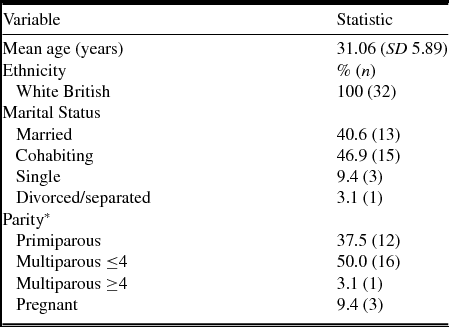
Thirty-two women under the care of the perinatal community mental health team with difficulties in emotion regulation (e.g. marked fluctuations in mood, inaccurate expression of emotion, thoughts/acts to self-harm/suicidal ideation) were assessed for group suitability via clinical interview. Table 1 describes the demographic characteristics of the 32 perinatal women (three pregnant and 29 postpartum) who were initially referred to the group. Ages ranged from 19 to 42 years (mean age 31 years). All were white British (100%). In terms of marital status, 40.6% (n = 13) were married, 46.9% (n = 15) were cohabitating, 9.4% (n = 3) were single, and 3.1% (n = 1) divorced/separated. In regard to parity, 37.5% (n = 12) of women were first time mothers, 50.0% (16) of women had between two and four children, and 9.4% had five or more children.
Demographic variables (n = 32)

* Parity: primiparous (1st child), multiparous ≤4 (2‒4 children), multiparous ≥4 (5+ children).
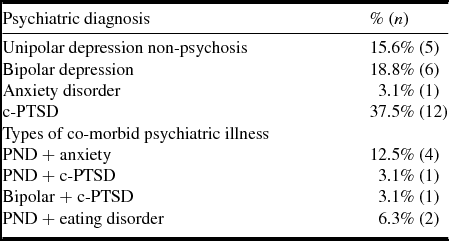
Table 2 outlines the psychiatric diagnoses (ascertained from clients’ clinical records). Complex post-traumatic stress disorder (c-PTSD) was the most common (37.5%; n = 12), six women had bipolar depression (18.8%), and five women had unipolar depression (15.6%). Twenty-five per cent (n = 8) of women presented with a comorbid diagnosis, in which post-natal depression (PND) and anxiety was the most represented (12.5%; n = 4), followed by PND and an eating disorder (6.3%; n = 2), and PND with c-PTSD, and bipolar with c-PTSD (both 3.1%; n = 1), respectively.
Psychiatric diagnosis (n = 32)

c-PTSD, complex post-traumatic stress disorder; PND, postnatal depression.
Procedure
The current study falls under the remit of service evaluation, and as such did not require NRES (National Research Ethics Service) approval. The study was declared to the Trust's research and development department who approved audit procedure.
Referral and clinical assessment
Participants were under the care of a community perinatal mental health team. The team works with women with severe and/or enduring mental health problems during the perinatal period (defined as during pregnancy and up to one year post-birth). The team is a group of multi-disciplinary professionals including psychiatry, psychology, community psychiatric nurses (CPN) and child care practitioners. Referrals for the skills class were accepted from the team. The skills class facilitators met individually for a one-hour assessment with each woman referred to the group to assess suitability and completed the group outcome measures. An individual emotion focused formulation of current difficulties was obtained using the Clarke (Reference Clarke, Clarke and Wilson2008) cognitive model. The description and aims of the group were provided. Inclusion criteria included: emotion dysregulation, wanting to attend the group, being able to commit to attend as many sessions as possible (i.e. at least eight or more) and being able to identify a specific goal for attending the group. Exclusion criteria included not wanting to attend the group, not being able to identify a goal for the group, not being able to commit to at least eight group sessions or engaging in frequent high risk to life behaviours (e.g. cutting, overdosing or endangering life including excess use of alcohol and/or non-prescribed medication).
Maternal emotional coping skills (ECS) group content
The skills class consisted of 12 two-hour weekly skills-based sessions facilitated by a consultant clinical psychologist (the lead author of this paper who is an accredited DBT therapist with the Society for DBT UK and Ireland) and a perinatal specialist mental health nurse trained in DBT (i.e. completed a 5-day training in DBT and receiving regular supervision via the consult team). The group was a closed group; no one new joined the group after session two.
The first hour of the group was dedicated to homework review and feedback. The second hour was dedicated to teaching new skills and setting homework. Session-by-session content is described in Table 3. A childcare crèche was provided. The group was hosted in a community centre in a central location to the large geographical patch covered by the perinatal community team.
DBT skills training curriculum and targeted components of emotion dysregulation

* DBT skills training module from the skills manual (Linehan, Reference Linehan2015b)
Skills from all four DBT modules were taught in the programme and drawn from Linehan (Reference Linehan1993, Reference Linehan2015a,Reference Linehanb). The teaching was adapted to address specific issues relating to this client group. Mindfulness skills focused on observing, noticing non-judgementally: the role and challenges of parenting and intersubjectivity [e.g. mind mindedness of baby (i.e. being aware of our thoughts about baby's thoughts)], emotional reaction to adverse stimulus such as tiredness and baby crying, and incorporating this skill into everyday activities (e.g. feeding and bathing baby). Emotional regulation skills focused on understanding emotions and their function so as to know when to problem solve and when to act opposite. Frequent examples of parenting paradigms (e.g. baby needs feeding in the middle of the night and you feel frustrated) were used. Cognitive reappraisal of challengeable thoughts was taught as a skill in order to reduce over-evaluation of the parenting role and unjustified guilt (e.g. Am I good enough?). Distress tolerance was taught with specific examples of radical acceptance of the loss of roles and previous freedoms when becoming a parent as well as how to soothe oneself in order to soothe baby when distressed. Interpersonal effectiveness skills focused on making new friends when going to baby groups, how to handle the expectations and offers of help (or lack of them) from others as well as ending relationships when necessary. In each module, time was also taken to consider each skill from the perspective of the child incorporating up-to-date child development knowledge from ‘Mary Sheridan's Birth to Five Years’ (Sharma and Cockerill, Reference Sharma and Cockerill2014) and ‘The Social Baby’ (Murray and Andrews, Reference Murray and Andrews2000).
Staff support – the consult team
Staff running the skills group were supported with a weekly, 1.5-hour consultation team. This was based on DBT team consultation principles offering supervision, education and support. The consult group encouraged the sharing of multi-perspectives and the use of dialectics.
Skills support
Women received additional skills support through their usual meeting with their perinatal team CPN throughout the group programme to aid the implementation of skills at home. The frequency of these meetings was agreed on an individual basis according to need. All the CPNs received a minimum of 3 days training in DBT. If unsure about using a skill or wanting support to resist acting on an unhelpful urge, women were also able to call the team's duty telephone helpline for skills coaching Monday to Friday, 10 a.m. to 4 p.m.
Outcome measures
Data were collected by the group facilitators using three self-report measures: Clinical Outcomes in Routine Evaluation (CORE-34), Mental Health Confidence Scale (MHCS) and Living with Emotions Scale (LES). These measures were chosen as the CORE-34 has been used in other stand-alone DBT skills groups (Sambrook et al., Reference Sambrook, Abba and Chadwick2006). The other measures are regularly used in the local DBT teams. Outcome measures were collected at three time points: at assessment (assessment score: time 1), beginning of the group (pre-group score: time 2), and upon completion of the group (post-group score: time 3). There were varying lengths of time from assessment to beginning of the group (mean 61.14 days, SD 21.74).
Clinical Outcomes in Routine Evaluation (CORE-34)
The CORE-34 outcome measure (Evans et al., Reference Evans, Mellor-Clark and Margison2000) is a 34-itemed standardized self-report psychometric measure for psychological distress. The measure consists of four core components that are designed specifically to assess: wellbeing (subjective wellness), problems/symptoms (degree of anxiety and/or depression), functioning (perceived coping) and risk (both to self and others). The questionnaire has been shown to have strong reliability (>0.75, <0.95) and validity (Evans et al., Reference Evans, Connell, Barkham, Margison, McGrath, Mellor-Clark and Audin2002). People are requested to read 34 statements regarding how they have been feeling over the past week, and state the frequency to which they experienced the described statement from a set of five multiple choice answers (‘not at all’, ‘only occasionally’, ‘sometimes’, ‘often’ and ‘most or all of the time’). Scoring is composed of a total sum for wellbeing (four items), problems/symptoms (12 items), functioning (12 items) and risk (six items). The current study demonstrated high reliability (pre-group α = .82, post-group α = .82).
Mental Health Confidence Scale (MHCS)
The MHCS measure (Carpinello et al., Reference Carpinello, Knight, Markowitz and Pease2000) was used to assess self-efficacy in relation to mental health and ability to cope with things that may commonly influence their lives. The MHCS consisted of three distinct subsections that are designed to assess: optimism (tendency to have a favourable view of events and the future), coping (ability to face/deal with difficulties) and advocacy (ability to express views and concerns). The MHCS contains 14 statements, rated on a 6-point Likert scale ranging from 1 being ‘very non-confident’ and 6 being ‘very confident’. Scoring consisted of a total sum for optimism (six items), coping (five items) and advocacy (three items). A low total score indicates less confidence in mental health-related self-efficacy beliefs. The current study demonstrated high reliability (pre-group α = .80, post-group α = .81).
Living with Emotions Scale (LES)
The LES measure (Clarke and Wilson, Reference Clarke and Wilson2008) assessed how confident a person is in expressing and managing their emotions. The LES consists of three questions which are scored on a 11-point Likert scale ranging from 0 being ‘not at all confident’ to 10 being ‘extremely confident’. A total score is derived from the sum of all items, and a low overall score is indicative of an inability to cope and express one's emotions. The current study demonstrated high reliability (pre-group α = .81, post-group α = .81).
Results
The data were analysed using SPSS version 19. Changes between the assessment (time 1), start of group (time 2) and end of group (time 3) were analysed using one tailed t-tests which were Bonferroni adjusted to account for post hoc error. Significance levels were set at p < 0.05.
Attendance
Twenty-one of the 36 women assessed for the group were identified as suitable at assessment and attended the initial skills class. Fourteen women completed the skills class (i.e. attended at least eight sessions), giving a drop-out of seven (33% of group starters) – see Diagram 1. All drop-outs occurred within the first four group sessions. Overall attendance for the group was 78%. Reasons for drop-out after starting the group were not assessed. There were no discernible demographic or diagnostic differences between completers and non-completers.
Symptomatic change
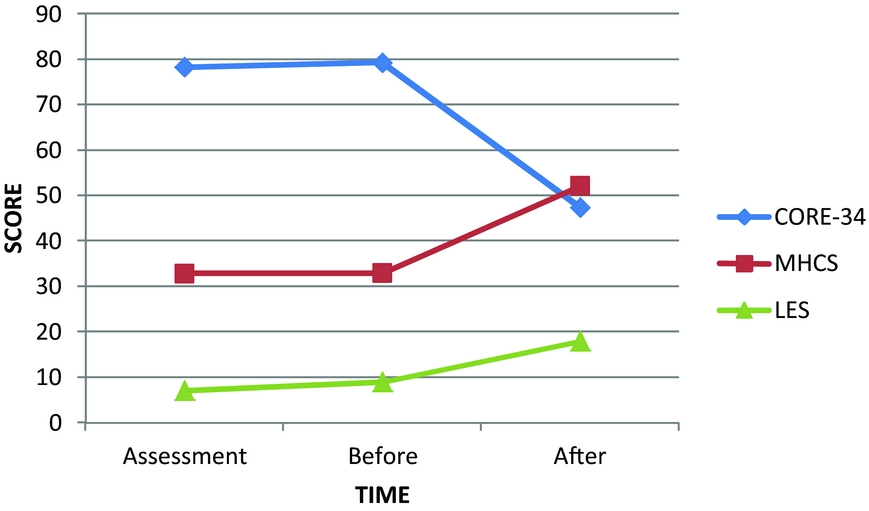
There were significant changes in all outcomes measures from start of the group to the end with large effect sizes (see Fig. 1). Overall psychological distress on the CORE-34 reduced at the end of the group compared with the start (time 2 versus time 3: t (13) = 5.32, p < .001; Cohen's d = 0.83). For three of the four subscales there was a significant improvement: wellbeing (time 2 versus time 3: t (13) = 5.04, p < .001; Cohen's d = 0.81), problems/symptoms (time 2 versus time 3: t (13) = 4.73, p < .001; Cohen's d = 0.80), and functioning (time 2 versus time 3: t (13)= 5.15, p < .001; Cohen's d = 0.82). The risk subscale was non-significant from start of the group compared with the end of the group (t (13) = 1.14, p > .05).
Graph showing changes in outcome measures over time: at assessment, start of the group and end of the group. CORE-34, Clinical Outcomes in Routine Evaluation; MHCS, Mental Health Confidence Scale; LES, Living with Emotions Scale.

Consort diagram of participants

There was a significant improvement in mental health confidence and self-efficacy from start of the group compared with the end of the group (time 2 versus time 3: t (13) = ‒8.03, p < .001, Cohen's d = 0.83). These improvements were replicated on each of the MHCS subscales: optimism (time 2 versus time 3: t (13) = ‒7.66, p < .001, Cohen's d = 0.90), coping (time 2 versus time 3: t (13) = ‒6.81, p < .001, Cohen's d = 0.88) and advocacy (time 2 versus time 3: t (13) = ‒3.57, p < .001, Cohen's d = 0.70).
There was a significant improvement in managing emotions more effectively between start of the group and the end as measured by the LES (time 2 versus time 3: t (13) = ‒9.42, p < .001, Cohen's d = 0.93).
There was no significant change reported between assessment and start of the group on any of the measures: (time 1 versus time 2: CORE-34, MHCS, LES; all p > .05).
Discussion
This study highlights the feasibility and applicability of adapting DBT skills for perinatal mental health. The results demonstrated a decrease in overall psychological distress, an increased confidence in managing mental health and ability to cope with emotions. The lack of symptom change between assessment and start of the group adds some weight to the evidence that these improvements could be due to the intervention. The results are encouraging and suggest that a DBT informed approach can be of value in perinatal services. The outcomes suggest that training and supporting staff to deliver such programmes is beneficial.
Limitations
It is possible that women may have improved with time alone without the group and further assessment of this is recommended. As this was a clinical audit rather than a formal research trial, the waiting times for the group differed considerably (from 5 to 77 days). Standardizing the waiting times to match the length of the group and adding a control group would be recommended for future studies as well as a standardized clinical assessment for inclusion/exclusion purposes. As group facilitators collected and administered the outcome measures, response as well as administration/scoring bias may have affected the results; blind, independent raters would have been preferable.
Drop-out rates between 20 and 33.3% are typical for psychotherapy (Davies et al., Reference Davies, Heslop, Onyett and Soteriou2014; Swift and Greenberg, Reference Swift and Greenberg2012) and consistent with the drop-out rates in the present study. However, certain factors such as the geographical distances women had to travel to attend the group (for example, one woman travelled more than 40 miles to the group) may have played a part in the current figures. Further assessment of causes of drop-out and ways to minimize this are recommended. The small sample size and limited diversity are also limitations.
Further studies would be helpful in determining the longer term impact of the group by including long-term follow-up measures. Further assessment on the efficacy of the group comparing pregnant, early postnatal and over 6 months postnatal would also be of interest. The wider impact of the group on the mother‒child relationship would also be of interest. Additional outcome measures specifically looking at this such as the CARE-Index (Crittenden, Reference Crittenden, Belsky and Nezworski1988), Post-Partum Bonding Scale (PPB; Brockington et al., Reference Brockington, Fraser and Wilson2006) or the 6 Month Ages and Stages Questionnaire: Social-Emotional (ASQ:SE; Squires et al., Reference Squires, Bricker and Twombly2002) could be included in future studies. Other measures such as the Difficulties in Emotion Regulation Scale (DERS; Gratz and Roemer, Reference Gratz and Roemer2004) and the DBT Ways of Coping Checklist (Neacsiu et al., Reference Neacsiu, Rizvi, Vitaliano, Lynch and Linehan2010) would have also aided comparison with other DBT skills group studies.
Acknowledgements
We are grateful to all the women who took part in the project. We are also grateful to Christine Dunkley for her support and encouragement.
Ethical statement: The authors assert they have abided by the Ethical Principles of Psychologists and Code of Conduct as set out by the APA: http://www.apa.org/ethics/code/. The authors declared the project to NHS Trust's research and development department who approved audit procedure and confirmed ethical approval was not needed as it was a service evaluation.
Conflicts of interest: The authors report no conflicts of interest. The authors alone are responsible for the content and writing of this article.
Financial support: This research received no specific grant from any funding agency, commercial or not-for-profit sectors.





Comments
No Comments have been published for this article.