



The concept of sustainability has become a widely sought after criterion in the food market. As one example, corporate social responsibility initiatives are increasingly common in the market place as companies strive to gain consumer loyalty by promoting their firms’ efforts to be better environmental stewards through labeling schemes and public relations campaigns. As one specific strategy on how local food systems may respond to eco-labels, Schaefer and Blanke (Reference Schaefer and Blanke2014) documented the proliferation of carbon labels for horticultural products in Europe along with the merits and shortcomings of those schemes. Although they categorized labels by the potential for a product to result in a reduced environmental impact, so that consumers can choose friendlier products with respect to the environment, they also concluded that such information may not be readily comprehended (Schaefer and Blanke, Reference Schaefer and Blanke2014). Clearly, whether eco-labels will bring about intended improvements in environmental quality is a complex empirical question because the market-wide outcome will depend on a set of place-based ecological and supply chain factors, but also, interactions between and within demand and supply responses to eco-labeling and the underlying mechanism of the label to influence environmental quality.
In the literature, both theoretical and empirical work has been done to investigate whether eco-labeling would affect market outcomes and environmental quality. For example, Ibanez and Grolleau (Reference Ibanez and Grolleau2008) showed that the overall impact of eco-labeling depends on the cost structure of the label certification and consumers’ preferences. Kotchen (Reference Kotchen2005) analyzed a ‘green market’ in which consumers can purchase green products that generate both private and public benefits. The counterintuitive results that Kotchen derived are that introducing or improving green technologies (e.g., by implementing eco-labels) can improve or worsen environmental quality depending on conditions such as the potential offsetting interactions (gross complementarity) between the private and the public benefits associated with the eco-label (Kotchen, Reference Kotchen2005). Specifically, in a study analyzing the effect of dolphin-safe canned tuna using actual purchase data, Teisl et al. (Reference Teisl, Roe and Hicks2002) found that consumers substituted away from canned tuna when the dolphin controversy was publicized, but they substituted back to canned tuna when a dolphin-safe label was introduced. Overall, they found that consumers did respond to the dolphin-safe label and the market share of eco-labeled canned tuna had increased.
Previous research has also reported that market reactions to green technologies can result in unintended outcomes. In the case of participation in green electricity programs, Jacobsen et al. (Reference Jacobsen, Kotchen and Vandenbergh2010) reported that some consumers increased their energy use after they participated in the green electricity program (i.e., moral-licensing), although they estimated that such increases in consumption were small enough that the participation in the green electricity program still resulted in a net gain in environmental benefits. On the supply side, Langpap and Wu (Reference Langpap and Wu2011) investigated the case in which increased production of corn-based bioenergy resulted in an aggregate negative effect on environmental quality in the region studied.
The previous studies indicated the importance of considering market-wide effects to assess the effectiveness of eco-labels and their underlying green technology or sustainable practice adoption. In this paper, we aim to analyze the effect of eco-labeling on overall carbon emissions, but go one step further to analyze how demand and supply shifts embedded in an equilibrium displacement model (EDM) could be used to predict net changes to carbon emissions from consumption changes, taking seasons into consideration. We focus on the fresh produce market, in particular, the fresh apple market. Fresh produce is gaining much attention from consumers, producers, government agencies and media in the context of food miles and the role of the local food movement in energy self-reliance. Although others have explored seasonable fresh product systems an exploration of a storable fruit raised in perennial orchard systems offers another unique case to explore using a more consumer- and price-focused method of market analysis (Plawecki et al., Reference Plawecki, Pirog, Montri and Hamm2014). In short, it is time to explore whether behavioral changes in the food system have a nontrivial impact on overall carbon emissions.
Although we rely on carbon emission estimates from others’ examination of the supply chain, this paper contributes to the literature by assessing the overall impact of carbon labeling on carbon emissions when market-wide reactions are estimated and new production and trade flows are considered. There is continued interest in how consumers respond to eco-labels, and with the proliferation of complementary or competing labeling schemes, the competitive dynamics of eco-labels for food retailers will change. Moreover, as the outcomes sought by environmental stakeholders continue to interplay with cause-based food production and marketing strategies such as eco-labeling, it is important to evaluate whether the desired environmentally beneficial outcomes are likely to occur.
Food Trade and Carbon Labeling
Food miles represent the distance that food travels from where it was produced to where it is consumed. The concept has been linked to the local food movement, and quickly gained momentum toward altering the landscape of the food market throughout the USA and other countries. Although a simple distance as a proxy for energy use is criticized as too simplistic, the local food movement is anchored on the concept that food procured locally uses less energy because of the shorter transport distances (which may also improve freshness and quality) (Smith et al., Reference Smith, Watkiss, Tweddle, McKinnon, Browne, Hunt, Treleven, Nash and Cross2005).
The literature studying the motivation for consumers to buy locally grown food is accumulating fairly rapidly, with expected outcomes linked not only to product quality (e.g., freshness), but also to characteristics such as renewal of local community, support for local farms and food businesses, preservation of local farmland and reduction of food miles and carbon emissions (e.g., Darby et al., Reference Darby, Batte, Ernst and Roe2008; Dentoni et al., Reference Dentoni, Tonsor, Calantone and Peterson2009; Martinez et al., Reference Martinez, Hand, Pra, Pollack, Ralston, Smith, Vogel, Clark, Lohr, Low and Newman2010; Onozaka et al., Reference Onozaka, Nurse and McFadden2011; Grebitus et al., Reference Grebitus, Lusk and Nayga2013). Just as an eco-labeling scheme aims to invoke a voluntary contribution to public goods (e.g., Kotchen, Reference Kotchen2005), it seems that the locally grown claim is similarly linked to outcomes that are related to public goods, albeit bundled with a broader set of potentially complementary private outcomes (e.g., better perceived quality, freshness for perishable items) compared with other eco-labels.
However, it is more complicated when one considers the locally grown claim in conjunction with carbon emissions. For example, in most countries, it is only possible to produce certain crops for a limited season. Thus, the availability of products varies substantially by country or region and season. The off-season demand is usually met by imports from other countries or regions. To compare the carbon footprint for a product procured locally/regionally with the same one that is imported, one must decompose the impacts because the local product may only have a lower carbon footprint during its primary production season, whereas the off-season imported product requires a different set of calculations depending on the supply chain (e.g., processing, storage). Based on a recent study of lettuce production, distant lettuce systems produced 4.3 times the carbon footprint as local production (Plawecki et al., Reference Plawecki, Pirog, Montri and Hamm2014). Although there are many new strategies to extend seasons so that climate only minimally constrains outdoor production, it is still common for local regions to use energy intensive facilities in the off-season [e.g., controlled atmosphere (CA) facilities for apples and heated greenhouses for tomatoes]. Some studies, in fact, reported that domestic products consumed during the off-season are more energy intensive than imported products (e.g., Saunders et al., Reference Saunders, Barber and Taylor2006; Mila i Canals et al., Reference Mila i Canals, Cowell, Sim and Basson2007; Sim et al., Reference Sim, Barry, Clift and Cowell2007). Thus, in an analysis of a fresh produce market linked to carbon footprint outcomes, it is essential to incorporate the production location claims to account for the interrelated effects.
The motivation for the aforementioned studies has been the increasing attention to climate change and environmental impacts in a wide array of trade and international policy discussions. As the conflicts in political economy among countries pose challenges for reaching any global agreement in managing climate change, a macro-level policy implementation, such as a carbon tax, may be implausible as an immediate policy solution. Instead, non-centralized, market-based approaches may be considered as a viable alternative to at least partially mitigate global carbon growth (Vandenbergh et al., Reference Vandenbergh, Dietz and Stern2011). Carbon labeling, especially in a globally important sector such as food, is one such example, which makes it important and relevant to analyze the potential market response and system-wide impact from carbon labeling in an era where such labels are proliferating (Schaefer and Blanke, Reference Schaefer and Blanke2014).
Although there have been some efforts to implement carbon labeling in the marketplace, such as the program administered by Carbon Trust (www.carbontrust.uk), carbon labeling is still in its infancy and remains relatively unknown to consumers (The Economist, 2011). In the existing literature, few studies analyze consumer responses to carbon labels. Vanclay (Reference Vanclay2011) studied the actual purchase data from a store in Australia, where a color-coded carbon label was attached to selected products. Only a small change in consumer purchase patterns was found; however, a fairly significant increase in sales was also found for less carbon intensive products when that product was also the cheapest. Onozaka and McFadden (Reference Onozaka and McFadden2011) employed a national online survey among the US consumers and found that consumers value carbon labels and are willing to pay some amount to reduce the carbon footprint. They found a significant interaction between purchase location claims and the carbon label; of note is that locally grown products are punished more for having a high carbon footprint, whereas imported products (which are otherwise discounted) are rewarded in a countervailing manner in the marketplace when associated with a low carbon footprint (possibly because it mitigates at least one consumer concern about imports).
The past literature offered evidence of potential for carbon labeling as a market-based driver of change, but its overall effectiveness is still uncertain. Moreover, since the valuation of carbon labeling interacts with location claims, any demand shifts to local or domestic food should be taken into account in a system-based analysis. Subsequently, the potential supply responses to increased demand for local or domestic food (in- and off-season) should also be taken into consideration.
Apple Market Characteristics
The apple market was selected as the focus of this study because of its unique characteristics. First, apples are one of the most commonly consumed fruits in the USA, ranking third for consumption of fruits, with an average per capita annual consumption of 48 lbs (National Agricultural Statistics Service, United States Department of Agriculture, 2008). Secondly, apples are cultivated throughout mainland USA with measurable production in all 50 US states, although Washington State accounted for 60% of domestic production in 2010. The apple industry has been shrinking in many other states since the late 1990s under the pressure of competition and oversupply in the domestic and international markets. This leads to the third point—a substantial amount of apples consumed in the USA are imported (8.4 and 4.1% of the total annual fresh domestic consumption and domestic supply/distribution, respectively, in 2010) (U.S. Apple Association, 2011). Fourthly, because apples are not as perishable as some other crops, they can be marketed over a longer season using CA storage. Fifthly, apples are regarded as a commodity, and there are still fairly competitive market conditions as packers and marketers sell their apples to retailers on the spot market, whereas big retailers such as Wal-Mart and Costco use contracts with large suppliers to ensure year-round supplies. Thus, the apple market is an interesting case for this type of carbon footprint analysis: the apple market can at least partially revert to more localized sourcing conditions in a number of places in the USA if market signals and forces are appropriate, and the market's scope is large enough to potentially alter overall carbon emissions by changing the mixture of production locations and supply chain practices.
It is also worth mentioning that, although there are a variety of processed apple products that could serve as substitutes for fresh apple consumption, focus groups completed for this project noted that consumers did not consider processed apple products as near substitutes for fresh apples. Thus, we do not consider the substitution effects, for example, of imported apples to locally grown processed apple products during the local off-season. Similarly, we did not consider substitution effects of apples to other fresh fruits because consumers seem to typically substitute within fresh apple categories as evidenced by the fresh apple markets’ stable domestic consumption numbers (U.S. Apple Association, 2011).
Modeling Consumer Choices in a Broader Economic Framework
EDMs are commonly used to explore the economic implications of changing dynamics, market or policy based, using estimates of how supply and demand schedules will shift, while also accounting for key market structure, price response and transmission relationships across levels of the market. Thus, EDM models have been used widely to estimate the market responses to supply or demand shocks. The EDM approach is most appropriate and interesting when the focus is on how consumers and producers will differentially be impacted by a changing dynamic in markets. In one recent example, EDM was used to estimate the effect of the state funded promotion of locally grown products in South Carolina (Carpio and Isengildina-Massa, Reference Carpio and Isengildina-Massa2009). The model used here extends that of Carpio and Isengildina-Massa by including the import market as well, and then using the resulting market changes to impute carbon footprint impacts given what we know about consumer preferences for different sources (local, domestic and imported) and carbon footprint labels. Carbon footprint in this paper is defined as the total amount of greenhouse gases (GHGs) emitted during the production, storage and transportation of the product (only to the site of sale—too little information exists to estimate consumer transportation from store to household). Thus, not only carbon dioxide, but also other GHGs, such as methane, are included in the calculation, using the measure of global warming potential converted to carbon equivalence (CO2E).
In the EDM estimation of the apple market, three levels of product sourcing differentiation (local, domestic and imported) are considered together with seasonality effects (through decomposing the local in- and off-seasons). In particular, the EDM models employed here are two-region models, segmented by season assuming that May–August is the ‘in-season’ and September–April is the ‘off-season’ (with seasons defined according to monthly import (USDA, Economic Research Service) and shipping point price records (USDA, Agricultural Marketing Service).
During the local season, it is assumed that all the apples come from domestic or local sources. Any locally produced apples are assumed to be consumed during the season (i.e., no apple storage is assumed based on terminal market information, which shows only shipments from major domestic and international sources occur in the off-season). During the off-season, there are only two supply sources: stored domestic apples and imported apples. Another simplifying assumption is that ‘locally grown’ products are only available in Colorado. This obviously does not reflect current reality, but extending the EDM model to a broader set of local designations would be problematic because of the heterogeneous conditions across states, so the domestic results from this model are limited by this assumption. The EDM framework specifies demand and supply equations for each region for each season, market clearing conditions and price relationships (price margins), yielding a total of 10 linear equations for the in-season and 12 equations for the off-season.
In-season
Region A (local)
Demand:
 $${\quad\rm D}_{{\rm A},{\rm in}}^{\rm l} = {\rm D}_{{\rm A},{\rm in}}^{\rm l} \left( {{{\rm P}_{{\rm wl},{\rm in}}},{{\rm P}_{{\rm wd},{\rm in}}},{\rm \alpha} _{{\rm A},{\rm in}}^{\rm l}} \right)$$
 $${\quad\rm D}_{{\rm A},{\rm in}}^{\rm d} = {\rm D}_{{\rm A},{\rm in}}^{\rm d} ({{\rm P}_{{\rm wl},{\rm in}}},{{\rm P}_{{\rm wd},{\rm in}}},{\rm \alpha} _{{\rm A},{\rm in}}^{\rm d} )$$
Supply:
 $${\quad\rm S}_{{\rm A},{\rm in}}^{\rm l} = {\rm S}_{{\rm A},{\rm in}}^{\rm l} ({{\rm P}_{{\rm l},{\rm in}}},{{\rm P}_{{\rm d},{\rm in}}})$$
 $${\quad\rm \; S}_{{\rm A},{\rm in}}^{\rm d} = {\rm S}_{{\rm A},{\rm in}}^{\rm d} ({{\rm P}_{{\rm l},{\rm in}}},{{\rm P}_{{\rm d},{\rm in}}})$$
Region B (rest of the country)
Demand:
 $${\quad\rm D}_{{\rm B},{\rm in}}^{\rm d} = {\rm D}_{{\rm B},{\rm in}}^{\rm d} ({{\rm P}_{{\rm wd},{\rm in}}},{\rm \alpha} _{{\rm B},{\rm in}}^{\rm d} )$$
Supply:
 $${\quad\rm S}_{{\rm B},{\rm in}}^{\rm d} = {\rm S}_{{\rm B},{\rm in}}^{\rm d} ({{\rm P}_{{\rm d},{\rm in}}})$$
Market-Clearing Conditions
 $${\quad\rm D}_{{\rm A},{\rm in}}^{\rm l} = {\rm S}_{{\rm A},{\rm in}}^{\rm l} $$
 $${\quad\rm D}_{{\rm A},{\rm in}}^{\rm d} + {\rm D}_{{\rm B},{\rm in}}^{\rm d} = {\rm S}_{{\rm A},{\rm in}}^{\rm d} + {\rm S}_{{\rm B},{\rm in}}^{\rm d} $$
Price Relationships
 $${{\quad\rm P}_{{\rm wd},{\rm in}}}(1 + {{\rm t}_{{\rm wd},{\rm in}}}) = {{\rm P}_{{\rm wl},{\rm in}}}$$
 $${{\quad\rm P}_{{\rm d},{\rm in}}}(1 + {{\rm t}_{{\rm d},{\rm in}}}) = {{\rm P}_{{\rm l},{\rm in}}}$$
Off-season
Region A (local)
Demand:
 $${\quad\rm D}_{{\rm A},{\rm off}}^{\rm d} = {\rm D}_{{\rm A},{\rm off}}^{\rm d} ({{\rm P}_{{\rm wd},{\rm off}}},{{\rm P}_{{\rm wi},{\rm off}}},{\rm \alpha} _{{\rm A},{\rm off}}^{\rm d} )$$
 $${\quad\rm D}_{{\rm A},{\rm off}}^{\rm i} = {\rm D}_{{\rm A},{\rm off}}^{\rm i} ({{\rm P}_{{\rm wd},{\rm off}}},{{\rm P}_{{\rm wi},{\rm off}}},{\rm \alpha} _{{\rm A},{\rm off}}^{\rm i} )$$
Supply:
 $${\quad\rm S}_{{\rm A},{\rm off}}^{\rm d} = {\rm S}_{{\rm A},{\rm off}}^{\rm d} ({{\rm P}_{{\rm d},{\rm off}}},{{\rm P}_{{\rm i},{\rm off}}})$$
 $${\quad\rm S}_{{\rm A},{\rm off}}^{\rm i} = {\rm S}_{{\rm A},{\rm off}}^{\rm i} ({{\rm P}_{{\rm d},{\rm off}}},{{\rm P}_{{\rm i},{\rm off}}})$$
Region B (rest of the country)
Demand:
 $${\quad\rm D}_{{\rm B},{\rm off}}^{\rm d} = {\rm D}_{{\rm B},{\rm off}}^{\rm d} ({{\rm P}_{{\rm wd},{\rm off}}},{{\rm P}_{{\rm wi},{\rm off}}},{\rm \alpha} _{{\rm B},{\rm off}}^{\rm d} )$$
 $${\quad\rm D}_{{\rm B},{\rm off}}^{\rm i} = {\rm D}_{{\rm B},{\rm off}}^{\rm i} ({{\rm P}_{{\rm wd},{\rm off}}},{{\rm P}_{{\rm wi},{\rm off}}},{\rm \alpha} _{{\rm B},{\rm off}}^{\rm i} )$$
Supply:
 $${\quad\rm S}_{{\rm B},{\rm off}}^{\rm d} = {\rm S}_{{\rm B},{\rm off}}^{\rm d} ({{\rm P}_{{\rm d},{\rm off}}},{{\rm P}_{{\rm i},{\rm off}}})$$
 $${\quad\rm S}_{{\rm B},{\rm off}}^{\rm i} = {\rm S}_{{\rm B},{\rm off}}^{\rm i} ({{\rm P}_{{\rm d},{\rm off}}},{{\rm P}_{{\rm i},{\rm off}}})$$
Market-Clearing Conditions
 $${\quad\rm D}_{{\rm A},{\rm off}}^{\rm d} + {\rm D}_{{\rm B},{\rm off}}^{\rm d} = {\rm S}_{{\rm A},{\rm off}}^{\rm d} + {\rm S}_{{\rm B},{\rm off}}^{\rm d} $$
 $${\quad\rm D}_{{\rm A},{\rm off}}^{\rm i} + {\rm D}_{{\rm B},{\rm off}}^{\rm i} = {\rm S}_{{\rm A},{\rm off}}^{\rm i} + {\rm S}_{{\rm B},{\rm off}}^{\rm i} $$
Price Relationships
 $${{\quad\rm P}_{{\rm wi},{\rm off}}}(1 + {{\rm t}_{{\rm wi},{\rm off}}}) = {{\rm P}_{{\rm wd},{\rm off}}}$$
 $${\quad\rm P_{\rm i,\rm off}}(1 + {\rm t_{\rm i,\rm off}}) = {\rm P_{\rm d,\rm off}}$$
where
 ${\rm D}_{X,T}^m $
(X = region A or B; T = in- or off-season; m = origin l, d or i) is region X's demand for apples from origin m in season T, and l, d and i represents local, domestic and imports, respectively.
 ${\rm S}_{X,T}^m $
is region X's supply for apples from origin m in season T. P
wm
,
T
is consumers’ willingness to pay for apples from origin m in season T, and P
m,
T
is price that suppliers receive for selling apples from origin m in season T.
 ${\rm \alpha} _{X,T}^m $
is the demand shock to consumers in region X for apples from origin m in season T resulting from the information obtained from carbon emission labeling. T
wm,
T
is the margin between consumers’ willingness to pay, and t
m,
T
is the margin between supplies for two competing types of apples in each season.
These equations can be totally differentiated to create a system of linear equations that characterizes shifts in equilibrium conditions (market prices, quantities and market shares in different apple market segments). A complete model specification is provided in the Technical Appendix, as well as variable and parameter definitions in Table A1.
Model Inputs
For the econometric estimation, it is necessary to consider a specific scenario to estimate realistic variable levels for the model. In particular, a detailed scenario is needed to obtain the carbon footprint estimates for products that are in turn used to estimate the demand responses. We utilized results from existing studies that analyzed the life cycle assessment (LCA) of apples and include various supply chain links representing the stages of the product's production, minimal processing and/or storage, distribution and marketing (although some studies considered consumers’ transportation to the retailer, storage and cooking at home and waste, but we limited our scope to the carbon emissions through the retailing stage of the food supply chain).
The specific market we considered is the Colorado apple market. Colorado is situated fairly centrally within the USA, so it can be considered representative in terms of geographic location. Significant volumes of apple production remain within the state to serve local and organic markets, although the state's apple processing industry has shrunk in response to international competition (Godin et al., Reference Godin, Haley, Johnson, Larsen, Pearson, Pokharel and Schultz2008). The state government oversees the ‘Colorado Proud’ program that promotes Colorado grown products, and there were 39 active producers selling in the market as of January 2012 (Colorado Market Maker, 2012). Domestic apples are assumed to be produced in Washington State, as it is by far the largest fresh apple production source in the USA. Washington apples were assumed to be produced in Yakima County, the largest apple production county within Washington State (National Agricultural Statistics Service, United States Department of Agriculture, 2008). Yakima County is about 1915 km from Denver by major transportation routes.
The off-season domestic apples are available through CA storage, where apples are chilled at a temperature of about 1°C. Imported apples are assumed to come from Chile, which is the largest exporter of apples to the USA and accounted for 57% of US total imports of fresh apples in 2008 (National Agricultural Statistics Service, United States Department of Agriculture, 2008). Chilean apples are assumed to be produced in the Acancágua Valley and transported to the Port of Valparaíso (the nearest port and the second largest in Chile) by truck for 120 km. The Chilean apples are then transported 9145 km (4938 nautical miles in port-to-port distance according to www.searates.com) by ship from the Port of Valparaíso to Los Angeles. The driving distance from Los Angeles to Denver is 1669 km (1037 miles) (note that land distances are obtained using Google Map (http://maps.google.no/). The supply scenarios are shown in Figure 1. Following the ‘best practices’ recommendation for producers, we considered CA as a standard practice to handle apples and prevent degradation and assume that, once apples have been initially cooled, these apples continue to be held in CA until reaching the retailers. Also note that CA is a fairly energy, and therefore, carbon intensive treatment (Mitcham et al., Reference Mitcham, Crisosto and Kader2011).
Food supply chain scenarios.

Carbon footprint estimation
The apple market is relatively well-studied in terms of LCA; thus, we utilized existing research to impute our carbon footprint estimates. Following the LCA literature, estimates of energy use in each supply chain stage is primarily obtained from Blanke and Burdick (Reference Blanke and Burdick2005) supplemented with estimates compiled by the Seattle Food System Enhancement Project (Morgan et al., Reference Morgan, Renzi, Cook and Radenovic2007).
The conversion from the energy use into carbon emissions (in CO2E per unit of the product) varies by the transportation mode or the energy source. Values of energy use by transportation stage are converted to carbon emissions based on the coefficients from Weber and Matthews (Reference Weber and Matthews2008); the energy for CA storage is assumed to come from the electricity grid and conversion coefficients are obtained from the International Energy Agency (IEA, 2011). The parameter values and estimated carbon footprints are shown in Table 1.
Carbon footprint estimate.

1 Seattle Food System Enhancement Project (Morgan et al. Reference Morgan, Renzi, Cook and Radenovic2007).
2 Blanke and Burdick (Reference Blanke and Burdick2005).
3 Weber and Matthews (Reference Weber and Matthews2008).
4 International Energy Agency (2011).
Demand parameters
The demand parameters used in the EDM model are obtained from estimates from the national survey data in Onozaka and McFadden (Reference Onozaka and McFadden2011) in which consumers’ preferences for fresh apples are elicited via hypothetical choice experiments. Because the experimental design and product attributes are thoroughly discussed in that paper, only a brief overview is provided here. The attributes included in the choice experiments are the production locations (locally grown, domestically grown and imported), and the credence-based production practices (organic versus non organic, fair trade versus non fair trade, and carbon footprint), as well as unit prices. The choice experiment responses were analyzed using a random parameter framework and panel mixed logit estimation, and a choice-specific individual-level willingness-to-pay (WTP) distribution for each attribute was simulated (Hensher and Greene, Reference Hensher and Greene2003; Train, Reference Train2003). In sum, they find that consumers are most concerned about the production origin, with strong preference for local and against imported apples. The carbon footprint labels had significant but relatively small effects. The interaction between the production location and carbon footprint label was found to be significant, such that local and foreign production are punished more when associated with high carbon emission than domestic production. The implication is that, although consumers in general seem to favor local production, not all local products would be valued similarly—high carbon intensity local production will be punished with lower WTP.
The demand side inputs needed for the EDM estimation are the WTP values and demand elasticities. Based on the estimation obtained by Onozaka and McFadden (Reference Onozaka and McFadden2011), first, median WTP values of the individual-level WTP distribution for relevant labels were computed for each individual in the sample. In this process, WTP equations were evaluated at the corresponding level of carbon estimates from Table 1 and the production origins. The computed median WTP values serve as the point estimate for individual's WTP for a certain attribute (or a combination of attributes), and it is assumed that the individual would be willing to pay for the attribute(s) if his/her median WTP is higher than the market price premium. Secondly, by aggregating over these individuals whose median WTP is higher than the market level price premium, we plotted the market share against various levels of price premiums that may occur in the EDM. The elasticities were then calculated as the percent change in market share as a result of a one percent change in price at the relevant price point. Figure 2 shows plots of estimated market share for apples from Colorado (local) versus Washington (domestic) and Washington (domestic) versus Chile (imported). This is one unique aspect of the study because the carbon footprint attribute may have a countervailing demand effect to the production source in some cases; for example, domestic apples in the off-season may be more carbon intensive, and a discount on the footprint may offset the baseline preference for domestic apples.
Simulated market share of apples; Colorado versus Washington apples and Washington versus Chilean apples.

It shows that almost all consumers would prefer to purchase local apples over domestic apples and domestic apples over imported apples, if the prices are the same (price premium at zero). As expected, the share of consumers who would choose local apples versus domestic apples and domestic apples versus imported apples decreases as the price premium for the former types of apples increased. From the market share results derived in the simulation, the own and cross-price elasticities were computed and used as inputs for the EDM models.
Supply parameters
Price margins, seasonal supply market shares and supply elasticities were estimated using retail market prices, terminal market prices, farmers’ market prices, and supplies for each market obtained from the USDA-AMS. The Seattle (Los Angeles) terminal market price was used to represent the price that representative domestic suppliers received for selling domestic (or imported) apples in-season (in the off-season when domestic supplies have been exhausted). The Colorado farmers’ market price was used to estimate the price that Colorado suppliers received for selling Colorado apples to Colorado consumers in-season (assuming Colorado apples are all consumed in Colorado). Seasonal supplies for each market were estimated. Decomposed supply elasticities were estimated based on formulas given by Alston et al. (Reference Alston, Norton and Pardey1995) and Armington (Reference Armington1969).
The market margin between the Colorado farmers’ market and Seattle terminal market and the market margin between Colorado farmers’ market and South Central retail market were estimated to be very large (104 and 58%). The price margin between the Seattle terminal market and Los Angeles terminal market is 10% (because other sources compete in this market). As expected, Colorado local and domestic apples are substitutes during the local season, and similarly, domestic and imported apples are substitutes in the off-season. The supply of each group of apples is more elastic to the other segment's price change rather than to its own price change. Colorado locally produced apples and imported apples are more sensitive to price changes than domestically produced apples.
Estimation Results
The EDM equations were solved using MATLAB, and resulting changes in market equilibriums are shown in Table 2. Two separate estimations were conducted based on two scenarios—one in which only production origin information is provided (‘location label’), and the other in which both origin and carbon label are provided (‘location + carbon label’). This way, the incremental effect of carbon labeling over the origin designation information was investigated.
Changes in overall carbon emission (in tonnes of CO2E).

The production location labels increase the demand for both local and domestic apples in Colorado, and subsequently, the supply price for local apples increases as compared with domestic apples. In the rest of the USA, demand for domestic apples decreases, resulting in a decrease in absolute quantities. The combination of carbon and production location information seems to work complementarily in the conventional US harvest season for local apples, and reduces the attractiveness of domestic apples in Colorado. On the supply side, the supply of local apples increases while the supply of domestic apples decreases both in Colorado and in the rest of USA, resulting in a net decrease in the overall supply of apples. The presence of a carbon label seems to diminish the attractiveness of local apples, and even more so for domestic apples, resulting in smaller equilibrium quantities than in the case of providing consumers only with location labels.
During the off-season, when only the location label is provided, consumers’ preference for domestic apples over imported apples puts upward pressure on the demand for CA-stored domestic apples. Because domestic and imported apples are substitutes, this will put upward pressure on the price of domestic apples, as well as downward pressure on the price of imported apples. Overall, the demand for domestic apples increases by more than 30%, whereas imported apple demand increases by almost 60%. The large percentage increase in imported apples is because of the smaller base consumption of imported apples as compared with that of domestic apples. The supplies of domestic and imported apples also increase, and for domestic apples, that may offset some of the lower demand for in-season apples, essentially shifting major production regions to increase the use of CA storage to manage their supplies.
However, when the carbon label is also provided, imported apples are punished more for the high carbon footprint than domestic apples, which reduces the WTP for imported apples. As a market outcome, the demand and supply for domestic apples increase (by about 6%), whereas those of imported apples will now decrease (by about 16%).
Changes in overall carbon emissions
Based on the results of the EDM model estimated above, the overall changes in carbon emissions were computed using the percent changes presented in Table 3 and the base market quantities. The results are shown in Table 4. During the local season, the quantity demanded shifted from domestic to local production in Colorado, and the quantities supplied decrease in the rest of the USA, which leads to a net decrease in carbon emissions in both scenarios. The estimated reduction in the carbon footprint from the location designation is about 3%, and it is significantly larger (22%) when a carbon label is also provided. During the off-season, there is a net increase in both domestic and imported apple quantities, resulting in a net increase in carbon emissions in both scenarios (37% with only the local label and 3% with both labels). The much lower increase in carbon emissions with the addition of carbon labeling is because consumers shift demand from imports to domestic apples. In the aggregate, providing a location designation label would increase overall annual carbon emissions by 21%, but providing both location and carbon labeling would reduce carbon emissions by 7%.
Changes in market outcomes (in percent).

Changes in overall carbon emission (in tonnes of CO2E) 2 .

1 Based on the weighted average (in-season: 4 months; off-season: 8 months).
2 In lieu of a sensitivity analysis, markets are shocked at two different points, at the current market level (shown above) and at the point of the median consumer (details of this point are provided in a companion paper, Hu et al., Reference Hu2012). The resulting overall changes in carbon emissions are similar to the results shown here and therefore were omitted from this table.
Discussion and Conclusions
This paper assessed the potential of eco-labeling schemes to reduce overall carbon emissions in the fresh apple market. In particular, we considered not only origin designation labels, such as locally produced, but also carbon labels (hypothetical in the current US market) in which the amount of GHGs emitted from the production and the distribution of the product is provided to consumers, as a potential mitigating factor to reduce overall carbon emissions. By employing a customized EDM, the demand and supply responses resulting from the implementation of these labeling schemes were estimated while the market-wide effects are taken into account. The results show that, with eco-labels, demand and supply both shift toward local apples in the local in-season and toward domestic apples in the off-season. These shifts lead to a net decrease in carbon emissions during the local season (considered a positive impact), and the decrease is greater if a carbon label is provided. Thus, both types of labels led to a net positive impact (decrease in expected levels) on overall carbon emissions during the local production season.
During the off-season, however, the results are more complex. Due to the strong consumer preference for domestic apples, both the demand and supply of domestic apples increase (perhaps as more in-season apples are stored and shifted to off-season supplies for the US market when no local alternatives are available). At the same time, the relatively lower price for imported apples contributes to a higher equilibrium quantity for imported apples, resulting in net quantity increases for both domestic and imported apples. This leads to a net increase in carbon emissions during the local off-season. However, providing a carbon label would partially mitigate the increased carbon emissions, as consumers ‘penalize’ the product with higher carbon emissions, resulting in a smaller increase in equilibrium quantities for both domestic and imported apples.
Since this paper's motivation was to explore whether market-based approaches may be considered as a viable alternative to at least partially mitigate global carbon growth, we will now revisit whether the potential market responses and system-wide impacts from carbon labeling we modeled inform this discussion. The important implications of our results are, although the location designation information shifts consumers demand to ‘closer’ origins, it will not necessarily lead to a reduction in carbon emissions, as many consumers may believe. This is somewhat related to the moral licensing discussed in Jacobsen et al. (Reference Jacobsen, Kotchen and Vandenbergh2010) (in that case, that people may use more electricity after signing up for a green electricity program).
Duram and Oberholtzer (Reference Duram and Oberholtzer2010) previously motivated the need for systematic approaches to local food in this forum when they concluded, ‘the geography of local food is specifically addressed by describing methods for assessing natural resource use in local food, including food miles, consumer transportation, scale and community, agricultural methods and diet.’ Along these lines, the policy implications of our results represent an interesting interface between consumer behavior and market-driven labeling schemes: If consumers feel that the eating of locally grown apples is morally more justifiable and therefore consume more apples, the net impact to environmental quality can be negative if seasonal aspects of production are not taken into consideration. The lesson is that one needs to consider the market-wide effects, rather than any single agent's actions, to assess the overall impact of cause-driven marketing.
The use of a customized EDM model to assess such overall impacts is novel; however, the EDM model specified in this study is necessarily based on a fairly specific scenario to allow for realistic assumptions to estimate the model. Although we selected a scenario that can be viewed as representative for numerous locations in the USA in terms of product choice, market selection, seasonality and in the calculation of the carbon footprint, careful interpretation of the results is recommended. For example, many products cannot be shifted to local systems because of climatic conditions. Moreover, many products cannot be stored, so year-round supplies from local, or even domestic, sources would require a more significant shift in the food system, such as investments in capital for season extension (Plawecki et al., Reference Plawecki, Pirog, Montri and Hamm2014), and again, this analysis may suggest that to do so would not be desirable. In short, discussion of these issues requires careful deliberation on the particulars of the food supply chain for each type of food.
This EDM model is based on a single commodity market (i.e., the fresh apple market). Thus, any substitution effect outside this specific market is not considered in the model. Although we argue that such substitution may not be large in the apple market, considering the intensive versus extensive margins may be important in analyzing different markets (e.g., substitution between beef and chicken rather than two products only differentiated by origin of production). However, also bear in mind that any alternative course of actions that involves more significant dietary changes will probably be less of a marginal change (given the separability assumed in demand systems), and thus, expected in fewer cases. Switching to apples from a different origin, on the other hand, may be viewed as a less drastic change that more individuals might actually undergo, and therefore, results in a larger overall effect.
It is important to recall the simplifying assumption we imposed that ‘locally grown’ products are only available in Colorado. It is the case that all US states have programs to promote products grown within their state, but extending the EDM model to a broader set of local designations with various growing and transportation conditions presented us with a challenge. Such a task is daunting, if not impossible. However, we can still gain insights from the current model. For example, given the high interest in buying locally grown produce among the US consumers, we can assume a similar response to origin designation labels on other products and in different locations (i.e., a shift from products with a domestic origin to those of a local origin), and the resulting impact on carbon emissions is likely to be larger than those presented in this study once all states/regions are considered.
The public good analyzed in this paper was the overall reduction in carbon emissions, but the extension and development of regional food systems may go beyond the concerns about carbon footprint, as various consumer research studies indicate (Schaefer and Blanke, Reference Schaefer and Blanke2014). Thus, including other non-market benefits resulting from the market responses to these labels considered is important if the welfare measures and potential alternative outcomes (e.g., land conserved, jobs created) are of interest.
Acknowledgements
The authors gratefully acknowledge the financial support of the USDA Cooperative State Research, Education & Extension Service, Hatch project # COL00205 and USDA NIFA grant #2008-35400-18693.
Technical Appendix
The market system depicted by equations (1)–(22) is exogenously ‘shocked’ by α, in this case, designating the introduction and use of geographic origin and carbon labels. Our aim in EDM is to assess the resulting changes in market outcomes. This can be achieved by totally differentiating equations (1)–(22), which yields the following equations:
 $$dln({\rm D}_{A,in}^l ) = {\rm \varepsilon} _A^{ll} dln({{\rm P}_{wl,in}}) + {\rm \varepsilon} _A^{ld} dln({{\rm P}_{wd,in}}) + {\rm \gamma} $$
 $$dln({\rm D}_{A,in}^d ) = {\rm \varepsilon} _A^{dl} dln({{\rm P}_{wl,in}}) + {\rm \varepsilon} _A^{dd} dln({{\rm P}_{wd,in}}) + \displaystyle{{w_{AA}^{{\rm D}l}} \over {w_{AA}^{{\rm D}d}}} {\rm \gamma} $$
 $$dln\left( {{\rm S}_{A,in}^l} \right) = {\rm \beta} _A^{ll} dln({{\rm P}_{l,in}}) + {\rm \beta} _A^{ld} dln({{\rm P}_{d,in}})$$
 $$dln\left( {{\rm S}_{A,in}^d} \right) = {\rm \beta} _A^{dl} dln({{\rm P}_{l,in}}) + {\rm \beta} _A^{dd} dln({{\rm P}_{d,in}})$$
 $$\; dln({\rm D}_{B,in}^d ) = {\rm \varepsilon} _B^{dd} dln({{\rm P}_{wd,in}}) + \displaystyle{{w_{AT}^{{\rm D}l}} \over {w_{BT}^{{\rm D}d}}} {\rm \gamma} \; $$
 $$dln\left( {{\rm S}_{B,in}^d} \right) = {\rm \beta} _B^{dd} dln({{\rm P}_{d,in}})$$
 $$dln\left( {{\rm D}_{A,in}^l} \right) = dln\left( {{\rm S}_{A,in}^l} \right)$$
 $$w_{AT}^{{\rm D}d} dln\left( {{\rm D}_{A,in}^d} \right) + w_{BT}^{{\rm D}d} dln\left( {{\rm D}_{B,in}^d} \right) = w_{AT}^{{\rm S}d} dln\left( {{\rm S}_{A,in}^d} \right) + w_{BT}^{{\rm S}d} dln({\rm S}_{B,in}^d )$$
 $$dln{{\rm P}_{wl,in}} = dln\left( {{{\rm P}_{wd,in}}} \right) + {t_{wd}}$$
 $$dln{{\rm P}_{l,in}} = dln\left( {{{\rm P}_{d,in}}} \right) + {t_d}$$
 $$dln({\rm D}_{A,off}^d ) = {\rm \varepsilon} _A^{dd} dln({{\rm P}_{wd,off}}) + {\rm \varepsilon} _A^{di} dln({{\rm P}_{wi,off}}) + {\rm \gamma} $$
 $$dln({\rm D}_{A,off}^i ) = {\rm \varepsilon} _A^{id} dln({{\rm P}_{wd,off}}) + {\rm \varepsilon} _A^{ii} dln({{\rm P}_{wi,off}}) + \displaystyle{{w_{AA}^{{\rm D}d}} \over {w_{AA}^{{\rm D}i}}} {\rm \gamma} $$
 $$dln\left( {{\rm S}_{A,off}^d} \right) = {\rm \beta} _A^{dd} dln({{\rm P}_{d,off}}) + {\rm \beta} _A^{di} dln({{\rm P}_{i,off}})$$
 $$dln\left( {{\rm S}_{A,off}^i} \right) = {\rm \beta} _A^{id} dln({{\rm P}_{d,off}}) + {\rm \beta} _A^{ii} dln({{\rm P}_{i,off}})$$
 $$dln({\rm D}_{B,off}^d ) = {\rm \varepsilon} _B^{dd} dln({{\rm P}_{wd,off}})\; + {\rm \varepsilon} _B^{di} dln({{\rm P}_{wi,off}}) + \displaystyle{{w_{AT}^{{\rm D}d}} \over {w_{BT}^{{\rm D}d}}} {\rm \gamma} $$
 $$\; dln({\rm D}_{B,off}^i ) = {\rm \varepsilon} _B^{ii} dln({{\rm P}_{wi,off}})\; + {\rm \varepsilon} _B^{id} dln({{\rm P}_{wd,off}}) + \displaystyle{{w_{AT}^{{\rm D}d}} \over {w_{BT}^{{\rm D}i}}} {\rm \gamma} $$
 $$dln\left( {{\rm S}_{B,off}^d} \right) = {\rm \beta} _B^{dd} dln({{\rm P}_{d,off}}) + {\rm \beta} _B^{di} dln({{\rm P}_{i,off}})$$
 $$dln\left( {{\rm S}_{B,off}^i} \right) = {\rm \beta} _B^{id} dln({{\rm P}_{d,off}}) + {\rm \beta} _B^{ii} dln({{\rm P}_{i,off}})$$
 $$w_{AT}^{{\rm D}d} dln\left( {{\rm D}_{A,off}^d} \right) + w_{BT}^{{\rm D}d} dln\left( {{\rm D}_{B,off}^d} \right) = w_{AT}^{{\rm S}d} dln\left( {{\rm S}_{A,off}^d} \right) + w_{BT}^{{\rm S}d} dln({\rm S}_{B,off}^d )$$
 $$w_{AT}^{{\rm D}i} dln\left( {{\rm D}_{A,off}^i} \right) + w_{BT}^{{\rm D}i} dln\left( {{\rm D}_{B,off}^i} \right) = w_{AT}^{{\rm S}i} dln\left( {{\rm S}_{A,off}^i} \right) + w_{BT}^{{\rm S}i} dln({\rm S}_{B,off}^i )$$
 $$dln{{\rm P}_{wd,off}} = dln\left( {{{\rm P}_{wi,off}}} \right) + {t_{wi}}$$
 $$dln{{\rm P}_{d,off}} = dln\left( {{{\rm P}_{i,off}}} \right) + {t_i}$$
The above equations model the system-wide shift due to the exogenous shock, α. All the parameter and variable definitions in equations (1′)–(22′) are summarized in Table A1. These 22 linear equations can be rearranged and written in a matrix form A × Y = X, where A and X are the matrix of parameters and Y is a matrix of endogenous variables:
 $$A = \left[ {\matrix{ 1 & { - {\rm \varepsilon} _A^{ll}} & 0 & { - {\rm \varepsilon} _A^{ld}} & 0 & { - {\rm \varepsilon} _A^{li}} & 0 & 0 & 0 & 0 & 0 & 0 & 0 \cr 0 & { - {\rm \varepsilon} _A^{dl}} & 1 & { - {\rm \varepsilon} _A^{dd}} & 0 & { - {\rm \varepsilon} _A^{di}} & 0 & 0 & 0 & 0 & 0 & 0 & 0 \cr 0 & { - {\rm \varepsilon} _A^{il}} & 0 & { - {\rm \varepsilon} _A^{id}} & 1 & { - {\rm \varepsilon} _A^{ii}} & 0 & 0 & 0 & 0 & 0 & 0 & 0 \cr 0 & 0 & 0 & 0 & 0 & 0 & 1 & { - {\rm \beta} _A^{FF}} & 0 & { - {\rm \beta} _A^{FS}} & 0 & 0 & 0 \cr 0 & 0 & 0 & 0 & 0 & 0 & 0 & { - {\rm \beta} _A^{SF}} & 1 & { - {\rm \beta} _A^{SS}} & 0 & 0 & 0 \cr 0 & 0 & 0 & { - {\rm \varepsilon} _B^{dd}} & 0 & { - {\rm \varepsilon} _B^{di}} & 0 & 0 & 0 & 0 & 1 & 0 & 0 \cr 0 & 0 & 0 & { - {\rm \varepsilon} _B^{id}} & 0 & { - {\rm \varepsilon} _B^{ii}} & 0 & 0 & 0 & 0 & 0 & 1 & 0 \cr 0 & 0 & 0 & 0 & 0 & 0 & 0 & 0 & 0 & { - {\rm \beta} _B^{SS}} & 0 & 0 & 1 \cr 1 & 0 & 0 & 0 & 0 & 0 & { - 1} & 0 & 0 & 0 & 0 & 0 & 0 \cr 0 & 0 & 0 & 0 & 0 & 0 & { - \displaystyle{1 \over {{\rm \beta} _A^{FF}}}} & 1 & 0 & 0 & 0 & 0 & 0 \cr 0 & { - 1} & 0 & 1 & 0 & 0 & 0 & 0 & 0 & 0 & 0 & 0 & 0 \cr 0 & { - 1} & 0 & 0 & 0 & 1 & 0 & 0 & 0 & 0 & 0 & 0 & 0 \cr 0 & 0 & 0 & 0 & 0 & 0 & 0 & { - 1} & 0 & 1 & 0 & 0 & 0 \cr}} \right]$$
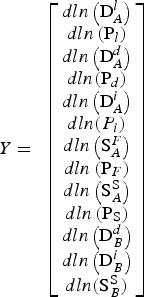 $$Y = {\rm \;} \left[ {\matrix{ {dln\left( {{\rm D}_A^l} \right)} \cr {dln\left( {{{\rm P}_l}} \right)} \cr {dln\left( {{\rm D}_A^d} \right)} \cr {dln({{\rm P}_d})} \cr {dln\left( {{\rm D}_A^i} \right)} \cr {dln({P_i})} \cr {dln\left( {{\rm S}_A^F} \right)} \cr {dln\left( {{{\rm P}_F}} \right)} \cr {dln\left( {{\rm S}_A^{\rm S}} \right)} \cr {dln\left( {{{\rm P}_{\rm S}}} \right)} \cr {dln\left( {{\rm D}_B^d} \right)} \cr {dln\left( {{\rm D}_B^i} \right)} \cr {dln({\rm S}_B^{\rm S} )} \cr}} \right]$$
 $$X = \left[ {\matrix{ { - {\rm \gamma}} \cr {\displaystyle{{w_{AA}^{{\rm D}l}} \over {w_{AA}^{{\rm D}d}}} {\rm \gamma}} \cr {\displaystyle{{w_{AA}^{{\rm D}l}} \over {w_{AA}^{{\rm D}i}}} {\rm \gamma}} \cr { - {\rm \alpha} _A^{Fg} dln{w_{Ag}} - {\rm \alpha} _A^{Fm} dlnw_{Am}^F - {\rm \delta}} \cr { - {\rm \alpha} _A^{{\rm S}g} dln{w_{Ag}} - {\rm \alpha} _A^{{\rm S}m} dlnw_{Am}^{\rm S} - \displaystyle{{w_{AA}^{{\rm S}F}} \over {w_{AA}^{{\rm SS}}}} {\rm \delta}} \cr 0 \cr 0 \cr 0 \cr 0 \cr { - {\rm \theta} _{Ag}^F dln{w_{Ag}} - {\rm \theta} _{Am}^F dlnw_{Am}^F} \cr { - {t_d}} \cr { - {t_i}} \cr { - {t_s}} \cr}} \right]$$
Our goal is to obtain the resulting changes in outcomes (Y) given the initial market equilibrium conditions and parameter values. These ‘input’ values are described in Model Inputs section, and also summarized in Table A2. The above system can be solved by multiplying both sides by the inverted matrix A; Y = A −1 × X.
Variable and parameter definitions.

Parameter and variable values.



