The question of whether international organizations have achieved gender equality remains unanswered. Although some international organizations have recently appointed woman leaders, there has been little examination of the overall history of gender trends among leaders of international organizations. This is somewhat surprising given that gender equality is a core commitment of the United Nations (UN), codified in international law and various policy statements, including the Sustainable Development Goals. Yet the difficulty of achieving stated goals suggests a deeper problem. In 2017, the UN secretary general publicly noted the lack of progress and voiced the UN’s commitment to increasing the number of women in top positions in the UN Secretariat by 2028.Footnote 1 Establishing gender equality among the leadership of international organizations is more than an ethical decision; it is necessary to fully represent the communities that these organizations serve.Footnote 2 Having women in leadership positions also encourages the next generation to consider similar career paths by reinforcing norms that women are fully acceptable and expected as leaders.
In this article, we explore the leadership appointment process in 129 international organizations, analyzing both the likelihood that the appointee will be a woman and the frequency with which women candidates appear in the pool of nominees. Our estimates show that since 1990, women leaders were chosen in only 25% of the top multilateral institutions. We find that women are underrepresented both in nominations and among selected candidates for multilateral positions. We also find that when they are selected, women tend to head the same subset of institutions. Thus, focusing on the total number of women has the effect of obscuring the fact that some international organizations appear to be “set aside” for women leaders, while others have never had a woman head.
The remainder of this article is organized as follows: The next section presents the background of the research and provides the conceptual framework. Then we describe the database and how the data were collected. Next, we provide the empirical patterns in the data that we uncovered, showing, for example, that women leaders are clustered in the same institutions. We next describe how we formulated and tested the hypotheses and discuss the obtained results. The main conclusions summarize the key takeaways and future research.
What We Know about Gender Progress in International Organizations
Goal 5 of the Sustainable Development Goals stipulates the need to counteract women’s underrepresentation in leadership in political, economic, and public life.Footnote 3 Yet, the UN and other international institutions are nearly always run by men and maintain institutional staff with an unequal gender profile. This has become such a clear problem that in 2017, the UN felt it necessary to create the UN System-wide Action Plan (UN-SWAP) on Gender Equality and the Empowerment of Women. In this article, we explore whether such recognition has been translated into action.
There are a number of studies of women’s representation in such roles as parliamentarians (Jankowski, Marcinkiewicz, and Gwiazda Reference Jankowski, Marcinkiewicz and Gwiazda2019; Johnson and Williams Reference Johnson and Williams2020), mayors (Ferreira and Gyourko Reference Ferreira and Gyourko2014), business owners (Gompers and Wang Reference Gompers and Wang2017; Presbitero, Rabellotti, and Piras Reference Presbitero, Rabellotti and Piras2014), and corporate managers (Skaggs, Stainback, and Duncan Reference Skaggs, Stainback and Duncan2012; Valls Martinez and Rambaud Reference Martínez, del Carmen and Rambaud2019), but the literature thins out considerably when looking at international organizations. This dearth of analysis is a data issue—at the highest levels, female heads are sufficiently rare that it is difficult to create anything beyond individual case studies.
A notable exception is the growing body of work on female CEOs. This literature examines how CEO gender impacts firm outcomes (Flabbi et al. Reference Flabbi, Macis, Moro and Schivardi2019) and the value of career-relevant experience (Fitzsimmons, Paulsen, and Callan Reference Fitzsimmons, Paulsen and Callan2014). Some of this literature is informative for our study. For example, when and how woman leaders are appointed determines their impact. Existing work highlights that quotas help increase the number of women leaders (Beaman et al. Reference Beaman, Chattopadhyay, Duflo, Pande and Topalova2009; Haack Reference Haack2017) and that the appointment of women typically occurs during times of crisis (e.g., Haack Reference Haack2014; Ryan, Haslam, and Postmes Reference Ryan, Haslam and Postmes2007); two examples are the International Monetary Fund (IMF) and the World Trade Organization (WTO).Footnote 4
While there is extensive literature on women’s representation in politics and the corporate world (e.g., Ferreira and Gyourko Reference Ferreira and Gyourko2014; Fitzsimmons, Paulsen, and Callan Reference Fitzsimmons, Paulsen and Callan2014; Flabbi et al. Reference Flabbi, Macis, Moro and Schivardi2019), our article expands the analysis of female leadership roles to include heads of international organizations (IOs). We accomplish this by building a new data set specifically focused on nominees and selected heads of IOs from 1930 to 2020. To our knowledge, our data set is the first to provide data on women at this level.
We felt that it was important to expand the literature to include IOs beyond the UN in order to acknowledge that there are other organizations that also hold an important place in the global economy. This expanded set of IOs represents institutions that have international impact from the student level to the geopolitical level. In most of these institutions, membership is at the state level. Given their global membership, we might expect that such institutions would reflect the efforts toward gender equality that are well underway in many nations. In addition, these institutions, through their funding of global initiatives, can be seen as impacting the overall policy agenda through their own programming (Shepherd and Stone Reference Shepherd and Stone2017).
Our focus on IOs draws inspiration from the literature on feminist institutionalism, which introduces a gender lens to institutional practices and outcomes (see, e.g., Kenny Reference Kenny2007; Mackay and Waylen Reference Mackay and Waylen2009). Our data on nominations and selection of institutional heads lends support to the thesis that institutions are gendered in both formal and informal ways. This literature explores how gender-positive change might be encouraged in both existing and new institutions (Chappell Reference Chappell, Krook and Mackay2011; Holmes Reference Holmes, Oksamytna and Karlsrud2020; Thomson Reference Thomson2018). We use our data set to show that there is a time lag in the impact of leadership change on staffing parity, which adds some nuance to questions about the timeline of gender-positive change. Finally, this literature acknowledges the methodological challenges associated with capturing gender impacts (Kenny Reference Kenny2014). Our data set and quantitative approach address this challenge and support the findings of the literature’s case-study-based approaches.
At the theoretical level, our article contributes to the cross-disciplinary exploration of the causes for the lack of gender parity in the overall workforce. One theory is that there are not enough junior women to move up to leadership roles. Much of this literature focuses on the cultural and institutional barriers to female participation (e.g., ADB 2015; Baron Reference Baron1994; Beaman et al. Reference Beaman, Chattopadhyay, Duflo, Pande and Topalova2009). Another theory is that there are unequal power structures that either assign certain roles to women or omit women from certain positions (e.g., Blackmon Reference Blackmon2021). International institutions are guilty of perpetuating this bifurcation of masculinity at the top and femininities as subordinate (Prügl Reference Prügl2016). By collecting data on the candidate pool as well as those who are serving or who have served in leadership roles, we identify the nomination stage as part of the reason why gender parity is bottlenecked in the selection process for IO heads.
In addition to highlighting the importance of the recruitment pipeline, research has also explored the intergenerational nature of female leadership. This vein of work examines whether female leaders today promote the selection of future female leaders and reduce biases regarding the suitability of a woman for the job (see, e.g., Beaman et al. Reference Beaman, Chattopadhyay, Duflo, Pande and Topalova2009; Cohen, Broschak, and Haveman Reference Cohen, Broschak and Haveman1998; Ferreira and Gyourko Reference Ferreira and Gyourko2014; Jankowski, Marcinkiewicz, and Gwiazda Reference Jankowski, Marcinkiewicz and Gwiazda2019; Virick and Greer Reference Virick and Greer2012). Our data show that institutions with women leaders are more likely than those headed by men to appoint women as second in command. Additionally, institutions that have had more than one woman at the helm exhibit markedly more parity in general staffing than those that have not had such experience.
A New Data Set on Women Leaders in Institutions
To explore the questions we had about women’s leadership in institutions, we created a novel data set. The following subsections describe both the institutions we included and how the data were collected.
Institutions in the Database
To construct our database, we began by defining the universe of IOs using three parameters. First, we included all multilateral institutions, which we defined as those having three or more countries as members. This includes all the UN institutions and many regional bodies. Second, we made an effort to ensure that the included institutions operated at the highest level of sovereignty and across a variety of issues. For example, we included the Association of Southeast Asian Nations (ASEAN) Secretariat, but not the ASEAN Free Trade Area Council, which only deals with trade. Third, we added as many large, global international nongovernmental organizations (INGOs) for which we could find data. NGOs, by definition, do not have nation-states as members, yet they are involved in global governance, so we used their data to see whether their inclusion would change the outcomes for the multilateral institutions (it did not). Finally, as a caveat, we excluded any institutions that met these parameters but for which we could not find any consistent historical data about the leaders or nominees.
Among the included institutions, the agencies of the UN provided the most consistent and publicly available data. We include all agencies, departments, and commissions that serve the UN principal organs according to the publicly available UN System organizational structure, which also includes Bretton Woods Institutions.Footnote 5 Different institutions of the UN have different sizes, mandates, and report to different UN principal organs. These differences are taken into account in our estimations. To test our results, we ran our estimations only on the UN subsample and found that it made no difference—appointments of women in the UN have the same pattern as our overall data set.
Regionally, we include both regional development banks like the Asian Development Bank and governance bodies of regional trade blocks like the African Union. We include regional groups because they cover a broad spectrum of issues, including trade policy as well as human rights, environment, climate, and gender. Secretariats of these regional blocks have therefore taken on a role of negotiation and policy forums for issues that are generally debated in the UN and its agencies.
Our inclusion of INGOs recognizes that recent years have seen the increasing influence of nonstate actors over global governance institutions that contribute to the governance functions of the UN system. To account for this trend, our data set includes INGOs with a stated interest in global governance. Availability of data for this group of institutions is limited, and we hope to expand it as more data become available.
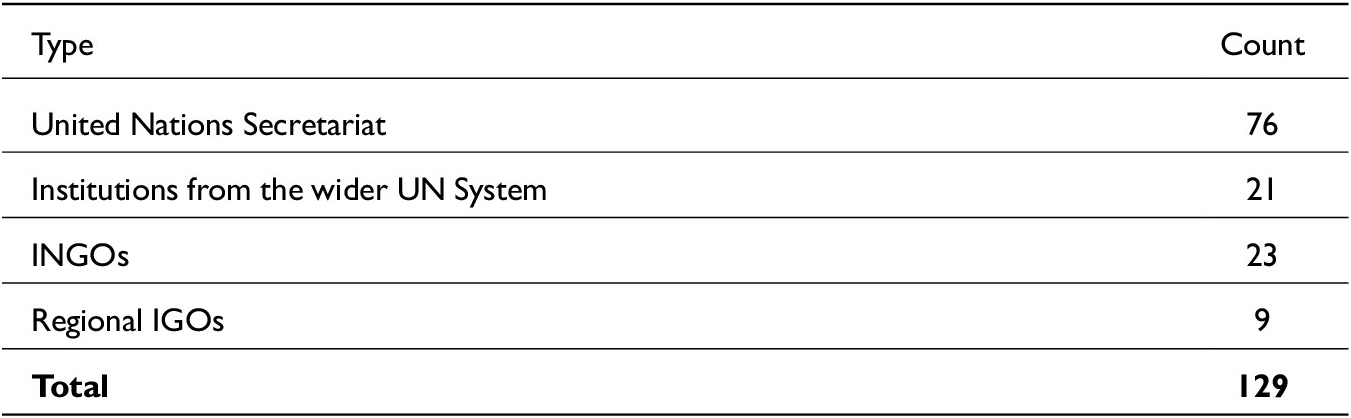
Since our data set is limited by the availability of data, we acknowledge that there are certainly institutions that should be included but are not.Footnote 6 We control for the lack of universality of institutions by using fixed-effects estimations that control for institution-specific, time-invariant characteristics. Table 1 describes the data set by institutional group.
Data set by institutional group

Sources: UN institutions drawn from https://www.un.org/en/about-us/un-system; international NGO (INGO) list drawn from https://en.wikipedia.org/wiki/International_non-governmental_organization; regional intergovernmental organizations (IGOs) include development banks as recognized by the U.S. Treasury: https://home.treasury.gov/policy-issues/international/multilateral-development-banks; and secretariats of regional INGOs include one from each major region: ASEAN, African Union, the European Union, and the Organization of American States.
We have leadership data for the full life span of 123 organizations. The remaining 6 organizations have only partial data. Regarding vice leadership, data have been collected for 94 organizations. However, these data can only be used for descriptive purposes as there are changes in structures and numbers of deputies, along with the common appointment of “special” deputies. The number of identified deputies varies from 1 to 6. For 38 of 129 organizations, we also have data on the gender of nominees for leadership positions. For 30 of the 129 IOs, we have data on staff gender composition (see Appendix 3).
Data Sources
We acquired information on candidates from public documents released by the UN and other IOs through their websites, annual reports, internal documents, and press releases. We submitted multiple requests to the UN Dag Hammarskjöld Library to obtain information and sources regarding the candidates for high-level positions and missing data on former leaders in the UN that were not readily available from public sources. Our ability to access complete data was limited by confidential or unavailable information. The data set was last updated in April 2021, with the appointment information stopping on December 31, 2020.
In most UN agencies, funds, and programs, the leader’s title is associated with “secretary general” or “director general.” In other institutions, the title is often “president.” We differentiate the type of appointment as follows:
-
• “Appointed by UNSG”—when the UN secretary general has the power of appointing/approving appointment
-
• “Appointed by member states”—when there is a general council or similar structure of member countries approving the head of organization
-
• “Appointed by UNGA”—when the decision comes from the UN General Assembly or is approved by it
-
• “Internal executive decision”—when leaders are chosen, appointed, or hired through internal organizational procedures or open hires through a job market
Interim appointments are not included in our estimations.Footnote 7 In the case of the president of the UN General Assembly (UNGA), we excluded observations for this position in instances of “emergency” or “special” assemblies. These assemblies tend to follow a faster pace and do not represent the conventional selection process. Appointments for less than one year were also omitted.
With respect to vice leaders, we based our research on available information about individuals holding the title of “deputy” to the leader of the organization in their title or “deputy” for a specific thematic group. We use World Bank classifications for the regions of origin of the leaders. Appendix 3 contains the list of organizations for which the information regarding vice leaders was collected. Such information is fragmented and sometimes depends on the specific period or program; for example, it is not clear whether a “deputy for special programs” position remains beyond the specific program. We also did not differentiate between deputies (or “directors”) for administrative issues and functional departments, as not every institution has a clear hierarchical structure at the top. Overall, the information was collected for 94 institutions, with varying information on the number of vice leaders found—from two up to seven.
Empirical Patterns in the Data
The data set we created offers quantitative insight into women’s changing fortunes in the leadership of IOs. The literature has detailed the formal and informal barriers that limit their attainment (Haslam and Ryan Reference Haslam and Ryan2008; McKinsey & Company 2019). Our data can show empirically whether this has, in fact, changed over time.
We collected information on 129 IOs with data spanning 1930–2021, which is the longest timespan the data allowed. For presentation and estimation purposes, we look at the data since 1990 because women’s representation was almost nonexistent in our data between 1930 and 1990.Footnote 8
A number of interesting patterns are revealed by our research. First, while women are better represented today than at any other time in history, they are still nowhere near parity. Second, when there are women candidates under consideration, they are likely to be selected. Perhaps most unexpected is the intergenerational nature of increased general institutional gender parity. That is, an organization’s first woman head is not associated with any change in overall staffing parity, but parity in staffing patterns increases in IOs that have had more than one woman leader. We describe each of these findings in detail next.
Women Leaders Have Yet to Achieve Parity
Most IOs claim to support diversity of gender and geographic origin in both their formal and informal rules. And certainly, since the 1990s, both measures have improved as the number of women leaders has increased and the prevalence of male leaders of European origin has decreased. Our data reflect this improvement but also reveal some underlying problems with this positive result. A key issue is that there is a dearth of women being appointed at the first step of the accession process. Absent greater representation in the first tier of leadership positions, the pool from which to nominate and draw organizational leaders is restricted.
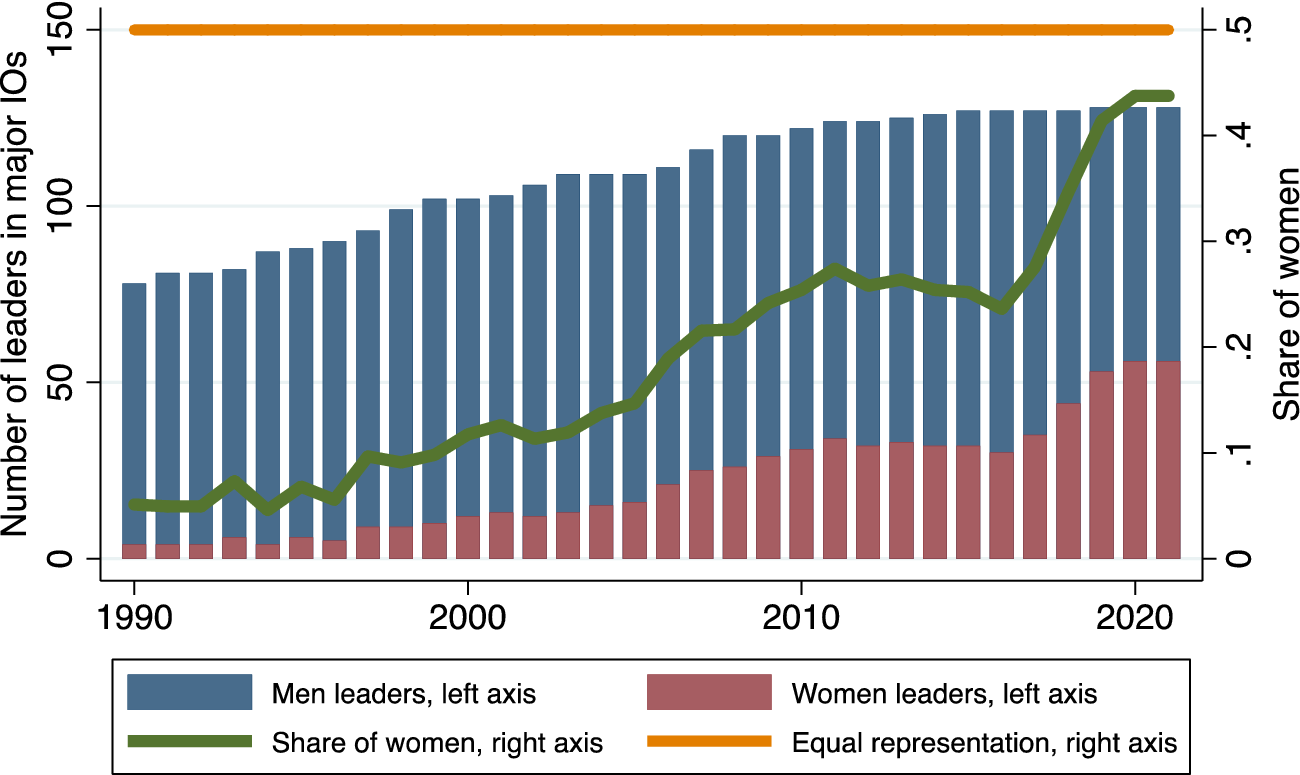
Since 1990, the overall number of women leaders has increased. Rising from 0% of leaders of multilateral organizations in 1990 to 45% by 2021, this signals significant progress toward a more equitable gender representation (see Figure 1). It should be further noted that the number of women leaders in “major” international institutions also doubled during the observed period.
Distribution of leaders in major international organizations, by gender, since 1990.
Source: Authors’ calculations. Left axis, number of institutions and their leaders’ gender breakdown. See Appendix 3 for the list of institutions.

Staff gender composition in 30 UN agencies, by the number of women leaders appointed in the institution.
Source: Authors’ calculations based on UN data. See Appendix 3 (column 5) for the list of institutions.

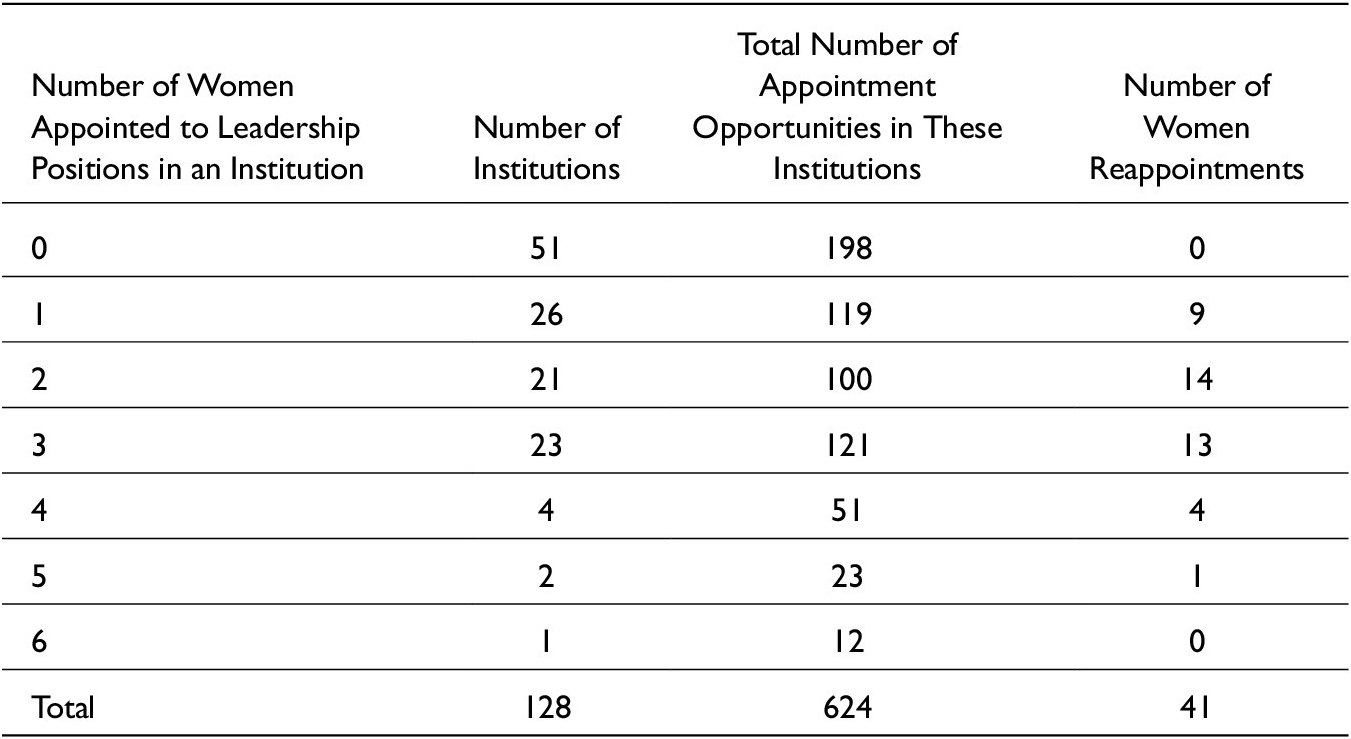
There is also a geographic component to women’s appointments. While candidate pools have become relatively more diverse and, overall, the prevalence of Europe as a region of origin has declined, we find that women of European or North American origin are more likely to be appointed. Therefore, we control for the geographic origin of the leaders in our analysis.Footnote 9 Strikingly, almost half (51) of the 129 institutions in our sample have never had a woman appointed or elected to the top leadership role. Even among institutions that have had a woman head, the historical data are surprisingly uneven (see Table 2). On average, only one in four appointments go to a woman, with the majority of these appointments occurring in the last decade. Among the institutions that have had women leaders, 61% of women’s appointments are attributable to only 30 institutions (23% of the sample).
Distribution of international institutions by share of women leaders appointed, 1990–2020

Notes: Reappointments refers to women who were appointed to more than one term in an institution. The total number of institutions included in this table is 128 rather than 129, since data on the head of the African Development Bank are missing.
Source: Authors’ research.
There are some notable outliers, however. The only institution that has had six women appointed to leadership positions is the UN Department of Management—a department that is largely responsible for the human resources strategy of the UN. The top institutions that have appointed women more than three times include United Nations Office in Nairobi (UNON) and the United Nations High Commissioner for Refugees (UNHCR). The data gathered suggest that women are appointed in smallerFootnote 10 or less prominent agencies.Footnote 11 This may indicate, as per Duerst-Lahti (Reference Duerst-Lahti, Borrelli and Martin1997), that offices that have had women leaders have been “regendered as female” or that these institutions become more comfortable with women leaders.
Women Leaders Contribute to a More Equal Internal Gender Composition
A common assumption about workplace gender equality is that having a woman as the head of an organization triggers higher gender parity inside the institution (Kunze and Miller Reference Kunze and Miller2017). Recently this assumption has been shown not to be the case at the IMF (Blackmon Reference Blackmon2021), but there is no large-scale research on this topic. Our data allow us to explore these connections from two different angles: do women leaders also have a woman as their second in command, and does the overall staffing gender composition change when there is a woman leader?
The second-in-command angle is interesting. We might expect that there is something of a glass ceiling, such that women are able to reach second-in-command positions even if they are not appointed as the head of an organization. Based on the information collected for 94 institutions, we find that the average share of women in “second-in-charge” positions for all IOs is a respectable 45%. However, when we only include organizations that have never had a woman leader, their share drops to 39%. This statistic, therefore, shows that institutions that have never had a woman leader do not appear to overcompensate by appointing a woman to the second-in-command position. Our data also show that institutions that have had women leaders have a more equal internal distribution of women in vice leadership positions—and it is even more prevalent if the organization has historically had women in the highest post.
The next question we examine is whether the presence of women leaders changes the internal gender composition of staff. We use publicly available information on staff composition for 30 UN organizations that are a part of our data set.Footnote 12 We find, first of all, that since 2003, the average number of women professional staff (including both employees and managers) has increased. The female proportion of staff in these organizations rose from 37% in 2003 to 45% in 2019. But does this trajectory change if a woman heads the organization? Looking at the cumulative order of the woman leader (Figure 2), we see that institutions that have never had a woman leader (first two bars) have the lowest shares of women staff (this includes professionals and managers but excludes administrative staff). Notably, the more women leaders an institution has had, the higher the share of women among the staff.
The data thus suggest that having more than one woman leader in an organization can bring greater gender parity over time. Therefore, we provide crucial context for Blackmon’s (Reference Blackmon2021) assertion that Christine Lagarde’s appointment had no effect on the staff gender composition at the IMF: as Lagarde was the first appointed woman, we would not expect any change until the institutions had subsequently appointed women leaders.
The Candidate Pool Matters as Much as the Leader
One of the reasons offered for the persistent lack of equal gender representation in top leadership is that it is difficult to find sufficient numbers of women candidates with the necessary qualifications. To explore this potential reason, we execute the following thought experiment: if the lack of women leaders comes from an absence of enough qualified women, then the presence of more qualified women candidates should have a positive effect on electing a woman to a leadership position.
We collected data on the candidate pool for the top job in 89 appointments in 38 IOs,Footnote 13 compiling the information on the candidate short list. We find, as expected, that there is nothing close to parity in the pool of prospective nominees. Each institution short-lists an average of four candidates. Among these candidates, 0.75 candidates—fewer than one in four—is a woman. These data suggest two hypotheses. First, if we assume that all short-listed candidates are fully qualified, then clearly qualified women exist ( H 1 ). Second, having a higher share of women on the short list should be associated with a higher probability of electing a woman leader ( H 2 ). We test this hypothesis on our data set in the next section.
Methodology and Estimations
Having gathered the data on key selection IOs, in this section, we provide measurable hypotheses that can be tested to show whether the selection of women leaders has a path dependency based on the institution’s history. We use the collected data to explore two hypotheses in particular. First, if a woman has been appointed to the lead position in an organization, does that signal a greater propensity to appoint subsequent women to the leadership position? Second, does the proportion of women candidates impact the likelihood of a woman being chosen?
Women Are More Likely to Head Institutions That Have Already Had a Woman in Leadership (H1)
Despite the rising share of women leaders, the previous section showed that it is often the same institutions that continually nominate women to leadership roles. To test this relationship empirically, we hypothesize that the presence of a woman leader in the past has a significant positive effect on having a woman leader in the future:
 $$ {P}_{inst}^{fem}\hskip0.35em =\hskip0.35em {\beta}_1{Hist}_{fem}+{\beta}_2{Controls}_{inst}+{\beta}_3{Controls}_{fem}+{FE}_{inst}+{FE}_{time}+\epsilon $$
In the main panel logit specification, we define
 $ {P}^{fem}=1 $
as the probability of having a woman leader in the institution (inst), meaning that every year there is a woman leader it is equal to unity, and zero when there is a man. In the alternative specification, we look at the
 $ {P}^{fem}=1 $
as the election of a woman, 0 election of a man, and missing values for the “continuous” years of the appointment.
We try both fixed- and random-effects estimations. By using fixed effects, we control for institution-variant, time-invariant characteristics, such as location of the institution, specific mandate, structure, and size. When using random effects, we assume that these unobserved characteristics (which we do not directly control in the model) are not “stable” throughout the observed period and change randomly. These types of models are used to find a common pattern in a broad set of data, such as we constructed.
Acknowledging that the length of appointment might skew the data, we include a specification for election years only and drop observations of nonelection years. Here, the years of appointment are 1 for women and 0 for men, with the rest of the years of appointment recorded as “missing.” It is important to note that we do not make a distinction if another woman leader immediately followed or not after the appointment of the woman. While this is an important issue to distinguish for qualitative research, because of the rarity of these cases, it would make empirical estimation not converge.
Our second hypothesis considers the importance of women’s presence in the nominee pool. If the lack of women leaders is related to the lack of women candidates, then having more women candidates should have a positive effect on the probability of electing a woman. Table 3 presents the results of the baseline estimations of the first hypothesis. We see that the previous presence of a woman leader has a significant impact on the possibility of electing a woman, increasing the log odds of electing a woman leader. A panel linear regression produces biased results with a 0/1 outcome variable; hence, our key estimation technique of interest is the logistic regression. The observation count falls from 3,436 to almost half the sample for the fixed-effects estimations because so many institutions have never had a woman leader.
Estimation results (women leaders are more likely when there has been a woman leader before)

Notes: Dependent variable: having a woman leader coded 1. Standard errors in parentheses; where possible (xtreg, xtlogit with random effects). standard errors are clustered at the level of institution.
***p < .01; **p < .05; *p < .1.
The rarity of having a woman leader until recently explains why there is no significance of the coefficient in estimations with a year fixed effect in columns (4) and (6)—women leaders are disproportionately underrepresented until late in the second decade of the 2000s. This observed delay is supported when, instead of fixed- or random-effects logistic regression, we look into population-averaged logistic regression (columns [7] and [8]). Overall, the log odds of having a woman leader in any IO since 1990 were about two times higher if there was a history of having women leaders previously.
As a robustness check, we also performed estimations on the UN subsets of the data. Since there is a different level of seniority and influence of leaders in the units of the system, we also tried different subsamples. The estimations hold and some coefficients get higher significance, especially for the subsample with only “more senior” positions.Footnote 14 This confirms that the concentration of women leaders is an overall pattern in IOs, not driven by any specific type of institutions.
Further, geographic origin of the leader and the type of the appointment can influence the election of women to top positions. Adding controls for origin and type of leadership position, we get a similar picture, presented in Table 4.
Results with controls

Notes: Robust standard errors in parentheses.
***p < .01; **p < .05; *p < .1.
The results of regressions with controls confirm that, indeed, there is a dependency on having a history of women leaders for another woman leader to be elected. Moreover, the election of a woman is far more likely for a woman from North America (or Latin America and Caribbean, as seen in column (5), but this result is dependent on the type of estimation), with log odds doubling for such candidates.
Interestingly, having member states decide on the election process has a negative effect on the probability of electing a woman. Other literature on this topic points to two factors that create this negative probability: first, the more political representatives are involved, the less likely they are to come to an agreement of having a woman leader as it is rather an uncommon and foreign occurrence; second, there is a projection in national capitals that they are committed to women’s representation in IOs, yet there is a dearth of women who have been elevated to senior positions within the countries, thus thinning the pool of eligible candidates. Another notable finding is that the UN secretary general’s efforts to reinforce the commitment to achieving gender parity drive the coefficient to be positive, but the effect is insignificant. It could be that this effect will become statistically significant as more time passes.
It is remarkable that based on the collected data, there are no appointment processes that have a significant and positive impact on the election of women leaders. This absence of the positive effect of type of appointment implies that institutional characteristics are less important than an individual’s commitment to leadership. A woman leader is less likely to emerge as a result of a certain institutional appointment structure but needs to be campaigned for on a case-by-case basis.
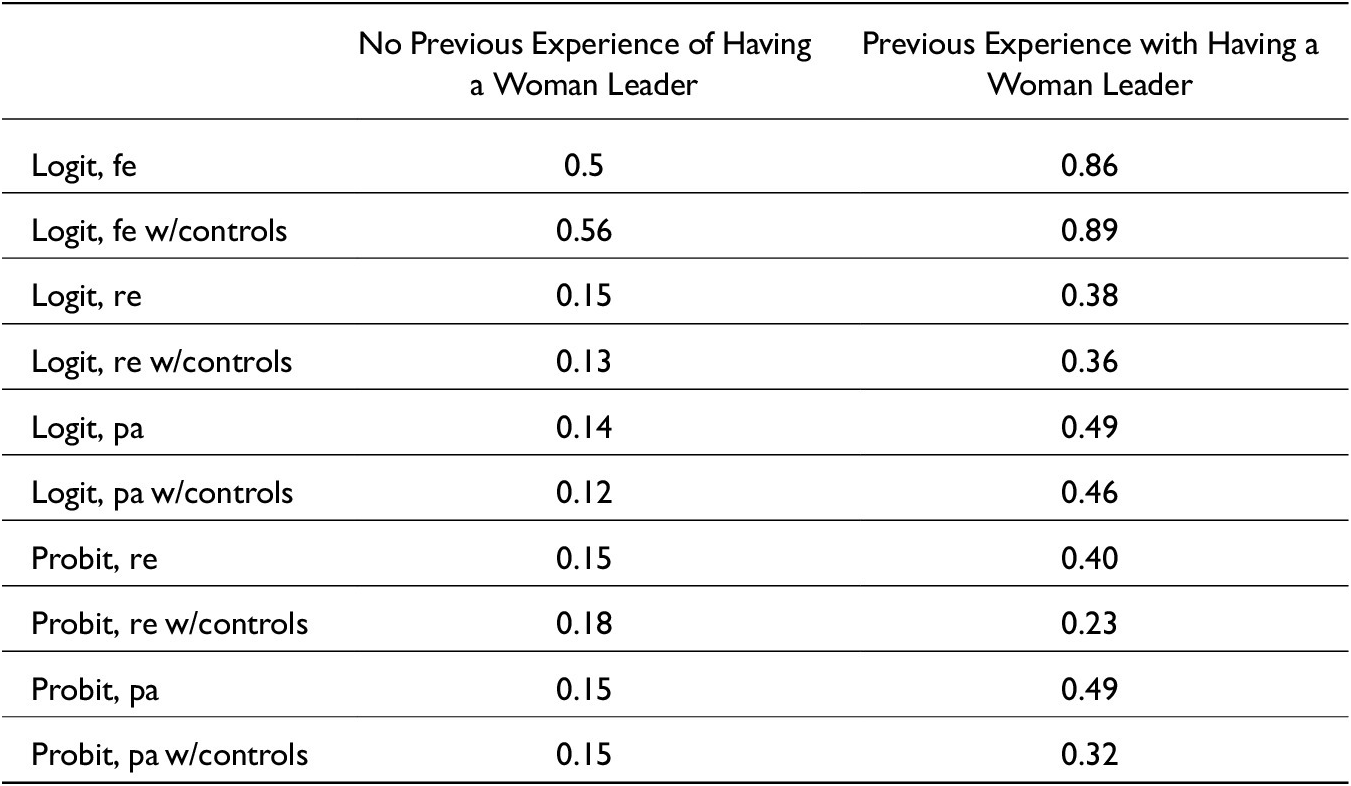
The results of the candidate pool estimations are presented in Table 5. Log odds are difficult to interpret, so to see the relevance of the established effect, we looked at the marginal effects of various estimation models, presented in Table 5 for estimations without year fixed effects (as the coefficient is not significant for them).
Estimation results ( H 2 : Having more women candidates should positively impact the election of a woman)

Notes: Standard errors in parentheses.
***p < .01; **p < .05; *p < .1.
Probability of having a woman leader in an institution

Source: Authors’ calculations.
In our benchmark estimation, if an institution has never had a woman leader, the overall probability of electing a woman leader is 50%. This percentage is representative of the population breakdown globally. By contrast, for institutions that have had a woman leader before, this probability goes up to 86%, implying that women leaders are more likely to be appointed when there has been a woman leader before. Taking into account that in 47% of the studied institutions there has never been a woman leader, this suggests a concentration of women leaders in certain institutions and their absence in others.
Holding all other variables constant, the probability of having a woman leader more than doubles when there has been a woman leader at some point in the history of the organization. As shown in Table 4, the marginal effect varies by the type of the model chosen (rows 1–8). Allowing for within-institution error correlation to control for institution-specific patterns, having had a woman elected increases on average the probability of having a new woman elected up to 60%.
Overall, our estimations show that having had a woman leader before doubles the odds of another woman being elected as a leader. When we look at the influence of the type of estimation, we find the result robust to probit (both for population averages and random effects models)—implying that our results are not specific to the choice of model.
Having More Women Candidates Will Result in More Frequent Election of Women Leaders (H2)
In this modeling strategy,
 $ Share\_{FemCandidates}_{inst, year} $
is the share of women among the candidates’ list for the top position:
 $$ {P}_{inst}^{fem}\hskip0.35em =\hskip0.35em {\beta}_1{Hist}_{fem}+{\beta}_2Share\_{FemCandidates}_{inst,year}+{FE}_{inst}+\epsilon $$
We run these estimations on a different, much smaller data set than we used for H 1 , as data on nominees are very hard to acquire. We do not control for year fixed effects because for most of the institutions, we have information on only one or two elections, but we do control for institution-specific fixed effects. In the estimation with controls, we add the information on the presence of previous women leaders. The benchmark equations are probit because of the small sample size, selection from the key data set (public information about nominations can represent self-selection into the sample), and unbalanced information about institutions.
With regard to H 2 , the results in Table 5 show that, overall, there is a positive relationship between the share of women candidates and the election of a woman leader. This relationship implies that when women are included on the short lists for top positions, the likelihood that they will be elected is greater. In addition, we see a similar effect of historical dependency in these elections: a history of having a woman leader shows a positive effect on the subsequent election of a woman leader, confirming our previous empirical findings. Our estimations suggest that there is a certain path dependency in electing a woman leader. Looking at the effect of increasing the share of women candidates from none to half, the probability of a woman being chosen is 62%—higher than the 50% we found when half the candidates are women. However, when we control for the presence of a previous woman in a leadership position, the probability becomes more aligned with women candidates’ representation at 51%.
From our sample of 65 election rounds,Footnote 15 there were no woman candidates in 26 election rounds, suggesting a selection bias in the candidate selection. When women are seriously considered and have fair representation,Footnote 16 the odds are in their favor. And once a woman has taken a leadership position, subsequent elections give better chances to women.
Outliers: Institutions That Have Never Appointed Women Leaders
Several empirical patterns can be tested and observed when looking at the 51 IO institutions that have never appointed a woman leader. First, it is commonly believed that women tend to be appointed to smaller, less important institutions. We have data on sizeFootnote 17 for 63 of 129 institutions in 2020 (21 non-appointers, 43 appointers). At first glance, our data do not appear to support the contention that non-appointing institutions are smaller. However, once we omit the four mega-sized outliers (World Health Organization, World Food Programme, United Nations Development Programme, United Nations High Commissioner for Refugees) from the observations (all of them have had at least one woman leader), we find that the institutions that have never had a woman leader are 48% larger than institutions that have had a woman leader. It should be noted that size of an institution as reported is not an accurate measure of the influence of that institution, since each tends to count employee types differently—some do not include consultants or staff on contracts not through headquarters, for example.
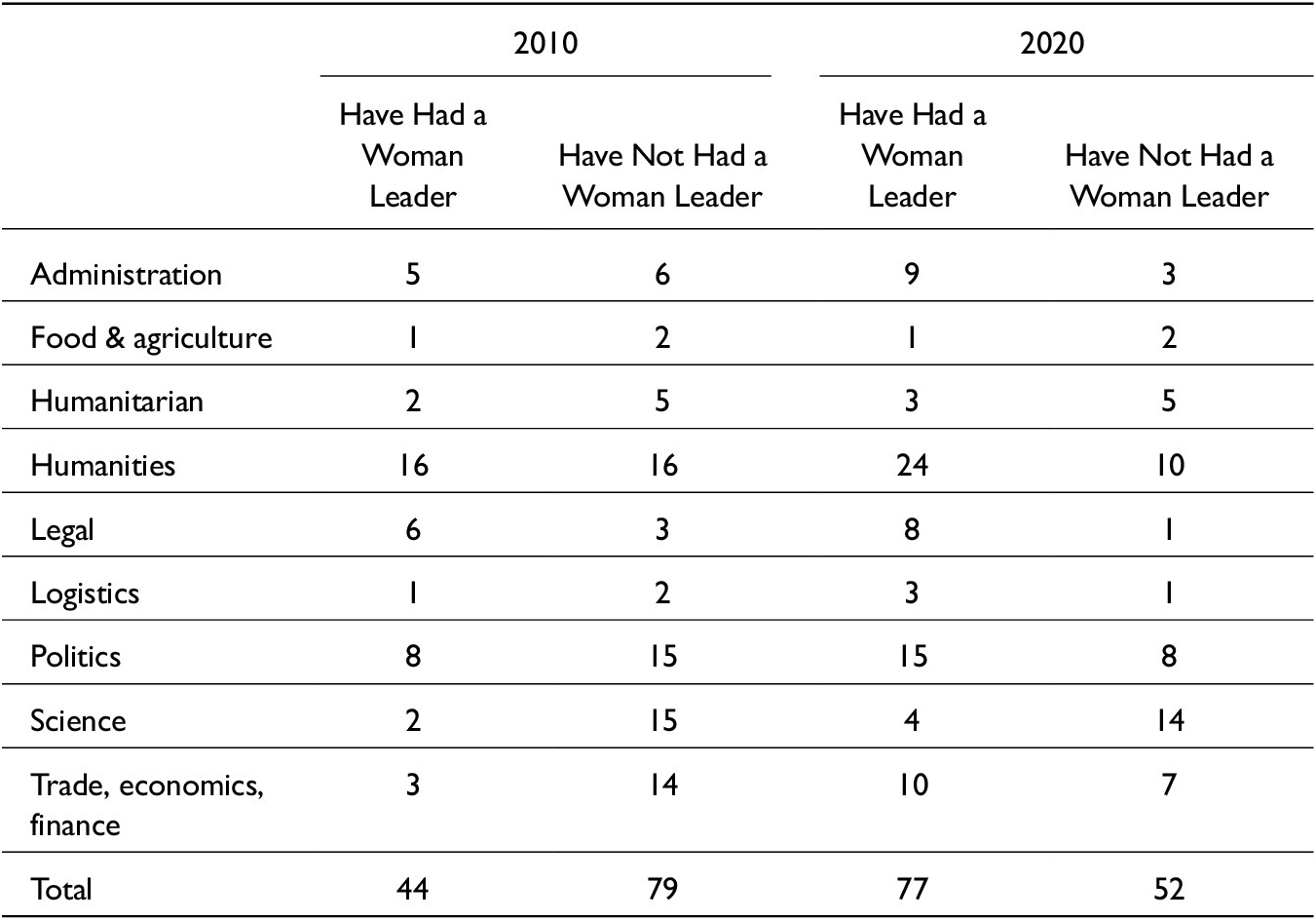
Another common suspicion is that women tend to be appointed to institutions with a “soft” portfolio. To examine this, we go back to our original data set of 129 institutions and look at the topics covered by the institutions in our data set. While acknowledging the complexity of some institutional mandates, we use the broad category of the mandate to classify organizations.Footnote 18 We find that in 2020, there was generally as many institutions that had appointed a woman leader as had not. Science is a notable exception that supports the claim. However, if we look at the change over time, we see that in 2010, the 78 institutions were indeed concentrated in politics, trade, economics, and finance. Table 7 breaks down institutions into nine categories of mandate. Overall, we can conclude that while historically, women have been indeed given a more “gendered” leadership portfolio, the situation is now better than before—though not yet at parity.
Breakdown by topic of institution

Notes: There are 126 institutions in 2010 and 128 in 2020 because Usahidi still had its first leader in 2010. No data are available for earlier leaders of the United Nations International Computing Centre and no information was found in public sources on the African Investment Bank.
Conclusion
Our research supports the hypothesis that certain IOs are “set aside” for women leaders and that if an organization has previously had a woman as its leader, it is more likely to elect another one.Footnote 19 A recent example is the IMF’s decision to appoint Kristalina Georgieva as managing director in 2019 following Christine Lagarde. The IMF falls into the group of 12 institutions that appointed another woman immediately following the organization’s first woman appointment. There were 25 other institutions that appointed another woman in the future, but not in succession. In this research, we do not explore the frequency of appointments of women as leaders. There is room for future research to explore questions around the length of time between woman leaders. Our data set could be extended for this purpose.
Our research clearly shows the shortfalls of making soft commitments or general goal statements about gender equality. Our data can be used to hold IOs to account to meet their goals and create true gender parity. We show that among 624 leadership appointments in the top 129 IOs between 1990 and 2020, women were appointed 158 times, but in only 69 institutions. While there is still persistent bias in the candidate selection, when the candidate pool consists of a higher number of women nominees, the likelihood that the leadership position will be filled by a woman is up to three times greater.
Having a history of women leaders doubles the chances for another woman leader to be elected. Yet, in 2020, 39% of IOs still had not had a woman in the top position. In 2021, the situation has improved with first-time women appointments to major organizations such as the WTO and the UN Conference on Trade and Development.Footnote 20 These additional appointments illustrate that appointments of women leaders are becoming more geographically diverse.
Our research shows that while many nations have undertaken gender parity commitments, few have made the same commitment to increase the participation of women in leading IOs. And those IOs that have made gender equality commitments have not followed through. To remedy the dearth of women leaders in IOs, it is imperative that both the organizations and the member states commit to nominating women to leadership posts.
We show that among institutions that have never had a woman leader, it is unlikely that the second in command will be a woman. In fact, appointing a woman as second in command is more likely to occur in institutions that have had a woman leader. While there is no visible change after the appointment of the first woman leader, institutions that have had more than one woman at the helm are markedly closer to gender parity in general staffing than those that have not.
It is up to IOs to undertake the actions to address gender inequality. Globally, women’s representation is improving, but is far from parity. Additional measures are needed to provide more chances for women to compete for leadership positions on equal terms so that the commitments of IOs become reality.
Supplementary Materials
To view supplementary material for this article, please visit http://doi.org/10.1017/S1743923X23000107.
Acknowledgments
The authors would like acknowledge participants in the TradeExperettes network, especially its founder, Hanna C. Norberg, for the inspiration and support for this work. This article was also influenced by insightful comments from seminar participants at the Gender Center of the Graduate Institute Geneva and the Women In Leadership in Global Governance network at the University of Massachusetts Boston. Special thanks to Professor Elisabeth Prügl, without whom the completion of this project would have not been possible.