

It is a decision that built up gradually as I was interviewing the different team members. In these types of very complex, moving, and emotionally charged situations, I first experience a sort of confusion . . . although without feeling overwhelmed, since that is a coach’s everyday work; but I let my emotions settle down and distance myself from the complexity of the situation. Then I experience a form of compassion for the team, an ability to ‘suffer with them’ . . . while at the same time a strong sense of determination, disembodied in a way because I am mindful of avoiding being numbed by the system (Alex, experienced coach, discussing an ethical decision).
Alex’s description of how his ethical decision unfolded is a good illustration of the claim made by Cornelissen, Mantere, and Vaara (2014: 699) that “the world does not present itself directly in its ‘raw form’” but rather results from interpretative construction on the part of individuals. To specifically account for such processes, the sensemaking perspective is burgeoning in organization studies, building on Weick’s seminal work (1988, 1995, 2001) that acts as a “centripetal force” (Brown, Reference Brown2015: 267) binding the field. For example, in the context of ethics, an increasing number of voices (Parmar, Reference Parmar2014; Reinecke & Ansari, Reference Reinecke and Ansari2015; Sonenshein, Reference Sonenshein2009) are developing a sensemaking perspective. In contrast to the objectivist portrayal of ethical dilemmas as waiting out there to be judged, the sensemaking perspective invites us to consider them as emerging within and between individuals, informed by context.
In terms of the sources of sensemaking, while the original focus was on individual cognitive processes (Brown, Reference Brown2015; Sandberg & Tsoukas, Reference Sandberg and Tsoukas2015), such as schemata and mental maps, research is increasingly expanding to consider such factors as emotions (Catino & Patriotta, Reference Catino and Patriotta2013; Maitlis, Vogus, & Lawrence, Reference Maitlis, Vogus and Lawrence2013; Maitlis & Sonenshein, Reference Maitlis and Sonenshein2010; Schabram & Maitlis, Reference Schabram and Maitlis2017), deliberative dialogue (Reinecke & Ansari, Reference Reinecke and Ansari2015), time (Kaplan & Orlikowski, Reference Kaplan and Orlikowski2013), and reflexivity (Guiette & Vandenbempt, Reference Guiette and Vandenbempt2016, Reference Guiette and Vandenbempt2017). Additionally, while most existing research tends to study the sources of sensemaking in isolation, a few studies have investigated their interplay (Catino & Patriotta, Reference Catino and Patriotta2013; Cornelissen et al., Reference Cornelissen, Mantere and Vaara2014; Holt & Corneslissen, 2014; Reinecke & Ansari, Reference Reinecke and Ansari2015) to honor “sensemaking agents ‘in the round’ [in] considering their embodied experiences and actions in full” (Cornelissen et al., Reference Cornelissen, Mantere and Vaara2014: 731). Answering a call to further analyze the interplay between the sources of sensemaking, and especially in ethics, we look into emotions and reflexivity at the intrapersonal level with the following research question: How does the intrapersonal interplay between emotions and ethics inform ethical sensemaking?
Our context is executive coaching, generally defined as the practice of a professional supporting individual, team, and/or organizational change (Garvey, Reference Garvey2011). This is of interest for a number of reasons. First, described as a sensemaking device (Du Toit, Reference Du Toit2007, Reference Du Toit2014; Palus, Horth, Selvin, & Pulley, Reference Palus, Horth, Selvin and Pulley2003; Stelter, Reference Stelter2007) that involves a coach, who—by means of questions, reflection, and feedback—helps process information in a timely manner and develop routes and choices within the wider context (Du Toit, Reference Du Toit2007), coaching is a very favorable context in which to study sensemaking. While the few existing research studies on sensemaking in coaching largely focus on the benefits to the coachee (see Du Toit, Reference Du Toit2007, Reference Du Toit2014; Stelter, Reference Stelter2007), our work stands out by focusing on the sensemaking process performed by and for the coach. Second, it offers a much-needed exploration of the complexity of an emerging and growing $2.3 billion industry (worldwide in 2015; see ICF, 2016) where the prevalent normative and rational approaches (Allan, Passmore, & Mortimer, Reference Allan, Passmore, Mortimer and Passmore2011) fail to equip coaches to deal with the “twists and turns” and “hollows and bumps” (Fatien Diochon & Nizet, Reference Fatien Diochon and Nizet2015: 278, 298) of the practice.
Our material consists of thirty-seven semi-structured interviews where coaches shared an ethical challenge they experienced using the critical incident technique (Flanagan, Reference Flanagan1954): they were invited to share a situation that made it difficult to coach using their usual practice or in line with professional standards. In Alex’s case, he wondered whether he should share sensitive, confidential information with his coachee’s boss that might explain the difficulties being experienced by the coachee’s teams. Other challenges included whether a pacifist coach should work for a client from the military industry, how to deliver an effective coaching session without abusing one’s power, and hurting a client with one’s diagnostic.
Our findings show that ethical decisions unfold over a three-phase emotional reflexive sensemaking process. At each phase, reflexivity supports the management of emotions, which takes the form of emotional awareness, emotional unpacking, and emotional (dis)engagement. Emotional awareness is how, during the first phase of the ethical sensemaking, reflexivity allows individuals to be aware of their emotions, instead of rejecting or neglecting them. Emotional unpacking describes how reflexivity supports the dissection and analysis of emotions during the second phase of the process. Finally, emotional (dis)engagement refers to the process whereby reflexivity allows individuals to engage (or not) with their emotions when making a decision.
Overall, we depict ethics as a fabric, a circular practice of production that appears as both an effect and condition of the subject. Ethics is an effect of the subject when it is produced through the individual’s emotional reflexive interplay; the term fabric is chosen to designate the aggregated dimension of this production process made by knitting the two “fibers”—emotions and reflexivity. Here our research provides a much-needed exploration of combined sources of sensemaking (Cornelissen et al., Reference Cornelissen, Mantere and Vaara2014; Hold & Corneslissen, 2014; Reinecke & Ansari, Reference Reinecke and Ansari2015). Ethics is a condition of the subject since ethical subjects appear to be produced (Foucault, Reference Foucault1980) as their decisions unfold through sensemaking activity; here our research provides encouraging perspectives on how ethical sensemaking can be empowering (Guiette & Vandenbempt, Reference Guiette and Vandenbempt2017; Helms Mills, Thurlow, & Mills, 2011).
EXPLORING EMOTIONS AND REFLEXIVITY IN ETHICAL SENSEMAKING: THEORETICAL GROUNDS
Beyond Objectivism: Making Sense of Ethics
Beyond Objectivism and Rationalism in Ethics
Objectivist, rationalist approaches have long dominated the literature that analyzes decision-making in ethics (Hartman, Reference Hartman2008; McCracken & Shaw, Reference McCracken and Shaw1995; Painter-Morland, Reference Painter-Morland, Painter-Morland and ten Bos2011; Parmar, Reference Parmar2014; Poldner, Branzei, & Steyaert, Reference Poldner, Branzei and Steyaert2018; Schwartz, Reference Schwartz2016; Sonenshein, Reference Sonenshein2007, Reference Sonenshein2009). They commonly portray issues as “out there” and their resolution as an application of individual judgment against externally given rules (Sonenshein, Reference Sonenshein2007, Reference Sonenshein2009). Referring back to an analogy proposed by Weick (Reference Weick2001), according to objectivist approaches, ethical issues are comparable to a master code to be deciphered by removing the shield when the ethical individual—the codebreaker—has successfully guessed each piece of the concealed code. Consequently, “unethical behavior [can only be] attributed to flaws in reasoning” (Parmar, Reference Parmar2014: 1105).
Several voices have urged a reexamination of this objectivist “rationality assumption” (Palazzo, Krings, & Hoffrage, 2013: 323), which holds that reason is “quintessential for ethics” (ten Bos & Willmott, Reference ten Bos and Willmott2001: 770). Indeed, rationality as the “epitome of moral thinking” (Painter-Morland, Reference Painter-Morland, Painter-Morland and ten Bos2011: 121) presents serious limitations, including an overestimation of the actor’s rational capacity (Palazzo et al., Reference Palazzo, Krings and Hoffrage2012; Sonenshein, Reference Sonenshein2007), neglect of the emotional, intuitive, and sensorial dimensions of ethical decisions (Scott, Reference Scott2002; Schwartz, Reference Schwartz2016; Sonenshein, Reference Sonenshein2007; Wray-Bliss, Reference Wray-Bliss, Alvesson, Bridgman and Willmott2009), and the reduction of ethical complexity to binary exclusive choices (Painter-Morland, Reference Painter-Morland, Painter-Morland and ten Bos2011). Therefore, these authors call for a reconsideration—if not reconciliation—of the “dual process” problem (Haidt, Reference Haidt2001: 820; Schwartz, Reference Schwartz2016: 767), isolating the intuitive from the system of reasoning. Against this abstract, depersonalized, and individualistic approach, several scholars have called for an expanded view of ethics, by emphasizing the compassionate (Kjonstad & Willmott, Reference Kjønstad and Willmott1995; Wray-Bliss, Reference Wray-Bliss, Alvesson, Bridgman and Willmott2009), embodied, sensorial, corporeal, and somatic dimensions of ethics (Hancock, Reference Hancock2008; Pullen & Rhodes, Reference Pullen and Rhodes2014; Poldner et al., Reference Poldner, Branzei and Steyaert2018). This means turning towards the socially constructed dimension of ethics (Reinecke & Ansari, Reference Reinecke and Ansari2015; Parmar, Reference Parmar2014; Sonenshein, Reference Sonenshein2007, Reference Sonenshein2009) by emphasizing the subjective, intersubjective, and socially informed processes at work. In this vein, the sensemaking perspective has emerged in the study of ethics, as we explore next.
Approaching Ethics as Sensemaking
The dominant approach is to study sensemaking in terms of “those episodes when some ongoing activities have been interrupted and need to be restored” (Sandberg & Tsoukas, Reference Sandberg and Tsoukas2015: 25). It is portrayed as triggered by particular disruptive events. Thus, the phenomenon of ethical sensemaking generally refers to “those processes by which people seek plausibly to understand ambiguous, equivocal or confusing issues or events” (Brown, Reference Brown2015: 272). And it is only natural that contexts of crisis or change (Weick, Reference Weick1988; Maitlis & Sonenshein, Reference Maitlis and Sonenshein2010) often characterized by “ambiguity, confusion, and feelings of disorientation” (Maitlis & Sonenshein, Reference Maitlis and Sonenshein2010: 552) have constituted privileged terrains from which to study sensemaking. Despite this dominant, episodic approach to sensemaking, we build on and offer a response to calls for sensemaking to be approached as a “continuous” or “ongoing” process (Gephart, Topal, & Zhang, Reference Gephart, Topal, Zhang, Hernes and Maitlis2010: 281; Maitlis and Christianson, Reference Maitlis and Christianson2014: 67; Weick, Reference Weick2012: 146). We therefore embrace a more “immanent” (Sandberg & Tsoukas, Reference Sandberg and Tsoukas2015: 26) perspective of sensemaking, where this practice is “ubiquitous” (Sandberg & Tsoukas, Reference Sandberg and Tsoukas2015: 22), i.e., actors are more or less permanently engaged in sensemaking and sometimes an event will cause sensemaking to “shift in terms of phenomenological quality by entering overtly in the meaning making arena” (Guiette & Vandenbempt, Reference Guiette and Vandenbempt2016: 86). In our research, this event relates to ethical issues where individuals are especially “compelled to ask themselves, and those around them, what is going on” (Maitlis & Sonenshein, Reference Maitlis and Sonenshein2010: 554). Indeed, ethics is an exemplary domain of complexity, indeterminacy, and equivocality (Reinecke & Ansari, Reference Reinecke and Ansari2015), where traditional ways of processing information, relating to one another and to organizations, are put to the test. We refer to ethical sensemaking as those processes of making sense and constructing meaning with regard to moral questions (Reinecke & Ansari, Reference Reinecke and Ansari2015).
Overall, these processes can be characterized as subjective and constructed, i.e., dependent on “individuals’ meaning construction,” rather than “objective properties” to which individuals “react” (Sonenshein, Reference Sonenshein2009: 223). From a sensemaking perspective, ethical issues do not stand outside of individuals who react to them but rather are “created from the sensemaking of employees parsing and interpreting ordinary organizational events” (Sonenshein, Reference Sonenshein2009: 223). In a way, ethical issues are part of the individual, their context, and their relationships (Parmar, Reference Parmar2014). Consequently, ethics are not “an objective feature of reality,” but rather subjective, social, and situational; indeed, “something is moral (vs. amoral) when a particular thinker interprets a situation as such” (Parmar, Reference Parmar2014: 1108). Going back to Weick’s analogies, ethical sensemakers are like mapmakers in front of a puzzling terrain. There is no pre-existing map to be discovered; rather they are converting “a world of experience into an intelligible world” (2001: 9). Against the “One Best Map” or “One True Map” (Weick, Reference Weick2001: 9) concept of a particular terrain—or ethical challenge—there are as many maps as there are different worlds of experience. Therefore, the challenge for the ethical sensemaker is to get a sense of provisional stability in the continuous flow of ever-changing organizational life, without any sense of certainty or durability.
While various sources of sensemaking have been explored (Maitlis & Christianson, Reference Maitlis and Christianson2014), from intrapersonal sources such as individual cognitions (Klein, Moon, & Hoffman, Reference Klein, Moon and Hoffman2006) to interpersonal sources such as collective deliberation (Reinecke & Ansari, Reference Reinecke and Ansari2015) and social interactions (Parmar, 2015), they are often studied in isolation. Our research answers the call to investigate interplays between the sources of sensemaking (Cornelissen et al., Reference Cornelissen, Mantere and Vaara2014; Holt & Corneslissen, Reference Holt and Cornelissen2014; Reinecke & Ansari, Reference Reinecke and Ansari2015), in this case emotions and reflexivity, and we explore this interplay at the intrapersonal level.
Next, we review the roles of emotions and reflexivity in sensemaking and ethics.
Emotions and Reflexivity in Sensemaking and Ethics
Emotions in Sensemaking
The predominantly “intellectualist” (Sandberg & Tsoukas, Reference Sandberg and Tsoukas2015: 7) approach to sensemaking, where it is depicted as a “deliberate” process as seen above, limits the examination of sensemaking to cognitive or linguistic domains, eschewing the exploration of other forms of embodied sensemaking, such as emotions (Cunliffe & Coupland, Reference Cunliffe and Coupland2011; Maitlis et al., Reference Maitlis, Vogus and Lawrence2013; Sandberg & Tsoukas, Reference Sandberg and Tsoukas2015). Consequently, very few studies explicitly look into the effect of emotions on sensemaking efforts (Sandberg & Tsoukas, Reference Sandberg and Tsoukas2015). But Sandberg and Tsoukas (2015: 7) insist that the fact that emotions are underexplored has more to do with a conceptual challenge connected to onto-epistemological underpinnings (the way we approach and define sensemaking as episodic and deliberate) than its being “under-researched (in a statistical sense of the term),” per se. Under the dominant episodic view of sensemaking, emotions—both felt and expressed—are largely portrayed as an “impediment” to sensemaking (Maitlis & Sonenshein, Reference Maitlis and Sonenshein2010: 566). Indeed, when puzzled by a situation, individuals’ anxiety, fear, and frustration may only increase their trouble, “consum[ing]” (Heaphy, Reference Heaphy2017: 645) their cognitive abilities and depriving them of the ability to attend to cues that might fully support the sensemaking activity, thus leaving them to fall back on habituated and rigid responses. Studying expressed emotions in the context of sensemaking under pressure (as in the case of the Stockwell shooting), Cornelissen et al. (Reference Cornelissen, Mantere and Vaara2014) underline the role of emotional contagion, i.e., a process through which emotions spread across individuals to generate a joint emotional state that triggers common sensemaking. In particular, they emphasize the potential for emotional escalation of commitment when emotions, built on each other, are reinforced through “gestures and expressions” (729) leading to a joint emotional state of panic.
However, research is increasingly documenting nuanced views on emotions in sensemaking (Helpap & Bekmeier-Feuerhahn, Reference Helpap and Bekmeier-Feuerhahn2016; Steigenberger, Reference Steigenberger2015). Positive emotions can also “derail” sensemaking when they cause individuals to “judge situations overly optimistically and misinterpret indicators of dangers” (see the example of climbing disasters) (Maitlis & Sonenshein, Reference Maitlis and Sonenshein2010: 567–8). However, positive emotions appear to enhance change by acting as sensegiving devices, supporting the value of change and facilitating commitment.
More generally, emotions play a positive role when they act as cues for interpretation in contexts of change (Heaphy, Reference Heaphy2017). They can play a signaling role when they enable “detecting and attending to anomalies” (Maitlis et al., Reference Maitlis, Vogus and Lawrence2013: 223). Felt emotions also signal plausibility when they are consistent with one’s interpretation and action orientation; here they can help conclude sensemaking (Maitlis et al., Reference Maitlis, Vogus and Lawrence2013). Vogus, Rothman, Sutcliffe, and Weick (Reference Vogus, Rothman, Sutcliffe and Weick2014) underline the benefits of emotional ambivalence, which leave individuals more open to alternative perspectives and more likely to engage in “adaptive sensemaking” (Cornelissen et al., Reference Cornelissen, Mantere and Vaara2014: 703), where they “update or revise their framing” instead of “holding onto a single, and possibly erroneous, frame” (731). Sonenshein (Reference Sonenshein2009) arrives at the same conclusion about the enabling role of ambiguity in sensemaking. Maitlis and Sonenshein (2010: 573) also point out how emotions potentially play a role of “functional magnetic resonance” when they mirror those of the person next to them. Finally, Steinberger (Reference Steigenberger2015) suggests that emotions not only constitute an input for sensemaking activity but also an output insofar as sensemaking influences the emotional states that people develop in response to a given issue.
Reflexivity in Sensemaking
Derived from subjective and intersubjective ontologies, and informed by humanistic and critical traditions (Cunliffe & Jun, Reference Cunliffe and Jun2005), reflexivity is concerned with “questioning what we, and others, might be taking for granted—what is being said and not said—and examining the impact this has or might have” (Cunliffe, Reference Cunliffe2016: 741). Under this umbrella, two forms can be distinguished: self-reflexivity and critical reflexivity. Being self-reflexive means engaging in a dialogue with the self about one’s own beliefs and values, and the nature of one’s relationships with others, how we speak to them, and how we treat them (Cunliffe, Reference Cunliffe2016). A self-reflexive coach might, for example, question his or her own relationship with an issue at stake like burnout, identifying any resonance between stories that might influence or interfere with his or her interpretations. While self-reflexivity targets self-examination, critical reflexivity targets organizational practices, policies, social structures, and knowledge bases. Informed by postmodern and poststructuralist approaches, critical reflexivity brings assumptions underpinning practice to the surface, provides a way of thinking more critically about the effects of such practice, and encourages (or supports) the design of alternative ways of organizing. A critically reflexive coach might, for example, examine discourses that sustain the use of coaching in organizations, ideologies, and theoretical assumptions that inform coaching (Askeland, Reference Askeland2005), and/or strategies for practicing control and discipline, as coaching has been portrayed in the critical literature (Louis & Fatien Diochon, Reference Louis and Fatien Diochon2018; Nielsen & Nørreklit, Reference Nielsen and Nørreklit2009).
A few studies account for the role of reflexivity in sensemaking. For example, in their study of the micro-processes of sensemaking during change implementation, Guiette and Vandenbempt (Reference Guiette and Vandenbempt2017) show how macro-level discourses of top-down change management inhibit sensemaking by constraining reflexivity. They document how the managerial approach to change suppressed the reflexivity present among employees prior to its potential emergence. In an earlier study on learning, Guiette and Vandenbempt (2015) identify reflexivity as generating one type of sensemaking—grounded in mindful coping—different to those grounded in detached coping or absorbed coping.
Next, we present our research methodology.
STUDYING ETHICAL SENSEMAKING IN COACHING: RESEARCH METHODOLOGY
Research Design
Given the prevalent positivist and cognitivist accounts in both ethics (Brand, Reference Brand2009) and sensemaking studies (Sonenshein, Reference Sonenshein2007; Sandberg & Tsoukas, Reference Sandberg and Tsoukas2015) with methodologies forcing actors to make choices in abstract settings (experimental designs, vignettes, or surveys), our research responds to calls for alternative onto-epistemological underpinnings in sensemaking and ethics, likely to shed light on phenomena neglected by dominant approaches. Therefore, we aim to generate understanding “from the inside, in context,” through “attention to detail and complexity” (Brand, Reference Brand2009: 433) in ethical sensemaking. We thus adopted a qualitative, interpretative research design (Prasad & Prasad, Reference Prasad and Prasad2002; Sandberg, Reference Sandberg2005) as a way to depict not only outcomes, but also the “messy” (Reinecke, Denis, & Palazzo, Reference Reinecke, Denis and Palazzo2016: xiii) processes and mechanisms (Brand, Reference Brand2009: 431) that inform how individuals make ethical sense and ethical decisions. Such nonpositivistic or antirealist methodologies (O’Fallon & Butterfield, Reference O’Fallon and Butterfield2005; Brand, Reference Brand2009) better enable us to embrace the highly subjective, emotional, and contextual dimensions of ethics (Brand, Reference Brand2009; Sonenshein, Reference Sonenshein2007) and immanence of sensemaking (Sandberg & Tsoukas, Reference Sandberg and Tsoukas2015), which we chose to reconsider the dual processing problem (Haidt, Reference Haidt2001; Schwartz, Reference Schwartz2016) in ethics and sensemaking.
We thus conducted in-depth, semi-structured interviews using the critical incident technique (CIT) (Flanagan, Reference Flanagan1954). Developed by Flanagan in the context of World War II for the purposes of military job analyses, the CIT was designed to collect real-life activities and behaviors perceived either as outstandingly effective or ineffective with respect to meeting the general aims of the activity (Flanagan, Reference Flanagan1954: 338). It has now become an established technique with a proven record as an investigative tool in a wide range of academic settings (Butterfield, Borgen, Amundson, & Maglio, Reference Butterfield, Borgen, Amundson and Maglio2005; Chell, Reference Chell, Cassell and Symon2004). An incident refers to “any observable human activity that is sufficiently complete in itself to permit inferences and predictions to be made about the person performing the act” (Flanagan, Reference Flanagan1954: 1). To be critical, an incident must “occur in a situation where the purpose or intent of the act seems fairly clear to the observer and where its consequences are sufficiently definite to leave little doubt concerning its effects” (Flanagan, Reference Flanagan1954: 1). More specifically, we referred to the “balanced experiential inquiry exercise” developed by Sekerka, Godwin, and Charnigo (Reference Sekerka, Lindsey and Godwin2012) in the context of ethics research and adapted it to our context—coaching, as detailed in the next paragraph. This inquiry technique invites the sharing of stories, and a diagnostic is made by the interviewee of the difficulties encountered in an appreciative inquiry of the support and abilities that he or she relied upon to proceed with ethical action. Thus, after setting the context (“think back to a time in your coaching practice when you were faced with an ethical challenge”), the interviewer invites the interviewee to share an incident, the recollection of a “situation [that] may have made it difficult for [them] to act, to know what to do, or to determine how to resolve the situation.” Follow-up questions were asked to gain a deeper and fine-grained understanding of the situation and decision. Overall, these questions provide a good illustration of the objective of the CIT⸺to “gain an understanding from the perspective of the individual, taking into account cognitive, affective and behavioral elements” (Chell, Reference Chell, Cassell and Symon2004: 48).
Research Context
As mentioned above, favored contexts for the study of sensemaking have been puzzling terrains where habits, routines, traditional ways of thinking, feelings, and the ability to relate to the self are all put to the test and trigger new ways of making sense of one’s surroundings (Weick, Reference Weick1988, Reference Weick1995, Reference Weick2001; Maitlis & Sonenshein, Reference Maitlis and Sonenshein2010). Our study combines two of these terrains: ethics and executive coaching. First, ethics, which often entails complex situations where we are unaware of, unsure, or disagree about what norms and values should prevail (Reinecke & Ansari, Reference Reinecke and Ansari2015), is definitely an interesting lens through which to study sensemaking (Parmar, Reference Parmar2014; Reinecke & Ansari, Reference Reinecke and Ansari2015; Sonenshein, Reference Sonenshein2007, Reference Sonenshein2009). Second, coaching has been portrayed as a sensemaking and sensegiving device (Du Toit, Reference Du Toit2007, Reference Du Toit2014; Palus, Horth, Selvin, & Pulley, Reference Palus, Horth, Selvin and Pulley2003; Stelter, Reference Stelter2007) that is particularly suited for transitions and challenging periods, helping “individuals [to] see ambiguity and uncertainty for what it is and then act accordingly” (Du Toit, Reference Du Toit2007: 24). Coaching is a practice well suited to stepping away and breaking free from the dominant organization and daily routine to reflect on past and future paths followed and choices made. One unique feature of our work is that it shifts away from the dominant focus on the benefits to the coachee towards the sensemaking activity by and for the coach (Du Toit, Reference Du Toit2007, Reference Du Toit2014; Stelter, Reference Stelter2007). Indeed, as professional third parties paid by a sponsor (the organization) but working directly with the coachee, coaches interact with multiple stakeholders, which exposes them to multiple and hidden agendas (Louis & Fatien Diochon, 2018; Shoukry & Cox, Reference Shoukry and Cox2018). They lie in a tricky in-between position (Korotov, Florent-Treacy, de Vries, & Bernhardt, Reference Korotov, Florent-Treacy, de Vries and Bernhardt2009) likely to result in ethical conflicts and challenge habitual sensemaking (Moore & Koning, Reference Moore and Koning2016).
Collection and Analysis of Material
Our interviewee coaches volunteered to participate in the study after they received a call for participants issued in the newsletter of their respective coaching associations. We partnered with the two major French coaching associations: Société Française de Coaching (SFC) and the French branch of the International Coach Federation (ICFF). The SFC is the oldest coaching association in France, established in 1996, and enjoys national influence (250 certified members), while the ICFF is the French branch, established in 2001, of the global ICF, founded in 1995 in the United States (20,000+ members worldwide, 652 in France, and 150 certified members in France). Our sample contained eighteen SFC coaches and nineteen from the ICF. Twenty-five participants were women and twelve were men, with ages ranging from thirty to sixty. Our interviewees, who had five to fifteen years of coaching experience, were all certified⸺or accredited⸺coaches, which means that they had gone through a selective process where they demonstrated the acquisition of and ability to practice the expected knowledge and skills as defined by the criteria of their association (Cloet & Vernazobres, Reference Cloet and Vernazobres2011). Interviews were conducted in French via Skype, tape recorded, and professionally transcribed verbatim. Analyses were conducted on the original material in French, which the authors translated verbatim into English for this article with the support of a bilingual professional copy editor. For anonymity, the names of the coaches used in this article have been modified. Transcripts had an average length of fifteen single-spaced pages, and interviews lasted an average of fifty minutes.
One-third of the situations shared had happened within the previous week, one-third within the previous two years, and the rest within a five-year timeframe. This means that we were told about events that had significantly impacted these coaches, so much so that they still remember them after two or even five years. What specific process of sensemaking are we capturing and studying? The retrospective nature of the event might be a disadvantage, flawed by recall bias, memory lapses, and respondent reinterpretation (Gremler, Reference Gremler2004); however, its criticality “means that subjects have a good recall; moreover, unlike the unstructured interviews, there is a focus, which enables the researcher to probe aptly, and the interviewee to ‘hook’ their accounts” (Chell, Reference Chell, Cassell and Symon2004: 47). Furthermore, distance from those often disruptive incidents, “events that may have been too emotionally powerful to articulate their impact as they were experiencing them” (Cope & Watts, Reference Cope and Watts2000: 116), might allow for easier communication. Indeed, temporal distance might facilitate the expression of emotions that would have been difficult to grasp in the heat of the action. Moment-to-moment emotions tend to be nonevaluative in that they are directly generated by the difficulty of the situation; by contrast, emotions recalled retrospectively appear more complex “as they include an evaluation of the overall goals and values associated with the situation as a whole” (Hetland, Vittersø, Bø Wie, Kjelstrup, Mittner, & Dahl, Reference Hetland, Vittersø, Bø Wie, Kjelstrup, Mittner and Dahl2018: 1). Therefore, it might be the sensemaking process that actually took place back then that we are studying. It might also be the sensemaking process that took place during the interview, or any time in between. In any case, we are studying a sensemaking process associated with the ethical issue shared.
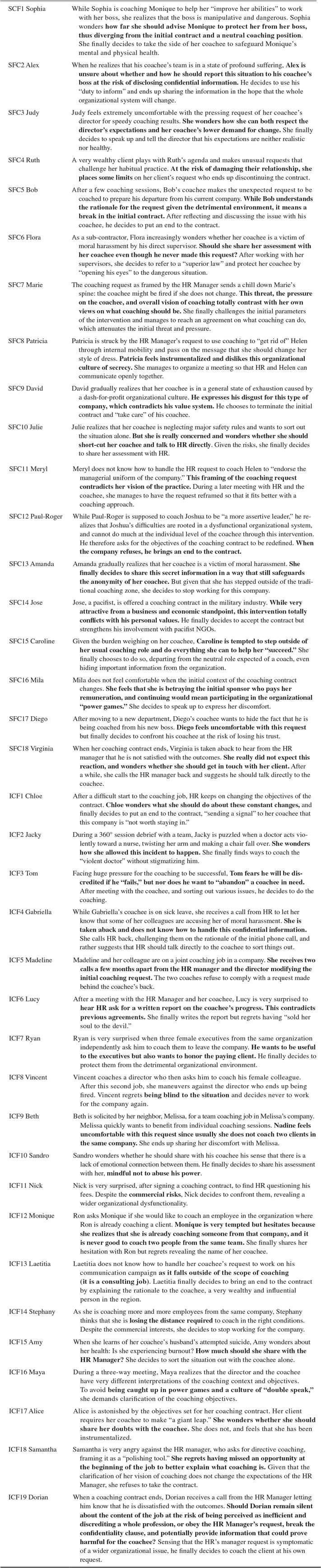
For each interview, we first identified the sensemaking process that each coach went through, mainly building on and combining perspectives developed by Sonenshein (Reference Sonenshein2009) and Maitlis et al. (Reference Maitlis, Vogus and Lawrence2013), as well as Guiette and Vandenbempt (Reference Guiette and Vandenbempt2016). Overall, we came up with a three-phase ethical sensemaking process, preceded by an “initial situation.” To provide an overview of the nature of the challenges experienced by the coaches, the Appendix contains a summary of the ethical issue of each of the thirty-seven coaches.
The initial situation, which Sonenshein (2009: 231) calls the “starting issue,” corresponds in our study to coaches’ usual way of delivering their service, of making sense of their activity, or of solving ethical issues. For example, Ryan’s initial situation is a request to coach three promising female executives from a consulting company in the fashion industry to develop their professional and personal assertiveness. This falls into his area of expertise and he feels enthusiastic about the intervention.
After the “initial situation,” where we consider that the actor is engaged in habitual sensemaking, comes a challenge to this approach. This is phase 1 of the “emergence of the issue,” where we began to code the roles of emotions and reflexivity in sensemaking. In our material, for example, this corresponds to Ryan being surprised when, over the course of the coaching job, the three executives express their desire to leave the company and ask him for help. He wonders what he should do: Should he abide by the initial contract and persuade them to stay, or listen to his gut and protect them from the detrimental organizational environment? The second phase sees the coaches processing the issue with sensemaking further unfolding. Here, Ryan talks to a senior colleague to consider possible options. Finally, phase 3 is when the actors make a “decision” that allows the sensemaking to conclude, as in the framework used by Maitlis et al. (Reference Maitlis, Vogus and Lawrence2013). Ryan finally agrees with the request of the three female executives to prepare them to leave the company.
For each of the three phases, we then analyzed the role of emotions and reflexivity in all thirty-seven interviews. We detail these findings in the next section.
FINDINGS: ETHICS AS A THREE-PHASE SENSEMAKING PROCESS WITH SPECIFIC ROLES FOR THE EMOTIONS–REFLEXIVITY INTERPLAY
How did the thirty-seven coaches make their decisions when faced with what they framed as an ethical issue? What does their ethical sensemaking look like, and what are the roles of emotions and reflexivity? Below, our findings are structured in two parts: the first presents the phenomenon of ethical sensemaking for our coaches; the second identifies how reflexivity supports the management of emotions and the specific roles of the emotions–reflexivity interplay at each stage of the ethical sensemaking process.
Ethics as a Process Unfolding over Time
Let us begin by considering comments by Meryl, who stated that “of course, I did not make a decision right away … it took time, several weeks ... it is not something that is done overnight.” Similarly, for Jose, “Saying ‘yes’ [accepting the mission] took several weeks,” while for Beth “Saying ‘no’ and being ready to put a stop to the coaching contract took over two months.” François portrays his decision as an “interesting adventure,” Monique as an “inquiry,” a “journey,” while Amanda describes it as a “path.” Over this period, François explains how “time after time, the client entrusted [him] with new pieces of information” that “opened [his] eyes” to the situation. Patricia details the “accumulation” of clues that “made [her] fear [she] was being dragged into something that wasn’t clear at all, not OK at all!” She goes on to list the series: “First, there was this strange thing ... Then, a second thing ... and a third thing a bit later.” The ethical issue is not, therefore, presented clearly or neatly packaged for the coach, and the decision instead appears as a process unfolding over time and which we have divided into three phases.
Phase 1: The Emergence of the Issue
Coaches notice something unusual that requires their attention and disorients them. For example, Patricia has to “pinch [her] arm” several times to double check that she has correctly heard the HR Manager’s request to tell the coachee she was badly dressed. Judy feels increasingly uncomfortable with a director’s requests for “speedy coaching results,” like a “gun over her head.” This pressure contradicts her vision of coaching where the coach matches the coachee’s own pace. And while David is assigned a client to improve her performance through greater team cohesion, he gradually realizes that the coachee is in a general state of exhaustion that he attributes to a “dash-for-profit organizational culture.” He is unsure of the role he wants to play in this system. Finally, while in the middle of a team-building debriefing, Jacky is puzzled when she witnesses a doctor acting violently towards a nurse, twisting her arm and making a chair fall over. “How did I allow this to happen? What did I miss?” she initially wonders. And a bit later, “how can the violent doctor be neutralized without stigmatizing him?” Overall, we see that phase 1 is a period of doubt where coaches are disoriented because their habitual way of defining or engaging in coaching is brought into question.
Phase 2: Processing the Issue
After the first phase of disorientation, coaches process the issue, trying to understand what is really at stake and to figure out the scope of their action. For most coaches, this processing involves reaching out to another person, usually a colleague with more experience (or a supervisor). François used this period to “take notice and appreciate” what was going on, Flora to “collect data,” Beth to “deconstruct to reconstruct later,” and Amanda to “construct a discourse” that made sense. This journey involves “permanent micro-adjustments” (Diego). This “readjustment” (Virginia) entails reframing: Marie explains that over the course of the coaching job, “it became obvious” that what she had initially considered—talking to HR—was not the right thing to do now, but rather “it was time to do more thinking.” This change in perspective resulted in the coaches holding “a position above” (Monique), or “meta-communicating with the client” (Dorian). This reframing allowed them to see “HR with a different eye” (Julie), understand why “after all, they might be angry with the employee” (Marie). It enabled Amanda to “distinguish the essential from the important.” In brief, processes of data collection, construction and deconstruction, and framing and reframing characterize phase 2.
Phase 3: The Decision
After processing the issue, and with its newly redesigned parameters, coaches are able to make a decision. For Samantha, this meant refusing a coaching contract given the lack of agreement with the HR Manager over its orientations and objectives. For Sandro, it meant finally deciding to trust his gut and, “at the right time,” share his conclusions that there was a lack of emotional connection with the client. Flora decided to use her “duty to inform,” i.e., share with her coachee the view that she might be a victim of moral harassment, which contradicted her initial neutrality principle.
How were these decisions made? For Ryan, it required him to “play a little game” with himself, while Jose had to “negotiate” with himself to make sure that he was “reinforcing [his] ethics, not compromising them.” It was interesting to hear a few coaches explain how arriving at this phase meant that they had managed to create a “little territory of autonomy” for themselves. As François explains: “There’s no easy answer to ethics [laughs] . . . but it’s about the margin of freedom that one chooses for oneself.” Similarly, Marie has worked towards “determining an area of freedom,” which is described, by Julie, as her “room for maneuver.” This space sets Amanda’s “limits of intervention,” and Julie similarly explains that up to this point she “can share [her] point of view.” Coaches either explicitly use the word “freedom” to designate this space in which they create the conditions to make a decision when faced with an ethical issue, or express the same ideas with other words such as “autonomy” or “authorization.” This freedom often refers to the ability to depart from externally imposed rules, such as those provided by the code of conduct of a coaching association, or from principles taught in coaching programs. Dorian mentions “the deviation from the expected standards” that led him to apply the “spirit of the code,” rather than the code itself. Flora mentions the “risks” she is taking by distancing herself from her company’s non-interventionist coaching model. A few interviewees, therefore, concluded that ethics can be difficult since “embracing one’s freedom is scary” (Flora). In brief, in phase 3, coaches make a decision based on interpretation and subjectivity in order to choose a course of action.
Overall, we see that our interviewees’ ethical sensemaking is a process that unfolds over time and which we have depicted in 3 phases. This process is characterized by an unsettling period of doubt (phase 1), engaging the sensemaker in data collection, framing and reframing (phase 2), requiring interpretation and subjectivity in order to choose a course of action, often departing from taken-for-granted practices, which some coachees compare to the construction of a freedom space (phase 3).
Next, we depict the interplay between emotions and reflexivity in each of the three phases of ethical sensemaking.
The Interplay between Emotions and Reflexivity in the Ethical Sensemaking Process
In each of the three phases of the ethical sensemaking process, reflexivity plays a distinctive role in emotions.
Phase 1: Emotions as Alerts
During the first phase—the emergence of the disorienting ethical issue—it is very common for coaches to experience “a range of emotions” (Monique). Interviewees present themselves as “taken aback,” “groggy,” “knocked out,” or “stunned”; they also mention “panic,” “disgust,” “incredulity,” and “powerlessness.” Tom quantifies his reactions: “80 percent curiosity, 20 percent fear.” Jose portrays his emotions in a negative way: “a feeling of betrayal, shame, and guilt,” made up of “uneasiness and discomfort.” Ryan also experienced guilt, as well as anger towards the organization: “This company is really stupid not to take care of these employees . . . They are ‘rare jewels’ that should be ‘pampered’!” Bernard expressed very similar feelings and was angry with his client “for making his life more complicated!” Virginia was “trembling with fear on her chair,” taken aback to discover several months after the job was over that the director was not satisfied with the coaching she had provided for a staff member. Meryl describes her initial “internal breath of panic,” asking herself “what am I going to do about this?,” i.e., about the HR request to make the coachee “endorse the managerial uniform of the company.” Vincent, meanwhile, experienced “remorse and guilt, furious to have been outsmarted by this ‘bitch’ who had maneuvered behind [his] back.” He felt like a “stupid boy,” “pathetic and ashamed.” A few coaches experienced more positive emotions, such as Marie who confesses to being “rather flattered and pleased” to have been identified as a qualified coach “for a complex job,” given the stakes of the coaching intervention. Ruth was honored to have worked for this “extremely wealthy and accomplished Indian businessman,” while Jose experienced “positive stress”: he was “excited” by the “sensitive, yet fascinating coaching mission.” While a few coaches depict these emotions as something to overcome, many of them sense their potential value.
Many of the coaches express how the ethical conflict first emerged as an emotion that required investigation. Mila’s first sense was that “something was not aligned . . . a kind of fear of ‘not being honest’ that caught [her] attention and required analysis.” Nick told us: “ethical issues are not processed mentally at first. Rather they go through emotions; it is very much part of the body, and I tell myself ‘oh oh, this is not OK . . . I will work this out with my supervisor.” Similarly, Marie explains that the way her coachee’s manager framed the request made her feel “as though [she] was turning white with a small pain in [her] stomach and tension in [her] jaw.” She needed to address the situation to avoid “constantly going over the same issues and staying trapped in a hamster wheel.” Emotions can thus be processed and work as a “signal that one is entering a grey zone” (Beth) to “transform a difficulty into an opportunity” (Beth). The interviewees used several images to describe this signaling role of emotions: “a signal,” “an alert,” “a red light,” “a flashing light,” or “an indication.” For this signal to work, coaches will tap into their reflexivity to decipher the origin of the alert. Often with the help of a senior colleague, or supervisor, they will try to understand the meaning of the signal. Indeed, a key hypothesis of most coaches is that what they are experiencing at the emotional level mirrors a problem that should be addressed. For example, Monique framed her relationship with the client as an “observation laboratory” of a wider dysfunction that needed investigation. Sandro raised the hypothesis that his own lack of emotional connection with his client, Nancy, might be a clue to understanding her own relational difficulties with her team. Similarly, Nick describes how he reflected his feelings back to the coachee: “Here is what I felt when you said this to me. I intuitively sense that this feeling is very similar to what your teammates are experiencing and that it is challenging.”
In brief, we see that during this first phase, reflexivity allows coaches to use their emotions as an alert to a potential problem to be addressed.
Phase 2: Personal Ecology and Power Detection
Overall, the second phase sees coaches both investigating and distancing themselves from the emotions generated during the first phase. Jose told us his initial reaction “seems very impulsive ... I need to dig further in.” Similarly, Amanda says: “I should not bury what I am feeling, but rather go after it.” She explains that she must “pay attention and listen to what is going on at an emotional level,” understand “what it affects, challenges, and precisely why it puts [her] in difficulty.” We suggest distinguishing between the role of self-reflexivity and critical reflexivity in this second phase.
First, self-reflexivity allows coaches to clarify their own connection with the issue at stake that generated such acute emotions. Most of the time, the emotions will be related to an issue that is not “trivial” (Beth), but rather specifically resonates with the coach, who can identify a personal connection with the situation or client. This is well put by Judy, who asks herself, “What belongs to my own history? What belongs to the company? To the coachee? To the coaching?” Beth refers to “parallel processes” occurring. These connections with the case range from a personal identification with the client to the issue raised, etc. For example, Bob clearly expresses “some projection with this guy [his client], very cool, with a brilliant profile,” which made it easier to “consider [him] the victim” and potentially take his side. Judy refers to her “personal history” to explain why her client’s attitude challenges her: “It made me angry, but this has to do with my own issues with the ‘failing male’,” referring to how the fragilities of her client echoed the deficiencies of the masculine figures in her own past. Similarly, Amy recognizes that she might be projecting her own burnout experience onto what the client is experiencing. For Sandro, the client “came to find [him] in issues [he him]self had.” This dissection of and distance from emotions that reflexivity allows develops an awareness of what belongs to them and what belongs to the case. Our respondents framed this role of reflexivity in terms of “cleaning” or “personal ecology” (Mila): there is constant work to be done to distinguish between “what belongs to the coach and what really belongs to the client and is legitimate to experience” (Mila). “Is this anger against me or against the client?” Samantha asks herself. Coaches perform their job with their own “hollows and bumps” (Beth). Their own “fragilities” (Beth) need to be sorted out to avoid reinforcing “the weaknesses of the system or relationship.” Self-reflexivity thus allows coaches to put their emotions at a distance and study them to sort out the personal connection with the topic, so that with increased awareness they gradually build a decision.
Critical reflexivity is the second type of reflexivity that facilitates this dissection of and distance from emotions. It helps coaches reflect on power relations, either as a subject of power (generating abuse of power as a coach) or object of power (potential victim of abuse of power).
Let us begin by looking at the coach’s potential abuse of power. Among the emotions that coaches experienced in the first signaling phase, a good number relate to their own power and associated dangers. Portraying coaching as “a transformation process,” Beth defines the responsibility of the coach as “maintaining the integrity of the coachee.” However, it is very easy to cross the line. For example, Caroline shares her astonishment: while she defines her job as a coach as “not wanting or knowing anything in the client’s shoes,” in this situation, she “chose to force the coachee to succeed.” She explains how her only solution was “to have a project for this guy; I had chosen success on his behalf.” She wanted him to change more than he himself wanted to; according to her, she had, therefore, gone too far. “Ethical juggling” (Alex) is thus required to navigate the fine line between “staying in the comfort zone” (Chloe) and “pushing too far, asking questions that are too hard” (Beth). This question of the coach’s influence also relates to their specific position as third parties where they can spot issues that are more difficult for those inside the system to identify. Flora wonders whether she can open her client’s eyes to an issue she has identified, but of which her client is totally unaware and has not inquired about. “What right do I have to open his eyes?” asks Flora. Similarly, Mila explains that “just because we see things doesn’t mean we must share them. Some, yes, and at the right time.” Beth also says that “the director was absolutely not asking to be challenged personally; rather he wanted teambuilding.”
Critical reflexivity also operates in coaches’ ability to identify in their emotions’ power relations of which they might be victims. Nick explains how, behind his initial discomfort, he could analyze manipulation by the manager: “She operates with me as she does with her team.” Virginia also tell of her guilt about the fact that she gradually became “numb” against her will, becoming an “element of the organizational culture of secrecy.” Several coaches similarly spoke of the risk of being “caught up in the organizational power dynamics” (Vincent), “manipulated” (Stephany; Mila), or “instrumentalized” (Alice; Sophia; Tom; Paul-Roger), playing a role that moves them away from that of coach. Rather, they become a “loudspeaker” (Meryl; Gabriella) for a manager who lacks courage, spies for a HR manager who wants to fire an employee (Judy, Tom), an accomplice of a culture of “double speak” (Maya), a member of the “clothing police” controlling how people dress (Patricia), etc. We see here that critical reflexivity allows coaches to step back from their emotions by dissecting what they reveal in terms of power issues and dynamics; with increased understanding, coaches are better equipped to purposefully use their emotions in choosing their course of action, which is the next phase we present.
Phase 3: Emotions Neutralized or Used as a Compass
After reflexivity had allowed the coaches to use their emotions as an alert (phase 1) and to distance themselves from personal issues raised by the case or identify power relations (phase 2), it then helped them to use emotions purposefully by either consciously neutralizing them, i.e., putting them aside, or using them as a compass.
First, for a few coaches, making a decision regarding their ethical issue entails putting emotions aside, having first identified their presence and origins during the previous phase. This is the case of David, who explains how he “is mindful to put [his] emotions aside . . . so that they do not pollute [his] relationship with his client, and so [he is] as neutral as possible.” Bob also forces himself to abide by the code of conduct: “I followed my reason, not my emotions.”
Now, let us turn to the image of the compass, the term used by Ruth to explain that she does not embrace a model where she “need[s] to expel emotions, rather a model where they offer support.” She told us how “invaluable” it is for her to experience emotions because “emotions are a compass.” In a similar vein, Sandro offers a very good illustration. While at the beginning of his decision-making process he was unsure of whether and how he should communicate “his lack of emotional connection with her” to his client, he now feels more confident about building on his emotions. Therefore, when he sensed, through “micro-signals,” that it was the right moment, he took the risk of sharing his feelings with Nancy, which proved to be a pivotal moment in the coaching process. Alex’s example, from the epigraph, is also very interesting. In the last phase of his decision-making process, he depicted his decision as being made up of “disembodied compassion,” i.e., an ability to “‘be’ in strong and authentic relationships with people, associated with a strong determination, a bit metallic, cold and distant towards the system, to avoid manipulation.” He uses the term “ethical juggling” to refer to this “area where you are able to be split, in a way schizophrenic, between compassion and determination, while at the same time connecting the two, and looping them back to one another.” He concludes by mentioning the importance of “being sure of one’s doubt or in one’s doubt.” He even explains how “doubting is what reassures” him:
For me, doubting entails the permanent ability to question oneself – and here I do not mean only at an intellectual level, but I include the ability to capture impressions, feelings, and emotions, the ability to be convinced in a solid, firm, and reassuring way that this kind of doubt—this hazy and unsettling thing—is precisely what will reassure me.
ETHICS AS A FABRIC
Ethical Sensemaking as Produced through the Interplay between Emotions and Reflexivity
In the dominant ethics literature, i.e., with a rational cognitive focus (e.g., Kohlberg, Reference Kohlberg and Goslin1969), ethical issues are depicted as objective entities to which individuals respond (Sonenshein, Reference Sonenshein2007). In such objectivist, rationalist approaches, ethical decision makers ask themselves such questions as, “Have I correctly processed this ethical issue?” (Parmar, Reference Parmar2014). They are codebreakers attempting to decipher a preexisting concealed code (Weick, Reference Weick2001). The questions that our coaches asked themselves are far different. They are rather along the lines of: Why does this specific situation raise an ethical issue for me? What belongs to my own story in this situation? What are the perimeters of my action? In brief, their questions echo the sensemaking perspective that ethical issues do not exist in the environment independent of individuals’ meaning constructions and are something they create rather than respond to (Sonenshein, Reference Sonenshein2009: 224). The process that we have identified is temporal: we have broken it down into three phases. Throughout this period, coaches construct their decision through doubts, micro-adjustments, and framing and reframing. Overall, the process is highly subjective and interpretive, and often departs from taken-for-granted practices. Our results thus confirm the very subjective, temporary, and approximate nature of ethical sensemaking depicted in previous research (Reinecke & Ansari, Reference Reinecke and Ansari2015; Weick, Reference Weick1995).
In this production process, the intrapersonal interplay between emotions and reflexivity is instrumental. Reflexivity facilitates the managementFootnote 1 of emotions in support of ethical sensemaking, in specific forms at each of the three phases and with associated roles. Below we discuss each of these forms and roles in respect of the literature.
Phase 1: Emotional Awareness
During the first phase of ethical sensemaking, we saw how the interplay between emotions and reflexivity functions as an alert, directing coaches to an issue that requires their attention. This finding builds on existing research that points to the “signaling” (Maitlis et al., Reference Maitlis, Vogus and Lawrence2013: 226) role of emotions, also captured as a “somatic marker” (Steigenberger, Reference Steigenberger2015: 436) that provides “information on the perception that triggered the emotion.” However, in these studies, emotions are often presented as a stimulus that is difficult to decipher. When referring to these emotions, individuals are often confined to moral dumbfounding (Haidt & Hersh, Reference Haidt and Hersh2001) with phrases like “I don’t know, I can’t explain it, I just know it’s wrong” (Haidt, Reference Haidt2001: 814), revealing that some of our emotions remain unconscious (Cornelissen et al., Reference Cornelissen, Mantere and Vaara2014; de Klerk, 2017). If left unconscious, these emotions run the risk of being an unattended or even muted signal. But our research actually suggests that, when intertwined with reflexivity, these emotions can gain in consciousness and act as a “readout” (Catino & Patriotta, 2016: 441), given that emotions should be viewed as “intelligent responses to perceptions of value” (Nussbaum, Reference Nussbaum2003: 1). With increased consciousness of one’s emotions, one reduces the risk of disregarding moral issues that still challenge and influence us, a neglect often rooted in the lack of attention paid to emotions (de Klerk, 2017). In this way, the sensemaker can be mindful of recognizing the presence of emotions and their potential value; ethical issues can thus be seen as “critical emotional incidents” (Sloan & Oliver, Reference Sloan and Oliver2013: 1845) that often constitute as turning points. We can also expect this awareness to mitigate the valence of emotions (how positive/pleasant or negative/unpleasant the emotion is) and their impact on sensemaking (Maitlis et al., Reference Maitlis, Vogus and Lawrence2013), as well as the characteristics of the sensemaking (for example, social or solitary; see Maitlis et al., Reference Maitlis, Vogus and Lawrence2013) that will unfold.
We can see that in phase 1 the interplay between emotions and reflexivity supports emotional awareness, defined as the process whereby reflexivity allows us to be aware of the presence of our emotions, inviting us to further explore why we “just know it’s wrong.”
Phase 2: Emotional Unpacking
Exploring why and how we “just know it’s wrong,” to come back to Haidt’s quote mentioned above (2001: 814), or whether this is not so wrong after all, is what happens during the second phase. Here the interplay allows coaches to distance themselves from the issue and dissect their emotions to facilitate emotional identification (Rosenberg, Reference Rosenberg1990) where reflexivity enables the interpretation of emotions. More specifically, we have identified how this interplay supports “personal ecology” (when self-reflexivity allows a personal connection with the issue raised to be clarified) and “power detection” (when critical reflexivity facilitates the dissection of power relations). These two roles very closely echo key mechanisms identified by Foucault in ethics: “personal ecology,” in making it possible to clarify one’s own connection with an issue, leads to the development of “power over oneself” (Foucault, Reference Foucault and Rabinow1984: 286–87), i.e., “mastery” over “oneself and one’s appetites” to avoid being a slave to oneself; and “power detection,” which helps clarify power relations and is a way to avoid “abuse of power” (Foucault, Reference Foucault and Rabinow1984: 288), i.e., when “one exceeds the legitimate exercise of one’s power and imposes one’s fantasies, appetites, and desires on others,” to regulate one’s “power over others.” In brief, Foucault portrays relationships with both the self and others as key in ethics, which our results also confirm.
We suggest encapsulating the interplay in phase 2 as emotional unpacking: through reflexivity, individuals “unpack” (Alvesson & Willmott, Reference Alvesson and Willmott2012: 33), i.e., dissect, step back from, analyze, and decipher the emotions connected to the ethical issue. This function builds on the study by Ruebottom and Auster (2018: 469), who argue that reflexivity allows reflection on the systems of values and relationships, in favor of social change. By locating not only cognitive but also emotional disembodying in reflexivity, Ruebottom and Auster contribute to analysis of the emotional components of reflexivity, embracing the call for an emotionalization of reflexivity (Holmes, Reference Holmes2010; Burkitt, Reference Burkitt2012), i.e., a reconsideration of the role of emotions in reflexivity.
Phase 3: Emotional (Dis)engagement
Finally, during phase 3, we have identified that reflexivity either allows emotions to be consciously neutralized as a potential impediment to sensemaking, or used as a compass, a guide for action. Here we suggest that the interplay supports emotional (dis)engagement (from) with the process to resolve the issue, whereby individuals decide to engage or not with their emotions when connecting to others (Sloan & Oliver, Reference Sloan and Oliver2013). Here reflexivity allows for either emotional engagement with the conscious display (Rosenberg, Reference Rosenberg1990) and regulation of one’s emotions, or disengagement from one’s emotions. Our results complement the psychoanalytical perspectives of de Klerk (2017), depicting how certain types of engagement with one’s emotions (such as undue avoidance, inappropriate regulation, or lack of regulation) lead to morally questionable decisions. Echoing de Klerk’s analysis of the importance of consciously dealing with one’s emotions in the support of ethical behaviors, our research points to the interplay between reflexivity and emotions.
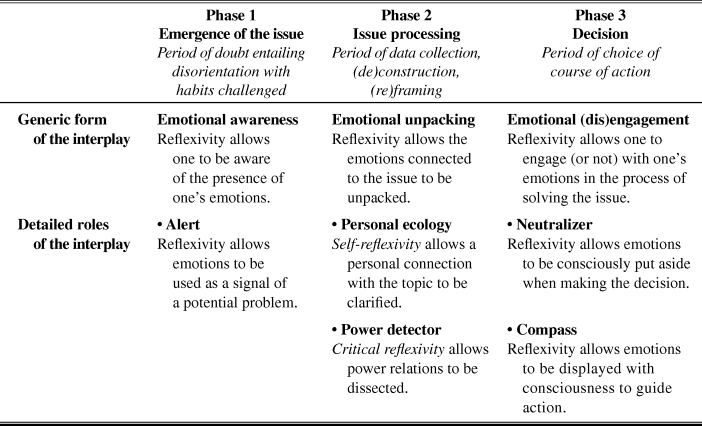
Overall, reflexivity supports the management of emotions through an interplay that takes on three main generic forms throughout the course of the ethical sensemaking process. First, emotional awareness, where reflexivity allows sensemakers to be aware of their emotions—an invitation to tap into them. Second, emotional unpacking, where reflexivity supports the dissection and analysis of the emotions connected to the ethical challenge. Third, emotional (dis)engagement, where reflexivity determines whether the person engages with their emotions, and steers this engagement. Given the long-term antagonism between emotions and cognition (Catino & Patriotta, 2018) and the “dual process” problem (Haidt, Reference Haidt2001: 820; Schwartz, Reference Schwartz2016: 767) separating the two, our research instead suggests the intertwining of emotions and reflexivity in ethical sensemaking.
Therefore, we portray ethics as a fabric, produced through the knitting of emotions and reflexivity together. While building on earlier work presenting ethics as constructed (e.g., Sonenshein, Reference Sonenshein2007, Reference Sonenshein2009; Reinecke & Ansari, Reference Reinecke and Ansari2015), our research uncovers its granular or fine-grained aspect. The term fabric designates the aggregated dimension of ethics, resulting from production that consists of a constant knitting or weaving process of two fibers—emotions and reflexivity. Our use of the terms produce or production reflects the political and performative dimension of the process (Foucault, Reference Foucault1980). Our results are summarized in Table 1.
Emotional Reflexive Interplay in Each of the Three Phases of the Ethical Sensemaking Process
The Ethical Subject as Produced through Ethical Sensemaking
When we portray ethical sensemaking as an emotional reflexive fabric, what implicit understanding of the ethical sensemaker are we proposing? We suggest locating a dual relationship between ethics and the subject within this fabric. While ethics is certainly produced by the subject, as we have seen, the subject is also produced by ethics insofar as ethics can be considered as the very process whereby one becomes a subject (Foucault, Reference Foucault and Rabinow1984).
First, we have seen that ethics as a fabric involves active subjects (Ibarra-Colado, Clegg, Rhodes, & Kornberger, Reference Ibarra-Colado, Clegg, Rhodes and Kornberger2006), in that they are aware of their emotions (phase 1), interrogating and unpacking them (phase 2), and engaging (or not) with them (phase 3). While individuals gradually build their ethical decision throughout this process, they are at the same time being built by their decisions as ethical subjects. “One becomes an ethical subject by experiencing ethical dilemmas” (Poldner et al., Reference Poldner, Branzei and Steyaert2018). This is illustrated in our material by Dorian, who refers to his “elaboration” and “construction” as an ethical subject through the permanent questioning of the world, so that he always challenges what is apparently “taken for granted.” In this process, he portrays “experience” as the “name given to our mistakes,” quoting Oscar Wilde. In a similar vein, as seen above, Alex describes ethics as a paradoxical process made up of “reassuring doubt” since “the day [he] will stop doubting, [he] will stop being a good [ethical] coach.” We see how the very process of questioning is both an effect and source of the ethical subject.
It is worth again returning to Foucault (Reference Foucault and Rabinow1984), whose work, shaped by the issue of subjectivity, i.e., how individuals constitute themselves as subjects, locates ethics at its heart. Indeed, for Foucault (Reference Foucault and Rabinow1984), this process, whereby individuals create ethics, in turn forms their subjectivity (Ibarra-Colado et al., Reference Ibarra-Colado, Clegg, Rhodes and Kornberger2006). Ethics is thus not located in the individual as a property but rather unfolds as the individual becomes an ethical subject by experiencing dilemmas. Here the subject appears as the retroactive effect of ethics. Therefore, we suggest, building on Foucault’s work (1984), that the relationship between subject and ethics is reciprocal. Ethics appears as both an effect and condition of the subject.
Furthermore, for Foucault the practice of ethics equates to a “conscious practice of freedom” (Foucault, Reference Foucault and Rabinow1984: 284), whereby “people develop a notion of ‘self’ that can be considered ethical” (Ibarra-Colado et al., Reference Ibarra-Colado, Clegg, Rhodes and Kornberger2006: 46). This practice is not “free in the sense that it is done in absence of constraint” but rather developed in relation to others, to rules and norms (Ibarra-Colado et al., Reference Ibarra-Colado, Clegg, Rhodes and Kornberger2006: 46). And “ethics is the considered form that freedom takes when it is informed by reflection” (Foucault, Reference Foucault and Rabinow1984: 284).
Perhaps under such conditions ethical sensemaking can be empowering rather than controlling. Indeed, sensemaking often acts as a controlling device when it is controlled by institutional contexts (Weber & Glynn, Reference Weber and Glynn2006) in the form of organizational narratives (Guiette & Vandenbempt, Reference Guiette and Vandenbempt2017; Holt & Cornelissen, Reference Holt and Cornelissen2014) that privilege certain values and lead to internalized privileged ways of being (Helms Mills et al., 2011; Pullen & Rhodes, Reference Pullen and Rhodes2014). Our findings show how making an ethical decision can be an opportunity to decipher socio-ideological organizational mechanisms of control, for example, “how organizational power and dominant assumptions privilege some identities over others and create them as meaningful for individuals” (Helms Mills et al., 2011: 188). Through their ethical sensemaking process, many of the coaches in this study are less concerned by “passing judgments” to relay the dominant organizational discourse than by “disrupting the taken-for-granted means through which judgement is violently imposed” (Pullen & Rhodes, Reference Pullen and Rhodes2014: 783). Therefore, our findings provide encouraging views on how ethical sensemaking can construct and empower ethical subjects.
CONCLUSION
While the codebreaker metaphor stands out in the dominant ethics literature, whereby the decision maker deciphers a preexisting master code, our research instead suggests the fabric metaphor. This primarily depicts ethics as produced through the emotional, reflexive knitting process that informs the sensemaking performed by an active subject; this interplay in sensemaking functions as emotional awareness, emotional unpacking, and emotional (dis)engagement. Emotional awareness is how reflexivity allows individuals to be aware of their emotions to inform their sensemaking; in our study, it functions as an alert. Emotional unpacking describes how reflexivity supports the dissection and analysis of emotions generated by an ethical challenge; in our study, it plays the specific roles of personal ecology and power detection. Finally, emotional (dis)engagement refers to the process whereby reflexivity allows individuals to engage (or not) with their emotions in sensemaking to solve the issue; in our study, it takes the form of neutralization and a compass. These findings provide a much-needed exploration of combined sources of sensemaking (Cornelissen et al., Reference Cornelissen, Mantere and Vaara2014; Holt & Corneslissen, Reference Holt and Cornelissen2014; Reinecke & Ansari, Reference Reinecke and Ansari2015) and suggest viewing emotions and reflexivity as intertwined rather than parallel processes. In doing so, they contribute to a depiction of sensemaking as a more holistic, instead of a purely cognitive, phenomenon, and we used an alternative approach to sensemaking (here an immanent view) likely to embrace a disregarded phenomenon, such as emotions (Sandberg & Tsoukas, Reference Sandberg and Tsoukas2015).
While ethics is produced by the subject, we propose a reciprocal relationship whereby ethics also produces the subject through his or her ethical sensemaking process. In contrast to the portrayal of ethics as a submissive process where individuals are passive reactive recipients, this reciprocal process emphasizes the performative dimension of ethical sensemaking: ethical subjects are produced by their sensemaking activity. Ethics is first and foremost a practice (Ibarra-Colado et al., Reference Ibarra-Colado, Clegg, Rhodes and Kornberger2006), a circular practice that appears as both an effect and condition of the subject.
Finally, in the context of the emergence in organizations of new sensemaking devices, such as coaching (du Toit, Reference Du Toit2007; Palus et al., Reference Palus, Horth, Selvin and Pulley2003; Stelter, Reference Stelter2007), our findings suggest that they are not confined to practices of control (Nielsen & Nørreklit, Reference Nielsen and Nørreklit2009) but can support empowerment (Louis & Fatien Diochon, Reference Louis and Fatien Diochon2018; Shoukry & Cox, Reference Shoukry and Cox2018). Our research especially encourages practitioners to view ethical issues as critical incidents, which can act as constructive turning points when emotionally (Cox & Bachkirova, Reference Cox and Bachkirova2007) and reflexively processed.
APPENDIX
List of the Ethical Challenges of the Thirty-Seven Coaches