Heart failure is a complex pathophysiological syndrome, which has high morbidity and mortality in children. Unlike adults, infants and children develop heart failure commonly due to congenital heart disease (CHD), myocardiopathy, and myocarditis.Reference Rossano and Jang 1 Myocardial fibrosis plays a key role in the evolution of heart failure, involving cardiomyocyte hypertrophy, fibroblast proliferation, and increased deposition of extracellular matrix proteins. At present, a number of biomarkers have been used in the early recognition of heart failure, assessment of severity, and prognosis of outcome.Reference Fiuzat, O’Connor and Gueyffier 2 , Reference Gruson, Ahn and Rousseau 3 Indeed, in clinical settings, the brain natriuretic peptide and N-terminal pro-brain natriuretic peptide have been used successfully to identify the presence of heart failure and assess the severity in several paediatric studies.Reference Cohen, Springer and Avital 4 – Reference Zhang, Zhang, Xu, Qiu and Chen 7
Connective tissue growth factor, known as CCN2, is a cysteine-rich, secreted peptide, which is a member of the CCN – acronym of Cyr61/CEF-10, connective tissue growth factor/Fisp-12, and Nov – family of growth factors, originally isolated from umbilical vein endothelial cells.Reference Bradham, Igarashi, Potter and Grotendorst 8 Connective tissue growth factor displays various biological effects including promoting cell proliferation, cell migration, extracellular matrix production, and angiogenesis. It has been confirmed that it plays an important role in the pathogenesis of various fibrotic disordersReference Chen, Charrier and Zhou 9 , Reference Klaassen, van Geest, Kuiper, van Noorden and Schlingemann 10 including myocardial fibrosis,Reference Wu, Wang and Lee 11 and its plasma concentration also correlates with the severity of fibrotic diseases.Reference Dziadzio, Usinger and Leask 12 Notably, plasma connective tissue growth factor levels were increased in 52 adult patients with chronic heart failure and correlated with brain natriuretic peptide and NYHA functional class.Reference Koitabashi, Arai and Niwano 13 In addition, elevated connective tissue growth factor was also associated with right ventricular dysfunction in adults with carcinoid heart disease.Reference Bergestuen, Gravning and Haugaa 14 More importantly, Behnes et alReference Behnes, Brueckmann and Lang 15 indicated that N-terminal pro-brain natriuretic peptide plus connective tissue growth factor measurements could improve the diagnosis of higher functional and structural heart failure stages. Taken together, these findings support the conclusion that the secreted connective tissue growth factor could be a potential plasma marker for heart failure. In fact, plasma connective tissue growth factor exists as an N-terminal connective tissue growth factor fragment, which is considered to reflect fibrosis in a variety of organs;Reference Dziadzio, Usinger and Leask 12 however, it is not verified in these clinical studies. At present, there are very few literature studies describing the value of plasma N-terminal connective tissue growth factor in children with evolving heart failure. In the present study, we therefore measured plasma N-terminal connective tissue growth factor levels using the novel subtraction methodReference Miyazaki, Kurashita, Fukamachi, Endo, Ng and Takehara 16 and assessed the diagnostic value of plasma N-terminal connective tissue growth factor in children with heart failure.
Methods
Study population
In this study, a total of 61 children, aged 4 months to 12 years, including 41 children with heart failure and 20 children without heart failure, were evaluated at the First Affiliated Hospital of Sichuan Medical University and Sichuan Provincial People’s Hospital from February, 2014 to August, 2015. According to modified Ross classification,Reference Ross 17 they were divided into no heart failure, mild heart failure, moderate heart failure, and severe heart failure groups. Results of detailed history and physical examination, including age, gender, weight, height, body surface area and body mass index, and electrocardiography findings, were recorded. In total, 30 healthy volunteers were included in the control group. The individuals included in the study did not have other fibrotic disorders such as skin, pancreas, liver, or kidney diseases as well as systemic hypertension. This study was also approved by the Ethics Committee of the Affiliated Hospital of Sichuan Medical University and Sichuan Provincial People’s Hospital. Informed consents were obtained from the parents of the patients.
Echocardiography
Standard M-mode, two-dimensional, colour, and Doppler echocardiography examinations were conducted by the same paediatric cardiologist using a Vivid Pro 7 echocardiography device (GE, United States of America) according to the recommendations for quantification methods.Reference Lopez, Colan and Frommelt 18
Measurement of plasma N-terminal connective tissue growth factor and N-terminal pro-brain natriuretic peptide levels
After overnight fasting, specimens were collected at 8–9 am. Blood samples were immediately transferred to chilled polypropylene tubes containing EDTA-2Na and centrifuged at 4°C at 2080 g for 15 minutes. The plasma samples were stored at −80°C. N-terminal pro-brain natriuretic peptide concentrations were measured by a fluorescent immunoassay method (Biosite Diagnostic, San Diego, California, United States of America).
A large amount of full-length connective tissue growth factors contained in platelets, which are shown to be released into plasma because of platelet activation during or after blood collection, may interfere with determination of plasma N-terminal connective tissue growth factor fragments.Reference Cicha, Garlichs, Daniel and Goppelt-Struebe 19 Subtraction of the platelet-derived full-length connective tissue growth factor levels is required for accurate measurement of plasma N-terminal connective tissue growth factor levels. The subtraction method was therefore used for the measurement of plasma N-terminal connective tissue growth factor levels in the present study.Reference Miyazaki, Kurashita, Fukamachi, Endo, Ng and Takehara 16 Anti-connective tissue growth factor antibodies were prepared, and each sandwich enzyme-linked immunosorbent assay was performed as described previously.Reference Miyazaki, Kurashita, Fukamachi, Endo, Ng and Takehara 16 , Reference Kato, Fujisawa and Hashimoto 20 The full-length connective tissue growth factor levels were detected by a sandwich enzyme-linked immunosorbent assay using two monoclonal antibodies against modules 1 and 4. Total connective tissue growth factor levels were determined by a sandwich enzyme-linked immunosorbent assay using two monoclonal antibodies against modules 1 and 2. N-terminal connective tissue growth factor levels were calculated using a subtraction method as follows: (N-terminal connective tissue growth factor level)=(total connective tissue growth factor level)−(full-length connective tissue growth factor level). All assays were performed in duplicate, and the mean value was reported for each.
Statistical analysis
Statistical Package for Social Sciences program version 13.0 was used for data analysis. Values are expressed as mean±SD or median plus interquartile range. Differences among the groups were compared using Student’s t-test, χ2, Mann–Whitney U-test, and one-way analysis of variance test as appropriate. Correlations between variables were explored using Spearman’s correlation test. Differences in connective tissue growth factor, N-terminal pro-brain natriuretic peptide levels, and connective tissue growth factor/N-terminal pro-brain natriuretic peptide in each modified Ross classification were tested by non-parametric Jonckheere–Terpstra statistic. Receiver operating curve analyses were performed using MedCalc statistical software version 11.5.0 for diagnosis of heart failure. The differences between area under curve were evaluated by Hanley and McNeil methods.Reference Hanley and McNeil 21 Net re-classification improvement and integrated discrimination improvement were calculated using the test developed by Pencina et al.Reference Pencina, D’Agostino, D’Agostino and Vasan 22 For all analyses, p<0.05 was considered to be statistically significant.
Results
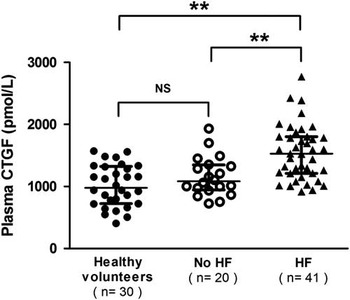
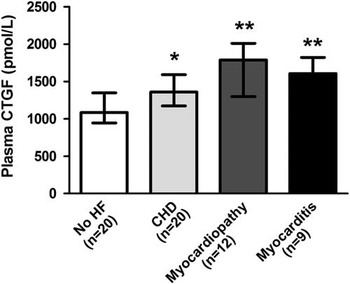
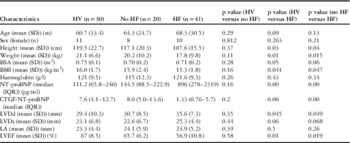
The study enrolled 41 individuals with heart failure, including 20 children with CHD, 12 children with myocardiopathy, and nine children with myocarditis. Table 1 showed that there were no significant differences in age, sex, body surface area, haemoglobin, left ventricular dimension (systolic), and left atrium among the healthy volunteers, the no heart failure group, and the heart failure group, respectively. N-terminal pro-brain natriuretic peptide and left ventricular end-diastolic dimension were higher in the heart failure group than in the no heart failure group and healthy volunteers, whereas height, weight, body mass index, connective tissue growth factor/N-terminal pro-brain natriuretic peptide, and left ventricular ejection fraction were significantly lower in the heart failure group compared with the no heart failure group. As shown in Figure 1, compared with the healthy volunteers (median 979.9 pmol/L, interquartile range 722.6–1322.7 pmol/L, n=30) and the no heart failure group (median 1084.4 pmol/L, interquartile range 945.8–1347.9 pmol/L, n=20), plasma N-terminal connective tissue growth factor levels were significantly elevated in the heart failure group (median 1529.8 pmol/L, interquartile range 1210.8–1803.1 pmol/L, n=41) (p<0.01), whereas there was no significant difference in plasma N-terminal connective tissue growth factor levels between healthy volunteers and the no heart failure group (p>0.05). Figure 2 indicates that plasma N-terminal connective tissue growth factor levels in children with heart failure were secondary to different diseases – that is, CHD, myocarditis, and myocardiopathy. Compared with the no heart failure group, plasma N-terminal connective tissue growth factor levels were increased patients with CHD (median 1357.6 pmol/L, 1171.5–1591.2 pmol/L, n=20), myocarditis (median 1604.9 pmol/L, interquartile range 1231.1–1821.3 pmol/L, n=9), and myocardiopathy (median 1788.7 pmol/L, interquartile range 1295.9–2008.9 pmol/L, n=12) (p<0.05), respectively.
Plasma N-terminal connective tissue growth factor (CTGF) levels in children with heart failure (HF). Compared with healthy volunteers and children without HF, plasma N-terminal CTGF levels were significantly elevated in children with HF (p<0.01), whereas there was no significant difference in plasma N-terminal CTGF levels between healthy volunteers and children without HF (p>0.05). Horizontal lines indicate median and interquartile range. **p<0.01. NS=not significant difference.

Plasma N-terminal connective tissue growth factor (CTGF) levels in heart failure (HF) secondary to different diseases. Plasma N-terminal CTGF levels in individuals with CHD, myocarditis, or myocardiopathy were higher compared with those without HF (p<0.05). Horizontal lines indicate median and interquartile range. *p<0.05, **p<0.01.

Baseline characteristics of 61 patients.

BMI=body mass index; BSA=body surface area; CTGF=connective tissue growth factor; HF=heart failure; HV=healthy volunteers; IQR=interquartile range; LA=left atrium; LVDd=left ventricular dimension (diastolic); LVDs=left ventricular dimension (systolic); LVEF=left ventricular ejection fraction; NT-proBNP=N-terminal pro-brain natriuretic peptide
p<0.05 was regarded as statistically significant
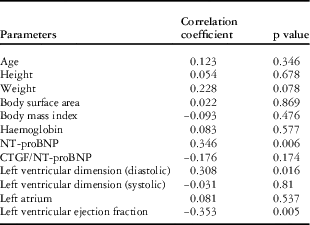
Table 2 reveals the results of Spearman’s correlation of the variables in heart failure patients. N-terminal pro-brain natriuretic peptide and left ventricular end-diastolic dimension were positively correlated with plasma N-terminal connective tissue growth factor levels (r=0.364, p=0.006; r=0.308, p=0.016). Inversely, there was a negative correlation between plasma N-terminal connective tissue growth factor levels and left ventricular ejection fraction (r=−0.353, p=0.005); however, there were insignificant correlations between plasma N-terminal connective tissue growth factor levels and age, height, body surface area, haemoglobin, connective tissue growth factor/N-terminal pro-brain natriuretic peptide, left ventricular diameters, and left atrium.
Association between connective tissue growth factor (CTGF) and clinical parameters in patients with heart failure.

NT-proBNP=N-terminal pro-brain natriuretic peptide
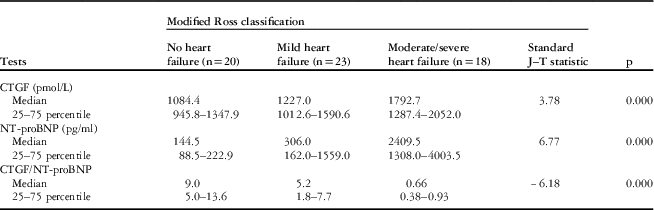
With regard to the modified Ross classification, connective tissue growth factor, N-terminal pro-brain natriuretic peptide, and connective tissue growth factor/N-terminal pro-brain natriuretic peptide were strongly correlated with the severity of heart failure (p<0.001) (Table 3).
Median (25–75 percentile) of connective tissue growth factor (CTGF), N-terminal pro-brain natriuretic peptide (NT-proBNP), and CTGF/NT-proBNP in each modified Ross classification.

J–T=Jonckheere–Terpstra
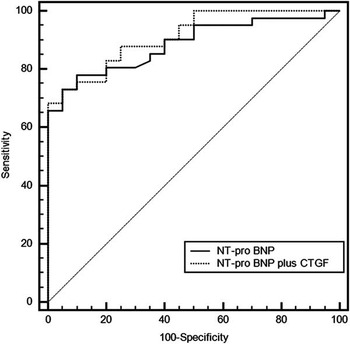
Through receiver operating curve analysis, although the combination of connective tissue growth factor and N-terminal pro-brain natriuretic peptide did not significantly increase area under curve for diagnosis of heart failure compared with N-terminal pro-brain natriuretic peptide alone (area under curve difference 0.026, p=0.33) (combination, area under curve 0.912, N-terminal pro-brain natriuretic peptide, area under curve 0.886), it showed a slightly higher specificity and positive predictive value compared with N-terminal pro-brain natriuretic peptide alone (specificity: combination 100% versus N-terminal pro-brain natriuretic peptide 95%; positive predictive value: combination 100% versus N-terminal pro-brain natriuretic peptide 97%) (Table 4, Fig 3). The addition of connective tissue growth factor to N-terminal pro-brain natriuretic peptide provided an integrated discrimination improvement (6.2%, p=0.013) and net re-classification improvement (13.2%, p=0.017).
Receiver operating curves of connective tissue growth factor (CTGF) combined with N-terminal pro-brain natriuretic peptide (NT-proBNP) and NT-proBNP alone for diagnosis of heart failure among children.

Clinical area under curve, sensitivity, specificity, positive predictive value, and negative predictive value of N-terminal pro-brain natriuretic peptide (NT-proBNP) and the addition of connective tissue growth factor (CTGF) to NT-proBNP.

Discussion
In the present study, plasma N-terminal connective tissue growth factor levels in children with heart failure were measured using a novel subtraction method, and the correlations between plasma N-terminal connective tissue growth factor levels and clinical parameters were investigated. Moreover, the diagnostic value of N-terminal connective tissue growth factor levels was evaluated. To our knowledge, it was first found that plasma N-terminal connective tissue growth factor levels were significantly elevated in children with heart failure. Conversely, connective tissue growth factor/N-terminal pro-brain natriuretic peptide was evidently lower in the heart failure group compared with the no heart failure group. Elevated plasma N-terminal connective tissue growth factor levels were positively correlated with N-terminal pro-brain natriuretic peptide, left ventricular end-diastolic dimension, and the severity of heart failure, whereas there was an inverse correlation between plasma N-terminal connective tissue growth factor levels and left ventricular ejection fraction. Finally, addition of connective tissue growth factor to N-terminal pro-brain natriuretic peptide obviously improved the ability of diagnosing heart failure in children, but also had a slightly higher specificity and positive predictive value.
Emerging evidence indicates that connective tissue growth factor is one of the key molecular mediators of cardiac fibrosis and re-modelling.Reference Wu, Wang and Lee 11 Previous studies have found that the expression of connective tissue growth factor was significantly increased in fetal mouse during early cardiac development, which was subsequently restricted in the postnatal heart.Reference Chuva de Sousa Lopes, Feijen and Korving 23 It has been shown that the expression of connective tissue growth factor is upregulated in various forms of heart failure both in humans and in animals.Reference Wu, Wang and Lee 11 , Reference Ahmed, Øie and Vinge 24 – Reference Tsoutsman, Wang, Garchow, Riser, Twigg and Semsarian 26 Several factors including transforming growth factor-β, angiotensin II, and endothelin-1 that induce cardiac re-modelling rapidly upregulate the expression of connective tissue growth factor.Reference Blom, Goldschmeding and Leask 27 Obviously, it is possible that plasma N-terminal connective tissue growth factor levels were significantly elevated in all children with heart failure secondary to CHD, myocarditis, and myocardiopathy in the present study. Similar to the features of N-terminal pro-brain natriuretic peptide in children with heart failure in previous studies,Reference Sahin, Portakal, Karagöz, Hasçelik and Özkutlu 28 our results showed that plasma N-terminal connective tissue growth factor levels were correlated with the severity of heart failure. Koitabashi et alReference Koitabashi, Arai and Niwano 13 also reported that plasma connective tissue growth factor levels in adult patients with chronic heart failure were increased and positively correlated with the NYHA functional class. The same study demonstrated that plasma connective tissue growth factor levels were significantly higher both in functional NYHA class III/IV and in structural American College of Cardiology/American Heart Association class C/D in adult patients suffering from acute heart failure.Reference Behnes, Brueckmann and Lang 15
In addition, previous data postulated that elevated connective tissue growth factor binds to transforming growth factor-β as a key pro-fibrotic growth factor to collectively stimulate the proliferation of cardiac fibroblasts, deposition of extracellular matrix, and myocardial hypertrophy, eventually leading to cardiac dysfunction and reduced ventricular compliance. Supporting this hypothesis, our results indicated that left ventricular end-diastolic dimension in children with heart failure was higher compared with those without heart failure. Moreover, left ventricular ejection fraction was lower in children with heart failure compared with those without heart failure, and plasma N-terminal connective tissue growth factor levels were negatively correlated with left ventricular ejection fraction and positively correlated with left ventricular end-diastolic dimension. In accordance with our study, Koitabashi et alReference Koitabashi, Arai and Kogure 25 also demonstrated that the expression of connective tissue growth factor was correlated with left ventricular stiffness in adult patients with heart failure; however, several contrary data showed that connective tissue growth factor attenuated chronic pressure overload-induced cardiac dysfunction and left ventricular dilatation in a mice modelReference Gravning, Ahmed, von Lueder, Edvardsen and Attramadal 29 and also prevented left ventricular re-modelling after myocardial infarction.Reference Gravning, Ørn and Kaasbøll 30 It is absolutely unclear about the mechanism of this phenomenon.
It is well known that the imbalance of pro-fibrotic factors and anti-fibrotic factors promotes myocardial fibrosis. N-terminal pro-brain natriuretic peptide and brain natriuretic peptide show an anti-fibrotic effect.Reference Braunwald 31 Expression of connective tissue growth factor in cardiac myocytes was inhibited by exogenous brain natriuretic peptide,Reference Koitabashi, Arai and Kogure 25 whereas the expression of brain natriuretic peptide was not induced by connective tissue growth factor.Reference Hayata, Fujio and Yamamoto 32 In a previous study, it was found that high connective tissue growth factor mRNA levels were correlated with brain natriuretic peptide mRNA levels, and increased connective tissue growth factor/brain natriuretic peptide ratio indicated myocardial fibrosis and impaired ventricular compliance in rats;Reference Koitabashi, Arai and Kogure 25 however, the present data showed that there was no correlation between connective tissue growth factor/N-terminal pro-brain natriuretic peptide and plasma N-terminal connective tissue growth factor levels. Moreover, connective tissue growth factor/N-terminal pro-brain natriuretic peptide ratio was lower in children with heart failure compared with those without heart failure, and it was gradually decreased with increased modified Ross classification. The different findings may be caused by the different cohorts, age groups, and assays.
The available literature shows that a single biomarker is unable to detect heart failure.Reference Jungbauer, Riedlinger and Block 33 New biomarkers that reflect different pathological features may develop additional diagnostic values. N-terminal pro-brain natriuretic peptide in addition to other new biomarkers has been widely discussed to improve the capacity of diagnosis of heart failure.Reference Braunwald 31 , Reference Bielecka-Dabrowa, Gluba-Brzózka, Michalska-Kasiczak, Misztal, Rysz and Banach 34 Behnes et alReference Behnes, Brueckmann and Lang 15 found that connective tissue growth factor plus N-terminal pro-brain natriuretic peptide improved the diagnostic capacity for adult patients with acute heart failure. The addition of transforming growth factor-β to N-terminal pro-brain natriuretic peptide improved the predictive capacity for heart failure in hypertensive patients compared with N-terminal pro-brain natriuretic peptide alone.Reference Bielecka-Dabrowa, Gluba-Brzózka, Michalska-Kasiczak, Misztal, Rysz and Banach 34 Consistent with these studies, our results showed that, although the addition of connective tissue growth factor to N-terminal pro-brain natriuretic peptide did not significantly increase area under curve for diagnosing heart failure, it demonstrated a slightly better performance in diagnostic specificity and positive predictive value. Furthermore, addition of connective tissue growth factor to N-terminal pro-brain natriuretic peptide obviously improved the capacity to diagnose heart failure in children as demonstrated by the integrated discrimination improvement (6.2%, p=0.013) and net re-classification improvement (13.2%, p=0.017) indices.
Of course, there are some limitations to the present study. First, this was a single-centre study, and the sample size was relatively small. Second, a study with longer follow-up should be performed to evaluate the relationship between plasma N-terminal connective tissue growth factor and clinical parameters. Third, the role of connective tissue growth factor in ventricular re-modelling remains to be further investigated.
In conclusion, this study demonstrated that plasma connective tissue growth factor levels were significantly elevated in children with heart failure, and connective tissue growth factor/N-terminal pro-brain natriuretic peptide was lower in children with heart failure. It was further found that plasma connective tissue growth factor levels were positively correlated with N-terminal pro-brain natriuretic peptide, left ventricular end-diastolic dimension, and the severity of the heart failure, respectively, whereas plasma N-terminal connective tissue growth factor was inversely correlated with left ventricular ejection fraction. Moreover, addition of connective tissue growth factor to N-terminal pro-brain natriuretic peptide may improve the capacity of diagnosing heart failure compared with N-terminal pro-brain natriuretic peptide alone. Plasma connective tissue growth factor is a promising diagnostic biomarker for heart failure in children.
Acknowledgements
The authors are thankful to all the children and their parents for their willingness to participate in the study. The authors also thank Yang F and Wu CX (Department of Cardiothoracic Surgery, the First Affiliated Hospital of Sichuan Medical University, Sichuan 646000, China).
Financial Support
This research received a grant from the Sichuan Medical University (Grant No. 2015-1-010).
Conflicts of Interest
None.
Ethical Standards
This study was conducted in accordance with the Declaration of Helsinki. This study was conducted with approval from the Ethics Committee of the Affiliated Hospital of Sichuan Medical University. Written informed consent was obtained from all patients.