Introduction
There are twelve continental Asian species of Begonia sect. Petermannia and allies, in great contrast to the diversity of Malesia, which harbours 415 species in the section (Hughes, Reference Hughes2008; Hughes et al., Reference Hughes, Moonlight, Jara, Tebbitt, Wilson and Pullan2015–; Lin et al., Reference Lin, Chung and Peng2017). The continental species are found in China (Begonia hainanensis Chun & F.Chun, B. pellionoides Y.M.Shui & W.H.Chen, B. sinofloribunda Dorr, B. sublongipes Y.M.Shui), Vietnam (B. abbreviata C.-I. Peng, B. boisiana Gagnep., B. cucphuongensis H.Q.Nguyen & Tebbitt, B. eberhardtii Gagnep., B. rubrosetosa Aver.), Laos (B. lamxayana Souvann.), Thailand (B. wrayi Hemsl.) and Peninsular Malaysia (B. holttumii Irmsch., B. wrayi) (Hughes et al., Reference Hughes, Moonlight, Jara, Tebbitt, Wilson and Pullan2015–). This group of species is not a natural group, and indeed, some of them are not placed in sect. Petermannia, but they share an evergreen caulescent growth form (a creeping rhizome in the case of Begonia abbreviata and B. eberhardtii), lack tubers, and usually have protogynous inflorescences with a small number of female flowers and many more male flowers. Two of the species from the south of the continent (Begonia holttumii and B. wrayi) belong to the core Petermannia clade, which is most diverse in Malesia (Thomas et al., Reference Thomas, Hughes, Phutthai, Ardi, Rajbhandary, Rubite, Twyford and Richardson2012), whereas the remainder from further north are a phylogenetically disparate group (Chung et al., Reference Chung, Leong, Rubite, Repin, Kiew, Liu and Peng2014), although only a few have been sampled to date. Begonia sinofloribunda has been recently assigned to sect. Coelocentrum based on molecular data, although it remains morphologically aberrant in the section, and B. boisiana is an early diverging lineage in Asian Begonia (Tebbitt et al., Reference Tebbitt, Lowe-Forrest, Santoriello, Clement and Swensen2006; Chung et al., Reference Chung, Leong, Rubite, Repin, Kiew, Liu and Peng2014). Here we add a further species to this group of continental sect. Petermannia, a group that begs further phylogenetic and biogeographic investigation. This is the latest addition to the endemic flora of Mount Dầu, the scene of many recent discoveries, including an endemic genus of Aracaeae (Lý et al., Reference Lý, Yeng, Haevermans, Nguyễn and Boyce2017). All measurements and descriptions of the new species are based on fresh material collected during field trips.
Species description
Begonia lecongkietii N.S.Lý & M.Hughes, sp. nov. Sect. Petermannia
Most similar to Begonia lamxayana Souvann., but differs in having leaves with short fleshy strigose hairs spaced along the veins abaxially (versus dense glandular hairs), densely villose pedicels and tepals (versus glabrous), larger tepals in the male flower (13.5–18 mm long versus 5–8 mm long), with the tepals having an undulate margin (versus flat), more stamens (86–116 versus 20–30) and longer petioles (2–6.3 cm versus 0.5–1 cm). – Type: Vietnam, Quảng Ngãi Province, Nghĩa Hành District, Hành Tín Đông Commune, Khánh Giang Village, Đá Bàn Hill, 14°53.691′N, 108°48.336′E, 489 m elevation, 11 iv 2015, Ngọc-Sâm Lý Lý 608 (holo VNM; iso E, P). Fig. 1.
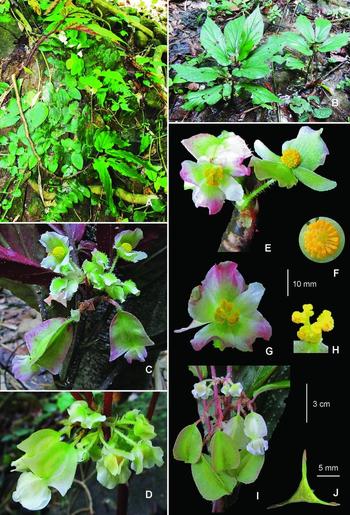
Begonia lecongkietii. A and B, Plants in their natural habit; C and D, inflorescences showing female flowers of different colours; E, detail of male and female flowers; F, top view of androecium; G, close-up of female flower; H, detail of stigma; I, infructescence; J, cross-section of mature fruit. Scale bars: E–H, 10 mm; I, 3 cm; J, 5 mm. Photograph by Ngọc-Sâm Lý: A, Lý 572; B–J, Lý 608.

Perennial, erect caulescent herb to 85 cm tall. Stem slightly woody, glabrescent, internodes (1–)1.5–5(–8) cm long, slightly swollen at nodes, young stem dull green-purple to red-purple with somewhat strigose hairs, becoming greyish and glabrescent. Stipules narrowly ovate-lanceolate, 1.2–1.6 cm long, 2.6–3.5 mm at widest point, opaque greenish or green-reddish, outer surface with strigose hairs, inner surface glabrous, with a shortly filiform extension at the tip 2–3 mm long, caducous. Leaves alternate; petiole 2–6.3 cm long, red-purple, with rather short strigose hairs; lamina basifixed, 12–24.5 × 4.5–9.5 cm, asymmetrical, somewhat elliptic-lanceolate, thin and chartaceous when dry, base cordate with somewhat overlapping lobes, apex long acuminate, margin irregularly dentate, venation palmate-pinnate, adaxially dark green with fleshy bristles scattered midway between the veins, abaxially maroon or green-maroon, with short fleshy strigose hairs spaced along the veins and minute white bristles scattered between the veins. Inflorescence bisexual, axillary and/or terminal; dichasial cymes, peduncle 20–25 mm long, c.1.5 mm wide, purple, densely villose; 2–5 branches, 5–40 mm long, usually 2 female flowers at base and 2–5 male flowers distally, protogynous; bracts semipersistent, membranous, suborbicular, 5–7 mm long, 4.5–6 mm wide, opaque whitish and rusty brown when aged, with a few strigose hairs on midvein of outer surface, inner surface glabrous, apex attenuate, margin dentate. Male flowers on 12–19 mm long, 0.4–0.6 mm thick pedicels, red-purple or greenish, villose; tepals 4: two outer tepals suborbicular, 13.5–18 × 11–14.5 mm, outer surface greenish, densely villose from base to three-quarters of tepal, white-pinkish tinge and glabrous in upper third, inner surface paler and glabrous, margin entire, undulate, slightly curved outwards; two inner tepals obovate to oblanceolate, 10–14 × 3.5–5 mm, paler than outer ones, with a few villose hairs at basal third of outer surface, margin somewhat straightened and shallowly crenate; androecium actinomorphic, with 86–116 stamens in a dense capitulum, subglobose, 5–7 mm in diameter, bright yellow, stamen 2–3 mm long; filaments 1–1.2 mm long, fused into a short central column; anther obovate, 0.9–1.2 mm long, dehiscing by longitudinal slits, c.0.5 mm long, connective not extended, apex slightly retuse. Female flowers on 19–21 mm long, 0.8–1 mm thick pedicels, angled obliquely downwards, red-purple or greenish, villose; ovary trilocular, obovoid, (15–) 22–28 mm long, (14–)20–26 mm at apex including wings, light greenish or pale reddish green, glabrous, wings 3, subequal, 11–15 mm wide, margin with a few strigose hairs; placentas 2 per locule; tepals 5, unequal, outer two suborbicular, 7–7.5 × 7 mm, inner three broadly obovate, c.7 mm long, c.6 mm at widest point, outer surface white or tinged greenish white and villose in basal half, distally tinged white pinkish and glabrous, inner surface paler and glabrous, margin entire, undulate; styles 3, 2–2.5 mm long, shortly fused at base c.0.5 mm long, broadening and flattened towards the apex, yellow-greenish, distally yellow; stigma densely setose-papillose, linear-cristate, lateral sides expanded into short helicoid band. Infructescence to 5 cm long; fruit pendent, on 8–12 mm pedicels, mature capsule 2.8–3.2 × 1.2–2.2 cm, wings equal and rounded at base, truncate at apex. Seeds ellipsoid, 0.2–0.3 mm long, light brown.
Additional specimens examined. Vietnam: Quảng Ngãi Province: Nghĩa Hành District, Hành Tín Đông Commune, Trường Lệ Village, Mount Dầu, Chí Stream, 14°52.702′N, 108°49.121′E, 108 m elevation, 19 v 2015, Ngọc-Sâm Lý, Lý 649 (VNM); ibid., Hill 48, around 14°51.791′N, 108°48.529′E, 153 m elevation, 8 iv 2015, Ngọc-Sâm Lý, Lý 572 (VNM); ibid., 14°51.737′N, 108°48.251′E, 108 m elevation, 9 iv 2015, Ngọc-Sâm Lý, Lý 575 (VNM).
Distribution and ecology
Begonia lecongkietii is endemic to Quảng Ngãi Province in the South Central Coast Region, Vietnam. It is known only from the type locality, Mount Dầu, in habitats such as stream banks, on shaded steep slopes in secondary evergreen broadleaved forest dominated by dipterocarps and associated with recently described endemic taxa such as Newmania orthostachys N.S.Lý & Škorničk. and Newmania serpens N.S.Lý & Škorničk. (Leong-Škorničková et al., Reference Leong-Škorničková, Lý, Poulsen, Tosh and Forrest2011), Zingiber skornickovae N.S.Lý (Lý, Reference Lý2016), Aspidistra averyanovii N.S.Lý & Tillich (Lý & Tillich, Reference Lý and Tillich2016) and Alpinia newmanii N.S.Lý (Lý, Reference Lý2017), at elevation c.100–490 m.
Phenology
Flowering from April to May and fruiting from late May to June or July.
Etymology
Named in honour of Professor Lê Công Kiệt, University of Science, Vietnam National University, Ho Chi Minh City, for his long-time contribution to Vietnamese botany.
Preliminary IUCN conservation assessment
Critically Endangered (CR B2a,b(ii,iii)). Four small populations of Begonia lecongkietii occur on Mount Dầu, with fewer than 10 individuals of mature plants in each population, and with a total area of occupancy of 6.5 km2. Although this species is under the protection of the local authorities of Khánh Giang and Trường Lệ Villages (Quảng Ngãi Province), these populations are vulnerable and continuing to decline in area, extent and quality of habitat, owing to destruction through human activities, such as harvesting of non-timber forest products (medicinal plants and rattans), forest fires, and especially clearing of forest land for Acacia plantations. The first author has surveyed areas around Mount Dầu, but no further populations of this species were found. According to the IUCN Red list criteria (IUCN, 2012), this qualifies it as Critically Endangered (CR B2a,b(ii,iii); severely fragmented, with an inferred decline in the area of occupancy and quality of habitat).
Begonia lecongkietii is most similar to B. lamxayana and seems likely to be a sister species to that taxon. There is a considerable distance between the two species, with Begonia lamxayana restricted to central Laos (Souvannakhoummane et al., Reference Souvannakhoummane, Hughes and Lanorsavanh2016), approximately 600 km north-west of the only known populations of B. lecongkietii.
Acknowledgements
We are indebted to Mr Trần Đại, the deputy head of the Department of Forest Protection (Quảng Ngãi Province) for issuing permits for the fieldwork, and to Mr Trần Văn Hùng (Mount Dầu, Nghĩa Hành District) for his assistance in the field. The work of the first author is supported by a grant from the Institute of Tropical Biology Key Laboratory of Plant Cell Biotechnology (no. 09/TH-SHNÐ/17/03/2016 and no. 29/QĐ-SHNÐ/31/01/2017). The research of the third author was supported by the Scottish Government's Rural and Environment Science and Analytical Services.