I. INTRODUCTION
Titanium dioxide, TiO2, as one of the well-known oxide semiconductor materials has been extensively investigated for many applications, such as photocatalysis,Reference Obee and Brown1 solar energy,Reference Mor, Varghese, Paulose, Shankar and Grimes2 gas sensors,Reference Ruiz, Cornet, Shimanoe, Morante and Yamazoe3 phosphors,Reference Li, Wang, Watanabe and Ishigaki4 and dilute magnetism,Reference Li, Buechel, Isobe, Mori and Ishigaki5 because of its outstanding properties including remarkable chemical and thermal stabilities, high transparency in the visible region, and high refractive index. It usually exists in two polymorphs: anatase (tetragonal, space group: ) and rutile (tetragonal, space group:
 ). These phases present quite different arrangements of structure-building blocks (Ti–O octahedrons).Reference Wells6 Specifically, in rutile, each octahedron provides two opposing edges, which are shared to form linear chains along the [001] direction, thus TiO6 chains are linked to each other via corner connection, whereas anatase has four shared edges per octahedron instead of shared corners, and so the zigzag chains of the octahedrons are linked together via shared edges. Because of the different features of these structures, anatase and rutile exhibit distinctly different properties in terms of theoretical density, refractive index, bandgap, and carrier mobility.Reference Fukumura, Toyosaki and Yamada7
It is well known that metastable anatase, which is considered to have a wider application domain than rutile, transforms to thermodynamically stable rutile at a high temperature above ∼500 °C, despite that the exact transformation temperature is affected by many factors such as crystallite size, impurity type and concentration, and atmosphere.Reference Hu, Tsai and Huang8–Reference Gennari and Pasquevich10 As a result, nanosized anatase-phase TiO2 with the ability to resist the high temperature treatment will become a highly desired material to yield the high performance. As a typical example, one of the potential applications is that transparent super-hydrophilic TiO2 coating films on glass or tiles, which give the surface of these substrates a self-cleaning function through utilizing the photocatalytic properties under UV light irradiation,Reference Watanabe, Nakajima, Wang, Minabe, Koizumi, Fujishima and Hashimoto11, Reference Sopyan, Murasawa, Hashimoto and Fujishima12 require the stable anatase to ensure the higher photocatalytic stabilityReference Tanaka, Capule and Hisanaga13 and the kept nanoparticles to improve the high hydrophilic surfaceReference Wang, Hashimoto, Fujishima, Chikuni, Kojima, Kitamura, Shimohigoshi and Watanabe14 after being fired during fabrication process.
Among the countermeasures for nanostructured anatase maintenance used to date, doping niobium into TiO2 has been effective at impeding anatase-to-rutile transformation and hindering appreciable grain growth. Typically, Ruiz et al.Reference Ruiz, Dezanneau, Arbiol, Cornet and Morante15, Reference Ruiz, Dezanneau, Arbiol, Cornet and Morante16 have found that the introduction of Nb into TiO2 retarded the phase transformation at calcination temperatures of 600–900 °C and significantly prevented the particle coarsening, but Nb/Ti atomic ratio via sol–gel synthesis just resided in 0–10%. In addition, recently, Hasegawa and his co-workersReference Hoang, Yamada, Hitosugi, Kasai, Nakao, Shimada and Hasegawa17–Reference Hitosugi, Yamada, Hoang, Kasai, Nakao, Shimada and Hasegawa21 have successfully fabricated the Nb-doped anatase TiO2 polycrystalline films with excellent conductivity and transparency, hence opening a paradigm that Nb-doped TiO2 materials should find the extensive application.
Currently, among the many synthesis techniques for Nb5+-doped TiO2 powder, wet-chemical techniques are most commonly used.Reference Ruiz, Dezanneau, Arbiol, Cornet and Morante15, Reference Ruiz, Dezanneau, Arbiol, Cornet and Morante16, Reference Traversa, Di Vona, Licoccia, Sacerdoti, Carotta, Crema and Martinelli22–Reference Ahmad, Shah, Buzby and Shah27 Such techniques, however, may easily produce low crystallinity, nonuniform doping, and hard aggregation via postannealing. In contrast, radio-frequency (RF) thermal plasma processing has been proven to be an effective tool for synthesizing various nanopowders because it has some promising advantages: (i) extremely high synthesis temperature (up to ∼15,000 K), (ii) high concentrations of chemically reactive radicals that enhance reactivity, and (iii) superfast quenching rate (∼105–106 K/s) in plasma tail flame region.Reference Ishigaki and Li28, Reference Ishigaki29 In particular, in our previous work, Li et al.Reference Li and Ishigaki30 have successfully utilized one-step Ar/O2 RF thermal plasma processing to synthesize highly crystalline TiO2 powders with controlled phase structures; Wang et al.Reference Wang, Li, Kamiyama, Katada, Ohashi, Moriyoshi and Ishigaki31 have shown the other advantage of thermal plasma processing, which gave rise to the nonequilibrium condition in synthesized Fe-doped TiO2 nanosized powders, that is, quite high-concentration doping; the (Fe/Ti) molar ratio was as high as 0.2 and was attained to form a unique crystal structure composed of ordered oxygen vacancies.
In this work, we have used Ar/O2 RF thermal plasma to synthesize (0–25.0 at.%) Nb5+-doped TiO2 nanoparticles through the oxidation of a mist precursor solution containing titanium (IV) tetrabutylate and niobium (V) pentapropylate, and then we have investigated the variation of phase composition, phase transformation from anatase to rutile, inter-particulate binding of the plasma-synthesized powders under high temperatures (600–800 °C), and influence of the heat treatment on photocatalytic stability. We found that solubility of Nb5+ into TiO2 via thermal plasma synthesis reached as high as ∼25.0 at.%, which has not been achieved using wet-chemical techniques, and that, for the Nb5+-doped powders at the high temperatures, the transformation from anatase to rutile could be effectively inhibited, crystallite size could be kept almost constant, intercrystalline sintering could be significantly avoided, and high doping concentration (25.0 at.%) saved the photocatalytic property from the influence of the thermal treatment. In the following sections, we report the synthesis process, phase composition, and particle morphology of the plasma-synthesized powders, their variation under the high temperatures, and photocatalytic stability as a function of the heating temperature.
II. EXPERIMENTAL SECTION
A. Synthesis process
All chemicals used in this work were of reagent grade from Wako Pure Chemical Industry Ltd., Osaka, Japan, and were used as received. Liquid precursors were made up of Ti(OBu)4 as titanium (IV) source and Nb(OBu)5 as niobium (V) source, using HN(OC2H5)2 (DEA) (in molar ratio, DEA:Ti(OBu)4 = 4:1 and DEA:Nb(OBu)5 = 5:1) to prevent hydrolysis against water or moist air. The nominal addition concentrations of Nb5+ in the precursor solutions were varied in the range of Nb/(Ti + Nb) = 0–25.0 at.%.
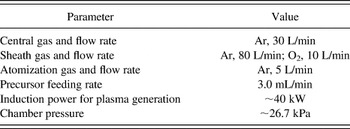
Experimental apparatus for synthesis of powder was primarily composed of a water-cooled induction plasma torch (model PL-50; Tekna Plasma System Inc., Quebec, Canada), a water-cooled atomizer probe (model SA792-260-100; Tekna Plasma System Inc., Quebec, Canada), a 4-MHz, 40-kW RF power supply system (Nihon Koshuha Co. Ltd., Yokohama, Japan), a water-cooled stainless steel reactor, a stainless steel filter connected to the reactor, and a vacuum pump for adjusting reactor pressure. Details of the experimental setup can be found elsewhere.Reference Li and Ishigaki30 In this work, the liquid precursors were first delivered by a peristaltic pump and were then injected axially into the plasma reactor as a mist through a probe at the top of the reactor. Experimental conditions for synthesizing the Nb5+-doped TiO2 nanopowders are summarized in Table I.
Experimental conditions for synthesizing the Nb5+-doped TiO2 nanopowders via the thermal plasma processing.

B. Heat treatment on the plasma-synthesized nanopowders
All the plasma-synthesized samples were heated in a tube furnace at varying temperatures (600–800 °C) using a digital program controller (model KP 1000; Chino Corporation, Tokyo, Japan) to control temperature rise at 5 °C/min, cooling down at 2 °C/min, and holding time for 3 h.
C. Characterization techniques
Elemental concentrations of Nb5+ in all the plasma-synthesized nanopowders were analyzed by an inductively coupled plasma optical emission spectrometer (ICP-OES; model SPS1700HVR, Seiko Instruments Inc. Chiba, Japan).
Oxidation states of titanium and niobium in the plasma-synthesized powders were determined by x-ray photoelectron spectroscopy (XPS) under monochromatized Al Kα irradiation (1486.6 eV) with incident power of 200 W (model XPS 5700; Physical Electronics, Inc., Chanhassen, MN). The core level of Ti 2p3/2 (458.5 eV) for binding energy was used as a reference to compensate for any possible electrostatic shifts, which are generally caused by the charging of the samples during the photoelectron measurement.
Phase identification was performed via x-ray diffraction (XRD) on a RINT 2200 x-ray diffractometer (Rigaku Corp., Akishima, Tokyo, Japan) using nickel-filtered Cu Kα radiation at 40 kV and 40 mA operation with a scanning speed of 0.5°/2θ per min and was examined via Raman spectroscopy using Ar+ laser excitation (514.5 nm) with source power of 50 mW and resolution of 1 cm−1 (model NR-1800; Jasco Corp., Tokyo, Japan). All the XRD patterns were obtained through the operations of baseline subtraction, Lorentz polarization correction, and Kα2 stripping. Rutile weight fractions were calculated from the integrated intensities of the rutile (110) diffraction peaks in the XRD patterns according to an equation derived by Spur and MyersReference Spurr and Myers32:
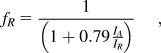
where f R is the weight fraction of the rutile and I R and I A are the integrated intensities of the rutile (110) and anatase (101) peaks, respectively.
The lattice constants (a and c) in anatase and rutile for the plasma-synthesized powders was evaluated from XRD with a slow scanning speed of 0.25°/2θ per min using mixed high-purity Si powders as an internal standard material according to the formulas given below:

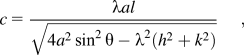
where (h,k,l) are the Miller indices, λ is the x-ray wavelength, and θ is the Bragg angle. The diffraction peaks of anatase [(101) and (004)] and rutile [(110) and (111)] were used due to their relatively strong diffraction intensities. The x-ray wavelength using nickel-filtered Cu Kα radiation was taken as 0.15405 nm.
Activation energy for anatase-to-rutile transformation in all the plasma-synthesized powders was estimated from the slope of the plot of the corrected natural log of the calculated rutile weight fraction as a function of the reciprocal of the heat treatment temperature as followsReference Ahmad, Buzby, Ni and Shah26:
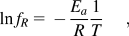
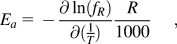
where E a is the activation energy for the phase transformation, T is the heat treatment temperature in Kelvin, R is the universal gas constant (8.314 J/mol K), and f R is the rutile weight fraction calculated from Eq. (1).
Ultraviolet–visible (UV–vis) spectra was made on a Jasco V-560 spectrophotometer (Jasco Corp.) using BaSO4 for baseline calibration. Band-gap energies (E g) were calculated from the UV–vis spectra according to the relationship between the absorption coefficient and incident photon energy for allowed indirect and direct transitions, respectively, given byReference Li, Ikeda, Tang, Moriyoshi, Hamanaka and Ishigaki33–Reference Hagfeldt and Gratzel35:
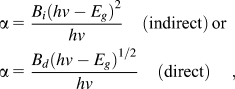

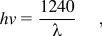
where α is the absorption coefficient, hv is the incident photon energy, B i and B d are the absorption constants for the indirect and direct transitions, respectively, and A is the absorption proportional to α. E g was obtained by extrapolating the linear parts of the curves in the plots of (Ahv)1/2 or (Ahv)2 versus hv.
Particle morphology was observed using field-emission scanning electron microscopy (FE-SEM) (model S-5000; Hitachi Ltd., Tokyo, Japan) and transmission electron microscopy (TEM) (JEM-2000 EX-II; acceleration voltage, 200 kV and JEM-4000 EX; acceleration voltage, 400 kV; JEOLLtd., Tokyo, Japan). Selected area electron diffraction patterns were acquired by JEM-2000 EX-II and high-resolution transmission electron microscopy (HRTEM) was conducted in JEM-4000 EX. Size distributions of particles were then determined from FE-SEM micrographs using an image analyzer software, with d 50 value taken as average particle size through counting at least 1000 particles in each case.
Specific surface area of the tested powders for photocatalytic performance was determined via Brunauer–Emmett–Teller analysis (Model Belsorp 18; Bell Japan Inc., Tokyo, Japan) with nitrogen chemisorptions at 77 K. Photocatalytic activity was evaluated by bleaching 20 μM of methyl orange (C14H14N3NaO3S, reagent grade; Wako Pure Chemical Industries Ltd, Osaka, Japan) solution containing the powder catalysts after ultrasonic dispersion under UV light irradiation at room temperature for 2 h. The UV light was generated by UVF–203S Type A light source (San-Ei Electric Co. Ltd; Osaka, Japan) with a composition of five wavelengths of 300, 316, 365, 405, and 436 nm and an intensity ratio of 40:82:100:39:30. The UV light was introduced through a light fiber to illuminate the suspension under agitation with a magnetic bar. The light intensity was adjusted to ∼1 mW/cm2 at the level of the suspension surface. After irradiation, the suspension was centrifuged at 12,000 rounds/min for 30 min using a centrifugal machine for separating the powders from the suspension. The supernatant solution was separated and centrifuged once more to remove the powders as thoroughly as possible. The relative concentration of methyl orange in the recovered solutions was determined by comparing the intensity of 465 nm absorption peak with that of the original methyl orange solution in UV–vis spectra. First of all, a blank test was made to indicate that the methyl orange solution in the absence of any photocatalyst almost had no photocatalytic performance.
III. RESULTS AND DISCUSSION
A. Non-equilibrium chemical composition and anatase phase selection
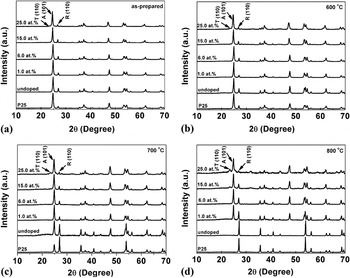
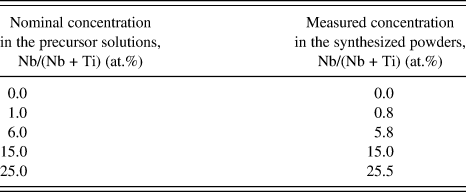
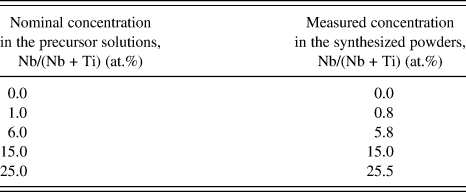
ICP-OES analysis results (Table II) confirmed that the nominal concentrations of Nb5+ in the precursor solutions have almost been retained in the resultant powders. Figure 1 shows XRD patterns of the plasma-synthesized Nb5+-doped TiO2 powders with various Nb5+ concentrations of 0–25.0 at.% (a) before heating, (b) after heating at 600 °C, (c) 700 °C, and (d) 800 °C. Well-defined diffraction peaks were observed for all the samples in Fig. 1(a) because of extremely high synthesis temperature (up to ∼15,000 K) in thermal plasma, which would save postannealing step frequently required to obtain good crystallinity in many wet-chemical processes for TiO2 synthesis.
XRD patterns of the P25 commercial and plasma-synthesized Nb5+-doped TiO2 powders at various temperatures: (a) before heating, (b) at 600 °C, (c) at 700 °C, and (d) at 800 °C. A, R, and T denote anatase, rutile, and TiNb2O7, respectively.

Elemental concentrations of Nb5+ in the plasma-synthesized Nb5+-doped TiO2 nanopowders.
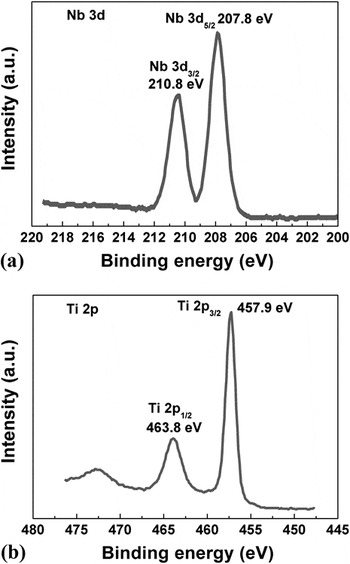
Oxidation states of niobium and titanium in the plasma-synthesized powders are demonstrated in high-resolution XPS spectra in Figs. 2(a) and 2(b), respectively, using the sample of 6.0 at.% of Nb5+ as an example. In Fig. 2(a), the featured peaks of Nb 3d5/2 and Nb 3d3/2 located at ∼207.8 and ∼210.8 eV, respectively, corresponding to the reported values for Nb5+ in Nb2O5.Reference Latta and Ronay36–Reference Qiu, Liu, Sun and Zhang38 In Fig. 2(b), Ti 2p peaks were found at ∼457.9 eV for Ti 2p3/2 and ∼463.8 eV for Ti 2p1/2 with a spin-orbital doublet splitting (Δ = Ti2p1/2-Ti2p3/2 = ∼5.9 eV), suggesting the presence of Ti in +4.Reference Zhang, Fung, Lin and Liao39, Reference Cho, Kim, Hwang, Jeong, Joh and Kim40 Both cases verify that the existences of Nb and Ti in the doped TiO2 powders as +5 and +4, respectively, have been retained from the precursor solutions due to the effective oxidizing atmosphere in the synthesis process. Considering the oxygen states of niobium and titanium, it can be simply understood that the dominant lattice defects in the Nb-doped TiO2 should not be the oxygen vacancies, V O, but interstitial oxygen, Oi, which was formed through a defect reaction:

High-resolution XPS spectra for (a) Nb 3d and (b) Ti 2p in the plasma-synthesized 6.0 at.% Nb5+-doped TiO2 powders.

where NbTi, and OO denote the niobium ions at titanium site and oxygen ions at oxygen sites, respectively, and symbols, •,x and ′ are the Kröger–Vink notations for the net charge +1, the zero net charge, and the net charge −1, respectively.Reference Kröger and Vink41
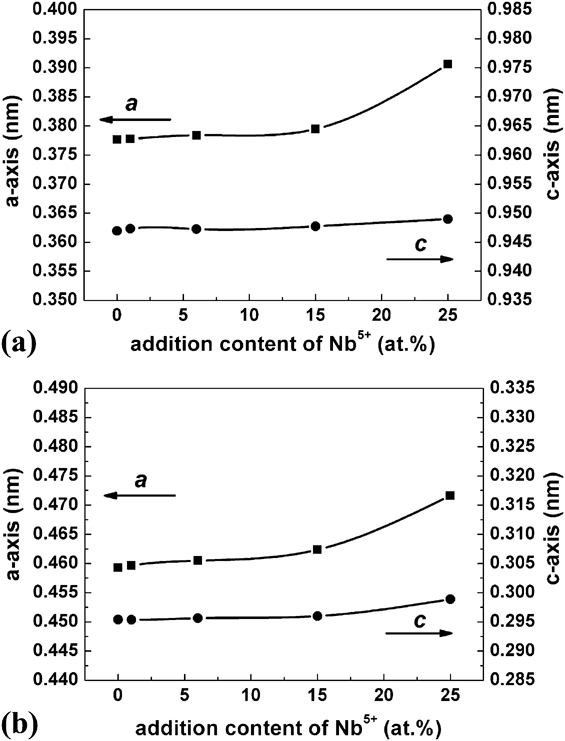
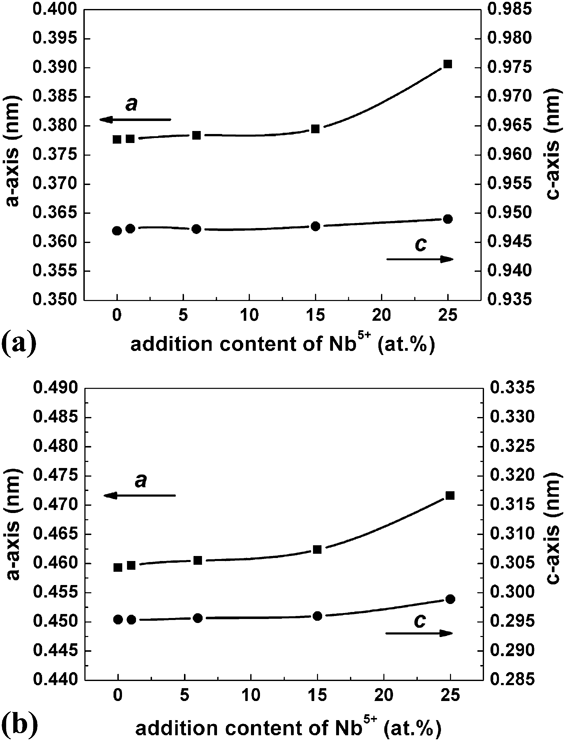
In Fig. 1(a), mixture polymorphs of anatase (JCPDS: No. 84-1286) and rutile (JCPDS: No. 78-2485) could be identified in all the cases. For the phase composition, the metastable anatase appeared as major phase, conforming to our previous theoretical analysis through the calculation on the critical free energy for nucleation,Reference Li and Ishigaki42 and the anatase composition was increased by the niobium doping. Moreover, in Fig. 1(a), relatively weak TiNb2O7 diffraction peaks (JCPDS: No. 77-1374) could be observed at 2θ = 23.9° in the case of 25.0 at.% of Nb5+ doping, indicating that the solubility of Nb5+ in the TiO2 host lattice was limited to ∼25.0 at.% in this work. Such a solubility is far higher than those prepared by wet-chemical methods, e.g., ∼10.0 at.% via sol–gel route synthesis by Ruiz et al.Reference Ruiz, Dezanneau, Arbiol, Cornet and Morante15, Reference Ruiz, Dezanneau, Arbiol, Cornet and Morante16 This may be conceivable from thermal plasma processing as a synthesis tool in this experiment, where synthesis temperature of ∼15,000 K ensured uniform doping reaction in evaporated state and high concentration of chemically reactive radicals effectively enhanced doping reactivity. To check the dissolubility of Nb5+ ions into the TiO2 host lattice, the lattice constants (a and c) in anatase and rutile in the plasma-synthesized powders doped with various concentrations of Nb5+ (0–25.0 at.%) were measured according to Eqs. (2) and (3) (Fig. 3). The evident change in the lattice constants of two phases at 25.0 at.% case implies that the solubility limit of Nb5+ in the TiO2 host lattice in this study may have been ∼25.0 at.%. Such a change might be caused by a radius slightly larger in Nb5+ (0.064 nm) than in Ti4+ (0.0605 nm)Reference Shannon43 or by the formation of some interstitial oxygen generally due to the valence discrepancy between Nb5+ and Ti4+.Reference Kamisaka, Hitosugi, Suenaga, Hasegawa and Yamashita44, Reference Nogawa, Hitosugi, Chikamatsu, Nakao, Hirose, Shimada, Kumigashira, Oshima and Hasegawa45 This implication of ∼25.0 at.% solubility of Nb5+ is consistent with the identification of the TiNb2O7 diffraction peaks at 25.0 at.% doping content in the XRD patterns [Fig. 1(a)].
Variations in the lattice constants (a and c) of (a) anatase and (b) rutile as a function of Nb5+ addition content.
The plasma-synthesized powders were recognized to possess the nonequilibrium chemical composition. The Nb5+ solubility was reduced to ∼15.0 at.% at 800 °C, which could be perceived from the appearance of TiNb2O7 diffraction peaks in Fig. 1(d), indicating that some Nb5+ ions were probably expelled out of the TiO2 host lattice at this temperature, with a suggestion that the Nb5+ solubility was affected by heating temperature. In addition, it can be clearly seen in Figs. 1(b)–1(d) that in the undoped TiO2 powders, the intensities of the anatase peaks decreased and those of the rutile peaks increased with the raising heating temperature from 600 °C to 800 °C, whereas in the plasma-synthesized Nb5+-doped TiO2 samples, the intensities of these two phases were not obviously altered by the heating temperature with the increase in doping content, suggesting phase transformation could be effectively inhibited by Nb5+ doping.
B. Elevated phase-transformation temperature
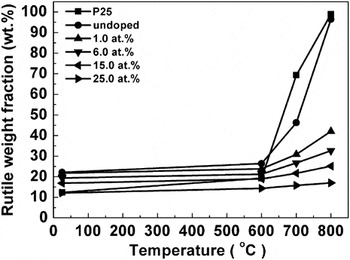
To further investigate the inhibition of anatase-to-rutile transformation as a function of Nb5+ doping, the variation in rutile weight fraction with heating temperatures was examined, as given in Fig. 4. Before heating, the rutile weight fractions of the plasma-synthesized powders were dependent on the Nb5+ addition content, attributable to the charge compensation for Nb5+ through the decrease in oxygen vacancies when Nb5+ ions were substituted into the TiO2 lattice,Reference Arbiol, Cerda, Dezanneau, Cirera, Peiro, Cornet and Morante23 as the formation of rutile was strongly dominated by the number of oxygen vacancies in the TiO2 lattice.Reference Akhtar, Pratsinis and Mastrangelo46 After heating, the increased tendency of the rutile fraction became slower with increasing Nb5+ concentration. The rutile weight fraction of the undoped TiO2 calculated from Eq. (1) increased sharply from 22.1 wt% (at 600 °C) to 96.4 wt% (at 800 °C), while that of 25.0 at.% Nb5+-doped TiO2 enhanced slightly just from 16.8 wt% (at 600 °C) to 25.1 wt% (at 800 °C), indicating that the anatase-to-rutile transformation could be effectively hindered by the Nb5+ doping.
Variation in the rutile weight fraction of the P25 commercial and plasma-synthesized Nb5+-doped TiO2 powders after heating.

Shannon et al.Reference Shannon and Pask9 have found that the phase transformation from anatase to rutile occurring at the surface of bulk anatase was correlated with the high tangential diffusion of anatase nanocrystals, which has later been deduced through molecular dynamics simulations by Ogata et al.Reference Ogata, Iyetomi, Tsuruta, Shimojo, Nakano, Kalia and Vashishta47 Therefore, the inhibition of the phase transformation through the Nb5+ doping at the high temperatures in this work might be attributed to the formation of strong Nb-O-Ti bonds that impeded the movement of Ti atoms at the surface of anatase to restrain the phase transformation to rutile. Moreover, there is another factor that influences the phase transformation: as the number of oxygen vacancies acting as nucleation sites for forming rutile transformed from anatase,Reference Hishita, Mutoh, Koumoto and Yanagida48 the smaller number of oxygen vacancies especially at 25.0 at.% Nb5+-doped sample resulting from the introduction of Nb5+ into the TiO2 host lattice via thermal plasma synthesis, as already stated as the reason for the less rutile weight fraction, should be responsible for the decrease in the number of nucleation sites for the phase transformation at the high temperatures.
In our previous works, we synthesized the doped TiO2 nanoparticles by Ar/O2 thermal plasma processing using the dopants of Fe3+,31 Eu3+,4 Er3+,49 and Co2+.Reference Li, Buechel, Isobe, Mori and Ishigaki5 For all the doped samples, the rutile fraction in the plasma-synthesized powders was increased steadily with the doping concentration. Based on the study of Vemury and PratsinisReference Vemury and Pratsinis50 on the effect of a dopant on the phase structure of TiO2 powders obtained via flame pyrolysis, who found that the rutile formation was enhanced by creating the oxygen vacancies in the gas clusters by doping with subvalent cations such as Al3+, the introduction of metal cations of Fe3+, Eu3+, Er3+, and Co2+ having lower chemical valence than Ti4+ into the TiO2 host lattice via thermal plasma processing, which has similarities to the flame pyrolysis approach, gave rise to creation of oxygen vacancies for charge compensation in the TiO2 gas clusters at the high temperature of thermal plasma and therefore promoted the rutile formation. Moreover, Barakat and ShahReference Barakat, Hayes and Shah51 reported that the ratio of rutile to anatase was raised with increasing Co2+ doping concentration at the same annealing temperature. This indicates that the formed oxygen vacancies resulting from the charge discrepancy between Co2+ and Ti4+ should be responsible for the inferior stability of the phase transformation by acting as nucleation sites for the rutile crystallization. In contrast, in our study, the formation of the oxygen vacancies as the rutile nucleation sites were inhibited by the Nb5+ doping into the TiO2 host lattice, due to the contribution of charge compensation from the higher chemical valence of Nb5+ than that of +4, therefore, resulting in the better stability of the anatase-to-rutile phase transformation compared to the cases stabilized with the other dopants with lower chemical valence when heating at high temperature. Such result is consistent with the finding reported by Guidi et al.,Reference Guidi, Carotta, Ferroni, Martinelli and Sacerdoti24 that is, for the doped TiO2 samples prepared by spray pyrolysis, in the temperature range of 750–850 °C, Ga3+-doped titania featured a transformation of 75% anatase to rutile, whereas the percentage of conversion was about 45% for Nb5+-doped samples.
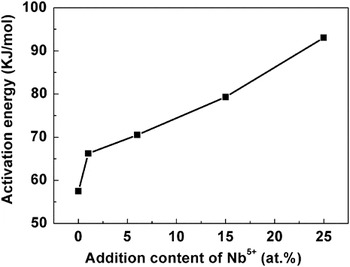
Besides, in contrast to the rutile weight fractions (42.7 wt% at 700 °C and 87.1 wt% at 800 °C) in 1.0 at.% Nb5+-doped TiO2 via sol–gel synthesis by Ahmad et al.,Reference Ahmad, Buzby, Ni and Shah26 the counterparts with the same Nb5+ doping concentration via thermal plasma synthesis in this study of 30.8 wt% at 700 °C and 42.0 wt% at 800 °C, are appreciably lower than them. In the Nb-doped TiO2 sensing films with a wide range of Nb contents (0–10 at.%) synthesized using the sol–gel route by Ruiz et al.Reference Ruiz, Dezanneau, Arbiol, Cornet and Morante15 at calcination temperature of 700 °C, the conversion efficiency of anatase-to-rutile transformation is 14% at doping concentration of 6.0 at.%, which was considered to make the saturated effect on the phase transition, namely, the percentage of phases was very similar at each calcination temperature owing to the TiNb2O7 formation at content of higher than 6 at.%. In comparison with this case, the plasma-synthesized 6.0 at.% Nb5+-doped TiO2 powders in this work, under the same heating temperature of 700 °C, the conversion efficiency of the phase transformation is just 7.3% (from 19.4 wt% in the as-prepared sample to 26.7 wt% in the 700 °C-heated one, as demonstrated in Fig. 4), which is less than 14% of the phase conversion efficiency in the Nb-doped TiO2 films. This indicates that the incorporation of Nb into TiO2 lattice upon the thermal plasma technique probably yielded more homogeneous doping distribution through the reaction in the evaporated state than upon the sol–gel synthesis due to the extremely high synthesis temperature of ∼15,000 K of the thermal plasma. Furthermore, such conversion efficiency is 3.7% at high Nb doping addition of 25.0 at.% (Fig. 4), indicating that more effective stability on anatase phase when heating at high temperature can be achieved by doping high concentration of Nb using the thermal plasma processing. For the comparison with Degussa P25 commercial powder (Nippon Aerosil, Tokyo, Japan), XRD patterns [Figs. 1(a)–1(d)] in conjunction with Raman spectra [Figs. 6(a)–6(d)] unambiguously reveal that the anatase composition was decreased with raising heating temperature by identifying the relative intensities of the anatase and rutile peaks. Especially, at 800 °C, most of the anatase in the P25 powder was transformed to the rutile upon the heating treatment, quite like the case in the undoped TiO2 powder. In contrast, such phase transformation in the Nb-doped TiO2 powders is not readily to be discerned. This suggests that the anatase stability is poor in both the powders of P25 and undoped TiO2 when heating at the high temperature. Through the calculation of the rutile weight fraction in the phase composition (Fig. 4), it was found that the rutile weight fraction of the P25 powder was appreciably increased from 12.3 wt% as as-received powder to 98.9 wt% after heating at 800 °C, with a conversion efficiency of 86.6%, which is slightly higher than 73.9% in the undoped TiO2, but is far less than 4.9% in the 25.0 at.% Nb5+-doped TiO2. This is indicative of the fact that high-concentration Nb doping into TiO2 can significantly improve the anatase stability, despite being treated at high temperature, which is also evidenced by their discrepant activation energies, calculated from Eqs. (4) and (5), of the phase transformation of 58 KJ/mol for the undoped sample and 93 KJ/mol for 25.0 at.% Nb5+-doped TiO2 in Fig. 5. The enhanced activation energy with increasing Nb5+ concentration indicates that the higher the Nb5+ content was, the higher the temperature required for completing the transformation. Although the accuracy of the calculation of activation energy was not high, due to relatively few heating temperatures (three temperatures: 600, 700, and 800 °C) in this work, a tendency of the increase in the activation energy with the addition of Nb5+was still found. In this case, heavier Nb5+ doping made such a transformation more difficult to progress upon breaking Nb–O–Ti bond.
Activation energy for the anatase-to-rutile transformation in the plasma-synthesized Nb5+-doped TiO2 powders as a function of Nb5+ addition content.

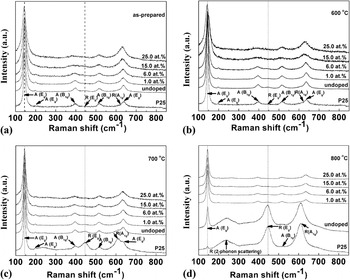
Raman spectra of the P25 commercial and plasma-synthesized Nb5+-doped TiO2 powders at various temperatures: (a) before heating, (b) at 600 °C, (c) at 700 °C, and (d) at 800 °C. A and R denote anatase and rutile, respectively. Characteristic Raman bands of A (E g) and R (E g) are marked with dashed lines.

Figure 6 exhibits Raman spectra of the plasma-synthesized Nb5+-doped TiO2 samples with various Nb5+ concentrations of 0–25.0 at.% (a) before heating, (b) after heating at 600 °C, (c) 700 °C, and (d) 800 °C. Because the structures of anatase and rutile of TiO2 are very sensitive to Raman scattering, Raman spectra can provide valuable characterization information upon the phase composition of the samples. Figure 6(a) shows that all the powders synthesized by thermal plasma were composed of mixture polymorphs of main-phase anatase and rutile on the basis of the fundamental vibrational modes,Reference Zhang, Chan, Porter and Guo52 as indicated in the Raman spectra, which are in good agreement with the identification in the XRD patterns [Fig. 1(a)], but the presence of TiNb2O7 Raman band was overlapped by strong TiO2 Raman bands due to its quite weak scattering intensity. Among these fundamental vibrational modes, two Raman bands A(E g) (∼145 cm−1) for anatase and R(E g) (∼446 cm−1) for rutile, as indicated by dashed lines in the spectra, are frequently used to characterize the variation in phase composition.Reference Parker and Siegel53 Thus, in the sequence from Figs. 6(b) to 6(d), the intensities of the characteristic A(E g) modes for anatase in the undoped TiO2 reduced and those of the R(E g) modes for rutile enhanced when heating temperature was elevated from 600 to 800 °C, whereas those in the Nb5+-doped TiO2 were not appreciably altered especially for the case of high doping concentration of 25.0 at.% at the same condition. This is also consistent with the result in the XRD analysis very well [Figs. 1(b)–1(d)], indicating that the phase transformation could be effectively inhibited by the Nb5+ doping.
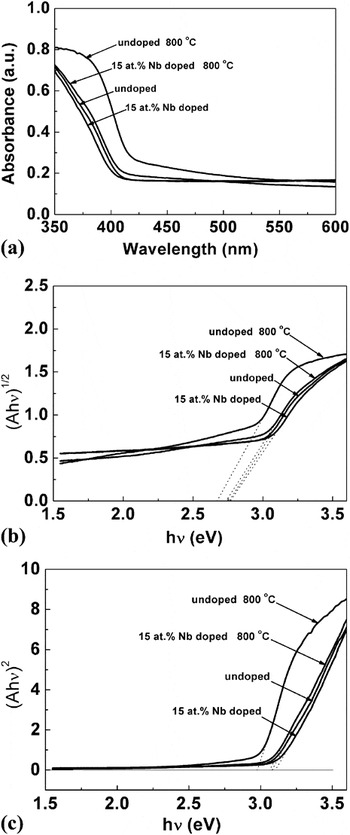
Figure 7(a) shows the absorption spectra of the undoped and 15.0 at.% Nb5+-doped TiO2 powders before and after heating at 800 °C, as representative cases for comparison. From this figure, it is hard to distinguish any obvious difference between the absorption onsets of these two powders before heating, but there is an obvious difference between them after heating at 800 °C, that is, the absorption onset in the undoped sample after heating occurred unambiguously redshift compared with that in the case of 15.0 at.% Nb5+ doping, suggesting that the Nb5+ doping prevented the band gap (E g) of TiO2 from narrowing after heating. Consequent evidence for this suggestion can be found in Figs. 7(b) and 7(c), which show the indirect and direct E g estimated from the UV–vis spectra [Fig. 7(a)] according to Eqs. (6)–(8), respectively. Semiconductors are classified as direct or indirect according to the lowest allowed electronic transition. The direct semiconductors are characterized by the minimum of the lowest conduction band positioned in k space directly under the maximum of the highest valence band, whereas for the indirect semiconductors, the minimum of the lowest conduction band is shifted relative to the maximum of the highest valence band and the lowest-energy interband transition must then be accompanied by phonon excitation.Reference Serpone, Lawless and Khairutdinov54 Even though TiO2 has generally been known to be an indirect semiconductor,Reference Kormann, Bahnemann and Hoffmann55–Reference Yu, Yu, Ho and Jiang57 both the indirect and direct interband transitions can occur simultaneously under irradiation with sufficient energyReference Daude, Gout and Jouanin58 and can be distinguished by their energy dependence of the optical absorption edge,Reference Hagfeldt and Gratzel35 as expressed by Eqs. (6)−(8) for E g estimation. The verification of the estimation accuracy has previously been preceded by using Degussa P25 TiO2 powder.Reference Li, Yang and Ishigaki59 The equations mentioned above have been used in our previous work of the Fe3+-doped TiO2 nanopowders synthesized in thermal plasma, with the mixture polymorphs of anatase and rutile, to estimate the indirect and direct band gap energies, respectively.Reference Wang, Li, Kamiyama, Katada, Ohashi, Moriyoshi and Ishigaki31 The estimated results in this work are presented in Fig. 7(b) for the indirect transition and in Fig. 7(c) for the direct transition. For the indirect band gap, E g of the undoped TiO2 was narrowed to ∼2.67 eV after the heating from ∼2.76 eV before the heating, with ΔE g = ∼−0.09 eV, and the variation of that in the 15.0 at.% Nb5+-doped TiO2 was ∼−0.03 eV, ΔE g = ∼2.74–∼2.77 eV, whereas for the direct band gap, after the thermal treatment, such E g variation (ΔE g) for the undoped sample was ∼−0.10 eV (from ∼3.09 to ∼2.99 eV) and the narrowed E g for the 15.0 at.% Nb5+-doped case was ∼3.07 eV, with ΔE g = ∼−0.03 eV (from ∼3.10 to ∼3.07 eV). The evaluations of the E g variation for the indirect and direct interband transitions claimed that the Nb5+ doping made a contribution in the band gap preservation for the TiO2 host lattice when being thermally heated. The probable explanation for the narrowing prevention of the band gap resulting from Nb5+ doping is that, when Nb5+ was introduced into TiO2 host lattice, the adjacent NbTi–VO and NbTi–Oi structures induced impurity states in the band gap and the Nb atom could stabilize the impurity state.Reference Kamisaka, Hitosugi, Suenaga, Hasegawa and Yamashita44 In this case, the stabilized impurity state might be responsible for the band gap preservation from heating.
UV–vis absorption spectra of the undoped and 15.0 at.% Nb5+-doped TiO2 powders synthesized via (a) the thermal plasma processing before and after heating at 800 °C, correspondingly estimated (b) indirect and (c) direct band gap energies (E g).

C. Variation in particle morphology
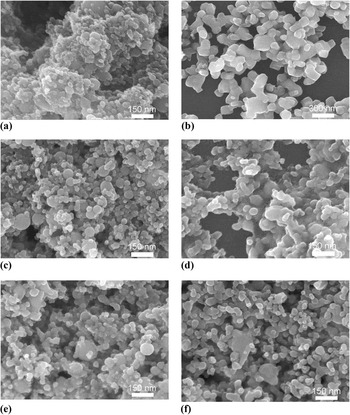
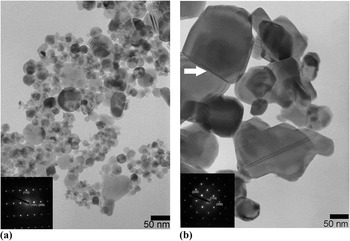
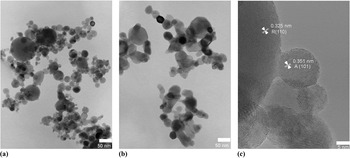
FE-SEM observation of particle morphologies of some plasma-synthesized powders as typical cases before and after heating are illustrated in Fig. 8 for comparison: (a) undoped TiO2, (b) undoped TiO2 at. 800 °C, (c) 15.0 at.% Nb5+-doped TiO2, (d) 15.0 at.% Nb5+-doped TiO2 at 800 °C, (e) 25.0 at.% Nb-doped TiO2, and (f) 25.0 at.% Nb5+-doped TiO2 at 800 °C. In the plasma-synthesized samples before heating [Figs. 8(a), 8(c), and 8(e)], a majority of nanosized particles (several nanometers) assumed faceted shape and a small proportion of submicrometer ones (∼100 nm) appeared as rough sphere. Such a characteristic morphology was more readily perceived from the TEM micrographs of the undoped and 15.0 at.% Nb5+-doped TiO2 samples in Figs. 9(a) and 10(a). The possible particle formation pathways for the morphology are as follows: the fine particles were produced via a gas–solid course, whereas the large ones were formed via a gas–liquid–solid route. In addition, there exists an interesting morphology in the 15.0 at.% Nb5+-doped TiO2 [Fig. 10(c)]: a small anatase nanocrystal was found to use a shared surface with a large rutile particle by identifying d space from HRTEM observation of individual particle, which has seldom been reported for solution-based methods. This intergrown morphology confirms that small anatase crystals should be formed in a rapid cooling process while large rutile particles should be created in a less cooling condition, which is conforming to the our previous thermodynamic analysis of nucleation of anatase and rutile from TiO2 melt.Reference Li and Ishigaki42 In contrast, it should be noted that this intergrown morphology is different from the case of the separated rutile structure in the approximately parallel lamellae of the crystallographic shear (CS) planes in Fe3+-doped TiO2 via thermal plasma synthesis.Reference Wang, Li, Kamiyama, Katada, Ohashi, Moriyoshi and Ishigaki31 In the case of Fe3+ doping, the intergrown morphology is attributed to the concentrated oxygen deficiencies originating from Fe3+ addition within these CS planes when atomic ratio (R Fe/Ti) reached a maximum value of 2%. On the other hand, in this study, the oxygen vacancies as deficiencies was reduced by charge compensation owing to Nb5+ doping, as proved by the estimation of rutile weight fraction (Fig. 4), causing little possibility of the formation of concentrated oxygen deficiencies.
FE-SEM micrographs showing the overall morphologies of some plasma-synthesized Nb5+-doped TiO2 powders: (a) 0 at.% of Nb5+, (b) 0 at.% of Nb5+ at 800 °C, (c) 15.0 at.% of Nb5+, (d) 15.0 at.% of Nb5+ at 800 °C, (e) 25.0 at.% of Nb5+, and (f) 25.0 at.% of Nb5+ at 800 °C.

TEM micrographs showing the morphology of the plasma-synthesized undoped TiO2 powders: (a) before heating and (b) after heating at 800 °C. Electron-diffraction patterns for individual anatase and rutile crystals are exhibited in the insets, respectively. White arrow indicates sintering between two particles.

TEM micrographs showing the morphology of the plasma-synthesized 15.0 at.% Nb5+-doped TiO2 powders: (a) before heating, (b) after heated at 800 °C, and (c) HRTEM lattice fringes of individual anatase and rutile particles.

After heating at 800 °C, the particle morphologies of these samples underwent significant changes, as seen in Figs. 8(a)–8(f). Some apparent sintering trace among particles occurred after heating the undoped TiO2 powders [Fig. 8(b)] with appreciable grain growth from d 50 = 33 nm before heating to d 50 = 75 nm after heating, as seen from their size distributions in Figs. 11(a) and 11(b). TEM observation [Fig. 9(b)] unambiguously revealed the occurrence of sintering phenomenon between two particles (indicated by a white arrow) in the undoped TiO2 powders. On the other hand, at the same heating temperature, in the 15.0 at.% Nb5+ case, the intergranular sintering was weak [Figs. 8(d) and 10(b)] and the variation in crystallite size was merely from d 50 = 55 nm to d 50 = 61 nm [Figs. 11(c) and 11(d)], and particularly, this variation in 25.0 at.% Nb5+ sample was held almost invariable [(d 50 = 60 nm before heating and d 50 = 61 nm after heating, Figs. 11(e) and 11(f)]. According to the findings of Sharma et al.,Reference Sharma and Bhatnagar60 substitutional Nb5+ could induce slight stress in the TiO2 lattice as a result of the slightly bigger ionic radius of Nb5+ (0.064 nm) than that of Ti4+ (0.0605 nm) to hinder the crystallite growth upon heating as a contribution from Nb5+ doping. The induced slight stress caused by Nb5+ substitution should be raised with the doping concentration, which is responsible for significant effect of the high doping concentration of 25.0 at.% on the growth inhibition.
Size distributions of the plasma-synthesized Nb5+-doped TiO2 powders: (a) 0 at.% of Nb5+, (b) 0 at.% of Nb5+ at 800 °C, (c) 15.0 at.% of Nb5+, (d) 15.0 at.% of Nb5+ at 800 °C (e) 25.0 at.% of Nb5+, and (f) 25.0 at.% of Nb5+ at 800 °C.

D. Photocatalytic stability
For the photocatalytic measurement, we used the P25 commercial powder, which has been a standard material in the field of the photocatalytic reactions, and plasma-synthesized powders of undoped and 25.0 at.% Nb5+-doped TiO2 as catalyst. The photocatalytic performance is a delicate function of many factors, among which specific surface area plays an important role in the migration survival from the crystallite interior to surfaces for free h+/e–.Reference Hoffmann, Martin, Choi and Bahnemann61 Thus, to exclude the effects of specific surface area, the surface area of all the tested powders was set as 0.125 m2 by varying the sample weight, according to their specific surface areas for P25 (~50 m2/g), undoped TiO2 (~46 m2/g), and 25.0 at.% Nb5+-doped TiO2 (~25 m2/g). Figure 12 shows relative concentration variation of the methyl orange using the catalysts of P25, undoped, and 25.0 at.% Nb5+-doped TiO2 powders after UV irradiation for 2 h as a function of heating temperature (600–800 °C), revealing the influence of the heat treatment on their photocatalytic performance. It was found that although the as-received P25 commercial powder has the superior photocatalytic performance to the as-prepared 25.0 at.% Nb5+-doped TiO2 powder, the performance of the P25 powder after being thermally treated at 600–800 °C decayed quite sharply, which could also be disclosed similarly for the undoped case after the treatment. On the other hand, by unambiguous comparison, 25.0 at.% Nb5+-doped sample retained its photocatalytic activity almost invariably, even though being heated at the high temperature. At 800 °C, the doped sample even possessed better performance than both the powders of P25 and undoped. This implies that the high Nb doping concentration saved the photocatalytic property from the influence of the thermal treatment, which is mainly understood from the advantage of anatase phase stability, as shown in Fig. 4. It has been known that the anatase is more active in the photocatalysis, which is probably ascribed to higher Fermi level and less surface hydroxylation.Reference Tanaka, Capule and Hisanaga13, Reference Bickley, Gonzalezcarreno, Lees, Palmisano and Tilley62 Therefore, high stability of the anatase after heat treatment is of importance to the photocatalytic performance.
Relative concentration variation of the methyl orange using the catalysts of P25, undoped, and 25.0 at% Nb5+-doped TiO2 powders after UV irradiation for 2 h as a function of heating temperature (600–800 °C).

IV. CONCLUSIONS
Nb (V)-doped TiO2 nanopowders have been synthesized via Ar/O2 RF thermal plasma oxidation mist precursor solutions, with doping concentrations (solubility) as high as ∼25.0 at.%. All the plasma-synthesized powders comprised mixture polymorph of anatase (major phase), ∼80 mass%, and rutile, whereas higher Nb5+ contents could effectively inhibit anatase-to-rutile transformation and preserve the band gap of TiO2 under high temperature. At high temperatures, Nb5+ doping could play an important role not only in restraining nanoparticle growth but also in avoiding binding between crystallites. High doping concentration (25.0 at.%) saved the photocatalytic performance from the influence of thermal treatment, mainly due to its advantage of anatase phase stability. This work might be an exploration in understanding TiO2 doped with other transition metal elements and might find the potential applications for TiO2 semiconductor materials in some high-temperature working environments.
ACKNOWLEDGMENTS
The authors are grateful to our colleagues at NIMS, Mr. Yoshiyuki Yajima and Mr. Satoshi Takenouchi, for their chemical analysis of the synthesized nanosized powders. This work was partially supported by KAKENHI, a Grant-in-Aid for Scientific Research (B 19360334) from the Japan Society for the Promotion of Science.