Coronavirus 2019 disease (COVID-19) is an ongoing global health challenge and is responsible for >2.5 million deaths worldwide. 1 The World Health Organization (WHO) describes the clinical criteria for a suspected case of COVID-19 as acute onset of fever and cough or acute onset of any 3 of the following symptoms: fever; cough; general weakness or fatigue; headache; myalgia; sore throat; coryza; dyspnea; anorexia, nausea, and/or vomiting; diarrhea; and/or altered mental status. 2 Similarly, the case definition of influenza-like illness, according to the WHO, is “an acute respiratory illness with a measured temperature of ≥38°C and cough, with onset in the past 10 days.” Reference Fitzner, Qasmieh and Mounts3 We evaluated the demographics, clinical history, physical findings, and comorbidities of patients with influenza and patients with COVID-19 to determine the most likely profile that may aid in differentiating between the 2 diseases.
Methods
We conducted retrospective chart review of hospitalized patients with confirmed influenza or COVID-19 between January 1, 2020, and April 2, 2020. In total, 100 charts were identified for each group based on billing codes for influenza and COVID-19. Data collected from the electronic medical record included results of severe acute respiratory coronavirus virus 2 (SARS-CoV-2) testing, rapid influenza testing, and respiratory virus panel testing; demographic information including age, sex, and race; comorbidities as included in the Charlson weighted index of comorbidity (CWIC) Reference Charlson, Pompei and Ales4 ; history, including the presence or absence of headache, myalgia, cough, fever, dyspnea, sore throat, nausea/vomiting, diarrhea, and backache; social history, including smoking and vaping; laboratory data, including serum creatinine, aspartate aminotransferase (AST), alanine aminotransferase (ALT), albumin, hemoglobin, creatinine phosphokinase (CPK), troponins, C-reactive protein (CRP), D-dimer, red blood-cell count (RBC), white blood count (WBC), lymphocyte counts, and neutrophil count; and data on medications including angiotensin converting enzyme inhibitors; angiotensin receptor blockers, macrolides, and nonsteroidal anti-inflammatory drugs. This study was approved by the Ascension St. John Hospital Institutional Review Board.
Data analysis
Patients with COVID-19 and influenza coinfection and patients without a positive test for either were excluded from the final analysis. Descriptive statistics were calculated to characterize the study groups. Continuous variables were summarized using the mean with standard deviation or median with range. Categorical variables were described as frequency distributions. Differences between groups were assessed using the Student t test and χ2 analysis. The multivariable analysis was done using logistic regression. Certain laboratory values, such as D-dimer and ferritin, could not be used in the regression model because the number of patients with data was limited. All data were analyzed using SPSS version 27.0 software (IBM, Armonk, NY) and a P value < .05 was considered statistically significant.
Results
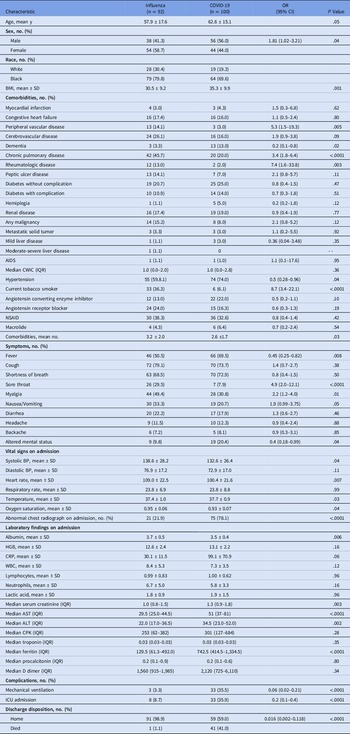
The final group included 192 patients: 100 COVID-19 patients and 92 influenza patients. As shown in Table 1, patients with COVID-19 were older (P = .05) and had higher body mass indexes (BMIs; P = .001). COVID-19 patients had higher rates of dementia (P = .02) and hypertension (P = .04) but had lower rates of chronic pulmonary disease (P < .0001), rheumatologic disease (P = .003), and peripheral vascular disease (P = .005). Influenza patients were 7 times more likely to be smokers (P < .001).
Univariable Analysis of Demographics, Comorbid Conditions, Presenting Symptoms, Vital Signs, Laboratory and Radiological Findings

Note. OR, odds ratio; CI, confidence interval; IQR, interquartile range; ICU, intensive care unit; HGB, hemoglobin; BMI, body mass index; SD, standard deviation; AIDS, acquired immunodeficiency syndrome; CWIC, Charlson weighted index of comorbidity; BP, blood pressure; AST, aspartate aminotransferase; ALT, alanine aminotransferase; CRP, C-reactive protein; CPK, creatinine phosphokinase; NSAID, nonsteroidal anti-inflammatory drug.
COVID-19 patients were more likely to present with fever (P = .008) and altered mental status (P = .04). Influenza patients were more likely to report myalgia (P = .01), sore throat (P < .0001) and nausea and/or vomiting (P = .05). We detected no significant difference in the 2 groups regarding the reported prevalence of cough, dyspnea, diarrhea, headache, or backache.
The mean temperature was higher in COVID-19 patients (P = .03). The mean systolic blood pressure (P = .04), pulse (P = .007), and oxygen saturation (P = .04) were lower in the COVID-19 group. The mean respiratory rate did not differ between the 2 groups. COVID-19 patients had a higher mean CRP (P < .0001) and higher median serum creatinine (P = .003), AST (P < .0001), ALT (P = .003), and ferritin (P < .0001). We detected no differences between the 2 groups in mean WBC count, lymphocyte count, or neutrophil count.
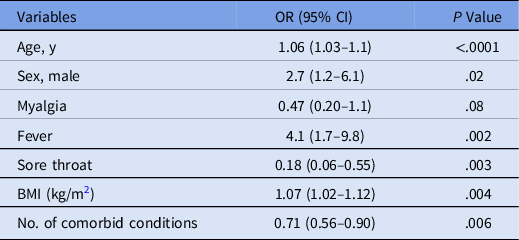
Variables initially entered into the logistic regression model included age, sex, myalgia, fever, sore throat, systolic blood pressure, nausea/vomiting, BMI, altered mental status, serum creatinine, and number of comorbidities. After controlling for age, male patients were 2.7 times more likely to have COVID-19, and patients reporting fever were 4.1 times more likely to have COVID-19. For each 1-unit increase in BMI, the odds of COVID-19 increased by 7.1%. Patients with myalgia were 2.1 times more likely to have influenza, and patients reporting a sore throat were 5.6 times more likely to have influenza. As the number of comorbidities increased, the risk of influenza increased 41% (Table 2).
Multivariable Prediction of COVID-19 Versus Flu

Note. OR, odds ratio; CI, confidence interval; BMI, body mass index.
Discussion
Considering the increasingly popular theory that COVID-19 will likely become seasonally endemic similar to influenza, it may be beneficial for clinicians differentiate between these 2 diseases based on clinical presentation. This differentiation may be particularly relevant when hand hygiene and masking are less frequent and endemic influenza may reappear. Our data suggest that patients presenting with acute respiratory illness may be more likely to have COVID-19 if they are male, older, obese, and/or present with fever. Similarly, patients presenting with sore throat and myalgia may be more likely to be presenting with influenza.
Throughout the pandemic, clinicians have considered lymphopenia to be indicative of COVID-19. Our study showed no significant difference in the lymphocyte, neutrophil, or WBC counts between the 2 groups. This finding suggests that lymphopenia is not specific to COVID-19 and, therefore, would not aid in differentiating between COVID-19 and influenza.
The COVID-19 group had significantly lower oxygen saturation but without a difference in dyspnea or respiratory rate compared with the influenza group. This finding suggests that hypoxemia may be more useful in distinguishing COVID-19 from influenza. Notably, influenza patients were more likely to be smokers and to have chronic pulmonary disease, suggesting that COVID-19 may have different mechanisms of inducing hypoxemic respiratory failure than influenza.
Although gastrointestinal symptoms are considered consistent with COVID-19, they were less common in COVID-19 compared to influenza. However, Pormohammad et al Reference Pormohammad, Ghorbani and Khatami5 published a meta-analysis comparing studies of COVID-19 to studies of influenza, which found diarrhea to be associated more with COVID-19 than with influenza. Studies directly comparing influenza and COVID-19 were not present in the meta-analysis. This finding suggests that factors relating to specific populations may affect the prevalence of gastrointestinal symptoms in COVID-19, influenza, or both. Reference Pormohammad, Ghorbani and Khatami5
Our study has several limitations. It was a small, single-center study, making it difficult to generalize results to populations different from the study population. Additionally, this study included only hospitalized patients. Further studies are needed to compare symptoms in patients who did not require hospitalization.
Finally, we were unable to evaluate for differences in anosmia and dysgeusia because these data were unavailable from the influenza group. One similar study of a small cohort of patients in France demonstrated that anosmia and dysgeusia are common among COVID-19 patients. Reference Zayet, Kadiane-Oussou and Lepiller6 Data regarding these symptoms, however, were missing from a larger meta-analysis comparing studies of influenza to studies of COVID-19. Reference Pormohammad, Ghorbani and Khatami5 Further studies are needed to determine whether anosmia and dysgeusia are specific to COVID-19.
In conclusion, for patients with symptoms of respiratory viral illness who require hospitalization, distinguishing between influenza and COVID-19 may be difficult. Our study demonstrates that clinical presentation and demographic information may be useful in making this distinction for patients that require hospitalization.
Acknowledgments
We would like to thank the Department of Internal Medicine and the Division of Infectious Disease at Ascension St. John Hospital for their tireless work throughout the pandemic and for their support on this project.
Financial support
No financial support was provided relevant to this article.
Conflicts of interest
All authors report no conflicts of interest relevant to this article.