Introduction
Although anxiety disorders are among the most prevalent mental disorders among older adults (Flint, Reference Flint1994), randomized controlled trials of treatment effectiveness for late-life anxiety are scarce and have focused primarily on the effectiveness of psychotherapeutic interventions, more specifically, of cognitive behavioral therapy (CBT; Mohlman, Reference Mohlman2004). Recently, our research group completed the first randomized controlled trial (RCT) of the effectiveness of individual format CBT versus an SSRI (sertraline) for the treatment of late-life anxiety disorders (Schuurmans et al., Reference Schuurmans2006). Although both treatments resulted in statistically significant improvement in outcome scores, effect sizes (Cohen's d, calculated as (Mpre-treatment – Mpost-treatment)/standard deviationpooled; Cohen, Reference Cohen1988) for CBT were relatively small (post-treatment mean d = 0.34), whereas effect sizes for sertraline were in the large range (post-treatment mean d = 1.00). This is in concordance with a recent meta-analytic comparison of psychological versus pharmacological interventions for late-life anxiety (Pinquart and Duberstein, Reference Pinquart and Duberstein2007), which concluded that the available studies indicate that pharmacotherapy shows larger average treatment effects than psychological interventions. However, follow-up measurements for our RCT were restricted to a three-month follow up. This is quite a short period, considering the fact that mixed-age population studies of CBT tend to find that CBT has enduring effects that reduce the risk for symptom return after termination of treatment. A similar effect is not found for treatment with an SSRI: after discontinuation of treatment, most patients eventually experience recurring anxiety symptoms (Hollon et al., Reference Hollon, Stewart and Strunk2006).
As yet, there have been no systematic studies investigating prognostic factors for the outcome of CBT for late-life anxiety. Treatment studies of late-life anxiety to date have primarily included older adults who are relatively young, well educated, and physically healthy (Stanley et al., Reference Stanley2009). It has been implied that this fact might have led to an overestimation of treatment effect in the available studies to date, and that CBT might be considerably less effective in the older old, the less educated and frail elderly. Since cognitive functions are assumed to deteriorate with age, and acquisition of new skills is an assumed prerequisite for the effectiveness of CBT (Mohlman, Reference Mohlman2005), it is possible that the “older old” (commonly defined as those aged 75 years and over) would benefit less from CBT. In summary, age, educational level and health factors are believed to have an impact on treatment effect in anxious older adults. However, this hypothesis awaits scientific testing. Neuroticism was found to be predictive of a detrimental naturalistic long-term outcome of anxiety disorders in older adults by our research group (Schuurmans et al., Reference Schuurmans2005). For the present study, we hypothesized that neuroticism might also affect treatment outcome for late-life anxiety disorders.
In mixed-age populations, studies on the prediction of treatment outcome for anxiety disorders are relatively scarce and often provide conflicting results. Documented predictors of a less favorable outcome of psychological interventions for anxiety in mixed-age populations include a longer duration of illness (Scheibe and Albus, Reference Scheibe and Albus1997), older age (Scheibe and Albus, Reference Stein, Montgomery, Kasper and Tanghoj1997), initial severity of anxiety (e.g. Seivewright et al., Reference Seivewright, Tyrer and Johnson1998), agoraphobic avoidance (e.g. Scheibe and Albus, Reference Stein, Montgomery, Kasper and Tanghoj1997), pre-treatment depression (e.g. Scholing and Emmelkamp, Reference Scholing and Emmelkamp1999) and certain personality dimensions or disorders (e.g. Scholing and Emmelkamp, Reference Stewart, Hays and Ware1999). Documented predictors of a less favorable outcome of drug treatment for anxiety in younger and mixed-age populations seem to be similar to some extent, including such factors as higher levels of symptom severity (Solvason et al., Reference Solvason, Ernst and Roth2003), a longer duration of symptoms (e.g. Slaap and den Boer, Reference Slaap and den Boer2001), depressive symptoms (Stein et al., Reference Stein, Montgomery, Kasper and Tanghoj2001), agoraphobic avoidance (e.g. Slaap and den Boer, Reference Slaap and den Boer2001) and certain personality disorders or traits (Slaap and den Boer, Reference Slaap and den Boer2001).
Since CBT and sertraline are fundamentally different treatment modalities and since we found some differences in degree of effectiveness between CBT and sertraline for the treatment of late-life anxiety (Schuurmans et al., Reference Schuurmans2006), we set out to explore differential predictors of treatment effect in this population. In this manner we might also be able to determine which characteristics are important when trying to decide on the treatment of choice for a particular patient.
The present study aims to examine the long-term outcome of CBT and sertraline for the treatment of late-life anxiety. Additionally, this study aims to investigate differential predictors for treatment outcome of sertraline and CBT for late-life anxiety disorders. For the present study, participants of the original RCT were contacted and measured one year after completing CBT and sertraline treatment, so that predictors for both short-term and long-term treatment outcome could be investigated. Since information on the prediction of treatment outcome of anxiety in older adults is virtually absent, ours is an exploratory study. The choice of predictor variables was based on frequently voiced opinions in the research literature on anxiety in older adults and on predictor variables found in anxious mixed age populations. Predictor variables included age, educational level, duration of symptoms, depressive symptoms, agoraphobic symptoms, neuroticism and perceived health.
Methods
The treatment study
Participants for the original randomized controlled trial (Schuurmans et al., Reference Schuurmans2006) included 84 adults, aged 60 years and over, with a principal DSM-IVTR (American Psychiatric Association, 1994) diagnosis of generalized anxiety disorder (GAD), panic disorder (with or without agoraphobia), agoraphobia without a history of panic disorder or social phobia. Patients excluded from the trial were those with an organic condition that provided a contra-indication for the use of selective serotonin reuptake inhibitors (SSRIs), current use of antidepressant medication, a comorbid diagnosis of alcohol dependency, current participation in psychotherapy and a history of psychosis or cognitive impairment as indicated by clinical impression and a score of less than 26 on the Mini-mental State Examination (Folstein et al., Reference Folstein, Folstein and McHugh1975). Individuals stabilized on benzodiazepines and their therapists were instructed not to change their dose or type of medication for the duration of the study. Medication use during treatment was monitored by the therapist in each session and recorded on a form to ascertain that the use of benzodiazepines was not altered. Individuals with comorbid depression, dysthymia, or other anxiety disorders were not excluded from participation, as long as their principal diagnosis was GAD, panic disorder, agoraphobia or social phobia. Principal diagnosis was defined as the most severely disabling disorder at the present time. Participants were recruited from 2000 to 2003 through media announcements, distribution of information leaflets in pharmacies and general practice clinics, and among referrals for treatment to five community mental health centers and out-patient clinics in five cities in the western and southern part of the Netherlands. All participants were selected on the basis of a structured diagnostic interview (SCID 2.0; First et al., Reference First, Spitzer, Gibbon and Williams1999), administered by psychologists who had received extensive training in this instrument.
Over a 3.5 year recruitment period, 160 subjects received a diagnostic interview, 115 (72%) of whom fit the inclusion criteria and were invited to participate in the research. Thirty-one patients (27%) refused to participate before providing preliminary data. Eighty-four participants remained who were randomized into the study. All participants read and signed an informed consent form prior to being randomly assigned to one of three study arms: 15 weeks of CBT (n = 42), sertraline (n = 29) or a 15 week-waiting period (n = 13). Figure 1 provides a flow chart of enrollment in the original trial. Randomization procedures were as follows: one envelope was filled with 62 labels stating “CBT”, 62 labels stating “sertraline” and 26 labels stating “wait-list”. We consciously planned for fewer subjects in the wait-list group because we assumed that it would show no effects, as is the case in comparable treatment studies (e.g. Wetherell et al., Reference Wetherell, Gatz and Craske2003). This distribution would yield maximum power to detect differences between CBT and sertraline, while still allowing for enough power to differentiate between the active treatment and the wait-list subsamples (Woods et al., Reference Woods1998). After completing the screening procedure for a given participant, the principal researcher would blindly take one label out of the envelope, which would then be excluded from further randomization procedures. However, even though we allowed for a lengthy recruitment period and great efforts were made to contact potential participants, we could only assign 84 participants and the remaining 66 labels were not used in the randomization procedure, which is why sample sizes are unequal.
Flow chart of enrollment in the RCT.

Trained psychologists and a trained research assistant performed assessment interviews at pre-test, post-test, and at three-month follow-up. Those who performed these assessments were not involved in the delivery of treatment. Participants in the CBT arm of the trial were treated individually by an experienced and certified behavior therapist in 15 weekly one-hour sessions. In total, 11 CBT therapists took part in the project. Most therapists had ample experience in working with standardized treatment protocols in treatment trials and most therapists were experienced in the treatment of older adults. There was a separate CBT protocol for each anxiety diagnosis, in which examples, information leaflets and the specification of exercises were adapted. However, the main ingredients of CBT (relaxation, exposure and cognitive restructuring) were similar across protocols. Treatment protocols for CBT were derived from prevailing treatment protocols of panic disorder (Clark and Salkovskis, Reference Clark and Salkovskis1986), GAD (Borkovec and Costello, Reference Borkovec and Costello1993) and social phobia (Scholing and Emmelkamp, Reference Scholing and Emmelkamp1995) in mixed-age populations which were adapted for use with older adults (our CBT protocol consisted of 15 sessions, allowing more attention to psycho-education and repeated explanation and revision of new information and newly learned coping skills). Participating therapists took part in regular supervision meetings, which were led by certified supervisors for behavior therapy. Therapists were repeatedly and explicitly instructed to contact their project supervisor if they felt that they needed to deviate from the protocol. Their supervisor would then talk through the problem at hand to ensure that therapists would adhere to the protocol.
In the sertraline arm of the trial, patients were treated by a psychiatrist or a resident-psychiatrist in eight 20-minute sessions over a period of 15 weeks. In total, three psychiatrists and six resident psychiatrists participated in the project. The protocol for sertraline included a dosage schedule adapted for older adults, in which the starter dose was lower (25 mg) and the dosage was built up more gradually than in the customary procedure (up to a minimum dose of 100 mg which had to be reached within four weeks and a maximum dose of 150 mg on the basis of tolerability and lack of clinical response). Medication was maintained during one-year follow-up, except when the participant explicitly requested the medication to be tapered off.
Ten (12%) of the 84 patients refused to participate in the trial immediately after randomization, four of whom were assigned to sertraline, three to CBT and three to the wait-list group. Seventeen (23%) of the remaining 74 participants dropped out of the trial before completing CBT (n = 9), sertraline (n = 7) or wait-list study arms (n = 1), culminating in a total attrition rate of 32% (27 of the initial sample of 84 participants). There were no significant differences in attrition rates across treatment groups. One participant randomized to sertraline switched to venlafaxine in one of the first weeks of treatment due to adverse side-effects and was excluded from outcome analysis. For completer analyses, data from 56 participants were available: 30 completed CBT, 17 completed the sertraline study arm, and nine stayed on the wait list. Another four participants failed to return their pre-test questionnaires although they did complete the HARS interview; one was assigned to sertraline, two to CBT and one to the wait-list group.
The present study
Sample
Analyses for the present study were based on the 47 completers in the active treatment arms of the RCT. Participants in the wait-list group were excluded from the present study, since they were referred to one of the active treatment arms after completing the 15-week waiting period. Measurements took place before and after completing the treatment arms, and at follow-up, one year post-treatment.
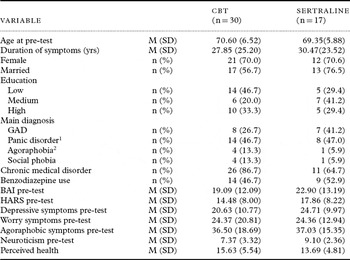
Age at pre-test varied from 61 to 81, with a mean age of 70. Age of onset was “early” (below the age of 60) in 28 participants (59.6%) and duration of anxiety varied from two months to 63 years, with a mean duration of 29 years. Thirty-seven participants (78.7%) suffered from some form of chronic somatic disease. The chronic diseases that were most common among participants were hypertension (n = 14; 29.8%), arthritis (n = 10; 21.3%) and cardiovascular diseases (n = 10; 21.3%). Twenty-three participants (48.9%) used one or more benzodiazepines. Further information regarding the distribution of baseline characteristics across the two treatments can be found in Table 1. A comparison on all pre-test demographic and clinical variables, including the distribution of principal diagnosis and severity of anxiety symptoms at baseline using χ2 tests and ANOVA's demonstrated no significant differences (Table 1).
Baseline characteristics of the sample

1With or without agoraphobia.
2Without a history of panic disorder.
BAI = Beck Anxiety Inventory; CBT = cognitive behavior therapy; GAD = generalized anxiety disorder; HARS = Hamilton Anxiety Rating Scale.
Measures of treatment outcome
Outcome was assessed at post-treatment and at one-year follow-up. Pre-test, post-test and follow-up measurements consisted of self-report measures and a structured interview. The interview consisted of the Hamilton Anxiety Rating Scale (HARS; Hamilton, Reference Hamilton1959; Cronbach's α = 0.82). The HARS was performed by two members of the research group. Inter-rater agreement on the HARS was measured in the initial stages of the project. Weighted κ was 0.58, constituting moderate inter-rater agreement. Self-report measures included the Beck Anxiety Inventory (BAI; Beck and Steer, Reference Beck and Steer1990; Cronbach's α = 0.93) and the Dutch adaptation of the Worry Domain Questionnaire (WDQ; Rijsoort et al., Reference Rijsoort, Emmelkamp and Vervaeke1999; Cronbach's α = 0.92). Items related to work situations in the WDQ were omitted because they were not considered appropriate for an older population. Depressive symptoms were measured with the Centre for Epidemiological Studies Depression Scale (CES-D; Radloff, Reference Radloff1977; Cronbach's α = 0.90).
Predictor variables of treatment outcome
Predictor variables of treatment outcome were measured at pre-test and included age, educational level, duration of symptoms in years, depressive symptoms as measured with the CES-D; Radloff, Reference Radloff1977), agoraphobic symptoms as measured with the Agoraphobia Scale (AS; Ost, Reference Ost1990; Cronbach's α = 0.96), neuroticism as measured with the neuroticism subscale of the Eysenck Personality Questionnaire-revised (EPQ-R; Eysenck et al., Reference Eysenck, Eysenck and Barret1985; Cronbach's α = 0.78) and perceived health (a subscale of the MOS-20; Stewart et al., Reference Stewart, Hays and Ware1988; Cronbach's α = 0.86). Items related to driving a car were omitted from the analysis of the AS, since a large proportion of participants did not own a car or no longer held a driver's license.
Data analysis
T tests and χ2 tests were used to compare participants assigned to CBT and sertraline on all predictor variables measured at pre-test. Therapy outcome at one-year follow-up was assessed with paired t tests and ANCOVAs on the outcome scores of follow-up measurements using pre-test scores as a covariate for all patients who completed treatment (Gibbons et al., Reference Gibbons1993). Both completer analyses and intent to treat (ITT) analyses for long-term treatment outcome are presented. A conservative Last Observation Carried Forward method (LOCF), in which the available pre-treatment score is regarded as the subsequent post-treatment score, was used to account for missing data in patients who dropped out of therapy without completing post-treatment assessments. Two measures of clinically significant change were assessed: (1) treatment response for anxiety, defined as an improvement of 20% on two measures of anxiety (BAI and HARS) and high end state functioning for anxiety, defined as a score of less than 10 on both the BAI and the HARS (which equals a score within the normal range). The 20% reduction criterion of treatment response in a composite measure of both self-report and interview-rated instruments is common in the treatment literature of anxiety in older adults (e.g. Barrowclough et al., Reference Barrowclough, King, Colville, Russell, Burns and Tarrier2001). Rates of treatment response and high end state functioning at one-year follow-up were determined and compared between treatment groups using χ2 analyses.
Predictor analyses were conducted for two moments in time: at post-treatment and at one-year follow-up. To investigate the prognostic value of predictor variables measured at pre-test for treatment outcome of anxiety, residual gain scores (Steketee and Chambless, Reference Steketee and Chambless1992) were used for the HARS, which was chosen as the main outcome variable. The residual gain score has several advantages over raw outcome scores or change scores, because it takes into account both pre-test differences and measurement error, by using the following formula: residT2 = z2−z1 × r12 (where residT2 is the residual gain score at post-test (T2); z2 is the standardized score at post-test (T2); z1 is the pre-test standardized score; and r12 is the correlation between z1 and z2). A series of linear regression analyses were run, using residual gain scores on the HARS at post-treatment and follow-up as outcome variables. Data for CBT and sertraline completers were analyzed separately. First, all predictor variables were entered individually in a univariate linear regression model. Next, all predictors showing a significant effect in the univariate regression analyses were entered in a forward multivariate regression model, to see which of the variables showed an independent contribution to treatment outcome and to establish the magnitude of this contribution (the amount of variance in residual gain scores explained).
Missing values were imputed by means of last observation carried forward. When baseline measures were missing (e.g. due to incompletely filled out questionnaires) we have imputed data by means of a missing value analysis in SPSS using data on gender, age and the main outcome measures as predictors.
Results
Loss to follow-up and differences between treatment groups
For post-treatment analyses, data were available from 47 participants who completed the CBT (n = 30) and sertraline (n = 17) treatment arms. Eight participants refused to cooperate with assessment at one-year follow-up, leaving a sample of 39 (25 CBT and 14 sertraline) participants who were included in follow-up analyses. Those who were lost to follow-up scored lower on the perceived health scale at baseline than those who participated in one-year follow-up assessments (t(42) = 2.09, p < 0.05). No other significant differences between participants and those lost to follow-up were found for any of the demographic or predictor variables included in this study. Also, ANCOVAs on the post-treatment outcome measures using pre-test scores as a covariate did not show differences in treatment effectiveness between participants and those lost to follow-up. Sertraline use was maintained during follow-up in at least 7 of 14 participants (50%). Unfortunately, data on sertraline use during follow-up are missing in 4 of 14 participants (28.6%). During follow-up, seven participants (3 CBT and 4 sertraline participants) sought additional treatment at the research centre, four of whom received an alternative psychopharmacological treatment and three of whom received CBT.
A comparison on all pre-test demographic and predictor variables using t tests and χ2 tests demonstrated no significant differences between those randomized to CBT or sertraline at baseline. However, sertraline completers did have a higher rate of comorbid depression at baseline than CBT completers (44.4% versus 10.0%; χ2(1) = 7.56, p < 0.05). Sertraline completers did not differ from CBT completers on any of the other variables included in the study.
Treatment outcome at one-year follow-up
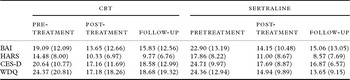
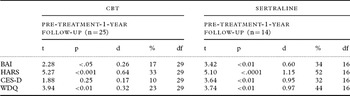
Paired t tests were performed to assess within-treatment effects for each group between pre-test and one-year follow-up. Table 2 presents means and standard deviations for all outcome measures at pre-treatment, post-treatment and one-year follow-up by treatment arm. Table 3 presents t and p values, effect size estimates and percentage of change over time by treatment.
Means and standard deviations for completers on all outcome measures at pre-treatment, post-treatment and one-year follow-up by study arm.

CBT = cognitive behavior therapy; BAI = Beck Anxiety Inventory; HARS = Hamilton Anxiety Rating Scale; CES-D = Centre for Epidemiological Studies Depression Scale; WDQ = Worry Domain Questionnaire.
Paired t tests and p values, effect size estimates and percentage of change over time by treatment arm.

CBT = cognitive behavior therapy; BAI = Beck Anxiety Inventory; HARS = Hamilton Anxiety Rating Scale; CES-D = Centre for Epidemiological Studies Depression Scale; WDQ = Worry Domain Questionnaire.
At one-year follow-up, improvement from baseline scores was significant on all outcome measures for sertraline completers. For CBT completers, improvement from baseline scores was significant on the BAI, the HARS and the WDQ, but not on the CES-D. Effect size estimates were calculated as the difference between mean pre-and one-year follow-up scores divided by the pooled standard deviations from baseline and follow-up scores (Cohen's d). In general, effect sizes for CBT at one-year follow-up remained relatively small (mean d at one-year follow-up = 0.35 versus post-treatment mean d = 0.42; Schuurmans et al., Reference Schuurmans2006) whereas effect sizes for sertraline remained in the large range (one-year follow-up mean d = 0.92 versus post-treatment mean d = 0.94; Schuurmans et al., Reference Schuurmans2006).
For a direct comparison of the effectiveness of treatment arms, we conducted ANCOVAs on the follow-up scores of all completers with pre-test scores as the covariate. Results favored sertraline on the HARS (F(1,45) = 4.24, p < 0.05, η2 = 0.09), but not on the BAI (F(1,45) = 2.30, p = 0.14, η2 = 0.05), the CES-D (F(1,45) = 2.74, p = 0.11 η2 = 0.06) or the WDQ (F(1,45) = 3.76, p = .06 η2 = 0.08). At post-treatment, rates of treatment response (57% for sertraline versus 44% for CBT participants) and high end state functioning (47% for sertraline and 48% for CBT participants) did not differ significantly between treatment groups (Schuurmans et al., Reference Schuurmans2006). At one-year follow-up, 67% of sertraline participants and 39% of CBT participants could be classified as treatment responders (χ2 (1) = 2.39, p = 0.12). Fifty-seven percent of sertraline participants and 44% of CBT participants fit criteria for high end state functioning at one-year follow-up (χ2(1) = 0.62, p = 0.43).
However, ITT analyses showed no significant differences with regard to the relative effectiveness of CBT versus sertraline at one-year follow-up, although the ANCOVA on the HARS reached near significance (F(1,66) = 3.52, p = 0.07, η2 = 0.05).
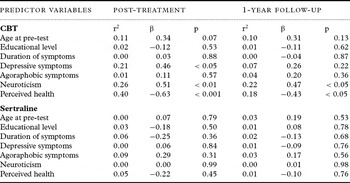
Predictors of residual gain scores on the HARS for CBT and sertraline participants

HARS = Hamilton Anxiety Rating; CBT = cognitive behavior therapy.
Predictors of treatment outcome for CBT
Regression analyses on post-treatment scores of the HARS using pre-test scores on the HARS as an independent variable revealed that 57.3% of the variance in post-test scores on the HARS was explained by the pre-test (β = 0.77, p < 0.001). Regression analyses on residual gain scores at post-treatment revealed several significant predictors for an unsuccessful treatment outcome for CBT participants. These included comorbid depressive symptoms, neuroticism and lower perceived health scores (Table 3). A multiple forward regression analysis incorporating these predictors revealed that only lower perceived health had a significant independent contribution to the prediction of an unsuccessful treatment outcome (β = −0.63, p < 0.01), explaining 40.0% of the variance in residual gain scores.
At one-year follow-up, 45.3% of the variance in HARS scores was explained by the pre-test scores (β = 0.69, p < 0.001). Regression analyses on residual gain scores at one-year follow-up again revealed lower perceived health and neuroticism as significant predictors for an unsuccessful treatment outcome (Table 3). Comorbid depressive symptoms were not found to be predictive for long-term treatment outcome. In contrast to post-treatment analyses, a multiple forward regression analysis incorporating perceived health and neuroticism revealed that only neuroticism had a significant independent contribution to the prediction of an unsuccessful treatment outcome at one-year follow-up (β = −0.63, p < 0.01), explaining 22.0% of the variance in residual gain scores.
Predictors of treatment outcome for sertraline
Regression analyses on post-treatment HARS scores using pre-test scores as an independent variable revealed that 36.5% of the variance in post-treatment HARS scores was explained by the pre-test (β = 0.60, p < 0.05). Regression analyses on HARS scores at one-year follow-up revealed that only 13% of the variance in follow-up HARS scores was explained by the pre-test (β = 0.36, p = 0.20). Regression analyses on residual gain scores at one-year follow-up revealed no significant predictors for treatment outcome.
Discussion
Treatment outcome at one-year follow-up
Data comparing short-term effectiveness of CBT and sertraline for late-life anxiety, described in a previous report by our research group (Schuurmans et al., Reference Schuurmans2006), revealed higher effect sizes and a better result on worry symptoms for sertraline. Long-term treatment outcome reflects similar results with sertraline showing more improvement on worry symptoms, but also on anxiety symptoms as measured with the HARS. Effect sizes for sertraline remained in the moderate to large range (Cohen's d = 0.60–1.62), while effect sizes for CBT were small to moderate (Cohen's d = 0.22–0.70). This is in concordance with a recent meta-analysis by Pinquart and Duberstein (Reference Pinquart and Duberstein2007) on the effectiveness of psychological versus pharmacological interventions, which concluded that pharmacological interventions seem to be more effective in reducing anxiety in late life than psychological interventions. However, ITT analyses revealed no significant differences with regard to long-term treatment effect. Although ITT analyses may provide a conservative estimate, since respondents were regarded as unchanged when post-treatment scores were missing, it is important to take into account that only those who complete treatment may benefit more from sertraline than from standard individual CBT.
Variables predicting treatment response
First of all, we would like to stress the exploratory nature of our analyses with regard to the prediction of treatment effect. As our sample was relatively small and no previous studies have focused on the prediction of treatment effect for late-life anxiety, results with regard to these analyses should merely be interpreted as plausible hypotheses to be tested and replicated in larger samples or meta-analytic research.
Our study provides support for several predictors for the treatment outcome of CBT for late-life anxiety, including comorbid depressive symptoms, poor perceived health and neuroticism. Poor perceived health seems to be predictive for treatment failure in CBT, but not in sertraline participants. This is a rather remarkable finding, since poor health is generally held to be detrimental to drug treatment effect. In fact, health issues in older adults are the reason why several papers have argued that psychological interventions constitute the preferred mode of treatment for late-life anxiety disorders (e.g. Mohlman, Reference Mohlman2004). With regard to the meaning of perceived health for the prediction of treatment effect, a recent publication on factors related to the self-perception of health sheds an interesting light on this subject. In this study, subjective health was found to be highly correlated with self-report measures of subjective well-being (life satisfaction, anxiety and depression) and the sense of coherence, while correlations with objective health-related variables were insubstantial (Schneider et al., Reference Schneider2004). The sense of coherence (SOC) is defined as a personality orientation that “expresses the extent to which a person has a pervasive, enduring feeling of confidence that (1) the stimuli deriving from one's internal and external environments in the course of living are structured, predictable and explicable (comprehensibility), (2) resources are available to meet the demands posed by these stimuli (manageability), and (3) these demands are challenges, worthy of investment and engagement (meaningfulness). Thus, SOC should be a personality orientation that facilitates coping with the health problems and disabilities of old age, influencing subjective health perception” (Schneider et al., Reference Schneider2004). These findings imply that perceived health in older adults may be a reflection of certain coping mechanisms and psychological factors rather than an accurate measure of objective health. Therefore, we should be careful in concluding from our study that disabled or chronically ill older adults with anxiety disorders should not be referred to CBT.
Neuroticism was found to be the strongest predictor for an unsuccessful long-term treatment outcome. In a previous study, our research group also found neuroticism to be predictive of a natural long-term persistent outcome of anxiety disorders in late-life (Schuurmans et al., Reference Schuurmans2005) and it has been found to be related to the onset and prognosis of mood and anxiety disorders in mixed-age populations in several other studies (for an extensive review of these studies, see Clark et al., Reference Clark, Watson and Mineka1994). However, there has been considerable debate over the meaning of the construct of neuroticism in recent years. Neuroticism is generally regarded as a personality trait, reflecting negative affectivity (Clarke et al., Reference Clark, Watson and Mineka1994). In a recent article, Ormel and colleagues pointed out that neuroticism might simply reflect a person's characteristic level of distress over a protracted period of time (Ormel et al., Reference Ormel, Rosmalen and Farmer2004). They argue that although self-report measures of neuroticism may be used to mark a vulnerable subgroup of patients who are at risk for onset and chronicity of all sorts of psychopathology, these measures do not actually offer an explanation for this vulnerability. In our study, neuroticism was measured by a subscale of the EPQ-R (Eysenck et al., Reference Eysenck, Eysenck and Barret1985). When investigating the items of this subscale, it appeared to us that high neuroticism scores may also reflect the tendency to perceive oneself as a generally nervous and unstable person, i.e. the tendency to perceive one's symptoms as an unchangeable character trait rather than as something that may be cured. To illustrate, example items of the EPQ-R include “Do you regard yourself as a nervous person?” and “Do you regard yourself as a worrisome person?”. This might reflect a disbelief in the possibility of change which may hinder both spontaneous remission as well as the effective psychological treatment of anxiety in late life.
Unfortunately, we were not able to discern any predictors for either short-term or long-term treatment outcome in sertraline participants. Some of the documented predictors of treatment effect found in mixed-age populations, such as duration of symptoms for both CBT and pharmacological treatment outcome (Scheibe and Albus, Reference Scheibe and Albus1997; Slaap and den Boer, 2001; Stein et al., Reference Stein, Montgomery, Kasper and Tanghoj2001; Solvason et al., Reference Solvason, Ernst and Roth2003) and depressive symptoms for pharmacological treatment outcome (Stein et al., Reference Stein, Montgomery, Kasper and Tanghoj2001) were not found to be related to outcome in our study. It should be noted, however, that some of the analyses reported in this study may have failed to reach statistical significance due to small sample size, as discussed below.
Limitations
The main limitations to the present study were its lack of power due to small sample size, differences in sample size between treatment arms and loss of subjects for follow-up measurements. Our randomization procedures were unsuccessful as a result of unforeseen recruitment problems. As a consequence, our study is not as persuasive as it might have been if other randomization procedures had been used, and certain predictors of treatment effect may have been overlooked.
Although treatment results for sertraline in this study seem promising, it should be noted that all analyses in the present study were based on completers (and those who participated in the one-year follow-up) and that the use of sertraline was maintained during follow-up in at least 50% of sertraline participants, which may have biased the comparison with CBT. The long-term treatment gains mentioned in this study should probably be ascribed to ongoing treatment with sertraline. Continuance of sertraline obviously carries certain disadvantages, such as side-effects, although available studies of SSRIs for depression and anxiety suggest similar tolerance for SSRIs between older and younger adults (e.g. Schneider et al., Reference Schneider2003; Lenze et al., Reference Lenze, Mulsant, Shear, Dew, Miller and Pollock2005; for a comprehensive overview of the side-effects experienced by participants in the current treatment study see Schuurmans et al., Reference Schuurmans2006). Also, older adults tend to prefer psychological interventions over drug treatments (van Schaik et al., Reference van Schaik2004). Furthermore, since the review board for medical ethics did not grant us permission to allocate older adults to a placebo study group, we cannot be certain if treatment effect should be solely attributed to the use of sertraline. However, the fact that treatment results were maintained during a one-year follow-up period makes it less plausible that treatment effect is attributable to a placebo-effect (Quitkin et al., Reference Quitkin, Rabkin, Markowitz, Stewart, McGrath and Harrison1987).
The long-term outcome of CBT showed less optimistic results and we found no evidence of an improved effectiveness over time. However, the fact that our sample consisted of patients with mixed anxiety disorders (mainly panic disorder and GAD) and the fact that we did not include assessment instruments specific to each disorder, might have masked some of the treatment gains from CBT. Although overall levels of anxiety only moderately improved due to CBT, disorder-specific symptom levels, such as frequency of panic attacks and agoraphobic avoidance in our participants with panic disorder, may have improved on a larger scale.
A significantly higher proportion of completers in the sertraline treatment group suffered from a comorbid depression. This is a result of selective drop-out of participants in the CBT group (those who had a comorbid depression were more likely to drop out of CBT, see Schuurmans et al., Reference Schuurmans2006). One might argue that improvement potential was simply much higher in the sertraline treatment arm. However, analyses with regard to differences on outcome measures that were used for the study did not show any significant differences between the active treatment groups at baseline. Furthermore, the differences found in the ANCOVA were based on anxiety measures, not measures of depression (HARS and WDQ).
No significant predictors of long-term sertraline treatment effect were found in this investigation. However, some of the predictors of drug treatment effect reported in studies in mixed-age populations were not included in the present study, such as the presence of certain early side effects (Solvason et al., Reference Solvason, Ernst and Roth2003) and unfamiliarity with psychopharmacological treatment (Stein et al., Reference Stein, Montgomery, Kasper and Tanghoj2001; Solvason et al., Reference Solvason, Ernst and Roth2003). Also, the sertraline group was markedly smaller than the CBT group, resulting in a substantial difference in statistical power to detect possible predictors of treatment effect between the two study arms.
It should be noted that participants were not requested to refrain from seeking additional treatment during follow-up and seven participants received additional treatment during follow-up at one of our research centers, which may have biased our results. Due to ethical considerations, participants could not be requested to refrain from seeking additional treatment or to maintain sertraline use during follow-up, although maintenance of sertraline was advised for at least one year.
Finally, it should be noted that assessors were not blind to the treatment arms.
Recommendations and conclusions
Long-term outcome analyses of the present study suggest that the long-term use of sertraline might be more beneficial for the treatment of late-life anxiety than an individually delivered, standard CBT program of 15 sessions. Our results clearly call for more studies on the pharmacological treatment of late-life anxiety with SSRIs, involving larger samples and a placebo group to establish true drug response. For anxious older adults, the barrier to seeking psychotherapeutic treatment from a mental health care specialist is high, due to logistical problems (e.g. transportation), the psychological strain involved in psychotherapy and the stigma on psychiatric care for this generation. Drug treatment with SSRIs may provide a solution to this problem, as in most cases the treatment can take place in a primary care setting. However, as stated before, anxious older adults tend to be reluctant to take medication for psychological problems (van Schaik et al., Reference van Schaik2004). The need for treatment fidelity is stressed by the lack of difference in long-term treatment effect in our ITT analyses. Also, older adults have a higher chance of suffering from a somatic disease that provides a contra-indication for the use of SSRIs and recent findings indicate that SSRIs may carry the same heightened risk for accidents, falls, fractures and cognitive decline as has been reported for benzodiazepines (e.g. French et al., Reference French, Campbell, Spehar, Cunningham, Bulat and Luther2006). Therefore, the development of more effective, low-threshold psychological interventions remains a necessity. Short-term psychological interventions provided at home or in a primary care setting may be more cost-effective and, moreover, more accessible to this particular group, than a relatively long and arduous cognitive behavioral treatment in a psychiatric setting. One recent study provides support for a short-term CBT intervention for late-life anxiety in primary care (Stanley et al., Reference Stanley2009), but more research is needed to develop effective primary care interventions for this population and to adapt common psychological interventions for anxiety disorders successfully to older adults.
Poor perceived health and neuroticism may be predictive of CBT treatment failure in anxious older adults. Future comparative treatment studies of CBT and SSRIs for late-life anxiety should include other possible predictors of treatment effect, such as the presence of certain (early) side effects, unfamiliarity with drug treatment, comorbid medication use and medical conditions. Also, findings from the present study should be replicated in a larger sample or meta-analysis of previous trials. This could provide more definite cues for clinical practice to establish the preferred type of treatment for each individual.
Conflict of interest
None.
Description of authors' roles
J. Schuurmans, I. J. C. Weijnen and H. C. Comijs collected the data. J. Schuurmans was responsible for carrying out the statistical analyses and for writing the article. P. M. G. Emmelkamp, R. van Dyck and M. A. van den Hout designed the study and supervised the data collection. All listed authors have made substantial contributions to the revisions of the first draft of this manuscript.
Acknowledgments
Financial support for the research described in the present manuscript was provided by a research grant from the Dutch Health Research and Development Council, project number 940–33-036.
Editor's note
Although this paper technically could be said to report information from a randomized controlled trial and was not registered in a RCT register as required by International Psychogeriatrics, it has been accepted because the original trial was done prior to 2003 and the paper itself represents a recontacting of the RCT participants rather than a clear report of an unregistered RCT. However, individuals contemplating submission of RCT related data to International Psychogeriatrics should not take the acceptance of this article to be any kind of precedent. Those intending to submit RCT data to International Psychogeriatrics should read the Instructions to Contributors thoroughly, and where they have queries in relation to the suitability of their articles for possible publication in International Psychogeriatrics, they should contact the editor prior to submission.