

INTRODUCTION
Proponents of the concept of neopatrimonialism assert that distinct features distinguish governance in the African state from its counterparts in other world regions (Bratton & van de Walle Reference Bratton and van de Walle1997; Chabal & Daloz Reference Chabal and Daloz1999; Englebert Reference Englebert2000; Médard Reference Médard and Clapham1982; van de Walle Reference van de Walle2001a). It is postulated that the particular nature of the African state, characterised by the lack of separation between the public and the private sphere, fundamentally inhibits state capability on the continent.
The inability to collect taxes,Footnote 1 which commonly form the financial basis for all other state functions (e.g. internal and external security, public welfare), is one of the most fundamental deficits in this respect (Bräutigam Reference Bräutigam2002: 14; Olowu Reference Olowu and van de Walle2003: 105; van de Walle Reference van de Walle2001a: 182–3). An IMF study (Silvani & Baer Reference Silvani and Baer1997: 6–7) found that in some African countries, more than 60% of the tax potential remains untapped. The neopatrimonial perspective implies that this must be attributed not only to Africa's low socio-economic status, but also to political interference with the process of collecting state revenue. This article seeks to test this premise in respect to Zambia, a country whose political practice – as in other African states – is assumed to be characterised by neopatrimonialism.Footnote 2
Since colonial times, Zambia's state finances have been based on the extraction of copper. The sharp decline of world market prices for the mineral resource in the mid-1970s caused a severe economic and revenue crisis. By 2000, real GDP per capita had declined to only about 55% of its 1975 level (World Bank 2003: 112). Up to the 2005 Heavily Indebted Poor Countries (HIPC) debt relief, Zambia had been one of the most heavily indebted countries in sub-Saharan Africa (IMF 2005b). Thus, Zambia has a long history of interaction with multilateral and bilateral donors. These have potentially exerted a strong leverage on domestic politics. Accordingly, donor influence is the key intervening variable incorporated into this analysis on the effects of neopatrimonialism on the collection of central state taxes in Zambia.
Despite the need for new sources of state income, the single-party government of President Kaunda refrained from strengthening domestic tax collection. Only after the reintroduction of the multiparty system in 1991 and the electoral success of the Movement for Multiparty Democracy (MMD), did the new government radically strengthen the tax administration, with the creation of the semi-autonomous Zambia Revenue Authority (ZRA). Yet, the indicators show that Zambia's political elite has resorted to neopatrimonial practices largely unabated. The country therefore constitutes a particularly interesting case study for analysing neopatrimonialism and its effects on the collection of state revenue in the African state.
Over 75 qualitative interviews conducted in Zambia allow for ‘process tracing’, and provide most of this study's empirical value added. Six respondent groups from inside as well as outside the tax administration were interviewed.Footnote 3 In addition, primary sources such as the tax administration's annual reports and the budget speeches were systematically analysed. In order to focus on analysis of Zambia's tax administration, this study deals only with the collection of central state taxes. Local taxes and their administration operate under specific conditions distinct from the central level. Furthermore, they play a minor role in Zambia (Gloppen & Rakner Reference Gloppen and Rakner2002: 35; NORAD 2002: 7). Nor does the analysis include the collection of non-tax revenue, fees or service charges by other authorities or ministries.Footnote 4 Reference is made to the collection of these other forms of state revenue where appropriate.
The analysis puts forward three main arguments. First, Zambia's 1991 transition from the one-party state to the multiparty system completely changed the impact of neopatrimonialism on tax collection. As the most crucial intervening variable, donor influence made the strengthening of domestic revenue generation a precondition for the resumption of official development aid to the country after the transition. Second, the reform of Zambia's tax administration has been consistent with a neopatrimonial rationale. Favours could still be awarded through state expenditure, tax exemptions and the effective non-taxation of the large informal sector. The larger consequences of the institutional reform of the Zambia Revenue Authority for how tax revenues are spent remain negligible. Third, there are indications that the heavily donor-supported Zambia Revenue Authority has provided additional resources for neopatrimonial exchange relations. Thus, it might have strengthened neopatrimonialism overall.
The article starts by conceptualising the main facets of neopatrimonialism. It then introduces indicators to operationalise and analyse neopatrimonialism in Zambia. Finally, it assesses the effects of neopatrimonialism on the collection of revenue.
CONCEPTUALISING NEOPATRIMONIALISM
Neopatrimonialism is a ‘universal concept’ which its proponents perceive to have particular value for explaining Africa's state weaknesses, democratic deficiencies and economic crisis. Bratton and van de Walle (Reference Bratton and van de Walle1997: 277), for instance, maintain that ‘the distinctive institutional hallmark of African regimes is neopatrimonialism’. The basic proposition of this heuristic concept is that informal, particularistic politics of the rulers pervade formal state institutions. The separation between the public and the private realm, which stands at the basis of the ‘modern’ conception of the state, is abrogated.Footnote 5
Principally, the term neopatrimonialism denotes the simultaneous operation of the two Weberian ideal types of patrimonial and rational-legal domination (Bratton & van de Walle Reference Bratton and van de Walle1997: 62; Clapham Reference Clapham1985: 48). Patrimonialism connotes that a patron in a certain social and political order bestows gifts from own resources on followers in order to secure their loyalty and support (Weber 1980 [Reference Weber1922]: 133–4, 136). Clients, in turn, obtain material benefits and protection. In a neopatrimonial system, patrons are typically office-holders in state institutions who misuse public funds or office in order to stay in power. Social practice as a result is fundamentally different from the impersonal formal rules which are supposed to guide official action (Alence Reference Alence2004: 165; Erdmann & Engel Reference Erdmann and Engel2007: 20).
In the case of tax collection, it can be hypothesised that neopatrimonialism leads to political interference with the tax administration and in turn reduces state revenue.Footnote 6 Donors as well as researchers regard these organisations as focal points of interference from the political sphere (Gill Reference Gill2003: 1; Rose-Ackerman Reference Rose-Ackerman2004: 28; World Bank 2002: 111). Two prime forms of undue influence from the political sphere are possible: first, the placement of unqualified top-, middle- and low-level tax officers, who fill patronage positions. Second, neopatrimonial interference with the tax administration's day-to-day business in order to prevent audits at businesses that enjoy political protection, inhibit controls at border posts, and harass opponents of the neopatrimonial ‘big man’. Both strategies serve the political interest of securing authority and the private interest of reducing tax payments. They keep the tax administration weak, and in turn significantly reduce the room for self-sufficiently financing the African state.
Reading the vast array of literature on neopatrimonialism in sub-Saharan Africa, it is striking that widely accepted indicators for this practice are non-existent, and systematic analyses of its effects on public policy are rare (one exception is Kjaer Reference Kjaer2004). The key methodological aim of this article is therefore to contribute to the systematic operationalisation of the concept. In accordance with Bratton and van de Walle (Reference Bratton and van de Walle1997: 63–8), it applies the three features ‘systematic concentration of political power’, ‘award of personal favours’, and ‘misuse of state resources for political legitimation’ for assessing the neopatrimonial profile of Zambia. Such analysis provides strong indicators of the character of the Zambian state, and reveals the continuity of neopatrimonial practices in the country.
NEOPATRIMONIALISM IN ZAMBIA
Since independence, Zambia's rulers have consistently applied all three features of neopatrimonial politics.
Concentration of political power
Concentration of political power implies the dominance of one individual, ‘who resists delegating all but the most trivial decision-making tasks’ (Bratton & van de Walle Reference Bratton and van de Walle1997: 63).Footnote 7 As a defining feature of this ‘big man politics’, the president or, in other words, the patron, stays in power for a long time, sometimes until the end of his life. Indeed, presidents in sub-Saharan Africa on average officiate significantly longer than their counterparts in Asia and Latin America (Bienen & van de Walle Reference Bienen and van de Walle1992: 693). Young (Reference Young1994: x) consequently speaks of ‘“life president” power management’. On the other hand, neopatrimonial rulers frequently rotate the political elite in order to prevent any potential opponent from developing his or her own power base, and also in order to extend the clientelist network (Snyder Reference Snyder1992: 392; Snyder & Mahoney Reference Snyder and Mahoney1999: 108–9). The simultaneous fulfilment of both requirements, a long tenure of presidents and a short tenure of key government members, therefore suggests a neopatrimonial power concentration.
This has been exactly the case in Zambia. With Kenneth Kaunda, Frederick Chiluba and Levy Mwanawasa, the country has seen only three presidents since independence in 1964. Their average length of tenure amounts to 14 years,Footnote 8 which stands above the 11·6 years African state leaders have on average managed to stay in power from 1980 to 2005 (van de Walle Reference van de Walle, Engel and Olsen2005: 74).
The first President, Kaunda, served for 27 years in office and entrenched his power with a corps of personal advisors, which in turn reduced the influence of the cabinet and other units of the ruling United National Independence Party (UNIP). He not only gained from particular legitimacy as Zambia's founding President who had led the struggle for independence, but also augmented his control of the political process by promulgating the one-party state in December 1972 (Scott Reference Scott and Tordoff1980: 152; Tordoff & Molteno Reference Tordoff, Molteno and Tordoff1974: 252).
The neopatrimonial centralisation of power in Zambia also finds expression in the frequent change of ministers. The average tenure of key ministers from independence until today stands at only 2·4 years.Footnote 9 Consequently, the most important cabinet members have exercised their functions for only half of a legislative period on average. This pattern of ‘elite circulation’ (Burnell Reference Burnell2001b: 241) has shown a high degree of consistency, and has endured during Zambia's one-party Second Republic (1972 to 1991), and the multiparty Third Republic (since November 1991).
In a major cabinet reshuffle in April 1993, for instance, President Chiluba removed from office those reform-minded ministers whom he perceived to be a threat to his rule. Others were frustrated to the extent that they resigned from government (Erdmann & Simutanyi Reference Erdmann and Simutanyi2003: 14). With an average tenure of less than two years, the ‘ministerial game of musical chairs’ (Tordoff & Molteno Reference Tordoff, Molteno and Tordoff1974: 254) in the key departments has not slowed down under the current President Mwanawasa, who was re-elected on 28 September 2006 (ECZ 2006).
Award of personal favours
Not only do Zambia's presidents frequently rotate ministers, they also award personal favours to other elite members in order to secure their rule. A prime means has been the expansion of the cabinet, which features prominently among means for awarding personal favours in Africa (van de Walle Reference van de Walle2001b: 32–3). The Zambian cabinet has grown significantly over the years; from 14 ministers in 1964 to currently 23 members.Footnote 10 This is congruent with the trend in many African countries. Van de Walle (Reference van de Walle, Engel and Olsen2005: 80) shows that the average number of cabinet ministers in the region rose from 20·1 members in 1979 to 24·6 in 2000.Footnote 11 As in Zambia, these cabinet sizes cannot be substantiated by functional necessities. Most developed countries, having much larger populations and economies, are governed by cabinets of only 15 to 20 ministers (OECD 2004: 2).
The number of core cabinet ministers only moderately reflects the enlargement of patronage posts in the Zambian government. In 1968, President Kaunda appointed ministers for each of Zambia's nine provinces. After the introduction of the one-party state, the UNIP Central Committee became a parallel structure to the cabinet (van Donge Reference van Donge and Wiseman1995: 196). The president also created additional posts in order to pursue his policy of ‘tribal balancing’ in Zambia's multi-ethnic society (Carey Reference Carey2002: 60). Despite the severe and enduring economic crisis, the cabinet went up to a peak of 27 ministers (1986 to 1988) during the Second Republic. Furthermore, the ‘UNIP patronage machine’ (Bratton Reference Bratton and Widner1994: 104) massively expanded public sector employment. Following Bates and Collier (Reference Bates, Collier, Bates and Krueger1993: 391), in 1985, the party filled over 40,000 public offices in Zambia's capital Lusaka alone.
After the transition to multiparty rule and the formation of his Movement for Multiparty Democracy (MMD) government in 1991, President Chiluba also formed a large cabinet. He appointed 25 ministers to the Third Republic's first cabinet; a number which rose to an all-time high of 28 posts one year later. Even today the bloated government is a feature of Zambian politics. A 2004 media campaign to reduce the number of high-level government posts remained unsuccessful (The Post 20.4.2004, 26.4.2004). According to a Government of Zambia document (RoZ 2005), the total number of government members (president, vice-president, ministers and vice-ministers) on 3 August 2005 stood at 67.
Misuse of state resources
The misuse of state resources, the third feature of neopatrimonialism, has also characterised Zambia's political practice. The expenditure side of the budget is particularly well-suited for analysing the misuse of state resources. In line with other research, this article also uses the existence of serious corruption levels as an indicator for the neopatrimonial misuse of state resources (Basedau Reference Basedau2003: 281–7; Manow Reference Manow2002: 24–5). It refers to the Corruption Perception Index (CPI) and the similar World Bank Governance Index in respect to ‘control of corruption’. Both are composite indices which incorporate various studies on a country's perceived corruption levels (Graf Lambsdorff Reference Graf Lambsdorff2005; Kaufmann et al. Reference Kaufmann, Kraay and Mastruzzi2005a).
During the Second Republic, a Leadership Code obliged all cabinet and Central Committee members to separate public office and private interests (Kaunda Reference Kaunda1972: par. 4). Yet, the text of the code was not put into practice. A general pattern emerged of misusing public functions and resources.Footnote 12 It became apparent that ‘bribes and favours offered a host of rewards for “gatekeeping services”’ (Szeftel Reference Szeftel2000: 210). Monitoring institutions such as the Anti-Corruption Commission remained toothless, and the infrequent exposure of corrupt practices in government did not counter the systematic misappropriation of public resources (Afronet 2002: 89; Tordoff & Molteno Reference Tordoff, Molteno and Tordoff1974: 287; van Donge Reference van Donge and Wiseman1995: 198). The party slogan ‘It Pays to Belong to UNIP’ could be taken literally (Szeftel Reference Szeftel2000: 212).
President Chiluba's government also misused state resources, often to the advantage of the ruling party MMD (Erdmann & Simutanyi Reference Erdmann and Simutanyi2003: 72; Szeftel Reference Szeftel2000: 217).Footnote 13 According to Transparency International Zambia (2002: 35–7; 2003: 9–10, 13), a number of ministers were involved in corruption scandals without being dismissed. Furthermore, Zambia has since 1998 received low scores on Transparency International's CPI. The country has always ranked in the lower half, for most of the time in the worst third of countries included in the index (ICCR 2005). Zambia's ‘control of corruption’ marks in the World Bank Governance Index have been equally low. The country has consistently featured among the third of countries perceived to be most corrupt (Kaufmann et al. Reference Kaufmann, Kraay and Mastruzzi2005b).
Under President Chiluba, a similar ‘blurring of the line’ (Rakner & Svåsand Reference Rakner and Svåsand2005: 95) between the governing party and the state took place as in the Second Republic. Before the 1996 elections, the government sold council houses to tenants on favourable conditions. Commentators largely perceived this move as an inducement to vote for the MMD (Bratton & Posner Reference Bratton, Posner and Joseph1999: 397; Financial Mail 27.8.–2.9.2002). President Chiluba also introduced the office of district administrator. These local-level positions were filled with political appointees who were accountable only to the president (Erdmann & Simutanyi Reference Erdmann and Simutanyi2003: 48; Meyns Reference Meyns and Eberlei2005: 48). In 1999, the government created a ‘Presidential Discretionary Fund’, unofficially called ‘Slush Fund’, to distribute favours to clients. The fund's reserved budgetary allocations of around 12 billion Kwacha per annum (roughly US$5 million at that time), were at the disposal of the President alone, who apparently deployed it for partisan purposes (Burnell Reference Burnell2001b: 251; Simon Reference Simon, Villalón and VonDoepp2005: 209).
In the face of these developments, President Mwanawasa began his tenure on 2 January 2002 by declaring his administration to be ‘a government of laws not of men’. One of the centrepieces of his ‘new deal’ government was the proclaimed fight against corruption (Erdmann & Simutanyi Reference Erdmann and Simutanyi2003: 78; Simon Reference Simon, Villalón and VonDoepp2005: 212). He lifted the immunity of former President Chiluba, and charged him and some of his allies with abuse of office. However, there are strong indications that Mwanawasa's campaign has remained inconsequential and is primarily used as a way of silencing his opponents (EIU 2005: 16; TIZ 2002: 30).
Furthermore, donor reports have repeatedly criticised the lack of budget discipline and the continued misuse of state resources (see detailed analyses in Burnell Reference Burnell2001a; TIZ 2003, 2004; World Bank 2003, 2004). In fact, the reform of Zambia's public expenditure management has been one of the centrepieces of current donor assistance in order to address ‘the various weaknesses in expenditure control’ (World Bank 2003: xv). One prominent reform programme has been the Medium Term Expenditure Framework (MTEF), which forms part of the Public Sector Reform Programme for Zambia. The World Bank report (ibid.: 29, xxi) on public expenditure management found ‘a pattern of failed budgeting’, and stated that ‘the most important recommendations … are not technical ones, but rather those that require a policy decision to be implemented’. This indicates lack of political will to strengthen expenditure control.Footnote 14 Consequently, the reform of the expenditure management has remained particularly unsuccessful. In other words: ‘Problems in budget execution and budget control lie at the root of Zambia's fiscal failure in the past decade’ (ibid.: 58). The MMD government's privatisation of state assets created even more routes for the misuse of state resources. Most prominent in this regard was the privatisation of the Zambia Consolidate Copper Mines (ZCCM) in March 2000 (see analysis in TIZ 2001).
On balance, neopatrimonialism has characterised political practice in Zambia since independence in 1964. Due to its inherent lack of accountability, the single-party state in the Second Republic reinforced the neopatrimonial impulse (Bratton Reference Bratton and Widner1994: 125). Yet, it is striking to see the continued application of these practices throughout the Third Republic, after the abolition of single-party rule. This deeply ingrained system has created a hostile environment for a rational-legal tax administration and the collection of revenue.
NEOPATRIMONIALISM AND THE COLLECTION OF REVENUE
The institutional development of Zambia's tax administration is characterised by two phases. The first lasted from independence in 1964 to 1994, when the Departments of Taxes and of Customs and Excise were integral parts of the state structure. The second began on 1 April 1994, when the government launched the Zambia Revenue Authority (ZRA). With this semi-autonomous agency, it outsourced the collection of revenue from the traditional public administration under the direct control of the Ministry of Finance.
In accordance with the discussion of neopatrimonialism above, this article uses two indicators for analysing the effect of Zambia's neopatrimonial system on tax administration: (a) merit orientation of staff, and (b) political interventions with day-to-day administrative work. This is followed by the assessment of the tax administration's revenue performance. The analysis shows that the donor-supported ZRA significantly reduced the influence of the neopatrimonial environment on central tax collection. Yet creating this institutional ‘island’ has been consistent with a neopatrimonial rationale, as it left open other routes for neopatrimonial practices and provided further resources for them.
Zambia's tax administration as part of the state structure
After independence, the Zambian government faced the need to strengthen the inadequate tax administration apparatus inherited from colonial rule. In its first report, the Department of Taxes noted that the government had authorised 141 posts, of which 127 were filled. The Department dealt with only 6,493 taxpayers at that time (DTZ 1969: 8). In common with the rest of the civil service, President Kaunda's UNIP government massively expanded the Departments of Taxes and of Customs and Excise. The number of staff in the Department of Customs and Excise for instance rose from 280 in the 1964 to 629 in 1967 alone (DCEZ 1966: 1).
However, available evidence paints the picture of an increasingly ailing administration. With the introduction of the one-party state in December 1972, Zambia's administrative structure lost most of its operational autonomy and had to predominantly follow a political logic. Goldsmith (Reference Goldsmith1999: 544) regards this as a general pattern for sub-Saharan Africa: ‘Political interference and low standards set the wrong tone at the beginning and interacted later with poor working conditions and low pay in a classic vicious circle.’
Political and neopatrimonial considerations significantly reduced the merit orientation of tax officers. The heads of both Departments were appointees with connections to the ruling party UNIP. According to a long-serving tax officer, this form of selecting the tax administration's leadership was widely resented among tax officers. They saw the managers as unqualified ‘outsiders’ (14.4.2004 int.). Although technical qualifications were not completely disregarded as a recruitment criterion, the apparently best-suited candidates did not fill the tax administration's leadership positions.Footnote 15
Working for the tax administration was very unattractive, as the salary levels were low and the employment conditions poor. By 1991, the real remuneration for most public sector groups had declined to only 11–22% of its 1975 value (World Bank 2003: 114). The fundamental reason could be found in Zambia's severe economic and fiscal crisis, which restricted the state's ability to remunerate its numerous civil servants properly. A second reason was that, as in many African countries, high inflation rates eroded more than 80% of the purchasing power of civil servants (van de Walle Reference van de Walle, Engel and Olsen2005: 78). According to an annual report from the Department of Taxes (1987: 9), trained tax officers ‘tend to leave for greener pastures largely because they can be much better remunerated elsewhere or they stand better chances of promotion in other government organs and hence get higher pay’.
The logic of neopatrimonialism was also felt in the day-to-day business of doing tax assessments and evaluating customs duties. According to a former tax officer, ‘some people had better treatment, the big shots. It depended on who you are’ (14.4.2004 int.). This assertion is also valid for the Department of Customs and Excise. In his 1979 annual report, the head of the department openly articulated his frustration: ‘The number of senior people in the Party and its Government who apparently feel they have immunity to Customs formalities continued to soar … Officers are now working under constant fear of being victimised if they stumble across these officials’ (DCEZ 1983: 6).Footnote 16
This neopatrimonial interference exerted strong effects on the tax administration's revenue performance. In the beginning of the 1970s, tax revenue amounted to about 30% of GDP, a value that was predominantly caused by the high copper price on the world markets (Coopers & Lybrand 1992: par. 1). At that time, taxing the mines' high profits was the major source of state income. After 1975, this ratio more than halved and, in 1993 the year before the introduction of the semi-autonomous ZRA, it amounted to only 15·3% (World Bank 2003: 15).
This could not only be attributed to Zambia's economic crisis. A significant proportion of the tax potential remained uncollected. In 1992, the minister of finance stated that the tax administration only tapped one third of formal sector incomes (RoZ 1992: 19). As the government refrained from capturing ‘difficult’ taxpayer groups with intimate connections to the ruling elite, the Department of Taxes never managed to significantly broaden the tax base. Self-employed individuals such as physicians and lawyers remained largely outside the tax net (DTZ 1976: 4).
Neopatrimonial interference with the recruitment of staff and with day-to-day operations were major factors causing the deficits of Zambia's tax administration during the Second Republic. Neopatrimonialism trickled down directly to the tax administration and reduced its performance. As a result, the weak revenue collection authorities inherited from colonial rule became largely dysfunctional during the Second Republic.
Relationship to the donor community
Apparently, drawing on international aid was less ‘costly’ for the UNIP government than taxing its citizens. From 1975 to the present day, Zambia has received large amounts of foreign donor assistance, both in absolute terms and relative to GDP. Up to 2001, donors in toto provided more than US$12 billion of financial assistance to Zambia, equivalent to almost 20% of GDP (McPherson Reference McPherson2004a: 446; World Bank 2005). With 14·4% of the Gross National Income coming from official development assistance in 2005, Zambia is still heavily reliant on external financial support (OECD 2007). In April 2005, the IMF and the World Bank under their Heavily Indebted Poor Countries (HIPC) initiative formally endorsed a US$ 3.9 billion debt relief for Zambia (IMF 2005b). Following the June 2005 commitment of developed countries to write off bilateral debt, the Minister of Finance and National Planning expected Zambia's foreign debt to decline to US$300–500 million by May 2006 (The Post 3.1.2006).
However, despite strong dependence on external financing, structural conditions attached to loans were not implemented. During the two decades of one-party rule, the UNIP government failed to meet the conditions of seven formal adjustment programmes negotiated with international donors (McPherson Reference McPherson2004b: 31). The government's commitment to structural reforms of the economy and the state apparatus was ‘lukewarm’ (Bratton Reference Bratton and Widner1994: 107), as illustrated by its half-hearted implementation efforts. This repeatedly led to arrears in loan repayments and breakdowns in international loan agreements. As affirmed by many scholars, financial reforms proved to be politically unsustainable (Bates & Collier Reference Bates and Collier1995: 135, 141; Bratton Reference Bratton and Widner1994: 107; Callaghy Reference Callaghy and Nelson1990: 294). Following Rakner (Reference Rakner2003: 58), the development was characterised by ‘the national leadership's insistence on setting political survival needs before economic survival’. Furthermore, the donor community implemented only weak sanctions for Zambia's non-compliance. In essence, financial donor aid proved to be more easily available and at least partly acted as a surrogate for domestic revenue generation.
The picture changed completely after the regime transition in late 1991. The newly elected MMD government not only swiftly liberalised Zambia's fiscal and economic policy (e.g. Craig Reference Craig2001; Rakner Reference Rakner2003), but also negotiated new loan agreements with the donor community. In the face of the experiences with the start-stop approach towards the implementation of conditionalities in the 1980s, the IMF made the strengthening of internal revenue collection a precondition for the provision of new loans (Gloppen & Rakner Reference Gloppen and Rakner2002: 32; Hill Reference Hill2004: 141). This was of crucial importance, as the route of de facto unconditionally financing the state through external funds was now closed. Reform of the tax administration had become inevitable for strengthening both internal and external state revenue.
Reform amidst Zambia's neopatrimonial environment
In 1992, the British government funded initial studies, which recommended the establishment of a semi-autonomous revenue authority (Coopers & Lybrand 1992; Gray et al. Reference Gray, Shera and Condy2001).Footnote 17 The arguments for taking the revenue generation out of Zambia's core state structure were two-fold. The first was to increase revenue performance through the business-like collection of taxes (see in general Devas et al. Reference Devas, Delay and Hubbard2001). The second was to insulate the tax administration from Zambia's neopatrimonial environment, i.e. from political interference (TPTF 1992: 4).
The Zambia Revenue Authority (ZRA), replacing the ministerial Departments of Taxes and Customs & Excise, started to operate on 1 April 1994. Its executive commissioner general is appointed by the Zambian president, and alone is responsible for the collection of central state taxes. He or she reports to a nine-member Governing Board and not to the Ministry of Finance and National Planning (RoZ 1996: sec. 10 (1), (3)).
The creation of the ZRA was also in the interest of the new Zambian government. Like other institutional innovations created in the ‘honeymoon period’ of the Chiluba government, the revenue authority acted as a forceful symbol of its commitment to turn Zambia's public administration around. The addressees of this visible ‘reform barometer’ were both the Zambian population and the donor community.Footnote 18
Strong expatriate management and merit orientation of staff
The ZRA has been a reform project closely monitored by donors. Until 2004, the British Department for International Development (DFID) provided technical assistance worth £15.8 million to the project.Footnote 19 The most prominent aspect was the provision of an expatriate management team for the ZRA. In the beginning, none of the authority's four most senior managers was Zambian. Three commissioners, including the Commissioner General, were from the United Kingdom and one was from Tanzania.
Foreign personnel were thought to be less responsive to Zambia's neopatrimonial environment (Delay et al. Reference Delay, Devas and Hubbard1999: 23; Gray & Chapman Reference Gray and Chapman2001: 40; Kasanga Reference Kasanga1996: 21). According to Donald Chanda (22.4.2004 int.), the long-serving economic advisor to President Chiluba, ‘it was a deliberate policy to have top managers paid by DFID. It was a very important influence to de-link Commissioners from local politics’. Only in February 2002, almost nine years after the creation of the tax agency, did the expatriate Commissioner General, the last manager from abroad, leave, to be succeeded by a Zambian. The donors' strategy therefore was to insulate the revenue authority from its neopatrimonial environment by bringing in foreign managers.
The ZRA's local managers maintain close connections to the political sphere (Gloppen & Rakner Reference Gloppen and Rakner2002: 34). The intimate exchange became obvious when a dismissed commissioner of customs directly appealed to the president and was reinstated following pressure from the Presidency (Times of Zambia 20.5.2004, 25.5.2004). Furthermore, in early 2007, President Mwanawasa, and not the ZRA's Governing Board, terminated the contract of the Commissioner General (Times of Zambia 3.1.2007). Although politicians do not openly interfere with the recruitment process as seems to be the case in other countries’ revenue authorities (for Uganda see Therkildsen Reference Therkildsen2004: 73), a high number of ZRA employees feel that politics are involved in the appointment of senior managers. Even one member of the ZRA's Governing Board agreed that ‘a lot of them have access to politicians’ (26.5.2004 int.). However, on the whole, the ZRA has brought a significant increase in the qualification of tax administration managers. The neopatrimonial environment today exerts less influence on them than under the old dispensation.
The lack of merit orientation among low-level and middle-level staff had been one of the main deficits of the former tax administration. In contrast, the ZRA pursues its own recruitment policy, thereby circumventing the Public Service Commission which is responsible for the rest of Zambia's civil service (see in general Devas et al. Reference Devas, Delay and Hubbard2001: 214). Before the revenue authority was launched, every civil servant had to reapply in order to be employed by the new institution. The revenue authority only took over the best-qualified officers, who had not been involved in corrupt activities.
Later, the management introduced minimum qualifications, meaning that every middle-level tax officer must hold a diploma or higher university degree. This entrance barrier has been of crucial importance for the ZRA's merit orientation: managers can resist the recruitment of unqualified staff due to neopatrimonial pressures. Accordingly, ZRA employees overwhelmingly perceive the recruitment process for low- and middle-level tax officers to be transparent and fair. The view of one officer from the Taxes Division is exemplary: ‘First and foremost you have to be qualified. There is a minimum threshold for the aptitude test. If you can't score the threshold you can be the nephew of someone from 9th floor – too bad’ (23.3.2004 int.).Footnote 20 This perception was mirrored by respondents from outside Zambia's tax administration.
The ZRA has largely de-linked the employment of administrative staff from Zambia's neopatrimonial environment. This is despite the fact that Zambia's political actors have continuously made use of neopatrimonial practices apart from the revenue authority. The prime actors setting the ZRA's foundations were, however, expatriate and not local. In this regard, the revenue authority for a long time was an ‘exterritorial’ organisation.
Furthermore, there are first indications that the ZRA has lost its special status with the phasing out of DFID's direct assistance in 2005. From 1998 to 2003, the authority had received higher funds from Zambia's government than accounted for in the respective budgets. The government ceased this funding facility in 2004 (Zambia Daily Mail 19.4.2004). An official from the Ministry of Finance and National Planning explained the change of government policy: ‘It is just a government organisation we can't treat them differently or give them huge amounts’ (25.3.2004 int.). The 2002 government funding for the ZRA was K7 billion short of the amount expected. As a consequence, the agency ran a deficit of K5.7 billion in its operational budget (ZRA 1999: 24).
In explaining the ZRA's funding problems in recent years, various government officials pointed to the financial crisis of the Zambian state and to the tight budget conditionalities set out for attaining the completion point of the HIPC initiative. In contrast, ZRA employees (mostly from the low and middle level) and several respondents from outside the authority believed that the funding problems have been related to the exit of the expatriate Commissioner General on 31 January 2002, and the takeover of a Zambian national. A ZRA manager articulated this concern by maintaining that ‘there is something unspoken. We are being punished. The minute a Zambian was appointed it changed’ (7.4.2004 int.).
The expatriate management was strongly supported by DFID. According to a former Commissioner General, at times he indeed reported to the British ambassador or the local IMF Representative, in order to protect the interests of the ZRA vis-à-vis political actors. This external control has been much weaker for the Zambian Commissioner General whose salary is not financed by DFID. As the ZRA has lost much of its ‘exterritorial’ status, the political environment is now able to exert ‘a lot more pressure’ on the ZRA, stated a former Commissioner General (16.8.2004 int.). This points to the crucial importance of donor influence in pressuring for the ZRA operating along rational-legal lines, and in preserving the authority's special status. The sustainability of this external intervention is currently under threat.
Restricted interference with day-to-day business
Despite donor surveillance and general government support, it appears that in various instances taxpayers have received preferential treatment whereas others have been harassed.Footnote 21 This indicates some neopatrimonial influence on the ZRA's day-to-day business of assessing tax liabilities.
At least in the beginning, prominent MMD politicians and their businesses were not controlled through tax audits (Kasanga Reference Kasanga1996: 23). A common phrase employees heard from their managers in these cases was ‘don't go to this man, this man is difficult’. Respondents mentioned several politician-owned companies which allegedly have never paid tax. Furthermore, the ZRA was apparently told not to control ‘special’ government members for dutiable goods at border posts. A customs officer working at Chirundu border post maintained: ‘That's how the system is – they make an independent ZRA and [then] break the rules’ (20.5.2004 int.).
On the other hand, the Chiluba government used arbitrary tax auditing and fines as a means of pursuing an ‘almost irrational behaviour … towards outspoken NGOs’ (Erdmann & Simutanyi Reference Erdmann and Simutanyi2003: 42). For example, in 2003 it set bailiffs on the organisation Afronet for tax evasion. Seven cars and other property were seized (ibid.: 57). One prominent member of the Zambian NGO Forum for Democratic Process (FODEP) reported a similar incident. According to him, the organisation did not have any tax arrears, which makes this measure arbitrary (26.4.2004 int.). It was only following donor pressure that seized FODEP money was released.
This suggests that taxation in the Third Republic in some cases has been used for harassment of opponents or the provision of unlawful benefits to government members. In general, however, the government has limited undue influence on the revenue authority's day-to-day business, compared with its predecessor institutions. Affirmed by most respondents, even from civil society, instances of positive or negative discrimination have – at least in the recent years – not been of a systematic nature.
Increased but stagnating revenue performance
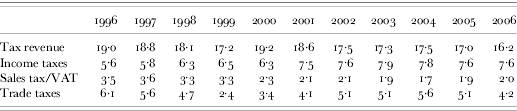
The restriction of neopatrimonial interference has resulted in improved revenue performance. The tax-to-GDP ratio went up sharply from 15·3% to 18·7% in the first year of ZRA's operation (World Bank 2003: 15); total revenue collected increased by 61% in the same period (Kasanga Reference Kasanga1996: 17). This tax-to-GDP ratio is above the regional average of 15·6% for 2003 (World Bank 2003: 14, sub-Saharan Africa excl. South Africa). In the following years, however, the tax take has largely remained stagnant at around 17% (see Table 1). At least in the beginning, economic development, tax policy and tax exemptions were contributory factors causing this stagnation. Until the end of the 1990s, Zambia experienced an economic downturn, which reduced the tax take (Gray et al. Reference Gray, Shera and Condy2001: 2, 11). The loss-making Zambia Consolidated Copper Mines (ZCCM) was a burden rather than a contributor to state revenue. Following a lengthy and contentious process, ZCCM was finally privatised and removed from state coffers in 2000 (Craig Reference Craig2001). Other parastatals such as the national electricity utility ZESCO amounted large tax arrears (World Bank 2003: 16, 43).
Revenue performance indicators Zambia
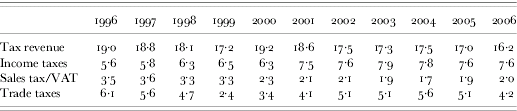
Notes: In per cent of GDP. Zambia's tax year begins at 1 January and ends at 31 December. Trade taxes include sales tax/VAT on imported goods. Data for 2005 are preliminary, for 2006 are projected.
Sources: 1996-2002: IMF (2004: 35), 2003-06: IMF (2006b: 22).
Tax rates and customs duties were lowered in order to induce economic growth. The highest income tax rate today stands at 37·5%; company tax is levied at 15% on farming, 35% on manufacturing and 40% on banks (PWC 2006). Tax exemptions were a further drain for revenue: at its peak in 1998, the government had granted tax exemptions to 500 corporations (Gray et al. Reference Gray, Shera and Condy2001: 22). The widespread exemption of the copper industry from taxation, for instance, meant that the Zambian state hardly participated in the high world copper prices of 2004 and 2005 (IMF 2006a: 11).Footnote 22 In the beginning, the major factors depressing the tax-to-GDP ratio therefore lay beyond the revenue authority's influence.
Yet, despite an average annual growth rate of 4·4% since 2000 (IMF 2005a: 55), the tax-to-GDP ratio has remained stagnant. This cannot be attributed only to the provision of tax exemptions. Some administrative weaknesses in recent years, possibly connected to the decreasing ‘exterritorial’ status of the ZRA, must also account for the stagnating revenue performance. This development augments the argument made that the sustainability of the tax administration reform project in Zambia is under threat. This initial upward movement in revenue performance followed by stagnation or even decline has been a characteristic feature of semi-autonomous revenue authorities in Africa (Fjeldstad & Rakner Reference Fjeldstad and Rakner2003: 17; Gray & Chapman Reference Gray and Chapman2001: 26).
At least in the Zambian case, this can primarily be attributed to the small tax base the ZRA collects from. The authority and the government have largely desisted from the administratively and politically demanding task of expanding direct taxation (Gray et al. Reference Gray, Shera and Condy2001: 12). Direct taxes have never amounted to more than 8% of GDP (see Table 1). For a long time, the government refrained from creating special tax instruments, such as a ‘presumptive tax’ for Zambia's huge informal sector. Only with the 2003 budget did the minister of Finance and National Planning announce that small-scale traders, marketers, unregistered mini-taxis and rental income would increasingly be targeted for taxation (RoZ 2003: 14). In 2004 he introduced a presumptive tax of 3% for businesses with an annual turnover of K200 million and below (RoZ 2004a: 19). Its significance has however remained modest.Footnote 23
It appears that political interests meet administrative interests in this case. The donor-supported revenue authority operates in line with business principles, and strongly focuses on revenue performance as the measure of success. The effort needed to raise a high amount of taxes from large registered businesses is lower than from the dispersed informal sector. Accordingly, the ZRA and other revenue authorities in Africa have not shown much interest in making the effort to tap these revenue sources (Fjeldstad Reference Fjeldstad2005: 3; Gloppen & Rakner Reference Gloppen and Rakner2002: 37). The Zambian government, for its part, has an interest in not taxing too strongly large parts of the electorate, who are found in the informal sector. Felix Mutati, then the deputy minister of finance and national planning, agreed that the Zambian government is wary of taxing this section of the economy: ‘every government in the world reacts to the retention in office’ (20.4.2004 int.). With formal sector employment accounting for less than 20% of Zambia's economically active population (CSO 1999: 40), the burden of income tax falls on the few individuals working for large companies or the public service.
* * *
The three features ‘concentration of political power’, ‘award of personal favours’, and ‘misuse of state resources’ reveal a striking continuity of neopatrimonial practice despite Zambia's regime transition in 1991. In spite of this neopatrimonial stability, the semi-autonomous ZRA has brought a significant increase in revenue performance. At about 17% of GDP, a larger part of state revenue today comes from domestic sources than under the old administrative structure.
In the African context, donors perceive the ZRA as a successful tax administration reform project (Gray & Chapman Reference Gray and Chapman2001). On the whole, the Zambian government has sustained the ZRA's independent position. It seems to interfere less with the ZRA's operations than other governments with their revenue authorities (for Uganda see Therkildsen Reference Therkildsen2004). Neopatrimonial and political demands can still be fulfilled through tax exemptions and the de facto non-taxation of the informal sector. Available evidence also suggests that the collection of non-tax revenue and service charges by other institutions is still characterised by ineffectiveness and the provision of political favours (cf. Burnell Reference Burnell2001a: 46–7). This demonstrates that the ZRA has limited neopatrimonial practices in relation to the collection of central state taxes only.
In other areas of the state, Zambia's political actors pursue neopatrimonial exchange relations largely unabatedly. Government members still satisfy particularistic demands through the expenditure side of the budget. As outlined, donor reports have repeatedly criticised the lack of budget discipline and the continued misuse of state resources (World Bank 2003, 2004; see also Burnell Reference Burnell2001a). In conjunction with strong donor oversight, the specific effects of Zambia's neopatrimonialism on the collection of domestic state revenue have changed, but neopatrimonialism has not vanished.
It can even be argued that the strengthened revenue generation function has provided additional funds for neopatrimonial practices, i.e. has increased them on the whole. This would amount to an unintended consequence of this technical donor intervention project. Following the argument, donors have overlooked the fact that limiting neopatrimonialism on the revenue side through ‘their’ ZRA as a strong formal institution, does not equal controlling neopatrimonialism completely. In the same vein, a former ZRA top manager stated with reference to President Chiluba that ‘it was in his interest to have a strong ZRA, to get money in’.Footnote 24 This reasoning fits well into other literature hypothesising that ‘new, relatively powerful Revenue Authorities that aid donors have been helping to establish in Africa have become major conduits for accumulating and channelling unrecorded revenues in wrong hands’ (Moore & Rakner Reference Moore and Rakner2002: 7).
Furthermore, the revenue authority has lost its special, donor-supported status. As a consequence of the DFID's exit in 2005 and the take-over of a Zambian management team, external actors have a declining leverage in pressuring for a well-funded and rational-legal tax administration. Funding problems and stagnating revenue performance in recent years are first indications that the sustainability of this donor intervention is under threat.
The reform of the tax administration in Zambia appears to be a typical example of the ‘partial reform syndrome’ (for Africa, see van de Walle 2001a: 60–3; for Zambia, see Rakner Reference Rakner2003: 168), meaning that political leaders only carry out reforms which do not hurt their vested interests. By strengthening tax administration, donors have provided more resources to Zambia's political actors. At the same time, expenditure management has remained largely ineffective. The ZRA's larger consequences for neopatrimonialism may therefore have been detrimental to its original intentions.