

Introduction
The number of calves produced per cow per year has a major influence on the economics and of beef production, with a high calf crop percentage being essential for profitability (Burris and Priode, Reference Burris and Priode1958; Meyer et al., Reference Meyer, Hammond, Parnell, Mackinnon and Sivarajasingam1990; MacGregor and Casey, Reference MacGregor and Casey1998). Calving interval (CI) can be defined as the number of days that elapse between two sequential parturitions from the same dam (Brown et al., Reference Brown, Durham, Cobb and Knox1954). For cattle, the desired CI is 365 days, in line with a target of one calving per year (Olori et al., Reference Olori, Meuwissen and Veerkamp2002). Reported CIs for beef cattle vary, with mean values of 370 days shown by Morris et al. (Reference Morris, Hickson, Martin and Kenyon2016) and a herd average of 376 days shown by Tapaloaga et al. (Reference Tapaloaga, Tapaloaga and Al Dulaimi2016); some studies have identified CIs beyond 399 days (Gutierrez et al., Reference Gutierrez, Alvarez, Fernandez, Royo, Dı´ez and Goyache2002; Yague et al., Reference Yague, Goyache, Becerra, Moreno, Sanchez and Altarriba2009; Huerta et al., Reference Huerta, Güereca and Lozano2016). Variation in CI can be attributed to its low heritability (Brzáková et al., Reference Brzáková, Svitáková, Veselá and Čítek2016) but environmental factors such as climate (Gwazdauskas, Reference Gwazdauskas1985) and nutrition (Maas, Reference Maas1987) significantly affect CI length. Lowman (Reference Lowman2012) estimated the cost of an extended CI at £3.50/additional day. Thus, reducing CI and optimising beef cow fertility is a key objective in modern beef production.
The objective of the current study was to evaluate the fertility of the most commonly used beef cow breeds in Northern Ireland (NI) and to investigate the effects of breed, season of birth, year of birth and offspring gender on beef cow fertility using CI as a primary measure. The information obtained will be used to better direct breeding programmes and help encourage better management practices to improve production efficiency and, in turn, profitability.
Material and methods
Data available
Data were extracted from the unique NI Bovine Information System (BovIS), an integrated database which captures and assimilates data from abattoirs with data reposited in the Animal and Public Health Information System (APHIS), a separate and centralised government record of all cattle currently registered in NI. Seven abattoirs (which collectively process ~90% of all cattle slaughtered in NI annually) currently participate in the BovIS project. These abattoirs each have a data upload tool installed in their IT infrastructure, which downloads data pertaining to each animal slaughtered. These data are aggregated on a daily basis and consolidated with APHIS data after cross-reference checks against four criteria (animal number, kill number, kill date and abattoir code). The data are compressed and uploaded to a central database through another custom built web service hosted on the Agri Food and Biosciences Institute website. The centralised cattle database sits on a SQL Server 2005 database hosted by the NI government’s Department of Environment, Agriculture and Rural Affairs. The database holds the combined data sets from both APHIS and each of the abattoirs. A total of 3 188 850 records exist for cattle slaughtered in NI between 04 January 2005 and 26 October 2012. Each record holds the following information: ear tag, sex, birth date, breed, dam ear tag, dam birth date, dam breed and carcase characteristics. The ear tag is a unique identification number exclusively assigned to a specific animal at birth and can be used to identify that animal throughout its lifetime, and postmortem. Using the individual dam tag number, data were cross-referenced to find dams with more than one offspring. Invalid breed and dam breed codes, and any records with missing data were removed, and filters were applied to discard dams younger than 550 days or older than 7300 days at calving. Due to the large number of dams recorded, it was not possible to include individual dam in the model to predict CI for all fixed effects. To negate the need for dam in the random model, only dams with one CI recorded were considered for individual analysis.
Seven beef cattle breeds (Charolais, Limousin, Belgian Blue, Simmental, Blonde d’Aquitaine, Aberdeen Angus and Hereford), and crosses thereof, accounted for 94.9% of the beef dams recorded on the database. In addition to these most common beef breeds, a further 56 beef breeds appear on the database and can be designated as ‘continental’ late maturing cattle that originated in mainland Europe, or ‘native’ early maturing, British breeds. In this study, recorded progeny breed was allocated as sire breed.
Age of dam (in days) was determined as the difference between dam date of birth and date of parturition. Dam age in months was the age in days divided by 30.5. To calculate CI, the dates of two consecutive births (parturition 1 and parturition 2) are required to be known. The CI is the number of days that elapse between parturition 1 and parturition 2. For accurate calculation of CI, offspring from both parturition 1 and parturition 2 must have been slaughtered at a participating BovIS abattoir. However, it was recognised that recorded parturitions 1 and 2 may not, in every case, have been consecutive if, for example, intervening offspring had been slaughtered at a non-BovIS abattoir, or bred as a replacement cow. To accommodate this CI was restricted to values between 250 and 600 days, based on the distribution of CI across 274 967 records. This CI range accounted for 89.3% of CI records and removed both any unduly extended CIs and CIs which were too short in length.
Statistical analyses
Predicted CI was analysed for cows with only one CI recorded, as a mixed linear model using the REML commands in GenStat. All breeds were included in this analysis, with less common breeds grouped by type (‘continental’ or ‘native’) as described previously. Fixed effects included in the analysis were dam breed, dam age (⩾48, 49 to 60, 61 to 72, 73 to 84, 85 to 96, 97 to 108, 109 to 120, 121 to 132, 133 to 144 and ⩾145 months), sire breed (parturition 2), previous sire breed (parturition 1), month of birth (parturition 2), previous month of birth (parturition 1), sex of offspring (parturition 2) and gender of previous offspring (parturition 1). Year was included as a random effect in the analyses and the variance component due to year of birth was constrained to be 7.68%. Cross-breeding of the dam was included in the original model, but was subsequently removed as it did not significantly affect the model and substantially reduced the volume of records available for analysis. Interactions were not included as they led to an over parameterised model.
Results
Breed effects
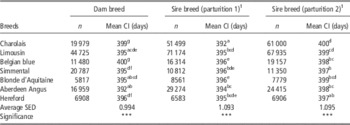
Regardless of breed, mean CI was found to be 395 days (±4.51). Table 1 shows that dam breed was significantly associated with CI (P<0.001) in the current data set. Of the most common breeds, the shortest CI was observed for Aberdeen Angus, however, it was not significantly shorter than the CI of the Limousin and Blonde d’Aquitaine dams (P>0.05). Charolais and Belgian Blue dams had the longest CI (P<0.05).
Comparison of dam breed effect on calving interval (CI) and impact of sire breed on subsequent CI (parturition 1) and previous CI (parturition 2)Footnote 1

a,b,c,d,e,f,gValues within a column with different superscripts differ significantly at P<0.05.
1 Two subsequent parturitions are required to calculate CI, thus the effects of sire from the first parturition (parturition 1) and second parturition (parturition 2) are included.
***indicates P<0.001.
Sire breed at parturition 1 was also significantly associated with CI (P<0.001). Charolais sires elicited the shortest subsequent CI. The longest CI was observed in Belgian blue, Simmental and Blonde d’Aquitaine sire breeds, but these were not significantly longer than Limousin and Hereford sires (Table 1). A range of only 4 days encompassed the mean CI of all sire breeds at parturition 1. At parturition 2, Herefords and Simmental elicited the shortest CI, but this was similar to those associated with Belgian Blue, Blonde d’Aquitaine and Aberdeen Angus sire breeds.
Age of dam effects
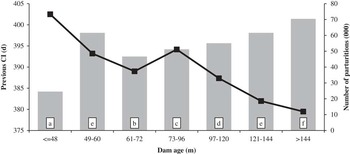
The highest proportion of CIs recorded showed dam age as <48 months at parturition 2 (26.8%; Figure 1). Dam age had a significant effect on CI (P<0.001). Dams <48 months of age had significantly shorter CI than dams in any age band >48 months. From 49 months of age onwards, a range of just 8.9 days encompassed the CI of all age ranges. The most extended CI was observed in cows over 144 months.
Effect of dam age on previous calving interval (CI). Bars denote mean of previous CI, line shows number of parturitions. Similar data labels denote where no significant difference was found (P<0.05).

Seasonal effects
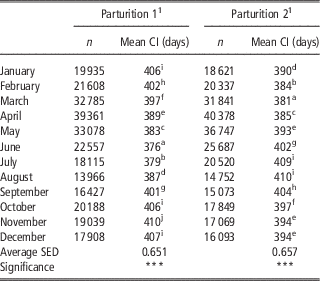
The month of birth had a significant association with both preceding and subsequent CI (P<0.001; Table 2). Moreover, there was evidence of seasonal calving, with 38.9% of all recorded calvings (parturitions 1 and 2) taking place in March, April or May. Dams which calved in November had the longest subsequent CI, whereas June-calving cows had the shortest subsequent CI. Preceding CI was longest in July and August (P<0.05) and shortest in March.
Effects of month of birth on subsequent calving interval (CI) (parturition 1) and previous CI (parturition 2)
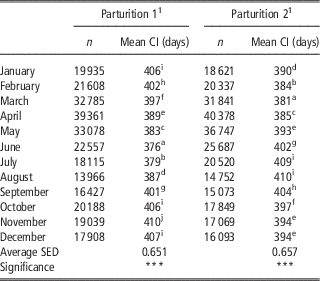
a,b,c,d,e,f,g,h,iValues within a column with different superscripts differ significantly at P<0.05.
1 Two subsequent parturitions are required to calculate CI, thus the effects of month of birth of the first parturition (parturition 1) and second parturition (parturition 2) are included.
***indicates P<0.001.
Sex of offspring
Sex of offspring was found to have no significant effect on either the previous or subsequent CI.
Discussion
The predicted means demonstrate a CI extended beyond the desired 365-day interval. Year of birth had accounted for little variation in CI; this is similar to a study by Slama et al. (Reference Slama, Wells, Adams and Morrison1976), who found no significant effect of year of calving on CI. However, this differed from that of MacGregor and Casey (Reference MacGregor and Casey1998) who found that year of birth had a highly significant effect on CI. MacGregor and Casey (Reference MacGregor and Casey1998) undertook a restricted study of one closed herd that had been developed with an emphasis on performance. As a result, the year effect may have been due to more progressive management on this farm compared with management techniques employed across the farms in the current study.
Dam breed was found to have a significant effect on CI, and this is supported by Osoro and Wright (Reference Osoro and Wright1992) who found that blue-grey cows had a shorter CI than Hereford cross-cows. There are several reasons why dam breed may affect CI, as dam breed is reported to cause variation in both oestrus length (Cushman et al., Reference Cushman, Allan, Thallman and Cundiff2007) and gestation length (Mujibi and Crews, Reference Mujibi and Crews2009) which both contribute to CI. The longest CI was observed in Belgian Blue, potentially due to double muscling which leads to a greater incidence of dystocia (Fiems et al., Reference Fiems, De Campeneere, Van Caelenbergh and Boucqué2001). Sire breed (parturition 1) had a significant effect on subsequent CI. This could be indicative of a sire effect on dystocia, Sire breed has been widely reported to effect dystocia (Long and Gregory, Reference Long and Gregory1974; Price and Wiltbank, Reference Price and Wiltbank1978; Mee, Reference Mee2008), which is reported as a factor in extending CI (Laster et al., Reference Laster, Glimp, Cundiff and Gregory1973; Hickson et al., Reference Hickson, Morris, Kenyon and Lopez-Villalobos2006). The significant effect of sire breed (parturition 2) on CI can be attributed to the variation between gestation lengths reported by Wray et al. (Reference Wray, Quaas and Pollak1987).
Dam age was found to significantly affect CI (P<0.001). This significant association is supported by MacGregor and Casey (Reference MacGregor and Casey1998) who also found the age of the dam to significantly (P>0.001) affect CI, but the scale of the relationship differs. Most studies which investigate age and CI find that as age increases CI decreases, Werth et al. (Reference Werth, Azzam and Kinder1996) found that 4-year-old cows calved 23.8 days earlier than 2-year-old cows, and MacGregor and Casey (Reference MacGregor and Casey1998) found that the shortest CI was achieved by 6-year-old cows (371.5±0.94 days; P<0.001), and the longest by 3-year-old cows (377.1±0.95 days; P<0.001). This differs from the findings of the current study, which show CI increasing as age increases.
The difference in CI throughout the months was supported by Lindley et al. (Reference Lindley, Easley, Whatley and Chambers1958) who reported that mean CI differed between seasons. Similarly, a model developed by MacGregor and Casey (Reference MacGregor and Casey1998) found that previous calving date had a highly significant (P<0.001) effect on CI. The distribution of calving throughout the year in the current data analysis, shows evidence for seasonal calving in the NI herd. This would suggest a restricted breeding period whereby the bull does not have access to the cows all year round. The shortest subsequent CI was observed in June (end of spring calving period), and so to maintain seasonal calving the subsequent CI must be relatively short. Restricted breeding periods can be used to help minimise postpartum infertility (Short et al., Reference Short, Bellows, Staigmiller, Berardinelli and Custer1990), however, limited breeding seasons can also have a detrimental effect on fertility as, when restricted breeding is practiced, cows calving later in the year are less likely to calve the following year (Burris and Priode, Reference Burris and Priode1958).
Sex could be expected to affect subsequent CI as male calves are known to have more difficult births due to their greater birth weight (Zaborski et al., Reference Zaborski, Grzesiak, Szatkowska, Dybus, Muszynska and Jedrzejczak2009), which can adversely affect uterine function (Roche et al., Reference Roche, Mackey and Diskin2000). Female calves are reported to have a shorter gestation length (Cundiff et al., Reference Cundiff, Gregory and Koch1974; Casas et al., Reference Casas, Thallman and Cundiff2011) which would reduce CI. The current study found sex of offspring from parturition one and two had no effect on CI (P>0.05). Sex not having an effect on CI is widely reported (Burris and Blunn, Reference Burris and Blunn1952; MacGregor and Casey, Reference Maas1998; Abdel-Aziz et al., Reference Abdel-Aziz, Ali and Ahmed2005) suggesting that although progeny sex can affect the constituents of CI, it will not affect the overall CI.
Conclusion
This study has illustrated that CI in NI is sub-optimal. There are variables within the farmers’ control (such as the choice of dam and sire breeds, and the length of the breeding period) which affect CI. This information can be used to facilitate future management decisions to increase beef cow fertility within both the NI herd and other populations, which have extended CI.
Acknowledgments
The author would like to thank the local Department of Agriculture and all of the abattoirs involved in the BovIS project.