Pour Catherine Cessac, amie de la duchesse du Maine mais point ennemie
Several years ago, the programme for the national meeting of the American Musicological Society included an unusual feature: a tag cloud of the paper abstracts (a computer-generated diagram representing the frequency of particular words in the texts). Front and centre in the diagram, in the largest print, was the word ‘opera’, a metric that underlines the popularity of opera scholarship in recent times, especially in anglophone musicology. This predominance of interest in the genre has certainly spurred on major scholarly contributions, but it also has its dark side in the neglect of other areas, especially sacred and chamber music. Chamber music, by its very nature, implies a small select audience, and in the eighteenth century it was less likely to attract the attention of chroniclers or journalistic writers, which in turn makes its influence and significance difficult to assess today. Thus an overemphasis on opera can potentially distort our view not only of ‘music history’, but also of the sources and collections that inform it.
This observation is particularly relevant to the study of the cantate française, the initial scholarly description of which by Eugène Borrel in 1958 as an ‘opera in miniature’ (‘opéra en miniature’) has since been problematized.Footnote 1 While the genre enjoyed a vogue from 1706 to the 1730s, a period that saw a sudden explosion of published prints, we have little information about its social and material history: who bought these volumes, what were the size and contents of their collections, and how did they use the scores? Indeed – in contrast to French operas and ballets – we know relatively little about the circumstances in which cantates were originally performed. This problem was noted by David Tunley, who ascribed the popularity of the genre to salons; more recently, Laura Naudeix has made a similar observation, asserting a relationship of sociability between singers and listeners.Footnote 2 However, the few early descriptions largely document performances for high-ranking nobles, often in celebratory situations (particularly those in the circle of Philippe d'Orléans, the future regent of FranceFootnote 3), or the inclusion of cantates in stage performances and, later, public concerts such as those of the Concert Spirituel.Footnote 4 Sometimes the volumes themselves give titbits of information about the particular circumstances in which pieces were written or performed, many of these again in public or semi-public social situations for high-ranking nobles.Footnote 5
Furthermore, it is clear that the vogue went beyond Paris and its environs, and that cantates played an important role in the communication of culture and style across political boundaries. Cantates were available in print in francophone cities in the Low Countries, particularly in collections issued in Amsterdam by Étienne Roger and Charles Le Cène. Roger's serial Recueil d'airs sérieux et à boire de différents autheurs, for example, includes cantates found nowhere else today, among them important works by figures such as Charles-Hubert Gervais, Michel Pignolet de Montéclair and Giovanni Antonio Guido, to name but a few.Footnote 6 Likewise, ongoing research in European libraries is still yielding evidence of the cultivation of cantates at francophile German courts, including new pieces attributed to Nicolas Bernier in Rostock.Footnote 7 Interest in the genre during the period prompted the publication of a collection of cantate texts in The Hague by Jean Bachelier, Recueil de cantates, contenant toutes celles qui se chantent dans les concerts: pour l'usage des amateurs de la musique et de la poësie (1728). While these sources reveal the existence of an international network for the transmission of cantates, the private nature of their performance makes it difficult to know the extent of this network's reach. Who were these ‘amateurs’, and what were these ‘concerts’? How did this repertoire – some of it even not publicly available in France – reach these centres? Who acquired these scores and how were they used?Footnote 8
Because detailed records of performances of cantates françaises and documents concerning their international exchange are very rare, it is instructive to turn to the musical sources themselves – and to the collections of which they form a part – in order to answer such questions. The recent rediscovery of a unicum source of the cantates françaises by Philippe II, duc d'Orléans (1674–1723), in a manuscript in the Württembergische Landesbibliothek in Stuttgart (D-Sl), represents a starting-point for such an investigation. This volume (shelfmark HB XVII 783), hereafter referred to as MS 783, represents a major discovery, since Philippe was not only a key political figure (nephew of Louis XIV and regent of France), but also active as both an amateur composer and a musical patron, especially to the composers of the first cantates.Footnote 9 Although Philippe's tragédies en musique have attracted attention – La Suite d'Armide having just received its modern premiere – his cantates françaises have been known only through their texts, printed in Bachelier's Recueil de cantates.Footnote 10 In fact, MS 783 entered the Landesbibliothek collection in 1922, but it remained unknown until a catalogue of the library's manuscripts was published in 2004, and it has escaped musicological notice until now.Footnote 11
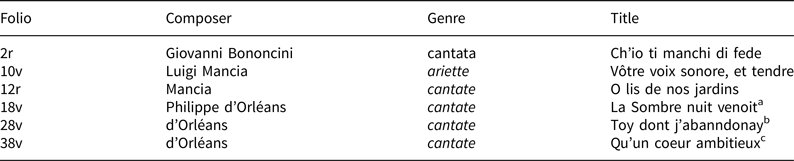
While Orléans's cantates have significant implications for the genre's early history, an understanding of their music requires resolving the complex problems raised by a number of curiosities about the source, particularly its unusually cosmopolitan contents (listed in Table 1) and its provenance. Why does MS 783 contain a well-known Italian cantata by Giovanni Bononcini, a heretofore unknown cantate and French air by Luigi Mancia – an Italian composer who is not known to have composed any other music to French texts – and three unique sources of cantates by a major historical figure? What was/were the original source(s) of these pieces and how did they end up together? Who had this unusual manuscript copied, when, and why? Furthermore, how did it end up in a library in southwestern Germany? Answering these questions requires an intensive investigation into the relationships between the repertoire preserved in MS 783 – along with its place in the Landesbibliothek collection – and the social contexts in which it was produced and used.
The contents of manuscript HB XVII 783, Württembergische Landesbibliothek, Stuttgart

a Text attributed to Philippe d'Orléans with the title ‘L'Amant trahi’ in Jean Bachelier, Recueil de cantates (The Hague: Alberts and Vander Kloot, 1728), 299.
b Text attributed to d'Orléans with the title ‘La Résolution inutile’ in Bachelier, Recueil de cantates, 284.
c Text attributed to d'Orléans with the title ‘Le Dégoût des grandeurs’ in Bachelier, Recueil de cantates, 268.
One approach to these questions begins in contemporary history, with MS 783's problematic provenance. MS 783 forms part of a collection that has long been known for its large component of French music but whose history and composition have been viewed largely through an operatic lens. According to Clytus Gottwald, the author of the catalogue made in 2004, the volume containing Philippe's cantates belongs to the collection of ‘Lully manuscripts’ in the library, an assertion that turns out to be quite misleading.Footnote 12 Gottwald's catalogue makes considerable use of an earlier study of the collection by Reiner Nägele, who viewed the cantate française as ‘eine Modeerscheinung, die außerhalb der Grenzen Frankreichs zwar kurzfristig auf geringes, insgesamt aber kaum mehr als marginales Interesse stieß’ (a fad that, although it briefly generated a limited interest outside the borders of France, was overall hardly more than marginal).Footnote 13 The rediscovery of the cantates by Philippe d'Orléans – which had not yet been catalogued at the time of Nägele's analysis – prompts a re-evaluation of the contents of this collection by focusing on its very large (and heretofore unstudied) component of cantates, rather than its operas.
This re-evaluation reveals a particularly complex network of international connections revolving around social exchanges between high-ranking aristocratic musical amateurs: not only Philippe d'Orléans himself, from whose personal library the manuscript's contents were almost certainly drawn, but also the noble couple who had MS 783 copied. My examination consists of three parts, each employing circumstantial and contextual evidence of links between musical sources and practices of sociability, connoisseurship and collecting that were largely private and thus left a very limited trace. First, an investigation of the contents of MS 783 in the context of Philippe's activities reveals that this manuscript reflects characteristic aspects of his international musical connections during the period 1701–1706, when he was deeply involved in experiments that gave birth to the cantate française. Second, an analysis of the manuscript's provenance and its place in the Stuttgart collection – in particular its connections to four volumes that belonged to Marie-Thérèse de Lannoy de La Motterie (1692–1750) – indicates that MS 783 was most likely copied for her. These volumes demonstrate that La Motterie was an amateur harpsichordist and collector, and probably a singer as well. As the wife of Joseph Lothar Dominik von Königsegg und Rothenfels (1673–1751), the representative of the Holy Roman Emperor to France during Philippe's regency, she played an important diplomatic role via the sociability required by her position. The couple was in Paris from March 1717 to July 1719, during which time they actively participated in the cultural life of the city and court, purchasing the large group of cantate prints that are now a major part of the French collection at the Landesbibliothek. Finally, an examination of documents from the couple's period in Paris, considering the central role played by collecting and connoisseurship in the courtly life of the regent, indicates that La Motterie was permitted to make a copy of Philippe's cantates via her cultivation of members of his circle. Thus MS 783 highlights the important role played in the international transmission of cantates françaises and other chamber music via diplomatic and familial connections of noble amateurs, especially those curious about musical developments beyond their own regional practices.Footnote 14
MS 783 and Philippe d'Orléans's International Contacts
The complex characteristics and contents of MS 783 play an important role in gaining a new understanding of the origins of the Stuttgart collection and of Philippe d'Orléans's international connections. The volume was copied on folio-size Dutch paper manufactured by Lubertus van Gerrevink in the early eighteenth century. It is bound in calf's leather with gold-stamped decorations, indicating a fairly wealthy owner.Footnote 15 The unknown copyist seems not to have been a native French speaker, as, for example, he or she uses unorthodox terms for genres: not only are Orléans's cantates labelled variously ‘Cantate Françoise’, ‘Cantata Françoise’ and ‘Cantata Françoises’ (the last shown in Figure 1), there are also corrections of errors in the text in a second hand.Footnote 16 However, a particular quirk helps identify its provenance as part of the large La Motterie collection: as is visible in the lowest staves of Figure 1, the manuscript presents lines for voice and continuo, but simultaneous rests in both indicate that there were originally accompanying instrumental parts that were copied separately and are now missing.
Philippe d'Orléans, Le Dégoût des grandeurs, first page. Württembergische Landesbibliothek, Stuttgart, HB XVII 783, fol. 38v. Used by permission

The distinctly cosmopolitan contents of MS 783 (Table 1) reflect Philippe's obsession with music, his international connections and his patronage of experiments in combining the French and Italian styles during the development of the cantate française. In addition to the three cantates by Philippe himself, the manuscript includes an Italian cantata by Giovanni Bononcini, Ch'io ti manchi di fede, and a heretofore unknown French air and cantate by the Italian composer and singer Luigi Mancia (c1665–after 1708), all for high voice and continuo.Footnote 17 The three cantates attributed to Philippe in MS 783 employ the same texts attributed to him in Bachelier's Recueil de cantates, and thus it seems fairly secure that he composed the music.Footnote 18 Although there is no way to date Philippe's cantates precisely, they almost certainly stem from the period prior to the beginning of his military service in 1706, when he was actively engaged in both composition and musical patronage. Reports of his musical activities peak in the period 1701–1706: after he inherited the Orléans fortune from his father, when he composed two operas and when his musicians were actively engaged in writing their first cantates.Footnote 19
The other pieces in the manuscript all have links to Philippe and were almost certainly copied from his personal collection; they reflect other sources associated with his network as well as his practice of using international familial connections to acquire music and musicians in order to satisfy his curiosity about Italian and French musical styles.Footnote 20 These phenomena all formed part of his experiments with the development of the French cantate, a genre that made its debut in a series of prints issued from 1705–1706 by musicians in his orbit: Jean-Baptiste Morin, Nicolas Bernier and Jean-Baptiste Stuck.Footnote 21 Around 1701, Philippe used his international contacts to bring two Neapolitan string player-composers to France: Stuck, who played cello, and the violinist Giovanni Antonio Guido. He also arranged for his violinist Jean-Baptiste Anet to study in Italy. In 1703 he organized the transfer of two castratos from cardinal Pietro Ottoboni in Rome (Pasquale Betti and Pasqualino Tiepoli) in order to fill out his ensemble of Italian musicians. This group certainly played a central role in concerts he hosted that involved ‘combats’ between the French and Italian styles, as reported by Hubert Le Blanc:
Monseigneur le Duc d'Orléans, depuis Régent, honoroit de sa présence, les combats de l'Harmonie Françoise et de l'Italienne, et tenoit la porte lui-même, pour ne laisser entrer que les Amateurs insignes ou l’élite de ceux qui éxécutent.Footnote 22
Monseigneur the duc d'Orléans, who has since become regent, honoured the combats between French and Italian harmony with his presence, and held the door himself in order to allow entrance only to exceptional amateurs and the elite among those who perform.
The two castratos stayed in France for two years, from 1703 to 1705, during what was probably the height of the experimentation with French cantates in his circle of musicians.Footnote 23
The first item in MS 783, a frequently copied Italian cantata by Giovanni Bononcini, might seem a surprising inclusion in a volume that otherwise contains French-texted music found in no other source, but in fact it reflects not only the popularity of Bononcini's cantatas in Paris but also their central place in the repertoire performed by Orléans's ensemble and in the early experiments with cantates.Footnote 24 Composed during Bononcini's period in Rome from 1692 to 1698 (and probably brought to France by Betti and Tiepoli), Ch'io ti manchi di fede played a critical role in these experiments because it employs a very rare and therefore characteristic feature that served as an important model for cantatas by Philippe, Stuck and Guido: a form Bertrand Porot dubbed the ‘air contrasté’ (contrast aria), a da capo aria with a B section in a different metre and/or tempo.Footnote 25 It was a notable feature of the first cantates in Philippe's orbit because it appears in seven out of the nineteen arias in Stuck's first book of cantates (1706), quickly disappearing from his subsequent publications. Contrast arias are likewise a feature of Guido's Italian cantatas, which were probably written for Philippe's Italian ensemble because they are found at the end of D-11588 in the Conservatoire collection at the Bibliothèque Nationale, Paris (F-Pc) – a miscellany of arias stemming largely from Neapolitan and Milanese operas performed in 1700–1703, probably collected by Guido on his travels to France in 1702–1703.Footnote 26 Furthermore, MS 783 reveals that Philippe's cantates were also dominated by this form, which accounts for five of their thirteen arias. These are unprecedented proportions for either the French or the Italian cantata repertoire, in which the usage of such arias was otherwise very rare, reflecting the important place of Ch'io ti manchi di fede among Philippe's circle of musicians, and therefore in his collection of music.
The connection between Philippe and the two French pieces by Mancia in MS 783 is more circumstantial, but also reflects a very unusual phenomenon: the composition of a French cantate by an Italian composer. This phenomenon is in fact largely found in sources associated with Philippe. Besides cantates by Stuck and Guido, there are three such works known today: Mancia's O lis de nos jardins in MS 783, Pietro Antonio Fiocco's Philomèle in Rés 1451 (F-Pc) and Handel's Sans y penser (in the British Library (GB-Lbl), R.M.20.d.11, fols 61–66). All three can be traced to Philippe via his practice of using international contacts in the service of his experiments with the cantate française, albeit indirectly in the case of the Handel piece, the origins of which are unknown but probably resulted from the composer's contacts with Orléans's two former singers, Betti and Tiepoli, during his stay in Rome. The two castratos not only both sang in Handel's Italian cantatas, but – according to a memoir attributed to Denis Nolhac – they maintained an interest in French culture that might have stimulated the composer's curiosity about cantates:
J'eus occasion de le [Handel] voir chez les fameux Musiciens du Pape nommez Pasqualini; comme ils avaient été long tems à Paris au service du Duc d'Orleans, ils étoient charmez quand ils rencontroient des François[;] ils leur faisoient mille honnêtetez; ils venoient méme quelquefois chez moi manger la soupe à la Françoise. Monsieur Haindel rendoit visite à Rome à tous ces Messieurs Musiciens qui avoient quelque réputation, il vint par consequent chez ceuxci, qui m'invitèrent à cette occasion.Footnote 27
I had occasion to see Handel at the home of the famous musicians of the pope, named Pasqualini. As they were in Paris for a long time in the service of the duc d'Orléans, they were charmed when they met Frenchmen; they did them many good turns; they even sometimes came to my home to eat French soup. Mr Handel made visits to all these Messieurs musicians who had earned some reputation in Rome, and consequently came to visit these two, who invited me on that occasion.
Not only did Philippe use his international contacts to acquire Italian musicians who wrote cantates (Stuck and Guido), but he employed them in the service of at least one long-distance ‘combat’: between his composer Jean-Baptiste Morin and Fiocco, a Venetian based in Brussels who had composed new French prologues for performances of Lully's operas in the city.Footnote 28 The results of this ‘combat’ can be found in Rés 1451, which preserves – side by side – the two composers’ competing settings of Philomèle, one of the earliest cantate texts by the genre's literary inventor, Jean-Baptiste Rousseau, who was also a protégé of Philippe.Footnote 29 The other contents of Rés 1451 demonstrate that the manuscript stems from the early period of experimentation with the cantate occurring in Philippe's circle, as it comprises unica copies of Stuck's Italian cantatas as well as early unpublished versions of cantates by Morin and several of his ariettes, French airs in da capo form that played a central role in early efforts in creating cantates.Footnote 30
This ‘combat’ between Morin and Fiocco would have required an international exchange: the receipt of Rousseau's text and the return of Fiocco's setting. This exchange may have occurred via Philippe's shared interest in the controversies concerning the French and Italian styles with Fiocco's patron, Maximilian Emanuel, Elector of Bavaria (1662–1726).Footnote 31 Although any correspondence between the two patrons has yet to surface, Maximilian Emanuel was not only a major connoisseur of both Italian and French music, but Philippe's cousin by marriage, and he had fought alongside Philippe during Louis XIV's Dutch campaigns of the 1690s.Footnote 32 Their common musical interests were evident during Maximilian Emanuel's visit to France in 1709, when he was the guest of honour at a two-hour concert hosted by Philippe at his château at Saint-Cloud, during which both Italian music and French cantates were performed, according to the Mercure:
La Musique commença à cinq heures & demie. Il y en eut d'Italienne & de Françoise; Mademoiselle Hullot fut fort applaudie, & apres quelques Cantates Françoises la Musique finit à sept heures & demie.Footnote 33
The music began at 5.30 [p. m.]. There was both French and Italian music; Mademoiselle Hulot was greatly applauded, and after a few French cantates, the music finished at 7.30.
During this same period the Elector acquired Philippe's violinist, Jean-Baptiste Anet.
The inclusion of Mancia's O lis de nos jardins and his ariette ‘Vôtre voix sonore, et tendre’ in MS 783 thus reflects what we know of Philippe's interests and transnational collecting practices. Like Fiocco, Mancia was a well-travelled musician fluent in French, Italian and German. There is no record of his travel to France, but in 1702–1703 he worked for another of Philippe's familial contacts: his cousin, Sophie Charlotte of Hanover (1668–1705).Footnote 34 Sophie Charlotte's courts in Hanover and Berlin – like those of Maximillian Emanuel – were known for their mixture of French and Italian musical influences, and Philippe cultivated her as another of his international connections, sending her a portable harpsichord as a gift, perhaps in recompense for the music by Mancia.Footnote 35 This instrument, a clavecin brisé (folding harpsichord) by Jean Marius, dated to exactly this period (c1700–1704), survives in the Staatliches Institut für Musikforschung in Berlin.Footnote 36
The ariette by Mancia also represents a parallel to the contents of Rés 1451, which includes ariettes by Morin and reflects the experimentation with settings of French texts via Italian forms that was central both to the musical life at Philippe's court and to the invention of the cantate. Therefore the pieces in MS 783 reflect Philippe's international connections, his collecting practices and his personal interest in a réunion des goûts during the period 1701–1706. These connections, considered alongside the unique stylistic links between the Bononcini and cantates composed in Philippe's circle, together with the rarity and exclusivity of the rest of the contents of MS 783, represent strong circumstantial evidence that the manuscript was copied from elements in Philippe's personal collection.
The French Collection at Stuttgart and the Problem(s) of Its Provenance
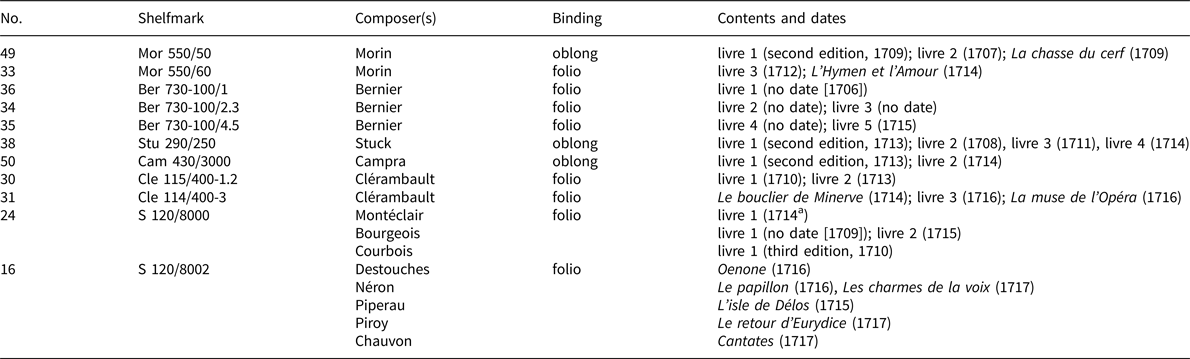
How and why did a manuscript copy of cantates by such a famous figure end up surviving in Stuttgart and nowhere else? The cosmopolitan mixing of French and Italian chamber music in MS 783 is a key to the re-evaluation of the collection of French scores at Stuttgart in which it is found. The core of this collection includes a large number of exclusively French scores dating from 1678 to 1733 that stem from the library of the Teutonic Order (Deutschordensbibliothek) at Altshausen (Swabia).Footnote 37 Although no catalogue from the period exists (the earliest, dated 1806, was compiled from a larger group of libraries), most of the volumes from the Deutschordensbibliothek are identifiable because they were numbered by a single hand on the upper-right corner of their flyleaves. Other identifying marks (or the lack thereof) divide the collection into two main halves, each with its own particular origins. The first half is formed from volumes dating from 1678 to 1702 that bear marks of ownership by Henry Wingfield (died 1712), a member of the exiled court of James II at Saint-Germain-en-Laye. This part of the collection is composed entirely of opera and ballet scores, both prints and manuscripts, and includes the well-known Lully sources. The other half, largely without indications of ownership, is more complex in composition but includes mostly prints. The seventeen opera scores in this group date from as early as 1686 (a print of Lully's Acis et Galatée, labelled no. ‘6’) to as late as 1733 (a print of Rameau's Hippolyte et Aricie, no. ‘11’). However, this group is dominated by no fewer than thirty-two cantate collections bound together into eleven volumes (listed in Table 2). They include virtually all of the works by the major composers in the genre up to and including 1717, and comprise a complete series of publications by Morin, Bernier, Stuck, Campra and Clérambault – all protégés of Philippe d'Orléans – up to that year. This collection is therefore an important one; few modern libraries can boast such a set. In addition, of course, there is the manuscript volume containing Philippe d'Orléans's own cantates, which bears the number 37 from the Deutschordensbibliothek. Thus it is in fact the cantates (that is, chamber music, not operas) that mark this group of later volumes as special and unusual.
Volumes of cantate prints stemming from the Deutschordensbibliothek, in the Württembergische Landesbibliothek, Stuttgart

a Montéclair's first book, although issued in 1714, must have been purchased after 1716, because it contains a handwritten addition to the list of the composer's works: the ballet Les Fêtes de l’été, which premiered that year.
It is this aspect of the collection that provides the clues to its origins: it was marked by its collector's interest in cantates françaises, to which he or she had access up to – but not much later than – 1718, a point that has so far been largely overlooked in discussions of its provenance. Gottwald points out that the collection had probably been assembled by the music-loving Austrian nobleman Christian Moritz von Königsegg und Rothenfels (1705–1778), who was Landkomtur (provincial commander) of Alsace and Burgundy at Altshausen from 1758 until his death.Footnote 38 During his tenure, Christian Moritz purchased two libraries for the Order, consisting of both scores and books (the catalogues of which have unfortunately not been preserved). One was that of his predecessor, Philipp Joseph Anton Eusebius von Froberg (1688–1757), who served as a Landkomtur in Altshausen from c1734 until his death; the second, for which the Orden paid 6,500 florins (a very high price), was probably that of his uncle and aunt, Joseph Lothar Dominik and Marie-Thérèse de La Motterie. One likely candidate for the source of the French scores was Froberg, who was originally from Savoy but lived in Paris for a good part of his life (acting as representative of the Elector of Bavaria) and died there in 1757.Footnote 39
For Nägele, the crucial piece of evidence in favour of Froberg as the originator of the collection was its latest item: a printed copy of Rameau's Hippolyte et Aricie (1733), whose date precedes Froberg's assumption of the position of Landkomtur by one year. Nägele claimed that its binding was similar to that of virtually all of the other printed volumes, meaning that they must have all been bound at the same time, after 1733. However, the binding of the Rameau is in fact distinctly different: it employs thick dark leather, whereas all of the cantate volumes (and most of the later operas) are bound in the thin mottled leather characteristic of commercial music binding in Paris during this period.Footnote 40 Furthermore, Hippolyte is an outlier in another crucial way: all of the other items in the collection were published before 1718. Why would an avid collector of French cantates and operas suddenly stop buying and then resume again fifteen years later with a single opera volume? Surely a better explanation is that the copy of Hippolyte, an opera that created a storm of interest, was bought later by someone else who was not necessarily a connoisseur of cantates.
Marie-Thérèse de Lannoy de La Motterie: Musical Amateur and Collector
An answer to these questions lies in the connections between this large cache of cantate prints and the contents of four other volumes in the collection of the Teutonic Order – of which three are manuscripts – that belonged to Christian Moritz's aunt, Marie-Thérèse de La Motterie. Among these is a print of André Cardinal Destouches's opera Amadis de Grèce (1699), with the following inscription:
Ce Livre est a Mademoiselle De La Mottry Chanoinesse De L'hilustre chapitre De Nivelles, souvenez vous je vous prie de celle qui vous à ecrite cela car elle vous aime beaucoup – De Reims le 29 Octobre 1706.Footnote 41
This book belongs to Mademoiselle de La Mottry, canoness of the illustrious chapter of Nivelles; remember, I pray you, her who wrote this to you because she loves you very much – Reims, 29 October 1706.
Given the terms of endearment in this inscription, this volume was probably given to the then thirteen-year-old canoness by her mother, who had likewise been a member of a convent before her marriage. Marie-Thérèse's father – François-Hyacinthe de Lannoy, comte de La Motterie (1648–1725), whose lands spanned both France and the Low Countries – served as envoy to both Charles II of Spain and, after 1701, to the Elector Palatine.Footnote 42
Marie-Thérèse had received a prebendary in Nivelles (south of Brussels, where her father had a house) on 20 September 1697, at the age of five; she gave this up in March 1720 because she had married Joseph Lothar von Königsegg und Rothenfels in Brussels in 1716, when he was serving as governor of the Austrian Netherlands. Königsegg spoke fluent French and was familiar with French culture, having been educated at a Jesuit school in Besançon; he had been intended for a career in the priesthood, but went into military and diplomatic service instead.Footnote 43 According to the Marquis de Dangeau, their marriage was made ‘for love’ (‘qui s'est fait par amour’) rather than duty.Footnote 44 In 1717 the newlyweds journeyed to Paris, where Königsegg acted as emissary of the emperor to the regent until the middle of 1719.Footnote 45 He then moved on to other diplomatic missions in Dresden and Warsaw before continuing his military career, dying childless in Vienna in 1751, one year after Marie-Thérèse.Footnote 46 At that point their library was inherited by their nephew, Christian Moritz, who presumably moved it with him to Altshausen when he took over as Landkomtur in 1757, eventually selling it to the Teutonic Order. Christian Moritz, an avid music-lover like his aunt, then played a major role in reinvigorating the musical life at the Teutonic Order by hiring musicians and acquiring new music.Footnote 47
Although little documentary evidence of Marie-Thérèse's musical life has come to light, her volumes of music bear witness to her performance of music as an amateur. Her copy of Destouches's Amadis de Grèce bears numerous markings and several inky fingerprints at page edges, suggesting its use by an adolescent amateur musician.Footnote 48 The contents of the other three volumes, with virtually identical bindings bearing Marie-Thérèse's maiden name (see Table 3 and Figure 2), indicate not only that she was a competent amateur harpsichordist (and probably singer), but also that she developed extensive interests in contemporary Italian and French music, especially cantates françaises. While it is not clear where or how the items in these manuscripts were copied, most of the pieces for which dates can be established were composed in the period 1699–1711. This is consistent with the fact that the bindings of the volumes are all inscribed with the stamp ‘Mad[emois]elle de La Motterie’ (shown in Figure 2), meaning they must have been bound sometime before her marriage in 1716.
Volumes in the Württembergische Landesbibliothek, Stuttgart, belonging to Marie-Thérèse de La Motterie

Binding of manuscript HB XVII 719. Württembergische Landesbibliothek, Stuttgart. Used by permission

Like the Destouches print, at least one other volume shows signs of use. D-Sl HB XVII 720 (hereafter MS 720) begins with four pages of exercises in figured-bass realization and ends with a section containing four solo harpsichord pieces, including a sarabande and a gigue by Jacques Hardel, a partially unmeasured prelude and a ‘très belle pièsse’.Footnote 49 These pieces do not all seem to be copied in a French notational style, and the prelude in fact employs ornaments notated as a double slash on the note stems, indicating a Dutch or English source, not surprising for a copy used by a girl who grew up not far from Brussels.Footnote 50
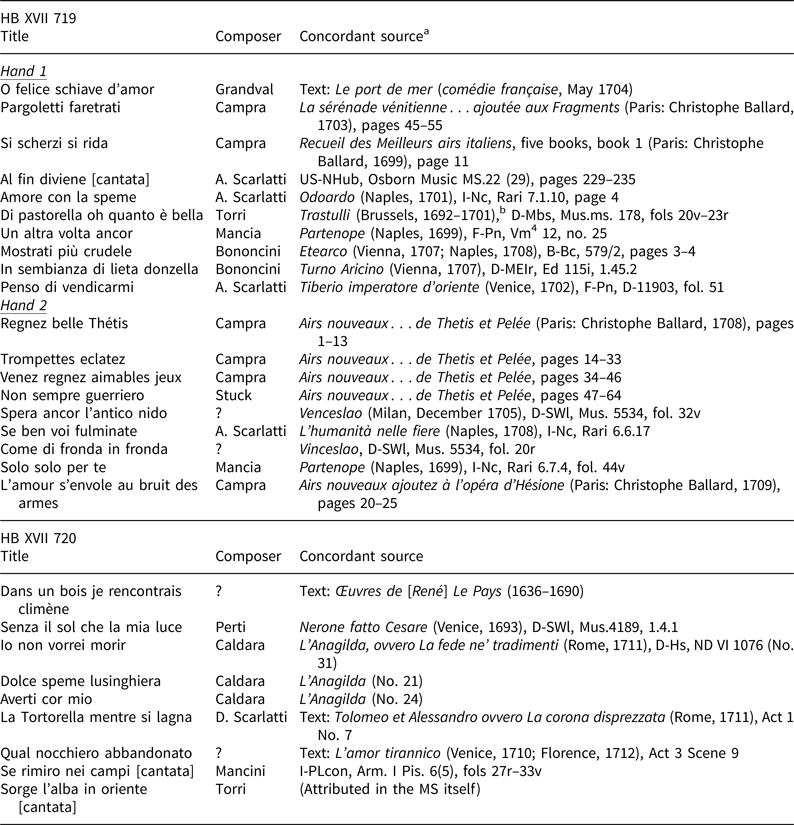
The repertoire in these volumes (Table 4) demonstrates Marie-Thérèse's interest in both French and Italian music as well as French cantates, as one of them (HB XVII 718, hereafter MS 718) is a complete copy of Bernier's first book (originally published in 1706). The manuscripts include solo music for soprano and continuo as well as arias for soprano and between one and three accompanying string parts. HB XVII 719 (hereafter MS 719) is a miscellany of fifty-one French and Italian items in the hands of two different copyists. As demonstrated in Table 4, it includes arias from Roman, Neapolitan, Milanese and Viennese operas from the period 1699–1707 and a combination of Italian-texted arias and French ariettes copied from Parisian printed sources, including Christophe Ballard's Recueil des Meilleurs airs italiens (book 1, 1699) and several ariettes by Campra from the Airs nouveaux . . . de Thetis et Pelée (1708).Footnote 51 MS 720, written in several different hands, includes arias from Caldara's L'Anagilda, ovvero La fede ne’ tradimenti (Rome, 1711), a solo cantata by Francesco Mancini (Se rimiro nei campi) and a cantata attributed to Pietro Torri for soprano and bass (Sorge l'alba in oriente). It also features several arias with orchestral accompaniment, including one from Pietro Torri's Trastulli collection (Brussels, 1701) and two attributed to Domenico Scarlatti (one is from his Tolomeo e Alessandro, which was – like L'Anagilda – given in Rome in 1711). The combined presence of arias from private commissions – L'Anagilda by Francesca Maria Ruspoli and Trastulli by Maximilian Emanuel – indicates that whoever assembled the manuscripts had ample access to Parisian sources and connections to various important patrons throughout Europe.Footnote 53
Attributable Items in the La Motterie miscellanies, Württembergische Landesbibliothek, StuttgartFootnote 52

a These sources were identified through searches in RISM, the CLORI database and various library catalogues. The Milanese excerpts are identified in Don Fader, Music, Dance, and Franco-Italian Cultural Exchange c. 1700: Michel Pignolet de Montéclair and the Prince de Vaudémont (Woodbridge: Boydell & Brewer, 2021), 172.
b See Marie Cornaz, ‘Inventaire complet du fonds musical des archives privées de la famille d'Arenberg à Enghien’, Revue belge de musicologie / Belgisch Tijdschrift voor Muziekwetenschap 58 (2004), 117–118.
Abbreviations:
- B-Bc
Conservatoire Royal de Bruxelles, Bibliothèque – Koninklijk Conservatorium Brussel, Bibliotheek
- D-Hs
Staats- und Universitätsbibliothek Carl von Ossietzky, Musiksammlung, Hamburg
- D-Mbs
Bayerische Staatsbibliothek, Munich
- D-MEIr
Meininger Museen, Sammlung Musikgeschichte, Max-Reger-Archiv, Meiningen
- D-SWl
Landesbibliothek Mecklenburg-Vorpommern Günther Uecker, Musikaliensammlung, Schwerin
- F-Pn
Bibliothèque Nationale de France, Paris
- I-Nc
Biblioteca del Conservatorio di Musica S. Pietro a Majella, Naples
- I-PLcon
Biblioteca del Conservatorio di Musica Vincenzo Bellini, Palermo
- US-NHub
Yale University, Beinecke Rare Book and Manuscript Library, New Haven
This interest in French ariettes and cantates as well as Italian arias is key to understanding the nature of the Stuttgart collection and also the provenance of the volume of Philippe's cantates. In particular, the many cantate prints in the Stuttgart library that stem from the Deutschordensbibliothek were almost certainly purchased by the couple during their stay in Paris in 1717–1719. The printed volumes all have virtually identical standard thin leather bindings, and several were purchased together as bound sets. For example, the volume labelled No. 49 contains Morin's first two books of cantates plus his La Chasse du cerf bound together by the Ballard firm, who added an additional communal title-page.Footnote 54 In Destouches's Oenone (1716), Jean-Baptiste-Christophe Ballard inserted a list of available cantate books (Figure 3), indicating those that could be purchased bound together, including three of the groups found in the Deutschordensbibliothek collection: the two books by Campra, four books by Stuck and three books by Morin.Footnote 55 Likewise, many of the early volumes in the collection are second editions (including those of Morin, Stuck, Campra and Courbois), indicating that they were all purchased after copies from the first print runs were exhausted. In other words, the purchaser of these volumes, although clearly an avid collector, bought many of them as bound sets well after the first cantate publications came out. Critically, all the cantate prints in the collection date from before 1718. Thus these cantate volumes, and probably the operas as well, seem to have been purchased around the same time shortly after 1717, which corresponds to the arrival of the Königseggs in Paris.
Table of cantate volumes offered by Jean-Baptiste-Christophe Ballard, in André Cardinal Destouches's Oenone (Paris: J.-B.-Christophe Ballard, 1716). Württembergische Landesbibliothek, Stuttgart. Used by permission

Finally, and most critically, there are a number of important links between the La Motterie manuscripts and MS 783, although the respective bindings, page sizes and hands in all these manuscripts are different. The watermarks (Figure 4) reveal some overlaps in the paper used, and, like MS 783, MS 718 and MS 719, use paper from Dutch mills, particularly from that of Lubertus van Gerrevink.Footnote 56 However, the most important connection relates to the aria ‘Se ben voi fulminate’ in MS 719, which was originally written for alto voice and strings but has an indication of transposition for soprano, along with an annotation referring to the accompanying string parts: ‘Les 3. Parties de cet air sont transportées à la quarte dans les 3. cayers des accompagnements’ (the three [instrumental] parts of this air are transposed by a fourth in the three volumes of accompaniments).Footnote 57 These three volumes are nowhere to be found in the library's current collection, but are likely to have been where the missing accompanying instrumental parts of Orléans's cantates in MS 783 were copied. This practice was extremely unusual for either print or manuscript sources of cantates, which almost invariably present all parts in score, even in the case of heavily orchestrated works like Nicolas Bernier's Les Nuits de Sceaux (1715). Given that the copying of instrumental parts separately from the voice and continuo in cantates was a practice that seems to have been virtually unique to MS 783, it very likely belonged to the La Motterie collection. This method of copying was evidently employed to facilitate the performance of the cantates by a singer-harpsichordist with an accompaniment of instruments, rather than merely to create an object that preserved the works in score, for a collector. Therefore, Marie-Thérèse presumably intended to have them performed, perhaps with herself at the harpsichord, accompanying side by side with professional instrumentalists, a phenomenon that Jean-Laurent Lecerf de la Viéville complains was all too common for noble amateurs of the period.Footnote 58 She would also have had enough musical knowledge to understand what the direction ‘transposed by a fourth’ meant.
Watermarks visible in the manuscript of Orléans's cantates (HB XVII 783, hereafter MS 783) and the La Motterie manuscripts (HB XVII 718, 719 and 720, hereafter MS 718, MS 719 and MS 720 respectively): (a) MS 783, fol. 1; (b) MS 783, fol. 2; (c) MS 783, fol. 17; (d) MS 783, fol. 50; (e) MS 718, fol. 22; (f) MS 718, fol. 23; (g) MS 718, fol. 78; (h) MS 719, fol. 142; (i) MS 719, fol. 143; (j) MS 720, fol. 97. Württembergische Landesbibliothek, Stuttgart. Used by permission

The Königseggs in Paris: Diplomacy, Sociability, Musical Connoisseurship and the Cantate française
How did Marie-Thérèse come into contact with Philippe d'Orléans's cantates? Unfortunately (but not surprisingly) for today's scholar, the few and fragmentary records of her and her husband's involvement in social activities during their stay in Paris contain no direct mention of chamber music. Although Königsegg had extensive private meetings with the regent, his dispatches to the emperor focus entirely on diplomatic issues, demonstrating an obsession with protocol and containing little information concerning cultural activities, even his visit to the Opéra with the regent and the tsar (Peter I).Footnote 59 The answer to the question of how the couple came into possession of MS 783 will, therefore, require consideration of broader contexts. These include, in particular, the important role of sociability and the arts in aristocratic diplomacy of the period and the central place occupied by music and connoisseurship in the courtly life of the regent, his family and many of his peers.
The recorded activities of the Königseggs during their Parisian sojourn reflect the social changes in the culture of diplomacy described by Ellen R. Welch.Footnote 60 At Versailles under Louis XIV, diplomats were supervised by official ‘introducteurs d'ambassadeurs’ who tightly controlled their access to important figures and who shepherded diplomats and their wives to highly scripted events and meetings. These activities gave way to a freer social life in Paris during the Regency, which Welch describes as having played out in theatres such as the Opéra. As Welch demonstrates, belief in the universality of the performing arts, and their place in shared values of European aristocratic sociability, gave them an important role in diplomatic rituals of confrontation between representatives of national interests.Footnote 61 Several scholars have pointed out that this element of sociability played important roles in international exchanges of music and musicians, and even collaborations with composers, as the international contacts employed by Philippe d'Orléans also attest.Footnote 62
Because of the central role of aristocratic sociability in the diplomatic practice of the period, women played important – if often private and hidden – roles in international musical exchanges.Footnote 63 It makes perfect sense that a French-speaking noble amateur musician who collected both Italian and French music prior to her arrival in France would want to employ her talents as musical amateur, connoisseur and collector in the diplomatic world in which she found herself. Indeed, musical connoisseurship permeated the courtly sociability in this period, particularly in the circles in which Philippe d'Orléans and his family moved.Footnote 64
The importance of music in French courtly circles had been established by Louis XIV, who not only was a music-lover but had his children and grandchildren trained by his best musicians; many of them grew up to become major patrons of the art.Footnote 65 In his youth, Philippe d'Orléans had been involved in organizing musical events for a group of young members of the royal family who gathered around Louis, the Grand Dauphin (1661–1711). Individuals in this courtly group acted as connoisseurs and patrons, and many of them continued to play important roles at court and in government during the Regency.Footnote 66 The importance of connoisseurship in their interactions was reported in an extraordinary letter written by Philippe's mother, Élisabeth-Charlotte, who complained about the young courtiers’ use of technical details during lengthy conversations in 1695:
Rien n'est tant à la mode présentement que la musique. Je dis souvent à mon fils qu'il en deviendra fou, quand je l'entends parler sans cesse de bémol, bécar, béfa, bémi, et autres choses de ce genre auxquelles je n'entends rien; mais Monsieur le Dauphin, mon fils et la princesse de Conti en parlent durant des heures entières.Footnote 67
Nothing is so fashionable at the moment as music. I often tell my son that he will go mad when I hear him talking endlessly of major and minor, flats and sharps and other things of this type of which I understand nothing; but the Dauphin, my son and the princesse de Conti discuss this for hours at a time.
These figures were highly trained amateur musicians: the princesse had been the harpsichord student of Jean-Henri D'Anglebert, who dedicated his Pièces de clavecin to her, and Philippe had been a composition student of Marc-Antoine Charpentier.Footnote 68
Musical performances were an important social pastime for this group in the years before the War of the Spanish Succession (which began in 1701), when they created their own private production of Lully's Alceste and performed chamber motets composed by Philippe and the son of the Duke of Noailles.Footnote 69 Philippe remained an avid connoisseur and patron of music, as demonstrated by his activities prior to his military service and his concert for Maximilian Emanuel in 1709. His interest in music continued into the period in which the Königseggs were in Paris, even if his official duties took up most of his time. Not only did he continue to be the object of dedications by musicians who praised his musical knowledge, but he also acted to advance the careers of his favourite musicians, and he regularly attended the opera, where Dangeau saw him frequently in his box, largely at work on papers rather than paying attention to the action.Footnote 70 Thus the ability to take a knowledgeable part in discussions about music would have remained a useful social skill for those entering the circle around the regent.
The important place of music and connoisseurship in the society in which the Königseggs moved, taken together with Marie-Thérèse's collecting activities revealed by the Stuttgart collection, provides important context for her acquisition of music during her stay. Indeed, reports of Königsegg's and Marie-Thérèse's activities – recorded in the Mercure and in the journals of the marquis de Dangeau and the duc de Saint-Simon, who was a member of the regent's inner circle – indicate that the couple was highly engaged in the cultural life of Paris. Saint-Simon, although noting that Königsegg played the typical Austrian diplomatic card of questioning French motives in negotiations, complimented him on his ability to fit into Parisian society and praised his ‘lovely but prudent’ expenditures for this purpose:
Il se mêla fort avec la bonne compagnie, fit belle, mais sage dépense . . . Par sa conduite dans le monde, et l'agrément de la société, il se fit fort estimer et compter.Footnote 71
He frequently mixed with good company, made lovely but prudent expenditures . . . By his conduct in good society, and by his social qualities, he made himself quite esteemed and valued.
This expenditure included sponsoring events in which the arts played a role. After his introduction to court on 30 March 1717 Königsegg organized ‘several magnificent celebrations’ over the next months that ‘left nothing to be desired’, and which included music (since at least one report of such a celebration mentions a ball).Footnote 72 Financial problems delayed his official entry to Paris until October of 1718, but then attracted considerable attention and involved commissions to various Parisian workshops.Footnote 73 It was celebrated in an engraving printed in Amsterdam (Figure 5) and in an eight-page printed booklet that describes the elaborate pictures painted on the carriages for the occasion by ‘les plus fameux maîtres de Paris’, including the workshop of Jean Berain the Younger (1678–1726), who was also in charge of decorations for the Paris Opéra.Footnote 74 At that point, Königsegg's position would evidently have allowed him to afford the ‘lovely but prudent’ purchase of the large number of cantate prints found in the collection – presumably for his new wife, an amateur musician and connoisseur of both French and Italian cantatas – as part of his mission to cultivate a Parisian society in which cantates françaises were currently en vogue. Indeed, employing repertoire that was currently fashionable in the cities to which ambassadors were assigned was a common practice in the period.Footnote 75
The entrance of Joseph Lothar von Königsegg und Rothenfels to Paris as ambassador on 23 October 1718. Copperplate engraving by Pieter Schenk, 1718. Wien Museum, inv. no. 199060. Used by permission

While most reports of the couple's activities focus on Königsegg's actions as ambassador, Marie-Thérèse – as his wife – played an important social and ceremonial role in court circles permeated by interest in music, and particularly in cantates. According to reports in the Mercure, she was officially presented to members of the court and was given the honour in court protocol of sitting on a tabouret (stool) in gatherings:
Le 28. du passé, M. le Chevalier de Sanctot, Introducteur d'Ambassadeurs, alla prendre dans le Carosse du Roy Madame la Comtesse de Kinigseg, épouse de M. le comte de Kinigseg, Ambassadeur de S. M. I. Il la conduit à l'appartement du Roy, où Madame la Duchesse de Ventadour la reçût, & l'accompagna dans le cabinet de S.M., qui la salua. Ensuite Madame l'Ambassatrice vint au diner du Roy, où elle eu le tabouret.Footnote 76
On the 28th of the past month the Chevalier de Sanctot, introducteur d'ambassadeurs, went in the King's carriage to collect Madame la Comtesse de Königsegg, wife of M. le comte de Königsegg, Ambassador of His Imperial Majesty. He conducted her to the apartment of the King, where Madame la duchesse de Ventadour received her, and accompanied her to the study of His Majesty, who greeted her. After that, Madame Ambassador went to the supper of the King, where she had a stool.
These reports indicate that she not only met the future Louis XV, the regent and his mother, but that she also participated in the ‘circle’ of Philippe's music-loving daughter, Marie-Louise, duchesse de Berry (1695–1719), at her Luxembourg palace, where the latter held regular gatherings, including both a toilette (the courtly ritual of dressing for ladies, at which music was a well-established entertainment) and appartements (gatherings initiated by Louis XIV at Versailles that involved gambling, dancing, music and refreshments):
Le premier de ce mois, Madame l'Ambassatrice se rendit au Palais de Luxembourg à six heures du soir, où l'on tenit appartement. Madame la Duchesse de Saint-Simon, Dame d'Honneur de Madame la Duchesse de Berry, alla la recevoir à la porte de la chambre où étoit le cercle, & la présenta à cette Princesse qui lui fit l'honneur de la baiser, & elle eu le Tabouret . . . Cette Princesse tient Toilette toutes les Fêtes et Dimanches, & il y a trois fois Appartement par semaine, òu l'on joue.Footnote 77
The first of this month, Madame the Ambassador went to the Luxembourg Palace at 6 in the evening, where an appartement took place. The duchesse de Saint-Simon, lady-in-waiting to the duchesse de Berry, went to receive her at the door to the chamber in which the circle was held, and presented her to the princess, who did her the honour of kissing her, and she had a tabouret . . . This princess holds toilette every holiday and Sunday, and appartement three times a week, where there is gambling.
While these reports dwell on matters of court protocol and make no specific mention of music, the duchess was an avid amateur singer, following her father in having ‘studied music in depth’ (according to Élisabeth-Charlotte d'Orléans).Footnote 78 She had been trained by the singer and composer Jacques Cochereau (c1680–1734), who showed particular interest in mixing Italian and French musical characteristics and who wrote a short cantata (cantatille) in the duchess's honour in September of 1718.Footnote 79 Thus if Marie-Thérèse had searched for a topic of conversation she had in common with the regent and his daughter, Italian and French cantatas would clearly have been an obvious choice.
It must have been through such conversations that Marie-Thérèse obtained permission to copy Philippe's cantates, a favour that would have required very strong social connections. Noble amateur musicians did not publicly advertise their skills and they generally performed to entertain and amuse one another, as had the group around the Dauphin, who were all members of the royal family.Footnote 80 Given that Philippe's cantates were intended for his private recreation, they would only have been available to a select few connoisseurs who had close social connections to him. Indeed, the only extant manuscript copies of Philippe's operas were preserved by Antoine-René Voyer d'Argenson, marquis de Paulmy (1722–1787), whose father, René-Louis de Voyer de Paulmy d'Argenson (1694–1757), had such access, having served Philippe in various posts during the Regency.Footnote 81 Moreover, the marquis de Paulmy, a major connoisseur of theatrical books and manuscripts, noted their ‘rare’ and ‘precious’ character in his annotations in the volumes, Philippe ‘never having ever permitted that [Penthée] be performed publicly, engraved or printed’ (‘M le duc d'Orléans n'ayant jamais permis que cet opera fut donné au public, gravé, ni imprimé’).Footnote 82 As unique rare objects and curiosités of interest to other musical amateurs, cantates composed by the regent of France would thus certainly have been valuable to a couple who combined a connoisseur of French and Italian music with a diplomat who understood the importance of cultivating social connections.
The important place of musicians in the social networks surrounding Philippe d'Orléans also probably played a role in the Königseggs’ acquisition of a copy of Philippe's cantates. In fact, a musician may have served as intermediary: the composer and wind-player François Chauvon (fl. 1710–1740). In 1717 Chauvon was ‘Usher to the Chamber of His Royal Highness Monseigneur le Régent’ (‘Huissier de Chambre de S. A. R. Monseigneur le Régent’), and he certainly encountered the Königseggs in his role of admitting visitors.Footnote 83 Chauvon was likewise intimately familiar with the musical life of Philippe's court, having cultivated contacts with a number of its noble amateurs: Chauvon's Tibiades, a collection of instrumental suites published in 1717, includes two pieces named for members of Philippe's household, one of whom, Jean-Louis du Rieu du Fargis (1682–1742), was a close acquaintance and Chamberlain to the regent in addition to being an amateur flautist.Footnote 84 Chauvon was likewise certainly familiar with the regent's cantates, because he set most of the text of Philippe's Le Dégoût des grandeurs under the title Le Philosophe amoureux, which he published in his 1717 book of cantates.Footnote 85 Although Chauvon was not a well-known composer, his cantates volume was nevertheless one of those acquired by the Königseggs during their stay, perhaps as a memento. So although there is no written record of a contact between Chauvon and the Königseggs, their intertwined interests and common personal connections – together with their knowledge of the regent's musical collection – form a strong web of circumstantial evidence not only for the central place of music in the social networks around the regent but also for the cooperation between a diplomat-collector and a musician in the creation of MS 783.
The particular circumstances of Marie-Thérèse's life and travels – taken in the context of the music-infused culture in which she found herself – thus explain the unusual characteristics of the collection, albeit a case based on circumstantial evidence. Trained from an early age as an amateur harpsichordist and probably as a singer, she collected both French- and Italian-style vocal music, bound into volumes stamped with her maiden name, and her collection also comprised other now-lost volumes, including the three partbooks mentioned in MS 719. During her sojourn in Paris with her husband, the two worked together to cultivate the social connections required for a successful diplomatic mission, which included involvement in events at the court of the regent, who was a central instigator of the fad for the cantate (a genre with which Marie-Thérèse was already familiar, having had Bernier's first book copied in MS 718). She and Königsegg acquired a sizeable corpus of cantate prints, including multiple volumes by a single composer that had been bound together for purchase. She shared a common interest in French and Italian music, and in cantates, with her social contacts: Philippe d'Orléans, the duchesse de Berry and Chauvon. Having heard about the regent's cantates, she must have asked Philippe for permission to make a copy of them. She had the vocal and continuo parts copied into MS 783, along with the works by Bononcini and Mancia that had served as important models for Philippe and his musicians, while adding the instrumental parts of Philippe's cantates to the now-lost part books.
Conclusion: Sociability, Collecting and the European Dissemination of the Cantate française
The private character of the composition, performance and collecting of cantates françaises has complicated the writing of the genre's musical, social and material histories. Unless more documents of cantate performances come to light, these histories will need to be written via circumstantial evidence in order to establish connections between particular musical sources and their contexts: the repertoire concordances of their contents, traces of their use, the provenance of the volumes and their place in collections. The analysis of the contents of MS 783 in the context of Philippe d'Orléans's patronage, music collecting and personal involvement in the compositional developments surrounding the cantate française considerably expands our understanding of the web of international relations that influenced the genre. Furthermore, the various strains of evidence provided by the Deutschordensbibliothek collection as it exists today not only point to Marie-Thérèse as the original owner of MS 783, but also characterize her as a collector of a major cache of cantate prints, which complemented volumes acquired before her marriage. Finally, viewing the repertoire in these sources in the context of the important role played by music connoisseurship in circles around Philippe d'Orléans indicates the central place of the genre in courtly sociability during the Königseggs’ assignment to Paris.
The scores assembled by the Königseggs represent an unusual example of a private collection rich in cantates françaises that has survived largely intact. Although its precise scope is uncertain because its contents were evidently mixed with other materials in the Deutschordensbibliothek, the collection nevertheless provides a unique window onto the tastes of a francophone aristocratic audience for music across Europe in the period. In contrast to sale catalogues or inventaires après décès (post-mortem inventories), this collection not only allows a listing of titles, but the volumes themselves are also available for study.Footnote 86 Unlike many large and well-known French collections – such as that of Louis-Alexandre de Bourbon, comte de Toulouse (1678–1637) – that were often dominated by operas, the one assembled by the pair represents a snapshot of the important place of the cantate in the musical life of le monde (high society) during the Regency in which they moved, and in the circle of Philippe d'Orléans himself.Footnote 87 Likewise, the size of the collection serves as an indication of the extent to which the cantate repertoire was transmitted beyond France during the period via diplomatic exchanges.Footnote 88
Finally, the case of MS 783 demonstrates the important place of collecting via private interactions among privileged and broadly educated members of the nobility. These figures had experience of – and great interest in – various European cultures, languages and musical styles via extensive international contacts and travel. Philippe's and Marie-Thérèse's collecting practices, as revealed by the Stuttgart collection, indicate that these interests played out in a form of sociability in which connoisseurship played an important role. The importance of connoisseurship – and the knowledge and sensitivity to musical style that it implies on the part of elite cantate audiences – therefore has implications for the modes of listening and appreciation involved in cantate composition and performance. Likewise, the private character of the exchanges of repertoire in these contexts helps explain the European transmission and publication of cantates that were not publicly available in Paris, especially those by Gervais and Guido, musicians employed by Philippe.
As the relationships cultivated by Philippe d'Orléans and Marie-Thérèse de La Motterie demonstrate, diplomacy was certainly an important vehicle for such exchanges, but it was clearly not the only one. Contacts that made transmission possible certainly also included webs of European noble familial relations as well as the phenomenon of the ‘Grand Tour’.Footnote 89 This European distribution of cantate sources serves to demonstrate not only that the cantate was more than ‘a fad’ that ‘generated a limited interest outside the borders of France’, but also that its international influence requires further study and attention.