Implications
Castration of pigs is a routine procedure in Denmark, performed primarily due to risk of boar taint. Surgical castration of male pigs conflicts with the values of organic farming and is labour demanding. Producing entires while maintaining the normal Danish slaughter weight can be challenging in relation to prevention of boar taint, not least within the organic production system. The present study reveals that concentration of androstenone and skatole in entires could be minimized by reduced weight, as found within the conventional system, and could therefore be part of an applicable management strategy for a future organic entire male pig production.
Introduction
Production of entire male pigs is associated with occurrence of boar taint (Walstra et al., Reference Walstra, Claudi-Magnussen, Chevillon, von Seth, Diestre, Matthews, Homer and Bonneau1999). In several countries, including Denmark, the normal procedure for preventing boar taint is to surgically castrate male pigs. However, the castration procedure impairs animal welfare by causing pain and distress (Prunier et al., Reference Prunier, Bonneau, von Borell, Cinotti, Gunn, Fredriksen, Giersing, Morton, Tuyttens and Velarde2006). As declared by the European Commission in 2010 (http://ec.europa.eu/food/animal/welfare/farm/initiatives_en.htm), pig production may have to face a total ban on surgical castration in the near future. This calls for alternative strategies for reducing boar taint.
Boar taint is an off-flavour and off-odour of pork, mainly caused by elevated concentrations of androstenone and skatole in the adipose tissue of entire male pigs (Bonneau, Reference Bonneau1982). Skatole is produced by microbial degradation of tryptophan in the gastro-intestinal tract and a fraction of the synthesized skatole is absorbed from the gut and accumulated in the adipose tissue (Zamaratskaia and Squires, Reference Zamaratskaia and Squires2009), with influence of dietary factors (Jensen and Jensen, Reference Jensen and Jensen1998). Androstenone is a steroid synthesized in the testis of entire male pigs, together with other testicular steroids. The development of androstenone is reported to have a peak in pigs already at around 2 weeks of age and a second increase occurring at puberty (Bonneau, Reference Bonneau1982), which is between 5 to 7 months of age in swine. The level of androstenone is thus primarily related to stage of sexual maturity and thereby age and slaughter weight (Bonneau, Reference Bonneau1982; Babol et al., Reference Babol, Zamaratskaia, Juneja and Lundström2004; Prunier et al., Reference Prunier, Brillouët, Merlot, Meunier-Salaün and Tallet2013).
This paper addresses the non-castration alternative for pig production. Considering the biological synthesis of androstenone, a potential alternative to surgical castration could be slaughtering entire male pigs at a younger age and/or lower weight, compared with the normal level of ~115 kg live weight, as a strategy for reduction of androstenone. This strategy might also affect skatole levels, since androstenone can influence skatole clearance by reducing liver metabolism (Babol et al., Reference Babol, Squires and Lundström1999). Previous research has investigated the effect of slaughter weight on androstenone levels, and the results are somewhat contradictory. Fàbrega et al. (Reference Fabrega, Gispert, Tibau, Hortos, Oliver and Furnols2011) found that slaughter weight affected the distribution of androstenone levels, with a higher percentage of animals with high androstenone levels at a slaughter weight of 130 kg live weight compared with 105 kg. In addition, Aluwè et al. (Reference Aluwé, Millet, Bekaert, Tuyttens, Vanhaecke, De Smet and De Brabander2011) found higher androstenone levels in entires slaughtered at 90 and 110 kg compared with 50 kg live weight. On the other hand, Andersson et al. (Reference Andersson, Andersson, Zamaratskaia, Rydhmer, Chen and Lundström2005) found no effect of slaughter weight ranging from 90 to 115 kg on androstenone level and Aldal et al. (Reference Aldal, Andresen, Egeli, Haugen, Grødum, Fjetland and Eikaas2005) found an incidence of high skatole and androstenone levels in young boars at a live weight of 75 kg. The slaughter weight effect on androstenone may depend on rate of growth, and hence age, as this is related to stage of puberty (Andersson et al., Reference Andersson, Hullberg, Malmgren, Lundström, Rydhmer and Squires1999). Besides age and slaughter weight, season of the year is also suggested as a significant factor for androstenone levels (Fredriksen et al., Reference Fredriksen, Lium, Marka, Heier, Dahl, Choinski and Nafstad2006), as season affects sexual maturation in the pig (Andersson et al., Reference Andersson, Rydhmer, Lundstrom, Wallgren, Andersson and Forsberg1998b; Prunier et al., Reference Prunier, Brillouët, Merlot, Meunier-Salaün and Tallet2013). However, the effect of season, defined as day length, on levels of androstenone is not unequivocal in the literature (Andersson et al., Reference Andersson, Wallgren, Rydhmer, Lundstrom, Andersson and Forsberg1998a and Reference Andersson, Rydhmer, Lundstrom, Wallgren, Andersson and Forsberg1998b; Walstra et al., Reference Walstra, Claudi-Magnussen, Chevillon, von Seth, Diestre, Matthews, Homer and Bonneau1999; Zamaratskaia et al., Reference Zamaratskaia, Babol, Andersson and Lundström2004).
Different countries use different breeds of pigs and, as a genetic impact on boar taint are reported (Zamaratskaia and Squires, Reference Zamaratskaia and Squires2009), results regarding effects on boar taint cannot be directly extrapolated across countries. Furthermore, the majority of studies dealing with entire male pigs and levels of boar taint are conducted within the conventional production system, with a possible difference in results compared with the organic system. Omitting castration is of special importance within the organic pig sector, as the castration procedure conflicts with the values of organic farming in terms of animal integrity (Verhoog et al., Reference Verhoog, Lund and Alrøe2004). Organic pig production differs from conventional production in factors that could affect the boar taint prevalence. Slower growth and use of early maturing breeds could have an influence on androstenone, whereas soiling level and different feed ingredients are suggested to affect skatole levels (Hansen et al., Reference Hansen, Larsen, Jensen, Hansen-Møller and Barton-Gade1994; Hansen et al., Reference Hansen, Mejer, Thamsborg, Byrne, Roepstorff and Karlsson2006). Furthermore, as organic feed prices are higher, the reported increased feed efficiency of entire males (Babol and Squires, Reference Babol and Squires1995) would be particularly economically beneficial for organic farmers. The primary objective of the present study was to investigate the extent to which the level of boar taint decreases with a decrease in live weight at slaughter (over the range of 70 to 130 kg) and/or age at slaughter (range of 5 to 6 months) of entire male pigs produced under organic standards. Boar taint, as an outcome, was measured as androstenone and skatole concentration in the carcass fat at slaughter.
Material and methods
Animals
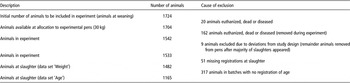
The pigs in the study were organic entire male pigs ((Landrace×Yorkshire)×Duroc) reared in parallel in five Danish commercial organic pig herds. Entire male pigs are not, in Denmark, produced on a regular basis within organic pig production, and within conventional pig production only on a small scale. Thus, the target population constituted a hypothetical population representing entire male pigs reared within the organic pig production system in Denmark. The study initially included 1724 entire male pigs commencing the finishing stage of the production cycle. In total 242 animals were subsequently excluded due to disease, death, deviations from study design and missing registrations from slaughter (see Table 1 for details).
Description of data sets including number of pigs and cause of exclusion from experiment

Housing system
The experimental pens consisted of an outdoor concrete area with sprinkling system and an indoor area divided into a lying area with straw bedding and an activity area with solid and partially slatted floors. The fixed facilities in the pens included automatic feeders or feeding troughs including access to water by individual water nipples/stations. Concentrate feed was provided ad libitum. Roughage (clover/grass silage) was provided daily in the resting area. Space allowance was ~1.2 m2/pig. Further details of housing and feed ingredients can be found in Supplementary Table S1.
Study design
The study was designed as a 2×2 factorial design, focusing on live weight and age at slaughter with parallel groups between and within five organic herds, each producing four batches of entire male pigs over a 2-year period from 2011 to 2013. Each batch consisted of four experimental pens with male pigs. Before the experimental period, the male pigs were reared according to the rearing system normally used on the respective participating farms (in pens mixed with female pigs (herd 1, 3 (one pen) and 5) or in single-sex pens (herd 2, 3 (one pen) and 4)). At an average of 30 kg, the male pigs were placed into the experimental pens, in group sizes of either 15 or 30 pigs. Grouping of the animals was performed according to two different grouping strategies, either regrouping or simple relocation. To create a variation in slaughter weight, the pigs in each pen were sent for slaughter in two steps (split marketing) approximating an average weight of 95 kg in the first delivery and 115 kg in the last delivery. According to the experimental design, the pigs were randomly allocated to slaughter weight (95 or 115 kg) except for 415 pigs out of the total of 1724, where the allocation was modified before slaughter because of different growth rates, to accommodate contract specifications of the slaughter house (restricted live weight range of slaughter pigs of 86 to 130 kg).
Measurements
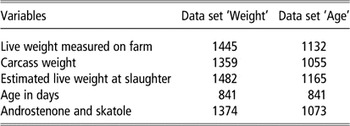
Each experimental pig had an electronic ear tag with a number that was linked to all registrations made on the particular pig in the herd, in the slaughter house and in the laboratory. Live weight was recorded for each pig on each farm at weaning, at allocation to the experimental pens and before slaughter. The number of days between weighing and slaughter was registered for further calculation of an estimated final live weight reflecting the live weight when delivered for slaughter. This was done to compensate for the period between weighing on the farm and actual slaughter time, as this period on some occasions exceeded several days due to slaughter house routines. Carcass weight was registered at the slaughter house after slaughter. Age was measured as days from mean farrowing date to slaughter date for each herd and batch. However, as the farrowings took place across several days, a range of up to 7 days was accepted for farrowing dates with the median date chosen for calculation of age. This gave missing registrations of age for herd 1, batch 1 and 2, herd 3, batch 1 to 4 and herd 4, batch 1 and 2. Season was defined based on slaughter period. The ‘winter season’ covered slaughter of animals in January to March and the ‘summer season’ covered slaughter in June to August. Table 2 summarizes the number of observations for the mentioned measurements.
Number of registrations for measurements included in data set ‘Weight’ and data set ‘Age’

Two different data sets were prepared for the statistical analysis. The data set ‘Weight’ included all animals remaining after exclusion due to the causes described in Table 1. The data set ‘Age’ included all animals from the data set ‘Weight’ with further exclusion of data in respect to missing registrations of age. Table 1 shows the different stages of exclusion of animals and the number of animals in each of the two data sets.
Boar taint analysis
HPLC method
Quantitative analysis of androstenone (5a-Androst-16-en-3-one) and skatole (3-methylindole skatole) was based on the HPLC method described by Hansen-Møller (Reference Hansen-Møller1994) with some modifications. Analysis was done on ~100 g of subcutaneous fat from the neck region collected from the experimental pigs after slaughter. The samples were frozen at −20°C and taken to the laboratory for further analysis. A thorough description on the method is given in Supplementary Material S1. Androstenone and skatole measurement was done on fat from 1374 animals. For five measurements of androstenone and 14 measurements of skatole no concentration was detectable, and these were set to be equal to the detection limit calculated from the HPLC calibration.
Statistical analysis
Concentration of androstenone and skatole were analysed by linear mixed effects models using the lmer function in R (R Core Team, 2013) with log transformation before analysis. Backwards elimination of variables was applied using a significance level of 5%. Two models were fitted: one using the data set ‘Weight’ (models i and iii) testing the effect of weight and one using the data set ‘Age’ (models ii and iv) testing both weight and age.
Live weight was estimated by fitting a regression model describing the effect of carcass weight and days from weighing to slaughter on the measured live weight; live weight=−1+(carcass weight)+(days from weighing to slaughter)+(days from weighing to slaughter)2. Parameter estimates from this model were used in the equation for calculation of an estimated final live weight as follows: for animals with a measured live weight, the estimation of live weight was done for 1445 animals using the following equation: live weight+(1.48×(days from weighing to slaughter))−(0.06×(days from weighing to slaughter)2). For animals without a measured live weight (37 animals), the estimation of weight was based on the registered carcass weight by following equation: 1.39×carcass weight.
Age was tested as a continuous variable measured as days from farrowing to slaughter. Furthermore, confounding between age and weight was tested. Season was tested as a nominal variable with two levels, summer and winter, as well as an interaction of season and age/weight. Group size and grouping strategy were tested as nominal co-variables. Herd was tested as a categorical variable and as an interaction including herd and age/weight. As an effect of the study design, the animals within each herd, within each season for the different group sizes and grouping strategies, were not expected to be independent of each other. To account for this, a variable including herd, season, group size and grouping strategy was made. This variable was set as random.
The resulting models were:
-
i. Log(Androstenone)=Weight+Weight2+Herd+ Season+Season : Weight
-
ii. Log(Androstenone)=Weight+Weight2+Herd+Age : Grouping
-
iii. Log(Skatole)=Weight+Herd
-
iv. Log(Skatole)=Weight+Herd+Age : Season
As a final model check, residual plots and Shapiro–Wilk normality tests were used to evaluate the model assumptions of normal distribution of fixed effects in each analysis as well as to identify outlier observations.
To evaluate the association between androstenone and skatole Pearson’s correlation was used at individual pig level.
Results
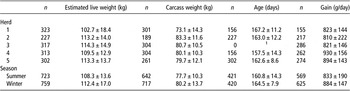
The average estimated live weight at slaughter was 110 kg, with 10% and 90% percentiles of 91 and 130 kg, respectively. Average carcass weight was 79 kg, with 10% and 90% percentiles of 63.5 and 94.5 kg, respectively. For age at slaughter the average was 163 days, with 10% and 90% percentiles of 148 and 177, respectively. The daily gain was on average 0.86 kg, ranging from 0.349 to 1.508 kg. Table 3 shows variation of data for live weight, carcass weight, age in days and daily gain, stratified by herd and season for the data set ‘Weight’.
Mean values±standard deviations of estimated final live weight, carcass weight, age and daily gain for experimental pigs included in the data set ‘Weight’

1 Herd 3 no registration of age.
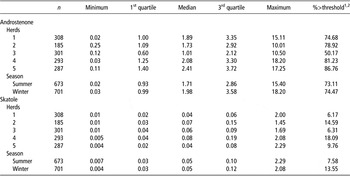
A large variation in levels of androstenone concentration was found across herds and seasons (minimum level 0.02 µg/g, maximum level 18.20 µg/g, overall median 1.9 µg/g). Skatole concentration showed an equal variation (minimum level 0.004 µg/g, maximum level 2.93 µg/g, overall median 0.05 µg/g). The correlation coefficient between androstenone and skatole was 0.33, showing a weak but significant positive correlation (P<0.001). Table 4 summarizes androstenone and skatole concentrations as well as rejection rates stratified by herd and season.
Concentrations of androstenone and skatole (µg/g) in carcass fat presented as median, minimum, maximum, 1st and 3rd quartile levels and percentage of pigs above skatole and androstenone threshold, stratified by herd and season for experimental pigs included in the data set ‘Weight’

1 Threshold androstenone 1 µg/g.
2 Threshold skatole 0.25 µg/g.
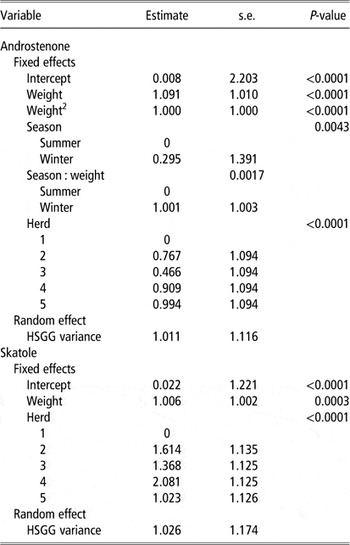
The statistical analysis for the data set ‘Weight’ showed a significant effect of weight as a continuous variable on the concentration of androstenone in carcass fat (P<0.0001). The relation was not linear but polynomial, with a significant effect of weight raised to the second power. In addition, weight significantly affected fat skatole concentration (P<0.001) with a slight increase in skatole with increasing weight. The association was different to that found for androstenone, as no effect of weight raised to the second power was found on fat skatole. Season was found to have an effect on androstenone (P<0.0001), with higher levels of androstenone in winter compared with summer. Moreover, a significant interaction between season and weight was found (P<0.001), with greater increase in androstenone levels with increasing weight for winter samples. No effect of season was found on skatole. An effect of herd was also found to be significant on both androstenone and skatole (P<0.0001). Table 5 summarizes model estimates of the significant variables affecting androstenone and skatole concentrations for the data set ‘Weight’.
Estimates of the significant effects from the mixed effects models i and iii, describing the weight effect on logarithmic androstenone and logarithmic skatole concentrations in entire male pigs

HSGG=herd, season, group size and grouping strategy.
Values are back transformed.
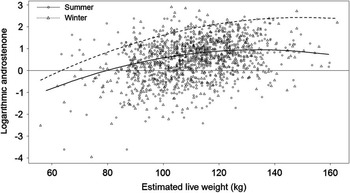
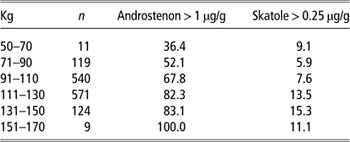
Figure 1 shows a graphical illustration of the relation between weight and androstenone separated for summer and winter, with each individual pig represented as a dot and model estimates shown as lines. A division of live weights into weight categories with intervals of 20 kg and calculated rejection rates of androstenone and skatole showed increasing percentages of pigs above threshold levels of androstenone with increasing weight, but with a less stable increase for skatole (Table 6).
Graphical illustration of the effect of live weight and season on logarithmic transformed androstenone concentration in entire male pigs. The horizontal line illustrates the threshold level of androstenone of 1 µg/g for detectable boar taint.

Percentage of animals above acceptable threshold for androstenone and skatole stratified by weight categories

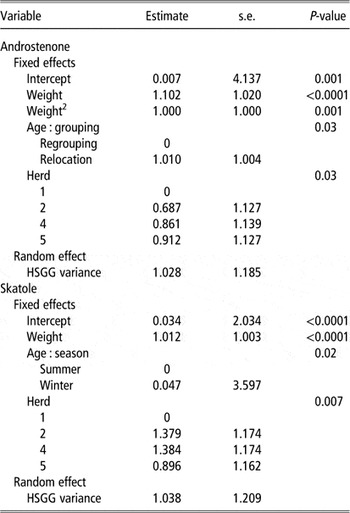
The statistical analysis for the data set ‘Age’ showed no additional direct effect of the continuous variable age on either androstenone or skatole. As regards androstenone, the effect was only significant as an interaction with the variable grouping, with increasing androstenone levels with increasing age for ‘relocation’ (slope=0.00518) and decreasing androstenone levels with increasing age for ‘regrouping’ (slope=−0.00521) when modelling the interaction with a constant live weight of 110 kg (mean level). As regards skatole, an age effect was found as an interaction with season, with increasing skatole with increasing age during winter periods and the opposite for the summer period. In contrast to the data set ‘Weight’, no effect of season or interaction between season and weight was found on androstenone. Otherwise, remaining variables also tested for the data set ‘Weight’ were found to be significant. Table 7 summarizes estimates of the significant variables affecting androstenone and skatole concentrations for the data set ‘Age’.
Estimates of the significant effects from the mixed effects models ii and iv, describing the weight and age effect on logarithmic androstenone and logarithmic skatole concentrations in entire male pigs

HSGG=herd, season, group size and grouping strategy.
Values are back transformed.
Discussion
Androstenone concentration varied greatly both across and within herds (0.02 to 18.2 µg/g) with a median level of 1.9 µg/g for an average of 110 kg live weight. A Danish study by Maribo (Reference Maribo2012), also dealing with organic pigs, reported a similar level with an average androstenone concentration of 2.3 µg/g for animals ranging from 77 to 86 kg carcass weight. Studies of conventionally reared entire male pigs report somewhat lower levels, although with variation (Walstra et al., Reference Walstra, Claudi-Magnussen, Chevillon, von Seth, Diestre, Matthews, Homer and Bonneau1999; Andersson et al., Reference Andersson, Andersson, Zamaratskaia, Rydhmer, Chen and Lundström2005; Chen et al., Reference Chen, Zamaratskaia, Anderson and Lundström2007; Nicolau-Solano et al., Reference Nicolau-Solano, Whittington, Wood and Doran2007; Aluwé et al., Reference Aluwé, Millet, Bekaert, Tuyttens, Vanhaecke, De Smet and De Brabander2011; Fábrega et al., Reference Fabrega, Gispert, Tibau, Hortos, Oliver and Furnols2011). Different results on androstenone between different studies could be attributable to the effect of genotype on androstenone levels, defined as both within and between breed effects, as reported by several studies (Xue et al., Reference Xue, Dial, Holten, Vickers, Squires, Lou, Godbout and Morel1996; Zamaratskaia and Squires, Reference Zamaratskaia and Squires2009; Aluwé et al., Reference Aluwé, Millet, Bekaert, Tuyttens, Vanhaecke, De Smet and De Brabander2011). In addition, stage of sexual maturity at slaughter (Zamaratskaia et al., Reference Zamaratskaia, Rydhmer, Chen, Madej, Andersson and Lundström2005b), or differences in boar taint detection methods and study design could be suggested to affect androstenone levels. The present results, however, indicate a higher overall level of androstenone for organic entire male pigs, increasing the importance of finding a way to reduce androstenone levels within organic farming. A higher overall level of androstenone within the organic pig production system could be caused by, for example, slower growth resulting in increased age at slaughter or use of specific breeds such as the Duroc, which is found to have a high androstenone level compared with other breeds (Xue et al., Reference Xue, Dial, Holten, Vickers, Squires, Lou, Godbout and Morel1996). Prunier et al. (Reference Prunier, Brillouët, Merlot, Meunier-Salaün and Tallet2013), studying different housing systems, however, found no effect of a conventional v. an enriched system on androstenone levels, even though animals within the enriched environment were largely exposed to the natural daylight, which has been found to affect androstenone levels as discussed further below.
A large variation in skatole concentrations was found for the animals within and between herds, with a median level of 0.05 µg/g. This level is similar to studies reporting skatole concentrations in fat of conventional reared pigs (Walstra et al., Reference Walstra, Claudi-Magnussen, Chevillon, von Seth, Diestre, Matthews, Homer and Bonneau1999; Nicolau-Solano et al., Reference Nicolau-Solano, Whittington, Wood and Doran2007; Aluwé et al., Reference Aluwé, Millet, Bekaert, Tuyttens, Vanhaecke, De Smet and De Brabander2011; Fàbrega et al., Reference Fabrega, Gispert, Tibau, Hortos, Oliver and Furnols2011), but somewhat lower than levels found in the study by Andersson et al. (Reference Andersson, Andersson, Zamaratskaia, Rydhmer, Chen and Lundström2005) and Aldal et al. (Reference Aldal, Andresen, Egeli, Haugen, Grødum, Fjetland and Eikaas2005). A screening of Danish organic entire male pigs showed a mean level of skatole of 0.18 µg/g (Maribo, Reference Maribo2012). There seems to be no obvious difference in skatole levels between conventional and organic entire male pigs, in spite of the differences between the production systems. This is in accordance with the study by Prunier et al. (Reference Prunier, Brillouët, Merlot, Meunier-Salaün and Tallet2013).
Decreasing live weight at slaughter was found to decrease androstenone concentration for organic entire male pigs as well as a reduction in rejection rates of tainted carcasses. The steepest increase in androstenone was found from 70 kg to around 100 kg, from where the level stabilized until 140 kg. The critical live weight at slaughter regarding threshold of androstenone was around 80 kg during summer and as low as 60 kg during winter, when the threshold for detectable taint was set to 1 µg/g which is the commonly used level in DK. A live weight at slaughter of this range may have considerable impact on market acceptance, however, different threshold levels for critical androstenone concentration are found in literature and it is obvious that increasing the threshold level would increase the critical live weight at slaughter. The overall effect of weight on androstenone concentration is in agreement with findings by Fàbrega et al. (Reference Fabrega, Gispert, Tibau, Hortos, Oliver and Furnols2011) and Aluwè et al. (Reference Aluwé, Millet, Bekaert, Tuyttens, Vanhaecke, De Smet and De Brabander2011). In addition, Chen et al. (Reference Chen, Zamaratskaia, Anderson and Lundström2007) and Nicolau-Solano et al. (Reference Nicolau-Solano, Whittington, Wood and Doran2007) found higher androstenone levels in heavier animals (90 to 115 kg live weight and 70 to 91 kg carcass weight, respectively). In a study dealing with organic pigs, an increase in androstenone with increasing weight was found for entire males slaughtered between 40 and 100 kg live weight (Jensen and Andersen, Reference Jensen and Andersen2005). Contradictory results to these findings were reported by Andersson et al. (Reference Andersson, Andersson, Zamaratskaia, Rydhmer, Chen and Lundström2005), with no significant effect of a live weight range of 90 to 115 kg, and by Maribo (Reference Maribo2012) with a carcass weight range of 77 to 86 kg of organic entire male pigs. However, the weight ranges used in these studies are relatively narrow compared to other studies. Aldal et al. (Reference Aldal, Andresen, Egeli, Haugen, Grødum, Fjetland and Eikaas2005) found that high levels of androstenone were already present in boars slaughtered at 75 kg live weight, although with a large variation between herds.
The link between puberty and androstenone is an important aspect with regard to an effect of live weight, as androstenone is related to pubertal changes (Zamaratskaia et al., Reference Zamaratskaia, Rydhmer, Chen, Madej, Andersson and Lundström2005b). Andersson et al. (Reference Andersson, Andersson, Zamaratskaia, Rydhmer, Chen and Lundström2005) reported a link between weight and sexual maturation, with animals of high weight being more sexually mature compared with animals of lower weight when maturation was measured as heavier testes and longer bulburethral glands at slaughter, however, with a similar difference in age between the two groups of animals. This adds to the fact that age is also reported to be related to stage of puberty (Bonneau, Reference Bonneau1982; Andersson et al., Reference Andersson, Hullberg, Malmgren, Lundström, Rydhmer and Squires1999). On the contrary, Aldal et al. (Reference Aldal, Andresen, Egeli, Haugen, Grødum, Fjetland and Eikaas2005) found no connection between weight and stage of maturation, as measured by weight of sexual organs, and Prunier et al. (Reference Prunier, Brillouët, Merlot, Meunier-Salaün and Tallet2013) found that live weight per se was not an important determinant of pubertal development. Variation in stage of maturation in different studies may explain the absence of agreement between the mentioned studies with regard to effect of weight on androstenone. A decrease in live weight was also found to decrease fat skatole concentration, which is in accordance with results of Zamaratskaia et al. (Reference Zamaratskaia, Babol, Andersson, Andersson and Lundström2005a) who found higher skatole levels in high-weight groups of pigs (115 kg) compared with low-weight groups (90 kg). Other studies have reported no effect of live weight on skatole (Aluwé et al., Reference Aluwé, Millet, Bekaert, Tuyttens, Vanhaecke, De Smet and De Brabander2011; Nicolau-Solano et al., Reference Nicolau-Solano, Whittington, Wood and Doran2007 (carcass weight); Chen et al., Reference Chen, Zamaratskaia, Anderson and Lundström2007).
In the present study a significant correlation of 0.33 between androstenone and skatole was found, which is in accordance with several other studies; for example, Babol et al. (Reference Babol, Squires and Lundström1999) r=0.45; Walstra et al. (Reference Walstra, Claudi-Magnussen, Chevillon, von Seth, Diestre, Matthews, Homer and Bonneau1999) r=0.30; Zamaratskaia et al. (Reference Zamaratskaia, Babol, Andersson and Lundström2004) r=0.68; Aluwé et al. (Reference Aluwé, Millet, Bekaert, Tuyttens, Vanhaecke, De Smet and De Brabander2011) r=0.35; and Bekaert et al. (Reference Bekaert, Aluwé, Millet, Goethals, Nijs, Isebaert, De Brabander, Verheyden, De Brabander, Vanhaecke and Tuyttens2012) r=0.37. The association between skatole and androstenone has been discussed in several studies. Babol et al. (Reference Babol, Squires and Lundström1999) among others showed that elevated levels of sex steroids, including androstenone, reduced the metabolism and subsequent clearance of skatole from the body, with the result of increased levels of skatole in the fat of the animals. This is in agreement with results of Rasmussen et al. (Reference Rasmussen, Zamaratskaia and Ekstrand2011), showing that one of the main enzymes involved in liver metabolism of skatole, can be inhibited by concentrations of androstenone, leading to increased levels of skatole in the adipose tissue. As androstenone increases around the time of puberty, it could be suggested that the changes in skatole coincides with the time of puberty (Babol et al., Reference Babol, Zamaratskaia, Juneja and Lundström2004) explaining the similar effects of weight on androstenone and skatole.
A direct effect of age on androstenone was expected, but was not found. This was possibly due to the large spread in daily gain found among the pigs at pen level. A slow growth rate could possibly affect onset or stage of maturation at slaughter, resulting in absence of an effect of age on androstenone. An effect of age was found by Zamaratskaia et al. (Reference Zamaratskaia, Babol, Andersson and Lundström2004) with increasing androstenone levels with increasing age over the range of 8 to 24 weeks. An age effect on androstenone as an interaction with grouping strategy was found, with decreasing androstenone level with increasing age for the animals undergoing a second regrouping, compared to increasing androstenone level with increasing age for the animals being relocated once and not mixed. A possible explanation could be related to differences in puberty induction for animals being regrouped. For high ranking pigs there is a possibility of earlier puberty induction as a consequence of high social status in a situation of greater social instability, whereas for the lower ranking pigs with a slower growth rate regrouping could cause a greater suppression of puberty. An effect of mixing of unfamiliar pigs on puberty is also suggested by Fredriksen et al. (Reference Fredriksen, Lium, Marka, Heier, Dahl, Choinski and Nafstad2006), with mixing having a sexual stimulating effect on boars. In addition to the effect of mixing on puberty, it may be that in less stable groups, as a result of repeated regrouping, there is greater importance of social status, and therefore chronic stress in being low ranking, possibly causing an effect on puberty induction. In the unmixed groups with animals only being relocated, puberty development seems to follow the natural age-related pattern. Age affected skatole as an interaction with season, with an increase in age resulting in increased skatole during summer, but the opposite during winter. No reason for the season effect on the association between age and skatole can be given and no similar effect was found for androstenone. However, an effect of age on skatole levels was found by Zamaratskaia et al. (Reference Zamaratskaia, Babol, Andersson and Lundström2004), with increasing plasma skatole levels with increasing age, although with high levels also in the very young animals (8 to 10 weeks). In addition, Babol et al. (Reference Babol, Zamaratskaia, Juneja and Lundström2004) found an effect of age on skatole in purebred boars, with relatively low levels up to around 180 to 190 days, after which increasing levels were seen up to around 240 to 360 days depending on breed. The age effect on skatole could be caused by puberty-associated factors as discussed previously.
Season affected androstenone concentration, with higher androstenone levels in pigs slaughtered during winter. The season effect interacted with weight, resulting in a greater difference in androstenone levels between seasons at high weights compared to low weights. Season is found to affect sexual maturation in the pig (Andersson et al., Reference Andersson, Wallgren, Rydhmer, Lundstrom, Andersson and Forsberg1998a; Prunier et al., Reference Prunier, Brillouët, Merlot, Meunier-Salaün and Tallet2013), with an accelerated pubertal development reported for pigs growing during autumn (Prunier et al., Reference Prunier, Brillouët, Merlot, Meunier-Salaün and Tallet2013). The reproductive success is highest during times of decreasing photoperiod (short-day period) when levels of sex steroids, including androstenone, are also found to be highest (Claus and Weiler, Reference Claus and Weiler1985). This corresponds to Andersson et al. (Reference Andersson, Wallgren, Rydhmer, Lundstrom, Andersson and Forsberg1998a), who found that fat androstenone was lower in a group of pigs reared during spring/summer (March to August under artificial light regimens) compared with a control group reared under natural light from January to June. The spring/summer group also had lower sensory boar taint levels compared with an autumn/winter (September to February). Contradictory results by Fredriksen et al. (Reference Fredriksen, Lium, Marka, Heier, Dahl, Choinski and Nafstad2006) showed the lowest levels of androstenone in the period October to March (short-day period) and Andersson et al. (Reference Andersson, Rydhmer, Lundstrom, Wallgren, Andersson and Forsberg1998b) finding that levels of androstenone in fat tended to be lower in Autumn compared with a group exposed to natural photoperiod from January to June. Conditions on organic farms most often include a natural light regimen, with animals experiencing dim light indoors and light corresponding to the actual day length when outside. This could make an effect of season more pronounced within organic farming than in conventional farming, where enclosed housing with artificial lighting is more predominant. However, Prunier et al. (Reference Prunier, Brillouët, Merlot, Meunier-Salaün and Tallet2013) found a similar influence of season in conventional housing and in housing with access to an outdoor run.
The experimental design used in the present study included herds similar in production system, management procedures and breeds. Nevertheless, an effect of herd was found on both androstenone and skatole, with variations both between and within herds, which was also evident from differences in rejection rates. The participating herds did not differ with respect to mean weight, age and live weight gain excluding these factors as potential causes of variation. The variation is suggested to stem from a variation in stage of puberty between the animals, as also reported by Claus et al. (Reference Claus, Weiler and Herzog1994), showing that most of the variation in androstenone concentration is explained by the time course of pubertal development. Puberty variation may be affected by health status and variation in growth rate, as found in present study, resulting in postponed puberty of slow-growing animals. In addition, androstenone variation could be caused by factors such as individual genetic difference in androstenone levels or different light conditions between farms.
As regards skatole, the median skatole level did not differ between herds, but herd 4 and 5 had higher maximum levels compared with the other herds. Variation in skatole levels between different herds was also reported by Aldal et al. (Reference Aldal, Andresen, Egeli, Haugen, Grødum, Fjetland and Eikaas2005), who ascribed the variation to difference in feed composition which is well known to affect skatole levels. The herds in the present study were fairly similar in respect to feed ingredients, and no obvious cause of differences in skatole levels between herds can be deduced from the present data. The variation found stresses the importance of including several herds when investigating boar taint levels, however, a more thorough investigation of both herd and individual animal characteristics are needed to know the cause of the herd variation.
Conclusion
Increasing live weight at slaughter increased androstenone concentration for organic entire male pigs. Up to around 100 kg the level continuously increased, after which the level stabilized until 140 kg. Skatole concentration increased slightly with increasing live weight. Age showed a different pattern of relationship with androstenone and skatole. The androstenone concentration level was higher during winter season as compared with summer. No difference between seasons was found for skatole. Both androstenone and skatole levels showed great variation both between and within the organic herds. Reducing live weight at slaughter could be an applicable management strategy within organic farming for reducing boar taint levels as well as levels of tainted carcasses. However, it should be emphasized that variations in boar taint compounds were found also for low weight animals.
Acknowledgements
The work was carried out under the project ‘Organic pig production without castration’, which is part of the Organic RDD program. This is coordinated by International Centre for Research in Organic Food Systems, ICROFS, and was funded by the Danish AgriFish Agency, Ministry of Food, Agriculture and Fisheries. The authors thank Center of Development for Outdoor Livestock production for collaboration during the project, the participating farmers for their cooperation and technician Pia Haun Poulsen for help on data recording.
Supplementary material
To view supplementary material for this article, please visit http://dx.doi.org/10.1017/S1751731115000786