

Introduction
In 1934, Axel Garboe, natural history scholar, priest, and active member of the evangelical temperance organization the Blue Cross, and Karl Kristian Steincke, Social Democrat and minister of social affairs, both contributed to an edited volume on eugenics called Heritage and Race (Socialpolitisk Forening 1934). Garboe’s background in science and revivalist Protestantism is thought provoking, and the collaboration between a leader in the mainly secular Social Democratic Party and a revivalist temperance adherer immediately raises questions about the relationship between religion, science, and social democracy, as well as between civil society and the state.
In interwar period Denmark, groups such as the mentally ill, prostitutes, criminals, vagrants, and alcoholics were increasingly targeted by scientifically inspired “illiberal” policies and practices such as confinement, restrictions on access to marriage, sterilization, castration, and disenfranchisement to replace or supplement the older “moral” techniques of deterrence and discipline such as the poor house and forced labor sentences. Such measures were common in most Western countries, and recent international sociological and historical scholarship has explained this fact through the existence of a “high modernist” state ethos, a communitarian-organic social democratic ideology, and the absence of strong civil society actors such as trade unions, churches, or nongovernmental organizations (NGOs). The Danish case is, in this regard, interesting because both a strong state and a strong civil society deeply involved in social relief existed. This makes the Danish case well suited to test the “high modernity” thesis: What role did civil society actors play in resisting or promoting illiberal policies and practices in the field of alcohol treatment in Denmark? How could both Social Democracy and Protestant civil society agree on a scientifically inspired interpretation of alcoholism as hereditary and on the use of force in treatment? Specifically, how were such ideas, policies, and practices integrated into the ideational tradition of Protestant temperance adherers and Social Democrats?
I challenge the “high modernist” thesis by showing that the Blue Cross did not protest the state’s eugenicist and illiberal policy measures, it promoted theories of degeneration and heredity early in the period and, in fact, publicly called for forcible commitment of alcoholics years before the state’s laws were introduced. I instead suggest that the emergence of discriminatory policies and practices in the Danish field of alcohol treatment should be attributed to the way that specific actors took advantage of institutional and discursive opportunity structures at the time, that is, aligned themselves with the new scientific discourse and promoted specific practices. I show that the case of forcible treatment of alcoholics was not plainly one of “leftist high modernity,” but, paradoxically, illiberalism had liberal roots; specifically, “bourgeois” rather than “progressivist” roots. Illiberal practices were made possible because of a common conservative cultural ideal of the family shared by Social Democrats and Protestant activists across the civil society and state spheres that resonated with scientific worries about “degeneration.”
Research on Eugenics, Illiberal Policies, Civil Society, and the State
Eugenic policies are arguably the most illiberal of illiberal policies, that is, initiatives that suspend civil, political, or social rights for the good of a greater community. Such initiatives flourished in Europe, especially from circa 1920 to 1960. Frank Dikötter expresses a common understanding of the reasons for this: “Open democracies with a vibrant civil society, such as Britain and the Netherlands, were generally less inclined to adopt extreme eugenic proposals than authoritarian regimes in Germany and the People’s Republic of China” (Dikötter Reference Dikötter1998: 476). Dikötter links eugenics and “illiberal practices” to totalitarianism and the ethos of the “high modern” “gardening state” (see Lucassen Reference Lucassen2010). This view, informed by the sociology of Michel Foucault, Zygmunt Bauman, and James C. Scott (Bauman Reference Bauman1998; Foucault Reference Foucault1995; Scott Reference Scott1998), contributes the illiberal practices to a strong centralized state guided by “technocrats” with the ambition to create social order and productive citizens (Dikötter Reference Dikötter1998; Hauss and Ziegler Reference Hauss and Ziegler2008; Mottier Reference Mottier2008; Weiner Reference Weiner2003). Dikötter supplements this with a thesis regarding the absence of strong civil society actors, such as trade unions, churches, or NGOs (cf. Scott Reference Scott1998: 4f), again with the Netherlands and Britain as examples (Dikötter Reference Dikötter1998: 476ff).
In relation to eugenics and illiberal policies, Leo Lucassen has nuanced the “strong state—weak civil society” thesis in an article on the relationship between “the left” and eugenics. In a comparison of six European cases (Sweden, Britain, Switzerland, France [and Belgium], the Netherlands, and Germany), Lucassen finds a number of inhibiting factors for eugenic thinking and measures to be taken up by the left, typically Social Democrats: (1) not a strong civil society per se but a “variegated and strong civil society,” where cultural heterogeneity dampens opposition to radical social policies, as in “pillarized” Netherlands; (2) related to this, Catholicism and the Catholic Church’s well-known resistance to all interventions in procreation; (3) the influence of neo-Lamarckianism with its emphasis on social factors’ interplay with genetic predispositions; and finally what Lucassen stresses the most (4) the interpretation of socialism in terms of class rather than in terms of “communitarian-organic thinking.” It was, according to Lucassen, the communitarian-organic conception of society among socialists, Social Democrats, and “progressives” as an organic whole that allowed for the rights of the individual to be suspended in the name of a perceived greater good. This view was promoted by the Fabian Society and the Webbs in Britain and by the Myrdals in Sweden.
Much research has been done on the links between socialism/social democracy and eugenics (Crook Reference Crook2007; Freeden Reference Freeden1979; MacKenzie Reference MacKenzie1976; Mottier Reference Mottier2008; Paul Reference Paul1984; Schwartz Reference Schwartz1995a, Reference Schwartz1995b; Spektorowski Reference Spektorowski2004; Weindling Reference Weindling1989; Weiner Reference Weiner2003; Winter Reference Winter1974) and the US progressive movement and eugenics (Crook Reference Crook2007; King Reference King1999; Leonard Reference Leonard2005; Stromquist Reference Stromquist2006). Most promote varieties of the high modernity/communitarian-organic argument.
The “affinities” between eugenics and Protestantism and Catholicism, respectively, have also been researched (Richter Reference Richter2001; Schwartz Reference Schwartz1995b; Zenderland Reference Zenderland1998), albeit to a lesser degree, finding that Protestantism more easily aligned itself with eugenics than did Catholicism (Kevles Reference Kevles1985).
The cases of the Nordic welfare states, which were among the first European countries to adopt eugenic practices and use force in treatment, are particularly well-described (Banke Reference Banke1999; Björkman Reference Björkman2001; Broberg and Roll-Hansen Reference Broberg and Roll-Hansen2005; Broberg and Tydén Reference Broberg and Tydén1991; Gerodetti Reference Gerodetti2006; Haave Reference Haave2007; Koch Reference Koch2000, Reference Koch2014; Porter Reference Porter1999). Most of this research has promoted versions of the “communitarian-organic” argument. However, in the Danish case, recent academic debates have centered exactly on the question of whether Social Democracy could truly be said to be carrying a “high modernist” or a “communitarian-organic” ethos. Koch has argued, based on extensive research on eugenics and sterilization in Denmark (Koch Reference Koch2000, Reference Koch2014), that eugenic policies and practices in Denmark were indeed the result of a social-democratic spirit of social engineering (Koch Reference Koch1996: 22). The discussion has centered on the figure of the social democratic Minister of Social Affairs (1929–35) K. K. Steincke, the main architect behind the great social reform of 1933 including punitive sanctions for “antisocial” elements and responsible for most of the eugenic legislation. Was he ideologically isolated (Christiansen Reference Christiansen2001) or does “silence equal consent” so that the fact that an exponent for socialist eugenics was backed by the party testifies to an affinity between social democracy and eugenics (Møller Reference Møller2002)? And can the eugenic laws be considered “Social Democrat,” when both conservatives and liberals supported the laws out of budget considerations (Christiansen Reference Christiansen2001: 201f)?
The links between Protestantism and illiberal policies and practices in Denmark have not been researched beyond the observation that the Protestant nature of the Nordic countries played a “negative causal” role in as much as Catholicism did not impede eugenic legislation, and the mono-confessional culture of the Nordic countries made state intervention less controversial (Roll-Hansen Reference Roll-Hansen2005). In fact, those scholars who have done research on the Blue Cross in Denmark (Bundesen et al. Reference Bundesen, Henriksen and Jørgensen2001; Eriksen Reference Eriksen1988; Henriksen and Bundesen Reference Henriksen and Bundesen2004) tend to base their work on the organization’s own historians who emphasize the Blue Cross’s resistance to illiberal policies (Granum-Jensen Reference Granum-Jensen1979: 139).
The hereditary interpretation of alcoholism has been studied to some degree. Examples are French neo-Lamarckians (Dikötter Reference Dikötter1998: 473), Auguste Forel in Switzerland (Lucassen Reference Lucassen2010: 278), the Webbs in Britain (Webb and Webb Reference Webb and Webb1911: 49), and scientists in the Netherlands (Noordman Reference Noordman1989; Snelders et al. Reference Snelders, Frans and Pieters2007; Stel Reference Stel1995).
The question of treatment of alcoholics has been researched most thoroughly in Sweden, probably due to the strict state approach in this country (Björkman Reference Björkman2001; Fredriksson Reference Fredriksson1991; Rosenqvist and Kurube Reference Rosenqvist and Kurube1992; Stenius Reference Stenius1999). Edman (Reference Edman2004) has written specifically on the topic of force in treatment and care in Sweden, but in the period 1940 to 1981. Interestingly, he points to the role of decentral interpretation of the law through “street level bureaucrats” (p. 43f)—the role of the Blue Cross in Denmark. In Denmark, Sidsel Eriksen has done the most thorough work on the question of alcoholism, while focusing especially on the temperance movement (Bundsgaard and Eriksen Reference Bundsgaard and Eriksen1987; Eriksen Reference Eriksen1988, Reference Eriksen1989, Reference Eriksen1990, Reference Eriksen1991, Reference Eriksen1992a, Reference Eriksen1992b) and to a lesser degree on treatment (Eriksen Reference Eriksen2007), while Thorsen has written on the historical development of alcohol policies (Thorsen Reference Thorsen1990; Reference Thorsen1993), but the relation between illiberal practices and Protestant treatment has not been studied.
What this literature in general teaches us is that, on the one hand, there may be certain “affinities” between certain ideational traditions and illiberal thinking and action (e.g., Catholic valuation of the sacredness of life or the ban against causing grievous bodily harm to another in the British legal tradition [Kevles Reference Kevles1985: 115, 119]). On the other hand, they show that eugenic ideas had broad political appeal from British conservatives to Spanish anarchists (Dikötter Reference Dikötter1998: 467), and touched upon several related issues: immigration control, population control, budget issues, public health, sex education, psychiatry, criminology, religion, and women’s liberation (Bashford and Levine Reference Bashford and Levine2010; for a review, see Lucassen Reference Lucassen2010). Moreover, they also show dissent within ideational traditions so that the Prussian Catholic Centre Party in 1930 would draft a sterilization law with the Social Democratic Party, while Pope Pius XI condemned such practices the same year (Richter Reference Richter2001). In addition, illiberal policies, eugenics in particular, were politically uncontroversial and not widely opposed in the Nordic countries (Christiansen Reference Christiansen2001: 201f; Tydén Reference Tydén2002: 184ff), leaving plenty of room for central actors and “street level bureaucrats” to interpret the law. All in all, this calls for an approach that considers both structural opportunities and how specific actors have seized these opportunities.
An Alternative Approach
I propose to follow the “third wave” in historical sociology in its focus on actors and multiple logics (Adams et al. Reference Adams, Clemens and Orloff2005) and, more specifically, to look for (1) institutional opportunity structures (McAdam Reference McAdam1996), (2) discursive opportunity structures (Ferree Reference Ferree2003), and (3) actors. Specifically, I focus on the structure of the relations between civil society and the state in the field of social assistance, the specific Protestant and Social Democratic ideas available at the time, and how specific collective and individual actors made use of these institutions and discourses at the time, that is, how scientific ideas of heredity were appropriated by Protestants and Social Democrats alike and made to resonate with their own ideational tradition.
I take inspiration from framing theory (Gamson and Modigliani Reference Gamson and Modigliani1989; Snow et al. Reference Snow, Rochford, Worden and Benford1986; Steensland Reference Steensland2006; Young Reference Young2006: 27) in analyzing why certain interpretive frames “resonate” with each other. Here, both causal and principled beliefs are essential—beliefs about how the world is and how it ought to be (Haas Reference Haas1997; Münnich Reference Münnich2010). I will consequently show how new scientific ideas resonated with the pertinent ideational traditions and their promotion of illiberal policies. I do not focus on actual negotiations, but on the discursive preconditions for reaching an agreement to show the timing, content, and political fate of specific ideas (Skocpol Reference Skocpol1992; Steensland Reference Steensland2006: 1274; Weir et al. Reference Weir, Orloff and Skocpol1988: 10ff). Such discursive processes work on the “backstage” beyond public “front stage” processes like negotiations in parliament (Campbell Reference Campbell1998), on the internal organizational lines, where new ideas are aligned with old. Discourses, however, “generate nothing. What matters is how they are appropriated by contemporary actors in their specific circumstances and amid the field of tension in which they find themselves, made up of practices, values, and institutions” (Joas Reference Joas2013: 140). This is especially the case in areas that were politically uncontroversial at the time.
This article analyzes a single case: the adaption of new scientific ideas of alcoholism and promotion of illiberal policies in Denmark. A single study of the Danish case is interesting, first, in terms of testing existing theories of the emergence of illiberal practices and, second, in terms of developing new theoretical approaches. The case works as a “black swan”: If it can be shown that the illiberal policies in the Danish field of alcohol treatment were not the result of high modernity or a communitarian-organic ethos, then there is no necessary link between a Nordic-type Social Democratic welfare state and illiberal policies (cf. Flyvbjerg Reference Flyvbjerg2006), and more complex interpretations are called for.
Source Material and Method
To show the interpretive processes described in the preceding text, I choose two different approaches for the Social Democrat and the Blue Cross perspective. For the Social Democratic perspective, I focus on the influence of “communitarian-organic” ideas in the Social Democratic Party, specifically by the influential K. K. Steincke.
As the social democratic position on eugenics is well described in the literature, the main empirical contribution of the article concerns the Blue Cross. Here, I rely on unexamined sources from the Blue Cross archives. The material collected consists of the organization’s members’ magazine (MM), the annual reports (AR), protocols from meetings of the Central Board (CB), and short stories published by the organization.
I have coded all articles related to theories of degeneration and heredity in the members’ magazine published bimonthly from 1900.Footnote 1 The analyzed issues are published in the periods 1900–1905, 1912–18, and 1931–38, covering the earliest articles; the period around the 1914 request to the government for forcible commitment of alcoholics; and the period around the 1933 social reform and the pertinent eugenic legislation. The organization’s annual reports (which include minutes of the annual meeting of representatives) and protocols of meetings of the Central Board (1899–1938) provide insight on the strategic stances and decisions regarding illiberal policies and practices.
Relying on the writings of Steincke and secondary sources, on the one hand, and archival material, on the other, entails some methodological limitations to understanding processes of frame alignment. Such sources do not provide insight into public debates or actual negotiations between Social Democracy and the Blue Cross. Rather, my method is one of comparison on the level of ideas, showing how scientific ideas were incorporated into the two traditions and then pointing out similarities and differences between the two perspectives.
How representative are Steincke and the Blue Cross for Danish Social Democracy and Protestantism? The analysis of Social Democracy focuses on Minister of Social Affairs K. K. Steincke, who was the architect of the 1933 social reform introducing the illiberal approach to alcoholics. Steincke was both the most influential Social Democrat in social policy as well as one of the few inspired by the “high modernist” Webbs (Christensen Reference Christensen1998: 41, 103f; Christiansen Reference Christiansen2001: 203). Steincke thus presents a “most-likely case” for the influence of “high modernism” among Social Democrats.
The Blue Cross, conversely, represents a “least-likely” case, both as a civil society group and as a Protestant social association that has been understood as an “advocate” of the alcoholics. The fact that other branches of the Danish Protestant social movement resisted the illiberal practices of the state (Kolstrup Reference Kolstrup2011: 195f) only shows that Protestantism was, in fact, an “opportunity structure,” making the question of how Protestantism, state interests, and theories of degeneration could be aligned in this case even more pertinent. Furthermore, the Blue Cross was not a fringe movement: Just as Steincke was the architect of legislative reform, the core founders of the Blue Cross were architects of a range of social initiatives (esp. Egyptologist and librarian H. O. Lange, statistician Harald Westergaard, and theologian and priest H. P. Mollerup).
Illiberal Laws on Alcoholism 1922–38
Legislation inspired by scientific ideas of heredity in Denmark targeted largely the groups exempted from the 1933 reform. The central laws were the sterilization law of 1929, the first in Europe; the law of 1934 regarding the mentally retarded; the sterilization and castration act of 1935; and the marriage acts of 1922 and 1938.
Already in 1922, the law of legal incapacity and guardianship had been passed, making alcoholism and similar vices cause for legal incapacitation and loss of custody over children. As the Marriage Act of 1938 was passed, “chronic alcoholics” were added to the list of groups who, from 1922, had not been allowed to marry without consent from the Ministry of Justice. This permission could be made contingent on consent to sterilization (Thorsen Reference Thorsen1993: 39–57).Footnote 2 There was a clear eugenic inspiration in both laws (Hansen Reference Hansen2005: 26).
Sterilization of alcoholics had been an option since the law on sterilization in 1935. This law was an extension of the preliminary law of 1929 and now introduced access to voluntary sterilization for chronic alcoholics. Voluntary sterilization was not universally accessible to alcoholics and other selected psychically “normal” persons, except “when specific concerns speak in favor of this” (når særlige hensyn taler derfor). These considerations had to do with whether there was a danger of burdening the offspring in terms of heredity (Justitsministeriet Reference Justitsministeriet1964: 10). As with sterilization of the mentally ill, the voluntary aspect of sterilization was questionable.
Reflecting the ambiguous state of the diagnosis of “alcoholism,” laws of a more disciplining character were also passed. While the penal code of 1930 in general did away with the sentence of forced labor, crimes committed by someone found to be an alcoholic were still punishable by commitment to a forced labor institution. The complex of laws passed in 1933 likewise named alcoholism as grounds for the loss of the right to disability and old age pension, just as alcoholics were denied entrance into retirement homes, care facilities, and the social support section of the workhouses (forsørgelsesafdeling), and further denied access to health insurance funds and mothers’ right to alimony.
In treating the alcoholics who showed a willingness to change, the Blue Cross treatment facilities came in handy. The penal code of 1930 and the reform of the welfare laws in 1933 introduced the possibility of treatment in a private facility. In the criminal cases, this was an additional sentence lasting a maximum of 18 months or three years in cases of repeated offences. In the cases of negligent providers (including spending the income on drink rather than the family) a sentence of private treatment could be dealt out administratively, without a court decision, as an alternative to a forced labor sentence or being committed to the workhouse. On top of this, the municipal social services committee was authorized to sentence an alcoholic to treatment for a maximum of one and a half years if the authorities or the alcoholic’s family approached the social services with the request that he be committed to treatment, and the committee found that he was a burden to his family and had obtained a medical opinion. Patients would be sentenced to forced labor if they broke off the treatment.
In those cases in which the patient was not able to pay for the treatment himself, the expenses paid for by the authorities were considered poor relief and thus had the concomitant legal consequences. This meant that the patient would have to cover the expenses of the stay, and the debt could not be cancelled until one year after the end of the stay. For those who voluntarily sought treatment, the legal consequences of receiving this kind of poor relief was disenfranchisement for the duration of the stay or, in cases in which the treatment was broken off, for two years from the day the stay had commenced. Those who were forcibly committed were also disenfranchised with no possibility of cancelling the debt and, moreover, with the risk of prohibition to marry until the debt was repaid (Thorsen Reference Thorsen1993: 51–57).
The treatment of marginal groups was of no great political concern. Only minor critique of the eugenic legislation was aired in the parliamentary debate leading up to the 1929 sterilization law, and the 1934 law was met with only four votes against in the two parliamentary chambers (Hansen Reference Hansen2005: 40). The 1929 critique came mostly from certain medical doctors, the Catholic Church, and conservative members of parliament. In general, there was no great interest in these matters in parliament. Liberals and conservatives supported the laws for budget reasons (Christiansen Reference Christiansen2001: 201f). Similarly, the continued use of the “old” means of forced labor and disenfranchisement in the 1933 reform laws toward alcoholics and similar types was criticized by the Communists only (Kolstrup Reference Kolstrup2011: 224f).
Criminal and negligent alcoholics along with other “morally questionable” groups were thus targeted in the 1920s and 1930s with illiberal laws inspired by the new scientific evidence of the heredity of alcoholism, while the “old” techniques of deterrence and discipline remained in place for those who were deemed unable or unwilling to change. Was this the result of “high modernity”? And how did civil society, charged with carrying out the treatment convictions, react?
Institutional Opportunity Structure: Civil Society and State Revisited
As we have just seen, the Blue Cross was essential in carrying out the sentences of the 1930s reforms. This already testifies to a flaw in the “high modernity” thesis: A strong civil society could indeed be complicit rather than oppositional in relation to illiberality. This is a result of the institutional structure of social assistance in the period, which has been called the collaborative epoch of voluntary-state relationship in Denmark, roughly from 1890 to 1940 (Henriksen and Bundesen Reference Henriksen and Bundesen2004: 613). Many philanthropic endeavors, often started in Lutheran Protestant revivalist circles, were now integrated into the emerging welfare state as they were taken over, financially supported by, or entered into contractual relations with the state (Malmgart Reference Malmgart2002, Reference Malmgart2005; Petersen et al. Reference Petersen, Petersen and Kolstrup2014).
Not all Christian initiatives, however, voluntarily gave up their independence. A number of Christian philanthropic initiatives argued that they would not contribute to the state’s division of people into “deserving” and “undeserving” poor. In such cases, civil society did in fact act as an oppositional force to the central state (Kolstrup Reference Kolstrup2011: 195f). But as I will show, this was not necessarily so.
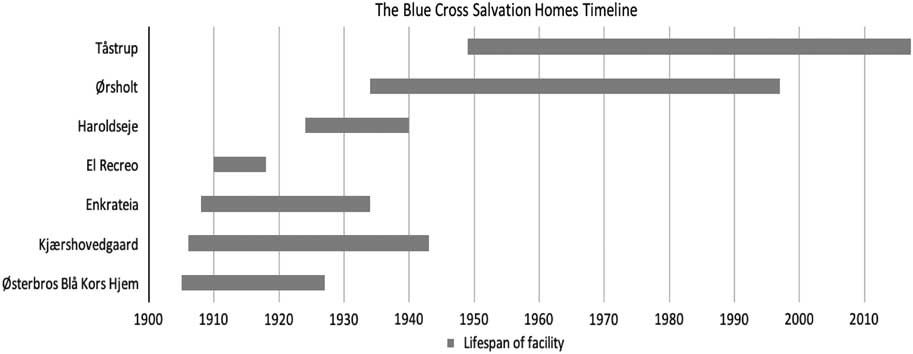
Alcohol treatment in Denmark was from the beginning of the period driven by civil society actors who, however, sought and gained funding and recognition from the state. The period from 1893 to 1915 saw the establishment of no less than 17 different treatment facilities for alcoholics. Fourteen of these were established by Christian groups, two were founded by the secular temperance organization, and one by the “White Band” women’s temperance association. By 1924, seven homes remained, four of which were run by the Blue Cross, two by other Christian groups from the revivalist branch of the national church, and one was a municipal institution.Footnote 3 All now enjoyed state recognition and financial support. The Blue Cross eventually (1949) would take over one of the Christian homes, while the other ceased to exist. The Blue Cross was thus the largest organization in the field of alcohol treatment in the period (Figure 1)
Life span of Blue Cross treatment facilities.

.
The Blue Cross was established in Denmark in 1895 as part of the international organization founded in Switzerland in 1886. It emerged out of the circles of the revivalist Home Mission in Copenhagen and continued to seek out strong ties to this conservative branch of the Danish Lutheran church. As a self-proclaimed evangelical temperance organization, it had the dual mission of saving the “victims of alcohol” and leading people to the faith. One was a means to the other and vice versa. The organization worked for total prohibition of alcohol, as well as through “activist” means of outreach in bars and bar areas. The main activity was the founding of associations across the country that worked as religiously led self-help groups through the use of the sobriety pledge and weekly meetings. The organization was democratically organized: The central board was elected by a general assembly consisting of representatives of the local associations. Increasingly, the organization also took up social work by establishing “salvation homes” for alcoholics. From 1905 to 1950, the Blue Cross ran seven treatment facilities, though not more than four at any given time. In 1938, 3,497 patients had been treated in the Blue Cross’s facilities since 1905, an average of 106 patients per year. Early on, it became the dominant actor in the field (AR 1938: 11).
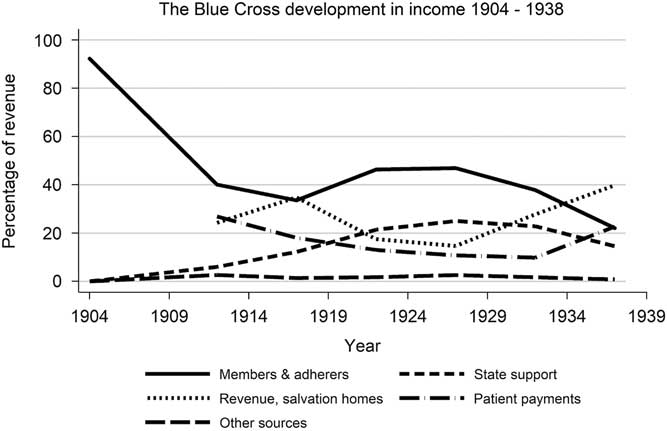
The Blue Cross received state funding for its treatment of alcoholics from the organization’s birth. However, as illustrated in figure 2, State funding was from 1905 to 1933 a minor means of income, constituting less than 25 percent throughout the period.Footnote 4
Development in income.

From 1913, the state would pay the Blue Cross a third of the expenses for patients who were not able to pay from their own pockets; most patients were not. The same year, a joint committee was established with representatives from the (then) seven existing treatment facilities assigned with the task of coordinating with the Ministry of the Interior. The ministry did not interfere with the methods of treatment.
In the field of alcohol treatment, as in other fields, a strong civil society thus existed in Denmark; a civil society that formed the backbone of the supposedly “high modernist” institutional infrastructure of forced treatment.
Discursive Opportunity Structures: Science, Communitarian Socialism, and Activist Protestantism
During the first decades of the twentieth century, a new scientific discourse was becoming available that helped shape the understanding of the problem of alcoholism, especially medical science, which offered to transform the alcoholic from a “morally flawed” individual to a physically ill “patient” (Edman Reference Edman2004; Macleod Reference Macleod1967).
In Denmark, alcoholics were singled out with the sobriety and alcohol commissions appointed by the government in 1903, 1914, 1934, and 1947. While the later commissions were mainly mandated to illuminate how consumption of alcohol could be brought down through regulations, the Sobriety Commission of 1903 also made recommendations on the care of alcoholics (Sobriety Commission Report 1907). The commission was dominated by temperance people (Eriksen Reference Eriksen2007: 61), and the main author of the final report, medical doctor Christian Geill, was a member of the Society for the Promotion of Sobriety, physician at a mental hospital, and manager of a prison. He would later become chairman of the Medico-Legal Council that had an advisory capacity for the eugenic-inspired marriage laws of 1922 (Koch Reference Koch2014: 53ff). The report published in 1907 marked a change in the view of alcoholics. It stated that alcoholism could no longer be viewed as a “moral aberration” but as a disease of the central nervous system. In other writings, Geill suggested more clearly degenerative causes for alcoholism and its influence on crime (Geill Reference Geill1906). In the 1907 report it was suggested that the state should build a treatment institution for alcoholics, overseen by doctors working according to rational medical principles. Force should be used in treatment because this would encourage voluntary admission. However, force should only be used where alcoholism had consequences for others than the alcoholic (Sobriety Commission Report 1907: 148–55). While no state facility was established at this time, the report did result in increased support for the private facilities, and the view of alcoholism as an illness as well as the principle of intervention when others were affected would prevail. As I will show, the theory of degeneration was, however, promoted before the 1907 report by Geill’s fellow temperance supporters in the Blue Cross.
Despite the Sobriety Commission Report, the hereditary status of alcoholism was discussed continually. In 1924, a commission was established by the new Social Democrat–led government to investigate how the question of degenerative persons could be handled. The members of the commission included researchers as well as practitioners who dealt with the care of the groups in question. Alcoholism was, on the one hand, not considered hereditary by the commission but alcoholics did, on the other hand, not meet the requirements of normality (Koch Reference Koch2014: 80). A more extensive approach emerged, as the medico-legal counsel in 1935 recommended that sterilization should be possible not only for the mentally ill but also among other groups for the insane (schizophrenic, bipolar), epileptics, psychopaths, and alcoholics, who were thought to have (too) many children. Alcoholics, moreover, like psychopaths, were difficult for the law to reach because they were not institutionalized (ibid.: 125).
In the science of eugenics, alcoholics thus represented a group that did not fall squarely within the hereditarily healthy or the degenerative group; it was not easy to determine whether they were curable or if they were asocial by their own volition. The alcoholic in effect fell between the three categories of the morally susceptible, the physically sick patient, and the hereditarily damaged. The state authorities’ response to alcoholics reflected this ambiguity in the perception of alcoholism and was combatted through the diverse means described in the preceding text.
Another central opportunity structure was constituted by the “reformist” socialist discourse put forward by the Fabian Society (the Webbs being the most influential) in the United Kingdom and the Myrdals in Sweden. This was a socialism put forth by social scientists that considered themselves above class interest, were opposed to Marxism, and sought to change society through centrally planned reforms (Carlson Reference Carlson1990; Spektorowski Reference Spektorowski2004: 87f). Finally, relevant for this article was a new philanthropic Protestant movement that emerged in the nineteenth century and spearheaded a range of social initiatives across Europe (Hopkins Reference Hopkins1982; Jones Reference Jones1968).
Social Democratic Community Ideals: A Liberal-Conservative Cultural Analysis
Contrary to the prevalent high modernist communitarian-organic analyses of eugenics, I will argue that while Danish Social Democracy shared “discursive opportunity structures” with many “progressives” in Europe, it was rather an affinity between theories of heredity and Steincke’s liberal-conservative cultural analysis that led to illiberal policies in alcohol treatment and related fields.
While the use of means testing had been limited by the liberal government through reforms in 1921–22, on a symbolic level, it was the grand social reform of 1933, spearheaded by the Social Democratic Party, that introduced universal social rights as the basic principle of social relief. K. K. Steincke, Minister of Social Affairs 1929–35, and main architect behind the reform, had laid out the principles for the reform in 1912 in a book that was suggestively called Alms or Rights (Steincke Reference Steincke1912a), and expanded these ideas in 1920 (Steincke Reference Steincke1920).
However, the farewell to means testing in the 1933 reform explicitly left out certain groups that were considered morally underserving, such as the “work-shy,” neglectful providers, tramps, professional beggars, prostitutes, and alcoholics (Kolstrup Reference Kolstrup2011). These groups would suffer the loss of rights and the deterrence and discipline of forced labor—contingent on an individual assessment (Steincke Reference Steincke1933: 14, 60). As Steincke notes in his comments to the law: “The rules extend a helping hand when the individual shows a wish to better himself, but are far from friendly if the patient does not want to contribute to his recovery” (ibid.: 60; my translation).
Steincke was most well acquainted with the thoughts of the Webbs and the Myrdals, and shared their enthusiasm for rational planning and fear of degeneration (Christensen Reference Christensen1998: 41, 103f, 240). Steincke vehemently opposed philanthropic organizations in poor relief as emotional humanism. The social system was to be based on facts and principles rather than feelings, and should be designed to educate and raise morals rather than encourage rent seeking. Rather than raising social standards in municipalities controlled by the Social Democrats, a unified system with minimum standards for social relief decided by the central administration should be pursued (ibid.: 124). Antisocial elements that would not or could not contribute to society should be reeducated, punished, denied marriage, or—possibly—sterilized.
So far, this looks very “high modern.” However, when one looks beyond the appearance, at the ideas that motivated Steincke, another picture is painted. First of all, civil society organizations were part of the Steincke’s vision. He emphasized that all public relief was a necessary evil, but an evil nonetheless. Consequently, public relief should as far as possible not appear as relief. To this end, civil society associations were effective because they could serve as the organizers of relief, while being subsidized by the state. In the case of compensation for illness, Steincke highlighted the voluntary sick-benefit associations as exemplary (ibid.: 123). While in the first draft of the 1933 reform (1930) he had been opposed to the role of philanthropy in social services, he was convinced after negotiations with private philanthropy representatives to include such organizations to function as “service providers” for the municipalities (Malmgart Reference Malmgart2005: 58). Steincke was probably not too difficult to convince because in 1920 he had envisioned this division of labor with regard to the care of children, vagrants, the mentally ill, prostitutes, and alcoholics, which should be carried forth by the “warm interest of the individual” but supported and recognized by the state (Steincke Reference Steincke1920: 391–402). Moreover, subsidizing existing initiatives was probably cheaper than creating state institutions. So, while opposing philanthropy in general, with regard to the groups also targeted by eugenic and illiberal measures, civil society organizations were key.
Second, in his analysis of morals and culture, Steincke was not “progressive.” In 1920, Steincke presented his understanding of the theory of degeneration and differential reproduction. The problem consisted especially in an urban proletariat that became increasingly numb and brutal. This situation was created by the “maelstrom of free competition,” and it was the duty of the state to secure that the intelligence, self-control, and order of society was not lowered by degenerates who procreated at a higher rate than average. Because modern science had suspended natural selection, “culture” (i.e. rational society) had to intervene with eugenic measures. It was not enough to simply eliminate poverty because one could not ignore the element of heredity in these matters (Koch Reference Koch2014: 41–45).
Again, this at a first glance reads as high modernist “racial hygiene” or communitarian “social hygiene.” However, Steincke was very specific in rejecting the “positive eugenics” of Nazi Germany, aiming at breeding an ideal man (Steincke Reference Steincke1934: 98). Also, Steincke received the thoughts of the Myrdals critically, a reception that should be understood in light of his “moral philosophy.” The Myrdals launched their vision of society on the backdrop of a fear of depopulation that had been voiced in Europe already in the nineteenth century, but gained prominence after the loss of a generation of young men in World War I and continued to be a cause for concern in the 1930s. Their solution was to let society take over much of the socializing that had been the responsibility of the family through kindergartens, free health care, subsidies, and the like, thus both emancipating women and enrolling them as part of the workforce (Myrdal and Myrdal Reference Myrdal and Myrdal1934).
Steincke shared the diagnosis of the Myrdals in so far as he agreed that the population needed to be expanded, but where the Myrdals analyzed the falling birth rates as a material-economic problem, where the economic burdens of childrearing were too heavy for most families, Steincke believed it to be a moral problem. He believed the city-dwelling bourgeoisie to be “degenerate” in its individualism and hedonism, threatening by not taking on the societal obligation of having children, thus contributing to differential reproduction (Banke Reference Banke1999: 36). Steincke envisioned a working class that would not repeat the mistakes of individualism and hedonism of the bourgeoisie but would grow to be responsible individuals. Socialism was not the end goal but only a step on the road to a society where a strong workers’ culture of independent, responsible individuals could oppose a bourgeois culture that had degenerated (Cornell Reference Cornell1982; Petersen Reference Petersen2014). Here, an early influence of the liberal J. S. Mill and Christian socialism was evident (Christensen Reference Christensen1998: 38–42, 64ff). Steincke thus rejected the part of the high modern and “communitarian” thinking of the Myrdals that aimed at recreating the community at the level of society by the state taking over childrearing functions, tax-financed and unified social assistance programs, and the emancipation of women (Banke Reference Banke1999: 47–53, 172; Christensen Reference Christensen1998: 103f). Steincke, however, thought that the bourgeois family should be strengthened. Already in 1911, Steincke had put forward the family as an ideal to mitigate the demoralizing consequences of urban modernity (Steincke Reference Steincke1912b: 68f). The family should be strengthened through political initiatives rather than weakened by supporting the emancipation of the woman from the home (Banke Reference Banke1999: 46). The bourgeois hedonism should be fought by creating a working class of respectful individuals and family men in the image of the bourgeois values that the liberals had lost.
The city was doubly dangerous: A hedonist bourgeoisie resided here, as did a numbed proletariat estranged from the loving relations of the countryside. Eugenic thinking resonated with this liberal-conservative analysis in so far as the urban undermining of public morals was affected by biological factors: Those that could contribute to the moral fiber of the country had stopped procreating, while those that could not proliferated in the city.
The question of heredity was, however, not simple, and there were categories that did not fall squarely on one or the other side of normalcy. There were individuals that could not be definitely determined as degenerate but still exhibited reckless behavior. Alcoholics were one such group (Steincke Reference Steincke1920: 264). In Steincke’s Reference Steincke1920 plan, he argued for increased use of force in confining and treating those that were a burden on the public assistance system, whose family was a burden because of the father’s alcoholism, or those who did not pay their child support, whereas those who would voluntarily undergo treatment for a year would not suffer the loss of civil rights (ibid., 400f). The measures regarding this “repugnant type” (Steincke Reference Steincke1933: 60) were put into law with the 1933 reform. While it is clear that such types were thought to threaten “society” as such (its budgets, average intelligence, and morality), it is similarly clear that it was “the family” that was the economic and moral nucleus in this society and “the family” against which the alcoholic posed an immediate threat. Moreover, not “society” but civil society organizations should be responsible for treating/reeducating those repugnant types.
A picture now emerges. Steincke’s “greater good” was not a state society, but a society of respectable individuals who provided for their families, were able to rationally plan ahead, and had a right to a minimum of social relief as a “necessary evil”; but they would have to give up civil liberties if they did not act as responsible family men or women or were so unfortunate as to carry genes that would eventually undermine this liberal-conservative cultural ideal. Eugenics and the use of force in treatment fit this bourgeois-socialist vision as well as the progressive-socialist vision. And as it turns out, it fit Protestant civil society groups equally well.
Revivalist Practice and Ideals: Forcible Commitment and the Rural Family
For the privately run treatment facilities, the penal code of 1930 and the social reform of 1933 meant that they effectively became part of the public criminal and social services system. How did the Blue Cross react to this enrollment? And what was their stance on degeneration, eugenics, and illiberal initiatives?
The Blue Cross’s rehabilitating work with alcoholics was guided by three principles, reiterated in the sources several times: (1) isolation from the temptation of alcohol, preferably in the countryside; (2) hard work to rebuild the body and regain work discipline; and (3) moral influence in the form of Bible reading and singing of psalms. Entertainment such as theatrical plays was frowned upon. The eugenic means of sterilization, castration, and lifelong confinement were clearly not within the organization’s jurisdiction, and the means of treatment do not seem to have been influenced directly by eugenic thinking. However, as I will show, the organization did publish extensively on theories of the hereditariness of alcoholism and its degenerative effects.
The Blue Cross did advocate for the increased use of forcible commitment throughout the period. During the 1910s, the issue of forcible commitment was raised several times. In 1914, the general assembly unanimously passed a resolution instructing the board to influence the government and parliament to pass a law on the forcible commitment of alcoholics when “specific [or special] reasons speak in favor of this” (når særlige grunde taler derfor) (AR 1914: 57); the same kind of exception clause as the one that would be used in the 1935 law on voluntary sterilization. The organization joined a public request by the united Danish temperance organizations in 1916 stating the same thing, besides calling for increased funding by the state (AR 1916: 11f).
When, in the early 1930s, forcible commitment of criminal alcoholics and the quasiforcible administrative commitment of alcoholic negligent providers became possible, the Blue Cross had already been advocating this measure at least since the 1910s. It should thus come as no surprise that neither the protocols of the board nor the minutes of the discussions of the general assembly mention the danger of an encroachment on individual freedom. The main concern seems to have been merely administrative: How would the organization accommodate all of the new patients? Should a new facility be built (AR 1934: 49–52; CB July 6, 1933)? After the introduction of the new laws, the main concern was how to deal with the criminal elements and how to separate them from the general patient population because they caused disturbance (AR 1934: 14, 51; AR 1936: 54; CB May 23, 1934; MM 1943: 20). Ultimately, in 1943, the Blue Cross sold one of their treatment homes to the state authorities, which now took over the job of rehabilitating the criminal alcoholics.
Contrary to the reports of the organization’s own historians, the Blue Cross actively lobbied for illiberal practices regarding forcible commitment. There is, however, no evidence that they pushed for eugenic measures like sterilization. Conversely, here is also no evidence that they opposed these measures, despite their own historian’s outrage over the reforms in 1930 and 1933 (Granum-Jensen Reference Granum-Jensen1979: 139). Strangely, it seems that it was never an issue.
Even if the Blue Cross was an evangelical organization, the scientific view of the alcoholic that was also put forward in the 1907 Sobriety Commission Report clearly informed the work being done: The alcoholic should be considered a patient afflicted by a disease by no fault of his own. We can see this when new principles for allocation of state funds were decided in 1913. The Blue Cross took this as a final state recognition of its work and as public recognition that alcoholism was now seen as a disease, and thus “as is the case with other diseases, it is not asked how little or much they [the patients] are to be blamed for their own condition” (AR 1913: 19). The label of patient was, however, ambiguous and could be used not only for removing stigma but also for paternalistic measures. A general assembly representative in 1912 stated that some use of force is unavoidable in the work with alcoholics because the patients ought to be treated for what they are: sick people or children (AR 1912: 49). Seemingly, the revivalists were even more consequent in considering the alcoholic physically ill than Steincke who wavered on the subject.
The patients were, however, not only considered sick but also hereditarily degenerated. The theories of degeneration and heredity resonated surprisingly well with biblical themes of hereditary sin, as well as with the temptations of the big city that might trigger inherited degenerative traits.
The Blue Cross introduced articles on degeneration long before social democracy put eugenic laws into practice. We need only consider the members’ magazine to find articles on the topic. During the entire period, 22 articles related to the hereditary effects of alcohol consumption appear. The first period, 1900–1905—before the Sobriety Committee Report was published in 1907—primarily contains articles with various versions of the more popular nineteenth-century theory of degeneration presented especially by medical doctors. As early as 1900, a text by Swedish temperance doctor Henrik Berg was printed, laying out how the excessive consumption of alcohol had effects in three generations. Berg argued that the alcoholic’s progeny would give in to temptation more easily and would show an increased risk of idiocy, insanity, “moral insanity,” meanness, cynicism and the like. In the third generation, the family line would slowly die out (MM 1900: 34–38), just as the medical doctor at the Blue Cross treatment facility reported mixed luck in keeping patients with hereditary traits from drinking (ibid.: 103). During the second period (1912–18), the statistical interest in the degenerative effects of alcoholism is continued. There are references to German and Swiss medico-statistical research, where the effects on children are documented with somewhat the same results regarding physical and mental health as well as moral behavior (reg. crime especially), and the degeneration theory is repeated (MM 1912, vol. 9, 19, 20, 21; 1913, vol. 8, 10, 12; 1914, vol. 2; 1915 vol. 5). In the 1930s (1931–38), the more evolved theory of eugenics is laid out. One article is informed by the new insights from biology on the workings of the genes. The author speculates that alcoholism may cause a mutation in the genes of the alcoholic, but if these genes are recessive, this may not be evident until the third generation if the carrier of the damaged recessive genes procreates with another person carrying the same recessive genes (1932, vol. 22). A second article (1933, vol. 5) critically assesses the thesis that it is material depravation that causes alcoholism. The author, Garboe, concedes that poverty can lead to alcoholism but maintains that heredity in the form of the degeneration of the lineage remains a factor among others such as alcohol supply, bad habits, ignorance, and brutality. Two separate publications by the Blue Cross were published in these years. The first argues for a positive but cautious evaluation of “negative eugenics,” hindering degeneration, rather than “positive eugenics,” improving the race (Garboe Reference Garboe1931). In 1938, Gunner Degenhardt, in a Blue Cross publication called “Temple and Spirit,” makes a plea to take the question of eugenics seriously based on statistical material on the overrepresentation of alcoholics in the insane asylums and other similar institutions, as well as physiological and psychological evidence (Degenhardt Reference Degenhardt1938).
Throughout the first decades of the twentieth century, the Blue Cross thus published on the scientific evidence of the degenerative effects of alcoholism, and the role of biological heritage is considered throughout as a cause interacting with others, with consequences for the possible success of treatment. In the first part of the period, this is backed by the theory of degeneration with reference to laboratory experiments and statistics, while in the latter part of the period we witness a change toward backing essentially the same causal claims with reference to the theory of genes and, finally, with the plea for eugenics.
While eugenic practices were not part of the Blue Cross’s means of treatment, it remains that the organization published on the scientific evidence of degeneration and heredity throughout the period. Well before the state’s commissions on the question of eugenics started discussing whether alcoholism was to be considered a hereditary condition (1924), before Steincke published on the issue in 1920, and even before the Sobriety Commission Report in 1907, the Blue Cross had published articles on degeneration. They continued to do so well after the illiberal practices were passed in 1930 and 1933, as well as around the passing of the Marriage Act of 1938.
Seeing that the Blue Cross was clearly committed to Lutheran evangelical Christianity, how did the scientific explanation of alcoholism as the result of hereditary laws fit into the evangelical Christian worldview? Theories of degeneration were in fact interpreted as an elaboration of principles already known through the Bible—a strategy used by Protestants to accommodate scientific evidence to biblical teachings (Møller Reference Møller2000). In 1912, for instance, we see an interlinking of the doctrine of hereditary sin with race theory, where the theory of race is taken as a confirmation of the well-known “original principle” (1912, vol. 20). The following year, the position is taken that God has put the hereditary law into human existence, and that this is a confirmation of Exodus 20:5: “punishing the children for the sin of the fathers to the third and fourth generation” (1913, vol. 11). We encounter this view in the moral of a short story from 1915, where all the four children of an alcoholic die in their youth: God has put the hereditary laws into nature so that misfortune will not spread (Aarestrup Reference Aarestrup1915). In 1938, this view was summarized: “The result is that the word of God is confirmed: The lineage dies out” (Degenhardt Reference Degenhardt1938; emphasis original). Scientific knowledge confirmed religious knowledge.
The new biological science was thus found to support biblical wisdom. But how did the diagnosis of the alcoholic as a patient and forcible commitment as a cure resonate with the community ideals of the organization?
The Blue Cross was, as mentioned, part of a wave of Christian philanthropy that emerged from the circles around the Copenhagen Home Mission. It has been shown how the ideal that this type of voluntary work aimed to realize was the ideal of the bourgeois nuclear family with clear gender roles, for example, in the case of homes for prostitutes that imitated a middle-class home and educated the “fallen” women to a middle-class life (Lützen Reference Lützen1998: 343–55). The Blue Cross’s vision of community similarly revolved around family life. In 1903, the temperance priest Dalhoff in the national newspaper B.T. argued that Denmark should follow the example of Prussia, where in 1900 it was made possible to legally incapacitate drunkards who could not provide for their family (MM 1903: 44). Similar opinions were voiced at the general assembly’s discussions of the municipal child welfare committees, which from 1905 were responsible for deciding when a child should be put into protective care. It was argued that rather than taking the child away from a family with an alcoholic father, the father should forcibly be committed to receive treatment (AR 1916: 59; 1930: 53). The family was the primary concern of the organization, not the individual rights of the alcoholic.
Similar to Steincke, the city was blamed for the erosion of the healthy rural family life. In articles in the member’s magazine as well as in fictional short stories, the city is presented as a place where one forgets the “God of one’s childhood”—and one’s parents (MM 1915: 295f), a place to hide out of shame (MM 1914: 89), a “Sodom and Gomorrah” (Garboe Reference Garboe1934) with false and degenerate friends (Christensen Reference Christensen1918; Leth Reference Leth1910, Reference Leth1928; Nielsen Reference Nielsen1938), evil innkeepers (Rasmussen Reference Rasmussen1923), and drinking habits (Dahl Reference Dahl1933, Reference Dahl1936; Rasmussen Reference Rasmussen1921) that either seduce the young persons who have been brought up well or trigger the existing tendencies in those who have not. The cure lies in the return to or discovery of the healthy Christian life, which includes an active revivalist Christianity (Carlsen-Skiødt Reference Carlsen-Skiødt1937), a devout wife or husband (Folmann Reference Folmann1938; Leth Reference Leth1915), good friends of the right faith, and maybe membership of the Christian temperance association (Dahl Reference Dahl1934; Pedersen Reference Pedersen1942; Rasmussen Reference Rasmussen1918). There is no easy solution to the alcohol question. While heredity plays its part, the only true cure for alcoholism is the temperate family life of the believer.
The Blue Cross did thus not oppose the eugenic-inspired state legislation but rather promoted the use of force in treatment. This becomes comprehensible once we understand how the theories of degeneration resonated with the organization’s reading of the Bible, family ideals, and complex etiology, where heredity taint and urban life caused alcoholism to flourish. Such measures were necessary, when it came to the protection of the (Christian) family.
Conclusion: Continuity Rather Than Caesura? Liberalism as the Father of Illiberality?
The “high modernist” and communitarian-organic theses suggest that illiberal policies and practices were completely novel driven by a bureaucratic-rationalist ethos to subsume society under one ideal by means of the state, made possible by the lack of a strong civil society, or a socialist or progressive leftist ethos that emphasized the national community rather than class struggle, respectively. In the Danish case, I find that this was not the case. An institutional and discursive opportunity structure constituted by a close collaboration between state and (many, but not all) civil society organizations in the field of social relief, ideas of degeneration and eugenics, “progressive” social rights ideas, “social engineering,” and Protestant activism spirit were utilized differently by actors in Denmark than in other European countries and US states.
Social Democratic social policy in Denmark, spearheaded by Steincke, followed the progressive-rational and social rights–oriented Fabian discourse so far as to propose a unification of the social relief system and a politics of a social minimum. It was not suggested, however, to break with the use of civil society organizations in specialized care, or to let the state take over functions of the family. Rather, social relief was a “necessary evil” that through transparent rules should aim to create individuals with high morality. Steincke’s concern with and support for eugenics stemmed rather from a liberal-conservative worry about the undermining of public morals—a taste for immediate pleasures rather than the common good among the bourgeoisie and proletariat alike, combined with a worry about the costs of “differential reproduction.”
Protestant civil society, in casu the Blue Cross, was strong in the area of social relief but did not protest eugenic measures. Rather, they promoted the use of force in treatment as well as scientific ideas of degeneration that were made to resonate with passages from the Bible.
My claim is that the emergence of “illiberal policies” in the field of alcohol treatment should be understood partly on the background of the institutional opportunity structure—the cooperative tradition between state and civil society and the lack of Catholicism and confessional-cultural diversity—but also on the background of a liberal-conservative cultural ethos with the family at the center shared by leading Social Democratic and Protestant actors. Both Steincke and the Blue Cross advocated the (bourgeois) family as the foundation of public morals. Put paradoxically: The roots of illiberal policies and practices were liberal, when “liberalism” is understood as class ideology rather than “progressivism.” Conversely: Rather than being a consequence of the high modernist welfare state were illiberal policies a consequence of the welfare state not being fully developed? This argument could be made, if the “baseline” for comparison is not the late twentieth century but the liberal nineteenth century.
Illiberal practices, including the use of force and restriction of civil rights in return for public help vis-à-vis the poor in general and alcoholics and other “morally tarnished” in particular, was a staple of the liberal nineteenth century. Receiving benefits came to inflict on legal status related to restrictions on the right to marriage, property, and eventually political rights of voting and being elected for office. While absolutism had relied on the principle of equality before the law, in the dawning liberal era this changed and was hardened by Malthusian ideas on the nature tenacity of poverty (Sørensen Reference Sørensen1998). Stricter rules for alimentation (child support) were enforced in 1819, and in 1824 an age limit was set to marriage (20 for men and 16 for women), and the right to marry was made contingent on permission from the local poor committees for persons who had received poor relief (Jørgensen Reference Jørgensen1975 [1940]: 54f). Paupers were similarly legally incapacitated from disposing of their own possessions, so they could not avoid this debt by giving away their estate (Kolstrup Reference Kolstrup2010: 208f). When the constitution of 1849 gave the vote to propertied males aged 25, individuals who received poor relief, had not paid back the relief, or had it canceled were denied the vote, as were those who did not have an “unblemished reputation.” Only from around 1890 were groups such as children, the elderly, and the sick exempted from the effects of the poor laws. The Social Democratic reform of 1933 marked a further step toward inclusion of the poor as citizens, as the principle of social rights was established. The illiberal policies and practices aimed at alcoholics and similar groups should be considered part a question of costs was not particular to the Social Democrats, part a consequence of the scientific idea of degeneration that stated that morally flawed individuals were sick and could not be blamed for their actions, and part residue of the liberal “moral approach” to poverty that put the family and public morality ahead of the (poor) individual. The latter two resonated across the state-civil society divide and with Social Democrat and Protestant actors alike, and this common liberal-conservative ideal helps understand why the two parties could agree on the “illiberal” policy of forcible commitment.
Historians who study eugenics often use history to warn against certain illiberal developments in our own time, whether the misuse of genetic information (Dikötter Reference Dikötter1998: 478), the adoption of communitarian-organic integration policies by Social Democrats (Lucassen Reference Lucassen2010: 296), or the similarities between eugenics and present-day utilitarian “bio-power,” where risk and cost-benefit analyses determine who should be offered specific offers of treatment or prognostics (Koch Reference Koch2014: 11–29). Such critiques should, however, not only be aimed at societies resembling the ideal typical “gardening state” but also at self-professed “liberal” regimes and civil society organizations because these are not foreign to prejudices against minorities and “deviant” behavior or social utilitarianism either.