

Introduction
Fat is used commonly in poultry feed to increase the energy density of the feed. However, fat is highly susceptible to peroxidation when exposed to heat, light and oxygen during production, processing and storage (Belitz et al., Reference Belitz, Grosch and Schieberle2009). Lipid peroxidation is more prevalent when vegetable oils, traditional fat sources in broiler diets, are used because they have higher content of polyunsaturated fatty acids (Schultz et al., Reference Schultz, Day and Sinnhuber1962; Engberg et al., Reference Engberg, Lauridsen, Jensen and Jakobsen1996; Tavárez et al., Reference Tavárez, Boler, Bess, Zhao, Yan and Dilger2011; Ayala et al., Reference Ayala, Muñoz and Argüelles2014). Research has revealed that lipid peroxidation can cause degradation of unsaturated fatty acids resulting in a reduction of energy digestibility in broilers (Inoue et al., Reference Inoue, Kurashige, Minetoma and Shigyo1984; Engberg et al., Reference Engberg, Lauridsen, Jensen and Jakobsen1996; Wiseman, Reference Wiseman1999) and deleterious effects on animal and human health and metabolic oxidative status (Dibner et al., Reference Dibner, Atwell, Kitchell, Shermer and Ivey1996; Narasimhamurthy and Raina, Reference Narasimhamurthy and Raina1999; Jankowski et al., Reference Jankowski, Zdunczyk, Koncicki, Juskiewicz and Faruga2000; Tavárez et al., Reference Tavárez, Boler, Bess, Zhao, Yan and Dilger2011; Matsuda et al., Reference Matsuda, Tao, Goto, Yamada, Suzuki and Wu2013; Ayala et al., Reference Ayala, Muñoz and Argüelles2014). Feeding oxidised or rancid fats to broiler chicks increases lipid peroxidation of cell membranes and decreases growth and feed efficiency of broilers (Hussein and Kratzer, Reference Hussein and Kratzer1982; Cabel et al., Reference Cabel, Waldroup, Shermer and Calabotta1988; Fei, Reference Fei1995; Engberg et al., Reference Engberg, Lauridsen, Jensen and Jakobsen1996; Jankowski et al., Reference Jankowski, Zdunczyk, Koncicki, Juskiewicz and Faruga2000). Rancid fats also cause the destruction of and lower biological values of fat soluble vitamins (A, D, E and K), pigments and amino acids (Sheehy et al., Reference Sheehy, Morrissey and Flynn1994; Zdunczyk et al., Reference Zdunczyk, Jankowski and Koncicki2002). Oxidised fat in diets have a significant impact on development of lipid rancidity of meat products that cause increased drip loss and decreased shelf life of the product (Jensen et al., Reference Jensen, Engberg, Jacobsen, Skibsted and Bertelsen1997; Delles et al., Reference Delles, Xiong, True, Ao and Dawson2015). The negative impact of dietary rancid fat also changes the taste, tenderness, and colour of the meat (Lin et al., Reference Lin, Asghar, Gray, Buckley, Booren, Crackel and Flegal1989; Delles et al., Reference Delles, Xiong, True, Ao and Dawson2014, Reference Delles, Xiong, True, Ao and Dawson2015).
Although trace minerals such as Se, Zn, Cu and Mn are involved in anti-oxidative reactions in numerous metabolic process in the body and are essential components of many antioxidant enzymes, such as glutathione peroxidase (GSH-Px), thioredoxin reductase and superoxide dismutase (SOD), transition metal ions such as Zn2+, Cu2+ and Fe2+ can actually speed up the peroxidation of lipid in the feed (Ingold, Reference Ingold1962; Braughler et al., Reference Braughler, Duncan and Chase1986; Wong et al., Reference Wong1989; Bondet et al., Reference Bondet, Cuvelier and Berset2000; Lawrence et al., Reference Lawrence, Dikeman, Hunt, Kastner and Johnson2003). Research showed that removal of iron and copper provided as inorganic salt from finisher diets of broilers was related to less oxidative activity in cooked leg meat (Ruiz et al., Reference Ruiz, Perez-Vendrell and Esteve-Garcia2000). Comparing with inorganic mineral salts, chelated minerals such as mineral proteinate should have the least destructive effect on the lipid peroxidation in the diet due to the following two major reasons: 1) structure of chelation that protects active free metal ion from reaction to other feed compounds such as lipids and vitamins, during processing, storage and digestion of the feed (Maestre et al., Reference Maestre, Pazos, Iglesias and Medina2009); 2) a lower inclusion rate of organic mineral chelate can be used when replacing inorganic mineral salts in the diet because they have higher bioavailability than the inorganic mineral salt (Cao et al., Reference Cao, Henry and Guo2000; Ao et al., Reference Ao, Pierce, Pescatore, Cantor, Dawson, Ford and Shafer2007, Reference Ao, Pierce, Power, Pescatore, Cantor, Dawson and Ford2009).
The aim of the current study was to evaluate the effects of feeding corn-soybean meal diets containing fresh or oxidised soybean oil with a commercial level of inorganic mineral salts versus a reduced level of organic mineral proteinate on the performance of broiler chicks.
Materials and methods
Chicks and diet
One-day-old male broiler chicks from a local hatchery (Avian Division, Cobb-Vantress, Monticello, KY, USA) were used. Chicks were housed in floor pens (122 × 183 cm) with room temperature following management guidance of Cobb 500. Light was provided at 22L: 2D daily. Chicks were given ad libitum access to feed and water. All procedures were approved by the University of Kentucky Institutional Animal Care and Use Committee.
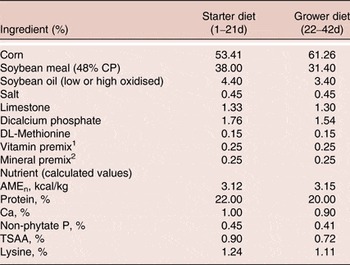
A corn-soybean meal basal diet (Table 1), fed in mash form, was used and formulated to be adequate in all nutrients (National Research Council, 1994). The minerals were added to the diet as inorganic salts or proteinates (Bioplex® mineral, Alltech Inc. Nicholasville, KY) for Zn, Cu, Mn and Fe (Table 1). Organic Se (Sel-Plex®, Alltech Inc. Nicholasville, KY) at 0.3 mg/kg of diet was used to replace 0.3 mg/kg sodium selenite in the control diet. Soybean oil with no added antioxidant was purchased from a local retailer, with an initial peroxide value (POV) of 23 meq O2/kg determined according to AOCS (2007). Oxidised soybean oil was prepared by convection heat (90°C for a period of seven days in a convection oven). The final POV of the pooled oxidised oil was 121 meq O2/kg which was used immediately for diet preparation.
Ingredients and nutrient composition (as-fed basis) of the basal diet

1 Supplied per kg diet for all diets: 11,025 IU of vitamin A (retinyl acetate), 0.0882 mg of vitamin D3 (cholecalciferol), 0.91 mg of vitamin K3 (2-methyl-1, 4-naphthoquinone), 2 mg of thiamin, 8 mg of riboflavin, 55 mg of niacin, 18 mg of Ca pantothenate, 5 mg of vitamin B6 (pyridoxines), 0.221 mg of biotin, 1 mg of folic acid, 478 mg of choline, 28 µg of vitamin B12 (cyanocobalamin). Vitamin E (DL-α-tocopheryl acetate): 50 IU/kg.
2 Supplied per kg diet for the diets containing inorganic salts: 80 mg Fe as FeSO4·H2O, 90 mg Mn as MnSO4·H2O, 125 mg Cu as CuSO4·5H2O, 100 mg Zn as ZnO, 0.35 mg I as KIO3, and 0.30 mg Se as sodium selenite. Supplied per kg diet for the diets containing organic mineral chelates: 20 mg Fe as Bioplex Fe, 23 mg Mn as Bioplex Mn, 31 mg Cu as Bioplex Cu, 25 mg Zn as Bioplex Zn, 0.35 mg of iodine as KIO3, and 0.30 mg Se as Sel-Plex.
Experimental design and sampling
A randomised, complete block design was used in this study with blocks based on physical location of the pens within the room. Treatment structure consisted of a 2 × 2 factorial arrangement with two forms of mineral (inorganic or organic) and two forms of oil (fresh or oxidised). The four treatments were: (1) Corn-soy basal diet with fresh oil and inorganic trace mineral; (2) Corn-soy basal diet with fresh oil and organic trace mineral; (3) Corn-soy basal diet with oxidised oil and inorganic trace mineral; (4) Corn-soy basal diet with oxidised oil and organic trace mineral. A total of 1152 chicks was randomly assigned to each of the four dietary treatments with 12 replicate pens of 24 chicks. The experiment lasted 42 days. Chicks and feed were weighed at the beginning of the trial and then weekly. On d42, one chick from each pen (12 chicks per treatment) were randomly selected and euthanised with argon gas followed by cervical dislocation. The breast meat was taken and stored in -20°C for the analysis of minerals by using an Inductively Coupled Plasma Optical Emission Spectrometer (ICP-OES) (Agilent, Santa Clara, CA).
Statistical methods
Data were subjected to ANOVA for a 2 × 2 factorial design using the linear model of Statistix V. 9 (Analytical Software, 2008). Mean differences were determined using Fisher's LSD test. The group averages of all birds (24) per pen were used for analysis of growth performance data while the averages of 12 randomly selected birds per treatment were used for analysis of mineral concentration in the breast meat.
Results and discussion
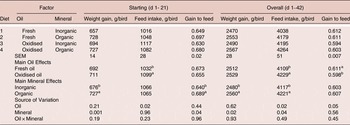
The effects of dietary treatments on the growth performance of broiler chicks are shown in Table 2. No statistical interaction between oil source and mineral form on the growth performance of broiler chicks was observed. During the first three weeks growing period, the chicks fed the diet containing organic minerals had greater (P < 0.01) weight gain and FCE compared with those fed diets containing inorganic mineral salts. Over the entire 42d growing period, chicks fed diets supplemented with organic minerals had higher (P < 0.05) feed intake and weight gain compared with those fed diets supplemented with inorganic minerals.
Effects of feeding fresh or oxidised oil and inorganic or organic minerals on the performance of broiler chicks

a,b Means not sharing a letter differ significantly (P < 0.05)
Bondet et al. (Reference Bondet, Cuvelier and Berset2000) pointed out that transition metal ions such as Fe2+ and Cu2+ act as promoters of lipid oxidation in the presence of hydroperoxides. These metal ions are involved in one-electron redox reactions, which leads to hydroperoxide decomposition. Maestre et al. (2000) showed that metal chelators were less active than reductants and slowed lipid oxidation effectively. Tavarez et al. (2011) observed that dietary antioxidant (the combination of ethoxyquin and propyl gallate) was effective for diminishing the depression of weight gain and feed intake caused by oxidised oil.
Chicks fed the diets containing oxidised oil consumed higher (P < 0.05) quantities of feed than those fed the diets containing fresh oil in both the starting and the growing periods. This is attributed possibly to the lower metabolisable energy in the diets with oxidised oil. Results from Engberg et al. (Reference Engberg, Lauridsen, Jensen and Jakobsen1996) indicated that the chicks fed oxidised oil had lower retention of fat and energy compared with those fed fresh oil. In this reported trial, chicks fed diets containing oxidised oil had lower (P < 0.05) FCE compared with those fed diets containing fresh oil overall in the 42d production period. These results are consistent with many other reported results. Engberg et al. (Reference Engberg, Lauridsen, Jensen and Jakobsen1996) demonstrated that the intake of oxidised oil caused a growth depression of chicks after two weeks. Similar results were reported by Cabel et al. (Reference Cabel, Waldroup, Shermer and Calabotta1988) and Dibner et al. (Reference Dibner, Atwell, Kitchell, Shermer and Ivey1996).
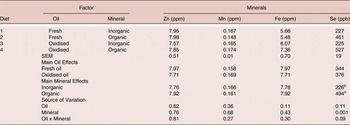
The effect of dietary treatments on the mineral concentration in breast meat is shown in Table 3. There was no significant effect of dietary treatments on the concentration of Zn, Mn and Fe in the breast meat. The Se concentration of the breast meat from chicks fed diets containing organic mineral products was higher (P < 0.01) than that from chicks fed diets containing inorganic mineral salts. The results were consistent with the data reported by Yaroshenko et al. (Reference Yaroshenko, Surai, Yaroshenko, Karadas and Sparks2004). Heindl et al. (Reference Heindl, Ledvinka, Englmaierová, Zita and Tůmová2010) indicated dietary organic Se significantly increased the Se level and activity of GSH-Px in breast meat compared with inorganic Se. Edens and Gowdy (Reference Edens, Gowdy, Lyons and Jacques2004) observed the antioxidant potential of many selenoproteins and Se containing enzymes in animals.
Effects of feeding fresh or oxidised oil and inorganic or organic minerals on the mineral concentration of breast meat

a,b Means not sharing a letter differ significantly (P < 0.05)
Conclusions
The data from this trial indicated that oxidation of lipid in poultry diets increased feed intake and decreased gain to feed ratio of broiler chicks. Dietary supplementation of organic minerals, even at a lower inclusion level (25% of inorganic levels), increased growth rate, feed intake and gain to feed ratio of chicks. The meat Se concentration was increased by using the organic Se source. Therefore, the data showed that the negative impact of feeding rancid, oxidised oil can be ameliorated by feeding organic mineral sources.