The trend that young adults are more gradually making their way into adulthood can be observed in the general population of most high-income countries (Arnett, Žukauskiene, & Sugimura, Reference Arnett, Žukauskiene and Sugimura2014): youngsters focus on identity exploration, self-development, and preparation of their adult life by taking time to finish their education, becoming financially independent, and deciding about parenthood. In 2000, Jeffrey Arnett proposed the term emerging adulthood for this distinct period of the life course, ranging roughly from the late teens through the middle to late 20s (Arnett, Reference Arnett2000). Emerging adulthood is now widely regarded as a critical transitional period, in which transition refers to the neurobiological process of maturation and the heterogeneous psychological and societal changes that are associated with this process (Davis & van der Stoep, Reference Davis and van der Stoep1997). These changes can be challenging for youngsters, and there is a growing recognition that young adults should be treated as a distinct subpopulation in policy, planning, programming, and research (Stroud, Walker, Davis, & Irwin, Reference Stroud, Walker, Davis and Irwin2015). Scholars of stress processes note that although developmental transitions are generally challenging, emerging adulthood particularly can disrupt young lives because many consecutive (societal) changes are needed (Pearlin, Reference Pearlin2010). This is even more so for those with interrelated problems and particularly when risks are high and resilience is low. Longitudinal research has shown that mental disorders (Tanner et al., Reference Tanner, Reinherz, Beardslee, Fitzmaurice, Leis and Berger2007), comorbidity (Newman et al., Reference Newman, Moffitt, Caspi, Magdol, Silva and Stanton1996), and offense rates (Loeber, Farrington, & Petechuk, Reference Loeber, Farrington and Petechuk2013) increase from childhood through adolescence and peak in young adulthood. However, whereas problem behavior in emerging adulthood may peak, there is also evidence that this is usually temporary and most emerging adults are sufficiently resilient to reach adulthood healthy. One study on the long-term effects of early mental health and judicial problems showed that even a large percentage of high-risk young adults were in stable marriages and jobs, and were responsible citizens in their community by the time they reached the end of their fourth decade of life (Werner, Reference Werner2004).
In contrast to this predominantly positive trend for most emerging adults, there are vulnerable youngsters who do not undergo this transition successfully, either because they are not able to handle the demanding requirements of this period or because they have more to handle with less support (Osgood, Foster, & Courtney, Reference Osgood, Foster and Courtney2010). These young adults have extensive histories of childhood adversities and have often been involved in juvenile care services. These agencies provided long-term support to them and their families with varying effectiveness. During emerging adulthood, many young adults still struggle with social problems, limited capacities, and/or mental health problems. Often, they lack the financial support of their also disadvantaged families, which may prove essential to continue their school/college careers. Educational failure and school dropout are important risk factors for engaging in antisocial behavior in adolescence and young adulthood (Henry, Knight, & Thornberry, Reference Henry, Knight and Thornberry2012) and consequently for judicial interference. Therefore, it comes as no surprise that these vulnerable young adults have educational and judicial problems on top of their psychosocial constraints; they experience interrelated problem behavior across several life domains. This co-occurrence and subsequent accumulation of problem behavior can be explained in terms of theories following an ecobiodevelopmental paradigm (Jessor, Reference Jessor1992; Monroe & Simons, Reference Monroe and Simons1991; Shonkoff et al., Reference Shonkoff, Garner, Siegel, Dobbins, Earls, Garner and Wood2012). Since the endorsement of a “complexity view” of human development and (mental) illness by Engel (Reference Engel1977) and the introduction of the bioecological model (Bronfenbrenner & Morris, Reference Bronfenbrenner, Morris, Lerner and Damon2006) by Bronfenbrenner in 1979, these theories not only address biological but also social, psychological, and behavioral dimensions of problem behavior. In 1988, the first empirical evidence for a “multiproblem” construct was found (Donovan & Jessor, Reference Donovan and Jessor1985); delinquency, substance abuse, and sexual risk behavior were shown to form a problem syndrome in both adolescence and young adulthood. Following this ecological view, models that focus on risk and resilience have been developed. For example, the diathesis-stress model (Monroe & Simons, Reference Monroe and Simons1991) posits that stress activates a diathesis, transforming the potential of predisposition into the presence of problem behavior. In this way, interpersonal and social stressors help explain the accumulation of problem behavior as one stressor leads to another. As chronic stress persistently increases, people are prevented from effectively coping with their stressors, which again lowers their chances of successfully transitioning from one life period to another. Models such as the diathesis-stress model theorize how cumulative adversity is a risk for health and developmental problems in general populations and suggest they apply to high-risk youth as well (Foster & Brooks-Gunn, Reference Foster and Brooks-Gunn2009), as most multiproblem youngsters descend from multiproblem families.
Further research has linked mental health problems to juvenile criminal behavior (Doreleijers, Moser, Thijs, Van Engeland, & Beyaert, Reference Doreleijers, Moser, Thijs, Van Engeland and Beyaert2000), and to substance abuse disorders as well (Hawkins, Reference Hawkins2009). Studies in the last two decades have consequently investigated delinquency, mental health problems, and substance abuse in young people as separate (Lee, Festinger, Jaccard, & Munson, Reference Lee, Festinger, Jaccard and Munson2017; Mulder, Vermunt, Brand, Bullens, & Marle, Reference Mulder, Vermunt, Brand, Bullens and Marle2012; Odgers et al., Reference Odgers, Caspi, Broadbent, Dickson, Hancox, Harrington and Moffitt2007; Zijlmans et al., Reference Zijlmans, Marhe, Van Der Ende, Verhulst, Popma, Tiemeier and Van Den Heuvel2017) as well as interconnected problem domains (Dembo, Wareham, Schmeidler, & Winters, Reference Dembo, Wareham, Schmeidler and Winters2016; Hawkins, Reference Hawkins2009; Mun, Windle, & Schainker, Reference Mun, Windle and Schainker2008; Potter & Jenson, Reference Potter and Jenson2003; Vaughn, Freedenthal, Jenson, & Howard, Reference Vaughn, Freedenthal, Jenson and Howard2007). In addition, as young adult social development is marked by an extensive expansion and modification of social relationships (Lane, Leibert, & Goka-Dubose, Reference Lane, Leibert and Goka-Dubose2017), social network problems have recently been linked to the above-mentioned key life domains as well (McPherson et al., Reference McPherson, Kerr, McGee, Morgan, Cheater, McLean and Egan2014). In addition, multiproblem behavior has been shown to be highly related to multiple interrelated childhood and context factors such as adverse childhood experiences (ACEs), including family dysfunction (Kalmakis & Chandler, Reference Kalmakis and Chandler2015) and child maltreatment (Gilbert et al., Reference Gilbert, Widom, Browne, Fergusson, Webb and Janson2009), high residential mobility (Perkins, Reference Perkins2017), academic failure (Baggio et al., Reference Baggio, Iglesias, Deline, Studer, Henchoz, Mohler-Kuo and Gmel2015), poverty (Font & Maguire-Jack, Reference Font and Maguire-Jack2016), service use (Garland, Aarons, Brown, Wood, & Hough, Reference Garland, Aarons, Brown, Wood and Hough2003), and unemployment (Liu et al., Reference Liu, Croft, Chapman, Perry, Greenlund, Zhao and Edwards2013).
To deepen our insight into the intricacies of multiproblem behavior, statistical methods such as cluster analysis can be used; such methods aim to identify subgroups of individuals with different (risk) profiles. Recent literature on this topic can roughly be divided into studies conducted within community-based normative samples versus studies within high-risk samples. One of the few studies that attempted to investigate population heterogeneity was conducted by Mun et al. (Reference Mun, Windle and Schainker2008). They showed that within an adolescent community sample a small multiproblem group who experienced an accumulation of delinquent behavior, sexual risk behavior, substance use, and mental health problems could be identified (Mun et al., Reference Mun, Windle and Schainker2008). There was a remarkable continuity of risk and dysfunction within this group from adolescence to young adulthood. The finding that a distinction in profiles of youth development is useful was replicated by Berzin (Reference Berzin2010) in a community sample of emerging young adults. Studies within high-risk groups, such as juvenile offenders, truants, and foster youth, also distinguished several profiles differing in the extent of problem behavior and in interrelationships of co-occurring adversities such as family dysfunction, poor peer relations, adverse psychological functioning, and a low educational level (Dembo et al., Reference Dembo, Wareham, Schmeidler and Winters2016; Mulder et al., Reference Mulder, Vermunt, Brand, Bullens and Marle2012; Potter & Jenson, Reference Potter and Jenson2003; Rebbe, Nurius, Ahrens, & Courtney, Reference Rebbe, Nurius, Ahrens and Courtney2017). Specifically, within a population of emerging adults with a history of childhood contact with Child Protection Services (CPS), a group with multiple mental health disorders who were troubled by a low rate of (mental) health service use was identified by Lee et al. (Reference Lee, Festinger, Jaccard and Munson2017). Van Duin et al. (Reference Van Duin, Bevaart, Paalman, Luijks, Zijlmans, Marhe and Popma2017) retrospectively distinguished several classes of multiproblem young adults with CPS contact during their childhood differing in their CPS characteristics, the amount of family problems during childhood, and their long-term mental health outcomes (Van Duin et al., Reference Van Duin, Bevaart, Paalman, Luijks, Zijlmans, Marhe and Popma2017). In sum, these studies highlight the possibilities to inform both theory and clinical practice by constructing useful typologies for young people who experience a plethora of problems and by linking these profiles to heterogeneous childhood risk factors and adult outcomes.
Juvenile and criminal justice have already been cautiously experimenting with classifications concerning the characteristics of juvenile delinquents to inform official decisions with regard to placement setting and security level (Andrews & Bonta, Reference Andrews and Bonta1994). However, empirical studies that can help inform judicial and clinical practice about multiproblem young adults are scarce as both the introduction of the developmental phase “emerging adulthood” and the concept of “multiproblem” behavior within our academic domain are relatively new. Furthermore, there are only a few studies (Lee et al., Reference Lee, Festinger, Jaccard and Munson2017; Mun et al., Reference Mun, Windle and Schainker2008; Rebbe et al., Reference Rebbe, Nurius, Ahrens and Courtney2017) that investigated multiproblem behavior in accordance with theory by clustering several key life domains (i.e., delinquency, substance abuse, sexual risk behavior, mental health problems, and social networks problems) and consecutively relating these clusters to well-documented childhood and context risk factors, such as ACEs and service use. Finally, research that uses such risk profiles to predict meaningful outcomes for daily practice, such as quality of life, education and employment, mental health problems, and (the severity of) recidivism, is even more scarce. Thus, little is known about the compositional variations of multiproblem behavior in young adulthood, the related adversity profiles, and the corresponding implications for multiproblem young adults’ functioning and treatment. As multiproblem young adults are in urgent need of professional support (Osgood et al., Reference Osgood, Foster and Courtney2010) to help themselves and to unburden society, and because treatment strategies may differ in effectiveness depending on the combinations of problem behavior (Collins, Murphy, & Bierman, Reference Collins, Murphy and Bierman2004), we must aim to disentangle multiproblem behavior in this population soon.
To address this, we aim to find meaningful clusters of multiproblem young adult behavior by analyzing problem behavior across several important life domains (i.e., addiction, mental health, social network, and justice). Although in accordance with previous studies we expect to find several problem clusters, specific hypotheses concerning the qualitative nature of these clusters within our understudied target population of multiproblem young adults are lacking. To provide a broad and comprehensive view on the nature of young adult problem behavior, we explore how the clusters relate to childhood risk factors (i.e., service use, ACEs and residential mobility) and to baseline functioning (i.e., comorbidity, and antisocial and risk-seeking behavior). Finally, as enhancing quality of life, stimulating education and employment, reducing mental health problems, and (the severity of) recidivism are important aims of multimodal interventions for multiproblem young adults (Luijks et al., Reference Luijks, Bevaart, Zijlmans, van Duin, Marhe, Doreleijers and Popma2017), these were our outcome variables.
Method
Sample and procedure
Participants were 696 male multiproblem young adult men (age 18–27) recruited at either the start of multimodal day treatment program De Nieuwe Kans (translated as “New Opportunities”) or at an intake at the social welfare agency in Rotterdam, the Netherlands (Jongerenloket). This agency itself refers young adults to treatment programs such as De Nieuwe Kans. Individuals were eligible for participation when they met the criteria for a multiproblem definition based on scores on the Self-Sufficiency Matrix (SSM; Fassaert et al., Reference Fassaert, Lauriks, Van De Weerd, Theunissen, Kikkert, Dekker and De Wit2014). Self-sufficiency is the capacity to create an acceptable level of functioning on eleven important life domains: income, daytime activities, housing, domestic relations, mental health, physical health, addiction, general life skills, social network, community involvement, and justice. It is measured on a 5-point scale with 1 indicating acute problems and 5 indicating complete self-sufficiency. The inclusion criteria were (a) a score of 1 or 2 on the domains income and daytime activities; (b) a maximum score of 3 on at least one of the following domains: addiction, mental health, social network, justice; and (c) a minimum score of 3 on the domain physical health. We excluded 16 participants who finished a higher secondary education, leaving a final sample of 680 participants. In total, four assessments over 14 months were performed during which a battery of questionnaires and tests was completed. Here, we present data from the baseline measurement, the final follow-up after 14 months, and judicial records (see Luijks et al., Reference Luijks, Bevaart, Zijlmans, van Duin, Marhe, Doreleijers and Popma2017, for a complete description of the study protocol).
All procedures performed in studies involving human participants were in accordance with the ethical standards of the institutional and/or national research committee and with the 1964 Helsinki declaration and its later amendments or comparable ethical standards. The study has been approved by the Medical Ethical Committee of the VU University Medical Center (registration number 2013.422-NL46906.029.13), and all participants provided written informed consent. Participants received a reimbursement of 20 euros for the baseline measurement and another reimbursement of 20 euros for the final follow-up measurement.
Measures
Indicators
As indicators for the latent profiles, we employed six measures that capture the range of problems within the multiproblem definition: drug use, alcohol use, internalizing problems, externalizing problems, friends’ delinquency, and personal delinquency. These measures correspond with four key life domains (i.e., addiction, mental health, social network, and justice) in accordance to ecobiodevelopmental theory (Donovan & Jessor, Reference Donovan and Jessor1985; Doreleijers et al., Reference Doreleijers, Moser, Thijs, Van Engeland and Beyaert2000; Hawkins, Reference Hawkins2009; McPherson et al., Reference McPherson, Kerr, McGee, Morgan, Cheater, McLean and Egan2014). As the SSM is an ordinal measure, which limits variability, we used continuous measures of validated questionnaires to capture the full range of variation between participants. We assessed drug and alcohol use (addiction) using the Measuring Addictions for Triage and Evaluation structured interview (Schippers, Broekman, Buchholz, Koeter, & van den Brink, Reference Schippers, Broekman, Buchholz, Koeter and van den Brink2010). The variables used were “number of days of alcohol use during the past 30 days” and “number of days of cannabis use during the past 30 days.” To assess internalizing and externalizing problems (mental health), we used the Adult Self-Report (ASR; Achenbach & Rescorla, Reference Achenbach and Rescorla2003). This questionnaire consists of 123 items on a 3-point Likert scale and measures psychological problems during the past 6 months. The reliability of the ASR is good, with a Cronbach's α of .83. We used the total “internalizing” and “externalizing” scales as variables. As a measure of social network problems, we employed the friends’ delinquency scale of the friends questionnaire (Meeus & Koot, Reference Meeus and Koot2007; social network). The reliability of the friends questionnaire is sufficient, with a Cronbach's α of .71. Finally, we assessed delinquency with the Research and Documentation Center of the Ministry of Service and Justice in the Netherlands self-reported delinquency questionnaire (Van der Laan & Blom, Reference Van der Laan and Blom2006). We employed the total score as a measure of overall lifetime delinquency (justice). The total score is computed by summing all reported offenses, weighted by severity. The reliability of the questionnaire is good, with a Cronbach's α of .85. We added age as an indicator to control for possible age effects and evaluate whether groups did not simply represent different age groups.
Childhood risk factors
We performed register and record research at CPS, the Psychiatric Case Register (PCR), and Probation Services (PS) to assess what proportion of participants has been in contact with these institutions. CPS monitors youth (age 0–18) when other institutions notice concerns about the upbringing, home environment, or police contact of youth. PCR registered the use of mental health care under the age of 18. At the request of the court, probation services aim to decrease recidivism after a criminal conviction. We were able to look into files of 85%, 92%, and 96% of participants, respectively. Missing data were due to refusal to participate in less than 1% of cases (N = 4) and otherwise due to the long-running inclusion period, which resulted in some participants not yet being included at the moment of the CPS, PCR, and PS administrative research (N = 101, N = 50, and N = 22, respectively). We assessed 11 ACEs in total. We assessed emotional abuse, physical abuse, sexual abuse, emotional neglect, and physical neglect during childhood using the Childhood Trauma Questionnaire (Thombs, Bernstein, Lobbestael, & Arntz, Reference Thombs, Bernstein, Lobbestael and Arntz2009). Cronbach's α are .89, .91, .95, .91, and .63 respectively. We dichotomized these into Yes/No variables as applied in earlier research. Alcohol abuse in the family, drug abuse in the family, police contact in the family, psychological problems in the family, domestic violence, and growing up in a single-parent family were assessed with Yes/No questions. Total number of ACEs was operationalized by summing the 11 ACE items. Residential mobility was operationalized as the number of movements and assessed with the residential mobility calendar (City of Rotterdam Regional Steering Committee, 2011).
Baseline functioning
Data on baseline functioning were gathered at the same time as data on the indicators were. We assessed whether participants have a basic job qualification (i.e., finished at least junior secondary education) based on their self-reported education. We measured IQ using four subscales of the Wechsler Adult Intelligence Scale—Third edition (digit symbol coding, information, block design, and arithmetic; Blyler, Gold, Iannone, & Buchanan, Reference Blyler, Gold, Iannone and Buchanan2000). As a measure of comorbidity, we used the number of research diagnoses based on DSM-IV criteria as assessed during the Mini-International Neuropsychiatric Interview (Sheehan et al., Reference Sheehan, Lecrubier, Harnett Sheehan, Janavs, Weiller, Keskiner and Dunbar1997). As a measure of aggression, we employed the total score of the Reactive Proactive Questionnaire (Cima, Raine, Meesters, & Popma, Reference Cima, Raine, Meesters and Popma2013; Raine et al., Reference Raine, Dodge, Loeber, Gatzke-Kopp, Lynam, Reynolds and Liu2006), which consists of 23 items scored on a 3-point Likert scale and has good reliability, with a Cronbach's α of .91. We used the total score of the Barratt Impulsivity Scale to assess impulsivity (Patton, Stanford, & Barratt, Reference Patton, Stanford and Barratt1995). The questionnaire consists of 30 items scored on a 4-point Likert scale and has good reliability with a Cronbach's α of .80. As a measure of psychopathic traits, we employed the total score of the Youth Psychopathy Inventory—Short Version (van Baardewijk et al., Reference van Baardewijk, Andershed, Stegge, Nilsson, Scholte and Vermeiren2010), a self-report measure that has been validated in young adults (Colins & Andershed, Reference Colins and Andershed2015). It consists of 18 items scored on a 4-point Likert scale and has good reliability with a Cronbach's α of .85. We used the total score of the Brief Sensation Seeking Scale (Hoyle, Stephenson, Palmgreen, Lorch, & Donohew, Reference Hoyle, Stephenson, Palmgreen, Lorch and Donohew2002) to assess sensation seeking. It consists of 8 items scored on a 4-point Likert scale and has adequate reliability with a Cronbach's α of .77.
Outcome variables
We assessed functioning at 14-month follow-up (response rate 78%). We again assessed internalizing and externalizing problems using the ASR. We measured quality of life using the total score of the Manchester Short Assessment of Quality of Life (Priebe, Huxley, Knight, & Evans, Reference Priebe, Huxley, Knight and Evans1999), which consists of 12 items scored on a 7-point Likert scale and has adequate reliability with a Cronbach's α of .74. We assessed whether participants were following school or were employed based on self-report. Finally, we obtained data from the Research and Policy database Judicial Documentation by the Research and Documentation Center of the Ministry of Service and Justice in the Netherlands to assess registered delinquent behavior (median follow-up period 31 months). We differentiated between violent crimes, sexual crimes, property crimes with violence, property crimes without violence, destruction/public order crimes, drug crimes, traffic crimes, and other crimes.
Statistical analysis
To account for missing data (% missing data for indicators varied between 0% and 12%), we used multivariate imputation by chained equation to obtain 20 complete data sets. This method replaces missing values with plausible values drawn from a distribution specifically modeled for that missing value. As all indicator variables are continuous, we used predictive mean matching to obtain the imputed values (van Buuren, Reference van Buuren2012). We then performed a model-based clustering analysis in R (R Core Team, 2016) using the clustMD package (McParland & Gormley, Reference McParland and Gormley2016) over all imputed data sets to identify latent groups. The input variables were mean-centered and then scaled by dividing the centered columns by their standard deviations before running the analysis. This is done to prevent variables with a large variance to have more influence on the clustering than other variables. We used the Bayesian information criterion and the integrated classification likelihood criterion as formal measures to inspect model fit, with higher values indicating a better fit. In addition, substantive theory and interpretability of clusters were taken into account to decide upon the number of classes. Individuals were classified to the most likely cluster based on the highest posterior probability. Next, we performed the same analysis on the nonimputed data set to evaluate whether results were not biased by imputations. We report these results in Table S.1 and Figure S.1. To assess whether the latent groups differed on past risk factors, baseline functioning, and group outcomes, we performed analyses of variance for continuous dependent variables and logistic regression for binary dependent variables. All post hoc comparisons were Bonferroni corrected.
Results
Clusters
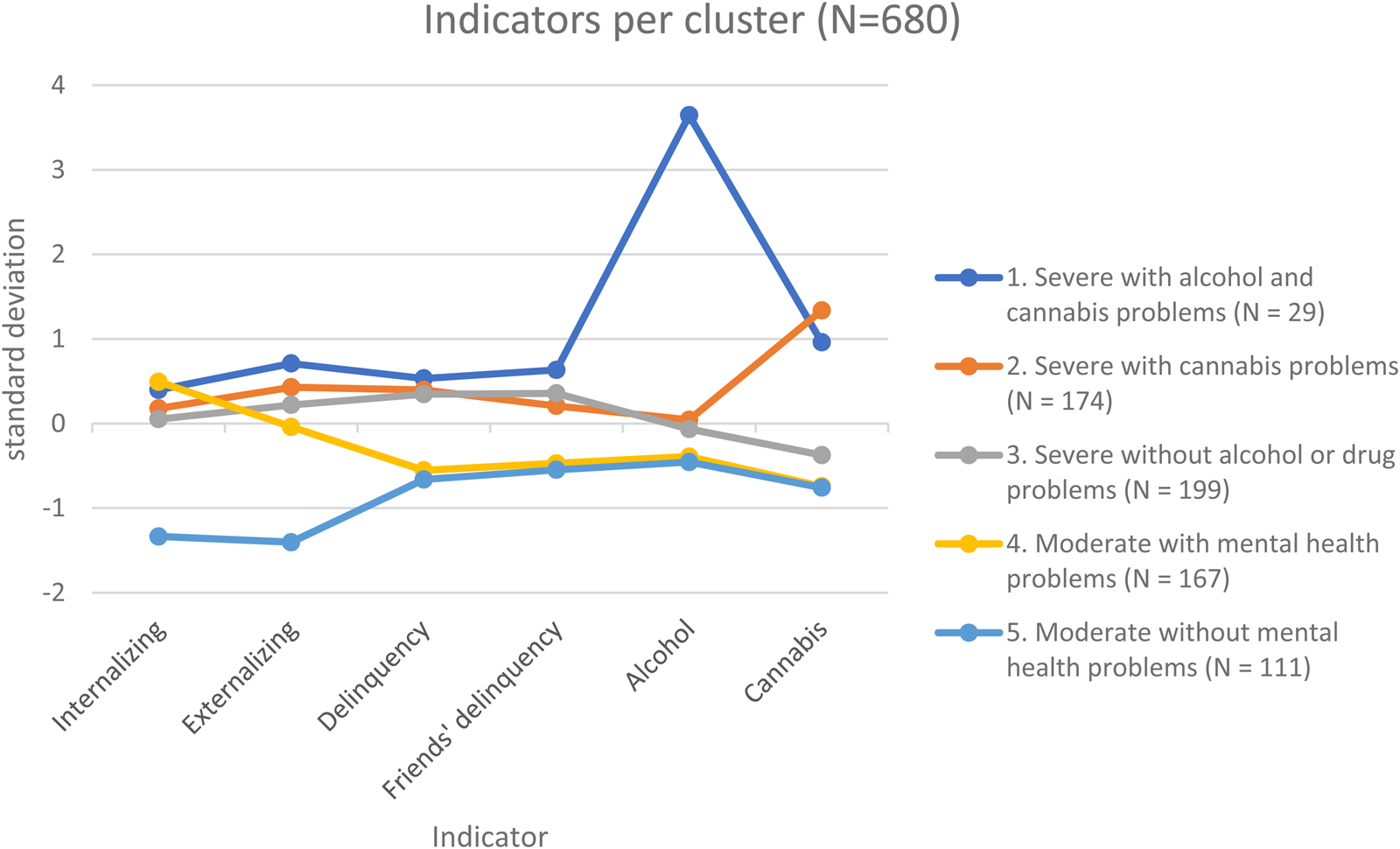
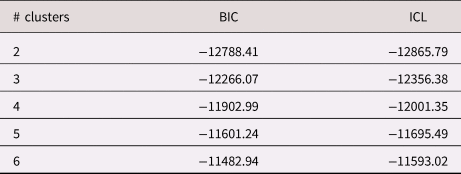
Both fit statistics were best for varying volume, equal shape models that allow for covariance matrices of variable volume and equal shape (Scrucca, Fop, Murphy, & Raftery, Reference Scrucca, Fop, Murphy and Raftery2016). In addition, they indicated better performance of models including more clusters (see Table 1). However, inspection of the five- and six-cluster solutions revealed that the added profile was not meaningful as profiles were either very small or similar to other clusters. Moreover, posterior probabilities for both the five- (0.93) and six-cluster (0.94) solutions were very high, and fit indices differed only slightly. Therefore, we decided upon the five-cluster solution for further investigation. The first and smallest cluster comprised 4.3% (N = 29) of the sample. It scored high on all indicators and was set apart most from the other clusters due to high alcohol use (M = 18 days per month) and high cannabis use (M = 19 days per month). We labeled it “severe with alcohol and cannabis problems.” The second cluster comprised 25.6% (N = 174) of the sample. It resembled the first cluster as it had similar albeit slightly lower scores on the mental health, delinquency, and social network indicators. It had very high cannabis use (M = 26 days per month), but no alcohol problems (M = 3 days per month). We labeled it “severe with cannabis problems.” The third cluster comprised 33.2% (N = 226) of the sample. It had comparable scores as the second group, but lacked the high cannabis use (M = 6 days per month). We labeled it “severe without alcohol and drug problems.” The fourth cluster comprised 22.9% (N = 156) of the sample. It presented with considerably fewer problems than the first three groups on the delinquency and social network indicators and showed little drug use. In addition, it showed fewer externalizing problems, but similar or even more internalizing problems. We labeled it “moderate with mental health problems.” The fifth and final cluster comprised 14.0% (N = 95) of the sample. Its profile was comparable to that of the fourth cluster, but scored low on mental health issues. We labeled it “moderate without mental health problems.” See Figure 1 for an overview of the clusters. It should be noted that the terms “severe” and “moderate” are relative to the problems our participants present with. All participants suffer from a multitude of problems and as such “moderate” does not imply that their problems are moderate compared to a general population.
Indicatiors per cluster.

Model fit statistics

Note: BIC, Bayesian information criterion. ICL, integrated classification likelihood criterion.
The supplemental analysis on the nonimputed data yielded highly similar results and indicated no bias due to imputation (see Table S.1 and Figure S.1).
Differences between clusters
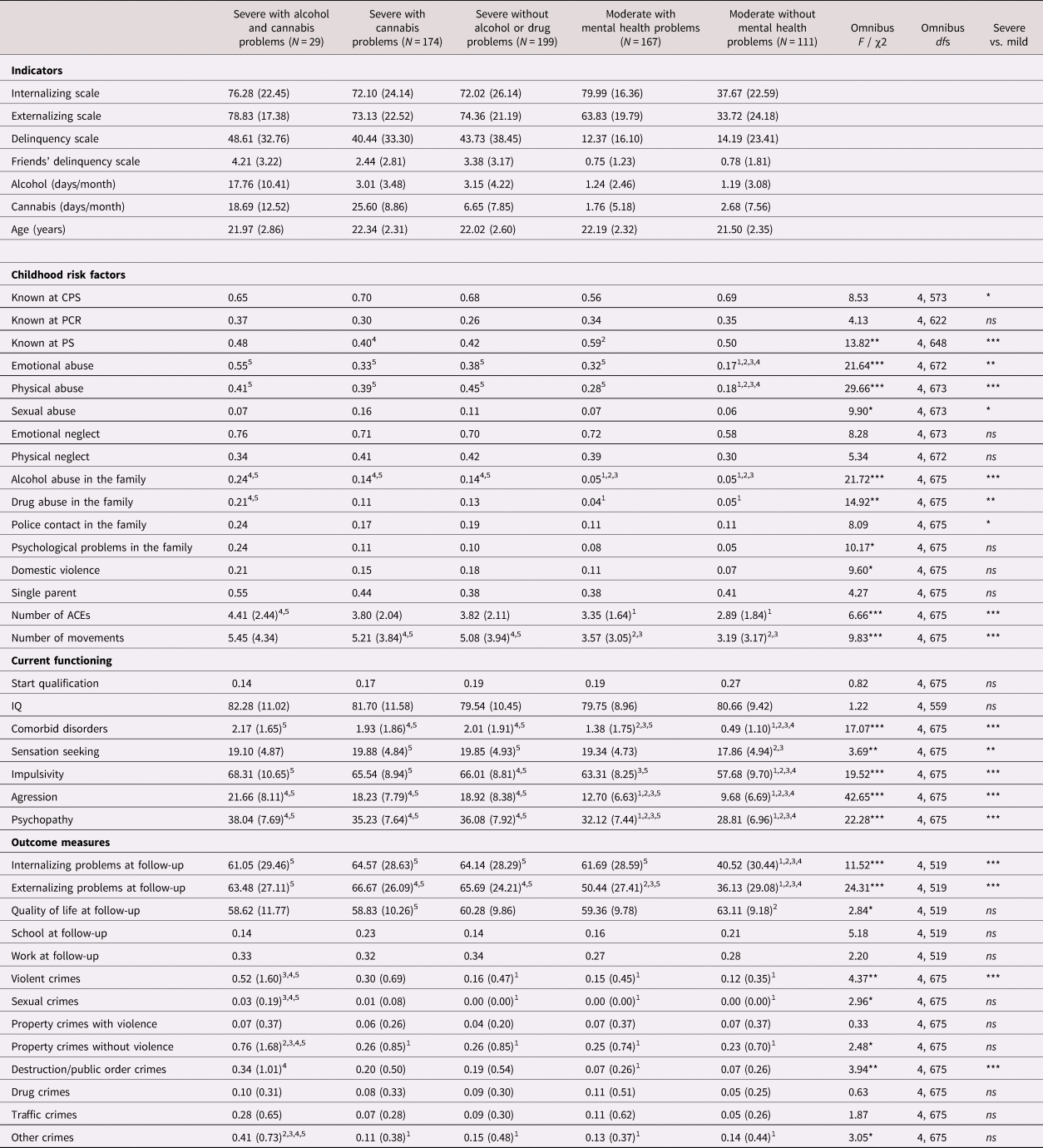
As the first three clusters and the last two clusters clearly differed in severity of baseline functioning, in addition to simple post hoc contrasts between individual groups we performed a post hoc test between the three severe clusters versus the two moderate clusters (see Table 2). When looking at childhood risk factors, all groups showed similar proportions of contact with youth services, with the severe clusters having had more contact with probation services. The moderate groups have experienced fewer total ACEs, specifically emotional and physical abuse, and alcohol and drug abuse in the family. Whereas there were no differences between the severe groups, the fifth group (moderate without mental health problems) has experienced significantly fewer ACEs than the fourth group (moderate with mental health problems). The severe groups have had more residential movements than the moderate groups.
Indicators, childhood risk factors, current functioning, and outcome measures for each cluster

Note: Superscripts 1,2,3,4,5 represent significant, Bonferroni corrected differences between individual groups. All dichotomous variables are coded 0 = no; 1 = yes. CPS, Child Protective Services. PCR, Psychiatric Case Registry. PS, Probation Services. ACE, adverse childhood experience. IQ, intelligence quotient. * p < .05. **p < .01. ***p < .001. ns, not significant.
Regarding baseline functioning, there were no differences in basic job qualification nor IQ between any of the groups, but there were sizable differences on comorbidity and the behavioral measures. The three clusters with severe problems showed larger comorbidity, greater sensation seeking, more aggressive behavior, higher levels of impulsivity, and more psychopathic traits than the two moderate clusters. Again, there were no differences between the severe clusters, but the fourth group presented with more impulsive and psychopathic behavior than the fifth group.
As for group outcomes, the differences in mental health problems between groups remained intact, but all groups scored lower on both internalizing and externalizing problems than at baseline. Quality of life was similar for all groups, although slightly higher for the fifth group. There were no differences in the proportion of individuals who go to school or have a job. The severe groups showed higher rates of violent crimes and destruction/public order crimes. Between the severe groups, the first groups committed the most violent crimes, sexual crimes, property crimes without violence, and other crimes.
Discussion
The current study sought to disentangle multiproblem young adult behavior by using a cluster analysis approach. A five-cluster solution provided a statistically efficient and conceptually helpful way of grouping the study population according to the severity and nature of their problems. Implications of the differences between the clusters were explored in terms of childhood risk factors, baseline functioning, and outcomes at 14-month follow up.
The major half of the study population (59.1%) scored above the total group mean on indicators of all key life domains, with the exception of cannabis use in Cluster 3; these multiproblem young adults constitute the three severe problem clusters. Cannabis and alcohol misuse, or the absence of it, showed to be important distinguishing indicators in the nature of the problems between the three severe problem clusters. The first cluster showed to have experienced the most traumas in childhood, although due to the small size of the first cluster (N = 29) and the strict correction for multiple testing applied not all comparisons reached significance. Likewise, they performed worst on virtually all measures of current functioning and outcome measures, with the largest differences being present in the number of crimes committed. This group is likely in need of long-term care starting in childhood and reaching into adulthood. This may be achieved by organizing care differently for this group, for example, following the Building Community Resilience Model, a recent collaborative approach covering child health, public health, and community-based agencies. It aims to target the root causes of childhood adversity and to build resilience within communities (Ellis & Dietz, Reference Ellis and Dietz2017). Such approaches that move from fragmented care toward more integrated care are more recently being developed and were not yet available during our participants’ childhood.
The other two severe groups scored very similar to each other across all measures. Notable differences are the larger number of school goers and the higher number of violent crimes committed by the severe group with cannabis problems compared to the severe group without cannabis problems. Plausibly, both groups experience similar problems, but use different coping mechanisms to address these. High-risk youth using cannabis as self-medication to cope with negative affect is well documented within the literature (Fox, Towe, Stephens, Walker, & Roffman, Reference Fox, Towe, Stephens, Walker and Roffman2011; Miller, Chen, & Parker, Reference Miller, Chen and Parker2011), especially in traumatized populations (Bonn-Miller, Vujanovic, Feldner, Bernstein, & Zvolensky, Reference Bonn-Miller, Vujanovic, Feldner, Bernstein and Zvolensky2007), and this is likely present in our sample as well. The alarmingly high levels of cannabis use in Clusters 1 and 2, and alcohol use in Cluster 1, calls for careful treatment attention to the interplay between multiproblem young adults’ problems resulting from substance use and their other existing mental health, social, and justice problems. Cognitive-behavioral interventions can be extended with modules concerning drug and alcohol use in which alternative means for dealing with negative affective states are addressed (Marlatt & Gordon, Reference Marlatt and Gordon2005). Furthermore, services to decrease recidivism appear to be most needed for the members of the addiction problem profiles, which is in line with findings from Lee et al. (Reference Lee, Festinger, Jaccard and Munson2017). One thing to consider are the legal and social implications of cannabis use. In the Netherlands, cannabis use is decriminalized and limited recreational use is generally accepted. However, daily or nearly daily use as is shown by Clusters 1 and 2 is both uncommon and socially disapproved of.
The minor half of the study population (40.9%) scored below the total group mean on indicators of all key life domains, with the exception of internalizing problems in Cluster 4; they constitute the two moderate problem clusters. Between the moderate groups, various differences in childhood risk factors, current functioning, and group outcomes were found, in which the members of the group without mental health problems (Group 5) consistently struggled less. The fourth group presented with higher rates of emotional and physical abuse, nearly thrice as many comorbid disorders, higher rates of aggression and psychopathy, and greater levels of both internalizing and externalizing problems at follow-up. The moderate group with mental health problems would probably benefit most from mental health care as during their lives their mental health problems have likely been underappreciated. The number of ACEs that multiproblem young adults have gone through is unrelated to mental health care use (Van Duin et al., Reference Van Duin, Bevaart, Zijlmans, Luijks, Doreleijers, Wierdsma and Popma2018). Early signaling of these problems in families may be key to ensure the initiation of prompt and proper care to prevent the accumulation of problems over time.
In contrast, the cluster without mental health problems seems to be functioning relatively well across all key life domains and reported less childhood adversities and better group outcomes. This group might benefit from more practical oriented intervention approaches in which assistance with issues such as financial management and finding a job is available. Such practical support can be an effective additional rehabilitation component when mental health problems, addiction, and antisocial behavior are already under control (MacKenzie & Farrington, Reference MacKenzie and Farrington2015). However, most traditional clinical practices treat mental health and substance use problems, but do not yet address the other care needs of multiproblem young adults, such as help with housing, education, and employment (Davis & van der Stoep, Reference Davis and van der Stoep1997). In order to make truly multimodal interventions for struggling youngsters more available and effective, we first need general consolidation of the idea that our care system must widen its scope beyond providing care for isolated problems. Rather, it needs to treat the complex social, environmental, and developmental interplay of adversities that multiproblem young adults encounter. Then, multimodal day treatment programs can address multiple problems and include various treatment modalities as well as distinct intervention elements. Employing cognitive behavioral techniques, such programs can focus on changing the antisocial behavior of the participants. Simultaneously, they should offer mental health care treatment for those with psychiatric and substance abuse problems. Finally, such interventions can offer extensive practical assistance in the sense of money management, education enrollment, and assisting in finding a job. Such multimodal interventions that target the multiple needs of participants have been proven more effective than narrowly focused programs, at least for delinquent juveniles (De Vries, Hoeve, Assink, Stams, & Asscher, Reference De Vries, Hoeve, Assink, Stams and Asscher2015).
The three severe groups differed greatly in many aspects from the two moderate groups. They have experienced more ACEs, specifically emotional and physical abuse, and alcohol and drug use in the family. In addition, they currently present with much higher levels of antisocial behavior, most notably in aggression and psychopathic traits. This is also visible from their higher numbers of committed violent crimes. As the structure of the multiproblem clusters was for an important part based upon the severity of problems, this may speak for screening early in the process of selecting appropriate intervention procedures and/or treatment programs for multiproblem young adults. In the Netherlands, young adults up to 27 years old can apply for help at municipal social welfare agencies when they experience problems in their key life domains. These institutions use the validated SSM-D (Fassaert et al., Reference Fassaert, Lauriks, Van De Weerd, Theunissen, Kikkert, Dekker and De Wit2014; Lauriks et al., Reference Lauriks, de Wit, Buster, Fassaert, van Wifferen and Klazinga2014) as a decision support tool; professional youth workers score the ability of the individual young adults to provide for themselves regarding key life domains (e.g., mental health, justice, social network, and addiction) with or without adequate help from informal or formal care providers. This early-stage, broad screening procedure helps to differentiate between young adults with adequate self-sufficiency and our target population who require professional support; an extended screening can subsequently be carried out within the multiproblem population to determine their specific treatment needs. Flexible interagency collaboration between municipal social services, multimodal treatment programs, mental health institutions, and the criminal justice system is urgently advised to ensure that multiproblem young adults’ problem heterogeneity is adequately recognized, diagnosed, and effectively treated. It remains a public health challenge to tailor treatment to individuals, as precision medicine and personalized treatment are likely to outperform generic treatment programs (Cuthbert & Insel, Reference Cuthbert and Insel2013)
A final, important consideration is the direction of future research: it should aim to study how and when problems in key life domains, as according to ecobiodevelopmental theory (Donovan & Jessor, Reference Donovan and Jessor1985; Doreleijers et al., Reference Doreleijers, Moser, Thijs, Van Engeland and Beyaert2000; Hawkins, Reference Hawkins2009; McPherson et al., Reference McPherson, Kerr, McGee, Morgan, Cheater, McLean and Egan2014), interact with each other. Although our study showed that within a multiproblem group problems concerning the domains of justice, addiction, mental health, and social network cluster together and that these clusters are meaningfully different in terms of childhood and context factors, no explications about causality and preferred treatment order of the problems can be made. Likewise, as intervening and changing one behavior or problem affects other behaviors and problems, it is hard to disentangle whether problems co-occur because they are results of the same pathway or lead to one another. As it is now widely acknowledged that human biological, psychological, and environmental conditions and problems in key life domains influence each other, the next step in thinking about multiproblem youth behavior is to understand how these adversities interact with human conditions and with each other. A new ecobiodevelopmental framework within the fields of clinical medicine and public health is syndemics—a promising theoretical approach to measure how social contexts provide opportunities for negative problem/disease interactions to occur and how diseases cluster together within a specific time and place (Singer, Bulled, Ostrach, & Mendenhall, Reference Singer, Bulled, Ostrach and Mendenhall2017). The syndemic framework might be easily adapted to fit within the fields of developmental psychology and child and adolescent psychiatry. The point of such research should be to identify causal paths that lead to disorders or complexes of problems. That information then should be used to establish how to intervene for whom at what time to either prevent the onset of problems and disorders or aid recovery. Our results are one of the stepping-stones in this process, showing that meaningful and practical clusters can be established within multiproblem young adults, that these clusters relate to childhood factors, current functioning, as well as long-term outcomes, and suggesting that they are viable means of tailoring treatment to individual needs.
Limitations
First, this study was exploratory; it aimed to identify latent clusters that exist within our sample. As a priori hypotheses about the differences between the clusters were not formulated, our findings might be partially dependent on specific sample characteristics. However, as we have a large sample size, our sample is likely representative of the population of multiproblem young adults in Rotterdam. Second, although sexual risk behavior is suggested to be an important construct of multiproblem behavior as well (Donovan & Jessor, Reference Donovan and Jessor1985; Mun et al., Reference Mun, Windle and Schainker2008), we did not have data to operationalize this construct in the current model. Future research may benefit from investigating the variability of sexual risk behavior within multiproblem populations.
Conclusion
Multiproblem young adult behavior clusters within profiles that differ according to the severity and nature of problems and relate to childhood factors, current functioning, and outcome measures. Such profiles are viable means of differentiating between groups of individuals who are in need of different quantities and qualities of care. Pursuing an ecobiodevelopmental policy, investing in multimodal treatments, and stimulating interagency collaboration are needed to break the cycle of interrelated adversities so that ultimately multiproblem young adults can stand on their own feet (again).
Supplementary material
The supplementary material for this article can be found at https://doi.org/10.1017/S0954579419001652.
Financial Support
This research project is funded by the De Verre Bergen Foundation. De Verre Bergen Foundation is a venture philanthropy organization that aims to build a better Rotterdam through substantial investments in innovative, impactful social ventures. The financer was not involved in the design of the study nor the drafting of the manuscript. Furthermore, the financer was not involved in the process of data collection, analysis, and interpretation. Contact information: Nanne Boonstra, Parklaan 22, 3016 BB Rotterdam, the Netherlands; Tel: 0031 10 209 2000; Email: nboonstra@sdvb.com.