2020 was a banner year for Beethoven, with several concerts and events (mostly online, due to Covid-19) celebrating his 250th birthday. It was also a banner year for Jeremy Yudkin, who published not one but two volumes on Beethoven, presumably on the occasion of that semiquincentennial. One volume he edited – The New Beethoven (a de facto festschrift for Lewis LockwoodFootnote 1); the other he authored – Beethoven's Beginnings. The otherwise curious omission of an essay by Yudkin in the former is made good by the latter, an expansive account of the various and sundry ways in which Beethoven – and also Haydn and Mozart, from whom he took inspiration – commenced his works. Yudkin is a generous and versatile scholar, as evidenced both by his catalogue of books, which runs the gamut from Medieval music to jazz, and by Beethoven's Beginnings itself, which surveys a wealth of works by the Viennese-Classical triumvirate and which purveys many sensitive insights couched in lively prose. It is a testament to the author's enviable conversancy with this entire corpus and with a motley of scholarly disciplines in addition to historical musicology – to wit, the first chapter covers rhetoric, literature, literary theory, and cognitive science. Indeed, Yudkin's intellectual interests are as catholic as those of the composer he celebrates.Footnote 2
Since Yudkin's is a lengthy, diffuse tome, a précis of its most salient points might be welcome.
1. Beginnings of movements (and of multimovement works and of multiwork sets) are packed with information (or at least implications) as to key, mode, mood, metre, and tempo – information that most listeners are cognitively equipped to decode in milliseconds. Put another way, since the listener's attention is naturally and necessarily piqued at beginnings, master composers, who on some level were aware of that fact, made the most of gambits, optimizing their structural and rhetorical impact.
2. Beginnings have myriad possible functions: they can house the main tonal and motivic material of the movement or even of the entire work; they can call the audience to attention with peremptory gestures or striking sonorities and textures; they can begin in medias res; they can plant structural or emotive seeds that will flower later on; they can deliberately and delightfully confound the listener as to key, metre, or form; they (especially slow introductions) can signal seriousness of tone and grandiosity of scope.
3. If beginnings are innately liminal, paving a path from silence to sound, slow introductions are especially so, deferring the onset of the movement proper by means of topical exploration, modulation and dominant expansion. Sometimes a slow introduction will lead to the main section only for that section itself to begin in a transitory way, further deferring true initiation. A case in point is Mozart's Symphony No. 38 in D Major, K504 (‘Prague’), whose desultory Adagio generates no small desire for the ‘real’ beginning; but when the exposition arrives, all we get are soft, motivically inchoate syncopations – more distinct motives emerge only gradually. A slow introduction is formally expendable by definition, but is all the more rhetorically impactful for that.
4. On a smaller scale, the main business of a movement is often preceded by a short introductory module of only one or two measures, a module that is sometimes external to the ensuing phrase rhythm, sometimes incorporated into it. Relatedly, a piece might proffer multiple, as if alternate, beginnings. Paradigmatic is the Finale of Beethoven's Symphony No. 9 in D Minor, Op. 125, which sports a Schreckensfanfare, an instrumental recitative, alternating Presto and recitative sections, a rehearsal of the three previous movements, an anticipation of the ‘Freude’ theme, and the baritone's ‘O Freunde’ averment – all prior to the pith of the movement, the vocal version of ‘Freude’.
5. Sometimes an incipit will return later in a sonata-cycle in order to emulate the faculty of memory. Such a ‘nostalgia return’, as Yudkin terms it, can be found, for instance, in Beethoven's Piano Sonata in A Major, Op. 101: its opening theme resounds, unexpectedly and poignantly, directly before the Finale, as if a protagonist had to come to terms with something in her past to be able to move on to her future.
6. The Classical composers typically grouped works in larger sets. (This fact is more evident in Haydn and Beethoven, where several such works often fall under the same opus number, than in Mozart, where each such work has its own Köchel number.) These composers were evidently attuned to how the group as a whole began; they aimed to open a set in a way as to maximize its public appeal. Accordingly, they typically placed an extroverted, major-mode, duple-metre work at the front, the single more introverted, minor-mode work in the middle (there are conspicuous exceptions). This sometimes entailed publishing the works in a different order from that in which they were composed.
7. Beethoven, as is well known, laboured relentlessly over his compositions, revising them even after finishing fair copies and even after the music was published and performed. He toiled over beginnings in particular and was especially anxious about tempo. Not that Beethoven was uncertain about the precise tempi he wanted, but, as evident from the sketchbooks, he struggled with finding the verbal expressions that best captured them.
Yudkin's book is neither broadly philosophical nor minutely analytical. Its tenor, rather, is resolutely typological: the central chapters (2–6) parade a panoply of categories covering Beethoven's multifarious exordia. Hence we have ‘Storehouse Beginnings’, ‘Beginning as Transition’, ‘Beginning as Iconoclasm’, ‘Beginnings that Return’, and so on. Yet, there is no sustained and methodical consideration of how Classical-style beginnings prototypically behave, and so these more specialized niches lack a secure foundation. Pages 58–79 enumerate some rather obvious key-defining techniques – outlining the tonic by means of scales, arpeggios, pedal points, and the like – but do not mention the tonal and also motivic-thematic and formal traits that, especially since William Caplin's Classical Form,Footnote 3 have become common parlance: bona fide beginnings tend to start on a tonic chord, proceed to compose it out by means of auxiliary (e.g., passing and neighbouring) chords, and then cadentially confirm it; they also sport a Grundgestalt-grounding theme that is situated in a discernible form – a relatively tight-knit period, sentence, or hybrid thereof. Indeed, cursory citations notwithstanding, Yudkin curiously and studiously avoids engaging with the form-functional theories of the past few decades that have done such a fine job codifying beginning behaviours in Classical works.
Lacking that or some other comparably rigorous framework, Yudkin cannot, and so does not, securely define some of his more particular types. For example, absent an exposition of the normative harmonic syntax of beginnings, the deviant ‘in Medias Res’ type is bound to falter, as is evident in the incommensurate examples he offers. He includes Op. 101Footnote 4 in this category partly because it opens not on a tonic but on the dominant chord (what Yudkin, incidentally, incorrectly identifies as the dominant key (p. 120), which is belied by the omnipresent D-naturals) – in other words, because it describes what in Schenkerian terms is an auxiliary cadence. One thus infers that such a harmonic manoeuvre is a defining feature of this category, which would make sense. Yet, another of Yudkin's examples is Beethoven's String Quartet in C Minor, Op. 18, No. 4, which asserts the tonic from the get-go, and as confidently as any piece imaginable. Evidently, the ‘in Medias Res’ type has no harmonic hallmarks.
Why, then, does Yudkin characterize the quartet's opening thus, despite not only its tonal assertiveness but also its secure theme – motivically delineated and ensconced in a sentence? Because of ‘the urgent momentum created by reiterated pedal eighth notes on the cello’ (p. 117). Now, it is certainly true, as Yudkin elsewhere observes, that the Classicists were fond of postponing such rhythmic regularity and the thematic stability it tends to telegraph. As Janet Levy states, ‘The beginning of a conventionally figured and regularly measured accompaniment pattern, such as an Alberti bass, is a sign that we will hear a presentational [i.e., expository] passage.’Footnote 5 A piece she cites that delays that pattern is Mozart's String Quartet in F Major, K590, which does not kick into gear, as it were, until bar 8. But the fact that such ‘true’ beginnings are often offset does not make the motoric opening of Op. 18, No. 4 any more like a middle; it merely makes the openings of pieces like K590 less like full-fledged beginnings.
A similar confusion plagues Yudkin's reading of Beethoven's Symphony No. 8 in F major, Op. 93. It is meant to exemplify the ‘Beginning as Ending’ type, whose most notable exemplar (which Yudkin offers) is Haydn's String Quartet in G Major, Op. 33, No. 5, which begins, winkingly, with a cadential gesture. But the Beethoven Symphony is a very different animal: it opens normally, with a motion from I to V7 and an antecedent-like pair of contrasting motives, the first of which is a routine tonic arpeggiation (bars 1–2). That Beethoven gets cheeky at the end and restates that first motive in the very last two measures does not mean, as Yudkin insists, that bars 1–2 are innately ending-like (on a par with the Haydn), only that the last two measures are facetiously beginning-like. Here again, we witness two incommensurate examples being shoehorned into the same fuzzy category.
The converse problem arises as well: he routinely places the same example under various, apparently incommensurate types from one chapter to the next. Of course, a given gambit might appropriately fall under more than one type. Yet, Yudkin rarely explains the connection between those different categorial vantages (or even acknowledges that he is revisiting the same example from a different vantage).Footnote 6 For instance, in Chapter 5, under the subsection, ‘Beginning before the Beginning’, he observes that the first two measures of the third movement of Beethoven's String Quartet in F Major, Op. 135 are prefatory, implying F minor before alighting on the true tonic, D-flat major. He had broached this passage back in Chapter 2, under the subsection, ‘Beginning as Transition’, where he insightfully suggested that the intimated F minor serves to transition from the F major of the second movement to the D-flat of the third. To be fair, in Chapter 5 he does nod toward the earlier reading, but he stops short of explaining how one and the same module can be at once a before-a-beginning and an after-a-beginning (that is, a transition). The answer, of course, is that a given unit can occupy different temporal positions and formal functions on different hierarchical levels; the Op. 135 passage is a before-a-beginning locally and a transition more globally (and inter-movementally).
Obvious the answer may be, but it warrants articulation nonetheless. And elsewhere, engagement with formal hierarchy is even more sorely missed, as when Yudkin entertains the question of ‘When does a Beginning End?’ (last subsection of Chapter 2). It is unsurprising that his response lasts only a page-and-a-half, for he does not avail himself of the paradigm that would render that question answerable. Consider: a basic idea begins a primary theme; more globally, a primary theme begins a primary theme/transition zone; even more globally, a primary theme/transition zone begins an exposition; more globally still, an exposition begins a sonata form; and so on. So, where does a beginning end? It obviously depends on the hierarchical level to which one is referring.
Thus far, I have voiced two principal qualms: some of Yudkin's categories, because ill-defined with respect to form-functional behaviours, admit of incompatible examples, apples and oranges; conversely, a single example will often fall under multiple categories that themselves seem incompatible, but only because Yudkin does not deploy the essential notion of formal hierarchy. Underlying both problems is a lack of fluency with the modern Formenlehre apparatus. This lack is especially evident in his tendency to describe as periods what are in fact sentences – that most Beethovenian of thematic forms and a concept that has enjoyed a veritable renaissance since Caplin's Classical Form. Indeed, Yudkin even labels as a period that most paradigmatic of sentences, the primary theme of Beethoven's Piano Sonata in F Minor, Op. 2, No. 1. I am not quibbling over semantics here: Yudkin is not merely using ‘period’ to denote behaviours that most contemporary theorists use ‘sentence’ to denote. He knows full well that ‘period’ carries connotations of repose and symmetry, as evident in his describing Beethoven's theme as a ‘balanced eight-measure period’ (p. 65, my emphasis). But it is nothing of the kind: its first four bars are not counterpoised by a modified repetition but unsettled by motivic fragmentation leading headlong to a half cadence. (Yudkin himself acknowledges the ‘foreshortening’ of the gestures.) In other words, bars 5–8 comprise a continuation, not a consequent.
Yudkin's problem with terminology is even more basic. Take cadences. He neither abides by standard definitionsFootnote 7 nor establishes his own, which licenses him to label anything and everything a cadence. We are told, for instance, that in Beethoven's Piano Sonata in F Minor, Op. 57 (‘Appassionata’), a cadence arrives in bar 8 ‘on a diminished chord’ (p. 144). The problem here is threefold: definitionally, there is no standard conception of cadence that would allow it to end on a diminished chord; analytically, the event of which he speaks – a V of the Neapolitan (Np.) – is smack dab in the middle of a broad progression: i – V6 Np. – V/Np. (=VI) – V (arriving in bar 9 and prolonged for several measures, after which there is still no cadence, for the V in bar 16 is inverted); and descriptively, the chord in question is not diminished but major (I suspect Yudkin misread D♭ as D♮ here).
As to the last, it gives me no pleasure to report that the volume is peppered with such faux pas. To cite just a few: in Beethoven's Piano Sonata in C Major, Op. 53 (‘Waldstein’), ‘the first right-hand motive’, in bar 3, I assume, by no means ‘briefly suggests E minor’ (p. 72). There is no F major chord at the start of the finale of Haydn's Symphony No. 62 in D Major (p. 142). Lastly, Example 81 (p. 212) attaches a one-flat key signature to Diabelli's C-major theme on which Beethoven's composed his Op. 120 Variations. While the last is likely a mere typographical error and I may appear ungenerous for highlighting it, I read it as a kind of parapraxis, an oversight consistent with the recurrent problem evident in the aforementioned misreadings and many others besides: Yudkin has persistent difficulty getting his tonal and harmonic bearings, which is an obvious liability for one who aims to theorize musical commencements.
Around 1800, Beethoven began to cultivate, as Yudkin avers, ‘a vivid new sense of the rhetoric of beginnings’ (p. 239), often embarking on a piece gradually and processively. For example, the first four measures of the Piano Sonata in B-flat Major, Op. 22 evince ‘multiple levels of beginning’ (p. 240). There is much more to this story than Yudkin lets on; indeed, it is a story of Beethoven's most radical innovation vis-à-vis beginnings. I have little space to recount it here; a few paragraphs will have to suffice.
In 1802, Beethoven sent to Breitkopf and Härtel his Variations in F Major, Op. 34 and Variations and Fugue in E-flat Major, Op. 35 (‘Eroica’), along with a letter that refers to having ‘composed [both] in quite a new style [or manner], a completely different type….’Footnote 8 (For being so auspicious, these variation sets were awarded opus numbers, the first by Beethoven to win that distinction.) Around the same time, Beethoven (according to Czerny) divulged to the violinist Wenzel Krumpholz that he was only partially satisfied with his work to that point and now sought a new path, starting with the three Piano Sonatas, Op. 31.
What precisely Beethoven meant by ‘neue Manier’ is not completely certain, but extrapolating from Opp. 31, 34 and 35, he was possibly referring to a novel approach to thematicism and, concomitantly, to musical unity. Beethoven no longer granted a theme the power to guarantee unity from the outset. Instead, as Stefan Kunze explains, ‘a work's unity [is] expressly established and induced rather than presupposed as something pre-formed – something already given (variation theme)….’Footnote 9 Unity would now have to be dutifully constructed from the ground up, by means of developmental processes. In Adorno's Hegelian formulation, ‘The Beethovenian form is an integral whole, in which each individual moment is determined by its function within that whole only to the extent that these individual moments contradict and cancel each other, yet are preserved on a higher level….’Footnote 10 In late Beethoven, in particular, ‘the idea of totality as something already achieved had become unbearable to his critical genius’.Footnote 11 The theme is thus nothing without the processes by which it is negated and ultimately sublated. In Beethoven, ‘the true is the whole’, to invoke one of Hegel's celebrated aphorisms.
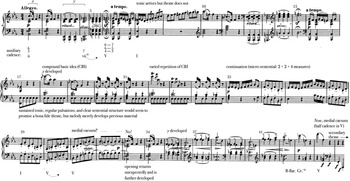
Beethoven's sonata and variation forms manifest the ‘neue Manier’ principle in similar but non-identical ways. To start, consider that Op. 31, Nos. 2 and 3 (No. 1 to a lesser extent) abstain from tendering the identifiable opening theme we expect, the theme that in a sense stands outside of the sonata discourse that then ‘remarks’ on or develops the theme. Rather, the Op. 31 ‘themes’, such as they are, are inseparable from the developmental process from the outset. The Piano Sonata in D Minor, Op. 31, No. 2 (‘Tempest’) has received the most notice in that regard,Footnote 12 but the Piano Sonata in E-flat Major, Op. 31, No. 3 (Example 1) is equally illustrative.
Beethoven, Piano Sonata in E-flat Major, Op. 31, No. 3, First Movement, bars 1–45

It begins in medias res, with an auxiliary cadence, which does not allow for, or at least conduce to, distinctive thematic material in the melody; hence the generic Seufzer figures, followed by an even more nondescript chromatic climb. It is as though ‘the beginning is an answer to something that has not been heard . . . [like] completing a thought rather than starting it’ – to borrow Yudkin's poetic description of another in medias res opening, that of Op. 101 (p. 120). Even once the tonic is reached, in bar 8, there is no melodic theme, for the music immediately backtracks, resounding the opening statement one octave higher. Then, bars 17ff seem to promise a theme, with their sustained tonic, rhythmic regularity, and clear sentence form. Yet, the melody is content merely to fragment and develop the previous Seufzer gesture (motive x). Before long, with the turn to the dominant key in bars 30–31, we retrospectively realize that we have already embarked upon the transition, which is clinched with the medial caesura (and caesura fill) at bars 31–32. In this way, we have gone straight from one post-beginning module (the in medias res opening) to another (the transition). In bar 33, Beethoven surprises us yet again, for no secondary theme is forthcoming; instead, the opening ‘theme’ returns and is still further developed – now it is the second motive (y) that is fragmented and sequenced (the minor-mode coloration enhances the sense of development). As a result, we revise our supposition that the transition had previously occurred; in fact, with the more pointed tonicization of the dominant and a more defiant caesura than in bars 30–31, it dawns on us that bars 33ff. comprise the transition. Finally, we get the secondary theme (not pictured), without having gotten a genuine primary one!
This opening, then, consists of three post-beginning modules, as it were: an in medias res incipit (bar 1), a developmental transition that turns out not to be a transition (bar 17), and a developmental restatement that turns out to be a transition (bar 33). The theme, as it stands, has been projected into its future from the very start. In short, what Dahlhaus says of the ‘Tempest’ Sonata is equally applicable here: ‘Nowhere is the thematic material “given”, in the sense of a text on which a development section comments; rather, it is involved in the developmental process from first to last.’Footnote 13
Yudkin broaches Op. 31, No. 3, but mainly to classify it as ‘Beginning as Mystery’ (which, in turn, belongs to the broader category, ‘Beginnings to Confound’). If this beginning does mystify or confound the listener, it is only in small part due to the in medias res harmonic profile and tonal vagueness that Yudkin cites. It is mainly due to the absence of a primary theme in the traditional sense, and to the formally fluid process from which the ‘theme’ is inextricable. Yudkin does not analyse such complexity here (or elsewhere) because his static conception of beginnings and hence of main themes (seemingly) obviates the need for such analysis; conversely, his reluctance toward navigating Beethoven's form-functional labyrinths reinforces that static conception.
The ‘neue Manier’ has a somewhat different modus operandi in a variation-form context. Whereas in Op. 31, Nos. 2 and 3 there are no self-contained main themes, in variation forms there are – by definition, in fact, since variations need a fixed entity to vary. (Op. 35, however, is more similar to the Op. 31 cases than are typical variation sets, for its theme arrives only after, and as the result of, a pre-developmental process by which it is literally built from the bottom up. As Beethoven himself described it, ‘the opening of this large variation set … begins with the bass of the theme, then turns into two, three, and finally four voices and only then does the theme arrive….’Footnote 14) In most variation sets, a theme is stated at the outset and stands apart from what follows in the sense of erecting a bass/harmonic and metric/phrasal scaffold that most variations embellish in some fashion: they either insert auxiliary tones into the pregiven melody, sound that melody in one voice while confecting figuration in other voices (as with so-called cantus firmus variations), or generate a largely new melody over the theme's bass/harmonic groundwork. Beethoven, no less than his predecessors, relies on these techniques and generally works within his chosen thematic scaffold. But, to a much higher degree than his predecessors, he deploys variations to tease out from the theme latent tonal and motivic potentials that might otherwise remain latent. Beethoven's variation themes, then, though more independent and identifiable than in the Op. 31 cases, are nonetheless ontologically dependent on their respective variations, since, if not for them, many of the themes’ innate possibilities would go unrealized. To that extent, Beethoven's variation themes, just like his sonata-form themes, are inseparable from how they are varied or developed.Footnote 15
Take the third movement of the Piano Sonata in E Major, Op. 109. One might think nothing of the chiastic manoeuvres of bars 1 and 2 – the voice-exchanges between the soprano and the bass – if not for Variation 3 teasing from them full-blown invertible counterpoint at the octave (compare bars 1–4 and 5–8). The slight, split-second inversion in the theme, of which one would ordinarily take scant notice, is greatly magnified by Variation 3, which thereby compels one retrospectively to realize what considerable potential those voice-exchanges always harboured. Yudkin touches on this movement, mainly to remark on the theme's ‘mood of … profundity’ (p. 209), partly by dint of intertextually resonating with the ‘Goldberg’ Variations. But profundity is not secured by the theme alone, much less by the theme's outward emotional demeanour; it stems from the process by which the variations systematically unearth thematic prospects that would otherwise remain dormant. It is a matter of variations being revelatory of the theme's potentialities.
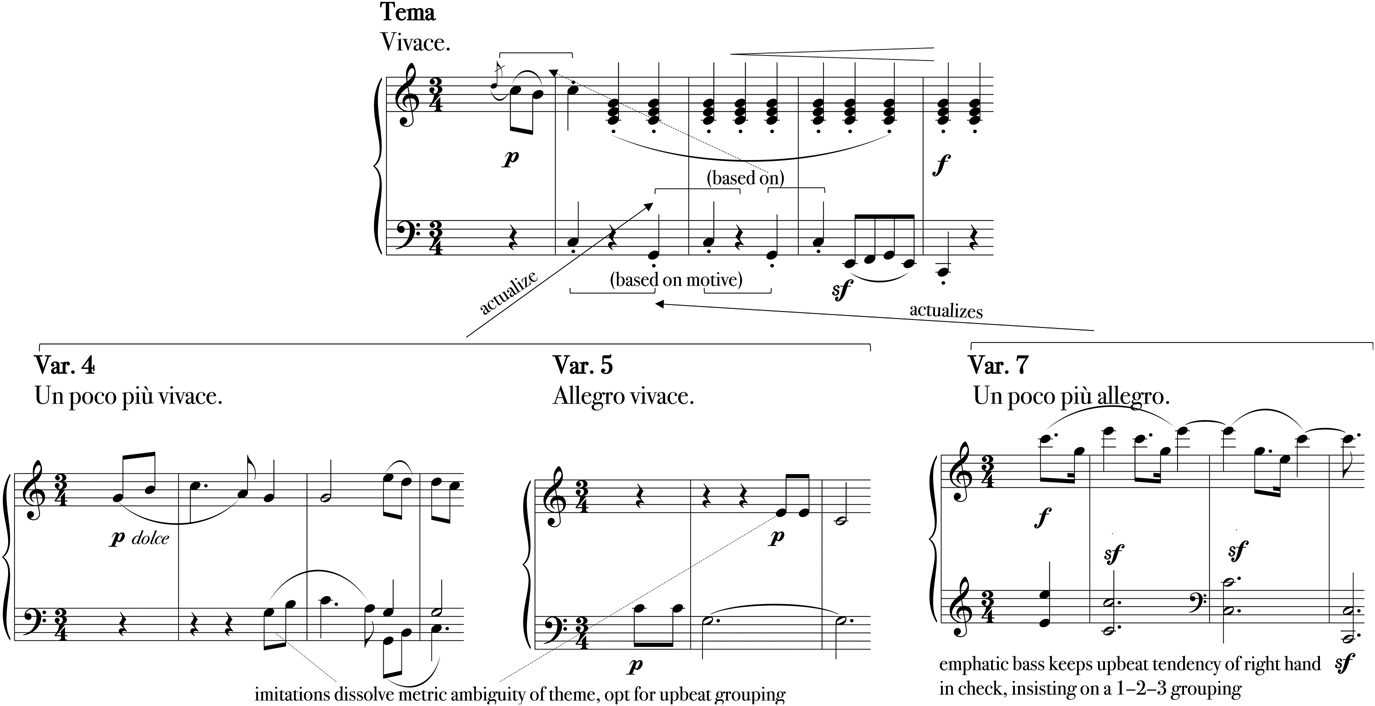
Similarly, consider Diabelli's theme (Example 2). The slight anacrusis at the start would seem as trifling and inconsequential a detail as any imaginable, but Beethoven makes a meal of it, and not only, most obviously, in foregrounding it as the main motive in Variation 9. More subtly, he evidently heard in it ramifications for bars 1–3. Consider: does the anacrusis frame the first downbeat such that we also hear the third beats of bars 1 and 2 as pickups to following downbeats (yielding 3–1–2 groups)? Or, alternatively, does the first downbeat disregard that anacrusis and assert a 1–2–3 group by virtue of initiating a motive? Several variations lay bare that metric ambiguity precisely by resolving it. For instance, Variations 4–6 all use imitation to opt for a 3–2–1 group; Variation 7 then changes course, jettisoning imitation so that the left hand may now reinforce 1–2–3.
Beethoven, Variations on a Theme by Diabelli, Op. 120: Excerpts

Yudkin is correct to hear potential in that opening gesture – in fact, in the pickup to the pickup, the very first grace note: ‘This tiniest note of all encapsulates … precisely that tone of … studied nonchalance, that gives the opening of the Diabelli Variations its special aspect of openness and promise’ (p. 212). But the abundant ‘promise’ or potential of that opening figure is not inherent in it, at least not prospectively; it can only be known ex post facto, by the way Beethoven's variations treat it. Moreover, potential, like the ‘profundity’ of Op. 109, is not mainly a matter of ‘tone’ or feeling; more codifiably, it is a matter of motivic working-out. As with Op. 31, No. 3, one can descry the specialness of Diabelli's beginning only by earnestly engaging and analysing the processes to which it gives rise.
For these reasons (on which I have touched only lightly), theorizing Beethoven's beginnings qua beginnings, as hypostatized fixities, is an inherently self-sabotaging enterprise. That is because one of Beethoven's most radical middle-style innovations was precisely to problematize the notion of fixed, thematically secure beginnings and to subsume thematic particulars by overarching formal, motivic and tonal processes. (Many of his early works, not to mention works by Haydn and Mozart, likewise begin in remarkably fluid, processive ways.) One can hardly hope to shed light on his beginnings if one is not prepared to scrutinize those processes. Beethoven's beginnings are simply not the kind of thing one can consider in isolation from the developmental or variational through lines to which they inextricably belong and in which they painstakingly forge their identity.
Yudkin's tendency to isolate beginnings, finally, is nowhere more evident than in his own beginning. The opening chapter, as I recognized at the outset, offers a tantalizing menu of interdisciplinary topics and issues and testifies to Yudkin's intellectual vivacity. Yet, none of these topics receives sustained or systematic treatment throughout the remainder of the book – these threads are left dangling. Alas, Yudkin's beginning turns out to be as segregated as he evidently conceives Beethoven's beginnings to be.