Introduction
Depression is a prevalent disorder, and a leading cause of global disease burden (Murray & Lopez, Reference Murray and Lopez1997). It causes more disability than any other disorder in high- and middle-income countries (WHO, 2008) and has considerable impact on productivity (Lim et al. Reference Lim, Sanderson and Andrews2000). Despite the availability of effective pharmacological and psychological interventions, many people remain untreated (Simon et al. Reference Simon, Fleck, Lucas and Bushnell2004). It is challenging for policy makers and governments to increase treatment rates cost-effectively. In industrialized nations, 4–7% of the adult population satisfy criteria for major depression in a year (Alonso et al. Reference Alonso, Angermeyer, Bernert, Bruffaerts, Brugha, Bryson, de Girolamo, de Graaf, Demyttenaere, Gasquet, Haro, Katz, Kessler, Kovess, Lepine, Ormel, Polidori, Russo and Vilagurt2004; Kessler et al. Reference Kessler, Chiu, Demler and Walters2005; Slade et al. Reference Slade, Johnston, Teesson, Whiteford, Burgess, Pirkis and Saw2009). But should governments aim for 100% treatment coverage? If not, what is an acceptable population treatment target?
The episodic nature of major depression (Andrews, Reference Andrews2007) necessitates understanding the extent to which recovery will occur without treatment. A meta-analysis of clinical trials by Krøgsboll et al. (Reference Krøgsboll, Hróbjartsson and Gøtzsche2009) attributed 35% of improvement in depression severity to spontaneous recovery, and a further 24% to placebo effects. Community-based epidemiological studies suggest that 90–98% of prevalent cases of depression achieve remission within 1 year (McLeod et al. Reference McLeod, Kessler and Landis1992; Lewinsohn et al. Reference Lewinsohn, Clarke, Seeley and Rohde1994; Kendler et al. Reference Kendler, Walters and Kessler1997); however, these estimates include both treated and untreated individuals.
Few studies allow estimation of the proportion of people who will remit from untreated depression (Posternak & Zimmerman, Reference Posternak and Zimmerman2000; Posternak et al. Reference Posternak, Solomon, Leon, Mueller, Shea, Endicott and Keller2006). Rigorous studies of depression using standardized diagnostic and outcome criteria have only been conducted since pharmacological treatments for depression became widespread (Fox, Reference Fox2002; Posternak et al. Reference Posternak, Solomon, Leon, Mueller, Shea, Endicott and Keller2006). Accurate treatment effects could be established by randomized study designs comparing treated and untreated groups (Schorer et al. Reference Schorer, Lowinger, Sullivan and Hartlaub1968; Ormel et al. Reference Ormel, Oldehinkel, Brilman and vanden Brink1993), but ethical constraints prevent randomizing depressed participants to remain untreated. Placebo-controlled trials are only useful if a ‘no-treatment’ group allows separation of the disorder's natural history from placebo effects (Musial et al. Reference Musial, Klosterhalfen and Enck2007).
Four study types provide a potential basis for inferring spontaneous remission proportions in ‘untreated’ samples of depressed patients (Posternak et al. Reference Posternak, Solomon, Leon, Mueller, Shea, Endicott and Keller2006). Each design has limitations, and because untreated participants are usually not the focus, data reported for these groups are typically less detailed.
The first type comprises longitudinal studies performed before the widespread availability of antidepressants (Hohman, Reference Hohman1938; Schorer et al. Reference Schorer, Lowinger, Sullivan and Hartlaub1968; Schorer, Reference Schorer1970). In these studies most depressed individuals did not receive treatment; those that did tended to be the most unwell. Inadequate methodology and samples of heterogeneous diagnostic groups limit the validity of these studies (Azorin, Reference Azorin1995). The second type comprises cohort studies of primary-care attenders designed to determine physician detection and treatment rates. Here, it is possible to identify patients who have depression at baseline, and whose disorder goes undetected and/or treatment is not offered during follow-up. These samples may lack generalizability to non-treatment seekers. The third is prospective, observational cohort studies that systematically assess diagnosis and service utilization at multiple time-points. These studies enable untreated samples to be carefully defined and identified. However, treatment is not randomly determined and those who remain untreated are likely to have less severe disorders than treated cases (Coryell et al. Reference Coryell, Endicott, Winokur, Akiskal, Solomon, Leon, Mueller and Shea1995; Grilo et al. Reference Grilo, Sanislow, Shea, Skodol, Stout, Gunderson and Yen2005). The fourth type comprises randomized controlled trials (RCTs) using a wait-list control group. Here, active treatment is delayed among participants randomly assigned to a wait-list group. Assuming no treatment is sought during the waiting period, this allows the episode to run its natural course. However, intervention outside the study protocol may be uncontrolled.
Posternak & Miller (Reference Posternak and Miller2001) reviewed psychotherapeutic intervention studies that randomized depressed individuals to wait-list control groups. They found that 19.7% of untreated participants (15/76 from seven studies) remitted over follow-up periods ranging from 4 to 20 weeks. The aim of the current study was to conduct a systematic review and meta-analysis of short-term remission rates for untreated major depression, updating the review by Posternak & Miller (Reference Posternak and Miller2001) and expanding inclusion criteria to capture further relevant designs. Specifically, we sought to:
(1) predict the probability of remitting from untreated depression over a 12-month period, after adjusting for study-level variables such as follow-up duration; and
(2) examine whether remission rates vary as a function of disorder severity.
Method
Search methodology
A systematic search conforming with PRISMA (Preferred Reporting Items for Systematic Reviews and Meta-Analyses) guidelines (Moher et al. Reference Moher, Liberati, Tetzlaff and Altman2009) was conducted. Medline, PsycINFO and EMBASE were searched using OVID from their inception years to September 2010. The following search string was used: depress* AND (longitudinal OR wait* OR prospective OR follow* OR naturalistic OR cohort OR observational) AND (untreat* OR remiss* OR unrecogni*). Searches were restricted to studies of humans classified as journal articles, clinical trials, meta-analyses or reviews.
Reference lists of retrieved articles were searched to identify additional studies. Four authors were contacted to clarify study results. Three authors with known access to datasets with the potential to derive remission estimates were contacted. They were also asked to suggest relevant studies; one provided previously unpublished data.
Initially, titles and abstracts were assessed for relevance. Full-text versions of potentially eligible papers were retrieved. Primary articles from potentially relevant secondary sources such as meta-analyses or reviews were obtained.
Inclusion criteria
Eligible studies fulfilled four criteria:
(1) Diagnosis of major depression. Participants experiencing a major depressive episode at study entry were identified by: (i) a structured clinical interview mapping to a major classification system for mental disorders [e.g. DSM, ICD, RDC] or (ii) scores exceeding thresholds on standardized symptom severity instruments such as the Beck Depression Inventory (BDI; Beck & Steer, Reference Beck and Steer1988) or the Hamilton Depression Rating Scale (HAMD; Frank et al. Reference Frank, Prien, Jarrett, Keller, Kupfer, Lavori, Rush and Weissman1991), congruent with a DSM or ICD diagnosis of major depression. Where diagnostic breakdown was reported, ⩾75% of the sample were classified as having major depression.
(2) Study design. Study design potentially allowed for the investigation of an untreated sample (Posternak et al. Reference Posternak, Solomon, Leon, Mueller, Shea, Endicott and Keller2006); that, is a study reported on a wait-list group or an observational cohort design.
(3) Definition of remission. The study applied clearly defined remission criteria based on either a rescinded diagnosis or a below-threshold score on a standardized symptom severity measure (usually a BDI score <10 or a HAMD score ⩽7).
(4) Remission data. The study quantified the number or percentage of ‘untreated’ participants remitted at one or more follow-up time-points up to and including 2 years after study entry. As the focus was on 1-year remission rates, it was determined, a priori, that only remission data from follow-up periods up to 2 years following study entry would be included.
Exclusions
Studies targeting samples with other mood disorder diagnoses (e.g. dysthymia, intermittent depression or minor depression) were out of the scope of this study. Studies defining remission exclusively through improved depression scale scores were excluded. Although it is generally accepted that a 50% improvement in symptom severity scores indicates clinical response, significant residual symptoms may persist, making this an inadequate remission definition (Mendlewicz, Reference Mendlewicz2009). Studies using a ‘treatment-as-usual’ wait-list condition referring participants back to their physician were excluded. These designs were considered to actively encourage treatment, and it could not be ascertained how many participants remained untreated. Samples where more than one-third of untreated participants were known to have received interventions for depression during follow-up were excluded. Studies investigating specific groups (such as refugee populations) that were not considered representative of the general population were also excluded.
Data extraction
Data were extracted independently by two authors (G.M. and C.P.). Recorded fields included: study identifiers (authors, publication year, country); study descriptors (design, sample/setting, diagnostic inclusion criteria, remission criteria, follow-up duration); untreated sample characteristics (study entry treatment restrictions, definition, treatments reported during follow-up); sample demographics (gender and age distribution); and outcomes (number and/or proportion of total sample remitted, number and/or proportion of followed-up sample remitted). Most studies assessed remission status at or within a short period (2 weeks) prior to follow-up. Two studies (Wang, Reference Wang2004; Posternak et al. Reference Posternak, Solomon, Leon, Mueller, Shea, Endicott and Keller2006) assessed the occurrence of remission over longer periods. For consistency, the follow-up time-points for these studies were taken as the mid-point between the last follow-up period and that of the reported remission estimate. Some studies used multiple acceptable remission definitions; all were documented. Extracted data were cross-checked by two authors (M.H. and H.W.). Discrepancies were resolved through discussion and consensus.
Assessment of methodological parameters
Methodological parameters of included studies (sampling method, diagnostic assessment, diagnostic heterogeneity, ‘untreated’ sample definitions, remission parameters, and follow-up rates) were evaluated using a template derived from existing indices (McGrath et al. Reference McGrath, Saha, Welham, El Saadi, MacCauley and Chant2004; Calabria et al. Reference Calabria, Degenhardt, Briegleb, Vos, Hall, Lynskey, Callaghan, Rana and McLaren2010) (see online supplementary material).
Statistical analysis
The probability of remission from untreated depression over a 12-month period was estimated using a regression model with logit transformed remission proportion as the dependent variable. For each study, the data closest to 52 weeks were identified, and the sample size, number of cases remitted and follow-up time in weeks were extracted and tabulated with other study characteristics. Where studies provided remission data based on multiple definitions, a rescinded diagnosis was preferred, followed by clinician-rated symptom scales (e.g. the HAMD) and then participant-rated symptom scales (e.g. the BDI). Because one-third of studies determined ‘untreated’ status at follow-up, rather than at baseline, we used the follow-up data from each study.
As proportions generally follow a binomial distribution, the proportion of remitted cases was logit transformed and weighted by sample size. The follow-up period for each study was centered at 52 weeks. This provides an intercept value that can be exponentiated to give the probability of remission at 12 months. To identify sources of study variability, we explored the effects of participant and study characteristics within the model. These were: age, explored as both a continuous (median age of sample) and a categorical variable (adult, child/adolescent, older adult); gender (percentage female); study type (wait-listed, community-based); and type of diagnostic measure used at follow-up (structured clinical interview versus symptom scale). Few studies reported remission according to symptom severity, therefore these data were examined descriptively.
Analyses were conducted in Stata 11.0 (Stata Corporation, USA) using the ‘blogit’ command, which produces maximum-likelihood logit estimates for grouped data. Robust standard errors were calculated to accommodate possible overdispersion in study estimates. The maximum-likelihood approach is highly sensitive to outliers so we calculated deviance residuals to identify influential studies. The relative impact of outliers on the model was explored using Cook's Distance, using the leave-one-out approach. Influential studies were reviewed to identify factors that might explain the variability in estimates and justify exclusion.
The most informative regression model was identified through backward stepwise regression. The probability of remitting within the follow-up period was estimated using the ‘margins’ post-estimation command. The average weighted survival for each study sample was calculated using the ‘predict’ command (Buis, Reference Buis2007).
Results
Included studies
Twenty-one studies met inclusion criteria (Fig. 1). The majority of participants were female (mean=73%). Ages ranged between 13 and approximately 80 years (mean=34 years). Included studies covered 32 years of research. As the duration of follow-up increased, the number of studies reporting remission data decreased. Key features of the included studies are summarized in the following sections.
PRISMA (Preferred Reporting Items for Systematic Reviews and Meta-Analyses) flowchart.

Wait-list control groups
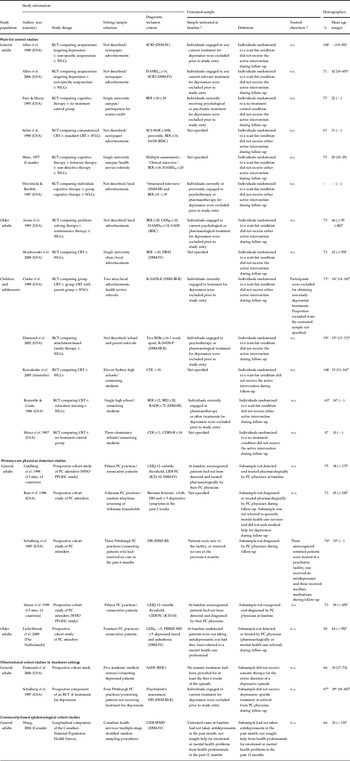
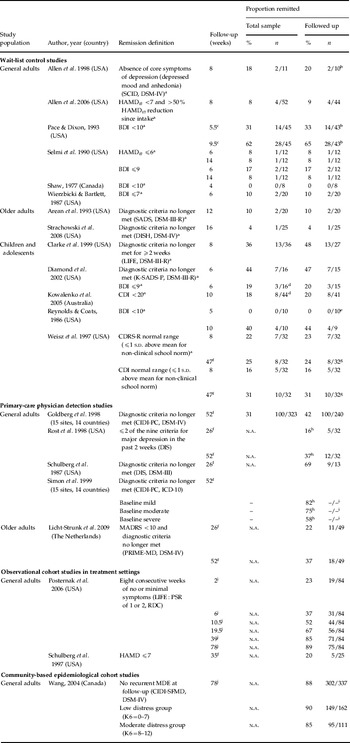
Thirteen samples were wait-list groups; see Table 1 for characteristics and Table 2 for remission parameters. Sample sizes were modest (mean=25 participants, range 8–52). Most (93%) reported remission proportions for follow-up periods of ⩽6 months. Half were conducted in general adult samples, two in older adults (⩾55 years) and five in children/adolescents. Two-thirds (62%) operationalized remission as a below-threshold symptom severity instrument score.
Summary of studies reporting short-term remission from untreated depression

BDI, Beck Depression Inventory; BID, Bellevue Index of Depression; CBT, cognitive behavioral therapy; CDI, Children's Depression Inventory; CDRS-R, Children's Depression Rating Scale (revised); CIDI-PC, Composite International Diagnostic Interview – Primary-care version; CIDI-SFMD, Composite International Diagnostic Interview – Short Form for Major Depression; DIS, Diagnostic Interview Schedule; DISH, Depression Interview and Structured Hamilton; F, female; GDS15, 15-item Geriatric Depression Scale; GDS30, 30-item Geriatric Depression Scale; GHQ-12, 12-item General Health Questionnaire; HAMD17, 17-item Hamilton Rating Scale for Depression; K-SADS-E, Schedule for Affective Disorders and Schizophrenia for school-age children – epidemiologic version; K-SADS-P, Schedule for Affective Disorders and Schizophrenia for school-age children – present and lifetime version; n.a., not applicable; n.s., not stated; PC, primary care; PPGHC, psychological problems in general health care; PRIME-MD, Primary-care Evaluation of Mental Disorders; RADS, Reynolds Adolescent Depression Scale; RCT, randomized controlled trial; RDC, Research Diagnostic Criteria; SADS, Schedule for Affective Disorders and Schizophrenia; SCL-90-R, 90-item Hopkins Symptom Checklist (Revised); WHO, World Health Organization; WLCs, wait-list controls; –, not available.
a Value not available for untreated subsample, value from total sample provided.
b Age range (years) refers to eligibility criteria rather than untreated sample descriptive statistics.
Summary of remission parameters

BDI, Beck Depression Inventory; CIDI-PC, Composite International Diagnostic Interview (primary-care version); CIDI-SFMD, Composite International Diagnostic Interview – Short Form for Major Depression; CDI, Children's Depression Inventory; CDRS-R, Children's Depression Rating Scale (revised); DIS, Diagnostic Interview Schedule; DISH, Depression Interview and Structured Hamilton; HAMD, Hamilton Rating Scale for Depression (version unspecified); HAMD17, 17-item Hamilton Rating Scale for Depression; K6, non-specific psychological distress scale; K-SADS-P, Schedule for Affective Disorders and Schizophrenia for school-age children – present and lifetime version; LIFE, Longitudinal Interval Follow-up Evaluation; MADRS, Montgomery–Asberg Depression Rating Scale; MDE, major depressive episode; n.a., not applicable because untreated status determined at follow-up; PRIME-MD, Primary-Care Evaluation of Mental Disorders; PSR, Psychiatric Status Rating; RDC, Research Diagnostic Criteria; SADS, Schedule for Affective Disorders and Schizophrenia; s.d., standard deviation.
a Data corresponding to this remission definition used in primary analysis.
b Denominator assumed to be number of participants followed up.
c Average of reported follow-up range: 4–7 and 8–11 weeks respectively.
d Denominator assumed to be number of participants at baseline.
e n=1 not lost to follow-up until 10 weeks.
f Converted from time in months, assuming 4.35 weeks in a month.
g Denominator assumes no loss to follow-up.
h Weighted proportion.
i Unable to derive sample size from weighted proportion.
j Mid-point between the previous follow-up time-point and that of the reported remission estimate.
One study (Selmi et al. Reference Selmi, Klein, Greist, Sorrell and Erdman1990), which included participants with RDC intermittent depressive disorder (17% of the sample) and used a conservative definition of remission (a HAMD score of ⩽6 rather than the usual ⩽7), reported a lower proportion remitted than studies of similar duration. Conversely, another (Clarke et al. Reference Clarke, Rohde, Lewinsohn, Hops and Seeley1999) included participants with DSM-III-R dysthymia (12.5% of the sample) but reported a relatively high proportion remitted. Two studies (Wierzbicki & Bartlett, Reference Wierzbicki and Bartlett1987; Pace & Dixon, Reference Pace and Dixon1993) targeted mild-to-moderate major depression by capping the upper bound of study entry symptom severity scores; the former reported a relatively high proportion remitted for studies of similar periods. One study (Wierzbicki & Bartlett, Reference Wierzbicki and Bartlett1987) used a conservative remission threshold (a BDI score of ⩽7 rather than the usual <10) and reported a lower than expected proportion remitted. Studies of older adults also reported lower proportions remitted than those in samples of adults or young people.
Wait-list studies tended to be constrained by convenience samples; failure to document/report treatment rates during follow-up and failure/inability to report diagnostic composition (see online supplementary material for evaluation summary). Patterns of remission were not systematic across wait-list studies that were not evaluated highly; however, two (Shaw, Reference Shaw1977; Reynolds & Coats, Reference Reynolds and Coats1986) reported no remitted participants after periods of 4 and 5 weeks respectively.
Primary-care physician detection studies
Five samples were drawn from primary-care physician detection studies (see Tables 1 and 2). Sample sizes varied (mean=125 participants, range 13–240). All reported remission data for follow-up periods of 6 months to 1 year and defined remission using rescinded diagnoses. All samples comprised adults. One study of older adults reported a relatively low proportion remitted.
By design, two primary-care detection studies (Rost et al. Reference Rost, Zhang, Fortney, Smith, Coyne and Smith1998; Licht-Strunk et al. Reference Licht-Strunk, Beekman, de Haan and van Marwijk2009) ensured untreated status by classifying the sample at follow-up. One study (Schulberg et al. Reference Schulberg, McClelland and Gooding1987) reported that 31% of the ‘untreated’ sample received interventions during follow-up, at least some of which were specific to depression. The proportion remitted was high relative to studies of similar duration. Another two studies (Goldberg et al. Reference Goldberg, Privett, Ustun, Simon and Linden1998; Simon et al. Reference Simon, Goldberg, Tiemens and Ustun1999) classified treatment status at baseline, without describing the proportion who may have received treatment during follow-up. Nonetheless, detection study methodology was generally evaluated positively (see online supplementary material).
Observational cohort studies
Three observational cohort studies were identified (see Tables 1 and 2). The first (Posternak et al. Reference Posternak, Solomon, Leon, Mueller, Shea, Endicott and Keller2006) defined remission using a rescinded diagnosis and reported proportions remitting after periods ranging between 4 weeks and 2 years. Although recruitment took place in academic medical settings, the intake episode was not analyzed and participants were regarded as ‘non-treatment seekers’ by choosing not to obtain somatic therapy. Remission rates for this study were high relative to estimates from studies with comparable follow-up durations. Another study (Schulberg et al. Reference Schulberg, Block, Madonia, Scott, Lave, Rodriguez and Coulehan1997) was the prospective component of an RCT that recruited participants from primary-care settings. Remission was defined as scores below the conventional HAMD threshold of ⩽7 after 8 months. This follow-up period was shorter than other studies of similar duration (1 year) and the remission rate was comparatively lower. The final study (Wang, Reference Wang2004) was the only longitudinal, community-based epidemiological study identified. Rescinded diagnoses defined remission after a 2-year period but service utilization was measured only in the preceding year.
These studies were of relatively good methodological quality. The most common methodological problem was the failure to report the extent of loss to follow-up (see online supplementary material).
Predicting the probability of remission from untreated depression
A regression model for predicting remission from untreated depression was developed through an iterative process of model building and testing. Two studies (Goldberg et al. Reference Goldberg, Privett, Ustun, Simon and Linden1998; Simon et al. Reference Simon, Goldberg, Tiemens and Ustun1999) reported data from overlapping samples. Only the data reported by Goldberg et al. (Reference Goldberg, Privett, Ustun, Simon and Linden1998) were entered into the model as these authors reported on the entire sample, unstratified by severity. Of several studies found to have large residual values (Pace & Dixon, Reference Pace and Dixon1993; Weisz et al. Reference Weisz, Thurber, Sweeney, Proffitt and LeGagnoux1997; Goldberg et al. Reference Goldberg, Privett, Ustun, Simon and Linden1998; Wang, Reference Wang2004; Posternak et al. Reference Posternak, Solomon, Leon, Mueller, Shea, Endicott and Keller2006), three (Weisz et al. Reference Weisz, Thurber, Sweeney, Proffitt and LeGagnoux1997; Goldberg et al. Reference Goldberg, Privett, Ustun, Simon and Linden1998; Wang, Reference Wang2004) were identified as having greater than expected influence over the model, with one (Wang, Reference Wang2004) exerting substantially greater influence than others, as judged by Cook's distance. Review of the methodological aspects of these studies showed that the latter study involved the longest follow-up duration (78 weeks) and was the only community-based epidemiological observational cohort study. No obvious methodological differences were found in the other studies that would justify their exclusion. Therefore, subsequent analyses excluded the Wang (Reference Wang2004) study.
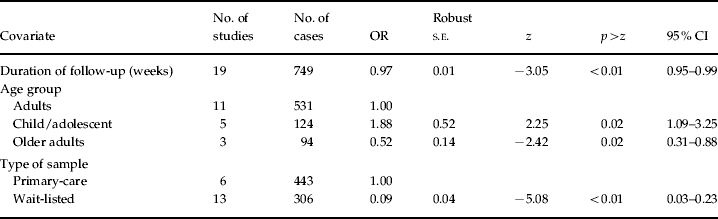
The final multivariate regression model is shown in Table 3. The factor most strongly associated with remission was study type. After controlling for other variables, the probability of remission at 12 months was significantly lower for wait-listed samples compared to samples ascertained through primary-care settings. Study follow-up duration was also significantly associated with the probability of remission such that, for each additional week of follow-up, the probability of remitting in that week diminished by 3%. The probability of remission was significantly higher in child and adolescent groups and lower in older adults compared to general adult samples, although analyses for these age groups were based on few studies (n=5 and n=3 respectively). No significant association was found between probability of remission and gender composition or type of diagnostic measure.
Odds ratios (ORs) for remission in untreated depression
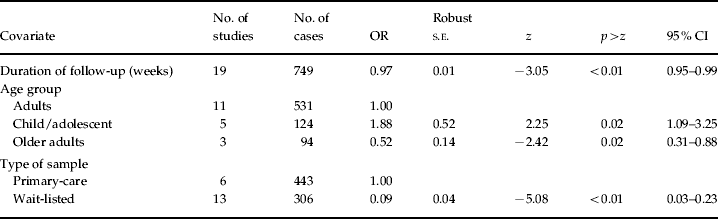
s.e., Standard error; CI, confidence interval.
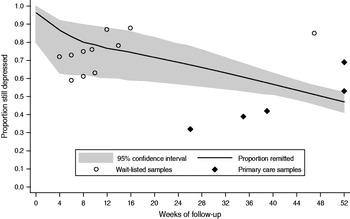
To investigate remission of adult cases of depression that are representative of the average community case, the predicted remission was adjusted to these reference categories. Figure 2 shows the adjusted distribution of the proportion of cases still depressed by time over a 12-month period for adults recruited from primary-care studies, based on the regression model. For every 100 adults with depression, 77 will still be depressed at 3 months, 68 at 6 months and 47 at 1 year. This suggests that, without treatment, 23% adult cases of depression will remit within 3 months, 32% within 6 months and 53% within 1 year.
Adjusted proportion of cases still depressed, by time, with 95% confidence intervals and weighted average proportions.

A sensitivity analysis tested the regression model with and without the influential study (Wang, Reference Wang2004). The regression equations differed considerably. As the model excluding the Wang study produced a lower Akaike Information Criterion (AIC) value (948 v. 1260), this model was considered more accurate.
Remission by severity
Two studies stratified remission proportions by disorder severity but methodological differences precluded pooling their data. Simon et al. (Reference Simon, Goldberg, Tiemens and Ustun1999) applied ICD-10 depressive episode severity criteria (mild, moderate, severe) and followed up participants after 1 year. Wang (Reference Wang2004) used thresholds on a non-specific psychological distress scale (K6), corresponding to low and moderate distress, and followed up participants after 2 years. Nonetheless, qualitatively similar results were observed. The proportions remitted decreased as depression severity increased. An estimated 82% (Simon et al. Reference Simon, Goldberg, Tiemens and Ustun1999) and 90% (Wang, Reference Wang2004) were in remission from mild depression after 1- and 2-year follow-ups respectively. This decreased to 75% (Simon et al. Reference Simon, Goldberg, Tiemens and Ustun1999) and 85% (Wang, Reference Wang2004) in remission from moderate depression after 1- and 2-year follow-ups respectively. Simon et al. (Reference Simon, Goldberg, Tiemens and Ustun1999) estimated remission from untreated severe depression to be 58% after 1 year.
Discussion
Our analysis, based on 19 studies, suggests that approximately 53% of prevalent cases of untreated major depression will remit spontaneously in a given year. This is almost half that of estimates (>90%) from community-based epidemiological studies that include both treated and untreated cases (McLeod et al. Reference McLeod, Kessler and Landis1992; Lewinsohn et al. Reference Lewinsohn, Clarke, Seeley and Rohde1994; Kendler et al. Reference Kendler, Walters and Kessler1997). There is also evidence that remission rates may depend on disorder severity, with rates among people with severe disorders being 20–30% lower than mild-to-moderate disorders. However, this observation is based on only two studies and should be interpreted with caution.
Can this information inform population treatment targets for depression? In the first instance they suggest that even if it were possible to achieve total coverage by providing sufficient services, this is not an appropriate target because of high natural remission rates. However, remission data alone cannot be used to set a treatment target. Duration of remission, personal preferences, available resources and financial and other treatment barriers may also play a part, but were beyond the scope of this paper to investigate.
In Australia, the National Surveys of Mental Health and Wellbeing estimated the treatment rate (defined as consulting a health professional) for affective disorders to be 66.8% in 1997 (Andrews et al. Reference Andrews, Issakidis and Carter2001) and 58.6% in 2007 (Burgess et al. Reference Burgess, Pirkis, Slade, Johnston, Meadows and Gunn2009). Many of those who remained untreated said they did not require interventions. The reasons for this are complex (Meadows & Burgess, Reference Meadows and Burgess2009) but support the view that prevalence alone is not an adequate indicator of need for treatment. An equity-based approach promotes the view that treatment rates for depression should match those of other common physical disorders that cause comparable levels of disability. In Australia, this would suggest rates of approximately 90% if disorders such as rheumatoid arthritis and osteoarthritis (treatment rate, 93%; Andrews et al. Reference Andrews, Simonella, Lapsley, Sanderson and March2006) and asthma (89%; Simonella et al. Reference Simonella, Marks, Sanderson and Andrews2006) were chosen. However, setting rates for face-to-face treatment at 90% would require considerable resource allocation out of reach for most countries. Fortunately, the increasing evidence base supporting online therapies (Griffiths et al. Reference Griffiths, Farrer and Christensen2010) suggests that increased treatment coverage might be achieved, at least in part, with judicious use of inexpensive e-therapies.
The findings of this study are also relevant to clinicians. Spontaneous recovery from depression is high, and attribution of recovery to the effects of treatment is likely to be overestimated. A short period without active treatment in mild-to-moderate depression would seem defensible, given the analysis was based largely on samples of consenting out-patient and wait-listed groups. This is consistent with the stepped-care model endorsed by the UK National Institute for Health and Clinical Excellence (NICE) guidelines (NICE, 2009), which recommend a watchful waiting period for mild depression, depending on individual case details. However, our findings provide little information for clinicians regarding relapse prevention, given that the scope of the paper was limited to time to remission.
Threats to validity
To our knowledge this is the most comprehensive review of remission from untreated depression conducted since 2001. The review conformed with PRISMA guidelines (Moher et al. Reference Moher, Liberati, Tetzlaff and Altman2009) and directed considerable effort towards review-level bias prevention. The search strategy did not impose language limitations, captured a variety of informative study designs and enabled unpublished findings to be included. The population of interest and acceptable criteria for defining remission were specified a priori. A purpose-designed methodological assessment template allowed us to describe potential sources of variation in detail.
Nonetheless, potential sources of bias should be considered. First, we could not be certain that all participants remained untreated for the duration of follow-up. For example, wait-list control groups may have received interventions for depression outside the study protocol; however, such data were rarely reported. Only one wait-list study (Clarke et al. Reference Clarke, Rohde, Lewinsohn, Hops and Seeley1999) measured other treatments received and excluded those participants from their analysis. In three of the five primary-care detection studies (Schulberg et al. Reference Schulberg, McClelland and Gooding1987; Goldberg et al. Reference Goldberg, Privett, Ustun, Simon and Linden1998; Simon et al. Reference Simon, Goldberg, Tiemens and Ustun1999), participants were classified as undetected/untreated at baseline and subsequent treatment was not reported by two of these (Goldberg et al. Reference Goldberg, Privett, Ustun, Simon and Linden1998; Simon et al. Reference Simon, Goldberg, Tiemens and Ustun1999). Studies also differed in the breadth of treatments considered to be restricted during follow-up; for example, somatic treatments only or somatic and psychological treatments. Potentially including treated individuals may have resulted in an overestimate of the remission rate.
Second, self-selecting samples recruited in treatment settings may have affected the generalizability of results. A perceived need for care has been associated with greater symptom severity (Sareen et al. Reference Sareen, Cox, Afifi, Clara and Yu2005; van Beljouw et al. Reference van Beljouw, Verhaak, Cuijpers, van Marwijk and Penninx2010a,b), which may have biased these samples towards lower spontaneous remission rates. On the contrary, more severe cases may have been excluded. Most wait-list studies excluded those describing suicidal ideation and/or requiring a higher level of care, and two (Wierzbicki & Bartlett, Reference Wierzbicki and Bartlett1987; Pace & Dixon, Reference Pace and Dixon1993) specifically targeted mild-to-moderate major depression. Several detection studies (Goldberg et al. Reference Goldberg, Privett, Ustun, Simon and Linden1998; Simon et al. Reference Simon, Goldberg, Tiemens and Ustun1999; Licht-Strunk et al. Reference Licht-Strunk, Beekman, de Haan and van Marwijk2009) showed that physicians were more likely to recognize and treat depression of greater severity, thus these individuals were less likely to appear in the ‘untreated’ group. On balance, the preponderance of wait-list and primary-care samples probably resulted in an over-representation of people with less severe depression and may have biased remission estimates in a positive direction.
Similarly, the inclusion of studies using symptom scales to determine diagnosis potentially affected the generalizability of our results. To maximize sample size and coverage of the targeted research designs, we included studies that derived diagnoses from scales with appropriate cross-walks to diagnostic systems. However, the threshold for diagnosis using symptom scales is not absolute. Symptom scales may admit more people to the diagnosis-positive group, particularly those with mild disorders. Assuming mild depression is more likely to remit, this may in turn overestimate remission rates. However, we did not find a statistically significant association between remission and type of diagnostic instrument (symptom scales versus diagnostic interview).
Third, some studies may have included a minority of participants with chronic mood disorders, which may have negatively biased remission estimates. However, diagnostic breakdown was reported in only three studies (Selmi et al. Reference Selmi, Klein, Greist, Sorrell and Erdman1990; Rost et al. Reference Rost, Zhang, Fortney, Smith, Coyne and Smith1998; Clarke et al. Reference Clarke, Rohde, Lewinsohn, Hops and Seeley1999).
Fourth, loss to follow-up potentially influenced our results. Studies have shown greater social impairment and symptom duration to be positively (Sonawalla et al. Reference Sonawalla, Farabaugh, Leslie, Pava, Matthews and Fava2002) and negatively (Simon & Ludman, Reference Simon and Ludman2010) associated with early drop-out from treatment. However, little is known about factors associated with drop-out from wait-listed groups due to inadequate reporting practices (Cisler et al. Reference Cisler, Barnes, Farnsworth and Sifers2007). As such, it is difficult to speculate on the effects of attrition on the present findings.
Fifth, more comprehensive definitions of remission require improvements in psychosocial functioning and physiological factors in addition to symptom reduction (Keller, Reference Keller2003; Israel, Reference Israel2006; Zimmerman et al. Reference Zimmerman, McGlinchey, Posternak, Friedman, Boerescu and Attiullah2006, Reference Zimmerman, McGlinchey, Posternak, Friedman, Boerescu and Attiullah2008). The consistent application of a comprehensive definition of remission across studies would have been ideal. However, the identified studies operationalized remission using information from instruments focused on symptom levels. These may have overestimated remission rates because remission criteria did not incorporate psychosocial functioning and physiological factors.
Finally, we noted the lack of spontaneous remission data available from epidemiological studies with a longitudinal component. These studies can arguably provide the most accurate estimate of remission as they include individuals who have not presented to health services, and who may or may not have a perceived need for care. It is possible that other researchers have access to such data, but they have not been reported. However, we did not anticipate publication bias to be a problem for this review because the untreated samples were generally not the focus of interest in the studies sought.
Conclusions
The findings from this suggest that, although treatment is likely to facilitate earlier remission, just over half of those with a major depressive episode will remit within a year without intervention. The high rate of spontaneous remission observed among wait-listed and primary-care samples in this review has implications for service planners and clinicians. For service planners it is undesirable to expect 100% treatment coverage because many people with less severe major depression will remit before access to services is feasible. For clinicians, a short period without active treatment for people with mild-to-moderate depression (NICE, 2009) seems defensible. Resources should be directed towards those with greatest need, for example those experiencing more severe depression and those whose symptoms are likely to persist or reoccur. Remission from untreated depression remains an overlooked area of research. There is a need for natural remission rates from high-quality population-level studies to be examined. Analyses of data from prospective cohort studies could focus on elucidating factors that may determine the likelihood of remission from depression among untreated individuals.
Supplementary material
For supplementary material accompanying this paper visit http://dx.doi.org/10.1017/S0033291712001717.
Acknowledgments
We thank G. Williams and A. Higginson from the University of Queensland for statistical advice. We also thank M. Dewey for the detailed statistical report he provided as a previous reviewer.
Declaration of Interest
None.