INTRODUCTION
This article discusses the intellectual context of and motivations that stand behind Francis Ysidro Edgeworth's original mathematical formalization of utilitarianism. Such a formalization may appear familiar to the readers (today, mostly historians of economics) of Edgeworth's 1881 monograph, Mathematical Psychics, one part of which was devoted to the ‘economic calculus’ and the other to the ‘utilitarian calculus’. But this dual structure of the monograph elides the fact that Edgeworth been engaged with utilitarian issues long before he turned to the economic calculus.Footnote 1
Tracing Edgeworth's motivations in formulating what he called ‘exact utilitarianism’ reveals two major tendencies. The first is a determination to advance utilitarianism (Henry Sidgwick's version of the doctrine, in particular), his arguments being made in the context of intensive disputes between the three camps in the field of ethics: intuitionism, utilitarianism and ethical egoism. The second is a desire to dress his arguments in the most scientific way possible (according to the way science was perceived at the time, of course).
Contrary to any impression that may arise on reading Mathematical Psychics, Edgeworth's formalization of utilitarianism was not at all the consequence of an awareness of theoretical developments within the economics of the time. Nevertheless, the field of ethics was in this period influenced and inspired by the same trends in science as was the field of economics – a point that has some significance for those historians of economics who have explored how economists of this time (Jevons in particular) were inspired by the natural sciences.
In addition, this article will deal with the implications of Edgeworth's decision, made following his acquaintance with Jevons's economics, to put the two moral sciences, economics and utilitarianism, together under the one umbrella of ‘mathematical psychics’. This decision, so I argue, situates his book in a very intriguing episode in the history of the relationship between utilitarianism and economics; it was a phase in which utilitarianism was not only considered as a meta-criterion for economic policy but was addressed in new – not necessarily the most applicable, but highly theoretical – ways, and translated into the language of formal mathematics. This phase reflects an emerging dissatisfaction with general estimations of aggregate utility alone and, as a consequence, a turning upside down of the traditional relations between economics and utilitarianism: with utilitarianism now addressed as a branch of economics,Footnote 2 and not (only) the other way around.
The first and last sections of the article locate Mathematical Psychics in the context of these shifting relations between economics and utilitarianism, while the three sections in between identify Edgeworth's motivations.
MILL AND JEVONS: KEEPING UTILITARIANISM AND MATHEMATICS APART
From the perspective of late nineteenth-century economists it must have seemed almost inevitable that two of their deepest proclivities – mathematization and utilitarianism – would somehow be theoretically unified. Then again, this had not occurred in previous generations. But, interestingly enough, both J. S. Mill and W. S. Jevons, two particularly important economists and utilitarians of the 1870s, shared the earlier tendency to keep the two subjects apart.
Both Mill and Jevons considered themselves faithful utilitarians, but each offered different interpretations of the doctrine.Footnote 3 Indeed, the divergence between their interpretations raises the question: what makes them both utilitarians? Furthermore, how are we to understand the doctrine in our current discussion? For present purposes, I would suggest utilitarianism be understood as an acceptance of two postulates: (i) that social utility is an aggregate (estimated or precise) of individual utilities (reflecting individuals’ pleasure, happiness, etc.); (ii) that making social utility as great as possible is the ultimate moral imperative (for an individual or a statesman). While both accepted these principles, Mill and Jevons were nevertheless very much divided on the interpretations and implementations of the doctrine as a whole. In the narrow context of this article, however, in which our primary concern is the way in which the two men viewed the relations between utilitarianism and their economic theories, they had much in common.
Thus, both considered utilitarianism as highly relevant for practical policy decision-making in the economic sphere.Footnote 4 Policy decisions, however, were considered by neither as a scientific task. In addition, neither considered utilitarianism a precise doctrine, nor did they formulate it mathematically, i.e. as (what we would address as) a branch of economics.
From an economic-theoretical point of view, and as a part of the classical tradition (yet with his own distinctive sensitivities and interests), Mill avoided using the concept of utility in any quantitative-mathematical context within his economic science.Footnote 5
As for Jevons, although he does suggest the possibility of a ‘higher calculus of moral right and wrong’, he did not engage in it. While formulating a mathematical representation of individual utility (focusing on the ‘lower feelings’) and, indeed, basing his whole theory on it, he nevertheless did not use it as a platform for a mathematical formulation of social aggregate utility. As he insisted:
The reader will find, again, that there is never, in any single instance, an attempt made to compare the amount of feeling in one mind with that in another. I see no means by which such comparison can be accomplished . . . Every mind is thus inscrutable to every other mind, and no common denominator of feeling seems to be possible.Footnote 6
A consequence of the inability to compare different individuals’ utilities is the uselessness of attempting to sum up those utilities in an aggregate.
EDGEWORTH'S ‘EXACT UTILITARIANISM’ IN PHILOSOPHICAL CONTEXT
It was Jevons's acquaintance, Edgeworth, who set out to combine mathematics and utilitarianism in an explicit manner, and in addition in some cases integrated a utilitarian apparatus into his economic models (i.e. as a part of the individuals’ motives while negotiating an exchange, as will be shown). Born in 1845 to an Anglo-Irish family, Edgeworth was tutored as a child in classics and mathematics, and after four years at Trinity College, Dublin, he entered Oxford, where in 1869 he took first-class honours in classics. The following years were spent in London, studying mathematics, law and philosophy, living on a modest private income and, later, from 1880, lecturing on logic and political economy at King's College. His first steps in economics were taken only in 1879–80, and were guided by his Hampstead neighbour, Jevons. But as already noted, Edgeworth, in contrast to Jevons, employed the differential calculus extensively, not only to address questions in economics but also (using integral functions) in order to address questions concerning the aggregate level of utility in his work in ethics.
Jevons, for Edgeworth, was the model for an economist, but he took Henry Sidgwick as the very model of a modern utilitarian. First published in 1874, Sidgwick's Methods of Ethics had an enormous influence on Edgeworth, converting him to Sidgwick's version of the doctrine. In his works between 1877 and 1881 Edgeworth thus directed his readers to take his presentation of utilitarianism as a mathematical interpretation of Sidgwick's philosophical account, an interpretation derived with the cutting-edge scientific tools of the day. Edgeworth's concept of ‘exact utilitarianism’, presented for the first time in New and Old Methods of Ethics (1877), was said to be derived from the combination of two disconnected set of ideas:
The doctrine of Fechner and Sidgwick may be termed exact utilitarianism, as distinguished from Hume's non-quantitative principle of utility, and the not very explicit greatest-happiness principle of Bentham and his followers, including J. S. Mill.Footnote 7
Edgeworth expresses here – and in the rest of his monograph – an aspiration to demonstrate a new kind of implementation of the utilitarian apparatus, albeit one based on the solid existing philosophical grounds provided by Sidgwick and supported by the modern scientific justifications provided by Fechner.
In his Methods of Ethics Sidgwick, the Cambridge moral philosopher (an academic philosopher, as opposed to previous prominent utilitarians such as Bentham and Mill), presented a meticulous analysis of what he took to be the three basic competing doctrines of ethics: ethical egoism, intuitionism and utilitarianism. The latter was defined by him as follows:
By Utilitarianism is here meant the ethical theory, that the conduct which, under any given circumstances, is objectively right, is that which will produce the greatest amount of happiness on the whole; that is, taking into account all whose happiness is affected by the conduct. It would tend to clearness if we might call this principle, and the method based upon it, by some such name as ‘Universalistic Hedonism’.Footnote 8
Sidgwick famously examined the rationality of each one of the three methods as an ethical guidance (mostly for individuals), distinguished carefully between them, and ultimately attempted to argue for the validity and superiority of utilitarianism, or ‘universal hedonism’. Nevertheless he did not dismiss the other two, nor adhere to ‘pure utilitarianism’. In fact, he cautiously argued in favour of a mixture of motivations, self-regarding and extra-regarding, both in his descriptive and in his normative accounts. In addition he did not dismiss intuitive elements from his philosophy and attempted to bridge the divide between intuitionism and utilitarianism.Footnote 9
The controversy between the three doctrines of ethics turned out to be a lively one. From 1876 it was in part argued out in the newly established journal Mind, the first issues of which contained important criticisms of Sidgwick by idealists and intuitionalists such as T. H. Green and Henry Calderwood, alongside critical articles from the other side of the spectrum by the likes of Alfred Barratt.Footnote 10 Edgeworth, well aware of this controversy, accepted Sidgwick's analysis, expressing his admiration for him in many places in his New and Old Methods of Ethics.Footnote 11 Even so, his own grasp of the controversy was different from that of his philosophical mentor.
These differences were reflected in Edgeworth's 1877 monograph, in which he was clearly more concerned with engaging with the ethical-egoist than the intuitionist side of the spectrum, whereas his philosophical mentor, at the very least, gave both sides a comprehensive and detailed treatment. Sidgwick's treatment of intuitionism was in fact an expression of the dispute at the heart of ethics prior to 1870.Footnote 12 Edgeworth, on the other hand, devoted only a brief discussion in his monograph to the intuitionist side, shoving most of it to an appendix.
The first of the two sections of Edgeworth's monograph provides a sympathetic presentation of the point of view of ethical egoism, that of Barratt in particular. Barratt might have been known to Edgeworth from his years at Oxford, as he was about the same age, an outstanding scholar and shared the same fields of interest. Edgeworth had still been at Oxford when Barratt's Physical Ethics was published back in 1869, a book that anticipated the objections to utilitarianism set out in his later Mind articles. Fundamentally, Barratt characterized Sidgwick's Methods as an obsolete form of ethics, based on the old-fashioned method of introspection rather than on scientific methods alone.Footnote 13
Barratt's objection to utilitarianism was connected, as he had already argued in his 1869 early work, with his aspiration to provide a scientific formulation of ethics. His view of ‘scientific ethics’ included, first, a separation between pure ethics and applied ethics (an approach that Sidgwick and Edgeworth shared), with a declaration to focus on the pure aspect; second, an aspiration to connect pure ethics with sciences such as physics and psychology (treating ethics ‘as one of their branches’); and third, a severe scepticism with regard to any traditional views of ethics.Footnote 14 In Barratt's view, when one adopts such an approach one cannot but justify a ‘physics of ethics’ based on a physiological leaning of individuals towards actions that have their own pleasures as their ends. In other words, he argues for a reductionist psychological egoism which, for him, must conclude in ethical egoism and nothing more. Obviously, he also rejected utilitarianism because, whereas egoistic conduct is scientifically based, in his opinion utilitarian conduct lacks scientific grounds.Footnote 15
Edgeworth in his 1877 work attempted to give a fair account of Barratt's view, which he then tried to reconcile with what he took to be Sidgwick's ultimately superior perspective. Edgeworth's reaction to Barratt was ambivalent. On the one hand, the attempt to provide a scientific account of ethics both appealed to and challenged him. Moreover, the fact that his motivation to combine ethics and science was not shared by intuitionists explains why Edgeworth was less interested in this side of the spectrum, while he expressed sympathy for the ethical-egoist side.Footnote 16 On the other hand, from an ethical point of view he (as had Sidgwick) took ethical egoism to be inadequate. Thus, while Barratt's ideas were appealing, they were presented by Edgeworth as premature and insufficient, still in need of the method of introspectionFootnote 17 and still requiring completion by the ethics of utilitarianism. Before turning to his mathematical interpretation of utilitarianism, then, Edgeworth, in opposition to Barratt, was coming down in favour of the possibility of reconciliation between (psychological) egoism and utilitarianism.Footnote 18 For that purpose he recruited Hume, Mill and Sidgwick alongside various arguments drawn from Herbert Spencer's theory of evolution.
For it is not inconceivable that one's greatest pleasure – in those calm moods which give the character to one's life – should invariably consist in the contemplated pleasures of others . . .Footnote 19
The egoist, then, may have the power and the motive to cultivate a desire for the general good, not, indeed, to the pitch of pure utilitarianism, but to a degree asymptotically approaching it, in the progress of evolution, in the course of generations.Footnote 20
Edgeworth, in the second section of this work (as in his later 1879 and 1881 works), provided a solid answer to Barratt's criticism and, together with his acceptance of Sidgwick's account of ethics, went on to formulate utilitarianism scientifically. Thus, what Edgeworth had to offer in his New and Old Methods of Ethics was similar to Sidgwick – an ethical stand that does not deny egoism as a motive, but yet leans towards the validity of utilitarianism as a normative compass. The more scientific character of his exact utilitarianism, however, helped him present the same doctrine in more modern fashion, and in so doing improve the philosophical argument. To the intuitionist he could now say (in addition to Sidgwick's philosophical arguments): your doctrine is not sufficiently in accordance with the science of the age; to the ethical egoist he would answer: my doctrine is more subtle and human, and no less scientific than yours.
THE SCIENTIFICATION OF UTILITARIANISM
Edgeworth considered his exact utilitarianism was consistent with Sidgwick's philosophical account. This was because, while on the practical level a utilitarian apparatus of aggregation was held by Sidgwick to be no more than a ‘rough’ estimation combined with other considerations, it could also be based, so Sidgwick suggested, on as accurate a theoretical account as possible.Footnote 21 Sidgwick obviously held a completely different understanding of what would be a precise exploration of the field.Footnote 22 Nevertheless, this was sufficient for Edgeworth to consider himself a mathematically well-equipped follower of the philosopher.
Interestingly enough, the path to ascribing ethics with a new scientific character entailed passing through and connecting it with ‘psychophysics’, mathematical formalizations and theories of evolution (with regard to at least the first two, in common with developments in economics in the same period, those of Jevons in particular).
‘Psychophysics’, with its emphasis on a more empirical approach to ‘the new psychology’Footnote 23 and its vision of a unified science of physical and mental phenomena, was very much ‘in the air’ and attracting the interest of many philosophers and economists.Footnote 24 It is important to note that these new ideas served British thinkers of all kinds, ethicists in particular, both as challenge and as opportunity. The challenge was to reconcile the new experimental approach to an interrelated mind and body with traditional and well-rooted ideas of volition, the uniqueness of the human mind and the use of introspection as a method of investigation.Footnote 25 On the two extremes (very much connected with the two extremes in the ethical dispute) stood, first, reductionists like Henry Maudsley, a pioneering psychiatrist admired by Barratt who held that mental states could be reduced to specific brain states and completely rejected introspection as a valid scientific method,Footnote 26 and, second, thinkers who held to the Cartesian dualism of mind and body and argued for a separation of the study of the human mind from the natural sciences (such as the earlier William Hamilton and the later T. H. Green). In between were many psychologists and philosophers offering different middle ways; among them were Mill, Alexander Bain, Spencer and, later, James Sully: thinkers who exercised a tremendous influence on Edgeworth. It should be noted that, for Edgeworth, connecting utilitarianism – hitherto connected to the now old-fashioned associationist psychology – with a more up-to-date psychology was an opportunity to advance its status.
In another neighbour, James Sully, Edgeworth found a perfect guide to these developments in mental science. Sully, who would subsequently become one of the founders of the Psychological Society in England (1901), and one of the first to write English textbooks on psychology,Footnote 27 had only recently returned from philosophical studies in Göttingen and Berlin. In his Sensation and Intuition (1874), Sully refers often to the experimental work of Gustav Theodor Fechner, the founder of psychophysics. Edgeworth adopted both Sully's approach and his adherence to the German scientists Fechner and Wundt – hence his reference to Fechner as allegedly one of the fathers of exact utilitarianism.
Fechner and Wundt offered the utilitarian a programme of psychophysics based on experimentation, complementing the method of introspection, within which the effects of a physical stimulus on an individual's sensations (pleasures or pains) were expressed as a mathematical function,Footnote 28 reflecting the tendency of the effect of a stimulus at some point to decrease with every sequential pulse.Footnote 29 An expansion of that formalization (using functions of similar kind) from an individual to a group of individuals could generate a new expression of the utilitarian apparatus, and thereby provide a service for the utilitarian Edgeworth.
Thus, in New and Old Methods of Ethics, as in his sequential ‘The Hedonical Calculus’ published in Mind, Edgeworth presents abstract problems of allocation (of stimulus, and then of ‘means to stimulus’ such as wealth and labour) so that the aggregate of pleasures/happiness, the result of that allocation, will be at a maximum.Footnote 30 Each and every problem entails a few possible mathematical interpretations, and Edgeworth's selection reflects its particular philosophical and ethical nuances, i.e. he chooses the interpretation that fits best with his idea of exact utilitarianism.
Edgeworth dealt with these theoretical questions in light of the properties of the basic functions of pleasure-producing, and by posing them as minimum–maximum problems, thereby using ‘the calculus of variations’, in which the aggregates are formulated as integrals.Footnote 31
‘The Hedonical Calculus’, then, was a natural continuation of the second part of New and Old Methods of Ethics, which focused on mathematical interpretations of the distribution problem using the exact utilitarianism inspired by SidgwickFootnote 32 as the best presentation of the problem. A prominent feature of Edgeworth's exact utilitarianism in both works is the embodied interpretation of the different ‘capacities’ of individuals (and groups) to acquire pleasure. In ‘The Hedonical Calculus’ the concept of capacity is defined as follows:
An individual has greater capacity for happiness than another, when for the same amount whatsoever of means he obtains a greater amount of pleasure, and also for the same increment (to the same amount) whatsoever of means a greater increment of pleasure.Footnote 33
The very idea of difference in ‘capacities’ is derived from evolutionary theory, notably that of Herbert Spencer. It should be noted that the reconciliation of Spencer and Sidgwick demonstrated in Edgeworth's works is not obvious, the two approaches being marked by a tension regarding the relation between ethics and evolution.Footnote 34
In New and Old Methods of Ethics, when discussing the possibility of ascribing different capacities within exact utilitarianism, Edgeworth quotes Spencer (from the first edition of Mind):
[T]he higher the evolution rises the stronger do the emotions become. For as the increasingly-complex emotions successively developed result from integration of pre-existing groups of actual and nascent sensations, the resulting totals must grow continually larger, &c.
Edgeworth continues: ‘With greater quantity may, perhaps, be enumerated more pleasurable quality, more sympathy, aesthetic feelings, sense of dignity. . .’Footnote 35
Within those of his works discussed here, Edgeworth aspired to provide a mathematical interpretation of these insights, representing an individual's ‘capacities’ and a (privileged) future generation's utilities inside the integrals.Footnote 36 In this he demonstrated originality in coping with the challenge of reconciling the static nature of utilitarianism with the dynamic character of evolutionism, a challenge that intrigued and troubled scholars of the period (as reflected in debates in Mind).Footnote 37
The implication of this presumption, however, as Edgeworth explicitly suggests, is the separation of exact utilitarianism from equality, the formal omission of the ‘for the greatest number’ clause from the utilitarian apparatus. A few strong lamps may be better than many weak ones when you have limited resources and maximum light as your goal.Footnote 38 Having said that, however, an important feature of exact utilitarianism should be emphasized: the exact component of the concept not only represents a highly scientific version of the doctrine, it also stands for its purely theoretical aspect. Thus, the intention of the project is to capture the idea of maximizing aggregate happiness in its most purified formulation, not at all to provide a sufficient practical guide. For example, while discussing the theoretical possibility that people in society will gain a negative utility in order to promote the sum total social utility, he comments:
Nothing indeed appears to be certain from a quite abstract point of view . . . It may be admitted however that a limit below the zero of happiness, even if abstractedly desirable, would not be humanly attainable . . . Let Politics and Political Economy fix some such limit above zero.Footnote 39
This important distinction between purely theoretical versus practical interpretations of utilitarianism is crucial to understanding Edgeworth's project. It also explains why, despite his departure from the maxima of equality (on a theoretical level), Edgeworth still saw himself as a loyal interpreter of Sidgwick's ethics and as developing Spencer's ideas, which both had a tendency to ideas of equality.
MATHEMATICAL PSYCHICS: BRINGING ECONOMICS AND ETHICS TOGETHER
The two years following the publication of ‘The Hedonical Calculus’ were the years in which Edgeworth delved into the new developments in economic theory. In 1879 he apparently read for the first time Jevons's Theory of Political Economy (the second edition appearing in that year), as well as Alfred Marshall's ‘Pure Theory of Domestic Values’. The new approach to economics embedded in these works had a massive impact on Edgeworth, and in his Mathematical Psychics he highlighted the view he shared with Jevons on the crucial role of individuals’ utilities as ‘the true key to the problem of Economics’, and a mutual adherence to the centrality of the differential calculus as the main tool of economics.Footnote 40 Edgeworth was probably enthusiastic, not only about the genius of the ideas, but also about the similarities and connections between his approach to ethics and the economists’ new approach to their discipline (both being inspired by the same trends in science). This is probably what led to the decision to put the two subjects of research into one monograph under the one title: Mathematical Psychics: An Essay on the Application of Mathematics to the Moral Sciences.
As presented in Mathematical Psychics, ‘the calculus of feelings/Pleasures’ is subdivided into two fields in a symmetrical manner:
Economics and Utilitarian Ethics. The economical Calculus investigates the equilibrium of a system of hedonic forces each tending to maximum individual utility; the Utilitarian Calculus, the equilibrium of a system in which each and all tend to maximum universal utility. The motives of the two species of agents correspond with Mr. Sidgwick's Egoistic and Universalistic Hedonism.Footnote 41
The part of the book titled ‘Utilitarian Calculus’ (pp. 56–82) is actually the article ‘The Hedonical Calculus’ in its entirety (as briefly noted by Edgeworth), the only changes (traced by Barbé) being the title and two additional footnotes in which he mentions Jevons and Marshall.
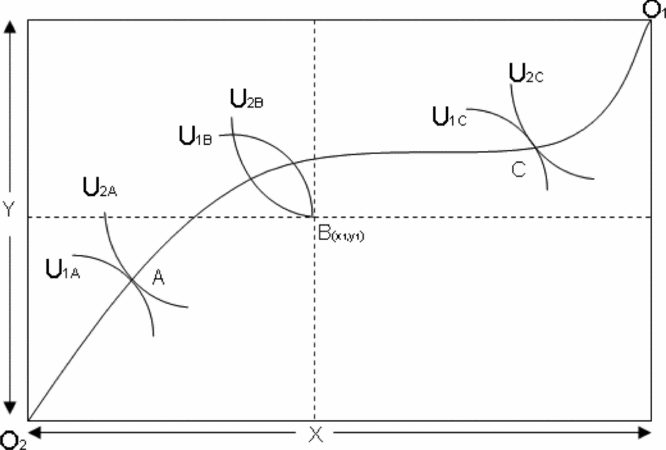
The ‘Economical Calculus’ includes some genuine development of the theory inspired by the works of political economists such as Marshall, Walras, Cournot, and of course Jevons (who receives the most praise). Edgeworth and Jevons were probably introduced by their mutual friend and neighbour in Hampstead, Sully.Footnote 42 The original contributions of Edgeworth to the science of economics, ‘the economic calculus’, have been broadly discussed in the literature.Footnote 43 The economic devices presented there, such as the indifference curves, the contract curve and the graphical representation that led to the ‘Edgeworth box’, are all still used in economics courses today.
In the context of this article, one aspect of Edgeworth's economics is not discussed in today's classrooms but is of particular interest. In the concluding part of the ‘Economical Calculus’ a general case is presented in which under the circumstances of imperfect competition the barter between two (or more) agents will not result in a unique equilibrium, i.e. one relative price of the two commodities, but in a set of points, inside the ‘core’ and on the contract curve. This is the famous ‘indeterminacy’ of a contract (see Appendix). Now, aware of the fact that ‘a principle of arbitration’ is required, Edgeworth suggests the utilitarian apparatus as the best candidate. Other possible candidates, he suggests, such as distribution based on other conceptions of equity, are less preferable solutions, and the utilitarian apparatus (used by the agents themselves) is the justified one:
Justice requires to be informed by some more definite principle, as Mill and Mr. Sidgwick reason well. The star of justice affords no certain guidance – for those who have loosed from the moorings of custom – unless it reflects the rays of a superior luminary – utilitarianism.
Now, it is a circumstance of momentous interest – visible to common sense when pointed out by mathematics – that one of the in general indefinitely numerous settlements between contractors is the utilitarian arrangement of the articles of contract, the contract tending to the greatest possible total utility of the contractors. In this direction, it may be conjectured, is to be sought the required principle.Footnote 44
The significant implication of this solution is that economic man is expected to demonstrate other motives apart from the maximization of his individual utility as a part of the process of exchange. Here the ethical account of Henry Sidgwick (in which the agent is presented as motivated by a mixture of ‘egoistic’ and ‘universal’ hedonism, i.e. utilitarianism) penetrates into the sphere of economic theory.
CHANGING THE RELATIONS BETWEEN ECONOMICS AND UTILITARIANISM: EDGEWORTH AND MARSHALL
Although the starting point of Edgeworth's project had not much to do with the field of economics, it nevertheless concluded with a monograph which embodied an original relationship between economics and utilitarianism. As explained in the first section, British economists who accepted utilitarianism as an ethical guide had tended to refer to it as a meta-criterion for assessing economic policy. From Edgeworth's point of view, and as exemplified by Mathematical Psychics, there was at the very least symmetry between the two fields: both are branches of the moral sciences, expressed with the same concepts and formalized with the language of mathematics. From a twenty-first-century point of view, one can interpret this more radically as the inclusion of ethics within the economic discipline.Footnote 45
I would like to argue briefly in this concluding section that Edgeworth's new point of view was not an idiosyncratic caprice, but was shared, at least to some extent, by Marshall, and is indeed a part of a wider tendency within the intellectual tendencies of the time.
Following his reading of Marshall's works in 1880, Edgeworth sent him a copy of New and Old Methods of Ethics, to which Marshall responded:
I have now nearly read all the book you sent me and am extremely delighted by many things in it. There seems to be a very close agreement between us as to the promise of mathematics in the sciences that relate to man's actions. As to the interpretation of the Utilitarian dogma, I think you have made a great advance: but I have still a hankering after a mode of exposition in which the dynamical character of the problem is made more obvious.Footnote 46
More striking than this reaction is Marshall's note (probably written at the beginning of the 1880sFootnote 47) titled ‘On Utilitarianism: A Summum Bonum’. Within this note we find Marshall playing with mathematical representations of the utilitarian apparatus, using and improving Edgeworth's basic integral (presented in ‘The Hedonical Calculus’ and therefore also in Mathematical Psychics).Footnote 48 As noted by John Whitaker, little trace of this remained in the Principles, but Marshall still proposed to use the ideas as late as 1912.Footnote 49 In between these two responses by Marshall to Edgeworth's exact utilitarianism, Marshall's review of Mathematical Psychics appeared in The Academy (18 June 1881), focusing on Edgeworth's economic developments.
There has been a broad debate in recent years on how much of a utilitarian Marshall was.Footnote 50 In our current discussion it is only important to observe that while clearly not as enthusiastic as Edgeworth, Marshall nevertheless had some affinities with the doctrine, studying Bentham and Mill's philosophies in his youth, although mixing them with other philosophical influences, and combining the whole within an evolutionary approach (in the spirit of Spencer).Footnote 51 As opposed to Edgeworth, Marshall, the economist, was not interested in engaging directly with the philosophical disputes of his time, nor did he want to commit himself fully to any particular ethical school. Famously, he also promoted the establishment of a new faculty of economics in Cambridge, taking it out of the Moral Sciences Tripos where it had been taught throughout the second half of the nineteenth century.
Nevertheless, and regardless of the particular extent of his commitment to utilitarianism, Marshall did share Edgeworth's aim of expressing utilitarian ideas by ‘translating’ them into the language of science. One way to do this was in the spirit of abstract ideas of evolution (i.e. social evolution as a utilitarian promoter); the other, which is more relevant here, was Marshall's attempts to ‘capture’ utilities that in his view could not be directly represented mathematically by finding other representatives (such as market prices) that could be expressed mathematically. Marshall's development of the concept of ‘consumer surplus’ is an early example of this tendency.Footnote 52
Marshall's own way of internalizing utilitarian reasoning within his economic theory (without accepting hedonism or using philosophical jargon), taken together with his positive reaction to Edgeworth's formalization of utilitarianism, suggests that the two indeed shared a similar new approach to the relationship between economics and utilitarianism.
This new way of coping with utilitarianism would not be recognized as a leading approach, and by the turn of the century utilitarianism in all its forms, and interpersonal utility comparisons in particular, was about to draw some harsh criticism. But from Edgeworth's and Marshall's point of view back in the 1870s and the 1880s the formalization of utilitarianism could be understood in the context of a shared belief that an idea could become stronger and appear more convincing if it was presented in a scientific and mathematical fashion,Footnote 53 a belief that was an integral part of the ‘spirit of the age’.Footnote 54 Within these new frameworks good old ideas such as utilitarianism were given with an up-to-date terminology.Footnote 55
APPENDIX
We can use the later pedagogical device that captures Edgeworth's theoretical framework, the ‘Edgeworth box’, as an illustration of the role of utilitarianism as a principle of arbitration. The line that connects O1 and O2 is the contract line. This means that all the points on it reflect the equation:
 \begin{equation*}
\frac{{du_1}}{{d\,f}} = \frac{{du_2}}{{dy}},
\end{equation*}
The initial endowment is represented by the point B. Any point inside the core (between the two indifferent curves U1B and U2B) and on the contract line are optional as a solution to the problem (and each of them resolves into a different relative price). Therefore another principle is needed in order to decide between them.